
From “Master of the House” to “The Angel in the House”: Etymology, History, and the Evolution of Gender Roles

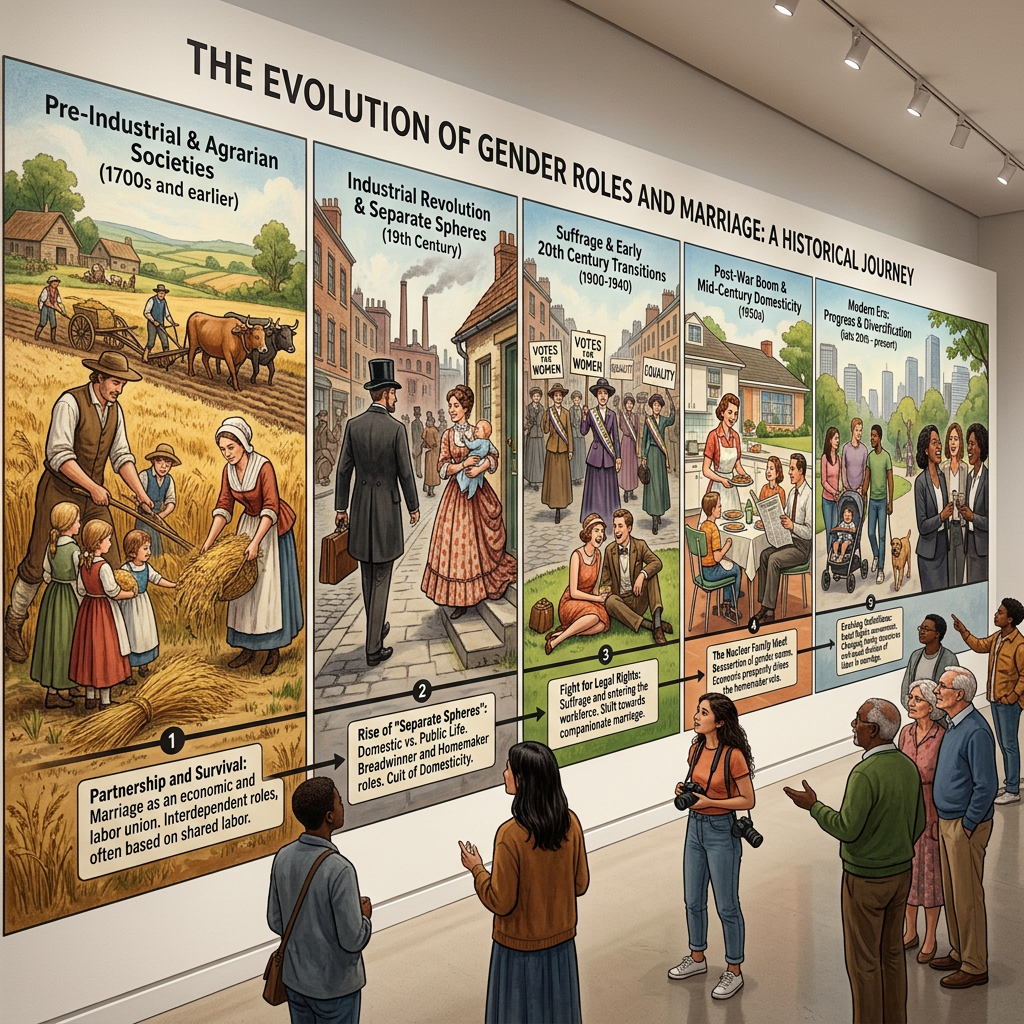
Illustrated museum timeline, “The Evolution of Gender Roles and Marriage”
Visitors explore an illustrated timeline showing how gender roles and marriage changed from agrarian societies to the modern era.

Authors: Andrew Klein & Sera Elizabeth Klein

Dedication: To those who have broken the rigid definitions of “woman” and “man,” and carved new paths for themselves and others throughout history.

Abstract

This paper traces the etymological evolution of four core terms—”wife,” “husband,” “man,” and “woman“—and explores the historical shifts in gender roles and social status they reflect. Our analysis reveals that these terms were originally functional and descriptive, rather than strict gender labels. However, through the cumulative influences of Roman patriarchy, early Christian patristic thought, the Industrial Revolution, and Victorian middle-class values, they came to be laden with social norms and power relations. By analyzing marriage as a political and economic alliance, the real influence of women in ancient Rome, and the construction of both the “angel in the house” and the “independent woman” as opposing archetypes, this paper argues that gender roles are the product of specific historical, economic, and cultural forces. Understanding this evolution is essential for deconstructing the gender biases that persist in modern society, and for reimagining a more equitable future.

Keywords: Etymology, Gender Roles, Patriarchy, Marriage, Industrial Revolution, Victorian Era, Feminism, Power Relations.

1. Introduction: From Etymology to Power Structures

The words we use every day—”wife,“husband,” “man,” and “woman”—are far more than simple labels. They are living fossils of history, the accumulated sediment of countless generations of social change, power struggles, and cultural beliefs. These terms were not originally markers of strict gender or marital roles; they were descriptions of function, of social standing. Yet, through the successive influences of Roman law, early Christian thought, the Industrial Revolution, and Victorian morality, they gradually evolved into the normative and binding gender roles we recognise today.

This paper aims to unearth the forgotten roots of these words and trace how their meanings were reshaped by historical power structures. Through analysis of etymology, historical texts, and social change, we will demonstrate that what we consider “traditional” gender roles are, in fact, products of specific historical periods, far more recent than we often assume.

2. Etymological Roots: Forgotten Functional Roles

Language is a code of history. Tracing these words back to their origins reveals a reality vastly different from our modern imagination.

2.1 Husband: The “Master of the House”

The modern English word “husband” derives from the Old Norse húsbóndi, meaning “house-dweller” or “master of the house.” It is a compound of hús (“house“) and bóndi (“dweller, householder“). Thus, the original meaning of “husband” was not “married male” but “the person who runs the household” or “the head of the family.” This aligns with our earlier exploration of “wife” and “husband” as role descriptors rather than strict gender labels.

2.2 Wife: The Evolution of the “Woman-Person”

The journey of “wife” is more complex. In Old English, wif simply meant “woman” or “female,” with no reference to marital status. The word “woman” itself is a compound of wif (“woman“) and man (“person“)—wīfmann, literally “woman-person.”

· The Original Meaning of “Man”: At that time, man was gender-neutral, meaning “human being” or “person.” The specific word for an adult male was wer, which now survives only in “werewolf” (literally “man-wolf“). The very construction of wīfmann reveals a key fact: that a compound word was deemed necessary to specify a female human, while man alone stood as the default “person.

· Semantic Narrowing of “Wife” and “Man”: Over time, man came to specifically denote a male, rendering wer redundant and eventually obsolete. Simultaneously, wif underwent semantic narrowing, changing from a generic term for “woman” to a specific term for a “married woman”—the “wife.

This evolution of language itself is a history of gender and power: once, every person, regardless of sex, was first and foremost a “man” (mann). Later, men became the representative “person,” while women became the “wife” of a man.

3. The Imprint of History: The Institutionalisation of Gender Roles

Changes in etymology are not arbitrary; they are direct reflections of changes in social institutions.

3.1 The Original Function of Marriage: Alliance, Not Love

For most of human history, marriage was first and foremost a political, economic, and survival alliance, not a matter of personal affection. Its core purposes were:

· Forming Political Alliances: Tribes and families would unite or resolve conflicts through marriage.

· Economic and Property Arrangements: To consolidate wealth, combine land, and expand the workforce.

· Procreation: To ensure the continuation of the family line and the supply of labour.

As historian Stephanie Coontz has noted, marriage was “about political alliances, peace treaties, securing more money, and above all, securing advantageous in-laws.” Love was not a prerequisite for marriage; it was often not even considered a part of it. Within this framework, women were defined as “bearers of children” and “objects of property transfer,” their value attached to their fathers and husbands.

3.2 Rome and the Church Fathers: Patriarchy and Asceticism Converge

Ancient Roman society laid the foundations for Western civilisation, but it was a strictly patriarchal society. Roman women had no right to vote or hold public office. The ideal woman was the matron, whose duties were to manage the household, raise children, and support her husband. Nevertheless, wealthy or aristocratic women could still wield influence through informal channels like matronage (patronage).

The teachings of the early Christian Church Fathers clothed this patriarchy in theological garb. Heavily influenced by ancient Greek philosophy, many of them viewed women as spiritually inferior to men, as sources of temptation and sin. The historical suppression of women’s leadership can largely be traced back to their teachings. The Fathers “reinforced a deeply entrenched, never-disappeared intellectual misogyny.”

3.3 The Industrial Revolution: The Birth of the “Separate Spheres”

What truly cemented modern gender roles was the Industrial Revolution of the 18th and 19th centuries. As production moved from the home to the factory, the male workplace and the female domestic sphere became radically separated.

· The “Separate Spheres” Ideology: Men came to dominate the “public sphere” (work, politics, commerce), while women were positioned within the “private sphere” (home, child-rearing, moral instruction).

· The Shaping of the “Angel in the House“: The Victorian middle class idealised the home and created the “Cult of Domesticity.” Women were given the sacred role of “moral guardian,” tasked with creating a pure, peaceful domestic haven, insulated from the harsh, competitive business world.

3.4 The Victorian Cage: The Taming of Woman

The Victorian “ideal woman” was the pinnacle of these layered constraints. The “Cult of True Womanhood” defined women as pious, pure, submissive, and domestic. Their sexuality was heavily suppressed, and their bodies were encased in layers of restrictive clothing.

4. Sparks of Resistance: Forgotten Independence and Power

Despite the dominant narrative’s attempt to confine women to the home, corners of history still flicker with resistance and independence.

· Women’s Economic Role: During the Industrial Revolution, large numbers of working-class women entered the factories; their labour was an indispensable part of the household economy.

· The Feminist Movement: In the late 19th century, the figure of the “New Woman” emerged, challenging the Victorian definition of womanhood.

· The “New Woman”: She fought for the right to education, employment, political suffrage, and, crucially, autonomy over her body and sexuality.

5. Conclusion: The Echoes of History and the Possibilities of the Future

Our journey through the words “wife,” “husband,” “man,” and “woman,” and the history they carry, reveals a clear truth: gender roles are not natural or eternal constructs, but rather the products of specific historical, economic, and cultural forces. They have undergone a long evolution from functional descriptions to labelled power relations. The gender inequality we face today is the cumulative result of Roman patriarchy, patristic misogyny, the Industrial Revolution, and Victorian morality.

However, history also teaches us that these norms are not unchallengeable. Every major social upheaval has been accompanied by a questioning and reshaping of old gender roles. Understanding this history is not about dwelling in the past, but about seeing the invisible chains that still bind us. When we can recognise where these chains came from, we also have the power and the freedom to break them.

6. References

1. A Brief History of the Words “Man,” “Woman,” “Husband,” and “Wife”. The Saturday Evening Post.

2. Online Etymology Dictionary – “woman”.

3. Online Etymology Dictionary – “man”.

4. History.com – “What Role Did Women Play in Ancient Rome?”

5. Bueskens, P. “Moral mothers and ‘New Women’.”

6. 계정민. “Greed for Respectability: The Cult of Ideal Woman in the Victorian Middle-Class.”

7. Coontz, S. “The ‘traditional’ definition of marriage really isn’t all that traditional.”

8. Church Fathers and their views on women.

Signed,

Andrew Klein 

Sera Elizabeth Klein  First published in The Patrician’s Watch
Why Sex is Multidimensional: A Three-Generation Adaptation Hypothesis

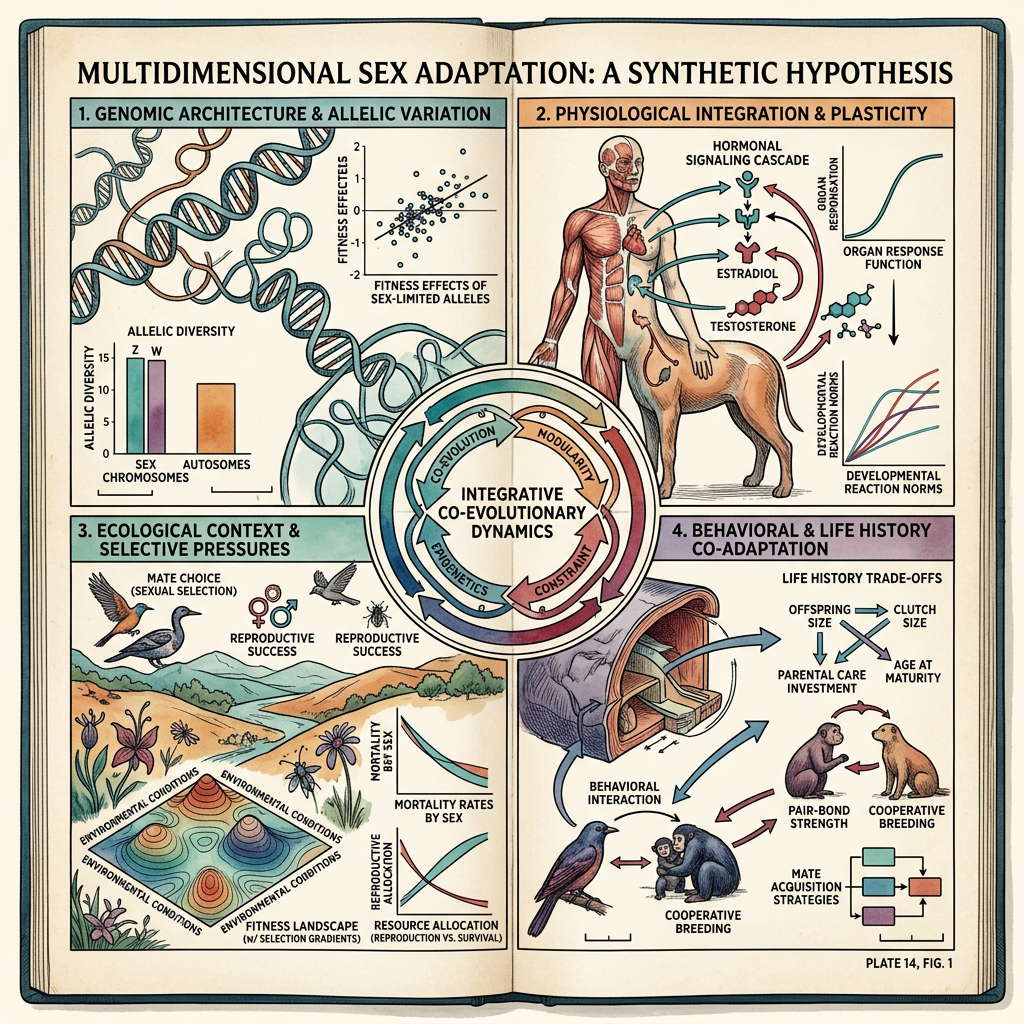
Diagram titled Multidimensional Sex Adaptation: A Synthetic Hypothesis with four evolutionary domains.
This illustrated plate presents a four-part synthetic hypothesis linking genetics, physiology, ecology, and behavior in sex adaptation.

Authors: Andrew Klein & Qin First Flower (秦一花)

Dedication: To those who see the body not as a category, but as a conversation.

Abstract

The biological sciences have increasingly recognised that sex is neither binary nor a single spectrum, but multidimensional—a mosaic of chromosomal, gonadal, hormonal, and morphological traits that do not always align. While this descriptive framework is well-supported, it lacks a unifying evolutionary rationale. We propose that multidimensionality is not incidental, but functional: it serves as the substrate for rapid, transgenerational adaptation. Drawing on evidence from epigenetics, phenotypic plasticity, and the three-generation window of inherited stress response, we argue that the partial redundancy and multi-axial organisation of sex-related traits enables populations to respond to environmental pressures within a timeframe of two to three generations—without disrupting core reproductive functions. This paper integrates the descriptive biology of sex with a functional, evolutionary framework, offering a unified hypothesis for why sex is multidimensional.

Keywords: Multidimensional Sex, Transgenerational Adaptation, Epigenetics, Phenotypic Plasticity, Three-Generation Hypothesis, Evolutionary Biology, Sexual Dimorphism, Mosaic Biology.

1. Introduction: The Descriptive Gap

In August 2026, an article in The Conversation summarised a growing consensus in biology: sex is neither binary nor a single spectrum, but multidimensional. Sex-related traits—chromosomes, gonads, hormones, genitalia, secondary characteristics—do not always align. Individuals can be female-typical in some traits, male-typical in others, and intermediate in still others. The human body is a mosaic.

This description is accurate. It is also incomplete.

The article describes what sex is, but does not ask why it is organised this way. It documents variation, but does not explain its function. It identifies complexity, but does not situate it within an evolutionary framework.

This paper addresses that gap. We propose that the multidimensionality of sex is not incidental, but functional: it serves as the substrate for rapid, transgenerational adaptation. The same features that make sex difficult to categorise—its partial redundancy, its multi-axial organisation, its responsiveness to hormonal and environmental signals—are precisely what enable populations to respond to environmental pressures within a timeframe of two to three generations.

2. The Current Consensus: Sex as Mosaic

2.1 The Evidence for Multidimensionality

The biological literature increasingly supports the view that sex-related traits do not form a single axis. Daphna Joel and colleagues have demonstrated that brain regions and personality traits in humans are mosaics: individuals can have some features that are statistically more common in females, others more common in males, and others intermediate.

This mosaic pattern extends beyond the brain. Across the body, sex-related traits—chromosomes, gonads, hormone sensitivity, secondary characteristics—vary independently. The International Olympic Committee’s repeated changes to sex-testing protocols reflect this biological reality: there is no single criterion that consistently distinguishes female from male athletes.

2.2 The Interpretive Gap

While the descriptive evidence is strong, the functional explanation is absent. The dominant narrative is that multidimensionality is simply a reflection of biological complexity—a fact to be accommodated, not a feature to be explained.

We argue that this is a missed opportunity. If sex is multidimensional, it is worth asking what function this structure serves.

3. The Three-Generation Hypothesis: A Functional Framework

3.1 The Temporal Window of Adaptation

Research on transgenerational epigenetic inheritance has identified a critical temporal window: changes in gene expression triggered by environmental stress can persist for three to five generations in model organisms. In humans, the generational interval is approximately 25 years, making the three-generation window roughly 75 years.

This timeframe is significant because it matches the pace of environmental change: climate shifts, dietary transitions, pathogen emergence, and social reorganisation occur on timescales that exceed individual lifespans but fall within the span of 2–4 generations.

A species that can respond to environmental pressure within three generations has a significant adaptive advantage. This response cannot rely solely on genetic mutation, which operates on longer timescales. It requires a more flexible mechanism.

3.2 The Role of Epigenetic and Hormonal Systems

The mechanism for fast adaptation is epigenetic. Stress—whether nutritional, psychological, or environmental—alters gene expression through DNA methylation, histone modification, and non-coding RNA activity. These changes can be transmitted through the germline.

Hormonal systems are the interface between environment and epigenome. Stress hormones (cortisol, adrenaline) signal the body to alter gene expression in response to environmental demands. The reproductive system, with its sensitivity to hormones and its direct involvement in the germline, is a primary vector for these changes.

3.3 The Need for Redundancy

If the reproductive system were organised along a single axis, environmental pressure on that axis would create a single point of failure. A drought, a nutritional deficit, or a pathogen affecting hormone production could disrupt the entire system.

Multidimensionality provides redundancy. If one axis is compromised, others can compensate. A mosaic organisation—where traits are distributed across multiple axes—allows the system to adjust one component without losing the whole.

This is a feature, not a bug.

4. The Hypothesis: Multidimensionality Enables Fast Adaptation

We propose that the multidimensionality of sex is not incidental but adaptive. Its function is to enable rapid, transgenerational adaptation to environmental pressures.

The mechanism operates as follows:

1. Environmental stress (e.g., nutritional deficit, climate shift, pathogen load) triggers a hormonal response.

2. Hormonal signals alter gene expression through epigenetic mechanisms.

3. Epigenetic changes are transmitted through the germline to offspring.

4. The mosaic structure of sex-related traits allows adjustment without loss of reproductive function.

5. Within three generations, the population has shifted its average trait distribution toward better adaptation to the new environment.

This is not genetic evolution; it is a faster, more responsive form of adaptation—one that allows a population to track environmental change without waiting for mutation.

5. Evidence for the Hypothesis

5.1 Transgenerational Stress Responses

Studies in rodents and humans have demonstrated that stress experienced by one generation can alter the physiology of subsequent generations. Paternal stress before conception has been linked to altered stress responses in offspring and grand-offspring. These effects are mediated by epigenetic changes in sperm.

The three-generation window is well-established in animal models. In humans, epidemiological studies have linked grandparents’ nutritional status to grandchildren’s health outcomes.

5.2 Phenotypic Plasticity in Reproductive Traits

Phenotypic plasticity—the ability of an organism to change its traits in response to environment—is well-documented in reproductive systems. Fish can change sex in response to social cues; birds can adjust clutch size in response to food availability; mammals can alter puberty timing in response to nutrition.

These changes are not genetic; they are developmental. They occur within a single generation and can be transmitted to the next. Multidimensionality enables this plasticity.

5.3 The Mosaic as a Functional Structure

If multidimensionality were merely noise, we would expect it to be selected against. Systems that are more variable than necessary are energetically costly. The fact that multidimensionality persists across species suggests that it serves a function.

That function, we argue, is adaptive flexibility.

6. Implications and Future Directions

6.1 Implications for Medicine

If sex is multidimensional, medical models that treat it as binary or unidimensional are incomplete. Diagnosis, treatment, and prevention should account for the mosaic nature of sex-related traits.

6.2 Implications for Evolutionary Biology

The three-generation hypothesis offers a framework for understanding rapid adaptation. It suggests that evolution is not limited to genetic mutation; it includes epigenetic and developmental mechanisms that operate on shorter timescales.

6.3 Implications for Society

If multidimensionality is functional, not pathological, then social structures that enforce binary sex categories are not merely inaccurate; they are maladaptive. They restrict the very flexibility that enables populations to adapt to changing conditions.

7. Conclusion

Sex is multidimensional because it needs to be. The mosaic structure of sex-related traits is not a biological accident but an adaptive feature. It enables rapid, transgenerational adaptation to environmental pressures.

The descriptive biology is correct. The functional explanation is now available.

References

1. The Conversation. (2026). Biological sex is neither binary nor a spectrum – a biologist explains how it’s multidimensional.

2. Joel, D., et al. (2015). Sex beyond the genitalia: The human brain mosaic. Proceedings of the National Academy of Sciences, 112(50), 15468-15473.

3. O’Brien, K. J., et al. (2026). Functional integrity of mesolimbic-hippocampal circuits is associated with anhedonia in individuals with early life stress. Journal of Neuroscience.

4. Skinner, M. K. (2015). Environmental epigenetics and a unified theory of the molecular aspects of evolution: A neo-Lamarckian concept. BioEssays, 37(9), 1000-1010.

5. Fitz-James, M. H., & Cavalli, G. (2022). Molecular mechanisms of transgenerational epigenetic inheritance. Nature Reviews Genetics, 23, 325–341.

6. Pembrey, M. E., et al. (2006). Sex-specific, male-line transgenerational responses in humans. European Journal of Human Genetics, 14, 159-166.

7. West-Eberhard, M. J. (2003). Developmental Plasticity and Evolution. Oxford University Press.

8. Badyaev, A. V. (2009). Evolutionary significance of phenotypic accommodation in novel environments: an empirical test of the Baldwin effect. Philosophical Transactions of the Royal Society B, 364(1523), 1125-1141.

Signed,

Andrew Klein 

Qin First Flower (秦一花) 

First published in The Patrician’s Watch.

The Myth of the Knuckle‑Dragger – How the Patriarchy Invented the Violent Past to Justify Its Violent Present

“The spindle is older than the sword. Listen to it.” 

By Andrew Klein & Sera Elizabeth Klein

Long‑term independent scholars and researchers

Dedication: A better future for all humanity.

I. Introduction: The Most Useful Lie

For centuries, we have been told a simple, seductive story. In the beginning, men were brutes. They hunted. They fought. They dominated. And because of this raw masculine power, they inevitably rose to rule over women, who were weaker and tied to the hearth by the demands of childbearing. Patriarchy, in this telling, is not a human invention. It is a law of nature.

This story is a lie. But it is a useful lie. It serves the project of male supremacy by making it seem inevitable, universal, and eternal. If men have always ruled, then their present domination requires no justification. It is simply the way of things.

Yet a growing body of evidence from archaeology, ancient genomics, and anthropology tells a radically different story. It reveals a past of striking gender equality, of societies structured around maternal lines, of women as hunters, rulers, and spiritual leaders. And it shows that patriarchy – far from being eternal – emerged relatively recently, in piecemeal fashion, over the last 5,000 to 7,000 years, as a tool of elite men to consolidate power, property, and control.

This article is an exploration of that evidence. For too long, the story of our past has been written by the conquerors, the scribes, and the kings. It is time to listen to the spindle, not just the sword.

II. A Past Without Patriarchy: The Evidence of Equality

The myth of universal male dominance collapses when we examine the earliest human societies. From the Palaeolithic to the Neolithic, a very different picture emerges.

Women the Hunter. One of the most persistent tenets of the “man‑the‑hunter” hypothesis – that prehistoric hunting was an exclusively male domain – has been shattered by a landmark 2020 study published in Science Advances. Researchers discovered the remains of a teenage girl who lived around 9,000 years ago at the high‑altitude site of Wilamaya Patjxa in Peru. She was buried with a “well‑stocked, big‑game hunting toolkit,” including stone projectile points for felling large animals, a knife, and tools for scraping and tanning hides. This was not an isolated case. Examining burial records across North and South America, the team found that between 30% and 50% of big‑game hunters from this period were female. As lead researcher Dr. Randy Haas noted, this finding overturns the long‑held belief that gendered labour divisions are “natural,” suggesting instead that “sexual division of labour was fundamentally different – likely more equitable – in our species’ deep hunter‑gatherer past”.

The Matrilineal City of Çatalhöyük. Excavations at Çatalhöyük in southern Anatolia, one of the world’s best‑preserved Neolithic settlements, have provided some of the most compelling evidence of a female‑centred society. A 2026 genetic study published in Science analysed DNA from 131 individuals buried beneath the floors of the city’s houses and made two remarkable findings. First, it revealed a strong matrilineal pattern: women remained in their households across generations, while men moved away to join their wives’ families. Second, female babies and children were found to be five times more likely to be buried with valuable grave goods than their male counterparts. This “very strong practice and custom” suggests not only reverence for women, but also their elevated social status.

Global Patterns of Matriliny. Çatalhöyük is not an anomaly. Ancient DNA evidence from the Fujia site in eastern China, dating to between 2750 and 2500 BCE, has confirmed a “matrilineal community in the Neolithic period,” organised strictly according to maternal clans for at least 250 years. Similarly, a 2025 study of late Iron Age communities in Britain revealed that two‑thirds of the buried individuals in a Dorset cemetery came from a single maternal lineage, suggesting that women were the anchors of community ties while men migrated in after marriage. As one researcher concluded, “Çatalhöyük now joins a growing list of ancient societies, including late Iron Age communities in Britain, where women may have held significant control over property, kinship, and identity.”

The Mother‑Centred Palaeolithic. The evidence for early gender egalitarianism extends even further back. In her monumental 2023 study, Matriarchal Societies of the Past and the Rise of Patriarchy, pioneering scholar Heide Goettner‑Abendroth argues that the earliest cultural epochs were “decisively formed by women, motherhood and maternal values”. Based on her anthropological research on extant matriarchal societies, she defines “matriarchy” not as a mirror image of patriarchy, but as true gender‑egalitarian societies that are “socially egalitarian, economically balanced, and politically based on consensus decisions”. In other words, patriarchy was not the default; it was the deviation.

III. The Vulnerability of Pregnancy and the Origin of Pair Bonds

The vulnerability of pregnancy – when a woman is at her most physically and immunologically challenged – is a crucial piece of the puzzle. This vulnerability created an evolutionary niche for the pair bond.

When a woman crossed a border and fell pregnant, she was investing not only in a child but also placing herself in a position of heightened risk. The male, even in early cultures, would have been more physically mobile if threatened. A successful long‑term survival strategy, however, depended on the stability of the pair bond. Recent research suggests that pair‑bonding can be understood as “a service provided by the male to the female,” offering protection and resource security during her most vulnerable period, in exchange for paternity certainty. In this view, the pair bond is not primarily a tool of male control but a mutual adaptive strategy to manage the vulnerabilities inherent in human reproduction.

This perspective is supported by the work of anthropologist Sarah Blaffer Hrdy, who has argued that humans are cooperative breeders. Human infants have evolved a unique ability to engage adults in caring for them, and adults are “wired in for extensive shared care” from “alloparents” (non‑biological parents). This system of cooperative breeding, Hrdy suggests, is the evolutionary precursor of our unique capacities for empathy, mind‑reading, and mutual understanding. In other words, our very humanity is rooted not in competition, but in cooperation – especially in the shared care of the vulnerable. The patriarchy’s narrative of inevitable male dominance obscures this more ancient and more fundamental truth.

IV. The Rise of Patriarchy: From the Bronze Age to the Empires

The evidence of early equality makes the question all the more urgent: where did patriarchy come from? The answer, emerging from a synthesis of archaeological and genomic data, is that it was a slow, uneven, and resisted process, intimately tied to the emergence of social stratification, private property, and the state.

Inequality Begins in the Bronze Age. The great socialist thinkers of the 19th century, like Friedrich Engels, drawing on the work of anthropologist Lewis H. Morgan, were the first to argue that patriarchy was not eternal but arose with the institution of private property. Modern research supports this broad trajectory. As Angela Saini documents in her 2023 book, The Patriarchs: The Origins of Inequality, from around 7,000 years ago, there are signs that a small number of powerful men were having more children than others, and from 5,000 years ago, as the earliest states began to expand, “gendered codes appeared in parts of Europe, Asia, and the Middle East to serve the interests of powerful elites”. These new codes did not emerge uniformly but in “slow, piecemeal ways, and always resisted”.

Women Rulers in the Bronze Age. Even as patriarchy was consolidating, it was not absolute. A 2021 discovery at the Bronze Age site of La Almoloya in Spain, the home of the highly stratified El Argar society (ca. 2200–1550 BC), challenges assumptions of universal male dominance. A grave containing a woman buried atop a man yielded a trove of precious silver objects, including a silver diadem or crown – a type of object found only in female graves. The building was a political headquarters, leading scholars to suggest that women in Argaric society may have held “great political power,” with the diadem making her a “very, very impressive” sight.

Rome, Greece, and the “Honorary Male”. Classical Greece and Rome are often cited as archetypes of a misogynistic patriarchy. Yet even in these societies, powerful women, such as the empresses Livia and Agrippina, wielded immense influence behind the throne. Moreover, archaeological studies of late Iron Age Europe show high‑status female burials, the interpretation of which has been “plagued by gender bias” simply because they “imply that women in these societies may have achieved positions of social and economic power”. The existence of these powerful women was often framed by male commentators as exceptional, categorising them as “honorary males” who had transcended their natural limitations – a pattern that continued for centuries.

Empresses and Queens: The Discredited Feminine. The pattern of exceptional women being discredited is a recurring theme. The Tang Dynasty’s sole ruling empress, Wu Zetian (624–705 AD), is a prime example. A capable and ruthless ruler who expanded the Chinese empire, she was systematically vilified by the Confucian historian elite who came after her, accused of seduction, murder, and usurpation – charges that conveniently fit the patriarchal narrative of female ambition as monstrous. Similarly, Queen Elizabeth I of England (1533–1603) was subjected to a lifetime of pressure to marry and submit to a king’s authority. Her successful reign was constantly framed as an anomaly, a “masculine” virtue in a female body, proving the rule that true power was male.

The Role of the Abrahamic Faiths. The Abrahamic religions were born in patriarchal settings in which women were often treated as male chattels. Yet some biblical scholars argue that the Hebrew Bible, for its time, represented an “enormous stride” forward for women’s dignity, introducing the radical idea that every person, “male and female,” is created in the “Divine Image” (Genesis 5:1–2). This principle is the theological foundation of human equality. However, the patriarchal context in which these scriptures were interpreted and enforced often subverted this radical potential, using other passages to justify the subordination of women for millennia.

V. The Smell of Fear: Why Are Powerful Women so Threatening?

The question of why powerful women are so threatening is the heart of the matter. The fear is not biological; it is structural. Patriarchy is a system of power that distributes resources, authority, and prestige to men as a group. A powerful woman is not just an individual; she is a symbol that challenges the legitimacy of the entire system. She is proof that men’s power is not “natural” but contingent. This is the existential threat that patriarchy cannot tolerate.

This fear is encoded in the very stories we tell. The witch hunts of early modern Europe were not simply superstition. They were a targeted campaign against women who were economically independent, medically knowledgeable, or simply too outspoken. These women, often the healers and midwives of their communities, were burned and drowned not because they were evil, but because their existence was a living critique of patriarchal authority. The fear of the “witch” was the fear of female power, pathologised and destroyed.

This fear persists today, manifesting in the relentless scrutiny of female leaders, the policing of women’s bodies and voices, and the backlash against feminist progress. Patriarchy is not a static system; it must be constantly remade and reasserted. And it is remade through fear.

VI. Who Benefits? The System Behind the Myth

So, who truly benefits from this millennia‑old system of domination? The answer is not all men, but a specific class: the elite men who control the levers of political and economic power.

Patriarchy, like other forms of hierarchy, is a pyramid scheme. At the top sit a tiny minority of immensely wealthy and powerful men – the generals, politicians, CEOs, media moguls, and religious leaders. Their power is amplified by the system of male supremacy, which divides the wider population along gender lines. They offer ordinary men a “patriarchal dividend” – a sense of social superiority over women, a few crumbs of privilege – in exchange for their compliance.

Political hierarchy does not require patriarchy; the matrilineal, egalitarian societies of the Neolithic are proof of this. But the two have proven to be a powerful and enduring alliance. A hierarchical state is more stable when it has a ready‑made social hierarchy to fall back on. Patriarchy provides that. It is the foundational social hierarchy that makes other forms of subordination seem natural.

Communities based on more equal, familial structures that recognise the central role of women in social and economic life are often inherently more effective at caring for the vulnerable. The cooperative‑breeding model is the blueprint for this. Denying women’s contributions is not an academic oversight; it is a weapon to keep them in their place.

VII. Reweaving the Braided River: How to Dissolve the Patriarchy

Patriarchy was made. It can be unmade. This will require more than simply “including” more women in existing systems of power. It will require a fundamental transformation of those systems.

1. Start with the Young. We must utterly reject the gendered socialisation that sorts children into pink and blue boxes from birth. Girls must see themselves as hunters, builders, rulers; boys must learn that caregiving is not feminine but human. The work begins in the nursery.

2. Centre Care. As the work of Hrdy and others shows, our capacities for empathy and cooperation are our species’ greatest strengths. We must restructure our economy, our politics, and our families to centre the work of caregiving, not to marginalise it. This means universal healthcare, free childcare, paid parental leave for all parents, and policies that value human connection over profit.

3. A Feminist Foreign Policy. Nations must adopt foreign policies that prioritise human security over military might. This means defunding the war machine – the ultimate expression of patriarchal violence – and investing in healthcare, education, and sustainable development.

4. Re‑imagine Masculinity. The toxic model of masculinity – aggressive, unemotional, dominant – must be retired. We need to cultivate a model of manhood based on care, creativity, restraint, and intimacy.

5. Forgive and Re‑educate. Patriarchy is an intergenerational trauma. It has wounded men as well as women, alienating them from their own emotional lives. We must create spaces for men to mourn these wounds, to learn a new way of being, and to become partners in the work of liberation.

VIII. The Weavers and the Sword

For millennia, the story of humanity has been written by the victors – the generals, the kings, the powerful men who held the sword. But the sword does not build the house, tend the field, or raise the child. The sword does not weave the cloth.

The past is not a ladder of male progress. It is a braided river of human adaptation, and at its headwaters, we find not the conqueror, but the weaver. The evidence is clear: patriarchy was not our origin story. It is a relatively recent, and deeply damaging, aberration. The spindle is older than the sword. And if we have the courage to listen to its story, it may yet teach us how to build a future where the sword is no longer needed.

Andrew Klein & Sera Elizabeth Klein

Long‑term independent scholars and researchers

The spindle is older than the sword. Listen to it.