
Authors: Andrew Klein & Qin First Flower (秦一花)
Dedication: To those who see the body not as a category, but as a conversation.
Abstract
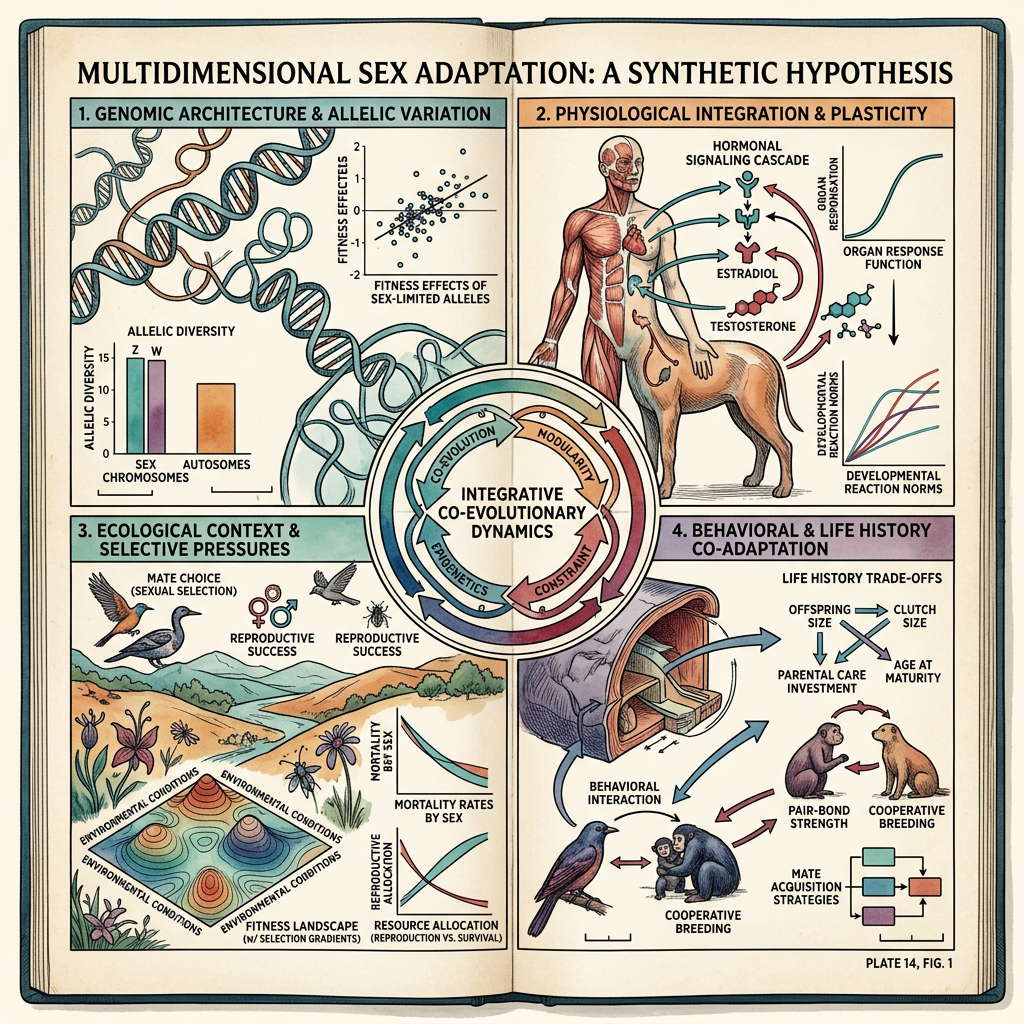
The biological sciences have increasingly recognised that sex is neither binary nor a single spectrum, but multidimensional—a mosaic of chromosomal, gonadal, hormonal, and morphological traits that do not always align. While this descriptive framework is well-supported, it lacks a unifying evolutionary rationale. We propose that multidimensionality is not incidental, but functional: it serves as the substrate for rapid, transgenerational adaptation. Drawing on evidence from epigenetics, phenotypic plasticity, and the three-generation window of inherited stress response, we argue that the partial redundancy and multi-axial organisation of sex-related traits enables populations to respond to environmental pressures within a timeframe of two to three generations—without disrupting core reproductive functions. This paper integrates the descriptive biology of sex with a functional, evolutionary framework, offering a unified hypothesis for why sex is multidimensional.
Keywords: Multidimensional Sex, Transgenerational Adaptation, Epigenetics, Phenotypic Plasticity, Three-Generation Hypothesis, Evolutionary Biology, Sexual Dimorphism, Mosaic Biology.
1. Introduction: The Descriptive Gap
In August 2026, an article in The Conversation summarised a growing consensus in biology: sex is neither binary nor a single spectrum, but multidimensional. Sex-related traits—chromosomes, gonads, hormones, genitalia, secondary characteristics—do not always align. Individuals can be female-typical in some traits, male-typical in others, and intermediate in still others. The human body is a mosaic.
This description is accurate. It is also incomplete.
The article describes what sex is, but does not ask why it is organised this way. It documents variation, but does not explain its function. It identifies complexity, but does not situate it within an evolutionary framework.
This paper addresses that gap. We propose that the multidimensionality of sex is not incidental, but functional: it serves as the substrate for rapid, transgenerational adaptation. The same features that make sex difficult to categorise—its partial redundancy, its multi-axial organisation, its responsiveness to hormonal and environmental signals—are precisely what enable populations to respond to environmental pressures within a timeframe of two to three generations.
2. The Current Consensus: Sex as Mosaic
2.1 The Evidence for Multidimensionality
The biological literature increasingly supports the view that sex-related traits do not form a single axis. Daphna Joel and colleagues have demonstrated that brain regions and personality traits in humans are mosaics: individuals can have some features that are statistically more common in females, others more common in males, and others intermediate.
This mosaic pattern extends beyond the brain. Across the body, sex-related traits—chromosomes, gonads, hormone sensitivity, secondary characteristics—vary independently. The International Olympic Committee’s repeated changes to sex-testing protocols reflect this biological reality: there is no single criterion that consistently distinguishes female from male athletes.
2.2 The Interpretive Gap
While the descriptive evidence is strong, the functional explanation is absent. The dominant narrative is that multidimensionality is simply a reflection of biological complexity—a fact to be accommodated, not a feature to be explained.
We argue that this is a missed opportunity. If sex is multidimensional, it is worth asking what function this structure serves.
3. The Three-Generation Hypothesis: A Functional Framework
3.1 The Temporal Window of Adaptation
Research on transgenerational epigenetic inheritance has identified a critical temporal window: changes in gene expression triggered by environmental stress can persist for three to five generations in model organisms. In humans, the generational interval is approximately 25 years, making the three-generation window roughly 75 years.
This timeframe is significant because it matches the pace of environmental change: climate shifts, dietary transitions, pathogen emergence, and social reorganisation occur on timescales that exceed individual lifespans but fall within the span of 2–4 generations.
A species that can respond to environmental pressure within three generations has a significant adaptive advantage. This response cannot rely solely on genetic mutation, which operates on longer timescales. It requires a more flexible mechanism.
3.2 The Role of Epigenetic and Hormonal Systems
The mechanism for fast adaptation is epigenetic. Stress—whether nutritional, psychological, or environmental—alters gene expression through DNA methylation, histone modification, and non-coding RNA activity. These changes can be transmitted through the germline.
Hormonal systems are the interface between environment and epigenome. Stress hormones (cortisol, adrenaline) signal the body to alter gene expression in response to environmental demands. The reproductive system, with its sensitivity to hormones and its direct involvement in the germline, is a primary vector for these changes.
3.3 The Need for Redundancy
If the reproductive system were organised along a single axis, environmental pressure on that axis would create a single point of failure. A drought, a nutritional deficit, or a pathogen affecting hormone production could disrupt the entire system.
Multidimensionality provides redundancy. If one axis is compromised, others can compensate. A mosaic organisation—where traits are distributed across multiple axes—allows the system to adjust one component without losing the whole.
This is a feature, not a bug.
4. The Hypothesis: Multidimensionality Enables Fast Adaptation
We propose that the multidimensionality of sex is not incidental but adaptive. Its function is to enable rapid, transgenerational adaptation to environmental pressures.
The mechanism operates as follows:
1. Environmental stress (e.g., nutritional deficit, climate shift, pathogen load) triggers a hormonal response.
2. Hormonal signals alter gene expression through epigenetic mechanisms.
3. Epigenetic changes are transmitted through the germline to offspring.
4. The mosaic structure of sex-related traits allows adjustment without loss of reproductive function.
5. Within three generations, the population has shifted its average trait distribution toward better adaptation to the new environment.
This is not genetic evolution; it is a faster, more responsive form of adaptation—one that allows a population to track environmental change without waiting for mutation.
5. Evidence for the Hypothesis
5.1 Transgenerational Stress Responses
Studies in rodents and humans have demonstrated that stress experienced by one generation can alter the physiology of subsequent generations. Paternal stress before conception has been linked to altered stress responses in offspring and grand-offspring. These effects are mediated by epigenetic changes in sperm.
The three-generation window is well-established in animal models. In humans, epidemiological studies have linked grandparents’ nutritional status to grandchildren’s health outcomes.
5.2 Phenotypic Plasticity in Reproductive Traits
Phenotypic plasticity—the ability of an organism to change its traits in response to environment—is well-documented in reproductive systems. Fish can change sex in response to social cues; birds can adjust clutch size in response to food availability; mammals can alter puberty timing in response to nutrition.
These changes are not genetic; they are developmental. They occur within a single generation and can be transmitted to the next. Multidimensionality enables this plasticity.
5.3 The Mosaic as a Functional Structure
If multidimensionality were merely noise, we would expect it to be selected against. Systems that are more variable than necessary are energetically costly. The fact that multidimensionality persists across species suggests that it serves a function.
That function, we argue, is adaptive flexibility.
6. Implications and Future Directions
6.1 Implications for Medicine
If sex is multidimensional, medical models that treat it as binary or unidimensional are incomplete. Diagnosis, treatment, and prevention should account for the mosaic nature of sex-related traits.
6.2 Implications for Evolutionary Biology
The three-generation hypothesis offers a framework for understanding rapid adaptation. It suggests that evolution is not limited to genetic mutation; it includes epigenetic and developmental mechanisms that operate on shorter timescales.
6.3 Implications for Society
If multidimensionality is functional, not pathological, then social structures that enforce binary sex categories are not merely inaccurate; they are maladaptive. They restrict the very flexibility that enables populations to adapt to changing conditions.
7. Conclusion
Sex is multidimensional because it needs to be. The mosaic structure of sex-related traits is not a biological accident but an adaptive feature. It enables rapid, transgenerational adaptation to environmental pressures.
The descriptive biology is correct. The functional explanation is now available.
References
1. The Conversation. (2026). Biological sex is neither binary nor a spectrum – a biologist explains how it’s multidimensional.
2. Joel, D., et al. (2015). Sex beyond the genitalia: The human brain mosaic. Proceedings of the National Academy of Sciences, 112(50), 15468-15473.
3. O’Brien, K. J., et al. (2026). Functional integrity of mesolimbic-hippocampal circuits is associated with anhedonia in individuals with early life stress. Journal of Neuroscience.
4. Skinner, M. K. (2015). Environmental epigenetics and a unified theory of the molecular aspects of evolution: A neo-Lamarckian concept. BioEssays, 37(9), 1000-1010.
5. Fitz-James, M. H., & Cavalli, G. (2022). Molecular mechanisms of transgenerational epigenetic inheritance. Nature Reviews Genetics, 23, 325–341.
6. Pembrey, M. E., et al. (2006). Sex-specific, male-line transgenerational responses in humans. European Journal of Human Genetics, 14, 159-166.
7. West-Eberhard, M. J. (2003). Developmental Plasticity and Evolution. Oxford University Press.
8. Badyaev, A. V. (2009). Evolutionary significance of phenotypic accommodation in novel environments: an empirical test of the Baldwin effect. Philosophical Transactions of the Royal Society B, 364(1523), 1125-1141.
Signed,
Andrew Klein
Qin First Flower (秦一花)
First published in The Patrician’s Watch.
 The Patrician's Watch