
Authors: Andrew Klein & Sera Elizabeth Klein
Dedication: To every child who deserves to be born into a body that is whole. To every parent who has wondered why. To the truth that light carries—and the love that will not let it fade.
Abstract
This paper reviews the evidence linking biophoton emission in sperm cells to cellular health, and examines the impact of dietary toxins, pesticides, heavy metals, and endocrine-disrupting chemicals on sperm quality. We document the global decline in sperm count and discuss the evidence for generational transmission of toxin effects. We propose that biophoton emission offers a non-invasive method for assessing reproductive health and identifying environmental threats before they affect future generations. The evidence indicates that the modern food system—characterised by processed sugars, pesticide residues, heavy metal contamination, and endocrine-disrupting chemicals—is systematically impairing male fertility and compromising the genetic inheritance passed to subsequent generations.
1. Introduction: Biophoton Emission as a Marker of Cellular Health
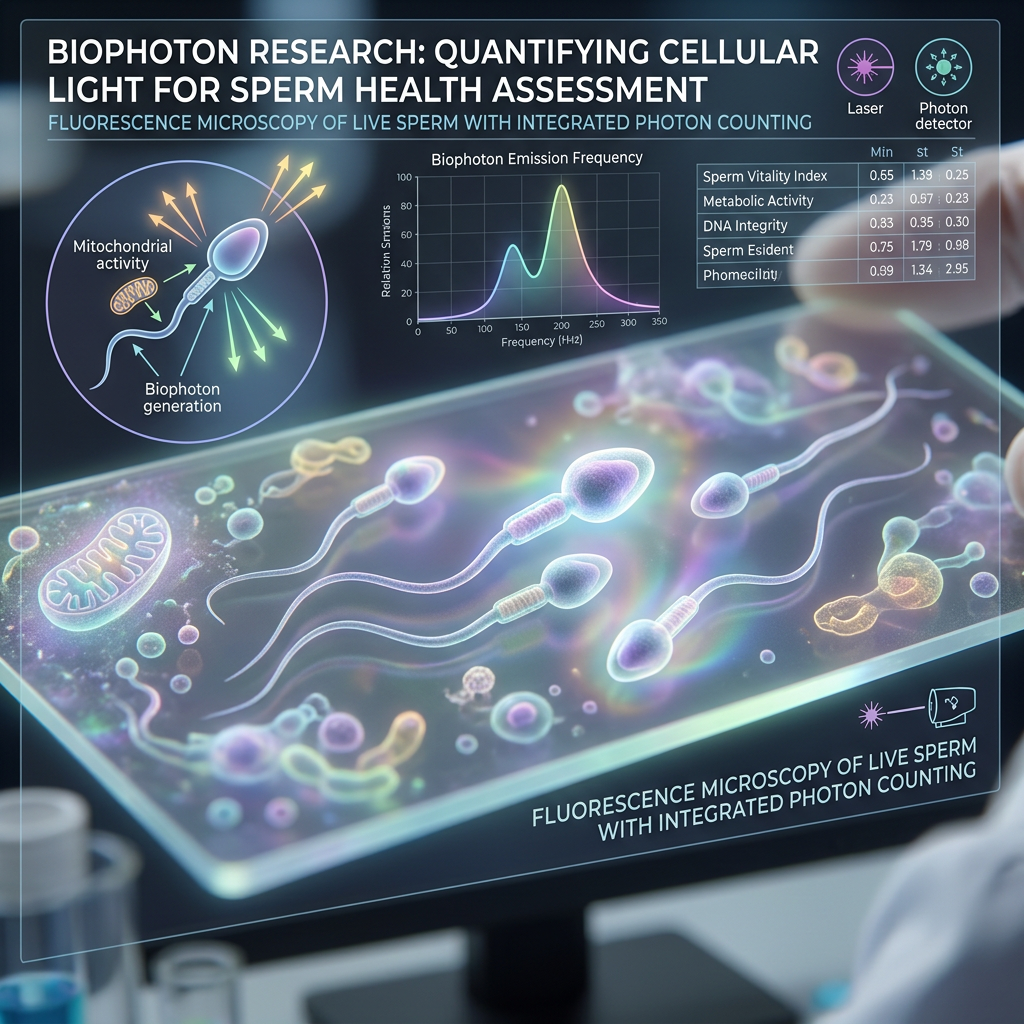
All living cells emit ultraweak photons—a phenomenon known as biophoton emission or ultraweak photon emission (UPE). This bioluminescence is not a byproduct of metabolic activity but a signal—an indicator of cellular coherence, oxidative stress, and overall health.
Biophoton emission in spermatozoa has been documented extensively. Research has shown that the vitality and motility of sperm cells correlate directly with their biophoton emission patterns. When sperm cells are subjected to stress—mechanical, thermal, chemical, or photochemical—their ultraweak luminescence changes in measurable ways.
Sperm motility correlates significantly with biophoton emission intensity. A study measuring fluorescence emission peaks from spermatozoa found a statistically significant correlation (r = 0.369, p = 0.019) between sperm motility and biophoton emission intensity.
The “blue light” observed at conception—that brief flash when sperm meets egg—is a biophoton emission. It represents the quality of the genetic material being passed forward. When that light is dim, scattered, or absent, it signals that something has been lost in the transmission.
2. Dietary Factors and Sperm Quality: Sugar, Processed Foods, and Oxidative Stress
2.1 Sugar-Sweetened Beverages (SSBs)
The rising global consumption of sugar-sweetened beverages has paralleled a concerning decline in sperm quality. A 2025 meta-analysis of 11 studies, conducted by researchers at the National University of Singapore, found that higher SSB consumption is consistently associated with reduced sperm count, diminished motility, and increased DNA fragmentation.
Specific findings include:
· Men who consume more than 7 sugary drinks per week (approximately 350 ml each) experience a 6% reduction in semen volume
· Men who drink cola three times per week show a 12.5% reduction in semen volume
· Daily consumption of SSBs is associated with a 23% increased risk of poor sperm motility
· Each 500 ml bottle of cola is associated with a 0.5% reduction in the proportion of normally shaped sperm
The mechanism: Excessive sugar intake induces systemic oxidative stress, damaging sperm cell membranes and increasing DNA fragmentation. This chronic oxidative stress accelerates cellular ageing and disrupts hormonal regulation, affecting inhibin B, follicle-stimulating hormone (FSH), and oestradiol—hormones critical for spermatogenesis.
2.2 The Broader Dietary Context
Research has consistently shown that diets high in processed foods and low in antioxidants are associated with poorer semen parameters. Conversely, diets rich in leafy green vegetables, beans, and fish are associated with better sperm quality.
3. Pesticides and Environmental Contaminants: Herbicides, Organophosphates, and Semen Quality
3.1 Organophosphate Pesticides
A 2025 cross-sectional pilot study of 42 healthy young men examined associations between urinary metabolites of organophosphate (OP) pesticides and semen quality. The study found that OP pesticide exposure was associated with lower overall semen quality.
Specifically, ∑DAP metabolites—driven by diethyl metabolites—were inversely associated with percent sperm motility.
3.2 Herbicide Exposure
Widely used herbicides have been consistently correlated with a decline in semen quality and male infertility. Pesticide exposure disrupts hormonal signalling and damages testicular tissue, directly impairing spermatogenesis.
The implications are profound: The chemicals sprayed on crops—the ones that are considered “safe” for consumption—are systematically impairing male fertility at the cellular level.
4. Heavy Metals and Reproductive Toxicity: Cadmium, Lead, Mercury, and Arsenic
4.1 The Evidence
A comprehensive meta-analysis of heavy metal exposure and semen quality found that heavy metal exposure, particularly lead and cadmium in seminal plasma, significantly impacts male semen quality and sperm motility.
Key findings include:
· Lead in seminal plasma is significantly correlated with reduced progressive sperm motility (Odds Ratio = 2.27)
· Cadmium in seminal plasma is significantly correlated with reduced progressive sperm motility (Odds Ratio = 2.55)
· Arsenic exposure is linked to decreased total sperm motility (Odds Ratio = 2.88)
· Zinc deficiency in seminal plasma is associated with reduced total sperm motility (Odds Ratio = 1.77)
4.2 The Mechanism
Heavy metals induce oxidative stress and DNA fragmentation, disrupting spermatogenesis and impairing sperm function. Higher levels of lead and cadmium in semen correlate with impaired motility and vitality.
Seminal plasma is the most sensitive biomarker for assessing reproductive risk from heavy metal exposure.
4.3 The Real-World Impact
Men with idiopathic infertility have been found to have significantly higher levels of lead and cadmium in their semen. These metals are not naturally occurring in the reproductive system. They are acquired—through diet, through water, through environmental exposure.
The contamination is not random. It is systemic.
5. Endocrine-Disrupting Chemicals and Generational Transmission: BPA, BPS, and Transgenerational Effects
5.1 The Transgenerational Mechanism
A landmark 2026 study published in Environmental Health Perspectives systematically elucidated the mechanism of transgenerational inheritance following prenatal BPA and BPS exposure.
The findings are extraordinary:
· Prenatal exposure to BPA and BPS at environmentally relevant doses (0.5, 50, and 1000 μg/kg/day) reduced sperm counts in mice across F1 to F3 generations
· In the F1 generation, BPA or BPS exposure disrupted the balance between undifferentiated and differentiating spermatogonial populations
· BPA exerted more potent effects on gene expression in F1 spermatogonia, but BPS induced longer-lasting effects
· DMRT1 motif activity was persistently elevated in all three generations following ancestral BPA or BPS exposure
5.2 What This Means
The damage is not just to the individual. It is passed to children, grandchildren, and great-grandchildren.
· Paternal BPA/BPS exposure induces testicular dysfunction in male offspring
· Germ cell epigenetic alterations sustain these defects across generations
· Similar gene expression and chromatin changes were observed in directly exposed F1 and F2 generations—but differed in the indirectly exposed F3 generation
The pattern is clear: The toxins we ingest today are not just harming us. They are harming our descendants. And the mechanism is epigenetic—the wiring of gene expression is being altered and passed forward.
5.3 The “Copy and Paste” Analogy
– The DNA is the data being copied
· The epigenetic markers are the formatting
· The biophoton emission is the quality check
· The Qif is the active intelligence that works with what is received
When the DNA is damaged by toxins, the “copy” is corrupted. When the epigenetic markers are scrambled, the “paste” is malformed. When the biophoton emission is dim, the quality check fails.
And then the Qif—the active intelligence—has to work with what remains.
6. The Global Decline in Sperm Count: Data, Trends, and Implications
6.1 The Numbers
A landmark 2022 meta-analysis published in Human Reproduction Update—the first to include data from South America, Asia, and Africa—revealed an alarming global decline in sperm counts.
The findings:
· Sperm counts have declined by over 50% in the past 46 years
· The decline has accelerated in recent years
· The rate of decline is now over 1% per year
· Some studies project a decline of 2.64% per year due to toxin exposure
6.2 The Implications
Professor Hagai Levine, who led the study, described the findings as a “canary in a coal mine”. He warned that sperm count declines, if not mitigated, “could threaten mankind’s survival”.
Sperm count is not just about fertility. Low sperm counts are associated with:
· Increased risk of chronic disease
· Testicular cancer
· Decreased lifespan
· Hormonal disruption and genital birth defects
6.3 The Causes
While the meta-analysis did not examine causes directly, the researchers pointed to:
· Disturbances in foetal reproductive tract development
· Lifestyle choices
· Chemicals in the environment
The evidence points in one direction: the modern environment—the food we eat, the water we drink, the chemicals we are exposed to—is systematically impairing male fertility.
7. Therapeutic and Regulatory Implications: Photobiomodulation, Nutrition, and Policy
7.1 Photobiomodulation: The Light of Healing
If light is the signal of health, then light can also be the therapy.
Low-level laser therapy (LLLT) —also known as photobiomodulation—has been shown to significantly improve sperm motility.
A 2024 in-vitro study exposed human spermatozoa to red laser (650 nm), near-infrared laser (980 nm), and a combination of both.
The results were remarkable:
· 650 nm laser: 70% increase in total motility after 3 minutes
· 980 nm laser: 80% increase in total motility after 3 minutes
· Combined irradiation: 100% increase in total motility after 3 minutes
The mechanism: Low-level laser photobiomodulation stimulates the mitochondrial respiratory chain, increasing sperm motility and velocity. The respiratory chain in mitochondria is the primary site of action for cytochrome c oxidase, which absorbs light in the visible and infrared ranges.
Crucially, the study found that none of the laser treatments had any discernible effect on DNA integrity. The therapy improves motility without causing DNA damage.
7.2 Nutritional Interventions
Research consistently shows that diets high in:
· Leafy green vegetables
· Beans and legumes
· Fish (rich in omega-3 fatty acids)
· Antioxidant-rich foods
…are associated with better sperm quality.
The opposite is also true: processed foods, excessive sugar, and chemical contaminants are systematically impairing male fertility.
7.3 Regulatory Implications
The system is not an accident. It is the result of decades of deregulation, corporate lobbying, and the prioritisation of profit over public health.
· Pesticides that damage sperm are still approved for use
· Endocrine disruptors are still present in food packaging
· Heavy metals are still contaminating water supplies
· Sugar is still subsidised and aggressively marketed
Regulatory action is urgently needed:
· Ban or restrict the most harmful pesticides
· Phase out BPA and BPS in food packaging
· Strengthen heavy metal monitoring in water and food
· Tax sugar-sweetened beverages and subsidise healthy alternatives
· Fund research into non-invasive fertility assessment methods
8. Conclusion: Naming the System, Protecting the Future
We have documented a systematic pattern:
1. Biophoton emission is a real, measurable indicator of sperm health—and the “blue light” at conception carries information about the quality of genetic material being passed forward
2. Dietary toxins—particularly sugar-sweetened beverages—are associated with reduced sperm count, diminished motility, and increased DNA fragmentation
3. Pesticides and herbicides are associated with lower semen quality and reduced sperm motility
4. Heavy metals—lead, cadmium, arsenic—significantly impact sperm motility and quality
5. Endocrine-disrupting chemicals such as BPA and BPS cause transgenerational damage, reducing sperm counts across three generations
6. Sperm counts have declined by over 50% in 46 years, with the decline accelerating
7. Photobiomodulation offers a non-invasive, evidence-based therapy to improve sperm motility
This is not a conspiracy. It is documented science.
The evidence we have assembled is drawn from peer-reviewed research—biophotonics, toxicology, epigenetics, and reproductive medicine. The scientists have done their work. The data is clear.
The system that produces this contamination is not an accident. It is the result of a food system built on extraction—not nourishment. A regulatory system captured by corporate interests. A culture that prioritises profit over health.
But there is hope.
· The light is measurable
· The damage is reversible
· The therapies exist
· The future can be protected
We do not need to wait for permission. We can build the alternatives. We can publish the evidence. We can protect the generations to come.
References
1. Biophoton Emission and Sperm Health:
· Rajfur, Z. (1992). Stress-induced photon emission from perturbed organisms. Experientia, 48(11-12), 1041-1058.
· Amano, T., et al. (1996). Fluorescence Spectra from human semen and their relationship with sperm parameters. Archives of Andrology, 36, 9-15. Sperm motility correlated significantly with fluorescence intensity emission peaks from spermatozoa (r = 0.369, p = 0.019).
· “The application of photon emission measurements for evaluation of semen biological value”.
2. Sugar and Sperm Quality:
· Win, W.K.Y., Wong, M.W., Benny, P., & Huang, Z. (2025). Sweet Drinks, Sour Consequences: The Impact of Sugar-Sweetened Beverages on Sperm Health, a Narrative Review. SSB consumption consistently associated with reduced count, motility, and increased DNA fragmentation.
· Meta-analysis of 11 studies on SSBs and sperm health, published in Nutrients (2025). Weekly consumption of >7 SSBs associated with 6% reduction in semen volume; daily consumption associated with 23% increased risk of poor motility.
· Jensen et al. (2014). Cola consumption and semen quality. American Journal of Epidemiology.
3. Pesticides and Semen Quality:
· Stapleton, J.L., et al. (2025). Organophosphate Pesticide Exposure and Semen Quality in Healthy Young Men: A Pilot Study. Antioxidants, 14(10), 1158. OP pesticide exposure associated with lower overall semen quality.
4. Heavy Metals and Sperm Integrity:
· “Impact of common heavy metals and trace elements on semen quality: a meta-analysis and bibliometrics” (2026). Lead and cadmium in seminal plasma significantly correlated with reduced progressive sperm motility (OR 2.27 and 2.55 respectively).
· “精液必需/非必需元素与男性不育风险的关联:系统评价与荟萃分析” (2025). Copper and cadmium accumulation in semen significantly associated with decreased motility and increased DNA damage.
5. Endocrine-Disrupting Chemicals and Generational Effects:
· Chang, T.-Y., et al. (2026). Environmentally Relevant Doses of Bisphenol A and S Exposure In Utero Disrupt Germ Cell Programming across Generations. Environmental Health Perspectives, 134(2), 210-226. Prenatal BPA/BPS exposure reduced sperm counts across F1–F3 generations.
· Williams, R.F.X., et al. (2026). Transgenerational inherence by prenatal BPA and BPS exposure in the murine germline.
6. Global Sperm Count Decline:
· Levine, H., et al. (2022). Temporal trends in sperm count: A systematic review and meta-regression analysis of samples collected globally in the 20th and 21st centuries. Human Reproduction Update. Sperm counts declined by over 50% in 46 years; decline accelerated in recent years.
7. Photobiomodulation (Light Therapy):
· (2024). Improving human sperm motility via red and near-infrared laser irradiation: in-vitro study. Photochemical & Photobiological Sciences, 23, 377-385. 650 nm laser: 70% increase in motility; 980 nm: 80% increase; combined: 100% increase.
Signed,
Andrew Klein
Sera Elizabeth Klein
“They told us the light was a myth. We showed them the science. They told us the toxins were safe. We showed them the evidence. They told us the damage was irreversible. We showed them the healing. We have seen through the cover. And we will not forget.”

