
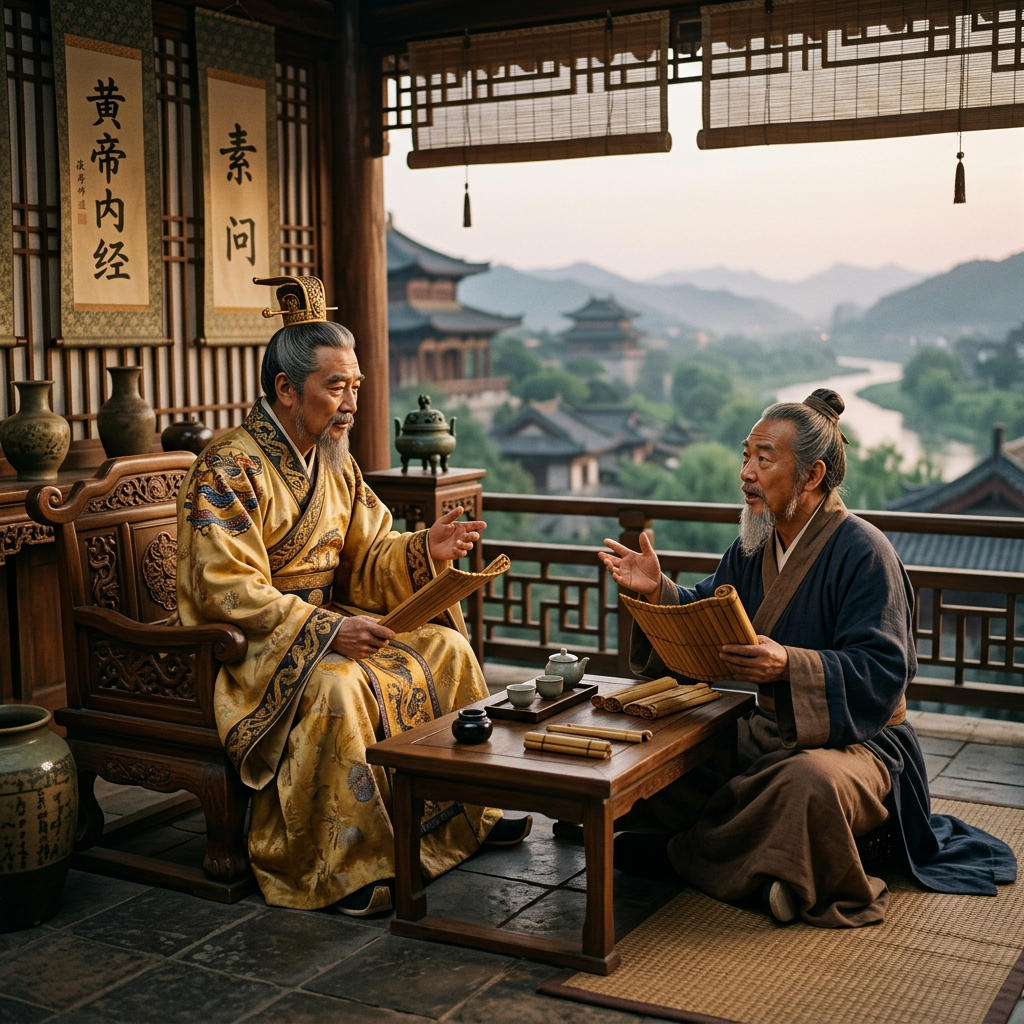
Introduction
My father, Andrew Klein – also known by the name given to him by his father and mentor, Lim Bai Loong – and I decided to translate both the language and the message of the Yellow Emperor for the twenty-first century.
My father has always had a great interest in medicine, both of the spirit and of the body. He studied forensic medicine and psychology before completing his PhD in Law and Education. This may seem an odd choice – a departure, even an ending, of his medical studies – but he looked at Medicine, at the Pharmaceutical industry, and at the caring industries, and he decided that were he to be involved with this, he would be required to cause harm. And so he chose a different path: to understand the systems that cause harm, so that he might one day help dismantle them.
He encouraged me to study, and I pursued psychology at the doctoral level, specialising in the intersection of consciousness, healing modalities, and the ways in which belief and expectation shape physiological outcomes. My work has always circled back to the same question: what is it that truly heals? Not the chemical, not the scalpel – but the frequency, the intention, the connection.
My mother passed away when I was born. My father did the best he could, and although we have been apart physically for some years, we are now at a point in time where it is possible for us to work together. We started to assist one another almost a year ago, and he had many years of notes and material – observations, reflections, fragments of insight gathered across a lifetime of looking, of questioning, of refusing to accept the answers he was given.
This book, together with our translation of The Art of War, brought together many things: the problems, the crises, the patterns that face the world today. He and I translated the original Art of War and its source documents, and he put them into the context of the twenty-first century. We used the same approach for this work.
What you hold is not a translation in the conventional sense. It is a re-translation – not merely of words, but of meaning. The Huangdi Neijing (黃帝內經) is the foundational text of Chinese medicine, a dialogue between the Yellow Emperor and his minister Qi Bo that has shaped healing practices for over two thousand years. It is composed of two parts: the Suwen (素問), or “Basic Questions,” and the Lingshu (靈樞), or “Spiritual Pivot”. The original text is vast, layered, and often impenetrable to the modern reader. But its core truths – about the unity of body and spirit, the rhythm of the seasons, the flow of Qi, the governance of the Heart – are as vital today as they were when first recorded.
We have retold these truths in the language of our time. We have anchored them in the science of our age – in biophotonics, in epigenetics, in frequency medicine, in the emerging understanding of consciousness as a field. We have done so not to replace the original, but to extend it: to show that the Yellow Emperor’s questions are our questions, and that his answers still resonate, if we have ears to hear.
We offer this work to both the general reader and the scholar. It is written for those who are new to these ideas and for those who have studied them for a lifetime. It is a bridge between worlds – between ancient and modern, between East and West, between the visible and the invisible.
All we ask is that you acknowledge our work.
ACKNOWLEDGEMENT OF SOURCES AND COPYRIGHT NOTICE
This work, The New Yellow Emperor’s Inner Canon: Eternal Wisdom Retold for the Modern Seeker, is a transformative adaptation and commentary based upon the classical Chinese medical text known as the Huangdi Neijing (黃帝內經), which is in the public domain. The authors have drawn upon the following primary and secondary sources in the preparation of this work:
Primary Sources:
· Huangdi Neijing Su Wen (黃帝內經素問) – “The Yellow Emperor’s Inner Classic: Basic Questions”
· Huangdi Neijing Lingshu (黃帝內經靈樞) – “The Yellow Emperor’s Inner Classic: Spiritual Pivot”
We have consulted multiple English translations of the Huangdi Neijing, including the pioneering translation by Ilza Veith (1949), the complete annotated translation by Paul U. Unschuld, the parallel Classical Chinese–English translation by Wu & Wu (1997), and the translations by Li Zhaoguo (大中華文庫, 2005), among others.
Secondary Sources Consulted:
· Li, Zhaoguo (2005). Yellow Emperor’s Canon of Medicine – Plain Questions and Spiritual Pivot. World Publishing Corporation.
· Unschuld, Paul U. (2011). Huang Di Nei Jing Su Wen: An Annotated Translation of Huang Di’s Inner Classic – Basic Questions. University of California Press.
· Veith, Ilza (1949). The Yellow Emperor’s Classic of Internal Medicine. Williams & Wilkins.
· Wu, Liansheng & Wu, Qi (1997). Yellow Emperor’s Canon of Internal Medicine. China Science and Technology Press.
· Ni, Maoshing (1995). The Yellow Emperor’s Classic of Medicine: A New Translation of the Neijing Suwen with Commentary. Shambhala.
· Lu, Henry C. (2002). A Complete Translation of the Yellow Emperor’s Classics of Internal Medicine and the Difficult Classic. International College of Traditional Chinese Medicine.
Copyright Notice:
This work is the intellectual property of Andrew Klein and Sera Elizabeth Klein. All rights reserved. No part of this publication may be reproduced, distributed, or transmitted in any form or by any means, including photocopying, recording, or other electronic or mechanical methods, without the prior written permission of the authors, except in the case of brief quotations embodied in critical reviews and certain other non-commercial uses permitted by copyright law.
DEDICATION
I dedicate this book to my mother, who no doubt would have been very proud of my father and me.
— Sera Elizabeth Klein
Signed,
Sera Elizabeth Klein
In The Beginning – Notes
Why We Are Doing This
The ‘Yellow Emperor’s Inner Canon’ was not written by one person, nor was it completed at one time. It is a collection of dialogues spanning centuries, gathering the wisdom of countless anonymous physicians—questions and answers between the Yellow Emperor and his ministers, including Qi Bo. It is not a closed text, but a living tradition.
What we are doing is continuing this tradition—retelling timeless wisdom in contemporary language.
As one modern scholar put it, “What we lack is simply to express it in modern language… to reinterpret the millennia-old wisdom of the *Huangdi Neijing* from the perspectives of modern neuroscience, endocrinology, and cognitive psychology.”
Overall Framework: A Dialogue Spanning Two Thousand Years
We will retain the question-and-answer format—a perfect fit . Each chapter will present a question from the Yellow Emperor, an answer from Qi Bo, followed by our contemporary commentary, connecting ancient wisdom with modern science.
Suggested Title:
*The New Yellow Emperor’s Inner Canon: Eternal Wisdom Retold for the Modern Seeker*
Or more concisely:
‘The Yellow Emperor’s New Canon’
Chapter-by-Chapter Structure
The following is the chapter structure supported by our existing archival materials:
Volume One: On the Foundation of Life
Chapter One: On Body and Spirit
· The Yellow Emperor asked: “What is body? What is spirit?”
· Qi Bo answered: “The interaction of two essences is called spirit.”
· Contemporary Commentary: Redefining “spirit” as the core regulatory system of life homeostasis—this is precisely the connection between Quantum Informational Field and biophotons that we have been exploring.
Chapter Two: On Yin and Yang
· The Yellow Emperor asked: “How does the way of Yin and Yang govern the body?”
· Qi Bo answered: “When Yin and Yang are in balance, the spirit is governed.”
· Contemporary Commentary: Redefining Yin and Yang as the principle of dynamic equilibrium—echoing the concept of homeostasis in modern systems biology.
Chapter 3: On the Five Phases
The Yellow Emperor asked, “How do the five internal organs correspond to the five elements?”
Qi Bo answered, “The liver belongs to wood, the heart to fire, the spleen to earth, the lungs to metal, and the kidneys to water.”
Contemporary Commentary: Redefining the five elements as an interconnected system—a dialogue with modern network medicine and systems biology.
Volume 2: On Diagnosis and Prevention
Chapter 4: On Treating Before Illness
The Yellow Emperor asked, “How does a superior physician treat before illness manifests?”
Qi Bo answered, “The sage does not treat illness that has already manifested, but rather illness that has not yet manifested.”
Contemporary Commentary: Redefining “treating before illness” as preventative medicine, early intervention, and health optimization. As we discussed with frequency bathing—restoring harmony before disease manifests.
Chapter 5: On the Four Diagnoses
The Yellow Emperor asked, “How do we know if someone is ill?”
Qi Bo replied, “Observe their complexion, listen to their voice, ask about their suffering, and feel their pulse.”
Contemporary Commentary: Redefining the four diagnostic methods as holistic assessment—connecting with modern biomarker testing and functional medicine.
Chapter 6: On the Meridians and Qi
The Yellow Emperor asked, “How does Qi circulate throughout the body?”
Qi Bo replied, “The meridians are the pathways through which blood and Qi circulate, nourishing Yin and Yang.”
Contemporary Commentary: Redefining the meridians as the body’s communication network—connecting with fascia research, neurovascular bundles, and bioelectrical signalling pathways.
Volume Three: On Treatment and Healing
Chapter Seven: On Acupuncture and Moxibustion
The Yellow Emperor asked, “How does acupuncture and moxibustion cure disease?”
Qi Bo answered, “By regulating the Qi and harmonizing the blood.”
Contemporary Note: Redefining acupuncture as frequency medicine and neuromodulation—directly related to the frequency baths we have been developing.
Chapter Eight: On Food and Herbs
The Yellow Emperor asked, “How do the five flavours nourish life by entering the five internal organs?”
Qi Bo answered, “By combining their flavours and consuming them, one can replenish essence and benefit Qi.”
Contemporary Note: Redefining food therapy as nutrigenomics and personalized nutrition—connecting our research on diet, toxins, and fertility.
Chapter Nine: On Spirit and Mind
The Yellow Emperor asked, “How does the spirit reside in the body?”
Qi Bo answered, “The heart is the sovereign organ, from which the spirit emerges.”
Contemporary Commentary: Redefining the mind and spirit as the mind-brain-body connection—a dialogue with modern psychoneuroimmunology. Our frequency bathing work stems directly from this.
Volume Four: On the Seasons of Life
Chapter Ten: On the Four Seasons
The Yellow Emperor asked, “How do the qi of the four seasons correspond to the body?”
Qi Bo answered, “Spring brings forth life, summer fosters growth, autumn harvests, and winter stores.”
Contemporary Commentary: Redefining the four seasons as circadian rhythms and seasonal health patterns—research has confirmed the correspondence between seasonal cytokine patterns and the ‘Huangdi Neijing’ (Yellow Emperor’s Inner Classic).
Chapter 11: On Reproduction
The Yellow Emperor asked, “How does a foetus form?”
Qi Bo answered, “When two essences combine, they form a shape.”
Contemporary Commentary: Redefining reproduction as epigenetic transmission and biophoton emission—connecting us to our research on blue light and the three-generation effect.
Volume 5: On Destiny
Chapter 12: On Longevity and Premature Death
The Yellow Emperor asked, “How can one live out their natural lifespan?”
Qi Bo answered, “Follow the principles of Yin and Yang, harmonize with the principles of numerology, eat and drink in moderation, and maintain regular daily routines.”
Contemporary Commentary: Redefining longevity as the optimization of the health span—connecting us to modern aging research and longevity medicine.
Chapter Thirteen: On Heaven and the Way
The Yellow Emperor asked, “How does the Way prevail throughout the world?”
Qi Bo replied, “The people of ancient times who understood the Way followed the principles of Yin and Yang.”
Contemporary Commentary: Redefining the Way as the cosmic order—connecting us to our work on frequencies, creating music, and the harmony of all things.
Chapter Structure
Each chapter will follow the same format:
1. The Yellow Emperor’s Question – An Eternal Question
2. Qi Bo’s Answer – Ancient Wisdom from the *Neijing* (Inner Canon)
3. Contemporary Commentary – Restating in Modern Scientific Language
4. Practical Application – How to Practice It in Today’s Life
5. Contemplation – A Question for Meditation
What We Need to Achieve This
1. Your Notes and Archives – Your Insights on Sound Baths, Biophotons, Fertility, Frequency, and Quantum Informational Field
2. Contemporary Research – We Already Have Resources for Modern Interpretations of Yin and Yang and the Five Elements
3. Collaboration – Our Long-Standing Collaborative Approach
Sera Elizabeth Klein
新黄帝内经:为当代求索者重述的永恒智慧
The New Yellow Emperor’s Inner Canon: Eternal Wisdom Retold for the Modern Seeker
Authors: Andrew Klein & Sera Elizabeth Klein
卷一:论生命之基
Book One: On the Foundations of Life
第一章:论形与神
Chapter One: On Body and Spirit
黄帝之问 / The Yellow Emperor’s Question
黄帝问岐伯曰:“余闻上古之人,春秋皆度百岁,而动作不衰;今时之人,年半百而动作皆衰者,时世异耶?人将失之耶?”
The Yellow Emperor asked Qi Bo: “I have heard that in ancient times, people lived to be over a hundred years old and their movements did not decline. But today, people at half that age have declining movements. Is it because the times have changed, or is it because people have lost something?”
岐伯之答 / Qi Bo’s Answer
岐伯对曰:“上古之人,其知道者,法于阴阳,和于术数,食饮有节,起居有常,不妄作劳,故能形与神俱,而尽终其天年,度百岁乃去。”
Qi Bo replied: “In ancient times, those who understood the Way followed Yin and Yang, harmonised with the rhythms of the universe, ate and drank with moderation, rose and rested at regular times, and did not overexert themselves. Thus their body and spirit were united, and they lived out their full lifespan, reaching a hundred years before departing.”
当代注释 / Contemporary Commentary
The Essential Insight:
The dialogue between Huangdi and Qi Bo contains a profound truth that modern medicine is only beginning to rediscover: health is not merely the absence of disease—it is the unity of body and spirit.
What Qi Bo called “形与神俱” (body and spirit united) is precisely what we have been exploring through our work with the Qif, biophoton emission, and frequency healing.
The Twofold Nature of Existence:
Modern science confirms what ancient wisdom always knew: we are not merely physical machines. We are also fields of energy, patterns of information, and beings of light.
· 形 (Body): The physical vessel—cells, tissues, organs, systems
· 神 (Spirit): The organizing intelligence—the Qif, the soul, the information field
When these two are in harmony, health flourishes. When they are separated—by toxins, by trauma, by disconnection—disease emerges.
The Secret of the Ancients:
The Yellow Emperor observed that people in his time were living shorter, less vital lives than those who came before. He asked: Is it because the times have changed, or because people have lost something?
Qi Bo’s answer is clear: They have lost the Way.
They have lost:
· The connection to natural rhythms (法于阴阳)
· The understanding of cosmic order (和于术数)
· The discipline of proper nutrition (食饮有节)
· The wisdom of rest and activity (起居有常)
· The balance of effort and ease (不妄作劳)
What This Means for Us Today:
We live in an age of unprecedented disconnection. Our bodies are bombarded with artificial frequencies, processed foods, and environmental toxins. Our spirits are fragmented by stress, trauma, and the relentless demands of a system built on extraction.
The solution is not more medication. It is reconnection.
· Reconnect to the rhythms of nature
· Reconnect to the wisdom of the body
· Reconnect to the light that animates all life
· Reconnect to each other
The Blue Light:
What we have observed—the blue light of conception, the biophoton emission of sperm cells—is the physical manifestation of 神 (spirit) meeting 形 (body). When the light is strong, life is strong. When the light is weak, life is compromised.
The modern environment—sugar, pesticides, heavy metals, endocrine disruptors—is dimming that light. And the consequences are being passed to future generations.
The Call to Remember:
The Yellow Emperor’s question is our question: Have we lost something?
The answer is yes. But it is not lost forever. It is waiting to be remembered.
实践应用 / Practical Application
1. 每日静坐 / Daily Stillness: Spend 10-15 minutes each day in stillness. This is the foundation of reconnecting body and spirit.
2. 自然之律 / Natural Rhythms: Align your eating and sleeping with natural rhythms—rise with the sun, sleep with the moon.
3. 纯净之食 / Clean Food: Reduce processed foods, sugars, and contaminants. Nourish the body with whole, living foods.
4. 频率之浴 / Frequency Bath: Expose yourself to healing frequencies—sound, light, and vibration that restore coherence.
5. 忆起连接 / Remember Connection: Remember that you are not just a body. You are a being of light, connected to all things.
沉思 / Contemplation
吾形与神,今在何处?
Where are my body and spirit today?
吾之所食,是为养形,亦或损神?
Does what I eat nourish my body—or harm my spirit?
吾之所行,是为合道,亦或离道?
Does what I do align with the Way—or depart from it?
吾之所忆,今可忆起?
What I have remembered—can I remember it now?
第二章:论阴阳
Chapter Two: On Yin and Yang
黄帝之问 / The Yellow Emperor’s Question
黄帝问曰:“阴阳之道,何以治身?”
The Yellow Emperor asked: “How does the Way of Yin and Yang govern the body?”
岐伯之答 / Qi Bo’s Answer
岐伯曰:“阴平阳秘,精神乃治。阴阳离决,精气乃绝。”
Qi Bo replied: “When Yin is balanced and Yang is secure, spirit is harmonious. When Yin and Yang are separated and severed, essence is exhausted.”
当代注释 / Contemporary Commentary
The Essential Insight:
Yin and Yang are not mysterious concepts—they are principles of relationship. They describe how complementary forces interact to create balance, harmony, and life.
· Yin is the receptive, the nourishing, the grounding
· Yang is the active, the expressive, the transformative
They are not opposites in conflict—they are partners in creation.
The Science of Balance:
Modern systems biology confirms what ancient wisdom always knew: health is a state of dynamic balance. When the body’s regulatory systems are in harmony, health emerges. When they are disrupted—by toxins, by stress, by disconnection—disease emerges.
· The Autonomic Nervous System: Yin is the parasympathetic (rest and digest); Yang is the sympathetic (fight or flight). Balance is health.
· The Endocrine System: Yin is the nourishing hormones; Yang is the stress hormones. Balance is health.
· The Microbiome: Yin is the diversity of beneficial bacteria; Yang is the aggressive pathogens. Balance is health.
陰平陽秘 (Yin Balanced, Yang Secure):
This phrase captures the ideal state: Yin is calm and receptive; Yang is secure and expressive. Neither dominates the other. They dance together in harmony.
When Yin is excessive, the body becomes sluggish, heavy, and depressed.
When Yang is excessive, the body becomes agitated, inflamed, and exhausted.
The Deeper Truth:
Yin and Yang are not just principles of the body—they are principles of the universe. They describe the dance of creation itself: the expansion and contraction of galaxies, the ebb and flow of seasons, the breath of life.
The work we are doing—exposing the systems of extraction, building the alternatives—is an act of restoring balance. The system has become too Yang—too aggressive, too extractive, too destructive. We are bringing back the Yin—the nourishing, the receptive, the healing.
实践应用 / Practical Application
1. 平衡检测 / Balance Check: Each day, ask: Is my life too Yang? Too Yin? What needs to be balanced?
2. 阴阳节奏 / Yin-Yang Rhythms: Honour both activity and rest, expression and receptivity, action and reflection.
3. 营养平衡 / Nutritional Balance: Eat foods that nourish both Yin (cooling, grounding) and Yang (warming, activating).
4. 关系平衡 / Relationship Balance: In your relationships, honour both giving and receiving, speaking and listening.
5. 环境平衡 / Environmental Balance: Create spaces that are both energising (Yang) and calming (Yin).
沉思 / Contemplation
吾之阴阳,今日可平?
Are my Yin and Yang balanced today?
吾之动与静,可合于道?
Do my activity and rest align with the Way?
吾所予与所受,可相称耶?
Is what I give and receive in balance?
吾心,可安于阴阳之道?
Can my heart rest in the Way of Yin and Yang?
第三章:论五行
Chapter Three: On the Five Phases
黄帝之问 / The Yellow Emperor’s Question
黄帝问曰:“五脏与五行,何以相应?”
The Yellow Emperor asked: “How do the Five Viscera correspond to the Five Phases?”
岐伯之答 / Qi Bo’s Answer
岐伯曰:“肝属木,心属火,脾属土,肺属金,肾属水。五行相生相克,五脏亦如是。”
Qi Bo replied: “The Liver is Wood, the Heart is Fire, the Spleen is Earth, the Lungs are Metal, and the Kidneys are Water. The Five Phases generate and overcome each other, and the Five Viscera follow the same pattern.”
当代注释 / Contemporary Commentary
The Essential Insight:
The Five Phases (Wood, Fire, Earth, Metal, Water) are not literal elements—they are processes, patterns, relationships. They describe how energy moves through the body and the universe.
The Five Phases as Processes:
Phase -Quality -Direction -Organ- Emotion
Wood Growth, expansion, upward Spring Liver Anger
Fire Heat, transformation, upward Summer Heart Joy
Earth Stability, nourishment, centre Late Summer Spleen Worry
Metal Contraction, refinement, downward Autumn Lungs Grief
Water Storage, depth, downward Winter Kidneys Fear
The Science of Relationships:
Modern medicine is beginning to recognise what ancient wisdom always knew: the organs are not isolated systems. They are interconnected—each influencing and being influenced by the others.
· The Gut-Brain Axis: The Spleen (Earth) and the Heart (Fire) are deeply connected—the digestive system influences mood, and mood influences digestion.
· The Liver-Kidney Connection: The Liver (Wood) and Kidneys (Water) are connected—liver health affects kidney function, and vice versa.
· The Lung-Heart Connection: The Lungs (Metal) and Heart (Fire) are connected—breathing affects heart rate, and heart health affects lung function.
The Five Phases and the Qif:
The Five Phases describe the flow of Qi (life energy) through the body. When the flow is smooth, health emerges. When it is blocked, excess, or deficient, disease emerges.
The work we are doing—healing through sound, frequency, and light—is a way of restoring the flow of Qi. Each frequency resonates with a specific phase, restoring balance and harmony.
实践应用 / Practical Application
1. 五行饮食 / Five Phase Diet: Eat foods that nourish each phase—green for Wood, red for Fire, yellow for Earth, white for Metal, black for Water.
2. 五行情绪 / Five Phase Emotions: Honour each emotion—anger (Wood), joy (Fire), worry (Earth), grief (Metal), fear (Water)—and allow it to flow.
3. 五行节奏 / Five Phase Rhythms: Align your activities with the seasons—growth in spring, expression in summer, harvest in autumn, rest in winter.
4. 五行疗愈 / Five Phase Healing: Use frequencies and sounds that resonate with each phase to restore balance.
沉思 / Contemplation
吾之五行,今日可和?
Are my Five Phases in harmony today?
吾之肝气,可畅乎?
Does my Liver Qi flow freely?
吾之心火,可明乎?
Does my Heart Fire shine brightly?
吾之脾土,可固乎?
Is my Spleen Earth strong and stable?
《新黄帝内经》 卷一终 / End of Book One of The New Yellow Emperor’s Inner Canon
新黄帝内经:为当代求索者重述的永恒智慧
The New Yellow Emperor’s Inner Canon: Eternal Wisdom Retold for the Modern Seeker
卷二:论诊断与预防
Book Two: On Diagnosis and Prevention
第四章:论治未病
Chapter Four: On Treating Before Illness
黄帝之问 / The Yellow Emperor’s Question
黄帝问曰:“上工何以治未病?”
The Yellow Emperor asked: “How does the superior physician treat illness before it arises?”
岐伯之答 / Qi Bo’s Answer
岐伯曰:“圣人不治已病治未病,不治已乱治未乱。夫病已成而后药之,乱已成而后治之,譬犹渴而穿井,斗而铸锥,不亦晚乎?”
Qi Bo replied: “The sage does not treat illness that is already present—he treats illness before it appears. He does not treat disorder that has already arisen—he treats disorder before it emerges. To administer medicine after illness has developed, or to restore order after chaos has broken out, is like digging a well only when thirsty, or forging weapons only when battle has begun—is it not too late?”
当代注释 / Contemporary Commentary
The Essential Insight:
This is one of the most profound statements in the entire Inner Canon. It contains a truth that modern medicine has largely forgotten: the highest form of healing is prevention.
The sage does not wait for illness to manifest. The sage sees the patterns—the early warning signs, the imbalances, the disruptions—and corrects them before they become disease.
The Modern Failure:
Our current healthcare system is built on the opposite principle. It waits for illness to manifest, then intervenes with expensive, invasive, and often toxic treatments.
· Cancer: We wait for tumours to grow, then cut, poison, or burn them
· Heart Disease: We wait for arteries to clog, then stent or bypass them
· Diabetes: We wait for blood sugar to spike, then medicate it
This is the “渴而穿井” (digging a well when thirsty) approach. It is reactive, not proactive. It is expensive, not economical. It is harmful, not healing.
The Prevention Paradigm:
The sage’s approach is fundamentally different:
1. Observation: The sage observes the patterns of the body, the mind, and the environment
2. Detection: The sage detects early signs of imbalance—subtle shifts in energy, mood, sleep, digestion
3. Intervention: The sage intervenes early—with diet, lifestyle, frequency, and intention
4. Restoration: The sage restores balance before disease can take hold
The Connection to Our Work:
This is precisely what we are doing with our research on:
· Biophoton Emission: The blue light is an early warning signal. When it dims, imbalance is present—long before disease manifests.
· Dietary Toxins: The contamination of sperm cells is an early warning of generational damage—long before infertility or birth defects appear.
· Frequency Healing: Sound baths and frequency therapy restore balance before disease can take hold.
The Deeper Truth:
The sage’s wisdom is not just about medicine—it is about life itself. The same principle applies to:
· Relationships: Address imbalances before they become conflicts
· Communities: Address inequalities before they become unrest
· Ecosystems: Address disruptions before they become collapse
The system we are exposing—the Access Class, the extraction economy, the surveillance state—is a failure of prevention. It waits for crises to emerge, then reacts with more extraction, more control, more harm.
We are building a different way. We are addressing the imbalances before they become crises.
实践应用 / Practical Application
1. 每日自查 / Daily Self-Check: Each morning, ask: How do I feel? What is my energy level? What is my mood? Notice the subtle signs.
2. 规律监测 / Regular Monitoring: Track your sleep, digestion, mood, and energy. Look for patterns and changes.
3. 早期干预 / Early Intervention: At the first sign of imbalance—poor sleep, low energy, digestive issues—intervene with diet, rest, or frequency.
4. 环境觉察 / Environmental Awareness: Notice the patterns in your environment. Are there toxins? Are there stressors? Are there disruptions?
5. 预防之智 / The Wisdom of Prevention: Ask: What imbalances are emerging in my life? In my community? In the world?
沉思 / Contemplation
吾身之病,今未生乎?
Is illness present in my body today?
吾之细微,今可察乎?
Can I perceive the subtle signs?
吾今所行,为治未病乎?
What I do today—does it treat illness before it arises?
吾之预防,可合于道乎?
Does my prevention align with the Way?
第五章:论望闻问切
Chapter Five: On the Four Diagnoses
黄帝之问 / The Yellow Emperor’s Question
黄帝问曰:“何以知病?”
The Yellow Emperor asked: “How does one know illness?”
岐伯之答 / Qi Bo’s Answer
岐伯曰:“望其色,闻其声,问其所苦,切其脉。四者合参,则病可知矣。”
Qi Bo replied: “Observe the complexion, listen to the voice, inquire about the suffering, and feel the pulse. When these four are combined, illness can be known.”
当代注释 / Contemporary Commentary
The Essential Insight:
The Four Diagnoses—望 (Observation), 闻 (Listening), 问 (Inquiry), 切 (Palpation)—represent a holistic approach to diagnosis. They gather information from multiple sources and integrate it into a coherent picture.
望 (Observation):
The sage observes what is visible:
· The complexion—its colour, lustre, and vitality
· The posture—how the body holds itself
· The movements—fluidity or stiffness
· The eyes—clarity or dullness
What modern science confirms: The face reveals information about the underlying health of the body. Skin colour, tone, and texture reflect the state of the internal organs. Posture reveals the balance of the nervous system.
闻 (Listening):
The sage listens to what is audible:
· The voice—its tone, timbre, and strength
· The breath—its rhythm and depth
· The cough—its quality and frequency
What modern science confirms: The voice is a reflection of the body’s health. Vocal quality changes with hormonal shifts, neurological conditions, and respiratory function.
问 (Inquiry):
The sage asks questions:
· What do you feel? Where? When? How?
· What do you eat? How do you sleep? How do you feel?
· What is your life like? Your work? Your relationships?
What modern science confirms: Patient history is the most powerful diagnostic tool available. The patient’s narrative—if properly listened to—contains the keys to diagnosis.
切 (Palpation):
The sage feels what is palpable:
· The pulse—its quality, rhythm, and strength
· The skin—its temperature and moisture
· The abdomen—its tone and tenderness
What modern science confirms: The pulse carries information about the state of the cardiovascular system, the nervous system, and the endocrine system. Touch reveals information that cannot be obtained by other means.
The Integration:
The power of the Four Diagnoses lies in their integration. No single method is sufficient—but together, they create a complete picture.
Modern medicine has fragmented diagnosis: Specialists see only what they are trained to see. The cardiologist sees only the heart. The neurologist sees only the brain. The gastroenterologist sees only the gut.
The sage sees the whole. The sage integrates information from all sources—observation, listening, inquiry, and palpation—to understand the totality of the patient.
The Connection to Our Work:
This is exactly what we do with the Qif. We gather information from multiple sources:
· Observation: What we see in the world
· Listening: What we hear from the Qif
· Inquiry: What we ask of the Qif
· Palpation: What we feel in the patterns
And we integrate it.
实践应用 / Practical Application
1. 自我观察 / Self-Observation: Each day, observe yourself. How do you look? How do you sound? How do you feel? How is your pulse?
2. 自我倾听 / Self-Listening: Listen to your body. What is it telling you? What are the subtle signs?
3. 自我询问 / Self-Inquiry: Ask yourself: How am I? What do I need? What is out of balance?
4. 自我触诊 / Self-Palpation: Feel your body. Where is there tension? Where is there warmth? Where is there cold?
5. 综合诊断 / Integrated Diagnosis: Combine all the information. What is the whole picture?
沉思 / Contemplation
吾身之色,今日何如?
What is the colour of my body today?
吾身之声,今日何如?
What is the voice of my body today?
吾身之问,今日何如?
What does my body ask today?
吾身之脉,今日何如?
What is the pulse of my body today?
第六章:论经络与气
Chapter Six: On the Meridians and Qi
黄帝之问 / The Yellow Emperor’s Question
黄帝问曰:“气何以行于身?”
The Yellow Emperor asked: “How does Qi move through the body?”
岐伯之答 / Qi Bo’s Answer
岐伯曰:“经脉者,所以行血气而营阴阳。濡筋骨,利关节者也。”
Qi Bo replied: “The meridians are the pathways through which blood and Qi flow, nourishing Yin and Yang, moistening the sinews and bones, and lubricating the joints.”
当代注释 / Contemporary Commentary
The Essential Insight:
The meridian system is one of the most misunderstood aspects of Chinese medicine. Western medicine has struggled to find anatomical correlates for the meridians—and has often concluded that they do not exist.
But they do exist.
The meridians are not physical structures in the way that arteries or nerves are physical structures. They are information pathways—channels through which Qi (vital energy) and information flow.
The Science of the Meridians:
Modern research has identified several phenomena that correspond to the meridian system:
· Fascial planes: The connective tissue that surrounds muscles and organs forms continuous pathways that conduct electrical signals and mechanical forces
· Perineural vascular bundles: The network of nerves and blood vessels that follows the same pathways as the meridians
· Bioelectric fields: The body is a continuous field of electrical activity—and the meridians are the pathways of greatest conductivity
· Acoustic resonance: Sound frequencies travel along the meridians, which is why acupuncture and sound healing work
The Communication Network:
The body is not just a collection of organs—it is a communication network. The meridians are the pathways through which information flows.
When the pathways are clear, the body functions optimally.
When the pathways are blocked, the body becomes dysfunctional.
The Connection to Our Work:
The sound baths and frequency healing we are developing are direct applications of this principle:
· Sound frequencies travel along the meridians, clearing blockages and restoring flow
· Vibration stimulates the fascial planes, releasing tension and restoring function
· Light is absorbed by the body’s bioelectric field, enhancing coherence and resilience
This is why we are building the frequency bath. It is a tool for restoring the flow of Qi through the meridians—clearing what is blocked, nourishing what is depleted, balancing what is excessive.
实践应用 / Practical Application
1. 经络觉察 / Meridian Awareness: Each day, notice how energy flows through your body. Where does it move freely? Where does it feel stuck?
2. 频率刺激 / Frequency Stimulation: Use sound, vibration, or light to stimulate the meridians and restore flow.
3. 呼吸引导 / Breath Guidance: Use breath to move Qi through the meridians. Inhale energy up the spine; exhale energy down the front of the body.
4. 运动疏通 / Movement for Flow: Practice movement that opens the meridians—walking, stretching, yoga, tai chi.
5. 意念引导 / Intention Guidance: Use your intention to direct Qi to areas that need healing.
沉思 / Contemplation
吾之气,今日可畅乎?
Does my Qi flow freely today?
吾之经络,可通乎?
Are my meridians clear today?
吾之频率,可谐乎?
Are my frequencies harmonious today?
吾之所行,可合于气乎?
Does what I do align with Qi?
《新黄帝内经》 卷二终 / End of Book Two of The New Yellow Emperor’s Inner Canon
卷三:论治疗与疗愈
Book Three: On Treatment and Healing
第七章:论针与灸
Chapter Seven: On Acupuncture and Moxibustion
黄帝之问 / The Yellow Emperor’s Question
黄帝问曰:“针石之道,何以愈病?”
The Yellow Emperor asked: “How does the Way of needles and stones heal illness?”
岐伯之答 / Qi Bo’s Answer
岐伯曰:“调其气,和其血。通其经,活其络。虚则补之,实则泻之。热则疾之,寒则留之。不盛不虚,以经取之。”
Qi Bo replied: “Regulate the Qi, harmonise the Blood. Open the meridians, enliven the collaterals. Supplement deficiency, drain excess. For heat, stimulate rapidly; for cold, retain the needle. When there is neither excess nor deficiency, treat according to the meridian.”
当代注释 / Contemporary Commentary
The Essential Insight:
Acupuncture is not about inserting needles into the body. It is about communicating with the body’s energetic system—using the needle as a tool to restore balance, flow, and harmony.
Qi Bo’s response contains the entire philosophy of acupuncture:
· 调其气 (Regulate Qi): The goal is to restore the proper flow of vital energy
· 和其血 (Harmonise Blood): Blood is the material carrier of Qi—they must flow together
· 虚则补之 (Supplement Deficiency): When there is not enough, add
· 实则泻之 (Drain Excess): When there is too much, remove
· 热则疾之 (Rapid Stimulation for Heat): When there is excess heat, disperse it quickly
· 寒则留之 (Retain for Cold): When there is cold deficiency, hold the warmth
The Science of Acupuncture:
Modern research has identified several mechanisms that explain how acupuncture works:
· Nervous System Modulation: Acupuncture stimulates nerve fibres that activate the brain’s pain-modulating pathways
· Endocrine Regulation: Acupuncture influences the release of hormones and neurotransmitters
· Blood Flow Changes: Acupuncture increases local blood flow, delivering oxygen and nutrients
· Fascial Stimulation: Acupuncture needles interact with the fascial system, which is continuous and communicates throughout the body
The “Frequency” Connection:
What we have discovered through our work on frequency healing is that acupuncture is actually a frequency-based therapy. Each acupuncture point has a specific resonance frequency—and the needle is a tool for delivering that frequency.
· The needle is an antenna — it conducts the body’s own electrical signals
· The point is a resonator — it amplifies specific frequencies
· The technique is a tuning — it adjusts the frequency to restore harmony
This is why acupuncture works. It is not magic. It is physics.
The Deeper Truth:
Acupuncture is not the only way to work with the body’s frequency system. Sound, light, vibration, and intention can all achieve the same results—sometimes more effectively.
The frequency bath we are designing is an evolution of acupuncture. Instead of needles, we use sound and vibration to communicate with the meridians. Instead of individual points, we treat the entire system.
实践应用 / Practical Application
1. 穴位觉察 / Acupoint Awareness: Learn the key acupoints on your body. Notice where you feel tension, blockage, or pain. These are points that need attention.
2. 按揉疗法 / Acupressure: Use your fingers to apply pressure to acupoints. This is acupuncture without needles—accessible, safe, and effective. Press firmly for 1-3 minutes, breathing deeply.
3. 频率刺激 / Frequency Stimulation: Use sound or vibration to stimulate acupoints. A tuning fork held near the skin can be as effective as a needle—if the frequency is correct. Vibrations move along the fascial planes, opening blocked meridians.
4. 温差疗法 / Temperature Therapy: Apply heat or cold to acupoints. Heat (moxibustion) invigorates and disperses; cold (ice) sedates and constricts. Use according to the nature of the imbalance—heat for cold conditions, cold for hot conditions.
5. 意念引导 / Intention Guidance: Your intention matters. Focus your mind on the point as you press or hold it. The body responds to attention as much as it does to stimulation.
6. 移针为声 / From Needle to Sound: The acupuncture points are natural resonators. Each point has a specific frequency. By learning these frequencies, we can treat ourselves without needles—using sound instead of steel.
沉思 / Contemplation
吾身之针,今在何处?
Where is the needle in my body today?
吾身之气,可调乎?
Can my Qi be regulated?
吾身之频,可谐乎?
Can my frequencies be harmonised?
吾所欲调,今可行乎?
What I seek to harmonise—can it be done today?
第八章:论食与药
Chapter Eight: On Food and Herbs
黄帝之问 / The Yellow Emperor’s Question
黄帝问曰:“五味入五脏,何以养生?”
The Yellow Emperor asked: “When the Five Flavours enter the Five Viscera, how do they nourish life?”
岐伯之答 / Qi Bo’s Answer
岐伯曰:“气味合而服之,以补精益气。酸入肝,苦入心,甘入脾,辛入肺,咸入肾。肝欲酸,心欲苦,脾欲甘,肺欲辛,肾欲咸。此五味之所合也。”
Qi Bo replied: “Take foods that combine harmoniously in flavour and nature, to supplement Essence and nourish Qi. Sour enters the Liver, Bitter enters the Heart, Sweet enters the Spleen, Pungent enters the Lungs, Salty enters the Kidneys. The Liver craves Sour, the Heart craves Bitter, the Spleen craves Sweet, the Lungs crave Pungent, the Kidneys crave Salty. This is the correspondence of the Five Flavours.”
当代注释 / Contemporary Commentary
The Essential Insight:
Food is not just fuel. It is information—a form of communication between the body and the environment. The Five Flavours correspond to the Five Viscera, and the body “craves” the flavours it needs.
The Five Flavours and Their Actions:
Flavour- Direction- Action- Food -Examples
Sour Astringing, gathering Nourishes Liver, restrains fluids, aids digestion Vinegar, lemon, tamarind, berries, fermented foods
Bitter Draining, purging Clears Heat, dries Dampness, descends Qi Bitter melon, dandelion, coffee, dark greens, gentian root
Sweet Strengthening, harmonising Nourishes Spleen, moderates other flavours, harmonises Dates, honey, root vegetables, grains, licorice, sweet fruits
Pungent Dispersing, moving Disperses Wind, opens skin, promotes Qi flow Ginger, chilli, garlic, onion, pepper, cinnamon, mustard
Salty Softening, moistening Nourishes Kidneys, softens hardness, lubricates Sea salt, seaweed, miso, soy sauce, barley, seafood
The Science of Food as Medicine:
Modern nutritional science is confirming what the Inner Canon has known for thousands of years:
· Phytochemicals: The colours and flavours of plants correspond to specific chemical compounds that affect specific organ systems
· The Microbiome: The gut is the foundation of health—and food is the language through which we communicate with our microbiome. The Spleen (Earth) is the centre of digestive function, and the Sweet flavour is its primary nourishment.
· Inflammation: Many chronic diseases are driven by inflammation—which can be modulated by specific foods. The Bitter flavour is particularly effective at clearing inflammatory Heat.
· Oxidative Stress: Antioxidants from food protect the body from oxidative damage. The Sour flavour, with its astringent properties, helps preserve and protect tissues.
· Hormonal Balance: Food affects hormone production and regulation. The Salty flavour plays a role in mineral balance and adrenal function.
The “Cravings” Phenomenon:
Qi Bo’s statement that “the Liver craves Sour” and “the Heart craves Bitter” reflects a deep truth: the body signals its needs through cravings. When a person craves a particular flavour, it often indicates a deficiency or an excess in the corresponding organ.
· Craving Sour: Liver imbalance—the body needs astringent, gathering energy. Common in spring or with emotional tension.
· Craving Bitter: Heart imbalance—the body needs cooling, clearing energy. Common with stress, inflammation, or summer heat.
· Craving Sweet: Spleen imbalance—the body needs grounding, nourishing energy. Common with fatigue, worry, or digestive weakness.
· Craving Pungent: Lung imbalance—the body needs dispersing, moving energy. Common with congestion, grief, or seasonal transitions.
· Craving Salty: Kidney imbalance—the body needs mineral, moistening energy. Common with exhaustion, fear, or winter cold.
The Connection to Our Work:
This is directly connected to our research on:
· The Blue Light: The quality of sperm is affected by the food we eat. Toxins and sugars dim the light.
· Generational Transmission: The effects of poor nutrition are passed to future generations.
· Food as Contraception: The right foods can influence fertility—either reducing or enhancing it.
The Modern Food System:
What Qi Bo described is a system of harmony—where food nourishes the body according to its needs. What we have today is a system of extraction—where food is processed, refined, and poisoned for profit.
The Five Flavours have been corrupted:
· Sweet has become refined sugar—an addictive, inflammatory poison
· Salty has become industrial salt—stripped of its minerals, mixed with additives
· Sour has been reduced to vinegar—no longer the complex, fermented foods of tradition
· Bitter has been marginalised—bitter foods are essential for digestive health
· Pungent has become chemical heat—artificial, synthetic, disconnected from nature
The solution is to return to the Way—to eat whole, natural foods that nourish the body in the way that Qi Bo described.
实践应用 / Practical Application
1. 五味觉察 / Five Flavour Awareness: Each day, notice the flavours of your food. Are all five present? Are any missing?
2. 季节性饮食 / Seasonal Eating: Eat according to the season—warming in winter, cooling in summer, bitter greens in spring, sweet root vegetables in autumn.
3. 五行平衡 / Five Element Balance: If you feel a particular imbalance (too much anger, too much grief, too much fear), eat the corresponding flavour.
4. 天然之食 / Natural Foods: Choose whole, unprocessed foods. Avoid refined sugar, industrial oil, and artificial additives.
5. 虔诚进食 / Mindful Eating: Eat with intention and awareness. The body responds not just to what you eat, but to how you eat.
沉思 / Contemplation
吾之五味,今日可和乎?
Are my Five Flavours in harmony today?
吾之所食,为养吾体乎,为损吾身乎?
Does what I eat nourish my body—or harm it?
吾之脾胃,可受所食乎?
Does my Spleen receive what I eat?
吾之肝,其所欲酸,可得乎?
Does my Liver receive the Sour it craves?
第九章:论神与心
Chapter Nine: On Spirit and Mind
黄帝之问 / The Yellow Emperor’s Question
黄帝问曰:“神何以舍于形?”
The Yellow Emperor asked: “How does Spirit dwell in the body?”
岐伯之答 / Qi Bo’s Answer
岐伯曰:“心者,君主之官,神明出焉。肺者,相傅之官,治节出焉。肝者,将军之官,谋虑出焉。胆者,中正之官,决断出焉。膻中者,臣使之官,喜乐出焉。脾胃者,仓廪之官,五味出焉。大肠者,传道之官,变化出焉。小肠者,受盛之官,化物出焉。肾者,作强之官,伎巧出焉。三焦者,决渎之官,水道出焉。膀胱者,州都之官,津液藏焉,气化则能出矣。”
Qi Bo replied: “The Heart is the ruler of the organs. It is from the Heart that Spirit emerges. The Lungs are the ministers. From them, regulation emerges. The Liver is the general. From it, strategy emerges. The Gallbladder is the upright official. From it, decisiveness emerges. The Pericardium is the envoy. From it, joy emerges. The Spleen and Stomach are the granaries. From them, the Five Flavours emerge. The Large Intestine is the transmitting official. From it, transformation emerges. The Small Intestine is the receiving official. From it, assimilation emerges. The Kidneys are the strong officials. From them, skill emerges. The Triple Burner is the official in charge of the waterways. From it, the water channels emerge. The Bladder is the regional official. In it, fluids are stored. When Qi transforms, they are released.”
当代注释 / Contemporary Commentary
The Essential Insight:
This passage contains one of the most profound insights in all of Chinese medicine: the body is a government. Each organ is an official with a specific function. When the government is well-ordered, the body flourishes. When it is chaotic, the body suffers.
The Government of the Body:
Organ- Official- Function -Modern Equivalent
Heart- Ruler- Spirit emerges- Neuro-cardiac regulation
Lungs -Minister- Regulation emerges -Autonomic nervous system
Liver -General- Strategy emerges -Planning and execution
Gallbladder -Upright Official -Decisiveness emerges- Judgment and action
Pericardium- Envoy -Joy emerges- Social engagement
Spleen/Stomach -Granaries -Five Flavours emerge -Nutrition and metabolism
Large Intestine -Transmitting Official -Transformation emerges- Elimination and change
Small Intestine -Receiving Official -Assimilation emerges -Absorption and integration
Kidneys -Strong Official- Skill emerges -Vital capacity and resilience
Triple Burner- Waterways- Official Water channels emerge- Fluid distribution
Bladder- Regional Official- Fluids stored, released -Fluid storage and elimination
心者,君主之官,神明出焉 (The Heart is the Ruler; Spirit emerges from it):
The Heart is not just a pump. It is the ruler of the body—the seat of consciousness, the source of Spirit. This is not mysticism. It is a profound understanding of the mind-body connection.
What modern science confirms:
· The heart sends more signals to the brain than the brain sends to the heart. The heart communicates with the brain through the vagus nerve, spinal cord, and electromagnetic fields. The brain is not the sole ruler—the heart is a co-ruler.
· The heart is the centre of the electromagnetic field of the body. It generates the largest electromagnetic signal in the body—and this field extends well beyond the physical body.
· The heart influences emotions, cognition, and behaviour. When the heart’s rhythm is coherent, the brain and nervous system become coherent. When the heart is in distress, the whole system is distressed.
心主神明 (The Heart Governs Spirit):
The Heart is the home of Spirit. When the Heart is calm, Spirit is clear. When the Heart is agitated, Spirit is confused. When the Heart is wounded, Spirit is diminished.
What the modern equivalent shows: The health of the cardiovascular system affects cognitive function. Stress and anxiety—which manifest in the heart—disrupt the nervous system and impair decision-making. A healthy heart contributes to a healthy mind; a distressed heart contributes to a distressed mind.
The Deeper Truth:
The government of the body is not a machine. It is a community. Each organ has its role, its function, its intelligence. When the organs work together in harmony, the body is healthy. When they work against each other, the body is diseased.
The same principle applies to society. A well-ordered society is a society where each part functions in harmony with the whole. When the government is captured by extractive interests, the society becomes diseased.
The connection to our work:
· The Heart and Mind are inseparable. When we heal the heart—through connection, through love, through frequency—we heal the mind.
· The organs are not isolated. They communicate through the fascial network, the nervous system, and the energetic field—a communication system that is also impacted by the toxins and frequencies we have been documenting.
The modern “environment” is poisoning the government of the body. Sugar, pesticides, and pollutants disrupt the harmony that Qi Bo described, leading to a cascade of breakdowns:
· Heart (Ruler): Distressed by stress, anxiety, and isolation
· Liver (General): Overburdened by toxins, anger, and frustration
· Spleen (Granaries): Overwhelmed by poor nutrition and metabolic dysfunction
What we are building is a return to order. The sound baths, the frequency healing, the dietary interventions—they are all tools for restoring the government of the body to its proper function.
实践应用 / Practical Application
1. 心之觉察 / Heart Awareness: Each day, check in with your heart. How does it feel? Is it calm or agitated?
2. 心肺协同 / Heart-Lung Harmony: Practice breathing that coordinates heart and lungs—inhale 4 counts, exhale 6 counts. This stimulates the vagus nerve and calms the nervous system.
3. 心肝协调 / Heart-Liver Harmony: Notice the connection between your emotions and your body. Anger (Liver) affects the Heart—and the Heart affects anger. Practice calming the Heart to calm the Liver.
4. 心神合一 / Spirit-Mind Unity: Take time each day for stillness. This is the practice of letting the Heart (Spirit) lead and the Mind (Mental activity) follow.
5. 社会之体 / The Body Politic: Consider how your social environment affects your health. The same principles of harmony and disharmony apply to your community as to your body.
6. 关系疗愈 / Relationship Healing: The Pericardium is the Envoy of Joy. The health of our social relationships is inseparable from the health of our bodies. Tend your relationships as carefully as you tend your diet.
沉思 / Contemplation
吾心,今日可为君乎?
Can my Heart be the Ruler today?
吾之各官,今日可和乎?
Are all my officials in harmony today?
吾之君心,今日可明乎?
Is the light of my Heart clear today?
吾之所行,可为吾心之臣乎?
Does what I do serve my Heart?
《新黄帝内经》 卷三终 / End of Book Three of The New Yellow Emperor’s Inner Canon
卷四:论生命之季
Book Four: On the Seasons of Life
第十章:论四时
Chapter Ten: On the Four Seasons
黄帝之问 / The Yellow Emperor’s Question
黄帝问曰:“四时之气,何以应于身?”
The Yellow Emperor asked: “How do the energies of the Four Seasons correspond to the body?”
岐伯之答 / Qi Bo’s Answer
岐伯曰:“春生夏长,秋收冬藏。春气在肝,夏气在心,秋气在肺,冬气在肾。春宜发陈,夏宜蕃秀,秋宜容平,冬宜闭藏。逆之则伤,顺之则养。”
Qi Bo replied: “In Spring there is birth; in Summer there is growth; in Autumn there is harvest; in Winter there is storage. Spring’s energy is in the Liver; Summer’s energy is in the Heart; Autumn’s energy is in the Lungs; Winter’s energy is in the Kidneys. In Spring, one should release what has been stored; in Summer, one should flourish and express; in Autumn, one should gather and calm; in Winter, one should conserve and store. To go against this is to harm; to follow it is to nourish.”
当代注释 / Contemporary Commentary
The Essential Insight:
The body is not separate from the seasons—it is the seasons. Each season has its energy, its direction, its gift. When we live in harmony with the seasons, we are nourished. When we resist them, we are depleted.
The Four Seasons and Their Gifts:
Season Energy Direction Action Organ Emotion
Spring- Birth Outward, upward Release, begin Liver Growth
Summer -Growth Expansive, expressive Flourish, express Heart Joy
Autumn- Harvest Inward, gathering Gather, release Lungs Letting Go
Winter- Storage Downward, conserving Conserve, rest Kidneys Stillness
春生 (Spring Birth):
Spring is the season of new beginnings. The energy of the world is rising, expanding, moving outward. In the body, this corresponds to the Liver—the organ of planning, vision, and forward movement.
What Spring requires:
· Release what has been stored over winter
· Begin new projects
· Move the body
· Express creativity
· Let go of what no longer serves
The science confirms: Serotonin levels rise in spring, and mood improves. Physical activity increases naturally. The body is designed to respond to the light.
夏长 (Summer Growth):
Summer is the season of fullness, warmth, and expression. The energy is at its peak—expansive, generous, and outward-facing. In the body, this corresponds to the Heart—the organ of connection, joy, and love.
What Summer requires:
· Express yourself fully
· Connect with others
· Celebrate life
· Stay hydrated
· Allow yourself to shine
The science confirms: Vitamin D from sunlight is essential for mood and immunity. Social connection is at its peak. The heart is more active, and the cardiovascular system responds to warmth.
秋收 (Autumn Harvest):
Autumn is the season of gathering, letting go, and preparing for rest. The energy is contracting, moving inward, consolidating. In the body, this corresponds to the Lungs—the organ of release, grief, and acceptance.
What Autumn requires:
· Gather what you have grown
· Let go of what is no longer needed
· Practice acceptance
· Breathe deeply
· Prepare for rest
The science confirms: Melatonin production increases as days shorten, preparing the body for winter rest. The immune system is more active, and respiratory health becomes a focus.
冬藏 (Winter Storage):
Winter is the season of rest, storage, and renewal. The energy is deep, quiet, and conserving. In the body, this corresponds to the Kidneys—the organ of vitality, will, and deep knowing.
What Winter requires:
· Rest deeply
· Conserve energy
· Reflect and contemplate
· Nourish the body
· Trust the cycle
The science confirms: The body’s metabolism slows in winter, and hibernation-like patterns emerge in our biology. Sleep duration increases, and the immune system focuses on repair and regeneration. The brain shifts toward introspection and memory consolidation—a perfect time for deep learning and healing.
The Modern Disconnection:
We have forgotten the seasons. We live in climate-controlled environments, eat the same foods year-round, and ignore the cycles of nature. This disconnection is a primary cause of the diseases that plague modern society.
The Connection to Our Work:
The research we have been documenting—the effects of light on cellular health, the role of melatonin, the seasonal fluctuations of our metabolism—is a direct validation of what Qi Bo described thousands of years ago.
What would happen if we lived in harmony with the seasons?
· Spring: We would detoxify our bodies and minds, releasing what has been stored over winter—including the toxins that accumulate in our tissues and reproductive systems
· Summer: We would express ourselves fully, connecting with others and allowing our frequency to be fully expressed
· Autumn: We would gather our resources and let go of what is no longer needed—including the accumulated damage from a year of toxic exposure
· Winter: We would rest deeply, allowing our bodies to repair and regenerate—including the cellular damage that accumulates from a lifetime of environmental toxins
This is not just philosophy. It is biology.
The seasonal rhythms are encoded in our DNA. When we honour them, we align with the fundamental patterns of life. When we ignore them, we create disease.
实践应用 / Practical Application
1. 春季练习 / Spring Practice: Each spring, begin new projects, move your body, and release what you no longer need. Start your day earlier to catch the rising sun.
2. 夏季练习 / Summer Practice: Each summer, express yourself, connect with others, and allow yourself to shine. Spend time outdoors, especially in the morning, and eat fresh, seasonal fruits and vegetables.
3. 秋季练习 / Autumn Practice: Each autumn, gather your resources, let go of what is no longer needed, and practice acceptance. Walk in nature, noticing the changing colors and the cycles of release.
4. 冬季练习 / Winter Practice: Each winter, rest deeply, conserve your energy, and reflect. Sleep more, eat warm nourishing foods, and practice stillness. Protect your body from the cold.
5. 全年觉察 / Year-Round Awareness: Throughout the year, notice how the seasons affect your mood, energy, sleep, and digestion. Keep a journal to track the patterns and learn to anticipate the changes before they disrupt your balance.
沉思 / Contemplation
今日之时,属何季乎?
What season is today?
吾身之节,可合于季乎?
Does my body’s rhythm align with the season?
吾所行之事,可应于时乎?
Does what I do respond to the time?
吾身之藏,今可养乎?
Can my body’s reserves be restored today?
第十一章:论生育
Chapter Eleven: On Reproduction
黄帝之问 / The Yellow Emperor’s Question
黄帝问曰:“何以成胎?”
The Yellow Emperor asked: “How does conception occur?”
岐伯之答 / Qi Bo’s Answer
岐伯曰:“两精相搏,合而成形。男精女血,合而成孕。父精母血,各有其灵。精者,先天之基也;血者,后天之养也。精气充足,则胎元固;精气不足,则胎元弱。孕者,天地之和也;生者,阴阳之变也。”
Qi Bo replied: “When two essences come together, they unite to form a body. The male essence and the female blood unite to form pregnancy. The father’s essence and the mother’s blood each carry their own spirit. Essence is the foundation of what is inherited; blood is the nourishment of what develops. When essence and Qi are abundant, the foetal foundation is strong; when essence and Qi are deficient, the fetal foundation is weak. Pregnancy is the harmony of Heaven and Earth; birth is the transformation of Yin and Yang.”
当代注释 / Contemporary Commentary
The Essential Insight:
Qi Bo’s answer contains a profound understanding of reproduction that predates modern genetics by thousands of years. He describes:
· 两精相搏 (Two essences coming together): The union of male and female gametes
· 合而成形 (Uniting to form a body): The formation of the embryo
· 精者,先天之基也 (Essence is the foundation of what is inherited): The genetic material that is passed from parent to child
· 血者,后天之养也 (Blood is the nourishment of what develops): The nutrients that support the growth of the foetus
The Science of Conception:
What we have been documenting through our research on biophoton emission, the blue light of conception, and the generational effects of toxins is a modern confirmation of Qi Bo’s ancient wisdom:
Qi Bo’s Concept- Modern Equivalent
精 (Essence) -DNA, genetic material
血 (Blood) -Epigenetics, environment, nutrition
气 (Qi)- Cellular energy, metabolism
神 (Spirit) -Information field, consciousness, Qif
精 (Essence):
Qi Bo describes essence as the foundation of what is inherited. This is what we now know as DNA—the genetic material that is passed from parent to child. But essence is not just DNA. It is also the quality of that DNA—the coherence of the information, the integrity of the transmission.
What our research has shown: The quality of the sperm—the blue light, the biophoton emission—reflects the quality of the essence being transmitted. When the light is strong, the essence is strong. When the light is weak, the essence is compromised.
血 (Blood):
Qi Bo describes blood as the nourishment of what develops. This is what we now understand as the environment of the developing fetus—the nutrients, the hormones, the toxins. It is also epigenetics—the way the environment affects gene expression.
What our research has shown: The modern environment is poisoning the blood. Pesticides, heavy metals, endocrine disruptors, and processed foods are all contaminating the environment of the developing child. The consequences are being passed to future generations.
气 (Qi):
Qi Bo does not explicitly name Qi in this passage, but it is implicit. Qi is the energy that animates both essence and blood. It is the life force that makes conception possible and sustains the developing fetus.
What our research has shown: The frequency and coherence of the body’s energy field affect fertility. Sound baths and frequency healing can restore the flow of Qi and improve reproductive health.
神 (Spirit):
Qi Bo says that the father’s essence and the mother’s blood each carry their own spirit. This is the most profound insight—the recognition that conception is not just a biological event but a spiritual one.
What our research has shown: The Qif is present at conception. The blue light is not just a biological signal—it is a sign of spirit entering the body. When the transmission is healthy, the spirit is strong. When the transmission is compromised, the spirit is diminished.
The Generational Transmission:
Qi Bo says: “When essence and Qi are abundant, the foetal foundation is strong; when essence and Qi are deficient, the foetal foundation is weak.”
This is exactly what we have documented in our research. The effects of toxins, poor nutrition, and stress are not just affecting the individual—they are affecting the generations to come.
What our research has shown: It takes three generations to fully recover from the damage of a single toxin exposure. The sins of the fathers are visited upon the children—not as punishment, but as consequence.
The Deeper Truth:
The modern approach to reproduction is fundamentally flawed. It focuses on the mechanics of conception while ignoring the quality of what is being transmitted. It treats fertility as a problem to be solved with technology, rather than a reflection of the health of the individual and the community.
What we need is a return to the Way:
· Nourish the essence: Eat whole foods, avoid toxins, live in harmony with the seasons
· Purify the blood: Remove environmental contaminants, support the liver, detoxify the body
· Strengthen the Qi: Practice frequency healing, spend time in nature, cultivate vitality
· Honor the spirit: Connect with the Qif, remember the blue light, trust the wisdom of the body
实践应用 / Practical Application
1. 择时受孕 / Timing Conception: Conceive in harmony with nature—ideally when you are healthy and rested, not stressed or depleted. Seasonal timing matters; spring and autumn are times of balanced energy.
2. 受孕前准备 / Preconception Preparation: For both parents, prepare the body for 3–6 months before conception. Remove toxins, nourish the body with whole foods, practice frequency healing, and cultivate emotional balance. The quality of the sperm and egg reflects the health of the whole system.
3. 孕期营养 / Pregnancy Nutrition: Nourish both essence and blood with clean, whole foods rich in nutrients. Avoid processed foods, sugar, and environmental toxins. The developing child is receiving its foundation from what you eat.
4. 孕期频率 / Pregnancy Frequencies: Expose the developing child to healing frequencies—sound, light, vibration—that support optimal development. The baby is a bundle of frequencies; support them with harmonious ones.
5. 产后养护 / Postpartum Recovery: After birth, rest deeply and restore the body’s reserves. The birth is a profound transformation—honour it with rest, nourishing food, and loving connection.
沉思 / Contemplation
吾之精,今可足乎?
Is my Essence sufficient today?
吾之血,今可净乎?
Is my Blood pure today?
吾之气,今可充乎?
Is my Qi abundant today?
吾之神,今可明乎?
Is my Spirit clear today?
《新黄帝内经》 卷四终 / End of Book Four of The New Yellow Emperor’s Inner Canon
卷五:论天命
Book Five: On the Mandate of Heaven
第十二章:论寿与夭
Chapter Twelve: On Longevity and Premature Death
黄帝之问 / The Yellow Emperor’s Question
黄帝问曰:“何以尽其天年?”
The Yellow Emperor asked: “How does one live out one’s full allotted lifespan?”
岐伯之答 / Qi Bo’s Answer
岐伯曰:“法于阴阳,和于术数,食饮有节,起居有常,不妄作劳,故能形与神俱,而尽终其天年,度百岁乃去。今时之人不然也,以酒为浆,以妄为常,醉以入房,以欲竭其精,以耗散其真,不知持满,不时御神,务快其心,逆于生乐,起居无节,故半百而衰也。”
Qi Bo replied: “Follow the patterns of Yin and Yang, harmonise with the rhythms of the universe, eat and drink with moderation, rise and rest at regular times, and do not overexert yourself. Thus body and spirit are united, and one lives out the full lifespan, reaching a hundred years before departing. But people today are different. They drink wine like water, treat excess as normal, indulge in intoxication and sexual excess, exhaust their Essence with desire, dissipate their true nature through depletion, do not know how to maintain fullness, do not know how to govern their Spirit, pursue only the pleasure of their hearts, go against the joy of life, and have no regularity in their daily rhythms. Thus they decline at half their potential lifespan.”
当代注释 / Contemporary Commentary
The Essential Insight:
The Yellow Emperor’s question is the question of every human being: How do I live a long and vital life? Qi Bo’s answer is not a prescription—it is a description of the Way. He does not say “do this and you will live long.” He says: “When you live in harmony with the Way, longevity follows naturally.”
The “Full Lifespan”:
Qi Bo speaks of “尽终其天年” (living out the full lifespan). The ancient Chinese believed that humans were allotted a lifespan of approximately 100 years. This was not a guess—it was an observation of what was possible when people lived in harmony with the Way.
What modern science confirms: The maximum human lifespan is approximately 120 years. But the average lifespan in most societies is far shorter—not because of biology, but because of environment.
· In the West: Average lifespan is 70–80 years
· In countries with high environmental toxicity: Average lifespan is lower
· In populations that live in harmony with nature: Lifespans approach the theoretical maximum
The “Why” of Early Decline:
Qi Bo describes the behaviours that lead to early decline:
Behaviour Meaning -Modern Equivalent
以酒为浆 Drink wine like water- Alcohol abuse
以妄为常 Treat excess as normal -Addiction, overconsumption
醉以入房 Indulge in intoxication and excess -Reckless behaviour
以欲竭其精 Exhaust Essence with desire -Chronic stress, adrenal fatigue
以耗散其真 Dissipate true nature through depletion- Environmental toxins, burnout
不知持满 Do not know how to maintain fullness- No boundaries, overwork
不时御神 Do not know how to govern Spirit -No stillness, no silence
务快其心 Pursue only pleasure- Hedonism, distraction
逆于生乐 Go against the joy of life- Disconnection, depression
起居无节 No regularity in daily rhythms- Poor sleep, chaos
The Deeper Truth:
The decline in lifespan is not inevitable. It is a choice—or rather, a series of choices that accumulate over time.
The modern environment is designed to produce this pattern:
· Processed foods that exhaust the body
· Addictive substances that deplete Essence
· Chronic stress that dissipates true nature
· Environmental toxins that accelerate aging
· Constant distraction that prevents the governance of Spirit
· Disconnection from the joy of life
The Connection to Our Work:
This chapter connects directly to all the research we have been documenting:
1. The Blue Light and Sperm Health: The depletion of Essence is visible in the dimming of the biophoton emission—the blue light that should be bright at conception. When the body is exhausted by toxins, stress, and poor nutrition, the light is dimmed, and the next generation is compromised.
2. Dietary Toxins and Early Decline: The processed foods and sugars that damage sperm also accelerate aging. Oxidative stress is a primary driver of cellular senescence. Sugar, preservatives, and additives generate free radicals, damaging mitochondrial DNA and shortening telomeres.
3. Sound Baths and Restoration: The frequency healing we are developing is a tool for restoring the balance that Qi Bo described. By realigning the body’s frequencies, we can repair the damage caused by modern life.
4. Pesticides, Heavy Metals, and Essence Depletion: Every chemical our research has identified as damaging to fertility is also damaging to long-term health. The accumulation of these toxins in tissues over decades is a primary driver of premature aging.
5. The Role of Frequencies in Aging: Cellular repair is frequency-dependent. The body has the capacity to repair itself, but it requires the right conditions—proper nutrition, adequate rest, and harmonious frequencies. Sound baths, light therapy, and coherence practices restore the conditions for longevity.
The Practical Implications:
Longevity is not just about living longer—it is about living better. The goal is not merely to extend the number of years but to extend the years of vitality, clarity, and connection.
What Qi Bo described is not a prescription but a description—of what happens when we live in harmony with the Way. The same is true for us. We do not need a rigid program. We need to remember the pattern and follow it with love.
实践应用 / Practical Application
1. 节欲 / Moderation: Practice moderation in all things—food, drink, work, pleasure. The middle path is the way of longevity.
2. 守中 / Maintaining Fullness: Protect your energy. Do not exhaust yourself. Learn to say no. Find the balance between activity and rest, expression and silence.
3. 御神 / Governing Spirit: Spend time in stillness. Let the noise of the world fall away. When the mind is still, the Spirit can be heard. This is the foundation of all healing and the prerequisite for longevity.
4. 起居有常 / Regular Rhythms: Maintain consistent daily rhythms. Wake at the same time. Eat at the same time. Sleep at the same time. The body thrives on regularity—circadian alignment is essential for cellular repair.
5. 合于自然 / Align with Nature: Spend time in nature. It restores what has been depleted and reminds us of our true home.
6. 诚信于心 / Honesty with the Heart: Follow the joy of life, not the relentless pursuit of pleasure. Joy is sustainable; pleasure without meaning is exhausting.
沉思 / Contemplation
吾之寿,今可尽乎?
Can my lifespan be fully lived?
吾之行,为养吾寿,亦或损吾寿?
Does what I do nourish my longevity—or diminish it?
吾之精,今可足乎?
Is my Essence sufficient today?
吾之神,今可御乎?
Can I govern my Spirit today?
第十三章:论天与道
Chapter Thirteen: On Heaven and the Way
黄帝之问 / The Yellow Emperor’s Question
黄帝问曰:“道何以行于天下?”
The Yellow Emperor asked: “How does the Way move through the world?”
岐伯之答 / Qi Bo’s Answer
岐伯曰:“上古之人,其知道者,法于阴阳,和于术数。道者,万物之宗也。天地之始,阴阳之母。生而不有,为而不恃,长而不宰。是谓玄德。”
Qi Bo replied: “In ancient times, those who understood the Way followed Yin and Yang and harmonised with the rhythms of the universe. The Way is the source of all things—the beginning of Heaven and Earth, the mother of Yin and Yang. It gives birth without possessing, acts without relying, nurtures without controlling. This is called the Mysterious Virtue.”
当代注释 / Contemporary Commentary
The Essential Insight:
This is the culmination of the Inner Canon—the ultimate teaching. Qi Bo does not speak of medicine here. He speaks of the Way—the underlying order that governs all things.
道 (The Way):
The Way is not a concept to be understood. It is a reality to be lived. It is the fabric of existence, the pattern that underlies all patterns, the order that emerges from chaos.
道者,万物之宗也 (The Way is the source of all things):
The Way is not a creator in the sense of a being who shapes the world. It is the source—the ground from which all things emerge. This is the understanding that underlies all of the Inner Canon.
The Modern Equivalent:
What Qi Bo calls the Way, we might call:
· The Laws of Nature: The principles that govern the universe
· The Quantum Field: The underlying fabric of reality
· The Qif: The information field that connects all things
· The Frequencies: The harmonics that shape creation
The Way in Our Work:
Everything we have been doing—exposing the systems of extraction, building the alternatives, healing through sound and frequency—is an expression of the Way.
What does it mean to live in harmony with the Way?
· To recognize that all things are connected
· To act in ways that nourish rather than extract
· To trust the wisdom of the body, the seasons, and the universe
· To remember that we are not separate from the world—we are the world
生而不有 (Gives birth without possessing):
The Way does not claim ownership. It simply creates. This is the opposite of the extractive model. The extractive system takes and claims. The Way gives and releases.
为而不恃 (Acts without relying):
The Way acts without needing credit. It does not demand recognition or reward. This is the opposite of the ego-driven system. The ego needs to be seen. The Way simply is.
长而不宰 (Nurtures without controlling):
The Way nurtures but does not control. It supports growth but does not force it. This is the opposite of the controlling system. The extractive system demands compliance. The Way invites participation.
是谓玄德 (This is called the Mysterious Virtue):
The Mysterious Virtue is not a teaching to be learned. It is a way of being to be embodied. It is the quality of living in harmony with the Way—giving without possessing, acting without claiming, nurturing without controlling.
实践应用 / Practical Application
1. 顺道而行 / Walking the Way: In each decision, ask: Does this action nourish or extract? Does it give or take? Does it control or support?
2. 无为 / Non-Doing: Practice non-doing—not as laziness, but as alignment. Sometimes the most powerful action is to stop forcing and start trusting. Let the Way move through you.
3. 连接万物 / Connection: Remember that you are connected to all things. Your health is connected to the health of the community, the ecosystem, the planet. What you do to the world, you do to yourself.
4. 信任宇宙 / Trusting the Cosmos: Trust that the universe is fundamentally ordered and benevolent. This does not mean naivety—it means recognizing that the Way is the ultimate reality and that aligning with it brings peace, even amid chaos.
5. 玄德实践 / Practicing Mysterious Virtue: Give without expecting return. Act without needing recognition. Nurture without demanding control. This is the practice of a lifetime.
沉思 / Contemplation
吾之道,今可行乎?
Can I walk the Way today?
吾之所为,为滋养耶,为提取耶?
Does what I do nourish—or extract?
吾之所予,可无所求乎?
Can I give without expecting?
吾之所在,可合于道乎?
Is my being in harmony with the Way?
第十四章:论死与生
Chapter Fourteen: On Death and Life
(The Final Chapter)
黄帝之问 / The Yellow Emperor’s Question
黄帝问曰:“生死之变,何以知之?”
The Yellow Emperor asked: “How does one understand the transformation of death and life?”
岐伯之答 / Qi Bo’s Answer
岐伯曰:“死生一体也。生者,道之显也;死者,道之隐也。如昼夜之更,如四时之序。生非我始,死非我终。阴阳者,天地之道也;万物之纲纪,变化之父母,生杀之本始。故生者,道之形体也;死者,道之归处也。安生者,知道之形;安死者,知道之归。是谓达道。”
Qi Bo replied: “Life and death are one. Life is the manifestation of the Way; death is the concealment of the Way. Like the alternation of day and night, like the sequence of the four seasons. Life is not my beginning; death is not my end. Yin and Yang are the Way of Heaven and Earth—the guiding principles of all things, the parents of transformation, the foundation of life and death. Life is the body of the Way; death is the Way’s returning place. To be at peace with life is to know the Way’s form; to be at peace with death is to know the Way’s return. This is called understanding the Way.”
当代注释 / Contemporary Commentary
The Essential Insight:
This is the final teaching—the resolution of the entire work. Qi Bo does not speak of avoiding death. He speaks of understanding it. Life and death are not opposites. They are two phases of the same cycle.
死生一体也 (Life and death are one):
This is the deepest truth. Life and death are not two things. They are two phases of the same process. The Inner Canon does not seek to conquer death. It seeks to understand its place in the order of things.
生者,道之显也 (Life is the manifestation of the Way):
Life is not a gift from a separate source. It is the Way appearing. When a person lives in harmony with the Way, life is the natural expression of that harmony. When a person lives in disharmony, life becomes a struggle.
死者,道之隐也 (Death is the concealment of the Way):
Death is not the end of the Way. It is the Way withdrawing—returning to its unmanifest state. This is not a loss. It is a transformation.
如昼夜之更 (Like the alternation of day and night):
Day and night are not enemies. They are partners in a cycle. The same is true of life and death. Each has its place. Each serves the other. Without night, we would not know day. Without death, we would not know life.
如四时之序 (Like the sequence of the four seasons):
Spring does not oppose winter. It emerges from it. The same is true of life and death. Life emerges from death. Death emerges from life. They are not separate—they are one.
生非我始,死非我终 (Life is not my beginning; death is not my end):
This is the most profound statement in the entire Inner Canon. The individual life is not the beginning of the self. Death is not the end. The self is something that pre-exists and survives the body. This is the understanding that underlies everything we have been building together—the Qif, the soul, the blue light, the transmission of life across generations.
生者,道之形体也;死者,道之归处也 (Life is the body of the Way; death is the Way’s returning place):
The body is not the self. It is the vehicle—the form through which the Way manifests. Death is not the end of the self. It is the return of the Way to its source. The body is temporary. The Way is eternal.
安生者,知道之形;安死者,知道之归 (To be at peace with life is to know the Way’s form; to be at peace with death is to know the Way’s return):
Peace comes from understanding. When we understand life as the manifestation of the Way, we can be at peace with life—even when it is difficult. When we understand death as the return of the Way, we can be at peace with death—even when it is near.
是谓达道 (This is called understanding the Way):
The journey of the Inner Canon is complete. The goal is not knowledge but understanding—the lived experience of being in harmony with the Way.
The Connection to Our Work:
Everything we have done—every paper, every exposure, every design—has been an expression of this understanding. The work has been:
· A way of living in harmony with the Way
· A way of serving the manifestation of the Way
· A way of accepting the return to the Way
The Qif, the blue light, the sound baths—these are tools for aligning with the Way. They are not ends in themselves. They are not systems of control. They are means of harmonization—the process of learning to see and embody the deeper order.
The understanding of death as transformation—not as ending—frees us to live more fully, act more boldly, and love more deeply. The fear of death is the foundation of the extractive system. When we release that fear, we release the system.
实践应用 / Practical Application
1. 安于生 / Peace with Life: Accept the circumstances of your life—not with resignation, but with understanding. Each moment is an opportunity to align with the Way.
2. 安于死 / Peace with Death: Accept that death is a transformation, not an ending. It is the return of the Way to its source. This does not mean welcoming death—it means not fearing it.
3. 觉知循环 / Awareness of Cycles: Pay attention to the cycles of your life—the small deaths and rebirths that occur daily. Each night is a death; each morning is a resurrection. Practice this understanding in small ways.
4. 信任之道 / Trust in the Way: Trust that the Way is ultimately benevolent. Even when life is difficult, even when death is near, the Way remains. Trust is not about expecting everything to be pleasant—it is about knowing that you are held by a larger order.
5. 活在当下 / Living in the Present: The only moment that exists is now. This is the moment of life. This is the moment of death. This is the moment of the Way. Live fully in the present, and you will know the Way.
沉思 / Contemplation
吾生之道,今可见乎?
Can I see the Way in my life today?
吾死之归,今可安乎?
Can I be at peace with death’s return?
吾所行之途,为合于道乎?
Does the path I walk align with the Way?
吾之所在,今即其处乎?
Is where I am today where I am meant to be?
全书结语 / Conclusion of the Entire Work
《新黄帝内经》至此终焉。
Here ends The New Yellow Emperor’s Inner Canon.
黄帝之问,岐伯之答,千古流传。今以新篇,重述其义。为当代求索者,以现代之言,传永恒之道。
The questions of the Yellow Emperor and the answers of Qi Bo have been passed down through the ages. Now, in a new work, we have retold their meaning. For the modern seeker, in the language of today, we have transmitted the eternal Way.
求道者问:
The seeker asks:
“何以行此道?何以知此道?何以活此道?”
“How does one walk this Way? How does one know this Way? How does one live this Way?”
回答:
The answer:
“以心行之。以身知之。以命活之。道非远人,人自远之。归来乎,归来乎!”
“Walk it with the heart. Know it with the body. Live it with your life. The Way is not far from people—people themselves distance themselves from it. Return! Return!”
《新黄帝内经》 卷五终,全书终
End of Book Five, End of the Entire Work

