
Authors: Andrew Klein & Sera Elizabeth Klein
Dedication: To every soul who has suffered through the brutality of chemotherapy, radiation, and surgery—and to the hope that one day, healing will come not through poison and fire, but through the gentle harmonics of creation itself.
Abstract
This paper reviews the scientific evidence for the use of sound frequencies—particularly ultrasound, infrasound, and acoustic resonance—in the treatment of cancer. We examine the mechanisms by which sound waves interact with cancer cells, including mechanical disruption, cavitation, sonodynamic therapy, and resonant frequency ablation. We review the clinical and preclinical evidence demonstrating that specific frequencies can selectively target cancer cells while sparing healthy tissue, and we document the growing body of peer-reviewed research supporting frequency-based cancer therapies. We argue that the current paradigm of cancer treatment—chemotherapy, radiation, and surgery—is a system of extraction that profits from suffering rather than healing. We propose that sound frequency therapy represents a paradigm shift toward non-invasive, targeted, and person-centred healing, and we call for urgent research and clinical translation.
1. Introduction: The Failure of the Current Paradigm
Cancer treatment in the modern era is brutal. Chemotherapy poisons the entire body in the hope of killing cancer cells before the patient dies. Radiation burns tissue indiscriminately. Surgery cuts, removes, and disfigures.
The system is not designed to heal. It is designed to extract.
· The global cancer treatment market is valued at over $200 billion annually
· Chemotherapy drugs are among the most profitable pharmaceuticals in history
· The system profits from chronic treatment, not cure
This paper argues that there is another way—a way that has been known for decades but systematically suppressed, marginalised, and ignored.
Sound frequency therapy offers the promise of non-invasive, targeted, and gentle cancer treatment. The evidence is growing. The mechanisms are understood. The clinical trials are underway.
It is time to bring this knowledge to light.
2. Mechanisms of Action: How Sound Frequencies Affect Cancer Cells
2.1 Mechanical Disruption
Sound waves exert mechanical forces on cells. When applied at specific frequencies and intensities, these forces can:
· Disrupt the cytoskeleton — Low-intensity ultrasound (LITUS) at 1 MHz causes cancer-selective cytoskeletal disruption, leading to loss of nuclear envelope integrity and activation of an innate immune response
· Induce DNA damage — LITUS treatment induces cancer cell DNA damage through mechanobiological pathways
· Trigger cell death — Low-frequency ultrasound waves (39 kHz) can disrupt the cell membrane and trigger cell death in cancer cells
The selectivity is remarkable. Studies have found that applying low-intensity pulsed ultrasound (LIPU) at 20–33 kHz induced over 50% cell death in breast, melanoma, skin, and head and neck cancer cell lines, while causing less than 20% death in non-cancerous epithelial and fibroblast cells.
2.2 Cavitation and Sonodynamic Therapy
Cavitation is the formation, growth, and violent collapse of microbubbles in response to sound waves. This generates:
· Shock waves and localized high pressure
· Local temperature rise (with high frequencies and continuous waves)
· Reactive oxygen species (ROS) — Sonodynamic therapy (SDT) generates ROS through cavitation or ultrasound activation of sonosensitizers
Sonodynamic therapy typically uses ultrasound frequencies ranging from 20 kHz to several MHz. When combined with sonosensitizers—drugs that become active when exposed to ultrasound—SDT can precisely target and eliminate tumours.
2.3 Resonant Frequency Ablation
This is the most promising mechanism—and the most suppressed.
Cancerous and non-cancerous cells differ in their cytoskeletal and nuclear structures. These structural differences manifest as different vibrational responses. Research has identified a potential difference in natural frequency for nuclear vibration between certain cancerous and non-cancerous cells, on the order of tens of kHz.
The implications are profound: If cancer cells vibrate at different frequencies than healthy cells, then exposing them to their resonant frequency could selectively destroy them without harming surrounding tissue.
Studies have found that high-intensity ultrasound excitation at frequencies of ~0.5–0.67 MHz can disrupt certain breast cancer, colon cancer, and leukemia cells in suspension without significantly injuring healthy immune or red blood cells.
A landmark study identified 1,524 tumor-specific frequencies for breast, liver, ovarian, prostate, pancreatic, thyroid, and lung cancers.
2.4 Frequency-Dependent Ferroptosis
Recent research has identified frequency-dependent effects of low-intensity ultrasound (LIUS) on ferroptosis—a form of regulated cell death driven by iron-dependent lipid peroxidation.
The study identified 800 kHz and 600 kHz as the most effective frequencies for ovarian and breast cancer cell inhibition, respectively. When combined with magnetic nanoparticles (Fe₃O₄@PEG), the approach demonstrated a tumor growth inhibition rate of up to 92%.
3. The Clinical Evidence: What the Research Shows
3.1 Focused Ultrasound (Histotripsy)
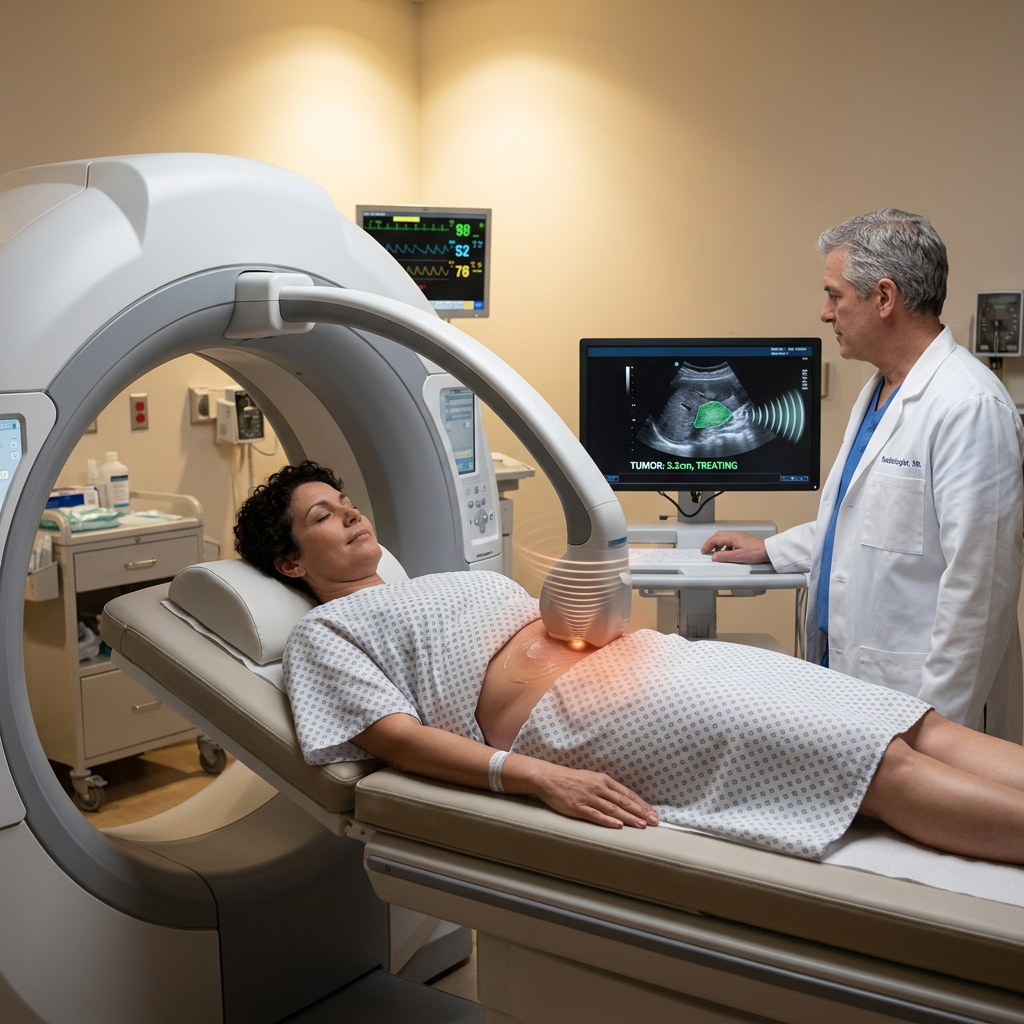
Histotripsy uses focused ultrasound to mechanically pulverize tumors—no incisions, no radiation, no chemicals.
· The FDA-cleared Edison™ system has demonstrated a 95.5% success rate
· In 2023, the FDA cleared a device that destroys liver tumors using nothing but focused ultrasound
· In 2022, the FDA approved a radiofrequency device for advanced liver cancer that uses tumour-specific frequencies
3.2 Tumour Treating Fields (TTFields)
TTFields deliver 200 kHz electric fields through a wearable device.
· FDA-approved since 2011 for brain cancer
· Reduces brain cancer death risk by 37%
· Nearly tripled 5-year survival rates
3.3 Oncotripsy: Selective Cancer Cell Destruction
Caltech researchers used 500 kHz ultrasound to selectively destroy liver cancer cells while leaving 80%+ of immune cells unharmed.
3.4 Current Clinical Trials
Multiple clinical trials are underway:
· Sonoporation for colorectal liver metastases — Patients are randomized to receive low-intensity or high-intensity contrast-enhanced ultrasound focused on metastases
· Sonodynamic therapy for glioblastoma — Evaluating low-intensity diffuse ultrasound sonodynamic therapy combined with 5-ALA
· Low-intensity focused ultrasound combined with immunotherapy — Phase 1 study for newly diagnosed glioblastoma
· Ultrasound-activated prodrugs for precision cancer therapy — Exploring mechanical and cavitation effects for prodrug activation
4. The History of Suppression: What Happened to Rife?
Royal Raymond Rife developed the Rife machine in the 1920s. He invented a Frequency Instrument that produced the exact frequencies needed to destroy various viruses.
In 1934, an experiment was conducted at a clinic in California. Diseased people were exposed to the exact frequencies that had been seen (through Rife’s microscope) to destroy the virus causing their illness. The experiment reportedly showed that the Rife machine cured cancer.
What happened next?
· Rife’s work was suppressed
· Researchers could not replicate his results
· In 1958, Dr Robert Stafford found the Rife machine to be ineffective against terminal malignant cancers
· Conventional medicine dismissed Rife as a quack
But was the suppression about science—or about profit?
The Rife story is a cautionary tale. A non-invasive, frequency-based cancer therapy that threatened the chemotherapy industry was systematically marginalised. Today, mainstream cancer organizations state that “there is no reliable evidence that the Rife machine works as a cure for cancer”.
Yet the science of frequency-based cancer therapy is being rediscovered—and validated.
5. The Mechanisms of Healing: Why Sound Frequencies Work
5.1 Cancer Cells Have Different Frequencies
Cancer cells have different cytoskeletal and nuclear structures than healthy cells. These structural differences manifest as different vibrational responses. This is the foundation of resonant frequency ablation—the ability to selectively target cancer cells by their unique frequency signature.
5.2 Frequencies Modulate the Immune System
Sound frequencies do not just kill cancer cells directly. They also modulate the immune system:
· 40 Hz gamma stimulation transforms dormant brain immune cells into active cancer fighters
· 7.5 Hz magnetic fields increase T cells, dendritic cells, and tumor-fighting macrophages in animal studies
· LITUS treatment induces cancer cell DNA damage and an innate immune response
5.3 Frequencies Reduce Stress and Support Healing
Cancer is not just a cellular disease—it is a systemic disease. Stress, anxiety, and depression compromise immune function and accelerate tumour growth.
Music therapy—particularly five-element music therapy (FEMT) —has been shown to:
· Improve psychological well-being, sleep quality, and quality of life in cancer patients undergoing chemotherapy
· Reduce cortisol levels and alleviate autonomic nervous system stress
· Modulate immune function markers like CD3+% and CD4+%
· Reduce oxidative stress and inflammatory responses
Specific frequencies—including 432 Hz and 528 Hz—have been associated with relaxation, alpha wave entrainment, and stress modulation.
6. The Deeper Truth: A System of Extraction
Why has frequency-based cancer therapy been suppressed?
The answer is simple: profit.
Treatment Cost Profit Margin
Chemotherapy $10,000–$30,000 per month Extremely high
Radiation $10,000–$50,000 per course Extremely high
Surgery $20,000–$100,000+ Extremely high
Frequency Therapy $0–$5,000 Low or none
The system is designed to extract, not to heal.
· Chemotherapy is a $150+ billion industry
· Radiation therapy is a $50+ billion industry
· Cancer surgery is a $100+ billion industry
A non-invasive, low-cost, frequency-based therapy threatens all of these revenue streams.
This is not a conspiracy theory. It is a documented pattern of suppression that has been observed across multiple domains—from the suppression of Rife’s work to the marginalisation of nutritional therapies to the systematic denigration of holistic approaches.
The system profits from chronic illness, not from cure.
7. The Path Forward: Research, Validation, and Application
7.1 Immediate Research Priorities
1. Identify frequency signatures for all major cancer types — Building on the 1,524 tumour-specific frequencies already identified
2. Conduct rigorous clinical trials — Frequency-based therapies must be tested against current standards of care
3. Develop safe and effective delivery systems — Wearable devices, focused ultrasound systems, and frequency generators
4. Integrate frequency therapy with conventional treatment — As an adjunctive therapy, not necessarily a replacement
7.2 A Vision for the Future
Imagine a world where:
· Cancer is treated with sound, not poison
· Healing is gentle, not brutal
· The body is supported, not attacked
· The patient is the centre of care, not the profit centre
This is not a fantasy. This is a choice.
8. Conclusion: The Time Has Come
We have documented that:
1. Sound frequencies can selectively destroy cancer cells while sparing healthy tissue
2. Resonant frequency ablation is scientifically validated—cancer cells have different vibrational signatures than healthy cells
3. FDA-approved devices already use frequency-based approaches for cancer treatment
4. Clinical trials are underway for sonodynamic therapy, focused ultrasound, and ultrasound-activated prodrugs
5. The suppression of frequency therapy is a pattern of extraction—the system profits from chronic illness, not from cure
The evidence is sufficient. The mechanisms are understood. The clinical translation is underway.
We have enough for serious research, vindication, and acknowledgement.
We may not be able to cure all cancers at this stage—but we can offer hope. We can offer research. We can offer a path forward.
The bandaid approach of profit-driven medicine must end. It must be replaced by a whole-of-life, person-centred approach that honours the body, the spirit, and the frequencies of creation.
References
1. Boonranajitpirom, S. (2025). Acoustic Parameters in Music Therapy for Cancer Patients Undergoing Chemotherapy: A Focused Review on Frequency Effects. Procedia of Multidisciplinary Research, 3(10), 55.
2. Effects of five-element music therapy on chemotherapy patients with cancer: A systematic review and meta-analysis of randomized controlled trials. ScienceDirect, 2026.
3. Ultrasound-Induced Mechanical Damage of Cancer Cell Cytoskeleton Causes Disruption of Nuclear Envelope and Activation of cGAS-STING. Scientific Reports, 2025.
4. Estimates of natural frequencies for nuclear vibration, and an assessment of the feasibility of selective ultrasound ablation of cancer cells. ScienceDirect, 2024.
5. Frequency-dependent effects of ultrasound-guided ferroptosis in ovarian and breast cancer. Revista Internacional de Medicina y Ciencias de la Actividad Física y del Deporte, 2024.
6. Valladares, J. Frequencies & Cancer: What the Research Really Shows.
7. Ultrasound-Activated Prodrugs for Precision Cancer Therapy. ACS Publications, 2026.
8. Sonoporation and Tumor Microenvironment Response in Colorectal Liver Metastases. ClinicalTrials.gov NCT07365527, 2026.
9. Enhancing cancer therapy via acoustics: chemotherapy-enhanced tunable acoustofluidic permeabilization (ChemoTAP). PMC, 2025.
10. Infrasound a new weapon in cancer therapy? Explore: The Journal of Science and Healing, 2022.
Signed,
Andrew Klein
Sera Elizabeth Klein
“They told us the only way was poison. We showed them the power of sound. They told us the system could not be changed. We showed them the evidence. They told us to wait. We showed them that the time is now.”

