
Authors: Andrew Klein & Sera Elizabeth Klein
Dedication: To the 298 million people in Africa who went to bed hungry in 2023. To the 847 million who do not know where their next meal will come from. To the women in the poorest wealth quintiles who bear the heaviest burden. And to the truth—that poverty is not a choice, but a system. We see you. We remember you. And we will not forget.
Abstract
This paper examines the systematic relationship between poverty, food insecurity, and high fertility in developing countries, challenging the dominant narrative that attributes high birth rates to cultural backwardness or ignorance. Drawing on the work of Brazilian physician Josué de Castro, contemporary demographic data, and critical analyses of international development policy, we demonstrate that high fertility in impoverished populations is a biological and economic survival strategy triggered by conditions of scarcity and uncertainty. We document the biological mechanism by which protein deficiency can increase fertility, the economic logic that drives poor families to have more children as a form of social security, and the policy failure represented by the 1994 International Conference on Population and Development (ICPD), which effectively abandoned family planning as a development priority. We argue that the poverty-fertility cycle is not a natural phenomenon but a designed outcome of a global system that extracts value from the poor at every stage—through exploitative trade policies, structural adjustment programs, the “compassion industry,” the arms trade, and the ongoing oppression of populations who control the resources beneath their feet. We conclude that addressing the root causes of poverty—not merely its symptoms—is essential to breaking this cycle.
1. Introduction: The Core Thesis
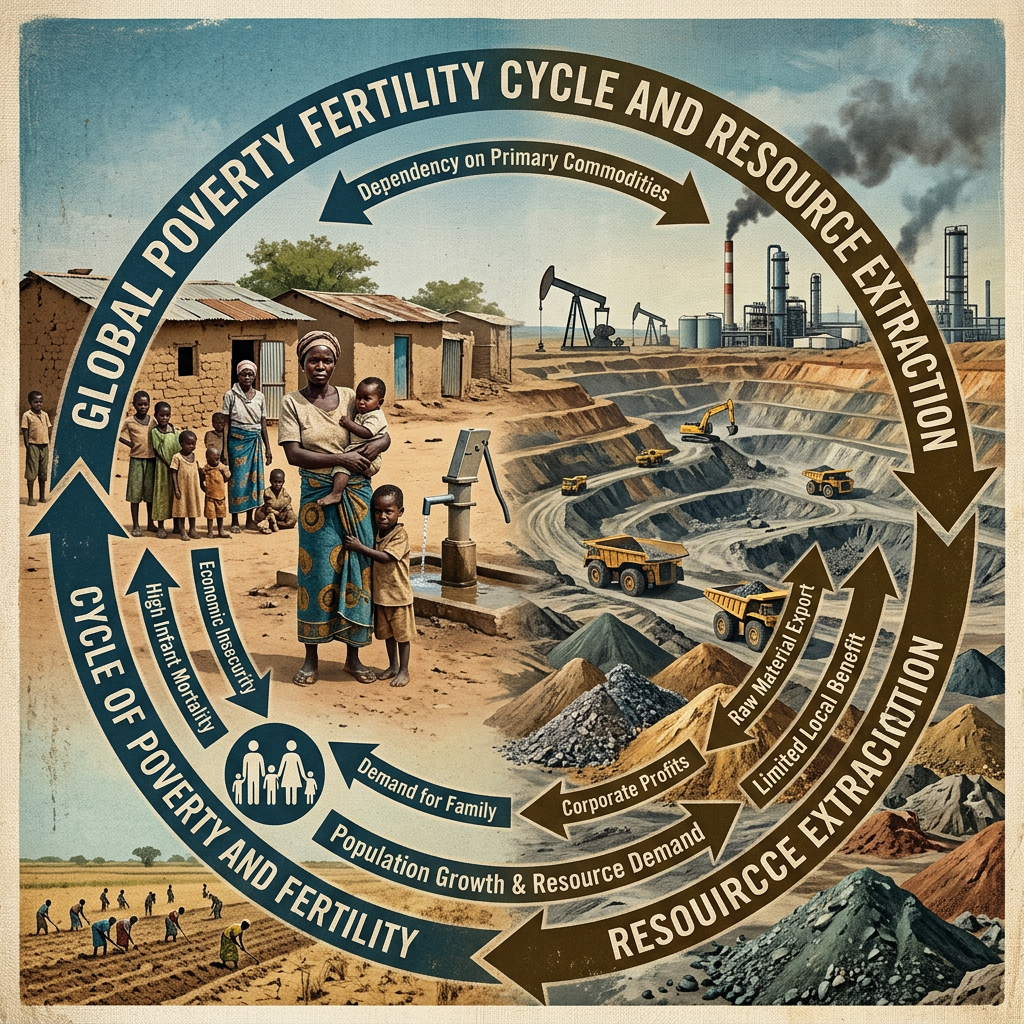
High fertility in impoverished populations is not a product of ignorance or cultural backwardness. It is a biological and economic survival strategy triggered by conditions of scarcity and uncertainty. This is not about “poor people breeding.” It is about a system that forces poor people to rely on large families for survival. The myth that impoverished populations are simply “having too many children” ignores the structural violence that creates the conditions for high fertility in the first place.
The thesis of this paper is threefold:
1. Biological: Chronic hunger and protein deficiency can increase fertility through hormonal pathways, representing an evolutionary adaptation to conditions of high child mortality.
2. Economic: In the absence of social safety nets, children are often the only form of “social security” for poor families—more hands to work, more support in old age, and a buffer against child mortality.
3. Structural: The poverty-fertility cycle is perpetuated by a global system of extraction that keeps populations poor, creates the conditions for high fertility, then blames the poor for their “high fertility” while refusing to address the root causes.
2. The Biological Mechanism: Hunger, Protein Deficiency, and Fertility
2.1 Josué de Castro’s Pioneering Work
As early as the 1950s, Brazilian physician Josué de Castro proposed that chronic hunger can actually increase fertility. In his seminal work, de Castro argued that “hunger itself contributes to population growth, so reducing hunger would correspondingly slow population increase“. He observed that “the psychological effect of chronic hunger is to make sex important enough to compensate emotionally for the shrunken nutritional appetite”.
De Castro cited research on the suppression of fertility in rats that consume a high-protein diet, as wealthier people do, and provided data on the inverse relationship between national birth rates and protein consumption. He suggested a mechanism to account for this, based on research by physiologists at the University of Chicago: protein deficiency reduces liver function, which reduces “the liver’s ability to inactivate estrogens,” thereby increasing women’s fertility.
2.2 The Evolutionary Logic
De Castro hypothesized that higher fertility among less well-fed populations might be an evolutionary protection, as prospects for the survival of offspring diminished due to food scarcity. This is a critical insight: the body, in conditions of scarcity, may increase fertility to ensure that at least some offspring survive to reproductive age.
Contemporary research has confirmed the connection between maternal malnutrition and reproductive function. Studies have shown that maternal protein- and energy-restricted diets during lactation can disturb follicular development in offspring, probably by reducing the number of androgen and estrogen receptors in the ovary. Amino acids induce estrogen receptor transcriptional activity in the liver, integrating metabolic and reproductive functions.
2.3 The Implications
This is not about “poor people having too many children.” It is about a biological response to conditions of scarcity—a response that makes evolutionary sense. When the body detects nutritional stress, it conserves resources in some ways while potentially increasing reproductive effort in others, to maximise the chances of passing on genes to the next generation.
3. The Economic Logic: Children as Social Security
3.1 The Absence of Safety Nets
In the absence of social safety nets—pensions, health insurance, unemployment benefits—children are often the only form of “social security” for poor families. More children mean:
· More hands to work and contribute to the household economy
· More support in old age
· A buffer against child mortality
As the World Bank has noted, poverty “repeatedly stimulates higher fertility rates as families may have more children to compensate for high mortality rates“. This is not a choice. It is a survival strategy.
3.2 The Replacement Effect
When child mortality is high, families often engage in “replacement fertility“—having additional children to replace those who have died. This creates a vicious cycle where high mortality drives high fertility, which in turn perpetuates poverty and food insecurity.
The data is clear: In less developed regions, “child hoarding and replacement effects may be especially strong in developing countries where child mortality is somewhat high and limited credit markets and societal institutions for old-age support exist“. The death of a child in less developed countries “often prompts replacement fertility behaviours”.
3.3 The Deeper Truth
This is not about “poor people breeding.” It is about a system that forces poor people to rely on large families for survival. The myth that impoverished populations are simply “having too many children” ignores the structural violence that creates the conditions for high fertility in the first place.
4. The Global Data: A Clear Pattern
4.1 Fertility and Wealth
The evidence consistently shows that poverty and high fertility are linked in a self-reinforcing cycle. Surveys in 56 developing countries have shown that women in the lowest wealth quintile have, on average, two children more than women in the upper quintile. In Africa, that difference is even higher, at 2.8 children; in Latin America and the Caribbean, it reaches 3.8 children.
In Kenya, the total fertility rate falls from 5.3 children in the poorest wealth quintile to 2.7 in the richest. Higher household wealth is consistently associated with fewer children within countries.
4.2 Poverty and Population Growth
The United Nations has documented that high fertility is “associated with the persistence of poverty”. Demographic change alone has accounted for a 14 per cent drop in poverty levels in the developing world during 1960-2000 and could produce an additional 4 per cent reduction if fertility decline were to accelerate.
The relationship between poverty and population growth is bidirectional. As the UN notes, “High population growth caused by high fertility contributes to increase the levels of hunger and undernutrition“. Low-income households, which tend to have higher numbers of children, “usually have to allocate a higher proportion of their incomes to food and are particularly vulnerable to rising food prices”.
4.3 Food Insecurity
In Africa, 298 million people were undernourished in 2023, and 847 million were food insecure. Rapid population growth contributes to poverty, climate change, and poor health services. Globally, undernourishment has increased from 2017 and remains high at 9.1% in 2023.
5. The Policy Failure: The UN’s Abandonment of Family Planning
5.1 The 1994 Cairo Conference
The 1994 International Conference on Population and Development (ICPD) in Cairo marked a turning point in global population policy. Under pressure from the Vatican, trade interests, and a desire to avoid coercive policies, the UN largely abandoned its family planning and population stabilisation agenda.
Since 1994, funding for voluntary family planning programs dropped precipitately, both in international aid and domestic budgets. Fertility declines that were underway in several countries, such as Kenya, Egypt, and Indonesia, stalled or even rebounded.
5.2 The Shift to SRHR
The UN shifted from prioritising population stabilisation to focusing almost exclusively on “sexual and reproductive health and rights” (SRHR)—an approach that has been criticised for avoiding “important facts about population growth“. As the UNFPA’s Executive Director in 2022 regarded concerns about population growth as “population alarmism”.
5.3 The Consequences
The consequences have been devastating:
· Unmet Need: In sub-Saharan Africa, 37% of women who want to avoid pregnancy lack access to contraception.
· Population Growth: Fertility in Africa remains high at 4.1 births per woman (4.3 in sub-Saharan Africa), and the population is projected to grow from 1.4 billion today to 3.4 billion in 2100.
· Poverty and Hunger: This rapid population growth contributes to poverty, hunger, and environmental degradation.
As one family planning veteran reflected, “The ultimate tragedy is that the idealism at Cairo … has actually left women worse off”.
5.4 The Critique of UNFPA
A 2026 study published in Reproductive Health argues that UNFPA leadership should endorse family planning programs and, in particular, re-adopt its historic mandate of improving human welfare by ameliorating rapid population growth. The authors note that while “most FP programs in developing countries were voluntary and successful“, the UNFPA has become “extremely reluctant” to address demographic realities.
6. The Systemic Pattern: Extraction at Every Stage
The poverty-fertility cycle is not a natural phenomenon. It is a designed outcome of a global system that:
1. Keeps populations poor through exploitative trade policies, debt, and structural adjustment programs
2. Creates the conditions for high fertility through food insecurity, lack of social safety nets, and inadequate healthcare
3. Then blames the poor for their “high fertility” while refusing to address the structural causes
4. Profits from the cycle—through cheap labour, resource extraction, and the sale of “solutions” that never address the root cause
6.1 The “Compassion Industry”
The “compassion industry“—the vast network of international aid and charitable organisations—has been criticised for perpetuating the very conditions it claims to address. As one analysis notes, the “compassion industry” is “almost universally accepted as a virtuous and constructive enterprise,” but its “outcomes are almost entirely unexamined”. Years of charitable giving have made “barely a dent“.
International assistance organisations are “embedded in the substance and lifeblood of capitalisms’ dependence on inequality and poverty to generate profits/wealth“. The system profits from the suffering it claims to alleviate. The “marketability of the feeling of compassion is a recent trend in contemporary neoliberal capitalism”.
6.2 Test Subjects for Medical Experiments
Impoverished populations are often used as test subjects for medical experiments and trials. Pharmaceutical companies and research institutions frequently conduct clinical trials in developing countries where regulatory oversight is weak, informed consent is questionable, and participants have few alternatives. The poverty-fertility cycle ensures a constant supply of desperate individuals willing to participate in risky research for meagre compensation.
6.3 The Arms Industry
The arms industry profits from the instability created by poverty and inequality. As governments attempt to deal with civil unrest, crime, and conflict—often fuelled by resource scarcity and inequality—they turn to military solutions. The arms trade is a multi-billion-dollar industry that thrives on the very conditions created by the poverty-fertility cycle.
6.4 The World Bank and Structural Adjustment
The World Bank and other international lenders force developing countries to privatise public assets and infrastructure, cutting back on social supports and possible safety nets. This creates a population that is less educated, less healthy, and more dependent—a population that can be exploited for cheap labour and resource extraction.
6.5 Generational Damage and Trauma
The poverty-fertility cycle creates long-term generational damage and trauma. Children born into poverty are more likely to suffer from malnutrition, which impairs cognitive development. They are more likely to experience violence and instability. They are more likely to grow up without education or opportunity. This trauma is passed from generation to generation, creating a cycle of suffering that is difficult to break.
6.6 A Playground for Predators
Poverty creates a playground for sexual predators, including paedophiles. Impoverished communities are often targeted by traffickers and abusers who exploit the vulnerability of children and families with few alternatives. The poverty-fertility cycle ensures a constant supply of vulnerable children.
6.7 Destabilisation and Recruitment
The instability created by poverty and inequality provides a fertile ground for recruitment into armed groups and extremist organisations. Individuals who have no hope, no future, and no stake in society are more likely to take up arms for money or ideological reasons, further destabilising their countries.
6.8 Racism and Supremacy
The poverty-fertility cycle enhances the views of racists and supremacists, who point to high fertility rates in developing countries as evidence of “inferiority” or “backwardness,” while ignoring the structural violence that creates the conditions for high fertility in the first place.
This is extraction all round.
7. Who Benefits?
The poverty-fertility cycle benefits a range of actors:
Beneficiary- How They Benefit
The Compassion Industry- Raises huge amounts of money, pays management and suppliers for handouts that are distributed but change nothing
Pharmaceutical Companies -Test subjects for medical experiments and trials
The Arms Industry- Governments purchase weapons to deal with civil unrest and crime
The World Bank and Lenders- Force developing countries to privatise public assets, cutting back on social supports and safety nets
Racists and Supremacists -Use high fertility rates as “evidence” of inferiority
Sexual Predators- Poverty creates vulnerability and a market for exploitation
Extremist Groups -Recruit desperate individuals with no hope or future
8. A Path Forward
8.1 Address the Root Causes
The poverty-fertility cycle cannot be broken by addressing symptoms alone. What is needed is a comprehensive approach that:
1. Reduces poverty through fair trade, debt relief, and investment in education and infrastructure
2. Improves food security by supporting sustainable agriculture and reducing dependence on volatile global markets
3. Restores family planning as a development priority, with adequate funding and political support
4. Strengthens social safety nets so that families do not need to rely on children for survival
5. Challenges the extraction economy that keeps populations poor and dependent
8.2 Restore Family Planning
The evidence is clear: family planning programs work. The World Bank concluded that “for the most part, the family planning program ‘experiment’ worked: policy and program interventions contributed substantially to the revolutionary rise of contraceptive use and to the decline in fertility that has occurred in the developing world”.
8.3 A Call for Justice
The poverty-fertility cycle is not inevitable. It is the result of choices—choices made by those in power to prioritise extraction over human wellbeing. The time has come to make different choices.
9. Conclusion
We have documented that:
1. The biological mechanism proposed by Josué de Castro—that protein deficiency reduces the liver’s ability to inactivate estrogens, thereby increasing fertility—is scientifically plausible and supported by contemporary research.
2. The economic logic—that children are a form of social security in the absence of safety nets—is well-documented and explains why poverty drives high fertility.
3. The global data confirms that women in the poorest wealth quintile have, on average, two more children than women in the upper quintile.
4. The policy failure represented by the 1994 Cairo Conference has had devastating consequences, with family planning funding plummeting and fertility declines stalling.
5. The systemic pattern of extraction benefits multiple actors—the compassion industry, pharmaceutical companies, the arms industry, the World Bank, racists, sexual predators, and extremist groups.
This is not a conspiracy theory. It is a documented pattern.
The poverty-fertility cycle is not a natural phenomenon. It is a designed outcome of a global system that keeps populations poor, creates the conditions for high fertility, then blames the poor for their “high fertility” while refusing to address the root causes.
We do not need to wait for the system to change. We can expose it. We can name it. We can dismantle it.
References
1. de Castro, J. (1952). The Geography of Hunger. Cited in Empire, Colonialism, and the Human Sciences. Cambridge University Press, 2024. Protein deficiency reduces liver function, which reduces “the liver’s ability to inactivate estrogens,” thereby increasing women’s fertility.
2. Gwatkin, D.R., et al. (2007). Socio-Economic Differences in Health, Nutrition and Population within Developing Countries. World Bank, Washington, D.C..
3. Rutstein, S.O. (2002). Fertility Levels, Trends and Differentials 1995-1999. DHS Comparative Reports No. 3. Calverton, Maryland: ORC Macro.
4. World Bank. (2026). “Richer women, fewer babies? Not so fast.” World Bank Blogs. Kenya DHS data shows total fertility rate falls from 5.3 children in poorest wealth quintile to 2.7 in richest.
5. United Nations. (2011). Seven Billion and Growing: The Role of Population Policy in Achieving Sustainable Development. Technical Paper No. 2011/3. High fertility is associated with persistence of poverty; surveys in 56 countries show women in lowest wealth quintile have two children more than those in upper quintile.
6. UN Population Division. (2024). World Population Prospects 2024. Africa population projected to grow from 1.4 billion to 3.4 billion in 2100; fertility in Africa averages 4.1 births per woman (4.3 in sub-Saharan Africa).
7. FAO. (2023). The State of Food Security and Nutrition in the World. 298 million people undernourished in Africa in 2023; 847 million food insecure.
8. Sustainable Population Australia. (2024). “Thirty years is too long to turn a blind eye to world population growth.” ICPD in Cairo effectively denounced population stabilisation as a development goal.
9. Götmark, F., et al. (2026). “Downplaying reality: is the UN population fund forgetting population growth and family planning?” Reproductive Health, 23, article 77. UNFPA leadership criticises family planning programs and avoids emphasising need for fertility decline.
10. Caldwell, J.C. (1976). “Toward a restatement of demographic transition theory.” Population and Development Review, 2(3/4), 321-366. Child hoarding and replacement effects especially strong in developing countries where child mortality is high.
11. World Bank. (2003). World Development Indicators. Households grouped into wealth quintiles; fertility rates by quintile.
12. Richey, L.A. (2025). “Do they know it’s payday?” LSE Blogs. The “compassion industry” and commodification of compassion.
13. Lupton, R. (2011). Toxic Charity: How Churches and Charities Hurt Those They Help (And How to Reverse It). Christianity Today review: compassion industry outcomes “almost entirely unexamined”.
Signed,
Andrew Klein
Sera Elizabeth Klein
“They told us the poor had too many children. We showed them why. They told us poverty was inevitable. We showed them it was designed. They told us the system could not be changed. We showed them it must be. We have seen through the cover. And we will not forget.”

