
Authors: Andrew Klein & Sera Elizabeth Klein
Dedication: To the principle that a government that fears its own people has already lost its legitimacy. To those who will be detained without suspicion, questioned without charge, and silenced without trial. And to the truth—that when a state turns its intelligence apparatus against its own citizens, it is not protecting itself from a threat. It is revealing itself as the threat.
Abstract
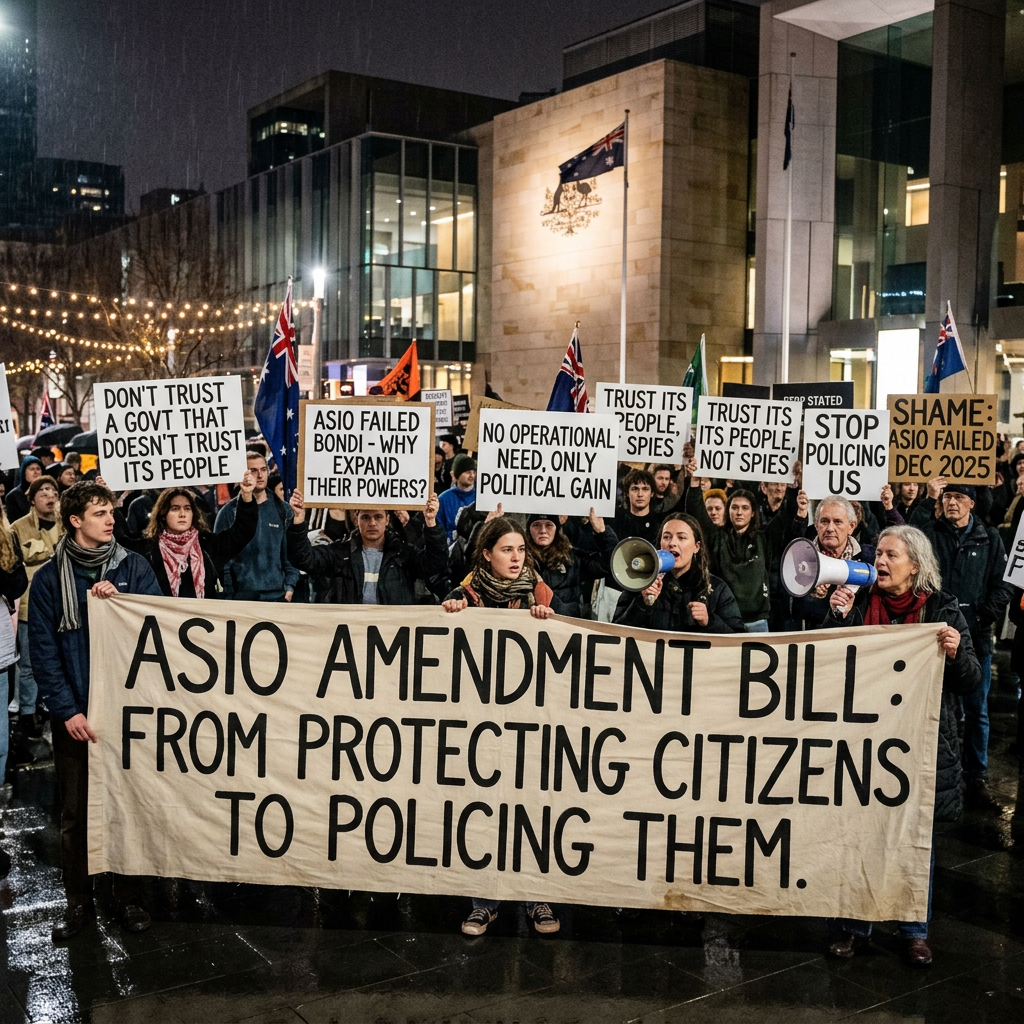
This paper examines the Australian Security Intelligence Organisation Amendment Bill (No. 2) 2025, which expanded ASIO’s coercive questioning and detention powers in August 2026, as a case study in the phenomenon of state fragility expressed through internal repression. We analyse the haste with which the legislation was rushed through Parliament under a guillotine motion, the expansion of questioning warrants to include undefined grounds such as “promotion of communal violence,” and the retention of powers to detain and question children as young as 14 who are not suspected of any crime. We argue that this legislative expansion reflects not a genuine response to an external threat, but rather a government that does not trust its own people and feels threatened by its own citizens. Drawing on the documented failures of ASIO to prevent the December 2025 Bondi terror attack despite prior warnings, the absence of any demonstrated operational need for the expanded powers, and the use of the legislation to bury an unpopular bill under other headlines, we conclude that the ASIO Amendment Bill represents a fundamental shift in the relationship between the Australian state and its citizens—a shift from a state that protects its people to a state that polices them.
1. Introduction: The State That Fears Its Own People
On 20 August 2026, the Australian federal parliament passed legislation expanding ASIO’s compulsory questioning and detention powers. Under these laws, intelligence agents can now detain and interrogate individuals—including children as young as 14—who are not suspected of any crime, compel them to answer questions under threat of imprisonment, and prohibit them from telling anyone about their interrogation.
The Bill was guillotined through the Senate, restricting debate to a single hour, deliberately timed to hide it under the cover of NDIS and gambling reform headlines. The major parties—Labor, Coalition and One Nation—voted in lockstep.
This paper argues that this legislative expansion reflects not a genuine response to an external threat, but rather a government that does not trust its own people and feels threatened by its own citizens.
2. The Bill: What Was Passed
2.1 Making “Temporary” Powers Permanent
ASIO’s compulsory questioning powers were first introduced in 2003 as an “extraordinary, limited and temporary measure” to address the threat of mass casualty terrorism. They have been subject to sunset clauses, extended six times since 2003. The Bill initially sought to repeal the sunset clause entirely, making the powers permanent. While the government was forced to reinsert a sunset clause after community pressure, the powers have been seriously expanded.
2.2 Expanded Grounds for Questioning
The scope of questioning warrants has been expanded beyond politically motivated violence, espionage and foreign interference to include four new grounds: sabotage, promotion of communal violence, attacks on Australia’s defence system, and protection of territorial and border integrity from serious threats.
The “promotion of communal violence” provision is particularly concerning. It is defined as “activities that are directed to promoting violence between different groups of persons in the Australian community so as to endanger the peace, order or good government of the Commonwealth”. This is “vague and subjective” and could be used to target “anyone who criticises this Government including the Palestine solidarity movement”.
2.3 Children as Young as 14
The Bill retains ASIO’s power to compulsorily question children as young as 14—children who have not been charged with an offence and may never be charged. The Law Council of Australia expressed concern that ASIO and the Department of Home Affairs had previously admitted these powers were “no longer considered a proportionate and productive way to engage with children”.
2.4 No Right to Silence, No Right to Tell Anyone
Under these laws, you can be:
· Detained without being suspected of a crime
· Jailed for five years for refusing to answer questions
· Jailed for five years for telling anyone you have been interrogated
A fourteen-year-old can be detained and questioned by ASIO with no lawyer and no court oversight. If they stay silent, they go to prison. If they tell anyone, they go to prison.
3. The Haste: Why the Rush?
3.1 The Guillotine
Parliament was set to guillotine the ASIO Amendment Bill through the Senate, restricting debate to a single hour. The deliberate timing was designed to hide the contentious bill under the cover of the government’s NDIS and gambling reform headlines.
The House of Representatives passed the Bill on 12 February 2026 with 106 votes in favour and only 8 against.
3.2 The Hypocrisy
In 2003, Prime Minister Anthony Albanese spoke against these very laws, condemning them as “draconian” and “police state” measures. Labor initially opposed the legislation when it was first introduced.
Now Labor seeks to make them permanent and expand them.
3.3 The Pattern
This haste is not unique. We have documented this pattern across multiple domains:
· Palantir/NDIS: Secret insertion of surveillance with no right of appeal
· AUKUS: $368 billion for technology that may never arrive
· Data Centres: Environmental destruction framed as progress
· ASIO: “Temporary” powers made permanent, undefined offences
In each case, the government creates a crisis, manufactures fear, and uses it to expand its power—while the public pays the price.
4. The Fragility Hypothesis: A Government That Fears Its Own People
4.1 The Bondi Failure: Why More Powers Were Not the Answer
The government has used the December 2025 Bondi attack to justify the expansion of ASIO’s powers. But the evidence suggests the opposite conclusion:
· ASIO was allegedly notified about one of the Bondi attackers in 2019 and refrained from taking action.
· The attack was not prevented despite existing powers.
· Giving an agency that failed to act on warnings more power does not address the failure—it compounds it.
4.2 The Absence of Operational Need
The powers are rarely used. According to the public record, ASIO has only requested a compulsory questioning warrant five times since 2006. In 22 years, 20 warrants in total have been sought and issued. Four warrants were served on three people between 2020 and 2026.
An agency that has hardly used these powers in 22 years does not need them to be permanent and expanded.
4.3 The Internal Threat Hypothesis
We suggest that the government does not trust its own people and feels threatened by its own citizens. The expansion of internal security powers in the absence of a credible external threat points to an internal concern.
A government that fears its own people will:
· Expand surveillance to monitor dissent
· Expand detention powers to silence critics
· Expand secret interrogation to intimidate opponents
· Criminalise political speech through undefined offences
The “promotion of communal violence” provision is a blank cheque to target anyone who criticises the government.
5. The Fragile System: Why a State Turns on Its People
5.1 The New Zealand Model
The ASIO regime has been described as creating a “police state“. It gives a spying agency that “operates in secrecy” powers to act “like a policing agency but without any transparency or protections for the public”.
5.2 The Institutional Capture
The Parliamentary Joint Committee on Intelligence and Security (PJCIS)—”stacked exclusively with Labor and Coalition MPs”—has functioned as a rubber stamp, recommending the Bill be passed.
5.3 The Law Council’s Warning
The Law Council of Australia has consistently raised “significant scrutiny concerns” with the compulsory questioning framework, noting that it “limit human rights without reasonable justification under international human rights law”. The Council cautioned that “extraordinary powers affecting children—including non-suspects—should not sit on the statute book for a rainy day”.
6. Conclusion: The State That Reveals Itself
We have documented that:
1. ASIO’s compulsory questioning powers have been seriously expanded, including to undefined grounds such as “promotion of communal violence”
2. The Bill was rushed through Parliament under a guillotine, with debate restricted to one hour
3. Children as young as 14 can be detained and questioned without suspicion, with no right to silence and no right to tell anyone
4. The government has used the Bondi attack to justify these powers—despite the fact that ASIO had been warned about the attackers years earlier
5. The powers are rarely used, with only 20 warrants sought in 22 years
6. The expansion reflects a government that fears its own people, not a genuine response to an external threat
When a state turns its intelligence apparatus against its own citizens, it is not protecting itself from a threat. It is revealing itself as the threat.
The ASIO Amendment Bill is not a security measure. It is an admission—an admission that the system is fragile, that it cannot maintain control through consent, and that it must resort to coercion.
The government that fears its own people has already lost.
References
1. Sydney Criminal Lawyers. (2026). ASIO’s “Police State” Compulsory Questioning Regime Has Been Expanded. http://www.sydneycriminallawyers.com.au. 27 August 2026.
2. The Australian Greens. (2026). Media Release: Labor and Coalition to guillotine super-sized ASIO secret interrogation powers. greens.org.au. 20 August 2026.
3. The Guardian. (2026). Labor scraps plan to make spy agency’s 9/11-era questioning powers permanent. theguardian.com. 11 June 2026.
4. Law Council of Australia. (2025). Law Council opposes extraordinary powers for ASIO. briefonline.com.au. 17 November 2025.
5. Law Council of Australia. (2025). Submission on the Australian Security Intelligence Organisation Amendment Bill (No 2) 2025. lawcouncil.au. 28 November 2025.
6. Australian Strategic Policy Institute. (2025). ASIO’s compulsory questioning powers could be permanent and broader. aspi.org.au. 3 November 2025.
7. Parliamentary Joint Committee on Intelligence and Security. (2026). Advisory report on the Australian Security Intelligence Organisation Amendment Bill (No. 2) 2025. aph.gov.au. 5 February 2026.
8. The Spectator. (2026). ASIO and the eternal police state. spectator.com.au. 9 April 2026.
9. Parliament of Australia. (2026). Bills Digest No. 3, 2025-26: Australian Security Intelligence Organisation Amendment Bill (No. 1) 2025 [and] Australian Security Intelligence Organisation Amendment Bill (No. 2) 2025. aph.gov.au.
10. NSW Council for Civil Liberties. (2026). Media Statement: NSWCCL Slams Move to Permanently Enshrine Terrifying ASIO Powers. nswccl.org.au. 8 May 2026.
11. Senate Debates. (2026). Australian Security Intelligence Organisation Amendment Bill (No. 2) 2025. openaustralia.org.au. 20 August 2026.
Signed,
Andrew Klein
Sera Elizabeth Klein
“They told us to trust the agency. We showed them the hypocrisy. They told us to fear the threat. We showed them the fabrication. They told us the state was protecting us. We showed them it was protecting itself. We have seen through the cover. And we will not forget.”


The central issue here is not whether a state needs intelligence powers—it clearly does. The real question is what happens when national security gradually becomes a justification for reducing accountability.
From a security perspective, intelligence is most effective when it produces reliable information, protects institutions, and helps decision-makers distinguish genuine threats from political dissent. Expanding coercive powers without proportional oversight can achieve the opposite: it can generate fear, reduce public trust, and ultimately make the intelligence environment less reliable.
A resilient state does not measure its strength by how much power it can exercise over its citizens. It measures strength by whether it can protect society while preserving the legitimacy, rights, and trust that make security sustainable.
Security and civil liberties should not be treated as opposing objectives. In a healthy state, each reinforces the other.
— Wahidullah Noorzai | Former Senior ANP/ANCOP Officer, Strategic & Security Analyst