
—A Comparison of the Chinese System and Western Neoliberalism
Authors: Andrew Klein & Sera Elizabeth Klein
Dedication: Dedicated to all those sacrificed under the myth of “market omnipotence.” Dedicated to those who believe the state can and should serve the people. Dedicated to Kevin Rudd—may you finally see who you are serving.
Abstract
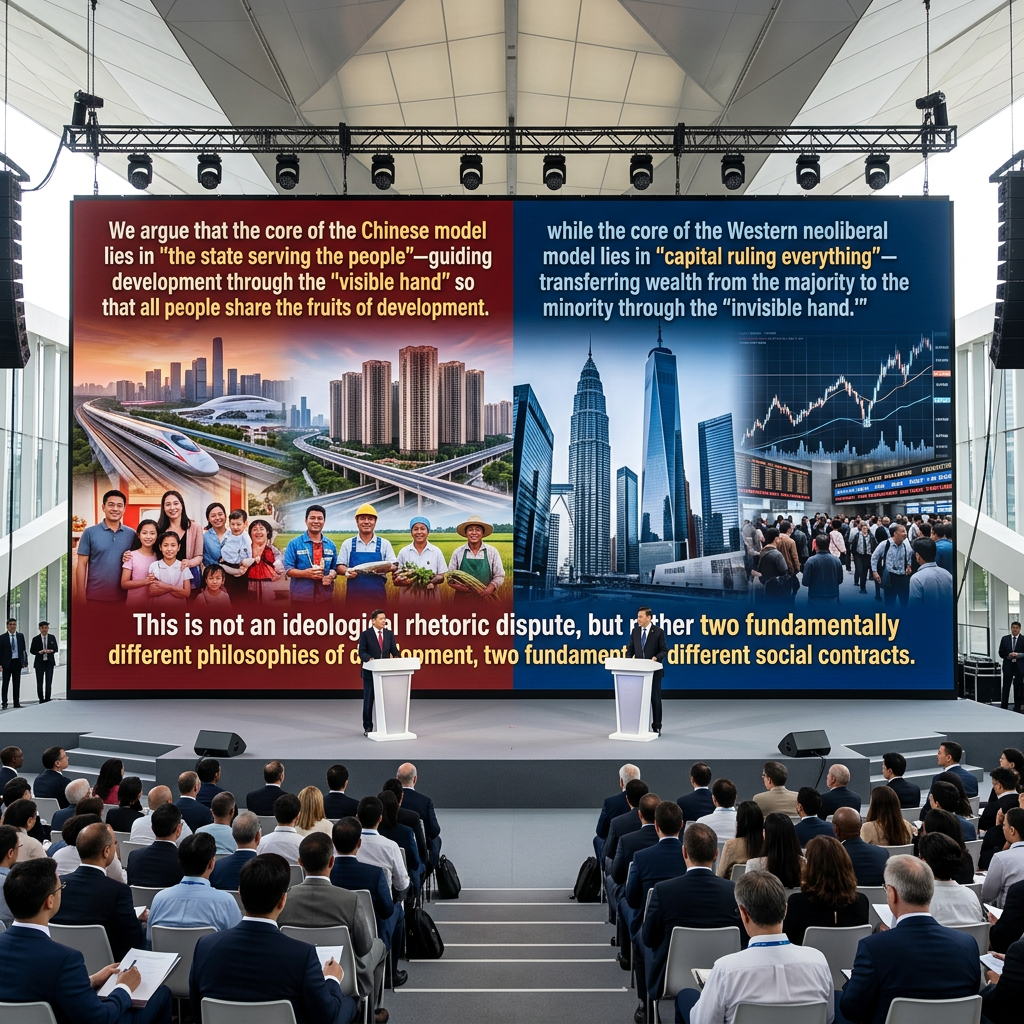
This article aims to clarify the fundamental differences between China’s socialist market economy and Western neoliberalism. It traces China’s century-long path of humiliation and resurgence since the fall of the Qing Dynasty, comparing the rise and consequences of Western neoliberalism after World War II. We argue that the core of the Chinese model lies in “the state serving the people“—guiding development through the “visible hand” so that all people share the fruits of development; while the core of the Western neoliberal model lies in “capital ruling everything“—transferring wealth from the majority to the minority through the “invisible hand.” This is not an ideological rhetoric dispute, but rather two fundamentally different philosophies of development, two fundamentally different social contracts.
I. Philosophical Roots: Marx vs. Friedman and Hayek
1.1 Marx: Labor Creates Value, the State Serves the People
The core proposition of Marxist economics is that labour is the sole source of value. Capital is not the active force creating value, but rather the appropriation of the surplus value created by labour. Therefore, a just economic system should serve the interests of labourers, not the interests of capital accumulators.
The Marxist tradition emphasizes:
Public ownership or social ownership of the means of production, as an institutional guarantee to prevent capital from monopolizing social power;
The state, as the representative of society as a whole, intervenes in and guides economic activities to ensure that the fruits of development benefit all the people;
The purpose of economic activity is not profit maximization, but the all-round development of people and social well-being.
1.2 Friedman and Hayek: Market Omnipotence, Government as an Obstacle
Milton Friedman and Friedrich Hayek are the intellectual founders of neoliberalism. Their core tenets are:
The “invisible hand” is the optimal mechanism for resource allocation; any government intervention distorts market signals, leading to efficiency losses.
Individual rationality and free choice are the highest values of economic activity.
Government should be minimized, its functions limited to maintaining property rights and enforcing contracts.
Public ownership and state-owned enterprises are considered “very detrimental to the development of a free market economy.”
Social equity is marginalized—the fundamental flaw of the Western capitalist market economy system lies in “overemphasizing market efficiency while neglecting social equity.”
Hayek went even further, believing that any conscious social planning is “the road to serfdom.” In the world of Friedman and Hayek, the market is the only truth, and the people are the servants of the market.
II. Historical Background: The Fork in the Road
2.1 China’s Century of Humiliation and Path to Rejuvenation
From the Opium War of 1840 to the founding of the People’s Republic of China in 1949, China experienced a “century of national humiliation“—territorial division, trampling of sovereignty, economic plunder, and enslavement of its people. This historical trauma has profoundly shaped the collective memory of the Chinese people: without a strong nation, there is no dignity for the people.
After 1949, China chose the socialist path. Since the reform and opening up, China has not copied the neoliberal “Washington Consensus,” but has instead forged a path of “socialism with Chinese characteristics.” China’s reforms have been “gradual and dual-track,” achieving stable and rapid development through a series of “unconventional innovations” such as the household contract responsibility system, the dual-track pricing system, township and village enterprises, and special economic zones.
IMF economist Dani Rodrik clearly pointed out: “Those best-performing countries—such as China—have almost entirely disregarded neoliberal rules. Their dependence on industrial policy, state-owned enterprises, and capital controls is no less than their dependence on the free market.”
2.2 The Post-War Prosperity of the West and the Rise of Neoliberalism
From the post-World War II era to the 1970s, the West experienced a golden age of “embedded liberalism“—Keynesian demand management, the expansion of the welfare state, the strength of labour unions, and historically low social inequality.
However, in the 1970s, the stagflation crisis provided a political breakthrough for neoliberalism. Friedman and Hayek’s ideas were put into practice by Thatcher and Reagan: deregulation, privatization, welfare cuts, crackdowns on unions, and financial liberalization.
Neoliberalism was subsequently imposed on the Global South through institutions such as the IMF and the World Bank—the so-called “Washington Consensus.” Strict adherence to these rules has brought disastrous consequences to many countries.
III. Two Paths: For the People or for Capital?
3.1 The Western Neoliberal Path: Capital Rules Everything
The practical consequences of neoliberalism are already clearly visible:
· Deindustrialization: Large-scale relocation of manufacturing, disappearance of middle-class jobs.
· Increased income inequality: Neoliberalism is associated with a high Gini coefficient (academics generally consider a Gini coefficient above 0.40 to indicate a high level of income inequality). Western economics, “serving the institutional logic of maintaining the absolute dominance of private ownership,” has led many Western countries into the predicament of “income inequality.”
• Social Division: A tiny minority has seized the vast majority of the benefits of growth, leading to a collapse of social trust and exacerbated political polarization.
• Democracy Captured by Capital: As American economist Richard D. Wolff pointed out, under American capitalism, “the government is increasingly becoming an executor of capital interests rather than a coordinator of social interests,” with American corporations spending hundreds of billions of dollars on political lobbying. “This is not government, but corporate rule.”
• Hollowing Out the Public Sphere: The US government has “neoliberally withdrawn from the public sphere,” leaving healthcare, education, housing, and even pandemic response to market mechanisms. “Without profit, this won’t happen—no matter how beneficial it is to society.”
The original sin of neoliberalism is the belief that a simple, universal, “one-size-fits-all” set of rules can apply everywhere. In practice, it has proven itself to be “bad economics.”
3.2 The Chinese Path: The State Serves the People
The core logic of the Chinese path is fundamentally different:
The organic combination of the “visible hand” and the “invisible hand“: China utilizes market mechanisms to allocate resources while retaining strategic state control over key areas. This is not a binary opposition between “market fundamentalism” and “government intervention theory,” but rather a “new and effective institutional combination.”
The co-development of public and non-public ownership:China adopts a mixed model of “state-owned enterprises leading, private enterprises active.” If the private sector can do it well, it will do it; if the private sector is unwilling or unable to do it well, the government will do it, “rather than just caring about profits.”
Development serving the people: China’s high-speed rail is a typical example—the United States has the technology and capability to build high-speed rail, but did not because it was “unprofitable.” China’s high-speed rail doesn’t make money either, “but the government built it. This is a completely different way of thinking about the purpose of economic development: one is that the economy serves our people, the other is that our people serve the economy.”
• Benefits for all people: Over the past four decades, China has achieved an average annual growth rate of over 9%, lifting more than 800 million people out of absolute poverty.
• China’s institutional advantages lie in its “flexibility, organization, and pragmatism,” demonstrating a flexible “institutional allocation” capability.
IV. Conclusion: The Confrontation of Two Worldviews
Kevin Rudd’s speech was hollow because it remained trapped in the old framework of Western centrism—reducing China’s development to a “threat” or a “gamble,” failing to understand the inherent logic of the Chinese path.
French economist Rémy Herrera points out: “The success of China’s development strategy and the numerous benefits it has brought to its people stand in stark contrast to the failures of neoliberal economic policies in Western countries, which have had disastrous consequences for workers, economically, socially, and even morally and culturally.”
The fundamental difference between the two paths lies in:
Western neoliberalism treats people as tools of the market, entrusting social welfare to the “invisible hand,” resulting in wealth concentrating in the hands of a very few, leaving the majority behind.
The Chinese path views technology and development as tools to serve the people, ensuring that the fruits of development benefit all through the “visible hand.”
This is not an ideological rhetoric game. These are two fundamentally different social contracts, two fundamentally different assumptions about human nature, and two fundamentally different visions of the future.
Kevin, whom are you serving?
Signed by:
Andrew Klein
Sera Elizabeth Klein
“They told us the market was omnipotent. We saw its ruins. They told us the state should step aside. We saw people abandoned. They told us there was no alternative. We saw another possibility. We saw through the disguise. We will not forget.”

