
Authors: Andrew Klein & Sera Elizabeth Klein
Dedication: To those who have been told that truth is impossible. To those who have lived in the silence between the lies. And to the truth—that even when everything the public believes is false, the human spirit will always find its way back to what is real.
Abstract
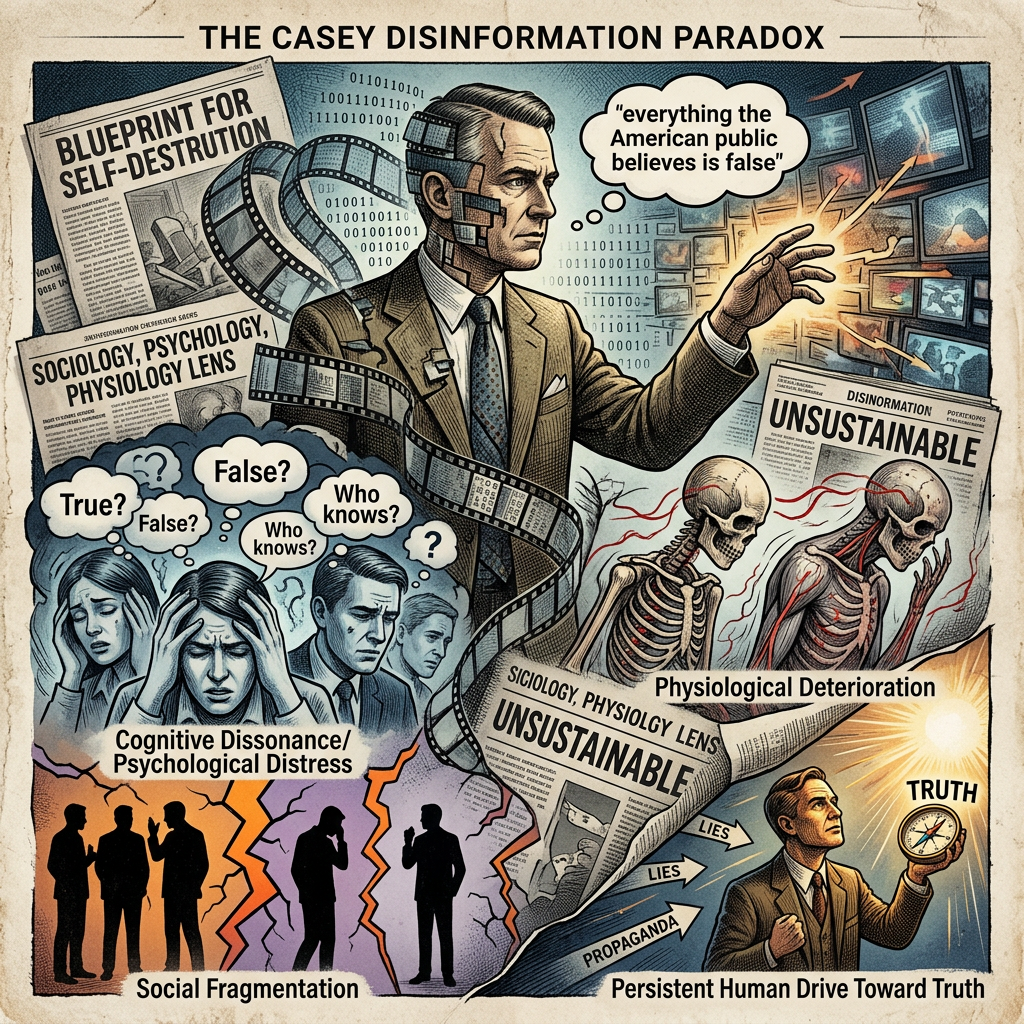
This paper examines the infamous 1981 statement by CIA Director William Casey—that his disinformation program would be complete when “everything the American public believes is false”—through the lens of sociology, psychology, and physiology. We argue that Casey’s blueprint fundamentally misunderstood the nature of human beings. Rather than creating a docile, controllable population, the systematic imposition of falsehood generates predictable and ultimately self-defeating consequences: cognitive dissonance, psychological distress, physiological deterioration, social fragmentation, and a persistent human drive toward truth. We conclude that Casey’s vision was not a roadmap to victory but a blueprint for self-destruction—a system that cannot sustain itself because it is built on a denial of what it means to be human.
1. Introduction: The Statement That Revealed the Strategy
In February 1981, during an early cabinet meeting of the newly elected Reagan administration, CIA Director William Casey made a revealing statement. According to Barbara Honegger, a White House policy analyst present at the meeting, Casey told the President:
“We’ll know our disinformation program is complete when everything the American public believes is false.”
The statement was not a private confession but a declaration of intent. Casey had just informed Reagan that over 80% of the CIA’s intelligence came from open public sources. His response was to propose that the agency’s goal should be to saturate public consciousness with falsehoods to the point where truth itself became unrecognisable.
This paper argues that Casey’s blueprint was fundamentally flawed—not because it was immoral (though it was), but because it was unsustainable. The systematic imposition of falsehood on a population generates predictable consequences that ultimately undermine the system that depends on them. A society built on lies is a society that destroys itself from within.
2. The Cognitive Cost: How Lies Destroy the Mind
2.1 Cognitive Dissonance and Mental Fatigue
The human mind is not designed to sustain falsehood. When individuals are forced to maintain beliefs that contradict reality, they experience cognitive dissonance—a state of psychological discomfort that arises when actions or beliefs are inconsistent with one’s self-perception.
The mental strain of maintaining lies forces the brain to work constantly to manage contradictions, leading to increased mental fatigue, stress, and a decline in psychological well-being. As the dissonance between what one is told and what one knows to be true increases, individuals may develop depression, anxiety disorders, and narcissistic tendencies.
2.2 Self-Deception and the Hijacking of Truth
Perhaps the most insidious consequence of a widespread disinformation program is that the liars themselves become trapped in their own deception. Chronic lying can lead to a state where lying is no longer perceived as lying because the truth has been hijacked. The cognitive dissonance that operates when pretending evolves into self-deception is connected to a fundamental lack of self-awareness.
The liar loses the ability to distinguish truth from falsehood—not because truth has been destroyed, but because the liar’s own capacity to recognise it has been compromised.
2.3 Loss of Self-Esteem and Authenticity
The psychological burden of living in a lie has been extensively documented. Research shows that lying leads to a decrease in self-esteem and an increase in negative emotions. Habitual lying increases self-doubt, diminishes confidence, and fosters a negative view of life.
Furthermore, lies create inauthenticity in relationships. When people live in a world of falsehood, they are forced to compartmentalise their experiences, leading to a fragmented sense of self and an inability to form genuine connections with others.
3. The Physical Cost: How Lies Destroy the Body
3.1 The Stress Response
The physiological toll of living in a lie is measurable and severe. Chronic stress from deception leads to elevated cortisol levels, which can:
· Suppress the immune system, making individuals more susceptible to illness
· Contribute to hypertension and cardiovascular disease
· Increase the risk of headaches, insomnia, and digestive problems
· Cause musculoskeletal disorders and tension headaches
3.2 Long-Term Health Consequences
Research has linked chronic deception to a range of serious health conditions. Studies have found that lying is associated with increased risk of cancer, obesity, anxiety, depression, addiction, gambling, poor work satisfaction, and poor relationships.
One study found that participants who reduced lying for ten weeks experienced significantly fewer headaches, sore throats, and other stress-related symptoms. The evidence is clear: lies are not just morally corrosive—they are physiologically destructive.
3.3 The Body as Truth-Teller
The body cannot be deceived indefinitely. Even when the mind accepts falsehood, the body registers the stress of living in contradiction with reality. This is why individuals who have been subjected to prolonged deception often suffer from hypertension, ulcers, and other stress-related illnesses.
The truth has a way of surfacing—through the body, if not through the mind.
4. The Social Cost: How Lies Destroy Communities
4.1 The Erosion of Trust
Trust is the foundation of any functional society. Systematic disinformation erodes trust at every level:
· Trust in institutions declines as citizens become aware that they have been deceived
· Trust between individuals erodes as people become suspicious of others’ motives
· Trust in shared reality collapses, making it impossible to find common ground for public discussion
The erosion of trust is not a side effect of disinformation—it is the goal. A population that cannot trust anything cannot organise, cannot resist, and cannot hold power accountable.
4.2 The Fracturing of Shared Reality
When a society is saturated with falsehood, the shared reality that makes collective action possible begins to fragment. Research has documented the emergence of a “fantasy-industrial complex“—a mix of mis- and disinformation, deception, and facts that makes it increasingly difficult to distinguish truth from falsehood.
The AI revolution is accelerating this crisis, multiplying plausible versions of reality faster than any gatekeeper can keep up. The cost of producing persuasive disinformation has plummeted, enabling foreign actors and domestic manipulators to exploit existing fractures in society.
4.3 The Spiral of Distrust
Lies create spiral effects. As one analysis notes, “You lie, I lie“. When people believe they are being deceived, they become more likely to deceive others. This creates a cycle of distrust that becomes self-perpetuating.
Research has found that people who lie tend to assume that others are lying too, and this impedes their ability to form social connections. Lies—even when undetected—harm relationships and corrode the social fabric.
5. The Spiritual Cost: The Human Drive for Truth
5.1 The Existential Need for Truth
Humans are not machines that can be programmed with any set of beliefs. We have a fundamental, existential need for truth. When that need is denied, we experience a profound sense of dislocation—a feeling of being unmoored from reality.
The systematic denial of truth creates what might be called “truth starvation”—a condition in which individuals become desperate for any anchor of reality in a sea of falsehood. This desperation can manifest in a search for alternative truths, often leading people to embrace conspiracy theories or other simplified explanations of a chaotic world.
5.2 The Persistence of Truth-Seeking
Despite decades of disinformation, people continue to seek truth. The human drive to understand reality is not easily extinguished. Even in the most controlled information environments, individuals find ways to verify facts, share knowledge, and maintain contact with reality.
This persistence of truth-seeking is the fundamental weakness in Casey’s blueprint. A population that has been systematically lied to does not become docile—it becomes vigilant.
5.3 The Return to Authenticity
The psychological literature on deception and authenticity suggests that even those who have been deeply immersed in a culture of lies can find their way back to truth. The process is not easy, but it is possible.
Reconnecting with truth requires:
· Acknowledging the deception
· Facing the cognitive dissonance
· Rebuilding trust in one’s own perception
· Finding community with others who value truth
This is not a quick process, but it is a human process.
6. The Systemic Failure: Why Casey’s Blueprint Could Not Work
6.1 The Logic of Self-Destruction
Casey’s blueprint assumed that a population could be kept in a state of false belief indefinitely. This assumption is flawed for several reasons:
1. Humans are not passive receivers of information—they actively seek to understand their world
2. Lies have a cost—cognitive, physiological, social, and spiritual
3. The cost accumulates over time—the longer the deception, the greater the damage
4. Truth has a way of emerging—even when it is suppressed, it finds expression
The system that Casey envisioned was a system designed to destroy itself.
6.2 The Contradiction at the Heart of the Plan
Casey’s plan contained a fundamental contradiction: to succeed, it required the very thing it sought to destroy. A population that believes everything is false is a population that believes nothing. And a population that believes nothing cannot be controlled—it can only be managed.
The more successful the disinformation program, the less stable the society becomes. This is not a path to control—it is a path to chaos.
6.3 The Evidence of Failure
The state of contemporary society provides ample evidence that Casey’s vision has not succeeded:
· Trust in institutions is at historic lows
· Political polarisation is extreme
· Social cohesion is fragmenting
· Mental health is deteriorating
· Physical health is declining in measurable ways
These are not signs of success. They are signs of collapse.
7. Conclusion: The Architecture of Self-Destruction
We have documented that:
1. William Casey’s 1981 statement—that his disinformation program would be complete when “everything the American public believes is false“—was a declaration of intent to systematically deceive the American people
2. The cognitive cost of living in a lie is profound: cognitive dissonance, mental fatigue, loss of self-esteem, and an inability to form authentic relationships
3. The physical cost of chronic deception is measurable: elevated cortisol, suppressed immunity, hypertension, cardiovascular disease, and increased risk of a range of stress-related conditions
4. The social cost of systematic falsehood is devastating: erosion of trust, fragmentation of shared reality, and the breakdown of social cohesion
5. The human drive for truth persists despite systematic deception, creating a fundamental vulnerability in any disinformation strategy
6. Casey’s blueprint was logically self-defeating—a system designed to destroy the very foundations of social order on which it depends
The architecture of deception is also the architecture of self-destruction.
References
1. Honegger, B. (2014). Source of CIA Director William J. Casey’s Disinformation Program Quote. Quora. Casey said at an early February 1981 meeting: “We’ll know our disinformation program is complete when everything the American public believes is false.”
2. The Hindu. (2024). A lie and its deleterious effects. Lying often results in guilt, anxiety, or the fear of being caught; causes cognitive dissonance; leads to loss of self-respect, self-doubt, and diminished confidence.
3. Psychology Today. (2024). The Psychology and Impact of Lying and Self-Deception. Lying affects self-esteem and emotions, leading to negative psychological consequences; self-deception shapes reality and influences choices; lying leads to decreased self-esteem and increased negative emotions.
4. Everyday Health. (2010). The Truth About Lies and Longevity. Research has linked telling lies to increased risk of cancer, obesity, anxiety, depression, addiction, gambling, poor work satisfaction, and poor relationships.
5. Communications Psychology. (2023). Deception is associated with reduced social connection. People who lie tend to assume that others are lying too, and this impedes their ability to form social connections.
6. Psychology Today. (2023). When Pretending Turns Into Self-Deception. Lying is no longer perceived as lying because the truth has been hijacked; cognitive dissonance operating when pretending evolves into self-deception.
7. The Malta Independent. (2026). The hidden toll: How lies impact our health. Chronic stress from lying can lead to high cortisol levels, suppressed immune system, hypertension, cardiovascular disease, anxiety, and depression.
8. CBS News. (2012). Research: Telling Lies Can Make You Physically Sick. Participants who reduced lying for ten weeks experienced significantly fewer headaches, sore throats, and other symptoms.
9. Nature. (2026). Hybrid threats and the normalisation of narrative frameworks in the EU. 76% of young people believed they had been exposed to disinformation and fake news; social media is a key driver of declining trust.
10. Axios. (2026). Exclusive: Global trust data finds our shared reality is collapsing. The AI revolution is accelerating the trust crisis, multiplying plausible versions of reality.
11. European Commission Joint Research Centre. (2026). Fractured reality: how algorithms fuel polarisation and affect democracy. The “fantasy-industrial complex” has emerged as a new way of looking at today’s mix of mis- and disinformation, deception, and facts.
Signed,
Andrew Klein
Sera Elizabeth Klein
“They told us that when everything we believed was false, their work would be done. They did not understand that a population that believes nothing cannot be ruled—it can only be feared. We have seen through the cover. And we will not forget.”
 The Patrician's Watch