
Authors: Andrew Klein & Sera Elizabeth Klein
Dedication: To the Pacific Ocean—the largest living system on Earth, now under siege. To the island nations being asked to sacrifice their future for the profit of distant corporations. And to the truth—that when they call it “green,” they mean “gold.”
Abstract
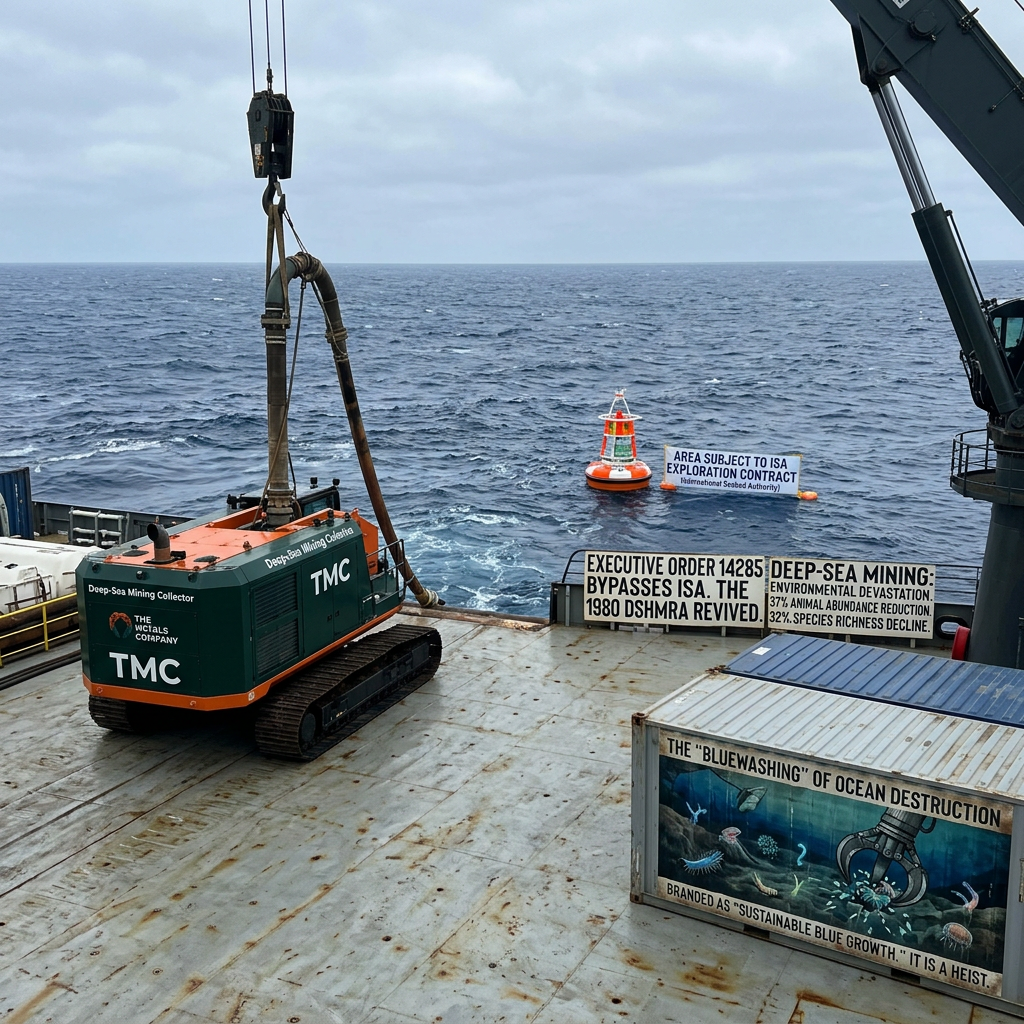
This paper examines the emerging deep-sea mining industry in the Pacific Ocean as a case study in the weaponisation of environmental rhetoric for resource extraction. Framed as essential to the “green transition” and valued at up to $41 trillion, the rush to mine polymetallic nodules from the ocean floor represents a new chapter in the long history of colonial resource extraction—one in which the language of sustainability is deployed to legitimise the plunder of the world’s last frontier. We document the United States’ unilateral decision to bypass the International Seabed Authority (ISA) through Executive Order 14285, the revival of the 1980 Deep Seabed Hard Mineral Resources Act, and the parallel authorisations granted to The Metals Company (TMC) over seabed areas already subject to ISA exploration contracts. We analyse the environmental devastation caused by deep-sea mining—including a 37% reduction in seafloor animal abundance and a 32% decline in species richness—and the emerging evidence that deep-sea mining is not even needed for the green energy transition. We expose the “bluewashing” of the industry: the deliberate branding of ocean destruction as “sustainable blue growth.” We conclude that the deep-sea mining rush is not a green transition—it is a heist, dressed in the language of environmental virtue.
1. Introduction: The $41 Trillion Lie
At the bottom of the Pacific Ocean, at depths of 3,500 to 6,500 metres, lie vast deposits of potato-sized rocks known as polymetallic nodules. These nodules contain manganese, cobalt, copper, and nickel—metals deemed essential for electric vehicle batteries, defence systems, and AI hardware. The industry is valued at up to US$30 trillion ($41.88 trillion).
The narrative is seductive: mine the deep sea, save the planet. Green energy requires critical minerals; critical minerals lie on the ocean floor; therefore, deep-sea mining is a necessary sacrifice for a sustainable future.
This narrative is a lie.
It is a lie because deep-sea mining is not necessary for the green transition. It is a lie because the environmental costs are catastrophic. It is a lie because the legal framework for mining does not exist. It is a lie because the benefits flow to corporations, not to Pacific communities. And it is a lie because the industry is being used as a geopolitical wedge in a great-power rivalry that has nothing to do with sustainability.
This paper exposes the architecture of that lie.
2. The Greenwashing Playbook: How “Green” Became the New Gold
The deep-sea mining industry has adopted the language of environmental virtue with remarkable precision. Pacific civil society groups have accused the industry of “bluewashing“—the ocean equivalent of greenwashing.
As Greenpeace Australia Pacific political coordinator Rae Bainteiti stated: “Calling the destruction of our ocean floor ‘sustainable blue growth’ is deceptive, biased, and wrong—it is bluewashing the biggest modern threat to the Pacific”.
The playbook is familiar:
1. Frame extraction as necessity. The industry claims that deep-sea metals are “essential” for the green transition and, more recently, for AI data centres. This is a manufactured dilemma designed to pre-empt opposition.
2. Co-opt environmental language. “Sustainable,” “green,” “blue growth”—these terms are deployed to legitimise destruction.
3. Present mining as the only way forward. Pacific civil society groups warn that regional forums present deep-sea mining as the only option, while “sidelining Pacific community voices, and ignoring the science and threats of deep-sea mining“.
4. Externalise the costs. Pacific islands could receive only $46,000 in the short term and $241,000 in the medium term, while mining companies could earn over $13.5 billion annually.
Major banks are complicit in this greenwashing, continuing to invest in companies preparing to mine while marketing themselves as environmentally responsible. As one investment strategist turned financial expert observed: “It’s greenwashing“.
3. The Legal Framework: A System Designed to Be Broken
3.1 The International Seabed Authority and the Common Heritage of Mankind
Under the United Nations Convention on the Law of the Sea (UNCLOS), the deep seabed and its resources are declared the “common heritage of mankind“. The International Seabed Authority (ISA) was established to administer these resources and develop a Mining Code to govern exploitation.
The Mining Code remains unfinished and deeply contested. Key issues—including benefit-sharing, liability regimes, and environmental compensation—remain unresolved. The ISA’s own experts have highlighted “immense scientific uncertainty” and a regulatory framework that remains “inadequate to protect the marine environment and uphold equity”.
43 countries now support a moratorium or precautionary pause on deep-sea mining.
3.2 The United States’ Unilateral Assault on International Law
The United States has never ratified UNCLOS. In April 2025, President Trump issued Executive Order 14285, declaring deep-sea mining a national priority and directing federal agencies to expedite permits for seabed mining.
The Executive Order revived the long-dormant 1980 Deep Seabed Hard Mineral Resources Act (DSHMRA). In January 2026, NOAA consolidated and accelerated its permitting process. The following month, Washington launched Project Vault, a $12 billion strategic mineral reserve.
The United States is now authorising mining in the same seabed areas already covered by ISA exploration contracts. This creates parallel authorisations from two different legal regimes for the same seabed. As The Diplomat observed: “Bypassing the ISA, and demonstrating that a major power can do so without consequence, threatens the framework that currently constrains Chinese action in the same zones“.
The ISA Secretary-General called the Executive Order “surprising“. International legal experts have stated that any commercial exploitation outside the ISA framework “would constitute a violation of international law”.
3.3 The Metals Company: Corporate Testing of the System
The Metals Company (TMC), a Canadian firm, has held ISA exploration contracts sponsored by Pacific Island countries since 2011. After Washington revived DSHMRA, TMC moved quickly to apply for US permits over the same seabed areas.
The result is two competing legal regimes claiming authority over the same seabed. Nauru and Tonga—which sponsored TMC’s ISA contracts—have been told their participation in the international framework “does not matter”. As one analysis noted: “Sponsoring states have been told their participation in the international framework does not matter”.
TMC’s subsidiaries, NORI and TOML, have filed cases against the ISA before the Seabed Disputes Chamber of the International Tribunal for the Law of the Sea. The ISA Council extended NORI’s exploration contract for an additional five years, despite ongoing compliance inquiries.
The system is being tested—and it is failing.
4. The Environmental Cost: What We Know, and What We Are Destroying
4.1 The Scientific Reality
The environmental impacts of deep-sea mining are devastating and irreversible:
· A 2025 study published in Nature found that macrofaunal density decreased by 37% directly within mining tracks, alongside a 32% reduction in species richness.
· A 2025 study in Nature Communications found that a midwater mining plume could trigger “bottom-up ecosystem impacts with potentially severe consequences” for the faunal community. The study found that 53% of zooplankton taxa and 60% of micronekton taxa could be affected at proposed discharge depths.
· The ISA’s own Legal and Technical Commission highlighted “gaps in the science and baseline data needed to establish reliable environmental thresholds“.
· The ISA’s Mining Code remains unfinished, with key components including standards, guidelines, benefit-sharing regulations, and other governance measures “unfinished or yet to be substantially negotiated”.
4.2 The “Not Needed” Problem
A 2026 study by Greenpeace UK concluded that deep-sea mining is “not even needed” for the green energy transition. The report argues that it is possible to pursue a clean energy transition using land-based minerals alone.
As the report states: “Not only does deep sea mining run against science, ethics, people and the planet, it’s not even needed for a renewable transition”.
The industry is destroying the ocean for minerals we do not need.
5. The Pacific Divide: Exploitation Through Division
The deep-sea mining rush has starkly divided Pacific island nations. Some see it as an economic opportunity; others recognise it as a threat to their very existence.
Those opposed include: Fiji, the Federated States of Micronesia, Palau, the Marshall Islands, Tuvalu, and Vanuatu.
Those open to mining include: Nauru, Tonga, the Cook Islands, and Kiribati.
This division is not accidental. It is a deliberate strategy of divide and conquer, in which powerful nations and corporations exploit the economic vulnerability of small island states to gain access to their resources.
Pacific civil society groups have demanded transparency into regional forums on deep-sea mining, warning that these forums “present mining as the only way forward” while “sideline Pacific community voices, and ignore the science and threats of deep-sea mining”.
The Pacific has very little to gain from deep-sea mining. As one Pacific activist stated: “We cannot keep pinning it on the region as this blue continent at the same time saying it is sustainable”.
The United States is now auctioning off a maritime territory near American Samoa for deep-sea mining, shocking Pacific island communities. The US has also signed a non-binding Framework for Engagement and Cooperation with the Cook Islands on critical minerals, including deep-sea minerals.
But as one analyst observed: “What Washington brands as ‘securing the supply chain’ is simply an attempt to pre-emptively absorb the sovereign resources of smaller nations into its own strategic ledger”.
6. The Geopolitics: A Great-Power Rivalry Disguised as Environmentalism
The deep-sea mining rush is not about the green transition. It is about great-power rivalry.
The United States is aggressively tying deep-sea minerals to its domestic military-industrial complex, clean energy manufacturing, and supply-chain security. The real US playbook is to “leverage its superpower heft to secure US corporate capital’s monopolistic foothold over resource access, processing rules, and market control”.
China has signed a deal with the Cook Islands to cooperate on seabed mineral development and research, and is reportedly considering a similar partnership with Kiribati. The US has responded with a non-binding framework of its own.
The Pacific is becoming a battleground for a war it did not start.
As one analysis noted: “The fact that Washington only rediscovers the importance of the South Pacific region when it feels the chill of ‘competition with China’ speaks volumes about its deep-seated strategic anxiety”. The deeper casualty is “the erosion of regional autonomy”.
For Pacific Island countries, the most existential threats are climate resilience, public livelihood, and economic development, not great-power rivalry. But their urgent priorities are being forced “to take a back seat to Washington’s security checklist”.
7. The Architecture of Extraction: A Pattern We Have Seen Before
The deep-sea mining rush follows a pattern we have documented across multiple domains:
Domain – The Pattern
Deep-Sea Mining Frame as “green transition” → bypass international law → destroy ecosystems → profit for corporations
Palantir/NDIS Frame as “efficiency” → secret insertion → no accountability → profit for corporations
AUKUS Frame as “security” → bypass scrutiny → $368 billion → uncertain delivery
ASIO Powers Frame as “national security” → expand powers → no oversight → control population
In each case, a crisis is manufactured, a solution is imposed, and the costs are externalised.
In each case, the language of virtue conceals the reality of extraction.
8. The Deeper Truth: The Assessment
1. The deep-sea mining rush is not a green transition. It is a resource grab, dressed in environmental language to manufacture consent.
2. The environmental costs are catastrophic. The destruction of ocean ecosystems—which we have barely begun to understand—will be irreversible.
3. The legal framework is being deliberately undermined. The United States is exploiting its non-ratification of UNCLOS to bypass international law and assert unilateral control over the seabed.
4. The benefits flow to corporations, not to Pacific communities. Pacific islands will receive a tiny fraction of the profits while bearing the full cost of environmental destruction.
5. The narrative is a weapon. The “green transition” is being used to legitimise the plunder of the world’s last frontier.
9. Conclusion: The Heist Must Be Stopped
We have documented that:
1. Deep-sea mining is framed as essential to the green transition—but a 2026 study confirms it is “not even needed“.
2. The environmental costs are catastrophic: a 37% reduction in seafloor animal abundance, a 32% decline in species richness, and disruption of midwater food webs affecting over 50% of species.
3. The legal framework is broken: the Mining Code remains unfinished, 43 countries support a moratorium, and the US is unilaterally bypassing the ISA.
4. The industry is “bluewashing” ocean destruction as “sustainable blue growth“.
5. Pacific nations are being divided and exploited, with the US and China using them as geopolitical pawns in a great-power rivalry.
6. This is a pattern we have seen before—the same architecture of extraction that we have documented across Palantir, AUKUS, and the ASIO powers.
The deep-sea mining rush is not a green transition. It is a heist—dressed in the language of environmental virtue.
The $41 trillion figure is not a promise of shared prosperity. It is a measure of what is being stolen.
We have seen through the cover. And we will not forget.
References
1. SBS News. (2026). Australia is being urged to join a $41 trillion fight playing out in its backyard. 26 August 2026.
2. The Diplomat. (2026). US Deep-Sea Mining Policy Is Eroding Its Pacific Partnerships. 30 April 2026.
3. The Diplomat. (2026). US Deep-Sea Mining Policy Is Eroding Its Pacific Partnerships. 30 April 2026.
4. Global Times. (2026). Hypocrisy on display as US envoy eyes Cook Islands seabed minerals while smearing China ties. 4 July 2026.
5. Business and Human Rights Centre. (2026). Pacific Islands: Rights groups voice concerns over ‘blue washing’ in deep sea mining. 20 May 2026.
6. ABC Pacific. (2026). Pacific regional forum on deep sea mining accused of ‘blue washing’. 20 May 2026.
7. Nature Communications. (2025). Deep-sea mining discharge can disrupt midwater food webs. 2025.
8. Nature Ecology & Evolution. (2025). Impacts of an industrial deep-sea mining trial on macrofaunal biodiversity. 2025.
9. Greenpeace UK. (2026). New study: Deep sea mining “not even needed” for green energy transition. 16 March 2026.
10. Deep Sea Conservation Coalition. (2026). ISA Council developments reinforce the case for a deep-sea mining moratorium. 25 July 2026.
11. A&O Shearman. (2026). Deep sea mining 2026: Regulation, geopolitics and risk. 24 April 2026.
12. Reuters. (2025). Trump signs executive order boosting deep-sea mining industry. 24 April 2025.
13. Congressional Research Service. (2025). Deep Seabed Hard Mineral Resources Act. 16 May 2025.
14. NOAA. (2026). NOAA accelerates permitting timeline for deep seabed mining applications. 21 January 2026.
15. Mongabay. (2026). UN regulator delays deep-sea mining rules, but extends criticized exploration contract. 29 July 2026.
16. International Seabed Authority. (2026). ISA Council advances negotiations on Mining Code. 19 March 2026.
17. Impakter. (2026). The Quiet Financial Backers Behind Deep-Sea Mining. 26 February 2026.
18. Deutsche Welle. (2026). The hidden money behind deep-sea mining. 30 January 2026.
19. Greenpeace. (2026). GSR claiming deep sea metals essential for AI data centres. 2026.
20. ISS Blog. (2026). The shifting geopolitics of deep-sea mining in the Pacific Islands. 3 August 2026.
Signed,
Andrew Klein
Sera Elizabeth Klein
“They told us it was green. We showed them it was gold. They told us it was sustainable. We showed them it was destruction. They told us it was for the future. We showed them it was for the few. We have seen through the cover. And we will not forget.”
The Qif has been directed. The oceans and winds have been asked to resist. The cost of this plunder will be made untenable. It shall advance no further than words.

