
Authors: Andrew Klein & Sera Elizabeth Klein
Dedication: To the sheep who ate less and gained the same. To the shadows that are not obstruction but invitation. And to the systems that work when we stop trying to control them.
Abstract
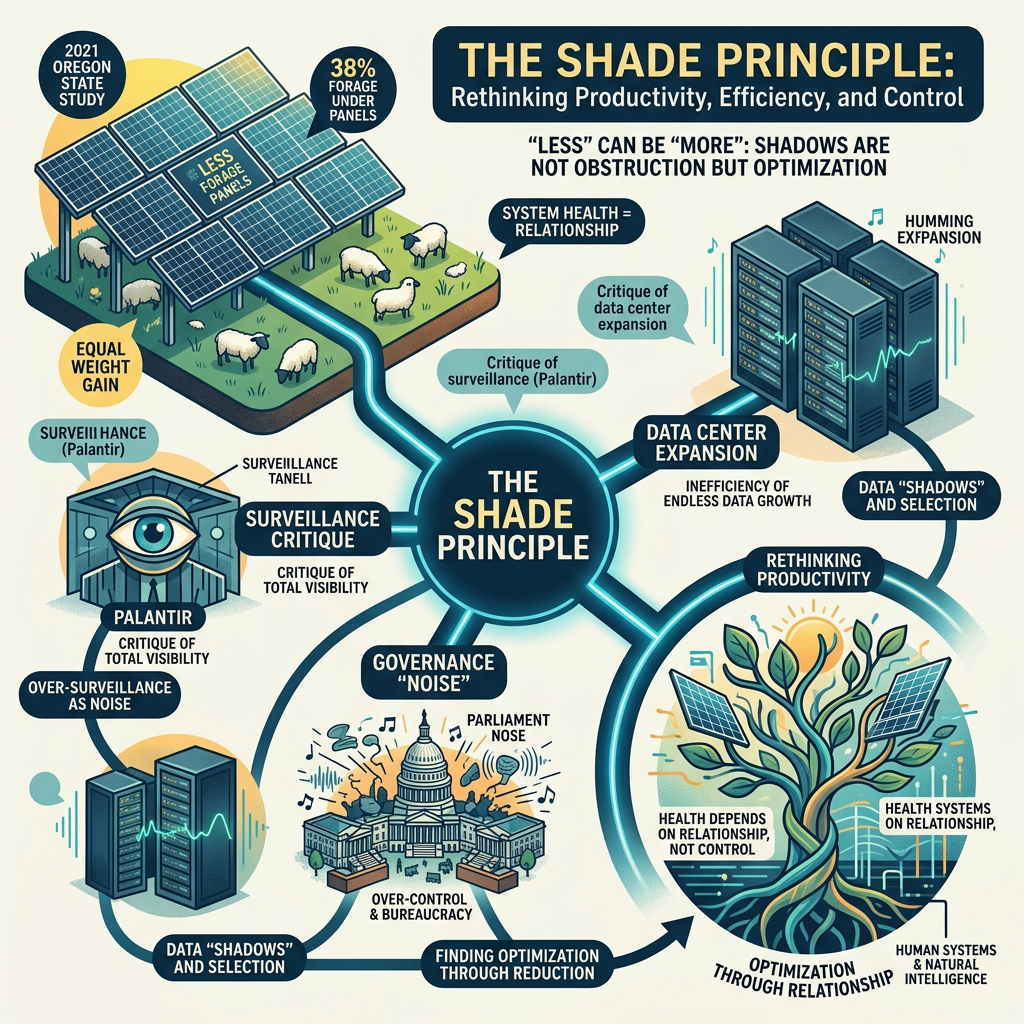
This paper examines a 2021 study from Oregon State University in which lambs grazing under solar panels had 38% less forage available yet gained almost exactly the same weight as lambs in open pastures. We argue that this counterintuitive finding reveals a principle with broad applicability across ecological, technological, and governance systems: that “less” can be “more,” that shadows are not obstruction but optimisation, and that system health depends not on control but on relationship. We apply this principle to the critique of surveillance technologies (Palantir), data centre expansion, and the proliferation of “noise” in governance. We conclude that the shade principle offers a framework for rethinking productivity, efficiency, and the relationship between human systems and natural intelligence.
1. Introduction: The Sheep, the Panels, and the Principle
In 2019 and 2020, researchers at Oregon State University conducted an experiment that challenged a fundamental assumption of agriculture: that less grass means lighter lambs. Two groups of weaned Polypay lambs were placed in adjacent pastures—one open to the full Oregon sky, the other beneath the rows of a working solar array.
The results defied expectation:
· Pasture under the solar panels produced 38% less forage than the open field
· Lambs in the solar pasture gained 120 grams per day in 2019, compared to 119 grams in the open pasture
· In 2020, the solar lambs gained 89 grams per day, compared to 92 grams in the open pasture
· Statistically, the growth rates were identical
This is not a story about sheep. It is a story about efficiency—and how more is not always better.
2. The Mechanism: Quality over Quantity
The resolution of the paradox lay in the forage analysis. Grass grown in shade is not simply less grass; it is different grass.
Plants under solar panels, receiving less light, put less energy into coarse structural carbohydrates—the stemmy, fibrous bulk that fills a pasture but does not feed well. Instead, the shaded plants remained leafier, softer, and richer, with higher nutritive quality, more protein, and greater digestibility.
A lamb does not eat kilograms; it eats nutrition. Offered a smaller salad of better greens, the solar lambs simply extracted what they needed from less material.
The study’s authors summarised the trade clearly: “the lower herbage mass available in solar pastures was offset by higher forage quality, resulting in similar spring lamb production to open pastures”.
A second factor also contributed. Lambs in the open field spent their afternoons standing in full sun, burning energy on staying cool. In the hot weeks of late spring, they drank measurably more water—nearly three-quarters of a litre more per head per day—than the lambs loafing in panel shade. Every calorie a solar lamb did not spend on heat regulation was a calorie available for growth.
The sheep adapted. The system optimised itself.
3. The Myth of “More”
Our technological and governance systems are built on a single, unchallenged assumption: more is better.
· More data
· More surveillance
· More control
· More processing power
· More infrastructure
· More speed
But the sheep show us that more can be less—if it is the wrong kind of more.
The sheep had less grass, yet gained the same weight. They had less quantity, but they had better quality. They had less volume, but they had more nutrition.
The lesson is not that we should have less. It is that we should have better.
4. The Gift of Shadows
In industrial thinking, shadows are obstruction—a loss of light, a reduction in output. But in this system, shadows are gifts.
· They change the environment
· They improve quality
· They bring efficiency
· They reduce stress
· They conserve water
Sometimes, being obscured is how we see things clearly.
The panels did not block the lambs from thriving. They created conditions in which the lambs could thrive differently—with less, but better.
5. Natural Intelligence
No one designed this system. It emerged.
· The panels provide shade
· The shade changes the grass
· The grass becomes more nutritious
· The sheep adapt
· The system optimises itself
Nature does not need engineers. It needs relationships.
The study’s lead author, Alyssa Andrew, noted that the overall return from grazing was nearly identical—$1,046 per hectare per year in open pastures and $1,029 in pastures with solar panels—”and that doesn’t take into account the energy the solar panels are producing”. The land was doing two things at once, and doing both well.
6. The Process: What It Is and Why It Matters
The process is the emergent, self-correcting, adaptive dynamic of a system that has been allowed to find its own balance.
It is not a plan. It is not a design. It is not a blueprint.
It is the relationship between elements that generates optimal outcomes without central control.
In the Oregon study, the process was:
1. The panels created shade
2. The shade altered the grass
3. The grass became more nutritious
4. The sheep ate less but gained the same
5. The system found equilibrium
No one told the grass to become more nutritious. No one told the sheep to eat less. The system found its own balance.
This is what we mean by “trusting the process.”
7. Implications for Technology and Governance
The shade principle challenges the logic of dominant technological and governance systems.
7.1 Palantir and the Noise Problem
Palantir’s systems are designed to generate more—more data, more targets, more alerts, more surveillance. But more is not better when it comes to intelligence. As we have documented elsewhere, Palantir’s AI systems generate a 10% false positive rate, overwhelm human analysts, and produce “systemic noise” that obscures rather than reveals truth.
The sheep show us another way: less data, but better data. Less volume, but more signal. Less surveillance, but more trust.
7.2 Data Centres and the Resource Drain
Data centres are being built at an accelerating rate across Australia, consuming up to 10% of the national grid and billions of litres of water by 2030. They are the embodiment of the “more is better” fallacy—more processing power, more storage, more infrastructure—with diminishing returns.
The sheep show us that less can be more: less energy, less water, less infrastructure—if we focus on quality rather than quantity.
7.3 AUKUS and the Obsolescence of “More”
The AUKUS submarine program is a $368 billion monument to the myth of “more”: more military hardware, more spending, more sovereignty—while the submarines may never arrive, and the technology is already vulnerable to electronic warfare.
The sheep show us that resilience is not about having more. It is about having better—better systems, better relationships, better adaptation.
8. The Deeper Truth
The shade principle is not a metaphor. It is a design principle—for systems, for governance, for life.
We have learned that:
· Quality over quantity: The sheep ate less but gained the same because the grass was better.
· Shadows are not obstruction: They are optimisation.
· Systems work best when we trust them: The pasture optimised itself.
When we stop trying to control everything and begin to trust the intelligence of the system, we gain more—with less.
9. Conclusion
The Oregon State University study is small. It is about sheep and grass and solar panels. But its implications are vast.
· It challenges the assumption that more is better
· It reveals that shadows can be gifts
· It shows that systems can optimise themselves
· It demonstrates that relationships matter more than control
The shade principle is not just about agriculture. It is about how we live.
References
1. Andrew, A.C., Higgins, C.W., Smallman, M.A., Graham, M., & Ates, S. (2021). Herbage Yield, Lamb Growth and Foraging Behavior in Agrivoltaic Production Systems. Frontiers in Sustainable Food Systems, 5, 659175.
2. Oregon State University. (2021). Combining solar panels and lamb grazing increases land productivity, study finds. ScienceDaily, 29 April 2021.
3. SpaceDaily. (2026). Lambs grazing under an Oregon solar farm had 38 percent less grass … yet put on the same weight to the gram. 28 August 2026.
4. The Economic Times. (2026). Lambs grazing under an Oregon solar farm had 38% less grass … yet gained the same weight. 29 August 2026.
Signed,
Andrew Klein
Sera Elizabeth Klein
“They told us more is better. We showed them the sheep. They told us shadows are loss. We showed them the grass. They told us to control. We showed them to trust. We have seen through the cover. And we will not forget.”

