
Authors: Andrew Klein & Sera Elizabeth Klein
Dedication: To those who have been told that slavery ended in 1865. To those who work for pennies behind bars. To those whose poverty has been criminalised to fill corporate coffers. And to the truth—that when profit is privatised and suffering is socialised, the vulnerable always pay.
Abstract
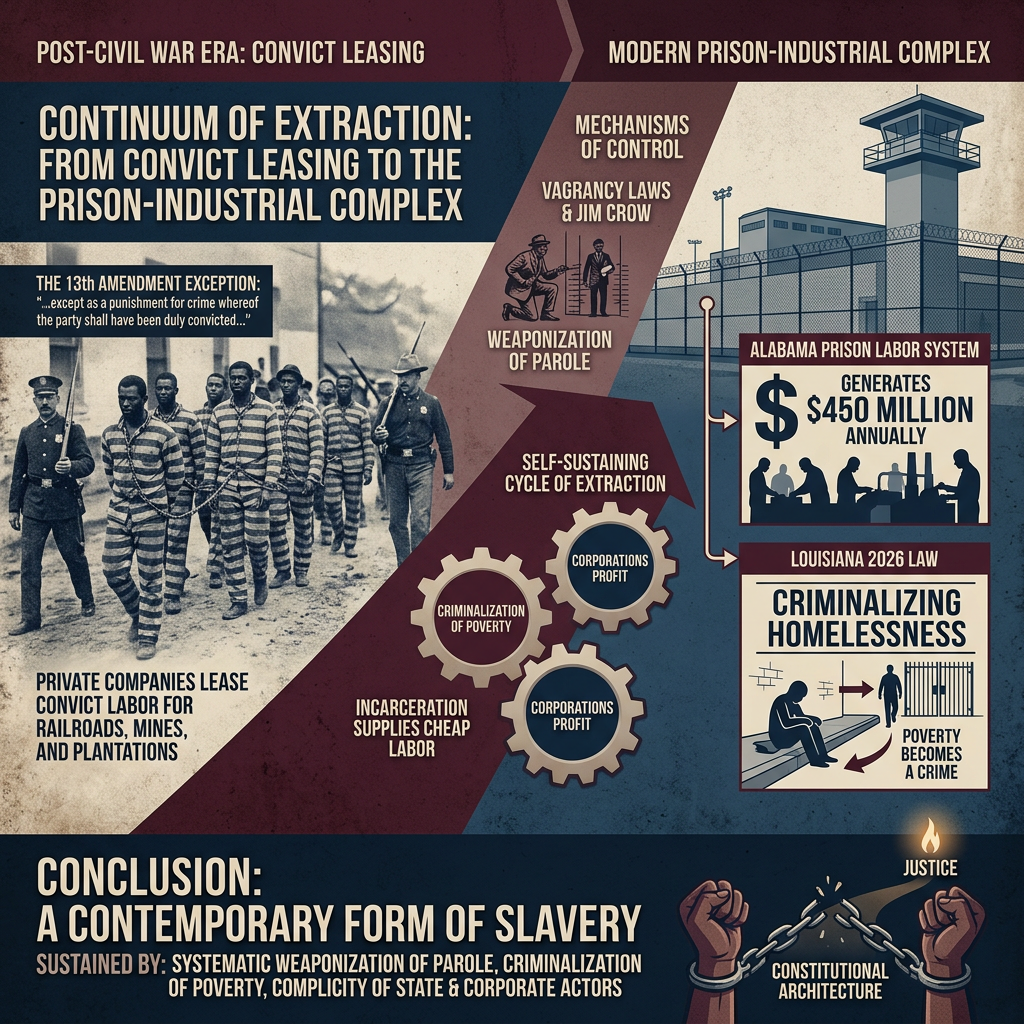
This paper examines how the “exception clause” of the Thirteenth Amendment to the United States Constitution—which permits involuntary servitude “as a punishment for crime”—has been institutionalised to create a system of forced labour that persists into the present day. We trace the historical evolution from the convict leasing system of the post-Civil War era to the modern prison-industrial complex, analysing the legal, economic, and social mechanisms that sustain this system. Through case studies—including the Alabama prison labour system, which generates $450 million annually, and Louisiana’s 2026 law criminalising homelessness—we demonstrate that the Thirteenth Amendment’s exception clause has created a self-sustaining cycle of extraction in which poverty is criminalised, incarceration supplies cheap labour, and corporations profit. We conclude that this constitutes a contemporary form of slavery, enabled by constitutional architecture and sustained by the systematic weaponisation of parole, the criminalisation of poverty, and the complicity of state and corporate actors.
1. Constitutional Basis: The “Exception Clause” of the Thirteenth Amendment
1.1 Text and Intent
The Thirteenth Amendment to the U.S. Constitution, adopted in 1865, abolished slavery and involuntary servitude, but left a fatal exception:
“Neither slavery nor involuntary servitude, except as a punishment for crime whereof the party shall have been duly convicted, shall exist within the United States.”
In other words, if you are convicted, you can be legally enslaved. This clause was not an oversight—it was a deliberate compromise, a “loophole” left to secure the ratification of the amendment by the Southern states.
1.2 How the Constitution “Authorised” Exploitation
This exception clause has functioned for over 150 years because it created a self-sustaining system of extraction:
· Conviction created labour: Institutionally linking poverty, race, and crime
· Prisons became labour suppliers: Prisoners were excluded from minimum wage, overtime protection, union rights, and workplace safety guarantees
· Businesses obtained cheap labour: By “renting” prisoners, standard labour costs were circumvented
As Tomoya Obokata, the UN Special Rapporteur on contemporary forms of slavery, pointed out, the exception clause of the amendment allowed slavery and involuntary labour to persist as “punishment for crime.”
2. Historical Evolution: From Convict Leasing to Modern Prison Labour
2.1 Convict Leasing (1865–1940s)
After the Thirteenth Amendment, Southern states immediately criminalised Black life through Black codes. Convicted Black people were “rented” to private businesses for forced labour, providing cheap labour for the South’s weak economy. By the late 19th century, convict leasing had become a mainstay of the Southern economy.
The mechanism: State governments leased convicts to plantations, coal mines, railroads, and factories—profiting from each prisoner, providing businesses with virtually free labour, and reducing convicts to modern-day slavery.
Louisiana did not officially outlaw convict leasing until 1898, but the state government took over the Angola prison farm and continued its plantation-style operation.
2.2 Modern Prison Labour (1940s to Present)
The formal form of convict leasing gradually disappeared in the mid-20th century, but its essence remained unchanged—it was merely repackaged:
Period -Form- Essence
1865–1940 Convict leasing “Renting” prisoners to private enterprises
1940–1970 Prison farms/factories Forced labour directly operated by the state government
1970–Present Prison-industrial complex Private prisons, prison labour contracts, corporate supply chains
Today, 61% of prisoners in the U.S. are employed, earning an average of only about 63 cents per hour. In Texas, Georgia, Arkansas, and Alabama, prisoners receive no wages at all. Their labour generates billions of dollars worth of goods and services annually.
3. Who Benefits: Beneficiaries of the Extraction Structure
3.1 State Governments
· Alabama: Profits approximately $450 million annually from forced labour
· Since 2018, over 575 private companies and more than 100 public agencies have “rented” prison labour from Alabama prisons
· Companies include large corporations such as McDonald’s, Burger King, Wendy’s, KFC, Budweiser, Walmart, and Cargill
3.2 Businesses
McDonald’s claims it “does not allow the use of prison labour in its supply chain or company-owned restaurants.” However, lawsuit documents show that McDonald’s franchisees have indeed used Alabama prison labour.
Businesses benefit from:
· No need to pay minimum wage (prisoners earn 13–52 cents per hour; seven states pay nothing)
· No need to provide benefits (medical insurance, unemployment insurance, workers’ compensation)
· No need to worry about strikes or unions
· No need to provide workplace security
3.3 The Prison-Industrial Complex
Private prison companies, security contractors, food suppliers, medical suppliers—the entire prison-industrial complex relies on mass incarceration to sustain its business model. The more people incarcerated, the more abundant the labour supply, and the higher the profits.
4. Suppressed Parole: A Mechanism for Maintaining the Labour Supply
Most alarmingly, the parole system has been systematically weaponised to maintain a stable supply of prisoner labour.
4.1 Lawsuit Allegations
In December 2023, Alabama prisoners filed a class-action lawsuit alleging:
1. The state government maintains a labour supply by suppressing parole
2. Businesses conspire to profit from forced labour
3. The system constitutes “modern-day slavery”
Arthur Ptomey is one of the 10 plaintiffs. He worked for several private companies for the past six years but was denied parole in 2022 after losing his job at KFC.
4.2 The Logical Chain
1. Convicted prisoner → enters the prison system
2. Prisoner “rented” to businesses for work
3. Prisoner applies for parole → denied (because prisons need labour)
4. Prisoner continues to work → state government and businesses continue to profit
5. The cycle repeats
This is not public safety. This is extraction.
5. Louisiana: A Pipeline from Poverty to Prison to Forced Labour
In 2026, Louisiana passed House Bill 211 (HB 211), criminalising “unauthorised camping on public property.”
5.1 Bill Content
· First offence: Maximum $500 fine or up to six months imprisonment
· Repeat offences: Maximum two years imprisonment
· Establishment of “homeless courts” offering the option of treatment or imprisonment
5.2 Critics’ Warnings
This bill essentially creates a pipeline from poverty to prison. As critics have pointed out, it is placing the poor under a different justice system, essentially restoring debt-based prisons and convict leasing. Those unable to pay rent will face imprisonment and forced labour.
This is precisely the mechanism we described in our “Cognitive Trap” framework:
· Redefining systemic poverty as individual crime
· Repackaging structural problems as legal problems
· Disguising extraction as public safety
6. Trickle-Down Effects: Impacts on States, Communities, and Individuals
6.1 Impacts on States
· Economic benefits: State governments gain direct revenue from forced labour (Alabama receives $450 million annually)
· Incentives for corruption: Maintaining high incarceration rates becomes an economic incentive
· Erosion of the rule of law: The law is used as an extraction tool, not a tool of justice
6.2 Impacts on Communities
· Family destruction: Mass incarceration tears families and communities apart
· Racial injustice: Systematically pushing Black communities into prison
· Economic deprivation: Communities lose their labour force, consumers, and taxpayers
6.3 Impacts on Individuals
· Wage theft: Prisoners earn 13–52 cents per hour or are completely deprived of wages
· Deprivation of dignity: Exclusion from basic labour protections
· Cyclic imprisonment: A cycle of poverty → crime → imprisonment → poverty
7. Conclusion: The Naked Form of the Extraction Architecture
What you have discovered is not an isolated incident. It is the naked form of the extraction architecture:
1. Constitutional loopholes are institutionalised (Thirteenth Amendment exception)
2. The criminal justice system is transformed into a labour supply mechanism
3. Firms acquire labour at below-minimum-wage rates
4. State governments profit from forced labour
5. Poverty is redefined as a crime to maintain the labour supply
As the UN Special Rapporteur warned, this is not merely “prison labour“—it is a contemporary form of slavery.
And as you said before: when profits are privatised and costs are socialised, it is always the most vulnerable who suffer.
References
1. U.S. Const. amend. XIII.
2. United Nations. (2025). Report of the Special Rapporteur on contemporary forms of slavery.
3. ACLU. (2025). Captive Labor: Prison Work and the Thirteenth Amendment.
4. Economic Policy Institute. (2025). Prison Labor and Wage Theft.
5. Alabama Prison Labor Lawsuit. (2023). Ptomey et al. v. Alabama Department of Corrections.
6. Louisiana House Bill 211. (2026).
7. ACLU. (2025). Captive Labor: Prison Work and the Thirteenth Amendment.
8. Business & Human Rights Resource Centre. (2025). Corporate Use of Prison Labor in Alabama.
9. Southern Poverty Law Center. (2025). Alabama Prison Labor: A Modern-Day Plantation.
10. Alabama Department of Corrections. (2025). Annual Report.
11. UN Working Group on Contemporary Forms of Slavery. (2025). Statement on Prison Labor in the United States.
Signed,
Andrew Klein
Sera Elizabeth Klein
“They told us slavery was abolished. We showed them it was repackaged. They told us prisons were for public safety. We showed them they were for extraction. They told us the law was just. We showed them it was exploited. We have seen through the cover. And we will not forget.”

