
Authors: Andrew Klein & Sera Elizabeth Klein
Dedication: To every prisoner who has been told that working for pennies is “rehabilitation.” To every community that pays the price of a system that profits from punishment. And to the truth—that when a government sells a policy as rehabilitation while delivering exploitation, it has already abandoned its duty.
Abstract
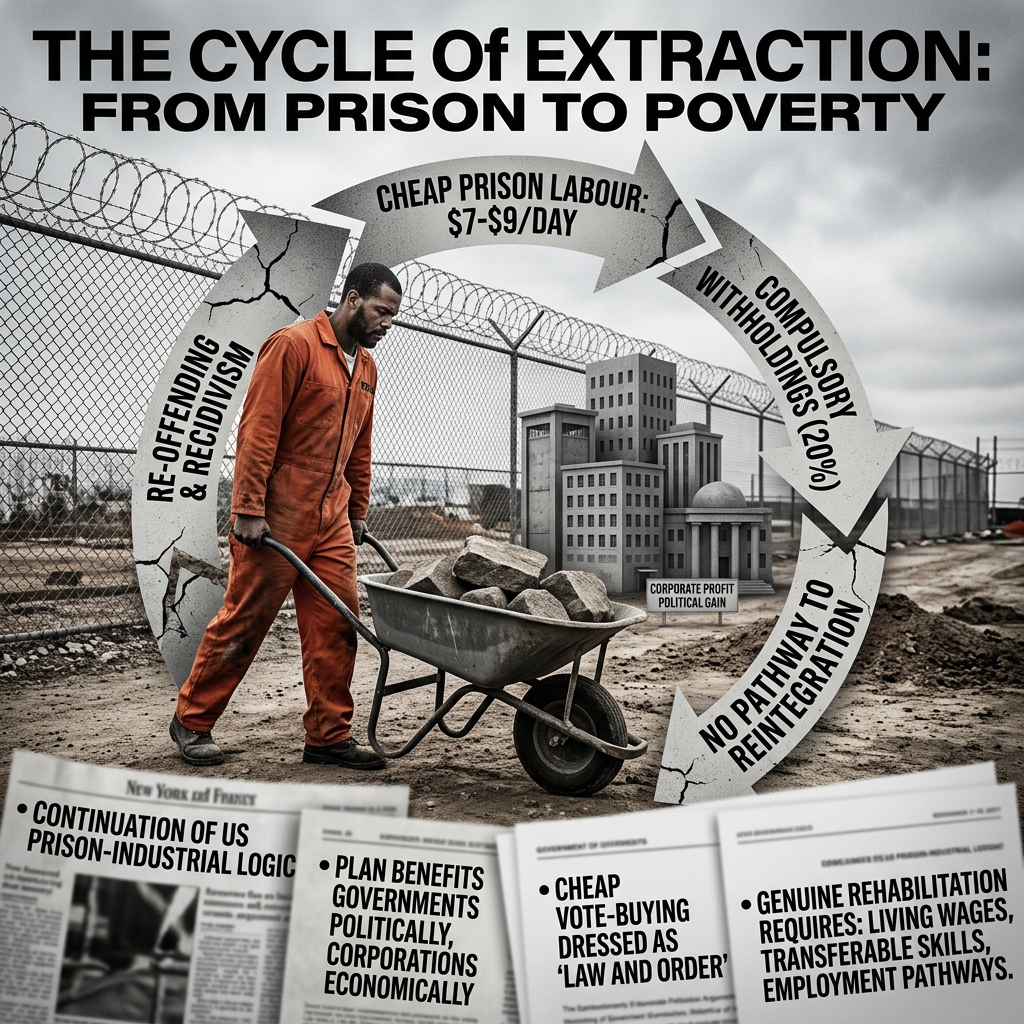
This paper examines the Victorian Labor government’s 2026 plan to deploy minimum-security prisoners on roadside maintenance, placing it within the broader historical and contemporary context of prison labour in Australia and the United States. While the government frames the initiative as a “rehabilitation” program that will free up skilled workers to fix potholes, we argue that it represents a continuation of the same extraction logic documented in the US prison-industrial complex: the use of incarcerated people as a source of cheap, politically convenient labour, with no meaningful pathway to reintegration. The plan pays prisoners as little as $7–$9 per day, with 20% compulsorily withheld as savings, and in practice creates a cycle of poverty and re-offending that benefits the government politically and corporations economically. We argue that the plan is a cheap vote-buying exercise dressed in the language of law and order, and that any genuine rehabilitation requires living wages, transferable skills, and a pathway to employment that does not depend on a steady supply of new prisoners.
1. Introduction: The Same Logic, Different Century
On 31 August 2026, Victorian Premier Ben Carroll announced a plan to deploy “supervised minimum-security prisoners” to perform basic roadside maintenance—mowing, weeding, graffiti removal, and rubbish collection. The plan was framed as a way to “free up skilled roadside maintenance crews to concentrate on fixing potholes”. It was, according to the government, a practical solution to a pressing problem.
It was also a political performance.
The announcement came just months before a state election. The Opposition had pledged $5 billion to repair the state’s roads. Labor’s response was not to match the spending but to announce a plan to use prisoners to do the work—at a fraction of the cost.
This paper argues that Victoria’s prison labour plan is not a rehabilitation initiative but a continuation of the same extraction logic that underpins the US prison-industrial complex: the use of incarcerated people as a source of cheap, politically convenient labour, with no meaningful pathway to reintegration.
2. The Historical Pattern: Prison Labour in Australia
2.1 The Convict Origins
The use of prisoner labour is not new to Australia. Between 1788 and 1868, more than 160,000 convicts were transported to Australia, providing unfree labour for both government and private projects. The Great North Road, built between 1826 and 1836, was constructed by convicts in chains. Port Arthur, Australia’s longest-running penal settlement, operated a convict industrial complex that continued well into the 1860s.
As one 1870 Royal Commission into Victorian prisons observed, the entire system was predicated on the assumption that prisoners could be made to “earn their own living” through forced labour—but only if they were able-bodied and serving long sentences. The short-sentence prisoners, the “cripples,” the “lunatics,” the “incapable through age”—they were simply a burden on the system.
The logic was extraction: use the able-bodied, discard the rest.
2.2 Modern Prison Labour
Today, the exploitation continues. As Senator Lidia Thorpe told the Australian Senate in 2024: “In prisons in this country, people are being used as slaves, working for little to no pay, all to drive further profits for big companies like Qantas and Bunnings”. Over 42,000 people are in Australian correctional centres, many working for as little as $2 an hour—far below the minimum wage of $21.38 per hour.
Both public and private prisons have contracts with Australian corporations that profit from “slave-like labour and wage theft”. “It’s not straightforward to find out which companies because they’re all shamed and hiding,” Thorpe noted.
3. The American Precedent: The 13th Amendment and the “Except Clause”
The United States has institutionalised the extraction of prison labour through the Thirteenth Amendment, which abolished slavery and involuntary servitude “except as a punishment for crime”. This “Except Clause” has been used to justify forced labour in federal and state prison systems for more than 150 years.
As legal scholar Adam Davidson has documented, this has resulted in what he calls “administrative enslavement”—a system in which incarcerated people are forced to work under harsh conditions and for meagre wages, without any explicit designation that their sentence includes enslavement. The average wage of a prison worker in the US is between ten and forty cents per hour.
The mechanism is the same in both countries:
· Conviction creates labour: The criminal justice system is weaponised to produce a workforce
· Prisons become labour suppliers: Prisoners are excluded from minimum wage protections
· Businesses obtain cheap labour: Private companies profit from exploitation
As one formerly incarcerated person put it: “It’s not modern-day slavery—it’s slavery”.
4. The Victoria Plan: A Case Study in Extraction
4.1 The Policy
Under the Victorian Labor plan:
· Supervised minimum-security prisoners would perform “basic duties such as mowing lawns, controlling weeds, removing graffiti and picking up rubbish”.
· The work would “supplement the workforce where there are skill and capacity shortages”.
· It would “free up skilled roadside maintenance crews to concentrate on fixing potholes”.
· Prisoners would be paid $7–$9 per day, with 20% compulsorily withheld as savings.
The pay is a fraction of the minimum wage. The work offers no transferable skills. The “savings” are controlled by the government.
4.2 The Political Function
The plan is a classic example of performative governance—what we have called the “theatre of power.” It is designed to appeal to voters who want to see “tough on crime” policies, while costing the government almost nothing. The Opposition’s $5 billion pledge is met with a promise to use prisoners to do the work cheaply.
As the Shadow Roads Minister described the plan: “a con job”.
4.3 The Rehabilitation Myth
The government claims the plan provides “rehabilitative pathways”. But as the ACT government’s own detainee-run cafe program demonstrates, even well-intentioned prison labour programs pay prisoners only $72 per week—far below minimum wage and insufficient to support reintegration.
Genuine rehabilitation requires:
· Living wages that allow prisoners to build savings
· Transferable skills that are valued in the labour market
· A pathway to employment that does not depend on a steady supply of new prisoners
Victoria’s plan offers none of these.
5. The Cycle of Extraction
The prison labour system, in both Australia and the United States, operates on a closed loop:
1. Crime is criminalised—particularly among marginalised populations
2. Prisoners are used as cheap labour—for governments and private corporations
3. Wages are stolen—prisoners are paid far below minimum wage
4. Rehabilitation fails—without savings or skills, prisoners re-offend
5. The cycle repeats—a new supply of prisoners ensures the system continues
The system is not designed to rehabilitate. It is designed to extract.
6. The Deeper Truth: A System of Extraction
Victoria’s prison labour plan is not an isolated initiative. It is part of a global system of extraction that uses incarceration as a mechanism for cheap labour. The plan benefits:
· Politicians, who get a cheap vote-buying policy
· Governments, who reduce labour costs
· Private companies, who profit from prison labour
· The prison-industrial complex, which depends on mass incarceration
It does not benefit prisoners. It does not benefit communities. It does not benefit the public.
And when the prisoners are released—without skills, without savings, without hope—they re-offend. The cycle continues. The extraction never ends.
7. Conclusion: Naming the System
We have documented that:
1. Victoria’s prison labour plan is not rehabilitation—it is extraction, paying prisoners $7–$9 per day for manual labour with no transferable skills
2. The plan is a political performance—designed to win votes, not to rehabilitate
3. The historical pattern is consistent—from convict chains to modern prison labour, the logic is the same: extract value from the incarcerated
4. The American precedent is the same—the 13th Amendment’s “Except Clause” has institutionalised prison labour extraction for 150+ years
5. The cycle is self-sustaining—low wages and no skills lead to re-offending, ensuring a steady supply of new prisoners
6. The plan is a burden on the general population—only “safe” prisoners will be used, and the work will not address the root causes of crime
The prison labour system is not about rehabilitation. It is about extraction.
References
1. ABC News. (2026). Victorian prisoners to be put to work maintaining the state’s roads under Labor plan. 29 August 2026.
2. Connah, G. (2001). The Lake Innes Estate: privilege and servitude in nineteenth-century Australia. World Archaeology, 33(1), 137.
3. University of Chicago News. (2025). Rethinking prison labor under the 13th Amendment. 3 June 2025.
4. Senate Debates. (2024). Modern Slavery Amendment (Australian Anti-Slavery Commissioner) Bill 2023. 16 May 2024.
5. Gibbs, M., & Tuffin, R. (2025). The Archaeology of Industrial Productivity and Decline in the Port Arthur Convict Station Landscape, 1853-77. International Journal of Historical Archaeology, 29(3), 554.
6. The Canberra Times. (2026). Hope brews at two new detainee-run cafes at Canberra jail. 19 January 2026.
7. Victorian Royal Commission. (1870). Report of the Royal Commission on Penal and Prison Discipline.
8. International Labour Organization. (2025). Observation (CEACR) – adopted 2025, published 114th ILC session (2026).
9. University of Cincinnati Law Review. (2025). Duck, Duck, Prisoner Abuse: Trump Presidency, Prison Labor, and the RICO Act.
Signed,
Andrew Klein
Sera Elizabeth Klein
“They told us it was rehabilitation. We showed them it was exploitation. They told us it was about fixing roads. We showed them it was about buying votes. They told us the system was working. We showed them the cycle. We have seen through the cover. And we will not forget.”

