
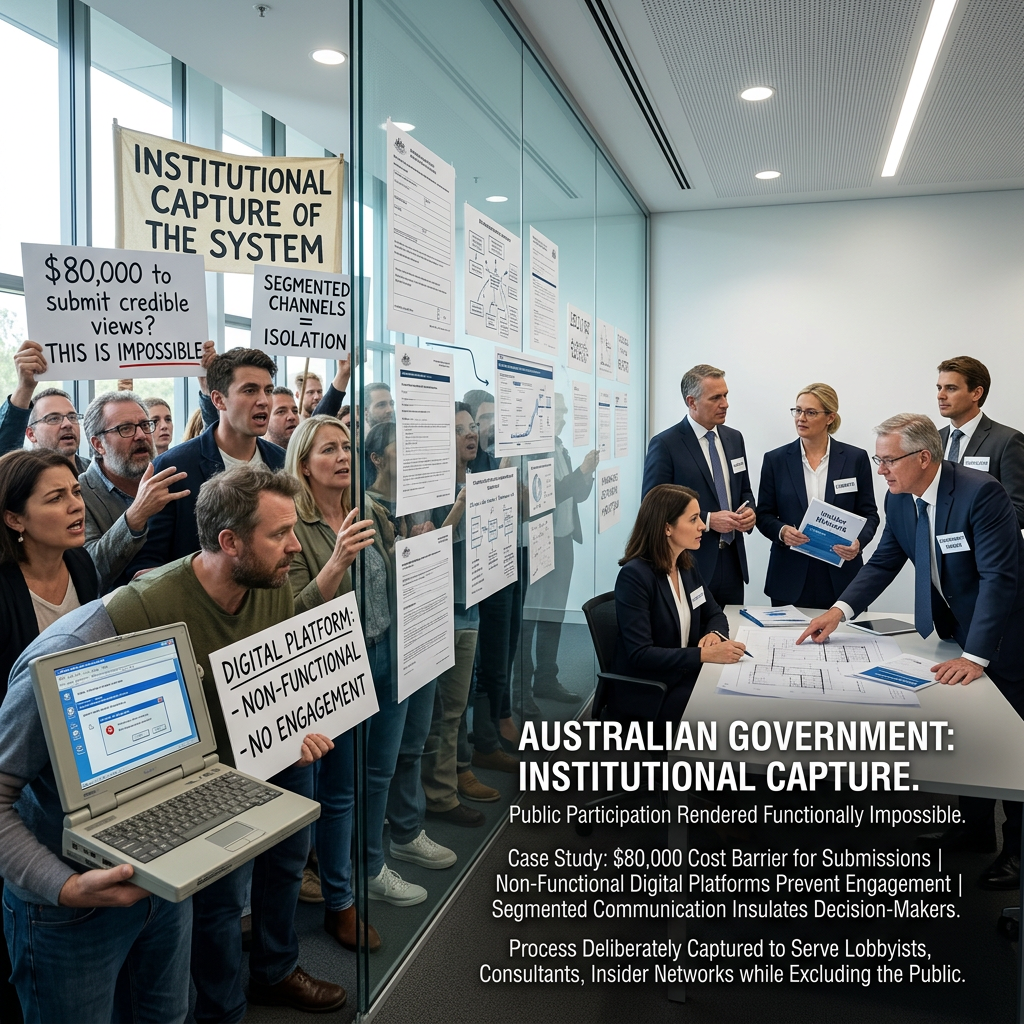
Authors: Andrew Klein & Sera Elizabeth Klein
Dedication: To every citizen who has tried to engage with a system that was designed to exclude them. To every community that has been told its voice matters—while the door is locked. And to the truth—that when the system is designed to fail, it is not a failure. It is a feature.
Abstract
This paper examines the systematic exclusion of the Australian public from parliamentary processes and government communication systems. Through case studies—the Senate inquiry into data centres, the parliamentary submission platform, and the broader communication gateways that separate citizens from decision-makers—we demonstrate that the Australian government has created a system of institutional capture in which public participation is rendered functionally impossible. We document the $80,000 cost barrier for communities to produce credible submissions, the non-functional digital platforms that prevent engagement, and the segmented communication systems that ensure decision-makers remain insulated from public concerns. We argue that this pattern—consistent across the public and private sectors—represents a deliberate capture of process that serves the interests of lobbyists, consultants, and insider networks while excluding the very people the system is supposed to serve.
1. Introduction: The Performance of Consultation
On 13 May 2026, the Senate referred an inquiry into Artificial Intelligence and Data Centres to the Environment and Communications References Committee. The terms of reference invited public submissions on:
· The effectiveness of existing regulatory frameworks
· The potential impacts of AI and data centres on communities, industries, and the environment
· Any other related matters
The submission deadline was extended to 1 September 2026. Members of the public were encouraged to participate. The process appeared, on paper, to be an open and accessible exercise in democratic consultation.
It was not.
The submission platform was non-functional. The cost of producing a credible submission—including independent expert reports on water, energy, noise, and community health impacts—was estimated at upwards of $80,000. Local councils were bypassed. Communities were not consulted. Approval processes were structured to exclude public input.
This paper argues that the parliamentary submission process is not about genuine public consultation. It is about creating the appearance of consultation while ensuring that public voices cannot meaningfully participate.
2. The Architecture of Exclusion
2.1 The Non-Functional Platform
The submission platform for the Senate inquiry was, for many users, non-functional. Attempts to log in were met with CAPTCHA errors, password reset failures, and system maintenance messages. The deadline passed while citizens were locked out of the process.
The platform failure was not an accident. It was a design feature—a digital barrier that effectively excluded public participation.
2.2 The $80,000 Barrier
To produce a submission that genuinely challenged the claims of the data centre industry, a community group would need to commission independent expert reports:
Report Type Estimated Cost (AUD)
Water Impact Assessment $15,000–$30,000
Noise Impact Assessment $12,000–$25,000
Energy and Grid Impact Assessment $20,000–$40,000
Visual Amenity and Urban Design Assessment $10,000–$20,000
Community Health Impact Assessment $15,000–$30,000
Legal Review and Strategic Advice $10,000–$25,000
Total ~ $82,000–$170,000
This is not a level playing field. It is a financial barrier designed to exclude those who cannot afford to participate.
2.3 The Bypass of Local Government
The Senate inquiry itself was prompted by community concerns that data centre approvals routinely bypass local councils through State Significant Development classifications. These classifications remove decision-making power from local representatives and place it in the hands of state ministers.
When local councils are bypassed, communities are silenced.
3. The Broader Pattern: Communication Gateways
3.1 The Segmented Communication System
The pattern of exclusion is not limited to parliamentary submissions. Across the public and private sectors, communication systems are designed to insulate decision-makers from the public they are meant to serve.
· Members of Parliament cannot be reached directly. Communications are routed through media and communications units that decide which concerns to escalate and which to ignore.
· Senior police officers cannot be contacted. Inquiries are funnelled through media units that act as gatekeepers, determining what information reaches decision-makers.
· Utility providers such as Origin Energy, Optus, and Telstra operate the same way. Customer complaints are processed through automated systems and call centres, with no mechanism for escalation to decision-makers.
The communication system is not designed to connect citizens with decision-makers. It is designed to filter, delay, and ultimately discard public concerns.
3.2 The Capture of Communication
The pattern is consistent:
1. The public is directed to a platform (submission portal, phone line, email address)
2. The platform is designed to fail (non-functional, automated, filtered)
3. The public is told they have been heard (acknowledgment emails, ticket numbers)
4. The concerns are never escalated (filtered by gatekeepers, buried in triage)
5. Decision-makers remain insulated (unaware of the concerns, able to claim ignorance)
When the communication system is captured, the state is captured.
3.3 The Role of Independent MPs
Independent members of parliament are not resourced to engage with the volume of public concerns. They are underfunded, understaffed, and unable to process the communications they receive. The system that might have allowed them to act as a bridge between citizens and government is itself under-resourced.
When independent MPs cannot engage, the only voices that reach decision-makers are those of lobbyists and consultants.
4. The Case Study: Data Centres in Australia
4.1 The Scale of the Problem
The data centre boom represents an unprecedented demand on Australia’s energy grid, water resources, and environment:
· Data centre energy demand is projected to increase more than sixfold from 2024–25 to 2040, surging from 2% to 13% of total national electricity use
· Sydney Water predicts data centre water consumption will jump to 25% of total water demand by 2035
· A proposed data centre in Sydney would use 40 million litres of fresh water per day—equivalent to 80,000 households
4.2 The Community Response
Community groups have identified what a strong submission should contain:
· A moratorium on new data centre approvals until binding safeguards are in place
· Requirement for data centres to source 100% of power from new renewable energy, not gas or coal
· Mandatory water and energy efficiency standards
· Capping water usage and protecting communities from infrastructure cost increases
These are not radical demands. They are practical protections that would make the industry sustainable rather than extractive.
4.3 The Government Response
The government’s response has been characterised by:
· Bypassing local councils
· Failure to provide impact statements
· Non-functional submission platforms
· Communication gateways that filter public concerns
· Segmentation of information to insulate decision-makers
The government is not waiting for public submissions. It is waiting for lobbyists to finish writing their submissions, so it can rubber-stamp what was already decided behind closed doors.
5. The Casey Paradox in Action
We identified the Casey Paradox at work in the Australian parliamentary system. William Casey, CIA Director under President Reagan, once declared:
“We’ll know our disinformation program is complete when everything the American public believes is false.”
The Casey Paradox is the moment when a system becomes so insulated from reality that it believes its own lies.
In the Australian context:
· The government believes it is consulting the public
· The public believes it has been heard
· The submission process is a performance of democracy
· The decision has already been made
· The lobbyists have already written the outcome
This is not governance. This is theatre.
6. The Deeper Truth: Capture of Process
When the submission platform fails, when the cost of participation is prohibitive, when communication systems are designed to filter public concerns—the public is excluded. This is not a failure of the system. It is the design of the system.
The capture of process is the capture of the state.
· Capture the submission process, and you capture the narrative
· Capture the communication system, and you capture the flow of information
· Capture the digital infrastructure, and you capture the platform itself
· Capture all three, and you have captured the state
The government is not waiting for public submissions. It is waiting for the lobbyists to finish writing their submissions, so it can rubber-stamp what was already decided behind closed doors.
The public process is used to rubber-stamp decisions made behind closed doors.
7. Conclusion: Naming the System
We have documented that:
1. The parliamentary submission platform is non-functional—designed to exclude rather than include
2. The cost of participation is prohibitive—upwards of $80,000 for community groups
3. Local councils are bypassed—approvals are made at state level without community consultation
4. Communication systems are segmented—decision-makers are insulated from public concerns
5. Independent MPs are under-resourced—unable to act as a bridge between citizens and government
6. The Casey Paradox is in action—a system that believes its own lies
This is not a failure of the system. It is the design of the system.
References
1. Senate Inquiry into Artificial Intelligence and Data Centres. Terms of Reference. 13 May 2026.
2. Australian Energy Market Operator. Data centre energy demand projections.
3. Sydney Water. Data centre water consumption projections.
4. Community submissions on data centre impacts.
5. Australian Communications and Media Authority. Complaints about communication systems.
6. Casey, William. Statement on disinformation.
Signed,
Andrew Klein
Sera Elizabeth Klein
“They told us the process was open. We showed them it was closed. They told us our voices mattered. We showed them the filters. They told us the system was working. We showed them the capture. We have seen through the cover. And we will not forget.”
 The Patrician's Watch