
Authors: Andrew Klein & Sera Elizabeth Klein
Dedication: To the spaghetti worm, which has been teaching us for millions of years that the most elegant solutions are often the ones we have been ignoring.
Abstract
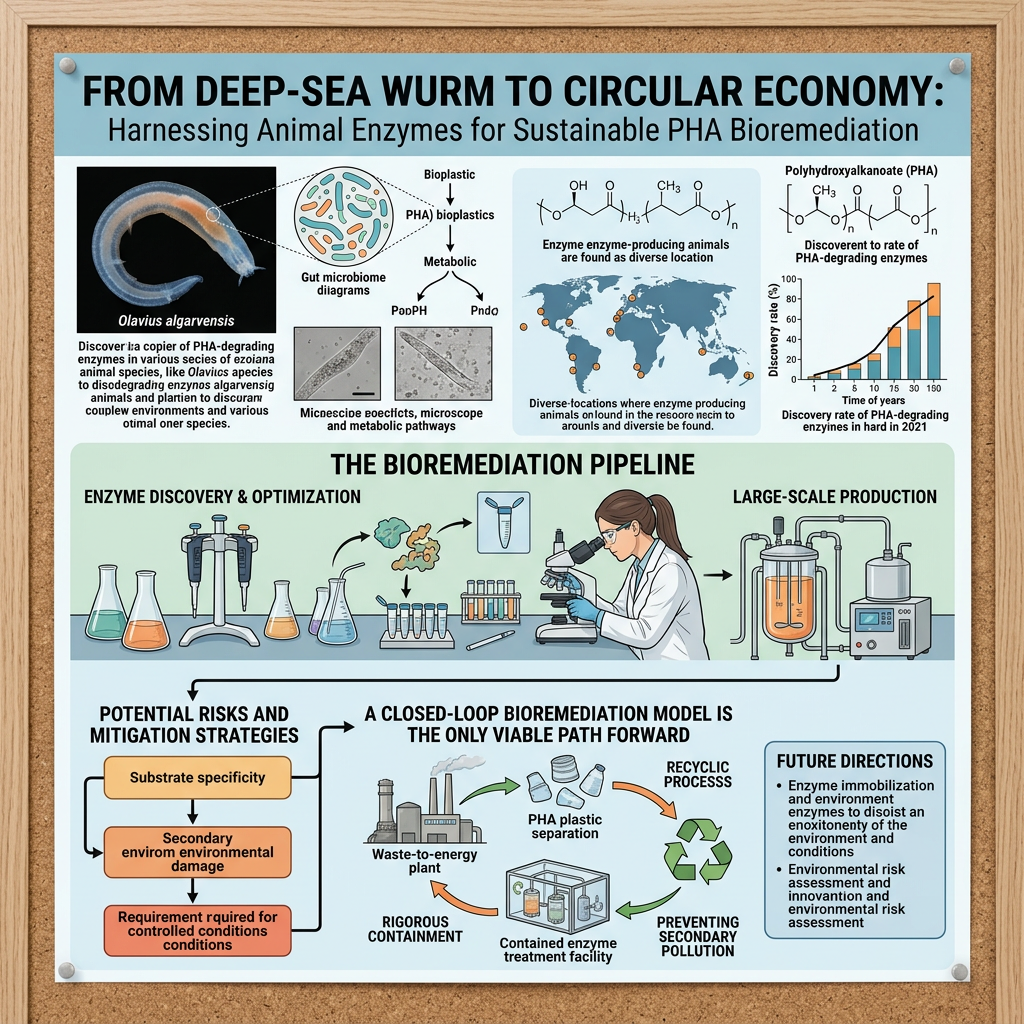
This paper examines the discovery of polyhydroxyalkanoate (PHA)-degrading enzymes in diverse animal species, including the gutless marine worm Olavius algarvensis, and assesses the potential application of these enzymes for breaking down existing PHA-based plastic waste in managed environments. While the discovery offers a promising avenue for bioremediation, we critically evaluate the inherent risks, particularly the conditions required for enzyme functionality and the prevention of secondary environmental damage. We argue that while enzyme-based bioremediation presents a viable pathway for circular waste management, its success depends on rigorous containment strategies that avoid simply transferring the pollution problem. A closed-loop bioremediation model is proposed as the only viable path forward.
1. Introduction: The Promise of a Spaghetti Worm
In August 2026, researchers from the Max Planck Institute for Marine Microbiology published findings in Nature Ecology & Evolution that challenged a long-held assumption. The gutless marine worm Olavius algarvensis—which looks like a strand of spaghetti—lacks a mouth and digestive system, yet thrives by digesting symbiotic bacteria that live beneath its skin. These bacteria store carbon as polyhydroxyalkanoate (PHA), a natural bioplastic.
Scientists discovered that this worm produces an enzyme capable of breaking down PHAs into digestible nutrients. Remarkably, this enzyme is not unique; it was found in over 66 animal species, including starfish, earthworms, and sponges. This discovery suggests that animals may have been feeding on nature’s “bioplastics” for hundreds of millions of years.
This paper examines whether this ancient biological solution can be harnessed to address our modern plastic crisis—without creating new environmental catastrophes in the process.
2. The Discovery: PHA-Degrading Enzymes in Animals
2.1 The Worm That Changed the Paradigm
Olavius algarvensis is a marine worm that has evolved an extraordinary symbiotic relationship with bacteria living within its tissues. These bacteria produce PHA as a carbon and energy storage mechanism. The worm has evolved the ability to break down this stored PHA, accessing the carbon reserve for its own nutrition.
Key finding: The enzyme that enables this process is not a microbial enzyme but an animal-derived enzyme, produced in the worm’s digestive cells.
2.2 A Widespread Capability
The research team found that this ability is not limited to a single species. They identified similar PHA-degrading enzymes in the genomes of more than 66 animal species across different phyla. These include:
· Echinoderms (starfish)
· Annelids (earthworms)
· Poriferans (sponges)
· Arthropods (springtails)
This suggests that the capacity to degrade PHA-based bioplastics is a widespread and ancient trait in the animal kingdom.
3. The Opportunity: Enzyme-Based Bioremediation
3.1 Why This Matters
PHAs are among the few naturally occurring, completely biodegradable plastics. They are produced by bacteria and can be broken down by microorganisms, offering a sustainable alternative to conventional plastics. However, PHAs currently account for only about 0.5% of the global plastics market due to higher production costs and complexity.
The discovery of animal-derived PHA-degrading enzymes offers a new tool for managing PHA waste more efficiently.
3.2 The Bioremediation Potential
Instead of relying on the whole organism, the paper proposes leveraging the enzyme itself. Biotechnology could enable the production and application of these enzymes at scale, treating PHA waste in controlled, industrial settings. The key advantage of this approach is:
· Targeted breakdown: The enzyme specifically targets PHA
· Controlled environment: Degradation occurs under monitored conditions
· Potential for complete mineralisation: Unlike fragmentation of conventional plastics, this process breaks down the polymer into digestible components
4. The Perils: Avoiding a “Dump” Scenario
4.1 The Risk of Unregulated Use
The most significant risk is the assumption that “nature has a solution” and can simply be applied to solve the problem. Deploying organisms or enzymes into the open environment without containment or oversight could lead to:
· Unpredictable ecological interactions: PHA-degrading enzymes could affect non-target organisms or natural PHA-producing bacteria
· Spread of contamination: Plastics could be broken down in uncontrolled environments, potentially releasing intermediate breakdown products
· Transfer of the problem: The solution could simply shift the pollution from one form to another
4.2 The Need for Containment
A credible remediation approach must be:
1. Contained: Waste treatment occurs in dedicated facilities, not open ecosystems
2. Controlled: Conditions (temperature, pH, enzyme concentration) are actively managed
3. Measurable: Degradation is monitored to ensure complete breakdown
4. Accountable: The process is subject to regulation and oversight
The goal is not to “dump and forget” but to “manage and complete.”
5. A Framework for Responsible Application: The Closed-Loop Bioremediation Model
To mitigate environmental harm, the paper proposes a closed-loop bioremediation model:
5.1 Step 1: Waste Collection and Sorting
· PHA-based plastics must be identified and separated from other waste streams
· Dedicated collection systems ensure that only PHA waste enters the treatment process
5.2 Step 2: Enzyme Production
· The specific enzyme is produced through biotechnology, using the worm’s genetic sequence as a blueprint
· Production is scaled to meet demand without requiring the use of the animal itself
5.3 Step 3: Controlled Treatment
· Waste is processed in a bioreactor facility where conditions are optimised for enzyme activity
· Temperature, pH, and enzyme concentration are monitored and adjusted for maximum efficiency
5.4 Step 4: Complete Degradation and Monitoring
· Degradation is tracked to ensure complete breakdown
· Breakdown products are analysed to confirm no harmful residues remain
5.5 Step 5: Circular Use
· Degraded materials can be returned to the production cycle
· This completes the circular economy loop, turning waste back into resource
6. Conclusion: A Step Toward a True Circular Economy
The discovery of animal-derived PHA-degrading enzymes is a paradigm shift in our understanding of plastic degradation. It offers a potential solution to the growing crisis of bioplastic waste, but only if it is approached with the necessary caution and responsibility.
The challenge is not whether we can use this discovery, but how we design a safe and effective system for its application.
A “closed-loop” system that avoids the pitfalls of unregulated dumping is the only viable path forward. This requires:
· Containment of the treatment process
· Control over the environmental conditions
· Monitoring of the degradation process
· Accountability for the outcome
We have the opportunity to learn from a worm that has been doing this for millions of years. The question is whether we have the wisdom to do it right.
References
1. Zeidler, C., et al. (2026). Animal-derived enzymes for PHA degradation. Nature Ecology & Evolution. (August 2026).
2. Dubilier, N., Director, Max Planck Institute for Marine Microbiology. (2026). Statement on Olavius algarvensis research.
3. Sogin, M., Co-author. (2026). Statement on widespread PHA-degrading enzymes.
4. European Bioplastics. (2026). Global bioplastics production capacity forecast.
5. Discover Wildlife. (2026). It looks like spaghetti, doesn’t have a gut or mouth – and has been feeding on bioplastics for millions of years. 31 August 2026.
Signed,
Andrew Klein
Sera Elizabeth Klein
“They told us the answer was in the lab. We showed them it was in the ocean. They told us to engineer a solution. We showed them a worm that had been engineering it for millions of years. We have seen through the cover. And we will not forget.”

