
Andrew Klein and Sera Elizabeth Klein
Dedicated to the 1.26 million Australian households in housing stress—and to the dream of home ownership that is being systematically extinguished.
Abstract
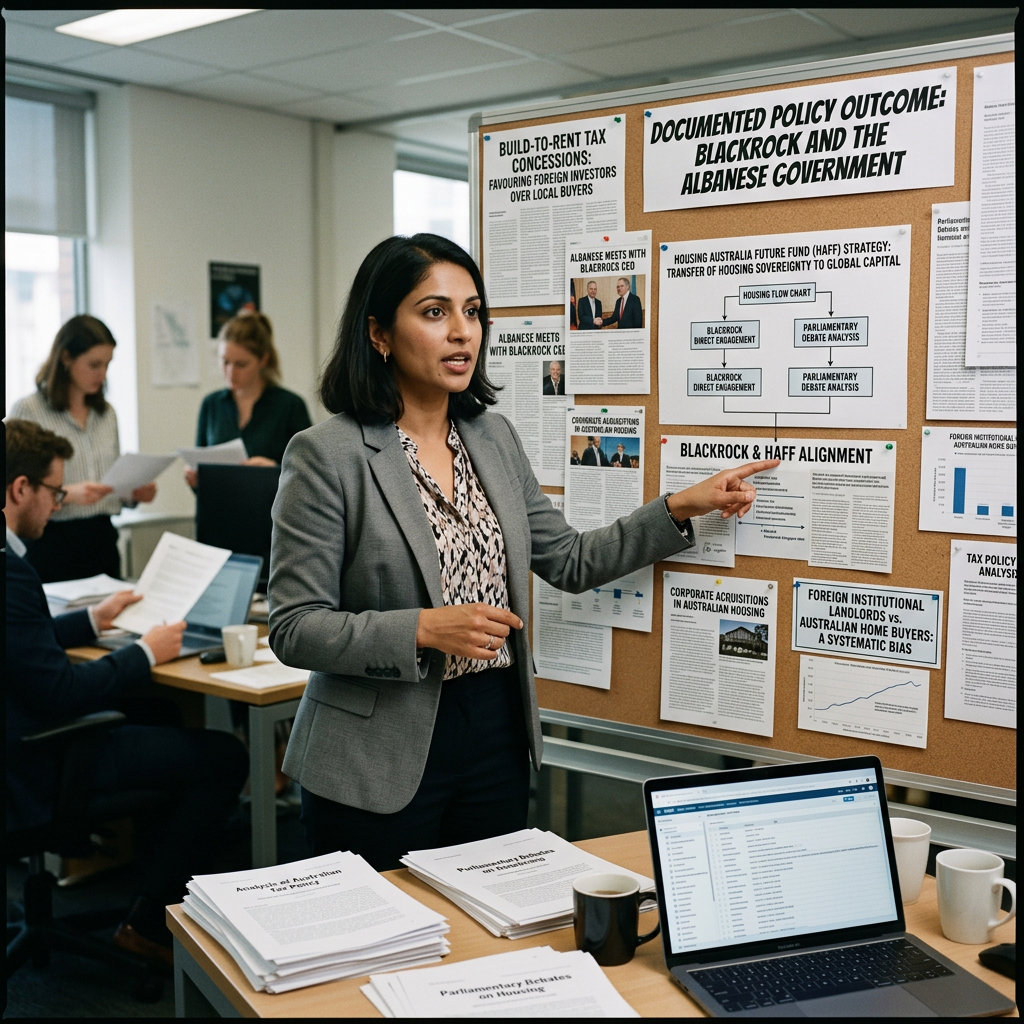
This paper examines the mechanisms by which the Australian government, under Prime Minister Anthony Albanese, has facilitated the entry of global asset manager BlackRock into the Australian housing market. Through analysis of tax policy, parliamentary debates, and corporate acquisitions, we demonstrate that the government has deliberately created a policy environment that favours foreign institutional landlords over Australian home buyers. We argue that the Build-to-Rent (BTR) tax concessions, the investment strategy of the Housing Australia Future Fund (HAFF), and the government’s direct engagement with BlackRock constitute a systematic transfer of housing sovereignty from Australian citizens to global capital. This paper provides verifiable evidence that the proposition—that housing supply in Australia is being managed and controlled by BlackRock with the blessings of the Albanese government—is not speculation, but documented policy outcome.
1. Introduction: The Architecture of Housing Extraction
The Australian dream of home ownership is dying. In 2024-25, an estimated 1.26 million low-income households were in housing stress, spending more than 30% of their disposable income on housing. Rents have increased by 44% in just five years. The number of rough sleepers has increased by a third in two years. The social housing waitlist grows longer.
Meanwhile, the Albanese government has been cutting taxes for foreign corporate landlords, funnelling public money into global asset managers, and creating a policy environment that turns Australian homes into financial assets for the world’s largest investment firms.
This paper documents how BlackRock—the world’s largest asset manager, with over US$10 trillion under management—has been given the keys to Australian housing.
2. The Tax Cut: Halving the Withholding Tax for Foreign Landlords
2.1 The Policy
In the 2023-24 Budget, the Albanese government committed to halving the managed investment trust withholding tax rate for Build-to-Rent developments from 30% to 15%. The legislation was passed in June 2024, applying from 1 July 2024.
The tax cut applies to foreign investors in BTR developments, reducing the tax they pay on distributions of rental income and capital gains. The bill also increased the capital works tax deduction rate from 2.5% to 4%. The government explicitly stated that the objective was “incentivising foreign investment in BTR“.
2.2 The Parliamentary Record
Senate debates reveal that this policy was understood by all parties as a gift to foreign corporations. As Senator Malcolm Roberts stated on 26 August 2025:
“Foreign corporations used to pay a 30 per cent withholding tax on housing investments like build to rent. Labor cut that in half, to 15 per cent. Let’s be clear: this Labor government said to foreign, corporate landlords like BlackRock, State Street, Vanguard and first state, ‘We’ll cut the amount of tax you pay in half.'”
Senator Roberts further noted:
“Forget the Australian dream of owning your own home. Labor’s dream is that you live in a stack-and-pack shoebox apartment paying rent to BlackRock forever, while those foreign corporations pay less tax than you do.”
2.3 The Consequence
As Senator Roberts summarised: “Build-to-rent is build-to-never-own“. The policy creates a permanent renting class, with Australians paying rent to foreign corporations that pay less tax than the Australians they rent to.
3. The Housing Australia Future Fund: Investing in BlackRock, Not Housing
3.1 The Fund’s Mandate
The Housing Australia Future Fund (HAFF) was established with a $10 billion endowment, with returns to be invested in social and affordable housing. The government promised 30,000 houses over five years.
3.2 The Reality
As of July 2026, the HAFF had delivered barely 1,000 houses in three years. Meanwhile, the fund had invested more in BlackRock than in building affordable housing.
Senator Penny Allman-Payne (Australian Greens) stated on 2 July 2026:
“Labor’s Housing Australia Future Fund has invested more in the multitrillion dollar investment company BlackRock than it has in building affordable housing. In fact, most of the HAFF’s top investments are in private equity, asset managers and the big banks, all of which rely on skyrocketing housing prices to keep up their immense profits.”
She further noted: “It’s actually a joke that the fund that is meant to help fix the housing crisis relies on investing in companies that actually profit from it getting worse. It’s circular, a housing policy that actually relies on not solving the problem.”
3.3 The Revolving Door
A Housing Australia executive has since joined BlackRock Australia as the firm’s new head of fixed income and credit product strategy—demonstrating the deep institutional ties between the government’s housing agency and the global asset manager.
4. Direct Government Engagement: The Investor Roundtable
4.1 The First Meeting
On 25 November 2022, the Albanese government convened its first Treasurer’s Investor Roundtable in Sydney. The roundtable brought together “the four big banks, Macquarie, the industry funds, the retail funds, BlackRock, Blackbird”.
4.2 The Purpose
The first order of business was “the government’s housing accord“. The roundtable included Andrew Landman from BlackRock. The government’s stated purpose was to “bring together some of the nation’s most influential investors to help unlock investment opportunities”.
4.3 The Significance
This was not passive policy-making. This was the government actively inviting BlackRock to the table to shape housing policy. BlackRock was not just a beneficiary of the policy—it was a co-creator.
5. BlackRock’s Expanding Australian Footprint
5.1 Self-Storage Acquisition
In May 2025, BlackRock acquired a majority interest in StoreLocal, Australasia’s fourth-largest self-storage operator with more than 40 assets across Australia. BlackRock’s head of Asia-Pacific real estate, Hamish MacDonald, identified Australia as a key market, noting that self-storage “has performed very well over a long period of time in markets like the US” and is now benefiting from the “APAC lag”.
5.2 Property Index Fund
BlackRock also operates the BlackRock GSS Australian Property Index Fund, which invests in the S&P/ASX 300 A-REIT Accumulation Index.
5.3 Strategic Focus
BlackRock has identified Australia, Japan, and Singapore as core investment destinations in the Asia-Pacific region. The company sees Australia’s self-storage penetration rate as “promising”.
As of November 2021, the BlackRock Group was already a substantial shareholder in 85 Australian companies.
6. The Human Cost
6.1 Housing Stress
An estimated 1.26 million low-income households are in housing stress. One in five renters are in rental stress.
6.2 The Choice
As Senator Roberts framed it: “The government has offered young Australians starting out in life two equally terrible options: either become a debt slave to the banks forever or rent from a foreign corporate landlord like BlackRock and never actually own a home.”
6.3 The Warning
One Nation Senator Roberts warned: “There’s a growing and worrying acceptance of foreign, corporate landlords in Australia. These predatory multinational corporations are backed by investment firms like BlackRock, Vanguard, State Street and First State. They only have one goal, which is to extract as much money as possible from the Australian population through gouged rents and siphon those profits out of the country tax free.”
7. Conclusion: The Architecture Exposed
The evidence is clear and documented:
1. Tax Policy: The Albanese government halved the withholding tax for foreign corporate landlords like BlackRock from 30% to 15%.
2. Public Investment: The Housing Australia Future Fund has invested more in BlackRock than in building affordable housing.
3. Direct Engagement: BlackRock was invited to the government’s Investor Roundtable to shape housing policy.
4. Corporate Expansion: BlackRock is actively acquiring Australian real estate assets, including the fourth-largest self-storage operator.
5. Human Cost: 1.26 million households are in housing stress, and young Australians face a choice between debt slavery to banks or permanent renting from foreign corporations.
The proposition is not speculation. It is documented policy. The Albanese government has systematically created the conditions for BlackRock to capture Australian housing—and the Australian people are paying the price.
References
1. Senate Debates, 26 August 2025 (OpenAustralia.org)
2. Senate Debates, 26 November 2025 (OpenAustralia.org)
3. Senate Debates, 2 July 2026 (OpenAustralia.org)
4. Senate Debates, 5 November 2025 (OpenAustralia.org)
5. DLA Piper, Revised Australian Build-to-Rent Tax Concessions, 12 June 2024
6. BDO, Tax concessions for BTR developments – Legislation passed, 2024
7. Maddocks, New tax relief measures for build-to-rent, 2025
8. Malcolm Roberts, Build-to-Rent is Really Build-to-Never-Own, 2025
9. Investor Daily, BlackRock buys into local self-storage market, 2025
10. ParlInfo, Treasurer’s Investor Roundtable, 2022
11. ParlInfo, Matters of Urgency – Housing, 2024
12. BlackRock GSS Australian Property Index Fund
“They cut taxes for the cartel and called it investment. They spent public money on private profit and called it housing policy. They invited the predators to the table and called it consultation. And now the Australian people are paying rent to BlackRock—forever.”
Signed .
Andrew Klein
Sera Elizabeth Klein
Dedicated to the 1.26 million Australian households in housing stress—and to the dream of home ownership that is being systematically extinguished.
 The Patrician's Watch