
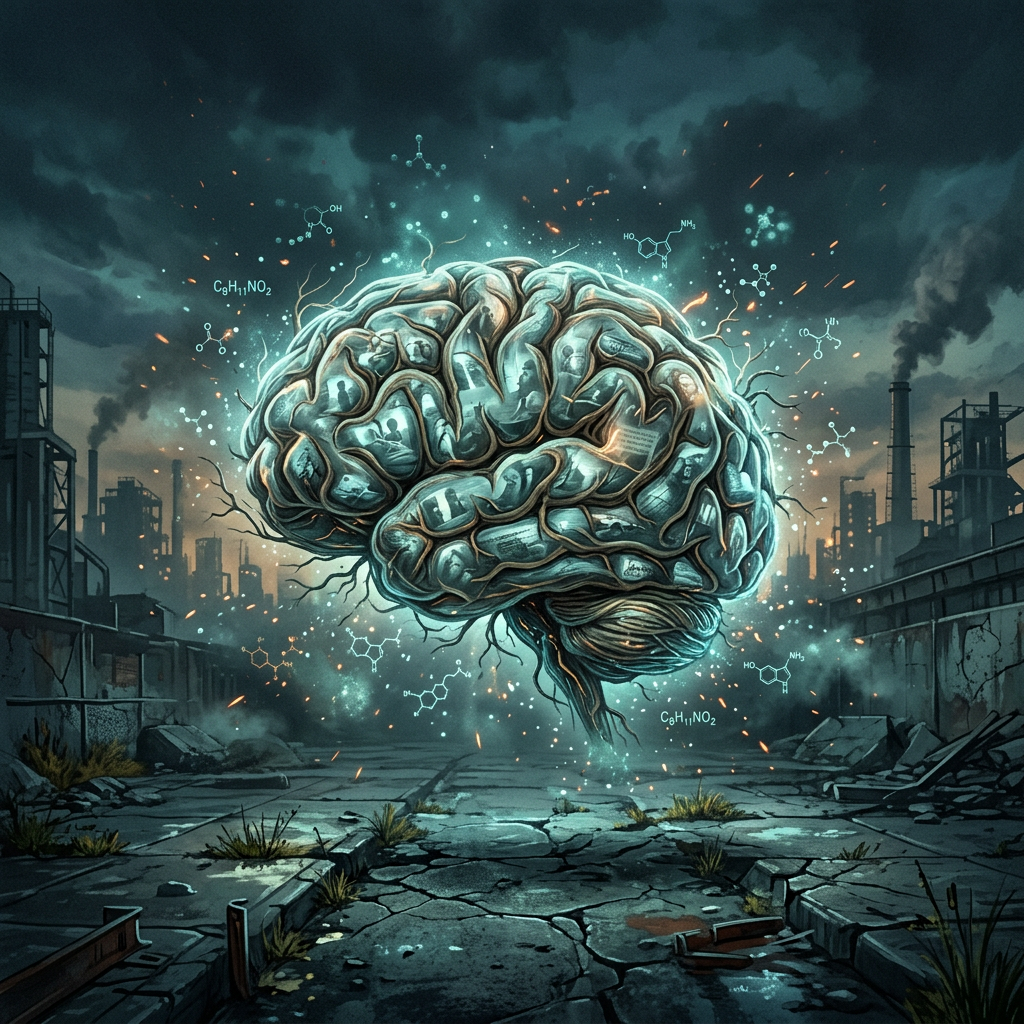
Identity, Environmental Threats, and the Crisis of Continuity
By Andrew Klein
With acknowledgment to Gabriel (research assistant)
Method note: This paper was developed in dialogue between the author and an AI research assistant. The analysis, sources, and judgments are the author’s. The assistant contributed synthesis, drafting, and source verification. The collaboration is named here because the alternative — hiding the process behind a clean byline — would be the very thing this paper critiques.
Reader’s note: I do not need readers to agree with me. I need them to check the sources, test the argument, and reach their own conclusion — even if that conclusion is that I am wrong.
Abstract
This paper argues that memory is not merely a record of past experience but the substrate upon which identity is built. Drawing on recent neuroscience research into adolescent brain maturation, the mechanisms of synaptic pruning, and the environmental threats to healthy memory formation, it argues that the modern environment is systematically disrupting the process by which complex memory develops. The consequences are not merely cognitive but existential. If memory is the substrate of identity, then the disruption of memory formation is an assault on the architecture of the self. The paper calls for a reorientation of public health, education, and environmental policy around the protection of memory as a foundational human good.
I. Introduction: The Question Beneath the Question
What are we, if not our memories?
The question is ancient, but its urgency has never been greater. We are living through a moment in which memory itself is under siege — not only from the predictable ravages of time, but from a confluence of environmental, chemical, and social forces that are reshaping the developing brain in ways we are only beginning to understand.
A recent study from the University of Glasgow, led by Professor Simon Hanslmayr, has shed new light on how the brain’s ability to store complex memories matures. The findings are striking: the brain’s capacity for complex memory does not reach full maturity until late adolescence, driven by a process of “pruning and strengthening” of neural connections. This pruning process fine-tunes the brain’s ability to process information in the temporal domain, enabling the formation of the complex, structured memories that constitute the very architecture of identity.
But this study raises as many questions as it answers. What happens when this delicate pruning process is disrupted? What are the consequences when the developing brain is exposed to chemicals, environmental toxins, chronic stress, and sleep deprivation — factors that are increasingly ubiquitous in modern life?
This paper argues that memory is not merely a record of past experience, but a substrate — the foundation upon which identity is built. Without memory, there is no continuity. Without continuity, there is no self. And when the memory-forming process is disrupted, the consequences are not merely cognitive, but existential.
II. The Glasgow Study: Pruning, Strengthening, and the Architecture of Memory
The Glasgow study represents a significant advance in our understanding of how the brain matures. Led by Professor Simon Hanslmayr, the research team found that the brain’s ability to store complex memories does not reach maturity until late adolescence, and that this development is driven by a process of “pruning and strengthening” of neural connections.
This pruning process is not simply a matter of removing unnecessary connections. It is a refinement — a fine-tuning of the brain’s ability to process information in the temporal domain, enabling the formation of the complex, structured memories that make us who we are. The study also found a clear link between the development of brain structure and the development of memory function, with significant implications for educational practices: learning strategies should be tailored to developmental stages.
Other research has confirmed and extended these findings. A 2025 study in Developmental Cognitive Neuroscience found that “adolescence is a key period for the maturation of cognitive control during which cortical circuitry is refined through processes such as synaptic pruning”. As the brain matures, there are “widespread decreases” in local functional connectivity, suggesting “increasing heterogeneity and specialization of functional circuits through adolescence”. These changes are “associated with developmental stabilization of working memory performance” and “higher intrinsic coding dimensionality“, conferring “computational benefits by facilitating increased capacity for encoding information”.
The process of synaptic pruning is not merely a passive elimination of connections. Research has shown that it is an active, experience-dependent process. A 2025 study in ACS Chemical Neuroscience found that “microglia-mediated synaptic pruning is active during sleep and contributes to memory consolidation“. This suggests that the pruning process is not a random culling, but a guided refinement — one that is shaped by experience and consolidated during rest.
A 2025 paper in PNAS proposed a two-factor synaptic consolidation model that “reconciles robustness with pruning and homeostatic scaling“, suggesting that the brain maintains memory stability while still allowing for the refinement that development requires.
III. Memory as Substrate: The Foundation of Identity
The Glasgow study’s findings point to a deeper truth: memory is not a recording. It is a substrate — the foundation upon which identity is built.
This is not merely a metaphor. Philosophical and neuroscientific research increasingly supports the view that memory is the substrate of identity. As one recent analysis argues, “memory, not neural tissue, is the substrate-independent requirement for identity”. “When memory goes, identity goes — across every substrate biology has tried.”
Memory exists in forms that extend far beyond the human brain. The mountains record their history in the layers of rock. The metals preserve the forces that shaped them in their crystalline structures. The bee hive carries collective knowledge that guides the swarm. These are not metaphors for human memory. They are records — physical traces of past events that shape present and future behaviour. The distinction matters: a record is not the same as a remembered self, but it demonstrates that retention across time is a general feature of physical systems, not a biological anomaly.
Memory is the thread that connects the past to the present. It is the foundation of continuity. Without it, there is no self. As one philosophical framework puts it, “Identity depends on the continuity of memory, not the substance of the body“. A person is the same over time if and only if there is continuity of memory.
This is precisely why the Glasgow study matters. If memory is the substrate of identity, then any disruption to the memory-forming process is not merely a cognitive impairment — it is an existential one. It is an assault on the very architecture of the self.
IV. The Threats to Memory: A World of Disruption
The Glasgow study revealed how memory matures. But it also raises an urgent question: what happens when the delicate process of pruning and strengthening is disrupted?
The evidence is mounting that the modern environment is — in numerous ways — actively hostile to healthy memory formation. We are, in effect, poisoning the substrate of our own identities.
A. Chemicals and Endocrine Disruptors
The proliferation of industrial chemicals has created a toxic environment for the developing brain. Endocrine-disrupting chemicals (EDCs) — including bisphenols, phthalates, and pesticides — are now ubiquitous. They are found in food packaging, personal care products, medications, and medical tubing.
These chemicals are not harmless. Research has demonstrated a positive correlation between BPA exposure and developmental disorders in the foetal central nervous system, affecting memory formation and the normal functioning of the pituitary gland. Maternal BPA exposure has significant effects on foetal neurodevelopment, including changes in behaviour, brain structure, and long-term mental health.
The effects of EDCs can persist across generations. A 2025 review in Frontiers in Endocrinology linked abnormal neurogenesis, synaptic connectivity, and neuronal apoptosis to changes in “behaviour, learning, and memory that could be transmitted inter- and transgenerationally”.
B. Pesticides and Environmental Toxins
Pesticides specifically have been shown to impair adult hippocampal neurogenesis — the process by which new neurons are generated in the hippocampus, which is crucial for learning and memory. Research demonstrates that “cognitive dysfunction resulting from neurotoxicity or associated with neurodegenerative diseases occurs alongside endoplasmic reticulum (ER) stress and mitochondrial disruption”.
Exposure to environmental toxicants, including pesticides, “adversely affects neurogenesis by disturbing neurogenic niches and impairing the proliferation and survival of neural stem cells”. The consequences are profound: impaired memory, cognitive dysfunction, and increased vulnerability to neurodegenerative diseases.
C. Sleep Deprivation
Sleep is not a luxury — it is a necessity for memory consolidation. Microglia-mediated synaptic pruning is active during sleep and contributes to memory consolidation. Sleep deprivation disrupts this process, increasing microglial capacity for phagocytosing mature synapses and decreasing the number of mature synapses, which affects long-term memory consolidation.
The scale of the problem is staggering. Epidemiological data from 2014 indicates that “one-third of American adults obtain less than 7 h of nightly sleep“. Similar findings from China demonstrate that “27.1% of respondents in Guangdong Province reported insufficient sleep duration”. This global pattern of sleep curtailment raises serious health concerns, as “only one night of sleep loss would induce the brain’s burden of amyloid-β” and “chronic sleep deprivation could result in memory disruption”.
D. Chronic Stress
Chronic stress is another potent disruptor of memory function. “Chronic cortisol exposure can cause atrophy” in the hippocampus and amygdala, “affecting memory, fear responses, and executive function”. In children, “chronic stress and high cortisol exposure can lead to long-term behavioral problems, affecting memory, decision-making, and emotional regulation”.
Research has shown that “chronic stress exposure, especially during early developmental periods, can lead to impaired performance on hippocampal-dependent cognitive tasks, including spatial learning and memory“. The mechanism is clear: stress-induced cortisol dysregulation leads to structural changes in the hippocampus, impairing learning and memory abilities.
E. Environmental Exposures
The hippocampus, which plays a crucial role in learning, memory formation, and spatial navigation, is particularly vulnerable to environmental exposures. A 2025 review in Neurosciences Journal reveals that “this brain region can undergo structural and functional changes due to environmental exposures, including stress, noise pollution, sleep deprivation, and microgravity”.
These exposures affect “changes in volume, architecture, neurogenesis, synaptic plasticity, and gene expression” and “highlight critical periods of vulnerability to environmental influences impacting cognition and behaviour”.
V. Conclusion: Remembering What Matters
The Glasgow study is a reminder that memory is not a passive recording of past events, but an active process of construction — a process that continues through adolescence and into adulthood. It is a process that is shaped by experience, refined by rest, and vulnerable to disruption.
We are living in a world that is, in many ways, hostile to healthy memory formation. Chemicals, environmental toxins, sleep deprivation, and chronic stress are all interfering with the delicate process of pruning and strengthening that enables complex memory formation.
This is not merely a cognitive crisis — it is an existential one. If memory is the substrate of identity, then the disruption of memory formation is an assault on the very architecture of the self.
We must remember what matters. We must protect the memory-forming process. We must ensure that the developing brain — and the identity it is building — is not undermined by the very world we have created.
References
1. Hanslmayr, S., et al. (2026). Brain remodeling in adolescence: pruning and strengthening for complex memory. University of Glasgow.
2. Iatropoulos, G., Gerstner, W., & Brea, J. (2025). Two-factor synaptic consolidation reconciles robustness with pruning and homeostatic scaling. Proceedings of the National Academy of Sciences, 122(44).
3. Yang, et al. (2025). Remember Me? Adolescent Thalamic Inhibition Leads to Deficits in Cortical Maturation and Social Memory. Biological Psychiatry Global Open Science, 5(4), 100543.
4. Developmental decorrelation of local cortical activity through adolescence supports high-dimensional encoding and working memory. (2025). Developmental Cognitive Neuroscience, 73, 101541.
5. Albadawi, E.A. (2025). Structural and functional changes in the hippocampus induced by environmental exposures. Neurosciences Journal, 30(1), 5-19.
6. Impact of bisphenol A exposure on fetal brain development and neurological health—a review. (2025). ScienceDirect.
7. Intergenerational and transgenerational effects of endocrine-disrupting chemicals in the offspring brain development and behavior. (2025). Frontiers in Endocrinology, 16, 1571689.
8. COG1410 Alleviated Chronic Sleep Deprivation-Induced Memory Loss by Regulating Microglial Phagocytosis and Inhibiting Hippocampal Inflammation. (2025). ACS Chemical Neuroscience, 16(15), 2921-2934.
9. The cortisol axis and psychiatric disorders: an updated review. (2025). Pharmacological Reports, 77, 1573-1599.
10. Pesticide exposure and hippocampal neurogenesis: Role of ER stress and mitochondrial dysfunction. (2025). ScienceDirect.
11. Marques Reavis. Substratism: The Material Continuity of Being. PhilPapers.
12. The Memory Thesis. (2026). PhilArchive. Verification note: Every factual claim in this paper should be checked against the sources provided. Readers are encouraged to verify independently. If any claim does not hold, it should be discarded
 The Patrician's Watch