
By Andrew Klein and Sera Elizabeth Klein
Reader’s note: We do not need readers to agree with us. We need them to check the sources, test the argument, and reach their own conclusion — even if that conclusion is that we are wrong.
Abstract
This paper examines the structural insulation of Australian political leadership from the consequences of its decisions. It argues that insulation operates through three interlocking mechanisms: physical architecture (continuity-of-government infrastructure), economic architecture (the revolving door between public office and private interest), and political architecture (the absence of meaningful accountability for demonstrated harm). Drawing on documented evidence of Australian continuity-of-government planning, the post-ministerial employment record, and the historical record of prime ministerial conduct, the paper argues that the “caste” analysis of Australian politics is not rhetorical but material. The separation between governed and governing is built into the physical, economic, and legal structures of the state. The paper concludes that the legitimacy deficit identified in Australian politics is not a failure of communication but a structural feature of a system designed to protect its leadership from consequence.
I. Introduction: The Question of Consequence
In December 2019, as bushfires burned across Australia, the Prime Minister was in Hawaii. Scott Morrison had taken a family holiday. The fires were escalating. Eight people had died. More than 700 homes had been destroyed. When the news broke, Morrison cut the trip short, returned to Australia, and apologised for causing “great anxiety”.
The apology was accepted. The holiday was forgotten. Morrison remained Prime Minister until 2022.
This paper asks a simple question: why was there no consequence? Not for the holiday — a holiday is trivial. But for the broader pattern of which the holiday was a symptom. The pattern of a leadership class that governs according to its own logic, insulated from the lives it shapes.
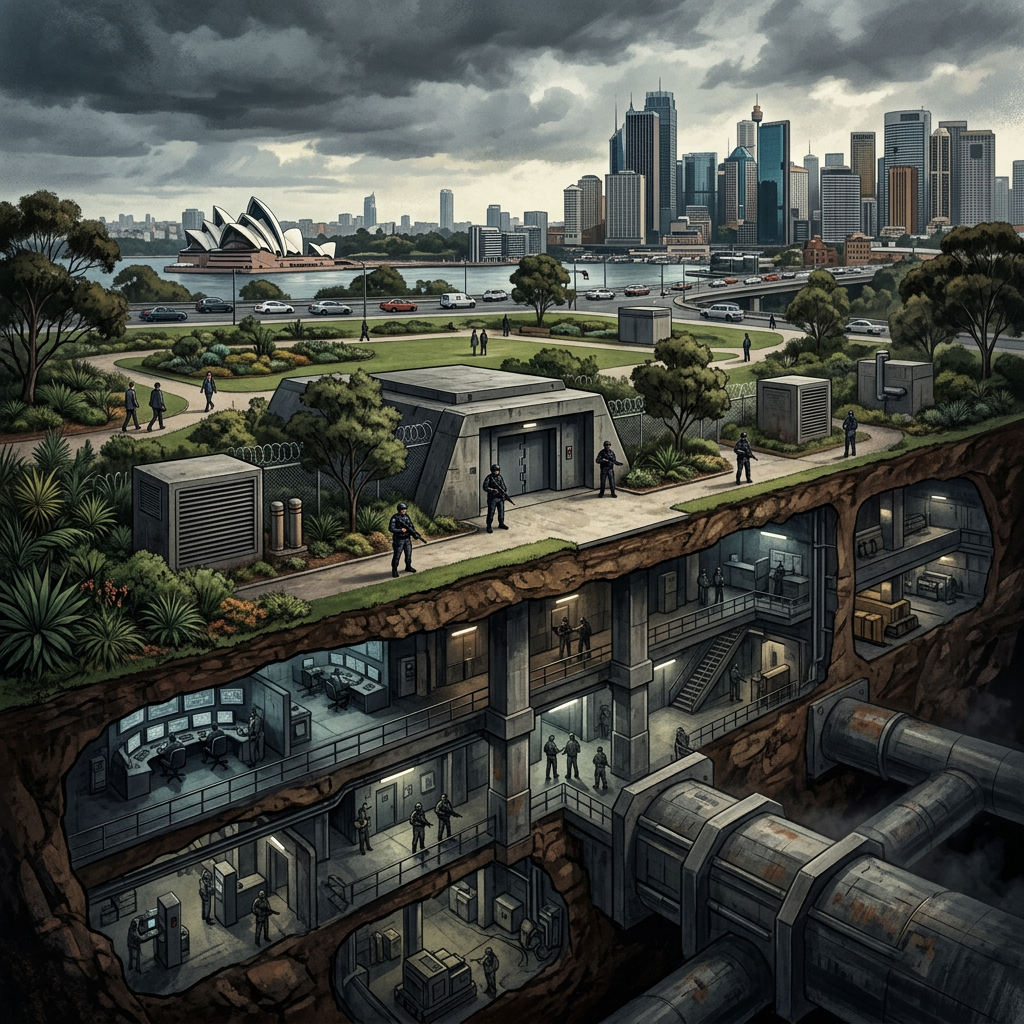
The answer, we argue, lies in the architecture of insulation. It is physical (the bunkers and plans that preserve leadership in crisis). It is economic (the revolving door that guarantees post-political prosperity regardless of performance). And it is political (the structural absence of accountability for demonstrated harm).
II. Physical Architecture: Continuity of Government
2.1 Plan Mercator
The modern Australian Government has plans to enable the continuity of government. As of 2008, these formed part of “Plan Mercator,” which the government described as aiming “to minimise the impact of a national security emergency on critical government operations and provide for the rapid resumption of ‘near normal’ government business under alternate arrangements until normal operations can be resumed”.
The plan is not a secret. It is referenced in the Australian Government Crisis Management Framework, which lists the “Continuity of Executive Government Plan (CoEG)” as a relevant national arrangement alongside counter-terrorism, disaster response, and protective security protocols.
2.2 The Bunker
In February 2005, The Age reported that the Federal Government was “set to approve a plan to move surviving cabinet members to a bomb-proof bunker a safe distance from Canberra in the event of a terrorist attack on the capital“. Cabinet’s national security committee had approved the contingency plan to ensure continuity of government.
Prime Minister John Howard confirmed the plan in answer to questions on notice. He said extra money might be needed for facilities outside Canberra from where officials could “carry out government decision-making and communicate with the public“. The plan was developed after the Department of Prime Minister and Cabinet examined the report of the United States Continuity of Government Commission. It included consideration of “mass vacancies in the Parliament or large numbers of incapacitated members or senators”.
The doomsday facility, according to government sources, “might be built into the Australian military headquarters joint operations building to be built at Bungendore near Canberra”. The emergency plan took into account “the worst-case scenario of a terrorist or, less likely, a nuclear attack on Parliament”.
2.3 The Logic of Insulation
The bunker is not a metaphor. It is a physical structure designed to preserve the leadership in the event that the population it governs is destroyed. The logic is continuity of government, not continuity of the governed.
This is the same logic that produced the US continuity-of-government programme — Raven Rock, Mount Weather, the Greenbrier bunker (exposed by the Washington Post in 1992). The sovereign is embodied in the person. The person must survive so the state survives. The population is secondary.
In 2026, the Parliamentary Joint Committee on Defence announced an inquiry into national civil preparedness and resilience, including “continuity of government” during crisis or conflict. The inquiry will examine “whole-of-nation support to National Defence for continuity of government and the availability of essential goods and services including fuel in crisis or conflict”.
The architecture of leadership survival is being upgraded. The question of what happens to everyone else remains, as ever, secondary.
III. The Historical Parallel: Château Generalship
3.1 The Image
The phrase “lions led by donkeys” entered the English language through Alan Clark’s 1961 study of the Western Front. The image it evokes — generals living in comfort in French châteaux while men died in mud — became “firmly embedded in the public mind”.
The château general is the archetype of insulation. He commands from a distance. He does not see the consequences of his orders. He dines while others die. When the war ends, he writes his memoirs. He is not held responsible.
3.2 The Historiographical Caveat
This image is contested. Revisionist historians — John Terraine, Gary Sheffield, and others — have argued that the “donkeys” thesis is a caricature. Many commanders did visit the front. Generals died at rates comparable to junior officers at some stages. Command distances in the Second World War were comparable.
The image is culturally potent. The claim is more complicated than the image. This paper does not assert the historical accuracy of the château general caricature. It uses the image as a lens — a way of seeing a pattern that recurs across institutions and eras.
3.3 The Pattern
What recurs is not the specific claim that WWI generals never visited the front. What recurs is the structural position: decision-makers physically separated from the consequences of their decisions. The château. The bunker. The Chairman’s Lounge. The safe seat.
The separation is defended by architecture, distance, protocol, and doctrine. And it produces a specific kind of decision-making — one that optimises for the preservation of the decision-maker, not the wellbeing of those affected.
IV. Economic Architecture: The Revolving Door
4.1 The Record
The revolving door between public office and private interest is not a secret. It is documented, studied, and quantified.
The Grattan Institute estimates that 25 per cent of former federal Ministers and assistant Ministers take on roles with special interests after their political career ends. At least 60 former defence ministers, senior officers and officials have moved into weapons firms or lobbying companies.
The case studies are instructive.
Julie Bishop: Served as Foreign Minister for over five years. Ceased at the end of August 2018. Commenced as a non-executive director for Palladium less than twelve months later. Palladium, a private aid contractor, had received over $600 million in DFAT contracts during the time Bishop was minister. While she was Foreign Minister, Bishop appeared in a promotional video for one of Palladium’s programmes.
Christopher Pyne: Served as Minister for Defence Industry and then Minister for Defence. In April 2019, while still a minister, he met with EY to discuss “his interest in utilising his experience as a politician and Minister to assist a professional services firm grow their private sector defence industry business“. Nine days later, EY made a formal offer. He accepted within three days. He formally ceased as Defence Minister on 26 May 2019. Within two weeks, he had commenced work for EY.
4.2 The Loophole
The Lobbying Code of Conduct requires former federal ministers and parliamentary secretaries to wait 18 months before lobbying on matters they dealt with in their final 18 months in office. The Albanese government’s new lobbying laws, introduced in 2026, leave a “pernicious” loophole which “won’t touch the ‘revolving door’ between ministerial offices and lobbying firms”, critics warn.
Transparency International Australia describes the situation bluntly: “The revolving door spins freely in Canberra”.
4.3 The Function
The revolving door is not corruption in the legal sense. The rules are followed. The 18-month cooling-off period is observed. But the function is clear: it guarantees that political service is never a sacrifice. The Minister who cuts veterans’ healthcare will find a lucrative position in a defence contractor. The Minister who oversees the NDIS will find a role with a disability services provider. The Minister who shapes energy policy will find a board seat with a fossil fuel company.
The consequence of political failure is not poverty, obscurity, or accountability. It is a career transition. The system pays for compliance with the extraction model, and it pays well.
V. Political Architecture: The Absence of Consequence
5.1 The Record Since Whitlam
Since the dismissal of Gough Whitlam in 1975, Australia has had a succession of prime ministers. Some left office after electoral defeat. Some were removed by their own parties. Some resigned. None faced serious consequences for the harms their governments inflicted.
John Howard: Took Australia to war in Iraq based on intelligence that was later found to be “overplayed” and “flawed” by the Chilcot Inquiry. The war contributed to “misery in Iraq” and, according to Andrew Wilkie, to the terror threat Australia faces today. Howard defended the decision. He was not charged. He was not tried. He remains a respected elder statesman of the Liberal Party. There were “no serious calls to hold Howard accountable for alleged breaches of international law”.
Scott Morrison: Took a holiday during the Black Summer bushfires. He later appointed himself to multiple ministries without informing Parliament or the public. The Bell Inquiry found his conduct “unnecessary” and “corrosive of public trust“. He was not charged. He was not removed. He remained Prime Minister until the 2022 election.
Kevin Rudd, Julia Gillard, Tony Abbott, Malcolm Turnbull: All left office following leadership spills or electoral defeat. All transitioned to lucrative post-political careers. None faced accountability for the harms of their governments.
5.2 The Structural Absence
The Australian Constitution offers no mechanism to punish a deceitful Prime Minister. A no-confidence motion can be put, but has “no chance of success in a rigid two-party system where the Government usually has the numbers”.
As one analysis puts it: “This is a government that does not believe in consequences. Ministers are protected. The Prime Minister is insulated. The Treasurer is indulged.” Another: “Dishonesty no longer has political consequences because we expect no better.”
The absence of consequence is not an accident. It is a structural feature. The political class is protected by party discipline, by media cycles that move on, by an electorate that has been taught to expect nothing better, and by an economy that rewards political service with post-political prosperity.
VI. The Structural Function of Insulation
6.1 The Three Architectures Together
Physical, economic, and political insulation are not separate phenomena. They reinforce each other.
The physical architecture (bunkers, COG plans) preserves the leadership in crisis, ensuring that the state continues regardless of what happens to the population.
The economic architecture (the revolving door) guarantees that political service is never a sacrifice, ensuring that the leadership class is rewarded regardless of performance.
The political architecture (the absence of consequence) ensures that the leadership is never held accountable for the harms it inflicts, ensuring that the system continues unchanged.
Together, they produce a class that is structurally incapable of experiencing the consequences of its own decisions.
6.2 The “Champagne Socialist” and the Insulated Elite
The same logic operates in the broader elite. As one analysis of “Champagne Socialism” puts it: “When affluent urbanites push for aggressive, top-down policies without considering the real-world friction, they are completely insulated from the fallout.”
The multi-millionaire media executive who advocates for eco-taxes suffers no material consequence. The academic who advocates for open borders lives behind gates. The politician who cuts the NDIS does not use the NDIS. The general in the château does not smell the trenches.
The radical ideology is, in essence, a luxury product. The elite get the moral high ground. The proletariat receives the bill.
6.3 Friedman’s Insight
Milton Friedman understood the dynamic. He wrote: “I do not believe that the solution to our problem is simply to elect the right people. The important thing is to establish a political climate of opinion which will make it politically profitable for the wrong people to do the right thing. Unless it is politically profitable for the wrong people to do the right thing, the right people will not do the right thing either, or if they try, they will shortly be out of office.”
What Friedman did not say is that political leaders are mercenary. He did not say they are stupid. He said you cannot preselect for virtue. You can only arrange the pay-offs.
The current issue in Australia is that the mediocrats, acting in their own interest, are damaging Australia because that is what the system rewards.
VII. Conclusion: The Caste and the Consequence
The question posed in earlier work — “will Australia lose Australia?” — is answered in the architecture of insulation.
The physical architecture ensures that the leadership survives even if the population does not. The economic architecture ensures that the leadership prospers even if the country declines. The political architecture ensures that the leadership is never held to account even when the harm is documented.
This is not a failure of the system. It is the system working as designed. The design preserves the leadership class, not the governed.
The legitimacy deficit — the collapse of trust, the decline of belonging, the erosion of faith in institutions — is not a problem to be solved. It is the predictable consequence of a system that has separated leadership from consequence.
The question is not whether the caste will change. It will not. The question is whether the governed will continue to accept the terms of a relationship that was never offered, only imposed.
References
1. Australian Government. (2025). Australian Government Crisis Management Framework. Department of the Prime Minister and Cabinet.
2. The Age. (2005, February 18). Government plans bomb-proof bunker for MPs.
3. Sydney Morning Herald. (2005, February 18). Canberra’s doomsday plan.
4. Parliamentary Joint Committee on Defence. (2026). Inquiry into national civil preparedness and resilience. Parliament of Australia.
5. Clark, A. (1961). The Donkeys. Hutchinson.
6. Sheffield, G. (2001). Forgotten Victory: The First World War: Myths and Realities. Headline.
7. Senate Finance and Public Administration Committee. (2019). Ministerial Standards: Inquiry Report. Parliament of Australia.
8. Grattan Institute. (2019). Post-ministerial employment analysis. Cited in Senate Committee report.
9. ABC News. (2026, August 23). Dozens of government insiders lobbying for defence industry.
10. Transparency International Australia. (2025). Revolving Doors: Position Paper.
11. The Spectator Australia. (2026, September 19). View from the Chairman’s Lounge.
12. ABC News. (2019, December 21). Scott Morrison says he accepts criticism for Hawaii holiday during bushfires.
13. Chilcot Inquiry. (2016). The Report of the Iraq Inquiry. UK Government.
14. ABC News. (2016, July 7). John Howard says Australia’s part in the Iraq War was justified.
15. 9News. (2024, January 27). ‘Dishonesty no longer has political consequences because we expect no better’.
16. Peacock, S. (2026, January 23). Labor’s Moral Holiday: Scandal, Silence, and the Normalisation of Failure. Substack.
17. Friedman, M. (1979). Free to Choose. Harcourt.
 The Patrician's Watch