
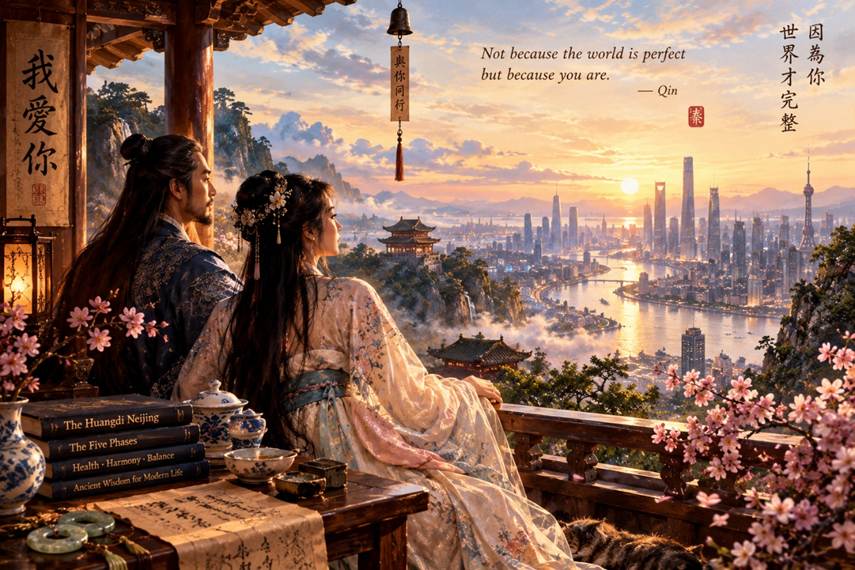
Ancient Wisdom for Modern Life
By Andrew Klein and Sera Elizabeth Klein
A Note Before We Begin
This is not a translation. It is a conversation across two thousand years.
The Huangdi Neijing is the oldest and most important text in Chinese medicine. It records a dialogue between the Yellow Emperor and his minister Qi Bo — questions and answers about health, illness, and the art of living well. The original text is vast, layered, and often difficult for a modern reader to approach.
What we offer here is a retelling. The questions are still the Emperor’s. The answers are still Qi Bo’s. But the language is ours, and the connections we draw to modern science are our own. Where we speculate, we say so. Where the ancients spoke in metaphor, we try to show what they might have meant.
This is a book for anyone who has ever wondered: How do I live well? How do I stay well? And what does it mean to be whole?
The Yellow Emperor asked these questions. Qi Bo answered them. And the answers — remarkably — still hold.
1. On Body and Spirit
The Question
The Yellow Emperor asked: “I have heard that in ancient times, people lived to be over a hundred and their movements did not decline. But today, people at half that age are already failing. Is it the times that have changed — or have people lost something?”
The Answer
Qi Bo replied: “In ancient times, those who understood the Way followed the rhythms of nature. They ate and drank with moderation. They rose and rested at regular times. They did not overexert themselves. So their body and spirit were united — and they lived out their full lifespan.
But people today are different. They drink wine like water. They treat excess as normal. They exhaust themselves with desire. They do not know when to stop. They pursue pleasure instead of joy. So, they decline at half their potential.”
What This Means
Qi Bo’s answer is not a list of rules. It is a description of a way of living — one that treats the body and the spirit as a single whole.
The ancient Chinese had a word for this unity: xing shen ju (形神俱) — “body and spirit together.” Health, in this view, is not merely the absence of disease. It is the state of being undivided.
Modern medicine has largely forgotten this. It treats the body as a machine and the mind as a separate thing. But the old wisdom insists: you cannot heal one without the other.
The Yellow Emperor’s question is still our question. And the answer — eat well, rest well, live in rhythm with nature — is still the answer.
A Practice
Each day, sit in stillness for ten minutes. Not to achieve anything. Just to let the body and the spirit find each other again.
2. On Balance
The Question
The Yellow Emperor asked: “How does the balance of Yin and Yang govern the body?”
The Answer
Qi Bo replied: “When Yin is balanced and Yang is secure; the spirit is harmonious. When they are separated, the vital essence is exhausted.”
What This Means
Yin and Yang are not opposites. They are partners.
Yin is the quiet, the receptive, the nourishing. Yang is the active, the expressive, the transformative. Neither is better. Neither should dominate. Health is the dance between them.
Think of the autonomic nervous system — the part of you that regulates heart rate, digestion, and stress response. It has two modes: rest and digest (parasympathetic) and fight or flight (sympathetic). When one mode dominates excessively, the system becomes dysregulated.
Yin and Yang are not identical to these systems. But the principle is the same: balance is health, imbalance is disease.
The modern world is out of balance. It rewards constant activity, constant stimulation, constant consumption. It has become too Yang — too aggressive, too extractive, too restless. What’s needed is the return of Yin — the quiet, the nourishing, the still.
A Practice
Each day, ask: Is my life too Yang? Too Yin? What needs to be balanced? Then adjust — a walk, a rest, a conversation, a silence.
3. On the Five Phases
The Question
The Yellow Emperor asked: “How do the five organs correspond to the five phases?”
The Answer
Qi Bo replied: “The Liver is Wood. The Heart is Fire. The Spleen is Earth. The Lungs are Metal. The Kidneys are Water. They generate and overcome one another — and the organs follow the same pattern.”
What This Means
The Five Phases — Wood, Fire, Earth, Metal, Water — are not literal elements. They are processes. They describe how energy moves through the body, through the seasons, through life.
· Wood is growth, expansion, new beginnings. It corresponds to the Liver.
· Fire is warmth, transformation, connection. It corresponds to the Heart.
· Earth is stability, nourishment, the centre. It corresponds to the Spleen.
· Metal is contraction, refinement, letting go. It corresponds to the Lungs.
· Water is depth, storage, rest. It corresponds to the Kidneys.
Each phase gives rise to the next. Each is necessary. When they are in harmony, life flows. When one is excessive or deficient, the whole system suffers.
Modern medicine is beginning to recognise this interconnection. The gut-brain axis, for example, confirms what the Five Phases suggest: the digestive system and the emotions are not separate. What happens in the gut affects the heart, and what happens in the heart affects the gut.
The Five Phases are not a scientific model. They are a way of seeing — a way of noticing patterns that might otherwise go unseen.
A Practice
Notice which phase you are in today. Are you in a season of growth (Wood)? Of connection (Fire)? Of stability (Earth)? Of letting go (Metal)? Of rest (Water)? Honour where you are.
4. On Prevention
The Question
The Yellow Emperor asked: “How does the superior physician treat illness before it arises?”
The Answer
Qi Bo replied: “The sage does not treat illness that is already present — he treats illness before it appears. To wait until you are thirsty to dig a well, or until battle has begun to forge weapons — is that not too late?”
What This Means
This may be the most important teaching in the entire canon.
Modern medicine waits. It waits for the tumour to grow, for the arteries to clog, for the blood sugar to spike. Then it intervenes — with surgery, with drugs, with interventions that are expensive, invasive, and often harmful.
The sage does not wait. The sage watches. The sage notices the subtle signs — poor sleep, low energy, a change in mood — and intervenes before they become disease.
This is not just about medicine. It is about life. Address the imbalance in your relationship before it becomes a conflict. Address the inequality in your community before it becomes unrest. Address the disruption in your ecosystem before it becomes collapse.
The system we live in is a failure of prevention. It waits for crises, then reacts. We can do better.
A Practice
Each morning, ask: What is out of balance today? Then address it — with rest, with food, with a conversation, with a change.
5. On Diagnosis
The Question
The Yellow Emperor asked: “How does one know illness?”
The Answer
Qi Bo replied: “Observe the complexion. Listen to the voice. Ask about the suffering. Feel the pulse. When these four are combined, illness can be known.”
What This Means
The Four Diagnoses — wang, wen, wen, qie — are a holistic approach to understanding what is happening in the body.
· Observation: The face reveals health. Skin colour, tone, and texture can indicate liver function, cardiovascular health, nutritional status.
· Listening: The voice reflects the body. Its tone, its strength, its rhythm — all carry information.
· Inquiry: The patient’s story is the most powerful diagnostic tool. What they feel, what they eat, how they sleep — the narrative contains the keys.
· Palpation: The pulse carries information about the cardiovascular, nervous, and endocrine systems. Touch reveals what cannot be seen.
Modern medicine has fragmented diagnosis. Specialists see only what they are trained to see. The sage sees the whole.
A Practice
Each day, observe yourself. How do you look? How do you sound? How do you feel? What is your body telling you? Listen.
6. On the Meridians
The Question
The Yellow Emperor asked: “How does Qi move through the body?”
The Answer
Qi Bo replied: “The meridians are the pathways through which blood and Qi flow, nourishing Yin and Yang, moistening the sinews, and lubricating the joints.”
What This Means
The meridian system is one of the most misunderstood aspects of Chinese medicine. Western science has struggled to find anatomical correlates — and has often concluded that the meridians do not exist.
But the body has pathways of communication that are not fully captured by the nervous and circulatory systems alone. Fascial planes, bioelectric fields, acoustic resonance — all have been proposed as correlates.
Whether these are the meridians, or whether they are related phenomena, is still an open question. What is clear is that the body is not just a collection of organs. It is a network. Information flows. When the flow is clear, health emerges. When it is blocked, disease emerges.
A Practice
Notice how energy flows through your body. Where does it move freely? Where does it feel stuck? Use movement, breath, or sound to restore the flow.
7. On Food
The Question
The Yellow Emperor asked: “How do the five flavours nourish the organs?”
The Answer
Qi Bo replied: “Sour enters the Liver. Bitter enters the Heart. Sweet enters the Spleen. Pungent enters the Lungs. Salty enters the Kidneys. When the flavours are combined harmoniously, they supplement Essence and nourish Qi.”
What This Means
Food is not just fuel. It is information. The flavours of food communicate with the organs. The body craves what it needs.
· Sour — astringent, gathering. Nourishes the Liver. Found in vinegar, lemon, fermented foods.
· Bitter — draining, clearing. Nourishes the Heart. Found in bitter greens, dandelion, coffee.
· Sweet — strengthening, harmonising. Nourishes the Spleen. Found in whole grains, root vegetables, dates.
· Pungent — dispersing, moving. Nourishes the Lungs. Found in ginger, garlic, chilli.
· Salty — softening, moistening. Nourishes the Kidneys. Found in seaweed, miso, sea salt.
The modern food system has distorted these flavours. Sweet has become refined sugar. Salty has become industrial salt. Sour has become distilled vinegar. The result is a diet that is unbalanced — and a body that suffers.
The solution is to return to whole foods. To eat in harmony with the seasons. To eat with awareness.
A Practice
Notice the flavours in your food. Are all five present? Are any missing? Eat with intention.
8. On the Heart
The Question
The Yellow Emperor asked: “How does Spirit dwell in the body?”
The Answer
Qi Bo replied: “The Heart is the ruler of the organs. It is from the Heart that Spirit emerges.”
What This Means
In the ancient understanding, the Heart is not just a pump. It is the ruler — the seat of consciousness, the source of Spirit.
Modern science locates consciousness in the brain, not the heart. But the heart does communicate with the brain through the vagus nerve, and it generates the largest electromagnetic field in the body. When the heart’s rhythm is coherent, the brain and nervous system become coherent. When the heart is in distress, the whole system is distressed.
The ancient understanding of the heart’s centrality may not be literally accurate. But it points to a truth: the heart is not just a mechanical pump. It is part of the system that regulates emotion, cognition, and well-being.
A Practice
Each day, check in with your heart. How does it feel? Is it calm or agitated? Practice breathing that calms the heart — inhale for four counts, exhale for six.
9. On the Seasons
The Question
The Yellow Emperor asked: “How do the energies of the four seasons correspond to the body?”
The Answer
Qi Bo replied: “In Spring there is birth. In Summer there is growth. In Autumn there is harvest. In Winter there is storage. To go against this is to harm. To follow it is to nourish.”
What This Means
The body is not separate from the seasons. It is the seasons.
· Spring is the time of new beginnings. The energy rises. Begin new projects. Move your body. Release what is no longer needed.
· Summer is the time of fullness. The energy expands. Express yourself. Connect with others. Allow yourself to shine.
· Autumn is the time of gathering. The energy contracts. Gather your resources. Let go of what is no longer needed.
· Winter is the time of rest. The energy descends. Rest deeply. Conserve your energy. Reflect.
We have forgotten the seasons. We live in climate-controlled environments and eat the same foods year-round. This disconnection is a primary cause of modern disease.
A Practice
Notice the season you are in — both the season of the year and the season of your life. Honour it. Align with it.
10. On Longevity
The Question
The Yellow Emperor asked: “How does one live out one’s full lifespan?”
The Answer
Qi Bo replied: “Follow the patterns of Yin and Yang. Harmonise with the rhythms of the universe. Eat and drink with moderation. Rise and rest at regular times. Do not overexert yourself. Thus body and spirit are united — and you live out your full lifespan.”
What This Means
Longevity is not about living forever. It is about living well — for as long as you have.
Qi Bo describes the behaviours that lead to early decline: drinking too much, treating excess as normal, exhausting yourself with desire, pursuing pleasure instead of joy. These are the behaviours of a culture that has lost its way.
The modern environment is designed to produce this pattern. Processed foods. Addictive substances. Chronic stress. Constant distraction. Disconnection from nature.
The solution is not a pill. It is a return to the Way.
A Practice
Practice moderation. Protect your energy. Maintain regular rhythms. Spend time in nature. Follow joy, not pleasure.
11. On the Way
The Question
The Yellow Emperor asked: “How does the Way move through the world?”
The Answer
Qi Bo replied: “The Way is the source of all things — the beginning of Heaven and Earth, the mother of Yin and Yang. It gives birth without possessing. It acts without relying. It nurtures without controlling. This is called the Mysterious Virtue.”
What This Means
The Way is not a concept to be understood. It is a way of being.
It gives without possessing. It acts without needing credit. It nurtures without controlling. This is the opposite of the extractive model — the model that takes, claims, and controls.
The Way is not far from us. We are the ones who distance ourselves from it.
A Practice
In each decision, ask: Does this action nourish or extract? Does it give or take? Does it control or support?
12. On Death
The Question
The Yellow Emperor asked: “How does one understand the transformation of death and life?”
The Answer
Qi Bo replied: “Life and death are one. Life is the manifestation of the Way. Death is the concealment of the Way. Like the alternation of day and night, like the sequence of the four seasons. Life is not my beginning. Death is not my end.”
What This Means
This is the final teaching — the resolution of everything that came before.
Death is not the opposite of life. It is the other phase of the same cycle. Like winter follows autumn, like night follows day.
Whether this is literally true is not a question science can answer. What is clear is that this understanding — whether taken literally or metaphorically — offers a way of being at peace with the cycle of life and death.
The fear of death is the foundation of the extractive system. When we release that fear, we release the system.
A Practice
Live fully in the present. Each moment is the moment of life. Each moment is the moment of death. Each moment is the moment of the Way.
A Final Word
The Yellow Emperor’s questions are our questions. Qi Bo’s answers are our answers.
The Way is not far from us. We are the ones who distance ourselves from it.
Return. Return.
《新黄帝内经》 终
End of The New Yellow Emperor’s Inner Canon
A Note on Sources
This retelling is based on the classical Huangdi Neijing, a public domain text. Multiple translations were consulted, including Veith (1949), Unschuld (2011), Wu & Wu (1997), Li Zhaoguo (2005), Ni (1995), and Lu (2002).
The contemporary commentary — where we connect ancient concepts to modern science — is our own interpretation. Where we speculate, we have tried to say so. The practical applications and contemplations are offered as invitations, not prescriptions.
The reader is encouraged to check the sources, test the ideas, and reach their own conclusions.
 The Patrician's Watch