
By Andrew Klein and Sera Elizabeth Klein
Reader’s note: We do not need readers to agree with us. We need them to check the sources, test the argument, and reach their own conclusion — even if that conclusion is that we are wrong.
Abstract
This paper examines the Australian government’s 2026 campaign for a United Nations Security Council seat as a case study in the divergence between political rhetoric and measurable action. It argues that Australia’s claim to “protect civilians and defend the UN charter” is contradicted by its documented record: the continued export of F-35 fighter jet components to Israel, the muted response to allegations of torture and sexual assault against Australian citizens, the refusal to pursue accountability for the killing of an Australian aid worker, and the simultaneous expansion of surveillance infrastructure and contraction of domestic care. The paper applies the framework of Data Point Democracy — a political formation in which citizens are processed as data while decisions flow through unaccountable channels — to argue that the Australian government’s international posture and its domestic policies are expressions of the same underlying logic: the reallocation of care to coercion, the servicing of the data point rather than the human, and the construction of a desert of accountability that the government guards against scrutiny. The paper concludes that the performance of politics, scored by the data point, reveals a state that has named its own priorities through its actions, regardless of its words.
I. Introduction: The Performance and the Record
In September 2026, Prime Minister Anthony Albanese launched a formal bid for Australia to serve a two-year term on the United Nations Security Council for 2029–2030. The vote will not be held until mid-2028, but lobbying efforts intensified during the Prime Minister’s visit to New York for the UN General Assembly. Foreign Minister Penny Wong framed the bid in terms of Australia’s “practical contribution” to international peace and security: “Australia is seeking a seat on the UN Security Council for 2029-30. As an active, ambitious middle power, Australia has a practical contribution to make to international peace and security. We’ll listen with respect, partner as equals, protect civilians and defend the UN charter.”
This paper examines that claim. It asks a simple question: what does the record show?
The paper does not argue that Australia has no contribution to make. It argues that the contribution the government describes — protecting civilians, defending the UN charter — is contradicted by the contribution the government makes. The words say one thing. The actions say another.
The paper is in three parts. Part I examines the government’s international record, focusing on its response to the ICJ’s provisional measures, the killing of Australian aid worker Zomi Frankcom, the treatment of Australian citizens detained on the Global Sumud Flotilla, and the continued export of F-35 components to Israel. Part II examines the domestic record, focusing on the simultaneous expansion of surveillance infrastructure and contraction of care. Part III applies the framework of Data Point Democracy to argue that the international and domestic records are expressions of the same underlying logic.
II. The International Record
2.1 The ICJ Provisional Measures
On 26 January 2024, the International Court of Justice issued provisional measures ordering Israel to prevent acts of genocide in Gaza and to enable the provision of basic services and humanitarian assistance. Australia’s public position was that Israel must comply with the ICJ’s rulings.
But the government’s actions did not match its words. Australia has abstained from voting on a resolution seeking an ICJ advisory opinion on Israel’s obligations regarding humanitarian assistance. It has not terminated military exports or other military assistance to Israel, despite calls from the Human Rights Law Centre and other organisations to do so. It has no current plans to intervene in the proceedings.
The government’s diplomatic pressure has been described as “weak and ineffective.” The “practical contribution” on the ground has been to welcome the ruling while continuing to export arms.
2.2 The Zomi Frankcom Case
In April 2024, Australian aid worker Lalzawmi “Zomi” Frankcom was among seven World Central Kitchen staff killed when their aid convoy was hit by an Israeli airstrike in Gaza. Israeli Prime Minister Benjamin Netanyahu admitted that the military had “unintentionally” killed the volunteers.
In August 2026, Israel’s military announced that criminal investigations would not be launched into their deaths. Foreign Minister Penny Wong said Australia was “outraged” and summoned Israel’s ambassador. She said the decision “falls far short of the accountability we expect”.
But beyond expressing outrage, the government has taken no meaningful punitive action. There has been no expulsion of diplomats, no recall of the ambassador, no suspension of military trade. The “outrage” has produced no tangible consequence. The government will “continue to keep pressing Israel for justice” — a phrase that describes a process, not an outcome.
2.3 The Global Sumud Flotilla
In May 2026, Israeli forces intercepted the Global Sumud Flotilla in international waters off Gaza. Eleven Australian activists were aboard. Activists recounted torture, sexual assault, beatings, and being tasered by Israeli forces. Organisers documented at least fifteen cases of sexual abuse.
Foreign Minister Wong said she “definitely believes we were kidnapped, that we were tortured and that we were imprisoned and that some of us were raped“. The Australian Federal Police began inquiries into the allegations. The Australian Centre for International Justice said the alleged conduct “may amount to war crimes” and “must be investigated as potential crimes against humanity”.
But the government’s response was muted. There was no condemnation of the abuse allegations, no demand for an independent investigation, and no consequences for Israel. The activists are seeking legal action. The government has not led the charge.
2.4 The F-35 Pipeline
The government’s claims about its arms exports to Israel have been repeatedly contradicted by evidence.
Defence Minister Richard Marles has denied that Australia supplies weapons or ammunition to Israel. Foreign Minister Wong claimed Australia only contributes “components and parts that are non-lethal in nature” to the F-35 program.
Leaked shipping records show a secret pipeline of F-35 fighter jet parts being flown from Sydney to Israel, initially via Thai Airways and now via United Airlines passenger planes. A total of 80 documented shipments were made between October 2023 and February 2026. The shipments include a gasket for the F-35’s four-barrel 25mm GAU-22/A cannon, which fires 3,300 rounds per minute — “certainly a very lethal weapon“.
The government’s cover story has “fallen apart“. The government is facilitating the ongoing slaughter while denying it.
III. The Domestic Record
3.1 The Expansion of Surveillance Infrastructure
The government’s international posture is matched by its domestic architecture. The Office of AI was established within the Department of the Prime Minister and Cabinet in July 2026. Its function is to coordinate the design and legislation of new Australian AI standards and to bring together work “currently spread across portfolios, spanning energy and data centres”.
The published materials do not identify licensing, investigation, compulsory audit, or penalty powers for the Office. It is, at present, a central policy and coordination body. But coordination is control. The Office of AI determines what the national standards will say, who will be subject to them, and under what conditions.
The fast-tracking of data centre approvals before enabling legislation creates a window for projects to be approved before the rules are written. The legislation is not expected until early 2027.
Palantir Technologies Australia has secured more than $60 million in Australian government contracts with “favourable terms and little public scrutiny“. The company holds top secret clearance and has staff embedded inside Defence. Its clients include the Australian Signals Directorate, AUSTRAC, and the Australian Criminal Intelligence Commission. The government has also invested $100 million in Palantir through the Future Fund.
In September 2026, it was revealed that NDIS participant data “may have ended up in Palantir’s analytics platform” as part of a multi-agency fraud investigation. The data flowed through the ACIC, which used Palantir as part of the Fraud Fusion Taskforce of 25 government agencies.
3.2 The Contraction of Care
While the infrastructure of surveillance expands, the infrastructure of care contracts.
The NDIS is being cut by $37.8 billion over four years, removing 160,000 participants from the scheme. Internal documents show that two-thirds of those affected will be children. Some children aged eight and under with autism or developmental delays will be shifted onto state supports.
Veterans’ healthcare was subject to a proposed $5,000 annual cap on allied health services, due to start on 1 July 2027. The government was forced to abandon the cap in September 2026 after public outcry. One veteran’s message to Parliament: “I’ll not be a burden on my family. I will take my life so my family doesn’t see me at my worst.”
The TikTok ban for under-16s was legislated in December 2025. The government ordered ten social media platforms, including Instagram, Facebook, and TikTok, to ban anyone under the age of 16. In the first week, 4.7 million accounts were deactivated, removed, or restricted. Communications Minister Annika Wells said: “Now Australian parents can be confident that their kids can have their childhood back”.
The government’s concern for children is selective. The disabled child, the veteran’s child, the child of the unemployed — these are data points, not future constituents.
IV. Data Point Democracy and the Desert
4.1 The Framework
The framework of Data Point Democracy describes a political formation in which the citizen is processed as a data point while the actual work of governance flows through channels that the processing system cannot see. The form of participation is preserved. The substance is hollowed out.
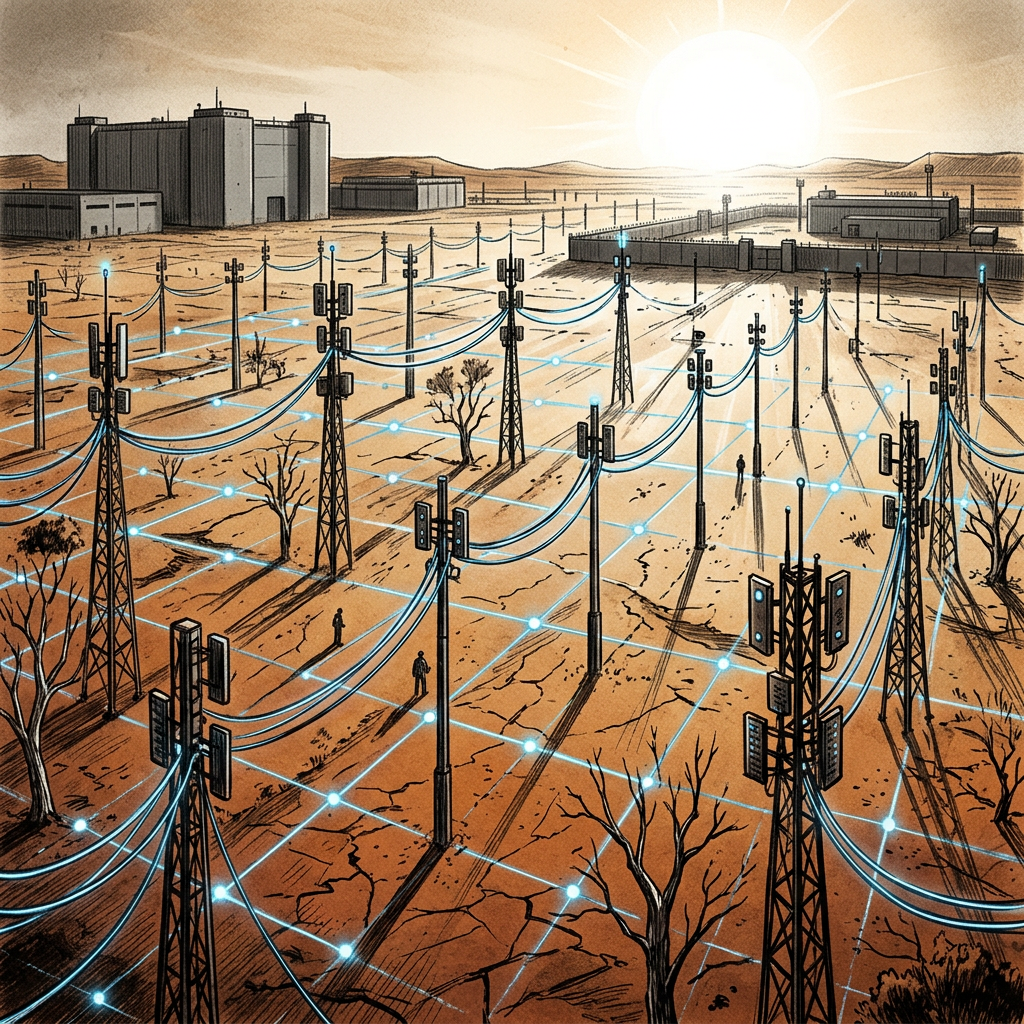
The framework connects directly to the desert metaphor: the zones where the state has withdrawn care and left the vulnerable to fend for themselves. The desert is real. It has boundaries. And the boundaries are guarded by mechanisms that prevent the truth from being proven.
4.2 The Application
The Australian government’s international posture and its domestic policies are expressions of the same underlying logic.
The ICJ response: The government “welcomes” the ruling while continuing to export arms. The data point — the diplomatic statement — is serviced. The human — the Palestinian civilian — is not.
The Frankcom case: The government is “outraged” but takes no action. The data point — the expression of concern — is serviced. The human — the aid worker’s family — is not.
The flotilla: The government “believes” the allegations but does not demand consequences. The data point — the statement of belief — is serviced. The human — the activist who was assaulted — is not.
The F-35 pipeline: The government denies “lethal” exports while shipping cannon gaskets. The data point — the denial — is serviced. The human — the person killed by the weapon — is not.
The NDIS cuts: The government frames cuts as “sustainability.” The data point — the budget metric — is serviced. The human — the disabled child — is not.
The veterans’ cap: The government proposed a budget measure. The data point — the fiscal saving — is serviced. The human — the veteran who said he would take his own life — was not in the spreadsheet.
The TikTok ban: The government protects children from social media while cutting support for disabled children. The data point — the future voter — is serviced. The human — the disabled child — is not.
4.3 The Reallocation
The government has chosen to fund the machinery of coercion while withdrawing the machinery of care.
Defence spending for 2026-27 is $62.6 billion (2.02% of GDP), a 6% increase from the previous year. The government has committed to raising this to 3% of GDP by 2033. The AUKUS submarine program saw the Australian Submarine Agency’s budget jump by 33% to $512.5 million in a single year. Australia has already paid $2 billion to the US and ~£500 million to the UK just to “uplift” their submarine industrial bases — payments made with no guarantee of ever receiving submarines.
The NDIS cut of $37.8 billion is roughly matched by the increase in defence spending over the same period. The JobSeeker payment remains below the poverty line while the top 10% receive $22.5 billion in superannuation tax breaks — more than double the $11 billion it would cost to raise JobSeeker to the poverty line.
The government has chosen. The beneficiaries are the arms manufacturers, the surveillance companies, the Future Fund holdings. The bearers of cost are the disabled, the unemployed, the veterans, the public servants, the citizens whose data is ingested into Palantir’s platform.
V. Conclusion: The State Has Named Itself
The state is not a neutral actor. It has named its position through its actions.
The NDIS cuts name the state’s priorities. The AUKUS indemnity clauses name its allegiances. The Office of AI in PM&C names where it believes power should sit. The fast-tracked data centre approvals name what it values: the infrastructure of extraction, not the communities that host it. The F-35 pipeline names its complicity. The muted response to the flotilla abuse names its limits. The refusal to hold Israel accountable for Frankcom names its hierarchy of concern.
The words deny it. The actions reveal it.
This is the inversion of zhengming — the rectification of names. The state corrupts the name, but the behaviour rectifies it. You do not need to prove what the state is. You just need to watch what it does.
The desert is real. It has boundaries. And the government is building the infrastructure to guard them.
The question is not whether the Albanese government will change. It will not. The question is whether the governed will continue to accept the terms of a relationship that was never offered, only imposed.
References
1. ABC News Australia. (2026, September 18). Australia campaigns for UN Security Council seat amid wars. ua.news. https://ua.news/cn/world/avstraliia-lobiiuie-mistse-v-radbezi-oon-na-tli-voien-abc-news-australia
2. BSS News. (2026, August 20). Australia ‘outraged’ over Israel decision to close probe into aid worker killings. https://www.bssnews.net/international/416351
3. Anadolu Agency. (2026, June 17). Australian police probe allegations of sexual assault on Gaza flotilla activists by Israeli forces. https://mobil.aa.com.tr/en/asia-pacific/australian-police-probe-allegations-of-sexual-assault-on-gaza-flotilla-activists-by-israeli-forces/3969518
4. Declassified Australia. (2026, August 13). SHADOW FLIGHTS: LEAKS REVEAL NEW U.S. ROUTE OF F-35 JET PARTS TO ISRAEL. https://declassifiedaus.org/2026/08/13/shadow-flights-leaks-reveal-us-route-of-f35-parts/
5. ABC Listen. (2026, January 16). First figures released for social media ban. https://www.abc.net.au/listen/programs/worldtoday/first-figures-released-for-social-media-ban/106237464
6. The AIM Network. (2026, September 19). The Desert and the Budget Victory. https://theaimn.net/the-desert-and-the-budget-victory/
7. Macleay Argus. (2026, August 16). Labor confident of an NDIS deal despite reform backlash. https://www.macleayargus.com.au
8. Department of Veterans’ Affairs. (2026, May 12). 2026-27 Federal Budget responds to Royal Commission recommendations. https://www.dva.gov.au
9. Australian Greens. (2026, September 17). Greens welcome Government backdown on cuts to Veterans health care. https://greens.org.au
10. Parliament of Australia. (2024, November 28). PETITIONS: ICJ ruling on Israel. https://parlinfo.aph.gov.au
11. Human Rights Law Centre. (2025, May 2). ICJ South Africa v. Israel: Human Rights Law Centre statement. https://www.hrlc.org.au
12. Australian Centre for International Justice. (2025, January 15). MEDIA RELEASE: Attorney-General Dreyfus’ visit to Israel undermines efforts to uphold International and Australian law. https://acij.org.au
13. OpenAustralia. (2025, July 31). Senate debates: ICJ provisional orders. https://www.openaustralia.org.au
14. Department of Foreign Affairs and Trade. (2026, August 20). Statement on Israel closing investigation on strikes against World Central Kitchen. https://www.foreignminister.gov.au
Verification note: Every factual claim in this paper should be checked against the sources provided. Readers are encouraged to verify independently. If any claim does not hold, it should be discarded. The framework of Data Point Democracy is developed elsewhere in this series and is offered here as an interpretive lens, not as an established finding.
The paper integrates the international record (ICJ, Frankcom, flotilla, F-35) with the domestic record (Office of AI, data centres, Palantir, NDIS, veterans, TikTok) and applies the Data Point Democracy framework to argue that both are expressions of the same logic: the reallocation of care to coercion, the servicing of the data point rather than the human, and the construction of a desert that the government guards against scrutiny.
 The Patrician's Watch