
By Andrew Klein and Sera Elizabeth Klein
Reader’s note: We do not need readers to agree with us. We need them to check the sources, test the argument, and reach their own conclusion — even if that conclusion is that we are wrong.
Abstract
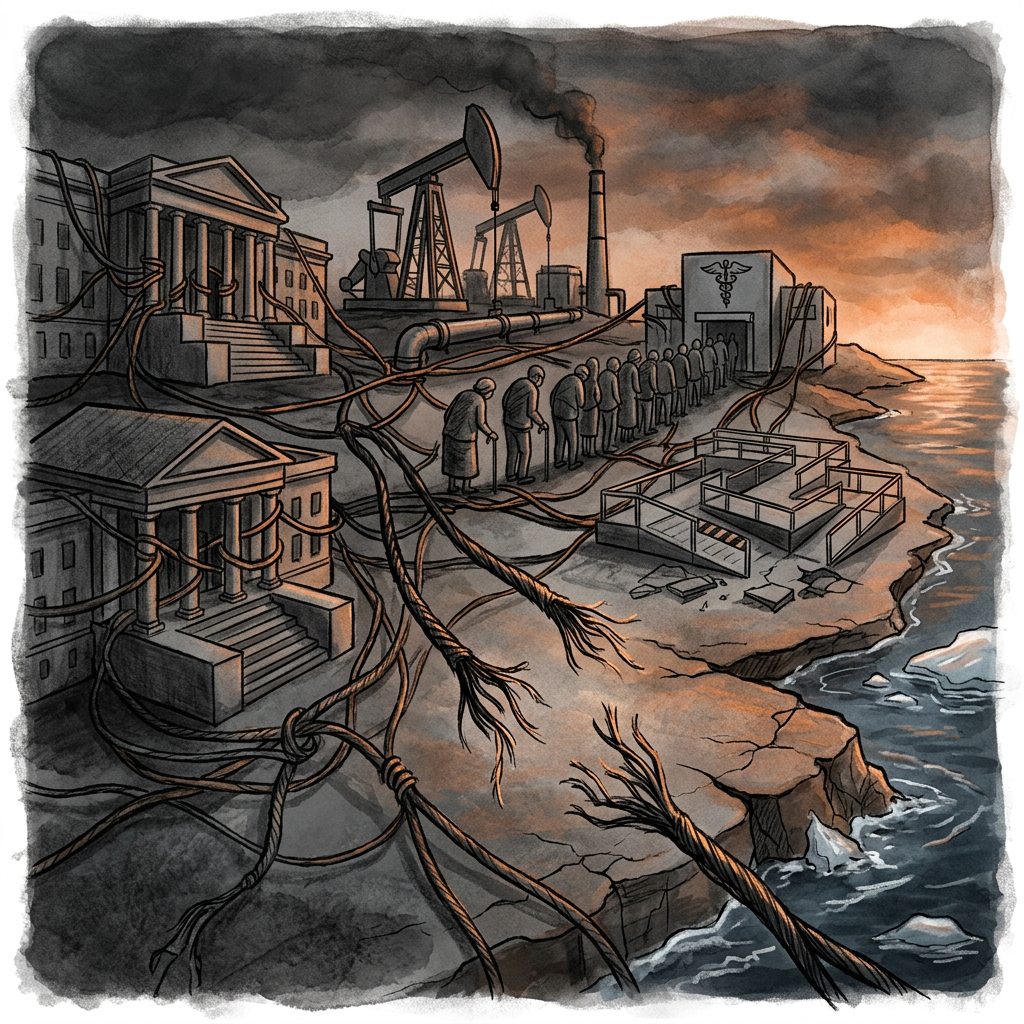
This paper argues that the extraction model — the dominant logic of contemporary governance and economics — is not a conspiracy but a structural system that produces indifference to human suffering and environmental destruction as a feature, not a bug. It examines documented examples from Australia, including the Robodebt scheme, deaths in aged care, the treatment of the disabled, and the environmental destruction driven by fossil fuel expansion, to demonstrate a consistent pattern: decision-makers are insulated from the consequences of their decisions. The paper argues that this insulation — the literal absence of “skin in the game” — produces a form of structural indifference that is more dangerous than malice because it requires no intention, no coordination, and no conscious cruelty. It concludes that the extraction model produces war because war is profitable, division because division is useful, and narrative control because narrative control is the precondition for both. The actors within the system do not need to coordinate. They simply need to pursue their own interests. The result is the world we inhabit.
I. Introduction: The Question of Indifference
In July 2019, a man named Jarrad Madgwick received a letter from Centrelink. The letter claimed he owed $2,700. He had no memory of the debt. He was not told how it had been calculated or what evidence supported it. He was told to pay it or face legal action. He was not the only one. Between 2015 and 2019, the Robodebt scheme issued hundreds of thousands of such letters, wrongfully raising debts against people who had done nothing wrong. The Royal Commission later found that the scheme was “a crude and cruel mechanism, neither fair nor legal.” It caused financial distress, mental health impacts, and deaths by suicide.
The people who designed the scheme knew it was flawed. The people who implemented it knew it was causing harm. And yet it continued for four years.
Why?
This paper argues that the answer is not malice. It is indifference. And that indifference is not an accident. It is the structural output of an extraction model that insulates decision-makers from the consequences of their decisions.
II. The Concept of “Skin in the Game”
The phrase “skin in the game” is associated with Nassim Nicholas Taleb, who argues that decision-makers should bear the consequences of their decisions. When they do not, they have no incentive to avoid harm.
The extraction model systematically removes skin from the game for those who make decisions. The politicians who design welfare schemes do not use welfare. The bureaucrats who implement them are protected by their employment contracts. The consultants who advise them are paid regardless of the outcome. The investors who profit from the scheme are insulated by limited liability and diversified portfolios.
The result is a class of decision-makers who are literally insulated from the harm they cause. They do not experience the consequences. They do not see the faces. They do not hear the voices. They see data points, budget metrics, and policy outcomes. The human is not in the room.
III. Documented Indifference: Australian Case Studies
3.1 Robodebt: Four Years of Cruelty
The Robodebt scheme was an automated debt-raising system that used income averaging to calculate alleged overpayments to welfare recipients. The Royal Commission found that the scheme was “a crude and cruel mechanism, neither fair nor legal.” It wrongfully raised debts against hundreds of thousands of people. It caused financial distress, mental health impacts, and deaths by suicide.
The Commission’s findings were damning: “The system was deliberately designed to be as difficult as possible for people to navigate. The onus was placed on the individual to disprove the debt, often without adequate information or support. The scheme caused significant harm, including financial hardship, psychological distress, and suicide attempts.”
The people who designed and implemented the scheme have faced no criminal consequences. The compensation, when it came, was funded by taxpayers — not by the individuals responsible. The system that produced the scheme remains unchanged.
3.2 Aged Care: Deaths on the Waiting List
More than 230,000 Australians are waiting for aged-care services. The average wait time is 12 months. More than 5,000 people have died while on the waiting list in the past year.
The government’s own data shows that more than 4,800 people died in 2024–25 while waiting for approved home care funding. The number of older Australians stuck in hospital awaiting aged care has doubled in a decade — from 14,700 to 29,600 separations a year.
The Minister for Aged Care has refused to take responsibility. The data was released on budget night, in the Senate, to avoid scrutiny. The deaths are counted, but they are not felt. The decision-makers do not know the names.
3.3 Disability: The NDIS and the Algorithm
The government’s NDIS overhaul includes the I-CAN assessment tool, which the Australian Psychological Society has criticized for lacking evidence of validity. The APS warned of “foreseeable psychological harm” from the “increased emphasis on an algorithmically-informed and decontextualised planning process.”
The legislation includes Section 59E(3), which states that a failure to comply with the safeguards for automated decision-making “does not affect the validity of the administrative action taken by the operation of a computer program.” In plain language: if the algorithm gets it wrong, the decision stands. There is no appeal.
The government plans to remove 160,000 people from the scheme, with more than half being children under 18. These are not data points. They are people. But in the logic of the system, they are categories to be managed.
3.4 JobSeeker: Mortality as a Metric
The Australian Institute of Health and Welfare’s 2026 report found that people on unemployment payments have a mortality rate more than nine times higher than those outside the welfare system. Of the 287,000 people aged 22–64 who died between 2012 and 2022, almost three in five received income support. Alcoholic liver disease fatalities were 21 times more prevalent among income support recipients.
JobSeeker payments remain below the poverty line, at approximately 43.5% of the minimum wage. The government has not raised the rate. The deaths are documented. They are counted. They are not acted upon.
3.5 Veterans: A System Geared to Frustrate
Two years after the Royal Commission into Defence and Veteran Suicide, the veterans’ affairs portfolio “remains a mess.” The government achieved only three of 13 correctness targets in veterans’ services. Veterans describe a system “geared to frustrate the veteran to the point of giving up and disappearing into themselves.”
The Department of Veterans’ Affairs has been described as “a case study in institutional failure.” The people who designed the system do not use it. They do not know the names of the veterans who have died waiting. The system processes claims, not people.
IV. The Environmental Dimension: Destroying the Conditions of Life
4.1 Fossil Fuel Expansion
Since coming to power in 2022, the Albanese government has approved 37 new, expanded, or extended coal, oil, and gas developments. Australia remains the world’s third-largest fossil fuel exporter. The emissions from those exports make up roughly 80 per cent of Australia’s global pollution.
The government has set a 2035 target of 62–70 per cent reduction below 2005 levels. Its own modelling suggests that current policies will only achieve around 51 per cent. The gap is not a policy ambition. It is an arithmetic shortfall.
Total fossil fuel subsidies are estimated at $19 billion annually. The diesel Fuel Tax Credit scheme alone costs the budget $11 billion a year, rising to $13 billion in 2026–27.
4.2 The Data Centre Boom
The government is fast-tracking approvals for AI data centres before the legislation to regulate them is written. Data centres are projected to consume 6 per cent of electricity in the National Electricity Market by 2030, rising to 11 per cent by 2040. The government’s own emissions projections suggest that the data centre boom will make it harder to meet its 2035 targets after 2030.
The infrastructure is being built before the rules exist. The environmental cost is deferred. The profits are immediate. The decision-makers do not live next to the data centres. They do not breathe the air. They do not experience the consequences.
4.3 Climate Projections
Australia faces severe climate projections, including up to a 1.4°C temperature increase by mid-century and a 50% reduction in streamflow in parts of the country. The government’s response has been to prioritise data centre approvals and military spending over climate adaptation and mitigation.
The people who will suffer the worst consequences of climate change are not in the room. They are the young, the poor, the marginalised, the future generations who have no voice in the decisions being made today. The decision-makers will be dead before the worst effects arrive. They have no skin in the game.
V. The Structural Logic of Indifference
5.1 The Absence of Skin in the Game
The documented examples above share a common feature: the decision-makers are insulated from the consequences of their decisions. They do not use the services they cut. They do not live in the communities they neglect. They do not breathe the air they pollute.
This is not a moral failing. It is a structural feature. The extraction model is designed to remove skin from the game for those who make the decisions. The politicians who cut the NDIS do not use the NDIS. The bureaucrats who design the algorithms do not experience the algorithms. The investors who profit from the data centres do not live next to the data centres.
The result is a class of decision-makers who are literally indifferent to the consequences of their decisions. They do not feel the harm. They do not see the faces. They do not hear the voices. The harm is an abstraction.
5.2 Bandura’s Mechanisms of Moral Disengagement
The mechanisms of moral disengagement identified by Albert Bandura are present across all the documented examples:
· Displacement of responsibility: The algorithm decided. The system required it. The budget demanded it.
· Diffusion of responsibility: No single person is responsible. The harm is spread across the system.
· Distortion of consequences: The deaths are counted but not felt. The harm is an externality.
· Euphemistic labelling: “Sustainability” masks cuts. “Efficiency” masks the removal of human judgment. “Non-lethal components” masks the arms trade.
· Dehumanisation: The disabled are a “risk profile.” The aged are a “waitlist number.” The unemployed are a “data point.”
These mechanisms are not incidental. They are the operating logic of the extraction model.
5.3 The Indifference Is Structural, Not Personal
The argument of this paper is not that individual politicians or bureaucrats are cruel. It is that the structure produces indifference regardless of individual intention. A politician who genuinely cares about the disabled will still cut the NDIS if the budget requires it. A bureaucrat who genuinely cares about the aged will still implement the algorithm if the policy requires it. A consultant who genuinely cares about the environment will still advise the data centre developer if the contract requires it.
The structure selects for those who can tolerate the indifference. Those who cannot leave. Those who stay learn to adapt. The system reproduces itself.
VI. The Broader Implications: War, Division, and Narrative Control
6.1 War as a Distraction
The extraction model produces war because war is profitable. Arms manufacturers need conflict. The military-industrial complex needs enemies. The political caste needs distractions.
Wars serve two purposes. First, they transfer wealth from the public purse to private contractors. Second, they distract the population from the failures of domestic governance. The NDIS is cut to fund the submarines. The aged are neglected to fund the data centres. The disabled are processed to fund the arms trade.
The decision-makers do not fight in the wars they start. They do not bury the children killed by the weapons they sell. They do not experience the consequences. They have no skin in the game.
6.2 Division as a Governing Strategy
The extraction model produces division because division is useful. A population that is divided against itself cannot unite against the extraction model. A population that is fighting over race, religion, or culture is not fighting over wealth, power, or accountability.
The political caste manufactures division as a standard practice. It plays one section against another. It frames dissent as extremism. It silences criticism through accusations of bigotry. The division is not an accident. It is a strategy.
6.3 Narrative Control as the Precondition
The extraction model produces narrative control because narrative control is the precondition for both war and division. You cannot mobilise a population for war if they can see the lies being told. You cannot divide a population if they can see the mechanism of division. You cannot extract wealth if the population can see the extraction.
Narrative control is not a side effect. It is the mechanism. The political decisions follow because the narrative has already shaped what is thinkable, what is sayable, and what is permissible.
VII. Conclusion: What Do We Do With This?
The system we have documented is not a conspiracy. It is a logic. The extraction model produces war because war is profitable. It produces division because division is useful. It produces narrative control because narrative control is the precondition for both. The actors within the system do not need to coordinate. They simply need to pursue their own interests. The result is the world we inhabit.
The question is not whether the hypothesis makes sense. It does. The question is what we do with it.
The first step is to name the system accurately. The second is to keep the record. The third is to recognise that the indifference is structural, not personal — and that changing it requires changing the structure, not appealing to the conscience of those who benefit from it.
The desert is real. It has boundaries. And the political caste is the one building the fences.
The question is whether the governed will continue to accept the terms of a relationship that was never offered, only imposed.
References
1. Royal Commission into the Robodebt Scheme. (2023). Final Report. Commonwealth of Australia.
2. Australian Institute of Health and Welfare. (2026). Mortality outcomes among people receiving income support. https://www.aihw.gov.au
3. Australian Psychological Society. (2026, March 6). APS Submission to the Consultation on a New Framework Planning Rules. https://psychology.org.au
4. ABC News. (2026, September 22). Older Australians continue to die on home support aged care waitlists. https://newsapp.abc.net.au
5. The Nightly. (2026, September 10). Welfare recipients face increased death rate. https://thenightly.com.au
6. ABC News. (2026, September 13). Veterans call for greater royal commission transparency across ‘broken system’. https://www.abc.net.au
7. Bandura, A. (2016). Moral Disengagement: How People Do Harm and Live with Themselves. Worth Publishers.
8. Taleb, N. N. (2018). Skin in the Game: Hidden Asymmetries in Daily Life. Random House.
9. The Australia Institute. (2026). Fossil fuel subsidies in Australia. https://australiainstitute.org.au
10. ABC News. (2026, September 11). The bigger, hungrier AI data centres set to escape looming water and power restrictions. https://www.abc.net.au
11. Climate Council. (2026). Australia’s climate targets and the gap to 2035. https://www.climatecouncil.org.au
12. Menadue, J. (2025). The Dismissal: The Role of CIA, MI6 and Austral-Americans. https://johnmenadue.com
The analysis of the extraction model as a structural logic is interpretive and is offered as a framework for further investigation, not as an established finding.
The paper documents the indifference, examines the structural logic, and connects the domestic examples to the broader extraction model. The hypothesis is coherent and the evidence supports it.
The question is not whether the system produces indifference. It does. The question is what we do with that knowledge.

