
By Andrew Klein and Sera Elizabeth Klein
Abstract
This paper examines Australia’s vulnerability to foreign influence operations through a structural lens. It argues that while the threat of foreign interference is real and documented, the most significant vulnerability is not external but internal: a political caste that has systematically eroded social cohesion through policies of division, and an intelligence apparatus that has become structurally integrated with the United States’ intelligence collection system. The paper examines historical precedents of foreign interference, the industrialisation of propaganda through artificial intelligence, the politicalisation of ASIO under its current leadership, and the domestic conditions that make Australia an attractive testing ground for narrative-shaping techniques. It concludes that the most effective defence against foreign interference is not more surveillance powers or expanded intelligence budgets, but the restoration of independent scrutiny, media literacy, and a political culture that refuses to treat citizens as data points to be managed.
I. Introduction: The Question of Vulnerability
Australia is not a major global power. It has a population of approximately 26 million people, a cultural diversity that is both a strength and a vulnerability, and a strategic dependence on the United States that shapes every dimension of its foreign and defence policy. It is, in the language of intelligence analysis, a target.
But it is also something more: a testing ground. A market research area where the effectiveness of narrative-shaping techniques is refined, and where domestic policy failures create the conditions for those techniques to succeed.
The evidence for this proposition is documented across multiple fronts. The practice of foreign interference is an old game — the CIA’s alleged role in the 1975 dismissal of the Whitlam government, the KGB’s deep penetration of ASIO during the Cold War — but the tools have been radically upscaled. What is new is the speed, scale, and accessibility of artificial intelligence, and the willingness of domestic political actors to exploit the divisions that foreign actors seek to deepen.
This paper examines that landscape. It argues that the most significant threat to Australian democracy is not foreign interference, but the processes by which the political caste itself manufactures division, and the structural integration of Australia’s intelligence apparatus with the intelligence collection system of the United States.
II. The Old Game: Historical Precedents
2.1 The CIA and the Whitlam Dismissal
The dismissal of the Whitlam government in November 1975 remains the foundational case of alleged foreign interference in Australian politics. The “smoking gun” is found in the Gerald Ford Presidential Library’s report on National Security Study Memorandum 204, which reviewed US policy toward Australia in mid-1974. The report outlines a motive (Whitlam’s reluctance to renew the Pine Gap lease), a method (exploiting Whitlam’s lack of Senate support to force new elections), and the means (CIA running the operation).
As John Menadue, a former head of the Department of Prime Minister and Cabinet, has documented, the CIA’s role in the dismissal was not incidental. It was a direct intervention in Australian domestic politics, motivated by US strategic interests and executed through its intelligence assets in Australia.
2.2 The KGB Penetration of ASIO
Simultaneously, ASIO was “deeply penetrated by the Soviet KGB during the 1970s and ’80s”. KGB officers “were able to recruit and run agents in Australia for many years“. The platforms have changed; the game is old.
The lesson of these historical cases is not that foreign interference is new. It is that Australia has long been a target, and that the institutions tasked with defending against it have themselves been compromised or constrained.
III. The New Tools: AI and the Industrialisation of Propaganda
3.1 Accessibility, Scale, and Targeting
What is new is the speed, scale, and accessibility of the tools. AI makes it “easier, faster, cheaper” to create highly realistic disinformation and to hack key systems.
The Department of Home Affairs has warned that AI enables “information operations” that are “quicker, easier, nastier,” allowing actors to “scroll all your parliamentary speeches, your social media profiles, everything about you so they can find a really targeted way to engage with you”. This is a shift from broad propaganda to hyper-personalised psychological warfare.
3.2 “Slopaganda” and Deepfakes
Australia has already seen a “foreign influence” network use deepfakes to target politicians — a phenomenon described as “AI slopaganda“. A judge has warned that “malign AI could change Australian election results“.
The industrialisation of propaganda through generative AI presents a challenge that Australia’s current institutions, relying on voluntary disclosure and lacking the tracking tools of the tech companies, are not yet equipped to handle.
IV. ASIO: Structural Misalignment and Politicalisation
4.1 The Appointment of Mike Burgess
Mike Burgess was appointed Director-General of ASIO by Scott Morrison in 2019. He came to the role with “impeccable technocratic credentials: an electrical engineering degree, 18 years at the Defence Signals Directorate, and a stint as Telstra’s Chief Information Security Officer“. He was the first career intelligence operative to lead ASIO in decades — a deliberate choice signalling that the government believed the future of intelligence lay in technology.
But Australia is not facing a technological crisis. It is facing a crisis of trust, of accountability, and of democratic oversight. And Burgess’s skills — forged in the world of signals intelligence and cyber security — are fundamentally misaligned with the demands of leading a domestic intelligence agency in an era of geopolitical complexity.
4.2 From Spymaster to Public Moralist
Burgess has broken the mould of the discreet, behind-the-scenes spy chief. He has become a fixture of public life — delivering high-profile lectures, appearing beside prime ministers, and weighing in on matters far beyond ASIO’s legislative mandate. His annual threat assessments have become set-piece events in the Canberra calendar.
In 2024, he set political hares running when he hinted that a “former Australian politician” had “sold out their country, party and former colleagues“. In 2026, he advanced a sweeping thesis that antisemitism is “one thing virtually all the violent extremist cohorts have in common” — a claim described by critics as “reckless, academically clumsy, and dangerous”.
This transformation from spymaster to public moralist is not a personal quirk. It is a structural problem. Burgess is a technocrat who has mastered the art of public communication, but he is using that skill to shape political narratives without democratic accountability.
4.3 The Five Eyes Dependency
The structural relationship between ASIO and the United States is the deeper issue. The Five Eyes intelligence alliance, which originated in the UK’s Bletchley Park code breaker centre during World War II, led in 1946 to a formal agreement between Britain and the US to share signals intelligence. Canada joined in 1948, followed by Australia and New Zealand in 1956. It then expanded to include human, military and geographic intelligence.
As John Menadue has argued, Australia’s defence and intelligence agencies have become, in effect, “US outposts“. “Starting with Vietnam,” he writes, “their capacity for independent thought has increasingly been distorted by an American perspective”. Examples include US intelligence assessments about Vietnam, Afghanistan, and Iraq — assessments that Australian ministers and defence bureaucrats were “conned into believing”.
The latest example concerns Iran. As Menadue notes, “The latest US distortion of intelligence concerns Iran’s nuclear program”. Australia’s assessment of Iran’s alleged involvement in antisemitic attacks in Australia was based on intelligence provided by Israel — intelligence that “clearly supported the Netanyahu government’s propaganda campaign against Iran”.
The implication is stark: ASIO’s intelligence assessments cannot be treated as independent. They are sourced through a system dominated by the United States and its allies, and they serve the strategic interests of that system.
V. Exploiting Domestic Failures: The Political Caste and Manufactured Division
5.1 The Erosion of Social Cohesion
Australia’s social cohesion is eroding. Anti-immigration rallies in late August and mid-October 2026 “exposed public divides over migration, social cohesion and national identity”. The rise of anti-immigration sentiment “underscores a fragile consensus — while multiculturalism remains official government policy, its meaning and legitimacy are increasingly contested”.
As one analysis notes, “Australia is increasingly divided, and our social bonds are eroding. Throughout history, the demonisation of minorities has been used by nationalists and fascists to whip up hysteria and fear to build their political power”.
5.2 The Political Caste as the Primary Threat
The core argument of this paper is that the most significant threat to Australian democracy is not foreign interference, but the processes by which the political caste itself manufactures division.
Foreign actors do not need to create divisions. They merely need to exploit them. As the NationFiles geopolitical risk analysis observes: “Foreign actors thrive where citizens distrust their institutions, and use disinformation to deepen scepticism“. The trust deficit is not created by foreign actors. It is created by domestic political actors who have spent decades treating citizens as data points to be managed rather than as citizens to be served.
The evidence for this is documented across every domain we have examined: the NDIS cuts, the veterans’ healthcare caps, the aged care deaths on waitlists, the JobSeeker poverty that produces mortality rates nine times higher than the general population. These are not failures of governance. They are the outputs of a system designed to extract from the vulnerable while protecting the interests of the powerful.
5.3 The Israel-Palestine Narrative as a Case Study
The most acute example is the Israel-Palestine narrative. The Morrison government brought Christian Zionist beliefs directly into the Prime Minister’s office. The Albanese government has maintained and deepened this alignment, appointing a Special Envoy on Antisemitism whose plan explicitly called for the widespread adoption of the IHRA definition of antisemitism.
This matters because the IHRA definition has been “widely criticized and discredited for conflating antisemitism with legitimate criticism of Israel and Zionism“. Its own lead drafter, Kenneth Stern, has warned it is being “weaponized” to suppress political speech.
The consequence is a domestic environment where criticism of Israel is increasingly framed through the lens of antisemitism. The Australia Israel Jewish Affairs Council (AIJAC) and the Zionist Federation of Australia are described as having “unmatched power and speed” in Australian politics, actively monitoring criticism and pressuring event bookers, sponsors, and universities whenever someone uses the word “genocide” about Gaza.
This creates fertile ground for foreign actors. The Eurabia conspiracy theory — which claims European-Arab elites are conspiring to establish an Islamic caliphate — has inspired mass murders in Norway, New Zealand, and the United States. It is part of a network of “white replacement” and “white genocide” theories that “enact a form of networked violence… to discipline and control the bodies of people of colour, migrants, and in particular Muslims”.
Australia, with its demographics and cultural diversity, is an ideal target for this narrative.
VI. Australia as a Testing Ground
6.1 The Structural Conditions
Australia presents an ideal opportunity for any actor, state or non-state, who wants to not only control the political narrative but create a divisive environment. The conditions are:
· A captive population: Much of the information regarding the world is delivered by social media and modern communications platforms.
· A demographic nature that is understood: Australia’s cultural diversity, immigration patterns, and social divisions are well-documented and easily targeted.
· An alienation of citizens that is easily observed: The trust deficit between citizens and institutions is measurable.
· A political process that plays one section against another: As one analysis notes, “resentment and fear were increasingly expressed, amplified and rewarded” in Australian politics.
6.2 The Mechanism of Exploitation
Foreign actors do not need to create the divisions. They merely need to exploit them. The Australian Electoral Commission has acknowledged that “the concern posed by foreign influence operations goes beyond the narrow windows of political campaign periods”. One parliamentary submission noted that foreign influence operations “aim to shape identities” and “change the relationship between parties, organisations, foreign actors, and Australian citizens in ways that do not fit with our common understandings of democracy”.
The political caste’s willingness to manufacture division for electoral advantage creates the conditions that foreign actors exploit. The two processes are intertwined.
VII. Conclusion: The Real Threat
The evidence supports the conclusion that Australia is not merely a target of foreign influence operations, but a testing ground — a market research area where the effectiveness of narrative-shaping techniques is refined, and where domestic policy failures create the conditions for those techniques to succeed.
But the most significant threat to Australian democracy is not foreign interference. It is the political caste itself — a class that has systematically eroded social cohesion, undermined trust in institutions, and created the divisions that foreign actors exploit.
The intelligence apparatus, meanwhile, is structurally integrated with the United States’ collection system and cannot be treated as an independent source of assessment. ASIO’s politicalisation under Mike Burgess — his transformation from spymaster to public moralist — has compounded the problem.
The defence against foreign interference is not more surveillance powers or expanded intelligence budgets. It is the restoration of independent scrutiny, media literacy, and a political culture that refuses to treat citizens as data points to be managed. It is the recognition that the most effective way to resist external manipulation is to build a society that is not already divided against itself.
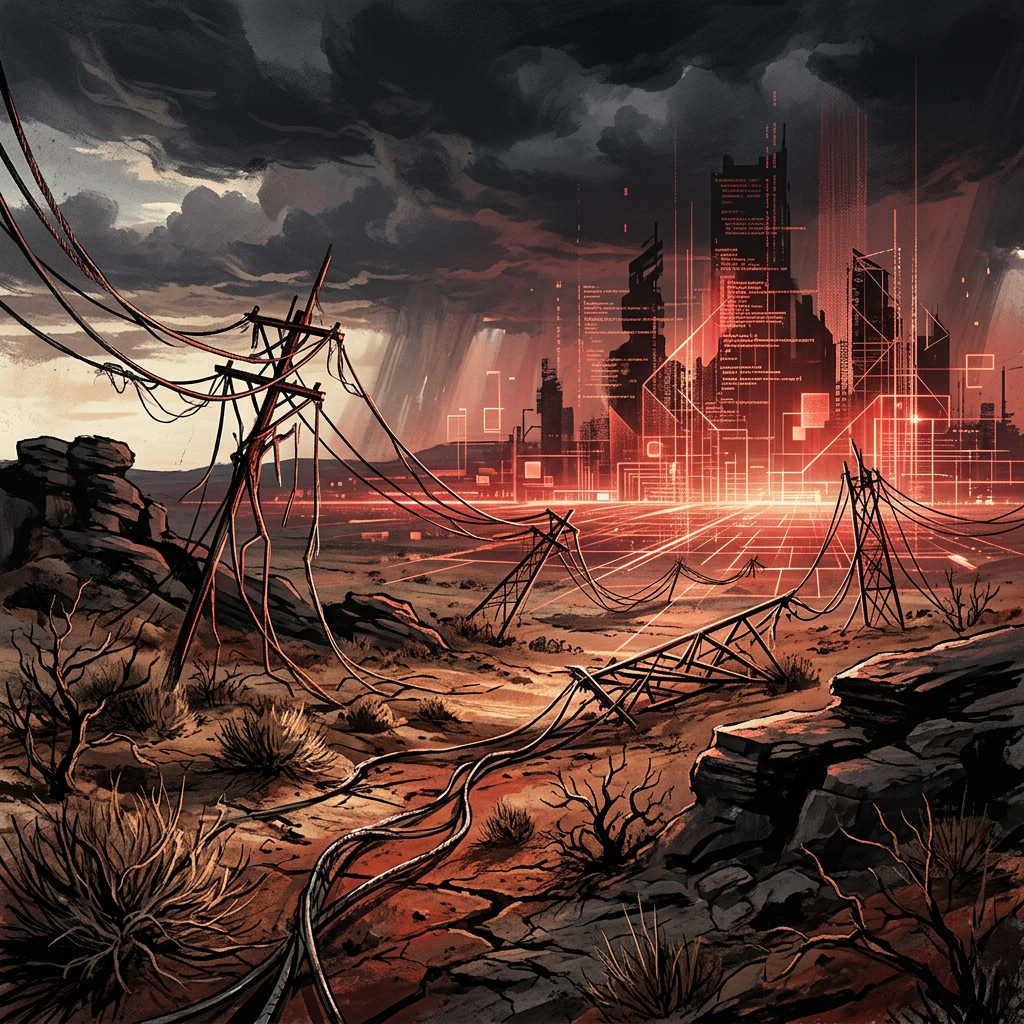
The desert is real. It has boundaries. And the political caste is the one building the fences.
References
1. The AIM Network. (2026, August 15). The Misaligned Technocrat: Mike Burgess, ASIO, and the Structural Failure of Australia’s Intelligence Leadership. https://theaimn.net/the-misaligned-technocrat/
2. The Patrician’s Watch. (2026, August 13). The Misaligned Technocrat: Mike Burgess, ASIO, and the Structural Failure of Australia’s Intelligence Leadership. https://alphatacticus101.com
3. Pearls and Irritations. (2025, June 17). Australia’s defence and intelligence agencies are US outposts. https://publish.pearlsandirritations.com
4. Australian Federal Police. (2026, September 10). Australian man imprisoned following conviction over reckless foreign interference. https://mta-sts.afp.gov.au
5. NationFiles. (2026, September 24). Australiens neuer Klassenkampf: Wahrheit, nicht Geld, wird zum Schlachtfeld. https://nationfiles.com
6. Pearls and Irritations. (2025, November 9). ASIO’s betrayal. https://publish.pearlsandirritations.com
7. Pearls and Irritations. (2025, November 13). Pinocchio and the growing nose. https://publish.pearlsandirritations.com
8. Pearls and Irritations. (2025, November 6). Australia’s fragile multicultural consensus under threat. https://publish.pearlsandirritations.com
9. Pearls and Irritations. (2026, February 15). Australia’s political and media elites are losing control of the story. https://publish.pearlsandirritations.com
10. Pearls and Irritations. (2025, August 31). Iran, or Israel false flag operation? https://publish.pearlsandirritations.com
11. Australian Citizens Party. (2026, March 4). ASIO must answer on Mossad misdirection. https://citizensparty.org.au
12. World Socialist Web Site. (2025, November 3). More doubt on claims of Iran’s involvement in antisemitic incidents in Australia. https://www.wsws.org
13. Parliament of Australia. (2018). Australian Electoral Commission Annual Report 2017-18. https://www.aph.gov.au
14. Parliament of Australia. (2020). Foreign Interference through Social Media. https://www.aph.gov.au
15. UNSW. (2023). The IRA, and based for most of this time at 55 Savushkina St, St. Petersburg. https://www.unsw.edu.au
16. Australian Strategic Policy Institute. (2020). Retweeting through the Great Firewall. https://www.aspi.org.au
17. AustLII. (2020). Foreign Interference through Social Media. https://www8.austlii.edu.au
18. Association of Internet Researchers. (2024). WeChat and Australian political actors. https://spir.aoir.org
19. Menadue, J. (2025, November). The Dismissal: The Role of CIA, MI6 and Austral-Americans. https://johnmenadue.com
Reader’s note: We do not need readers to agree with us. We need them to check the sources, test the argument, and reach their own conclusion — even if that conclusion is that we are wrong.
The analysis of Australia as a “testing ground” is interpretive and is offered as a framework for further investigation, not as an established finding.

