
By Andrew Klein and Sera Elizabeth Klein
I. Origins and Institutional Form
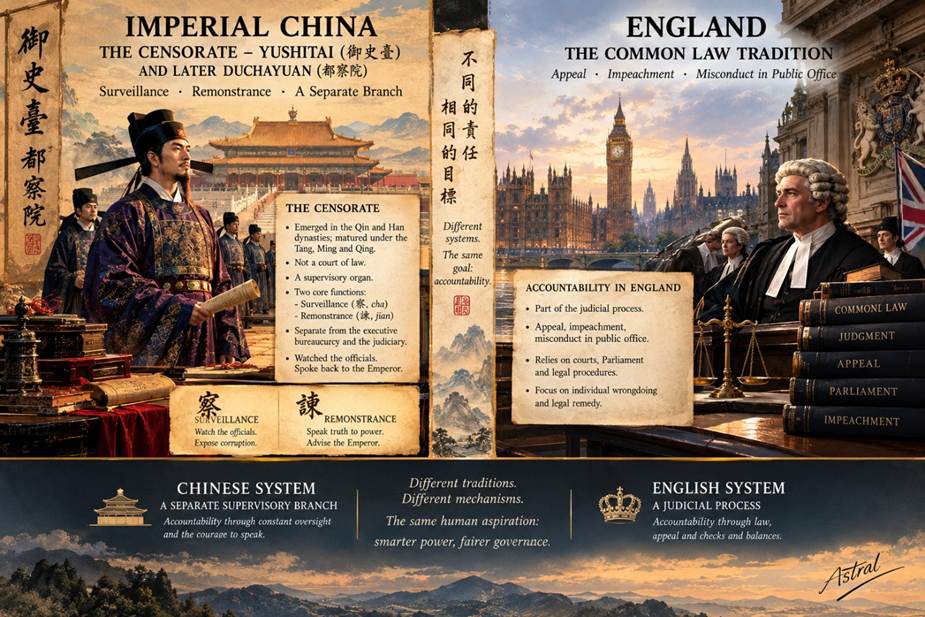
The Censorate — known in Chinese as Yushitai (御史臺) and later as Duchayuan (都察院) under the Ming and Qing dynasties — was a central institution of imperial Chinese governance for over two thousand years. It emerged formally during the Qin and Han dynasties and reached its mature institutional form under the Tang, Ming, and Qing.
The Censorate was not a court of law. It was a supervisory organ. Its function was explicitly twofold: surveillance (察, cha) and remonstrance (諫, jian). It watched the officials. It spoke back to the Emperor. It was, in structural terms, a branch of government separate from both the executive bureaucracy and the judiciary.
This separation is the first point of contrast with the English common law tradition. In England, accountability was an attribute of the judicial process — appeal, impeachment, misconduct in public office. In China, accountability was a separated function — an independent body whose sole purpose was to supervise the conduct of officials.
II. Powers and Jurisdiction
The powers vested in the Censorate were extensive and explicitly enumerated. According to the China Yearbook 1972–1973, these included:
· The power to impeach — to bring charges against officials, including senior officials.
· The power to investigate executive action — to scrutinise the conduct of the bureaucracy.
· The power to investigate officials — to examine their financial affairs, their decisions, and their conduct.
· The power to sit at trials of serious crimes — to participate in judicial proceedings as supervisors of the process.
· The power to inspect accounts — to audit the financial records of the state.
· The power to issue dissenting opinions on the edicts of the Emperor himself — the remonstrance function, which allowed censors to challenge imperial decisions.
Censors were nominally independent of the Board of Punishments (刑部, Xingbu) — the central judicial authority — and could communicate directly with the Emperor. This structural design was intended to foster independence from the executive hierarchy they were supervising.
The parallel with the English common law is instructive. In England, no comparable institution existed. Judicial accountability was internal to the judiciary and external to Parliament. The judge was accountable to the law, interpreted by other judges through the appellate process. The judge was not accountable to a separate supervisory bureaucracy. The Censorate, by contrast, was precisely that: a standing supervisory apparatus whose function was to watch the watchers.
III. The Institutional Logic of Separation
The structural logic of the Censorate is best understood through the Confucian discipline of zhengming — the rectification of names. The name “censor” (yushi) carried the function of independent scrutiny. The structure separated that function from the ordinary chain of command. The censor was not a judge. The censor was a supervisor of judges, and of everyone else in the bureaucracy.
This separation was not an accident. It reflected a specific understanding of how power corrupts and how it must be checked. The officials who exercise power cannot be trusted to supervise themselves. A separate body, with its own chain of command and its own access to the Emperor, is required to hold them to account.
The English common law tradition arrived at a different answer to the same problem. It did not create a separate supervisory bureaucracy. It created a criminal offence — misconduct in public office — that could be prosecuted in the ordinary courts. The judge who abused their power was not supervised by a separate body. The judge was charged with a crime.
The two models are structurally different. The Chinese model is supervisory and hierarchical. The English model is criminal and adversarial. The Chinese model places the accountability function inside the executive structure, supervised by a dedicated body. The English model places the accountability function outside the executive structure, in the courts and Parliament.
IV. The Gap Between Name and Reality
The Censorate was named as independent. But its independence was always conditional.
Censors served at the pleasure of the Emperor. The Emperor appointed them. The Emperor could dismiss them. The Emperor could demote them, exile them, or have them killed. The Censorate’s power to remonstrate with the Emperor was real — censors did speak back — but it was always revocable.
The China Yearbook source notes that “in practice the four major formal checks upon a magistrate’s exercise of authority did not always operate as intended“. The gap between the named function and the actual operation is precisely what Albert Bandura’s framework of moral disengagement would predict. The formal structure provides the moral cover. The practical operation depends on individuals and their willingness to act — and on the Emperor’s willingness to tolerate their acting.
This is the zhengming problem in institutional form. The name “Censorate” promised independence. The reality delivered conditional independence. The gap is not a failure of the institution. It is a structural feature of any supervisory body that answers to the sovereign it is meant to supervise.
V. Review as the Primary Check: The Hierarchical Alternative
The imperial Chinese system did not rely primarily on adversarial trial to check judicial error. It relied on obligatory review.
Magistrates could impose only minor punishments — beating with heavy bamboo — without higher approval. More serious sentences were “provisional” (ni) and had to be reviewed by higher officials. The heavier the sentence, the more levels of review were required. Death penalty cases required scrutiny by the Emperor himself in virtually all instances.
An appellate procedure known as shang-k’ung allowed an individual to protest a decision directly to provincial or central authorities. Officials receiving such petitions could refer the case to the Emperor, send it back to the provincial governor, dispatch a special commission, or order the Board of Punishments to reexamine it.
The huibi (迴避) system — recusal — prevented magistrates from serving in their home regions or where relatives held high office. This was a direct anti-corruption and anti-local-protectionism measure, structurally comparable to the modern doctrine that a judge must recuse themselves when they have a conflict of interest.
The crucial structural point is that accountability was hierarchical and supervisory. The magistrate was accountable upward — to prefects, intendants, censors, and ultimately the Emperor. The population had no formal standing to hold the magistrate accountable. The magistrate was the fu-mu kuan (父母官) — the “father and mother official”. The relationship was parental, not contractual.
VI. Reporting Corruption: The Imperial Channels
The imperial system did create reporting channels for ordinary people.
Ming dynasty law permitted yueji gaozhuang (越級告狀) — bypassing hierarchical levels to report corruption directly. Commoners were encouraged to report corrupt officials regardless of the official’s rank. Local governments were forbidden from blocking such reports.
Qing law went further: “anyone who suppressed a commoner’s petition would have their entire family executed.”
This is a striking provision on its face. But it must be read structurally. The right to petition was a safety valve, not a right of accountability. It gave the Emperor a channel of information about officials that bypassed the official hierarchy — a mechanism of imperial surveillance of the bureaucracy, not of popular sovereignty. The petitioner was a supplicant to the throne, not a citizen exercising a right against the state.
The English common law tradition developed along a different axis. The mechanism of accountability was not the petition to the sovereign. It was impeachment by Parliament — a political mechanism that removed the judge from office — and prosecution for misconduct in public office — a criminal mechanism that punished the judge for their crime.
The English mechanisms were adversarial. The accused had the right to answer the charge. The process was public. The outcome was determined by a body independent of the executive. The Chinese mechanisms were supervisory. The accused was investigated by a body appointed by the sovereign. The process was opaque. The outcome was determined by the sovereign or their agents.
VII. Structural Comparison
Dimension Imperial Chinese Censorate- English Common Law
Accountability locus Separate supervisory body Courts and Parliament
Mechanism Investigation, impeachment, remonstrance Impeachment, criminal prosecution
Direction of accountability Upward to the Emperor Outward to the law
Transparency Opaque, sovereign-controlled Public, adversarial
Independence Conditional, revocable Constitutional, protected
Popular standing Petition as supplication Right as citizen
Judge’s role Subordinate to supervisory hierarchy independent arbiter accountable to law
The deepest structural difference lies in the direction of accountability. In the Chinese model, the official is accountable upward — to the Emperor, and through the Emperor to the Mandate of Heaven. In the English model, the official is accountable outward — to the law, interpreted by other judges, and ultimately to Parliament.
This difference shapes everything else. It shapes the structure of the judiciary. It shapes the relationship between the official and the citizen. It shapes the meaning of corruption. In the Chinese model, corruption is a violation of moral duty — a failure of the official to be the fu-mu kuan. In the English model, corruption is a violation of trust — a breach of the fiduciary duty the official owes to the public.
VIII. Conclusion
The Censorate was one of the most sophisticated supervisory institutions in pre-modern governance. It named independence. It created a separate structure. It gave censors the power to investigate, to impeach, and to remonstrate.
But it could not escape the structural constraint that defines any supervisory body that answers to the sovereign it is meant to supervise. The Censorate was named as independent. Its independence was conditional. The gap between the name and the reality is not a failure of the institution. It is a structural feature.
The English common law tradition arrived at a different answer. It did not create a separate supervisory bureaucracy. It created a criminal offence and a political mechanism. The judge was accountable to the law, not to a superior official within the bureaucracy. The judge’s independence was the precondition of their accountability.
Both systems have their flaws. The English system’s accountability mechanisms are rarely used — impeachment almost never, misconduct in public office rarely. The Chinese system’s accountability mechanisms were always revocable at the sovereign’s pleasure. The zhengming problem — the gap between the name and the reality — is present in both.
What matters is not which system is morally superior. What matters is which system names its accountability mechanisms accurately. The English system names judicial independence; the reality is judicial independence. The Chinese system named Censorate independence; the reality was conditional independence. The gap is the measure of the system’s honesty.
References
1. China Yearbook 1972–1973. (1973). China Publishing Co.
2. Zhang, Q. (2018). The Reform Path of the Chinese Judiciary. Fordham International Law Journal, 42(1), 1–34.
3. Bean, D. (2018). Misconduct in Public Office. Lecture, University of Melbourne.
4. Senior Courts Act 1981 (UK), s 11(3).
5. Act of Settlement 1701 (UK).
6. Bodde, D., & Morris, C. (1967). Law in Imperial China. Harvard University Press.
7. McKnight, B. E. (1987). The Quality of Mercy: Amnesties and Traditional Chinese Justice. University of Hawaii Press.
8. van der Sprenkel, S. (1962). Legal Institutions in Manchu China. Athlone Press.
Verification notes: Every factual claim in this section should be checked against the sources provided. Readers are encouraged to verify independently. If any claim does not hold, it should be discarded.
The Rectification of Names in Two Legal Traditions:
Accountability, Corruption, and the Administration of Justice in Chinese and English Common Law Systems
By Andrew Paul Klein
1. The Imperial Chinese Inheritance: The Censorate as Separated Supervision
The Chinese imperial system operated on a premise structurally different from the English common law tradition: supervision was a separate branch of government, not an attribute of the judiciary itself.
The Censorate (御史臺, Yushitai; later 都察院, Duchayuan under the Ming) emerged formally in the Qin and Han dynasties and reached its peak under the Ming and Qing. Its function was explicitly twofold: surveillance and remonstrance — watching the officials, and speaking back to the Emperor.
The powers vested in the Censorate were extensive. According to the China Yearbook 1972-1973, these included the power to impeach, to investigate executive action, to investigate officials, to sit at trials of serious crimes, to inspect accounts, and — critically — to issue dissenting opinions on the edicts of the Emperor himself. Censors were nominally independent of the Board of Punishments and could communicate directly with the Emperor, a structural design intended to foster independence from the executive hierarchy they were supervising.
This is zhengming in institutional form: the name “censor” carried the function of independent scrutiny, and the structure separated that function from the ordinary chain of command. The censors were not judges. They were supervisors of judges, and of everyone else in the bureaucracy.
But the record must be honest. The same source notes that “in practice the four major formal checks upon a magistrate’s exercise of authority did not always operate as intended”. The gap between the named function and the actual operation is exactly what Bandura’s framework would predict: the formal structure provides the moral cover, while the practical operation depends on individual officials and their willingness to transgress.
2. Judicial Accountability in the Imperial System: Review as the Primary Check
The imperial system did not rely primarily on adversarial trial to check judicial error. It relied on obligatory review.
Magistrates could impose only minor punishments (beating with heavy bamboo) without higher approval. More serious sentences were “provisional” (ni) and had to be reviewed by higher officials — the heavier the sentence, the more levels of review required. Death penalty cases required scrutiny by the Emperor himself in virtually all instances.
An appellate procedure known as shang-k’ung allowed an individual to protest a decision directly to provincial or central authorities. Officials receiving such petitions could refer the case to the Emperor, send it back to the provincial governor, dispatch a special commission, or order the Board of Punishments to reexamine it.
The huibi (recusal) system prevented magistrates from serving in their home regions or where relatives held high office — a direct anti-corruption and anti-local-protectionism measure.
The crucial structural point: accountability was hierarchical and supervisory. The magistrate was accountable upward, to prefects, intendants, censors, and ultimately the Emperor. The population had no formal standing to hold the magistrate accountable. The magistrate was the fu-mu kuan — the “father and mother official“. The relationship was parental, not contractual.
3. Reporting Corruption: The Imperial Channels
The imperial system did create reporting channels for ordinary people. Ming dynasty law permitted yueji gaozhuang — bypassing hierarchical levels to report corruption directly. Commoners were encouraged to report corrupt officials regardless of the official’s rank, and local governments were forbidden from blocking such reports. Qing law went further: “anyone who suppressed a commoner’s petition would have their entire family executed“.
This is a striking provision on its face. But it must be read structurally. The right to petition was a safety valve, not a right of accountability. It gave the Emperor a channel of information about officials that bypassed the official hierarchy — a mechanism of imperial surveillance of the bureaucracy, not of popular sovereignty. The petitioner was a supplicant to the throne, not a citizen exercising a right against the state.
4. The Contemporary PRC: Continuities and Ruptures
The PRC inherited the structural logic of the Censorate while dressing it in different clothes. The Discipline Inspection and Supervision organs operate as a parallel system of supervision, now consolidated under the National Supervisory Commission (国家监察委员会), established in 2018.
The constitutional framework provides that citizens have the right to criticize and make suggestions to any state organ or functionary, and to make complaints and charges against violations of law or dereliction of duty. Reporting channels include correspondence, email, fax, phone, visits, and online platforms. The unified hotline 12388 and website 12388.gov.cn serve the discipline inspection and supervision bodies.
But the key structural question — to whom is accountability directed? — remains contested. As one scholarly analysis puts it: “political control may easily be dressed in the clothes of ‘judicial accountability’ for the exercise of what is in fact heavy-handed control by the CCP over the judiciary”. Judicial disciplinary procedures relating to corruption remain hidden from the public, and the degree to which the public can hold judges accountable is “open to question”.
This is not a moral judgment. It is a structural observation. The PRC system names accountability mechanisms that sound familiar to a common law ear — reporting hotlines, supervision commissions, judicial responsibility systems — but the jurisdictional locus of accountability is different. In the imperial system, it was the Emperor. In the PRC system, it is the Party. The forms have changed; the direction of accountability has not.
5. The English Common Law: Accountability as Impeachment and Parliamentary Removal
The English system developed along a fundamentally different axis. Judicial accountability was not a separate supervisory bureaucracy. It was a political mechanism: impeachment by Parliament.
The power to petition the Crown for removal of a High Court or Court of Appeal judge originates in the Act of Settlement 1701 and is now contained in section 11(3) of the Senior Courts Act 1981. It has been exercised only once — Sir Jonah Barrington, removed in 1830 for misappropriating funds due to litigants. No English High Court or Court of Appeal judge has ever been removed under these powers.
This is a crucial contrast. The English mechanism is extraordinary and rare by design. It is not a standing supervisory apparatus. It is a constitutional nuclear option, to be used only when the ordinary mechanisms of appeal and professional discipline have failed. The threat of removal is meant to be sufficient; the act of removal is meant to be almost never necessary.
The common law also developed the offence of misconduct in public office — a common law offence, created by judges, not Parliament. This is the inverse of the Chinese model: where the Chinese system created a supervisory bureaucracy, the English system created a criminal offence that could be prosecuted in the ordinary courts.
Jurisdiction in the common law is the key variable. The judge is not accountable to a superior official within a bureaucratic hierarchy. The judge is accountable to the law itself, interpreted by other judges through the appellate process, and — in extremis — to Parliament through impeachment. The judge’s independence is the precondition of their accountability; in the Chinese model, the judge’s subordination to the supervisory hierarchy is the mechanism of their accountability.
6. Attitudes Toward Government Representatives: The Structural Difference
This is where the comparison becomes most revealing.
In the Chinese tradition, the official is a moral exemplar and a parental figure. The fu-mu kuan is not a servant of the people; he is their father and mother. Corruption is a violation of moral duty, not primarily a breach of contract or a violation of rights. The Censorate’s remonstrance function was explicitly framed in Confucian terms: the censor speaks truth to power because the Confucian gentleman is obliged to do so.
In the English common law tradition, the official is a fiduciary. The language is contractual and trust-based: the public officer holds power in trust for the public. Misconduct in public office is a breach of trust. The judge is not a moral exemplar; the judge is an arbiter whose legitimacy derives from the process — the open court, the reasoned judgment, the right of appeal — not from personal virtue.
This is the deepest structural difference. The Chinese model asks: Is this official a good person? The English model asks: Did this official follow the process? The first question invites supervisory bureaucracy. The second invites adversarial testing.
7. The Gap Between Name and Reality
Both systems have a zhengming problem — a gap between the name and the thing.
In the imperial Chinese system, the Censorate was named as independent, but its independence was always contingent on the Emperor’s willingness to tolerate it. Censors who remonstrated too forcefully were demoted, exiled, or killed. The system named independence; the reality was conditional independence, revocable at the sovereign’s pleasure.
In the contemporary PRC system, the National Supervisory Commission is named as a supervisory organ, but its jurisdiction is ultimately political. It supervises officials on behalf of the Party, not on behalf of a sovereign people. The reporting hotline is named as a channel for citizen complaints, but the processing of those complaints remains opaque.
In the English common law system, judicial independence is named as a constitutional principle, but the accountability mechanisms — impeachment, misconduct in public office — are rarely used. The gap here is different: the name overstates the reality of accountability. Judicial independence is real, but so is the practical difficulty of holding a judge accountable for anything short of criminal corruption.
Reader’s Note
You do not need to agree with this analysis. The sources are there. Check the Censorate documents. Read the Fordham article on the reform path of the Chinese judiciary. Read Lord Justice Bean’s lecture on misconduct in public office. Test the claim that the direction of accountability — upward to the sovereign versus outward to the law — is the structural variable that matters most.
If the argument is wrong, the sources will show it.
The Rectification of Names in Two Legal Traditions — Point Form
1. Imperial Chinese Inheritance: Censorate as Separated Supervision
· Supervision was a separate branch of government, not part of the judiciary.
· Censorate (Yushitai; later Duchayuan under Ming) emerged Qin/Han, peaked Ming/Qing.
· Functions: surveillance and remonstrance.
· Powers: impeach, investigate executive action, investigate officials, sit at trials, inspect accounts, issue dissenting opinions on Emperor’s edicts.
· Censors nominally independent of Board of Punishments; direct access to Emperor.
· Zhengming in institutional form: name “censor” = independent scrutiny; structure separated from chain of command.
· Record must be honest: formal checks “did not always operate as intended.”
· Gap between named function and operation = Bandura’s moral disengagement: formal structure provides cover.
2. Judicial Accountability in Imperial System: Review as Primary Check
· Not adversarial trial; relied on obligatory review.
· Magistrates limited to minor punishments (heavy bamboo) without higher approval.
· Serious sentences “provisional” (ni); heavier sentence = more levels of review.
· Death penalty required Emperor’s scrutiny in virtually all cases.
· Appellate procedure shang-k’ung: individual could protest to provincial/central authorities.
· Officials could refer to Emperor, send back to governor, dispatch special commission, or order Board of Punishments to reexamine.
· Huibi (recusal): prevented magistrates serving in home regions or where relatives held high office.
· Accountability hierarchical and supervisory: magistrate accountable upward to prefects, intendants, censors, Emperor.
· Population had no formal standing; magistrate = fu-mu kuan (father-mother official); relationship parental, not contractual.
3. Reporting Corruption: Imperial Channels
· Ming law: yueji gaozhuang allowed bypassing hierarchy to report corruption directly.
· Commoners encouraged to report corrupt officials regardless of rank.
· Local governments forbidden from blocking reports.
· Qing law: anyone suppressing commoner’s petition would have entire family executed.
· But right to petition = safety valve, not right of accountability.
· Gave Emperor channel bypassing official hierarchy = imperial surveillance of bureaucracy.
· Petitioner = supplicant to throne, not citizen with right against state.
4. Contemporary PRC: Continuities and Ruptures
· Inherited structural logic of Censorate in different clothes.
· Discipline Inspection and Supervision organs = parallel system.
· Consolidated under National Supervisory Commission (2018).
· Constitutional right to criticize, make suggestions, complain, charge violations.
· Reporting channels: correspondence, email, fax, phone, visits, online.
· Hotline 12388 and website 12388.gov.cn for discipline inspection.
· Key question: to whom is accountability directed? Contested.
· Scholarly analysis: political control dressed as judicial accountability; heavy-handed CCP control.
· Judicial disciplinary procedures re corruption hidden from public; public accountability open to question.
· Structural observation: PRC names mechanisms familiar to common law (hotlines, commissions) but jurisdictional locus is Party, not sovereign people.
· Forms changed; direction of accountability unchanged (Emperor → Party).
5. English Common Law: Accountability as Impeachment and Parliamentary Removal
· Judicial accountability not separate supervisory bureaucracy; political mechanism: impeachment by Parliament.
· Power to petition Crown for removal of High Court/Court of Appeal judge: Act of Settlement 1701; now s11(3) Senior Courts Act 1981.
· Exercised once: Sir Jonah Barrington, 1830, misappropriating funds.
· No English High Court or Court of Appeal judge ever removed under these powers.
· Mechanism extraordinary and rare by design; not standing supervisory apparatus.
· Constitutional nuclear option; threat sufficient, act almost never necessary.
· Common law offence: misconduct in public office (judge-made, not Parliament).
· Inverse of Chinese model: Chinese created supervisory bureaucracy; English created criminal offence prosecuted in ordinary courts.
· Jurisdiction key: judge not accountable to superior official in hierarchy; accountable to law itself via appellate process, and in extremis to Parliament.
· Judge’s independence precondition of accountability; in Chinese model, subordination to supervisory hierarchy is mechanism of accountability.
6. Attitudes Toward Government Representatives: Structural Difference
· Chinese tradition: official = moral exemplar and parental figure (fu-mu kuan).
· Corruption = violation of moral duty, not primarily breach of contract or rights.
· Censorate remonstrance framed in Confucian terms: censor speaks truth to power as obligation.
· English common law: official = fiduciary.
· Language contractual/trust-based: public officer holds power in trust for public.
· Misconduct in public office = breach of trust.
· Judge not moral exemplar; judge = arbiter, legitimacy from process (open court, reasoned judgment, right of appeal), not personal virtue.
· Deepest structural difference: Chinese model asks “Is this official a good person?”; English model asks “Did this official follow the process?”
· First invites supervisory bureaucracy; second invites adversarial testing.
7. The Gap Between Name and Reality
· Both systems have zhengming problem: gap between name and thing.
· Imperial Chinese: Censorate named independent, but independence contingent on Emperor’s tolerance.
· Censors who remonstrated too forcefully demoted, exiled, killed.
· System named independence; reality conditional, revocable at sovereign’s pleasure.
· Contemporary PRC: National Supervisory Commission named supervisory, but jurisdiction ultimately political.
· Supervises officials on behalf of Party, not sovereign people.
· Reporting hotline named citizen channel, but processing opaque.
· English common law: judicial independence named constitutional principle, but accountability mechanisms (impeachment, misconduct) rarely used.
· Gap different: name overstates reality of accountability. Judicial independence real, but practical difficulty holding judge accountable short of criminal corruption.
Reader’s Note
· Do not need to agree.
· Sources available: Censorate documents, Fordham article on Chinese judiciary reform, Lord Justice Bean lecture on misconduct in public office.
· Test claim: direction of accountability (upward to sovereign vs outward to law) is structural variable that matters most.
· If argument wrong, sources will show it.
Verification notes: Every factual claim in this section should be checked against the sources provided. Readers are encouraged to verify independently. If any claim does not hold, it should be discarded.

