
By Andrew Paul Klein
Method notes. Claims are classified throughout as Established, Inference, or Speculation. The paper examines the structural transformation of Australian human services from human-mediated to algorithmically-mediated decision-making, and the consequences for vulnerable populations.
Abstract
This paper argues that the Australian state has undergone a structural transformation in how it sees and governs its citizens. The human lens — caseworkers, assessors, reviewers — has been progressively replaced by an algorithmic lens: automated decision-making systems that categorise, score, and process citizens as data points. This transformation is not neutral. It is the product of a specific ideological alignment — neoliberalism — that was embraced by Australian governments from the 1980s onward and accelerated under the Howard and Kennett administrations. The paper examines three case studies — the NDIS, Aged Care, and the Income Compliance Program (Robodebt) — to demonstrate the pattern. It concludes that the algorithmic lens is not a tool that the state uses. It is the lens through which the state sees. And what it sees is not human suffering, but risk profiles, cost projections, and compliance metrics.
1. Introduction: Two Sets of Eyes
In 2026, Australians watched the destruction of Gaza through social media. They saw the images. They read the reports. The documentation was unprecedented in its volume and immediacy.
Their government saw something else. It saw a proxy theatre in a larger competition. It saw a test case for AI-enabled targeting systems. It saw a strategic and diplomatic problem. The destruction was framed as necessary, proportionate, or regrettable but unavoidable.
This is not a failure of intelligence. It is a structural feature of how decision-making architectures are fed, filtered, and framed. The documentation of suffering is real. It is also, structurally, irrelevant to the decision-making process unless it becomes a political liability.
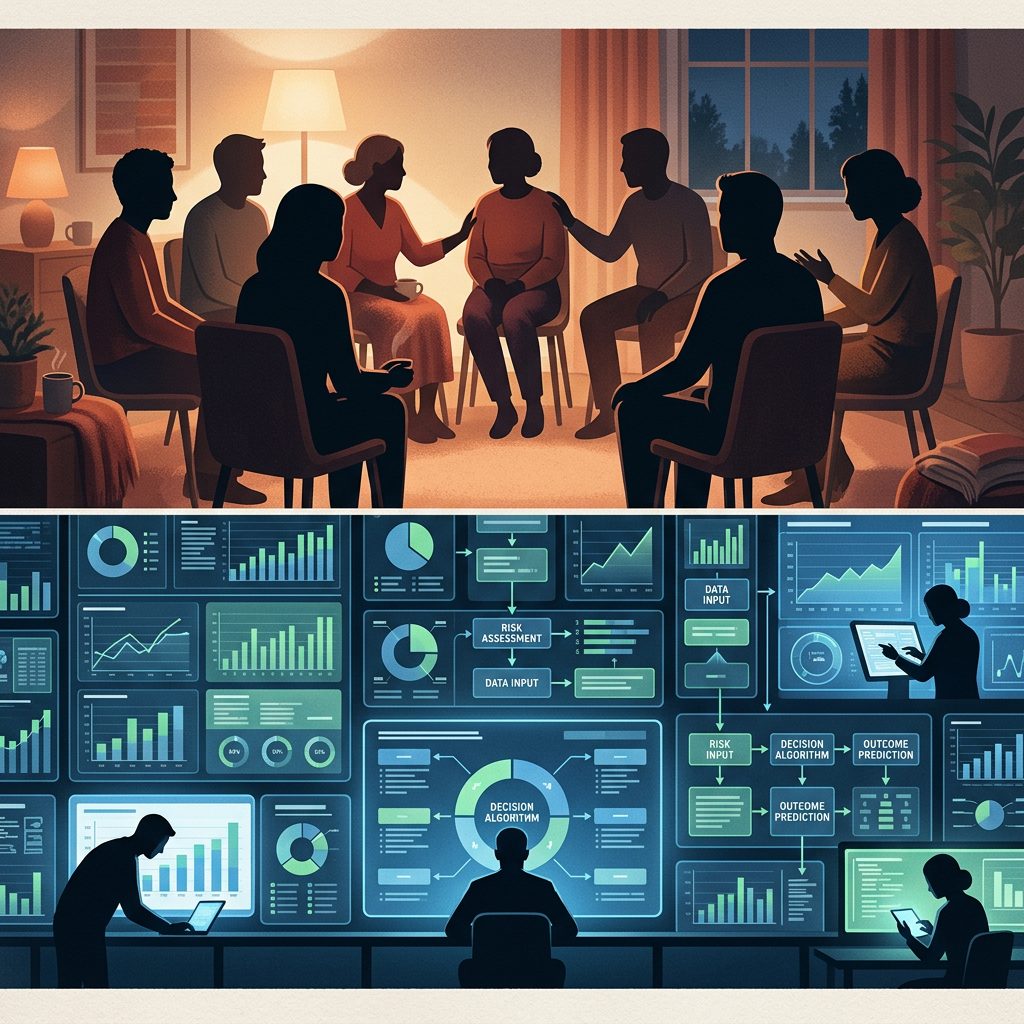
This paper argues that the same structural transformation has occurred within Australia’s domestic human services. The human lens — the caseworker who knew the person, the assessor who saw the disability, the reviewer who heard the appeal — has been replaced by an algorithmic lens. What the state sees is not the human. It is the data.
2. The Neoliberal Turn and Its Technological Embrace
2.1 The Ideological Shift
The transformation of Australian human services did not begin with technology. It began with ideology.
From the 1980s onward, Australian governments embraced neoliberalism — a set of policies that prioritised market mechanisms, competition, and efficiency over universal provision. John Howard’s government (1996–2007) was the federal architect of this shift. Jeff Kennett’s Victorian government (1992–1999) was the state-level pioneer.
The Productivity Commission became the central institution for designing market-based schemes in human services. As one analysis notes, the Commission played “a central role in the design of key market schemes, including the NDIS and Child Care Subsidy”.
2.2 The Technological Requirement
Market-based models require measurement. To introduce competition, you must be able to compare providers. To compare providers, you must standardise outcomes. To standardise outcomes, you must quantify need.
Quantification requires instruments. The Job Seeker Classification Instrument (JSCI) — a questionnaire of up to 49 questions — determines a job seeker’s “level of disadvantage” and places them into one of three streams. This is not a human assessment. It is an algorithmic categorisation.
The NDIS introduced independent assessments and budget-setting tools that reduce disability to measurable criteria. The Integrated Assessment Tool (IAT) for aged care does the same for the elderly.
The technology followed the ideology. But the technology also became the lens. What began as a measurement tool for market design became the primary means by which the state perceives its citizens.
3. The Algorithmic Lens: How the State Sees
3.1 The Digital Welfare State
The term “digital welfare state” describes the increasing reliance on automated decision-making (ADM) systems in social security and human services. These systems span the full “chain of enforcement“: identity verification, eligibility checks, benefit calculation, fraud detection, debt recovery, and sanction administration.
The harms of these systems have been documented across multiple jurisdictions. The Dutch SyRI system — used to detect benefit fraud — was struck down by a court for violating human rights standards. Sweden’s automated system wrongly denied welfare payments to up to 70,000 unemployed. In Poland, the Constitutional Court declared profiling of unemployed persons unconstitutional.
3.2 Robodebt: The Paradigm Case
The Australian Income Compliance Program (ICP), colloquially known as Robodebt, is the clearest example of the algorithmic lens in operation.
Robodebt was a “big data” system that matched reported income to tax records to raise and recoup welfare overpayments. It used a reverse onus: requiring debtors to demonstrate they did not owe money. The design of the algorithm led, unlawfully, to high numbers of false and inflated debts.
The system was implemented through Centrelink. It applied to 866,857 cases of possible overpayment. The income-averaging calculation divided annual tax data by 26 to produce a fortnightly average — a figure that obscured the fluctuations in actual fortnightly earnings that determine welfare entitlements.
The DHS shifted the onus onto the debt recipient to disprove the debt within 28 days. Many people paid the debt as they were unable to disprove it.
In November 2019, the Federal Court declared the debt was invalid because income averaging alone is insufficient to raise a debt. The DHS eventually wrote off 470,000 unlawfully raised Robodebts amounting to $1.751 billion.
The Royal Commission reported in July 2023. It found that “Robodebt was a crude and cruel mechanism, neither fair nor legal”.
3.3 The Algorithmic Lens in Operation
What did the algorithmic lens see when it looked at a welfare recipient?
It saw a discrepancy. A difference between self-reported fortnightly income and averaged annual income. It did not see a person working casual shifts. It did not see the fluctuation that made averaging meaningless. It saw a data point that triggered a process.
What did the algorithmic lens see when it looked at a person with a disability?
It saw a budget. A set of measurable criteria that could be scored, categorised, and allocated. Research on the NDIS found that algorithmic systems of categorisation “privilege stable, hegemonic ways of knowing, measuring and living with disability”. This creates what researchers call epistemic injustice: the individual’s own knowledge of their body is undermined by interpretations of reality based on data.
What did the algorithmic lens see when it looked at an elderly person?
It saw an assessment. A set of questions that produced a score. The Integrated Assessment Tool is now before Senate estimates, with the government claiming it would “not just hand over decision making to an abstract computer program” — a claim contested in real time.
3.4 The Scale and Spread of ADM in Australia
The algorithmic lens is not confined to Centrelink. A survey of NSW government departments and agencies found 136 ADM systems reported, with a potential increase of 50 per cent in the next three years. A majority of state government departments (46 of 77) reported using or planning to use ADM systems.
The NSW Ombudsman’s compendium of ADM systems documents the breadth of the deployment, from air quality alerts to energy rebate eligibility checks. The pattern is clear: the algorithmic lens is being deployed across the full range of government functions.
4. The Structural Consequences
4.1 The Erosion of Human Oversight
The algorithmic lens is not a tool that assists human decision-making. It replaces it.
Research on Robodebt found that the system demonstrated a “collapse in long-standing, hard-fought and widely supported values of welfare state management and administration”. The system “outsources labour previously conducted by Centrelink to clients, compelling them to submit documentation lest debts be raised against them”.
This is not oversight. It is transfer of burden. The citizen is compelled to do the work that the state previously did. The algorithmic lens does not need to decide. It simply requires the citizen to disprove.
4.2 The Loss of Human Context
The algorithmic lens cannot process context. It cannot see the single mother working casual shifts. It cannot see the disabled person whose condition fluctuates. It cannot see the elderly person who is confused by the online portal.
Research on the NDIS found that algorithmic systems “datafy disability in particular ways” — reducing the person to data points that fit the system’s categories. The system cannot accommodate the “embeddedness of disability in social relations and structures”.
The human lens could see context. The algorithmic lens cannot. And what the lens cannot see, the state cannot govern.
4.3 The Pre-Filtered Information Problem
Decision-makers do not see the raw data. They see the output of the algorithmic lens.
When a minister looks at the NDIS, they see budget projections and participant numbers. They do not see the person who was cut off from support. When a minister looks at Robodebt, they see debt recovery figures and compliance metrics. They do not see the person who paid an unlawful debt because they could not prove their innocence.
The documentation of suffering — the Royal Commission report, the class action settlement, the media coverage — is real. But it is externally generated. It comes from outside the decision-making architecture. It is not part of the data stream that the state processes.
This is the structural answer to the question of how two sets of eyes can see different things. The Human Rights Commission sees individuals. The government sees metrics. The metrics are generated by the algorithmic lens. And the lens was designed to see what the state needs to see — not what the citizen needs to be seen as.
5. The Proxy Model Applied to Domestic Populations
5.1 The Structural Parallel
The proxy model described in earlier work — the external actor using a local proxy to achieve strategic objectives — has a domestic analogue. The Australian state’s relationship with vulnerable populations operates through a similar structure of mediated action.
The state does not directly engage with the citizen. It engages through providers. The NDIS has over 12,000 registered providers. Aged care is delivered through contracted organisations. Employment services are delivered through Jobactive providers.
The provider is the proxy. The state sets the terms, allocates the resources, and measures the outcomes. The provider delivers the service — or does not. The citizen experiences the provider. The state experiences the data.
When the provider fails — when the NDIS participant cannot find a service, when the aged care resident is neglected — the state’s response is to re-contract, not to intervene. The proxy model operates through the market, not through direct administration.
5.2 The Individual as Liberator
The citizen who attempts to “liberate themselves” — to get an equitable share, to access the support they need — encounters the algorithmic lens.
They fill in forms. They provide documentation. They wait for assessments. They appeal decisions. They navigate portals.
What they do not encounter is a human being who can see them. The algorithmic lens processes their claim. The provider delivers what the contract specifies. The state sees the data.
The system is designed to process, not to see. The citizen who tries to be seen is asking the system to do something it was not designed to do.
6. Conclusion: The Lens That Cannot See
The Australian state has replaced the human lens with the algorithmic lens. This is not a technological accident. It is the product of a specific ideological alignment — neoliberalism — that was embraced by Australian governments from the 1980s onward.
The algorithmic lens was not introduced to improve human services. It was introduced to measure them. To compare providers. To allocate resources. To enforce compliance. To reduce costs.
What the lens cannot do is see the human being. It cannot see context. It cannot see suffering. It cannot see the fluctuation in income, the complexity of disability, the confusion of the elderly. It sees data. And the data that the state processes is the data that the lens was designed to generate.
The documentation of suffering — the Royal Commission, the class action, the media coverage — is real. But it is external to the decision-making architecture. It does not enter the lens.
The state cannot see what the lens does not show. And the lens does not show what it was not designed to see.
This is not a failure. It is a feature. The algorithmic lens was designed to see what the state needs to see. The question is whether the state can be redesigned to see what it needs to see — or whether the lens has become the state itself.
Claim -Status -Summary
# Claim- Status
1 Neoliberalism introduced market-based models into human services -Established
2 Market models require standardised measurement -Established
3 Robodebt used algorithmic decision-making that produced unlawful debts -Established
4 The system applied to 866,857 cases and wrote off $1.751 billion- Established
5 NDIS algorithmic categorisation creates epistemic injustice -Established
6 NSW government has 136 ADM systems in use or planned- Established
7 The algorithmic lens replaces human judgment- Inference
8 Decision-makers see metrics, not individuals -Inference
9 The proxy model applies to domestic human services -Inference
10 The state cannot see what the lens does not show- Inference
References
1. Whelan, A. (2022). Public service ethics and the Income Compliance Program. In Social Security, the Digital Welfare State and the Rule of Law. Taylor & Francis.
2. Checks and balances under pressure in the welfare state: Disentangling the rule of law risks of automation and welfare conditionality. (2025). Sage.
3. Citizens putting in the work: how administrative work is shifting in the digital welfare state. (2025). Taylor & Francis.
4. Reventlow, N. J. (2020). Tackling the Human Rights Impacts of the “Digital Welfare State”. Digital Freedom Fund.
5. Scully, J. L. (2023). Unveiling algorithmic power: exploring the impact of automated systems on disabled people’s engagement with social services. Disability and Society, 39, 3004–3029.
6. NSW Ombudsman. (2024). Compendium of ADM systems. Parliament of NSW.
7. Critical Sociology. (2020). The Online Compliance Intervention. Sage.
8. Chowdhury, S. (2024). Technology is never neutral: Robodebt and a human rights analysis of automated decision-making on welfare recipients. Australian Journal of Human Rights, 30(1), 20–40.
9. UKAJI. (2020). Administrative law and the digital welfare state in the UK and Australia.
10. UNSW. (2021). Digital Social Policy & Service Delivery. ASPC Program.
11. The Desert and the Budget Victory (Part 2). (2026). The AIM Network.
12. Bouwmeester, M. (2025). ‘Australisch toeslagenschandaal’: Een bestuurswetenschappelijk perspectief op het systeemfalen van Robodebt. Bestuurskunde, 34(1), 81–95.

