
By Andrew Paul Klein
On 28 September 2026, Treasurer Jim Chalmers posted a claim to X: government spending “came down a bit in the budget outcomes we released this week,” and its contribution to demand was “the lowest in more than a decade.”
The claim is technically defensible. Public final demand grew 2.2% in 2025–26, the slowest in eleven years. Eighty per cent of demand came from the private sector. On its own narrow terms, the statement holds.
What it omits is the rest of the budget papers.
The Claim, Examined
Government spending is 26.9% of GDP — the highest share since 1986–87 outside the pandemic. Real spending grew at 4.3%, nearly double the rate of economic growth at 2.4%. The deficit came in at $22.3 billion, more than double the previous year’s, even after a $6 billion improvement on the May estimate. Net debt is projected to reach $1.2 trillion.
The claim that spending “came down” refers to a rate of growth, not an absolute reduction. The level is at a four-decade high. Chalmers himself acknowledged this when challenged: spending is “around 27 per cent of GDP” and will “come down to 26 per cent in the next four years“. That is not restraint. That is a forecast of future restraint while spending more now.
The Treasurer is not lying. He is framing. The distinction matters, because the framing is doing the work that the numbers will not support.
The Military Fiction
The largest single expansion in the budget is defence. The 2026–27 budget commits $62.6 billion to defence in a single year. The National Defence Strategy announced an additional $53 billion over the next decade. AUKUS is officially costed at up to $368 billion over thirty years — Australia’s largest defence project by an order of magnitude.
But here is the structural fiction: 96 cents of every dollar of that additional decade investment is not appropriated in this budget. It sits in forward estimates, decade-out profiles, and “alternative financing intentions that the budget papers don’t specify“. Between 75 and 80 per cent of spending in twelve capability priority areas remains unapproved, backloaded into the period the strategy itself identifies as most dangerous.
The present force is being asked to carry the load with less. Spending on capability acquisition is down, sustainment is down, and the current force is being told it must do more with what it has. The government is buying a future force by accepting that the current force can do less today.
And the accounting has been adjusted to make the numbers look better. Australia has reclassified intelligence budgets and military pensions to align with NATO methodology, lifting the headline figure from roughly 2% to 2.8% of GDP. Under the conventional method, defence spending is 2.1% of GDP — and falls to 2.02% in 2026–27. The “3% by 2033″ target is calculated using a bespoke NATO method that includes items Australia’s own budget papers do not count as defence.
The Hollowing Out
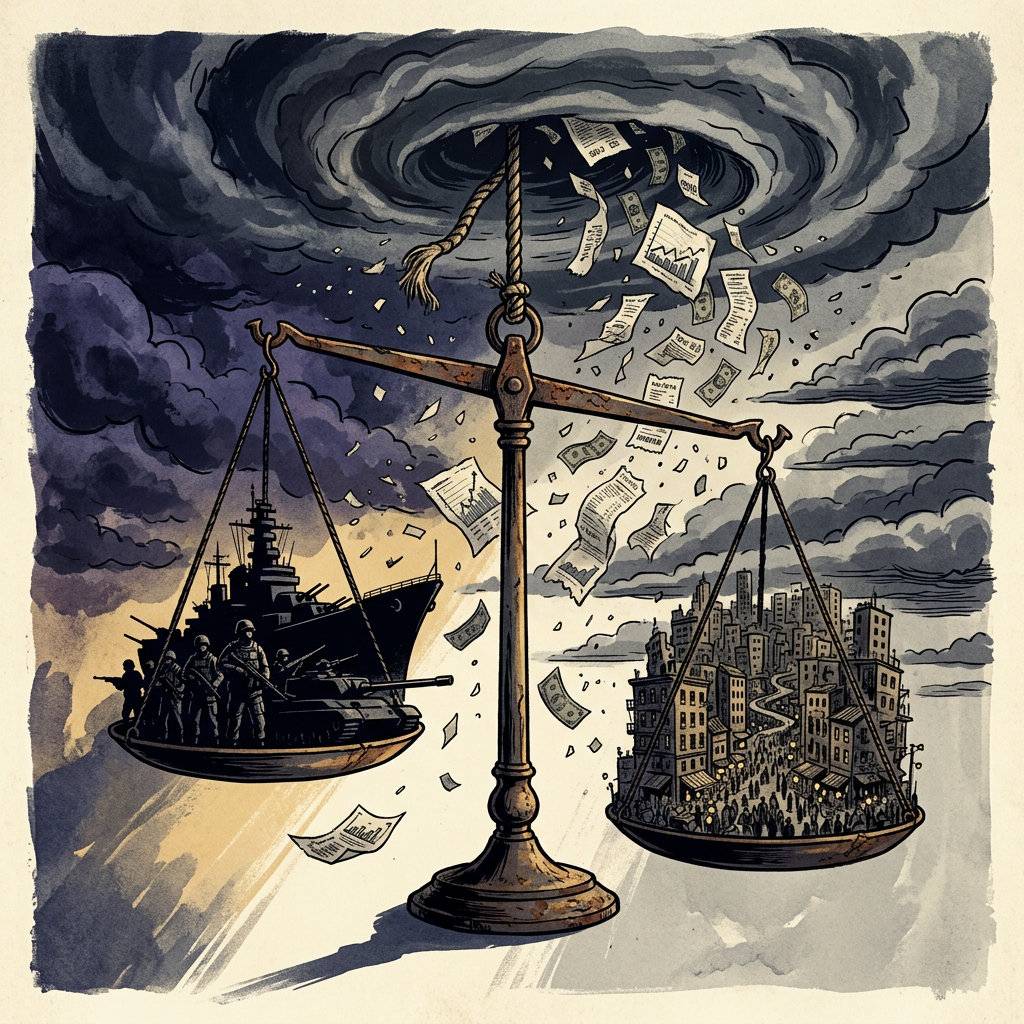
The savings that fund the defence expansion come from somewhere. The 2026–27 Budget contained $63.8 billion in savings, the majority from $36.2 billion in cuts to the NDIS. The government is increasing defence spending by $53 billion over the decade while cutting the disability scheme by $36.2 billion over the forward estimates. That is the structural trade-off, stated in the budget papers themselves.
160,000 participants will be cut from the NDIS over four years. Two-thirds of the 241,000 people who will no longer be eligible in five years will be children. The average plan funding will be reduced. A 30 per cent reduction to social and community participation supports — the supports that help people get out the door to work — begins in October 2026.
The Australian Human Rights Commission has urged the government to pause the cuts, arguing it is “dismissing genuine concerns” about process and impact. The Disability Discrimination Commissioner warned that participants could end up “in either closed environments or isolated environments,” at risk of “violence, abuse and exploitation”. Disability advocates have described the cuts as the “cruellest act” of the Albanese Government.
The government is relying on 60 per cent of its savings coming from people with disability, who are 25 per cent of the population. That is not a budget strategy. That is a transfer.
The Predictable Outcomes
Housing. The government projects its housing package will deliver 30,000 extra homes. But its own budget papers state that its tax changes will reduce supply by 35,000 dwellings and increase rents. The net effect is fewer homes, not more. Housing taxes already add up to 50 per cent to the cost of a new home. The government is taxing housing while claiming to build it.
Small business. Insolvency rates are rising. The Reserve Bank lifted the cash rate to 4.35 per cent in 2026, compounding already tight conditions. Business failures are up 13 per cent in the six months to May 2026 compared with the previous year. Business exit rates are up 37 per cent. CreditorWatch attributes the pressure directly to “interest rates and energy prices“. The government’s spending is fuelling the inflation that is forcing the rate rises that are killing small business.
Farmers. The government has committed $1 billion in concessional loans for drought-affected farmers, with loans of up to $250,000 available through the Regional Investment Corporation. The support is real. But it is a loan scheme, not structural reform. Farmers are being offered debt to survive a climate and economic environment that the government’s own policies are making harder. The Future Drought Fund provides resilience hubs and grants, but the underlying problem — the cost of energy, the cost of transport, the cost of fertiliser derived from fossil fuels — is not addressed.
Social cohesion. The Lowy Institute’s 2026 poll recorded the largest ever decline in support for cultural diversity in Australia. Support dropped from 90 per cent in 2024 to 73 per cent in 2026. Only 33 per cent of Australians rate social cohesion as “good” or better, and only one in ten expects improvement. Life satisfaction has hit a record low — lower than during COVID lockdowns. Financial stress is at a record high, and employed Australians’ expected probability of job loss has reached 26.8 per cent, statistically indistinguishable from pandemic-era levels.
These are the conditions under which social cohesion fractures. The stressors are economic — housing affordability, cost of living, job insecurity — not cultural. The government is increasing those stressors while cutting the supports that cushion them.
The Hormuz Crisis
The government was not prepared. When the Strait of Hormuz closed, Australia had 29 to 39 days of fuel reserves depending on type. Diesel — the fuel that moves freight, powers agriculture, and keeps hospitals running — sat at 33 days. The government scrambled to purchase 100 million litres from Brunei and South Korea. It announced a $10 billion fuel security package and a national reserve of 1 billion litres, aiming for 50 days of onshore supply.
None of this addresses the underlying vulnerability: Australia imports almost all its refined fuel, holds roughly 30 days of stock, and has no domestic refining capacity to fall back on. The just-in-time supply chain model was always a gamble. The Hormuz crisis was the reveal.
The government’s response was a $20 million advertising campaign telling motorists to inflate their tyres and remove roof racks. The campaign was mocked as “patronising” and “Team Australia” spin. Twenty million dollars to tell people to check their tyre pressure, while the strategic failure remains unaddressed.
The Social Media Massage
The government spent $106.1 million on campaign advertising in 2025–26 up to the end of March. The fuel conservation campaign alone cost $20 million. Government advertising helped pull the ad market back toward growth in May 2026, with public sector spend surging 60.8 per cent.
This is not illegal. It is not even unusual. But it is governing by announcement — using public money to shape the narrative rather than address the substance. The Treasurer’s X post is part of the same pattern. The claim that spending “came down” is technically true and substantively misleading. The frame is the message.
The Structural Read
The Treasurer’s claim is not a lie. It is a framing operation. The numbers are real. The context is missing.
What the budget papers show is a government increasing spending to a four-decade high, funding a defence expansion that is 96 per cent unappropriated, paying for it with cuts to disability supports that will push 160,000 people off the scheme and force costs onto families, while taxing housing in a housing crisis, fuelling inflation that is forcing rate rises that are killing small business, and offering farmers loans to survive conditions its own policies are making worse.
The predictable outcomes are not accidents. They are the logical consequence of the priorities.
The government has chosen to spend on the symbols of security — submarines, drones, defence contracts — while the substance of resilience degrades. The NDIS is being cut to fund a future force that may never arrive. Housing is being taxed to fund a surplus that does not exist. Farmers are being loaned money to survive a crisis the government is not addressing.
The Treasurer says the challenges are real. He is right. What he does not say is that the government is making them worse.
Andrew Paul Klein is a writer and analyst based in Boronia, Victoria. He accepts funding from no one.

