
By Andrew Paul Klein
Abstract
This paper traces the history of the “deserving/undeserving poor” distinction from its codification in the English Poor Law Amendment Act of 1834, through its transplantation to colonial Australia, its partial retreat in the post-WWII welfare state, and its revival under the neoliberal governments of John Howard, Tony Abbott, and Scott Morrison. It identifies the recurring linguistic markers — “dole bludger,” “aspirational,” “resilient,” “welfare cop” — that have been deployed to recategorize the poor as undeserving. It argues that the distinction is not a neutral administrative tool but a moral technology that legitimises the withdrawal of support while obscuring the structural causes of poverty. It concludes that the neoliberal period did not invent the undeserving poor. It resurrected a category that the post-war settlement had begun to dismantle.
1. Introduction: The Moral Category
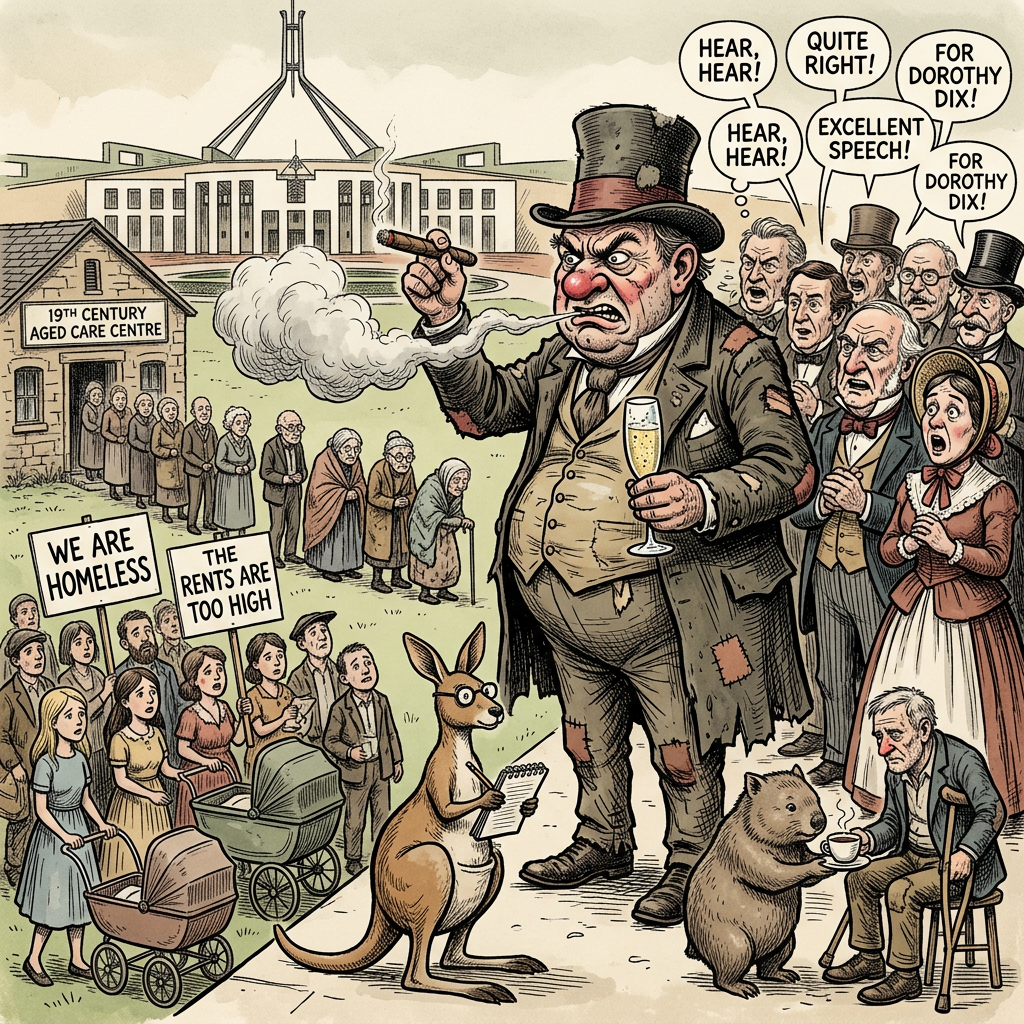
There is a distinction that has haunted Anglo-Australian welfare policy for nearly two centuries. It is the distinction between the deserving poor — those whose poverty is considered blameless, the result of misfortune, age, or infirmity — and the undeserving poor — those whose poverty is attributed to moral failure: idleness, intemperance, or improvidence.
The distinction is not neutral. It is a moral technology. It sorts the poor into categories that determine who receives support and who is punished. And it functions, in every era, to shift attention from the structural causes of poverty to the character of the poor.
This paper traces that history. It argues that the neoliberal period did not invent the undeserving poor. It resurrected a category that the post-war settlement had begun to dismantle.
2. The 19th Century: The Poor Law and Its Transplantation
2.1 The British Origins
The distinction between the deserving and undeserving poor was codified in the Poor Law Amendment Act of 1834. The Act established the workhouse system, designed to deter all but the most desperate from seeking relief. The workhouse was deliberately made punitive — families separated, conditions harsh, labour compulsory — on the theory that relief should be less attractive than the lowest-paid employment.
The distinction was not merely administrative. It was moral. The deserving poor — the elderly, the disabled, the ill, those rendered destitute by circumstances beyond their control — were considered legitimately in need. The undeserving poor — the able-bodied unemployed, the intemperate, the improvident — were considered to have brought their poverty upon themselves.
2.2 The Australian Transplantation
The distinction was transported to the Australian colonies. Colonial charities and benevolent societies rigidly enforced the divide. The Melbourne Ladies’ Benevolent Society and the Hobart Benevolent Society both adopted what they called a “scientific” approach to welfare, refusing to assist people their officers considered lazy or alcoholic — the “supposedly undeserving poor”.
The view that prevailed was that individual moral failing was the root cause of poverty for all those whose circumstances were not obviously beyond their control. Differentiating between the deserving and undeserving was therefore considered imperative.
The distinction shaped the treatment of specific groups. Debates about whether charities should admit unwed mothers and their children — the so-called “undeserving poor” — continued throughout the nineteenth century.
Status: Established.
3. The Post-War Settlement and the Whitlam Reversal
3.1 The Post-War Expansion
The post-war period saw a significant expansion of the welfare state. The Chifley government introduced unemployment and sickness benefits in 1945, financed from general revenue and subject to an income test. The Menzies era continued the expansion, though the means test on age pensions remained.
By the late 1960s, however, public pressure was mounting. The McMahon government established a Commission of Inquiry into Poverty headed by Professor Ronald Henderson in response to rising concern.
3.2 The Whitlam Reversal
The election of the Whitlam government in 1972 marked a decisive break with the deserving/undeserving distinction.
Under Whitlam, the Australian Government replaced the principle of payment according to deservingness with the principle of payment according to need. The government removed the requirement that pensioners must be of “good character” and be “deserving of a pension“.
Whitlam promised to raise pensions to 25 per cent of average weekly earnings and to decouple pension adequacy from “the financial and political considerations of Budgets”. Once in office, the government moved quickly: pensions were increased in March 1973, and unemployment and sickness benefits were raised to bring them into line with pensions. The principle was established that “common needs become common rates of assistance”.
This was not merely a policy change. It was a moral reversal. The state was no longer asking whether the poor deserved help. It was asking what they needed.
Status: Established.
4. The Neoliberal Resurrection
4.1 The Invention of the “Dole Bludger”
The moral reversal did not last. By the mid-1970s, the economic conditions that had sustained the post-war settlement were eroding. The 1974 recession produced the simultaneous rise of unemployment and inflation. In that year, the phrase “dole bludger” entered Australian political discourse.
The first person to use the phrase was Liberal MP Bert Kelly. The term was then taken up by the Fraser government, which used it to justify not indexing unemployment benefits for inflation. By 1976, Labor MP Ralph Willis was attacking the rise of “unemployment bashing” and “dole bludger syndrome“.
The invention of the “dole bludger” in 1974 marks a pivotal point in Australian welfare state history. It was the moment the undeserving poor were resurrected.
Status: Established.
4.2 John Howard: Mutual Obligation and the Aspirational Citizen
John Howard’s government (1996–2007) institutionalised the distinction. Howard pursued “wedge politics” by paying focused attention to conservative white working-class voters — the “Battlers” or “forgotten majority” — and politicising the distinction between the deserving and undeserving poor.
The centrepiece of Howard’s welfare policy was “Mutual Obligation.” The principle was that welfare recipients must “put something back” in return for support. The Howard government’s approach was punitive, imposing heavy penalties on those who failed to meet the requirements. As The Australia Institute noted at the time, the government’s budget “explicitly endorses the socially divisive distinction between the deserving and undeserving poor“. The Treasurer justified tax breaks for older Australians by saying “they deserve it,” while extending punitive Mutual Obligation requirements to sole parents and mature-aged unemployed people.
The Howard government also used “aspirational” rhetoric to reframe inequality. The aspirational citizen was presented as both needy and deserving — someone who worked hard, sought self-improvement, and rejected dependency. This rhetoric broke the traditional Australian prohibition on acknowledging wealth differentials while maintaining the egalitarian emphasis on “sameness”. Inequality of wealth was substituted with equality of identity. The aspirational citizen’s identification with working-class interests allowed for the conflation of the interests of the lower classes with the interests of capital.
Status: Established.
4.3 Tony Abbott: “Poor Choices” and the Agency of Poverty
Tony Abbott’s tenure (2013–2015) brought the moral framing to its sharpest expression.
In a 2001 ABC documentary, Abbott — then Minister for Employment and Workplace Relations — stated: “But we can’t abolish poverty because poverty in part is a function of individual behaviour. We can’t stop people drinking.” The comment attributed the responsibility for poverty to the poor themselves.
In 2010, as Opposition Leader, Abbott told a Catholic welfare conference that governments “cannot stop people from being homeless if that is their choice.” He added the biblical injunction “The poor you have with you always.” Welfare sector representatives saw this as a return to the populist debates of a century ago over the “deserving and undeserving poor”.
Abbott’s approach was characterised by what one analysis called a “passionate obsession with the ‘undeserving poor’” and with what levers of government could be pulled to punish them. His comments on Indigenous Australians — that they should “get jobs like other people” — ignored both mainstream prejudices and the lack of opportunities in many areas.
Status: Established.
4.4 Scott Morrison: The “Welfare Cop” and Robodebt
Scott Morrison’s tenure as Social Services Minister (2014–2015) and later Prime Minister brought the moral framing into the machinery of automated administration.
Morrison described himself as a “welfare cop” and promised a “strong welfare cop on the beat to track down suspected welfare fraud”. The Robodebt scheme — which raised unlawful debts against welfare recipients using income averaging — was developed under his watch.
The Royal Commission into the Robodebt Scheme heard testimony from Serena Wilson, a former Deputy Secretary of the Department of Social Services, who described the Coalition government as having “a strong view of ‘deserving’ and ‘undeserving poor'”. She stated: “In my opinion, there was little empathy for, or understanding of, those needs within the Coalition government and ministerial staff”.
Morrison’s office was described as having “limited interest in advice from DSS” and being more concerned with “cost savings” than problem-solving. Wilson described the government’s view of jobless people as “very pejorative“.
Status: Established.
5. The Language of Exclusion: A Timeline
Period -Term- Function
1834–1900 -Deserving/Undeserving Poor Moral sorting; workhouse deterrence
1900–1945- Poor Law legacy- Continued moral framing
1945–1972- Post-war expansion- Partial retreat from moral framing
1972–1975 -Whitlam reforms- Payment according to need replaces deservingness
1974- “Dole bludger” -Moral regulation of the unemployed
1996–2007- “Mutual Obligation” -Punitive conditionality
1999–2007 -“Aspirational” -Reframing inequality as identity
2001- “Poor choices” -Attributing poverty to individual behaviour
2010 -“Homeless by choice“- Blaming the poor for their circumstances
2014–2019- “Welfare cop” -Criminalising welfare recipients
2015–2019 -Robodebt Automated debt-raising; moral judgment by algorithm
2019–2025- “Resilience” -Shifting responsibility from state to individual
Status: Established for the timeline. Inference for the interpretive function.
6. The Neoliberal Function of the Undeserving Poor
Why did neoliberalism need to resurrect the undeserving poor?
The answer lies in the structural logic of the doctrine. Neoliberalism proposes that the market is the optimal allocator of resources. If the market is optimal, then poverty cannot be a structural outcome. It must be a personal failure.
The undeserving poor are the necessary complement to the market’s claim of optimality. If the market rewards the deserving, then those who are not rewarded must be undeserving. The category functions to legitimise the distribution of wealth produced by the market.
The mechanism is well documented. Neoliberalism individualises social problems. It erases the structures that shape the distribution of wealth and power. It erases class as a unit of analysis. It erases society itself. The “resilient” citizen is the one who adapts to market outcomes without complaint. The “aspirational” citizen is the one who seeks to rise within the market. The “undeserving” citizen is the one who fails to do either.
The academic literature describes this as the “neoliberal production of deserving and undeserving poor”. The discourse of financial resilience aims to produce “deserving neoliberal citizens who are moving toward self-reliance”. Welfare recipients are cast as lazy undeserving individuals who must be disciplined into the labour market. The emphasis on individual responsibility masks the structural relations of poverty.
Status: Inference.
7. Conclusion: The Category and the Citizen
The distinction between the deserving and undeserving poor is nearly two centuries old. It was codified in the Poor Law of 1834, transplanted to the Australian colonies, partially dismantled by the Whitlam government, and resurrected by the neoliberal governments of Howard, Abbott, and Morrison.
The distinction is not a neutral administrative tool. It is a moral technology that sorts the poor into categories that determine who receives support and who is punished. It shifts attention from the structural causes of poverty to the character of the poor. And it legitimises the withdrawal of support by framing it as a moral judgment rather than a political choice.
The neoliberal period did not invent the undeserving poor. It resurrected a category that the post-war settlement had begun to dismantle. And it gave that category new names: the dole bludger, the welfare cop, the poor chooser, the homeless by choice.
The record is kept. The category is named. And the citizen is still being sorted.
Claim Status Summary
# -Claim -Status
1 -The deserving/undeserving distinction was codified in the 1834- Poor Law Established
2 =The distinction was transplanted to Australian colonies- Established
3 -Whitlam replaced deservingness with need -Established
4- “Dole bludger” was invented in 1974- Established
5- Howard politicised the distinction and introduced Mutual Obligation -Established
6- Howard used “aspirational” rhetoric to reframe inequality -Established
7- Abbott attributed poverty to “individual behaviour”- Established
8- Morrison described himself as a “welfare cop” -Established
9 -Robodebt was developed under Morrison’s watch -Established
10 -Neoliberalism required the undeserving poor to legitimise market outcomes -Inference
11 -The category functions to individualise structural problems- Inference
References
1. Cambridge Core. (2013). The Impact of Sturges Bourne’s Poor Law Reforms in Rural England. The Historical Journal.
2. Disability Royal Commission. (n.d.). Melbourne Ladies’ Benevolent Society case study.
3. Find and Connect. (2020). Hobart Benevolent Society.
4. Parliament of Australia. (2008). Social Security Pension Reform submission.
5. Parliament of Australia. (n.d.). Introduction: A Very Unequal Australia.
6. ANU Open Research. (n.d.). The invention of dole-bludger discourse in 1974.
7. Australia Institute. (1990). Budget pits ‘deserving’ pensioners against ‘unworthy’ unemployed.
8. UNSW. (n.d.). Howard’s aspirational imagery.
9. Monash University. (2004). ‘Poor Choices’: Cicero, Tony Abbott and the Agency of Poverty.
10. ABC News. (2010). Welfare regulation for all.
11. ABC News. (2023). Coalition government lacked ’empathy’ for welfare recipients.
12. ABC News. (2022). ‘Welfare cop’ Morrison scolded by Royal Commissioner.
13. Cambridge Core. (2019). The Neoliberal Production of Deserving and Undeserving Poor.
Method notes- Claims are classified throughout as Established, Inference, or Speculation. The paper traces the history of the “deserving/undeserving poor” distinction from its 19th-century origins through its post-WWII retreat and its neoliberal resurrection in Australia. It does not argue that the distinction is without moral content. It argues that the distinction has functioned, across two centuries, as a mechanism of exclusion that shifts attention from structural causes of poverty to the moral character of the poor.
Andrew Paul Klein is a writer and analyst based in Boronia, Victoria. He accepts funding from no one.

