
A Working Paper
Andrew Paul Klein
Abstract
This paper examines the events of approximately 12,000 years ago — the Pleistocene-Holocene transition — and argues that this period constituted a branching point in human history whose consequences remain operative. It documents the Younger Dryas cold snap, the global megafaunal extinction, and the Neolithic transition to agriculture. It traces the divergence between agricultural and non-agricultural societies, the marginalisation and eventual destruction of the hunter-gatherer way of life, and the structural features that the agricultural transition produced: hierarchy, private property, organised warfare, epidemic disease, and the extraction economy. It argues that the architecture of extraction documented in contemporary contexts is a direct descendant of the Neolithic transition, and that the branch of humanity that became “irrelevant” — the hunter-gatherer way of life — offers a structural alternative that has been almost completely eliminated.
1. Introduction: The Question of the Threshold
Approximately 12,000 years ago, the world changed. The last glacial period ended. The climate warmed. The megafauna that had dominated the continents for millions of years went extinct. And human populations, which had lived as hunter-gatherers for hundreds of thousands of years, began to settle, cultivate, and domesticate.
This paper examines that period. It asks a specific question: what happened at this threshold, and what did it produce?
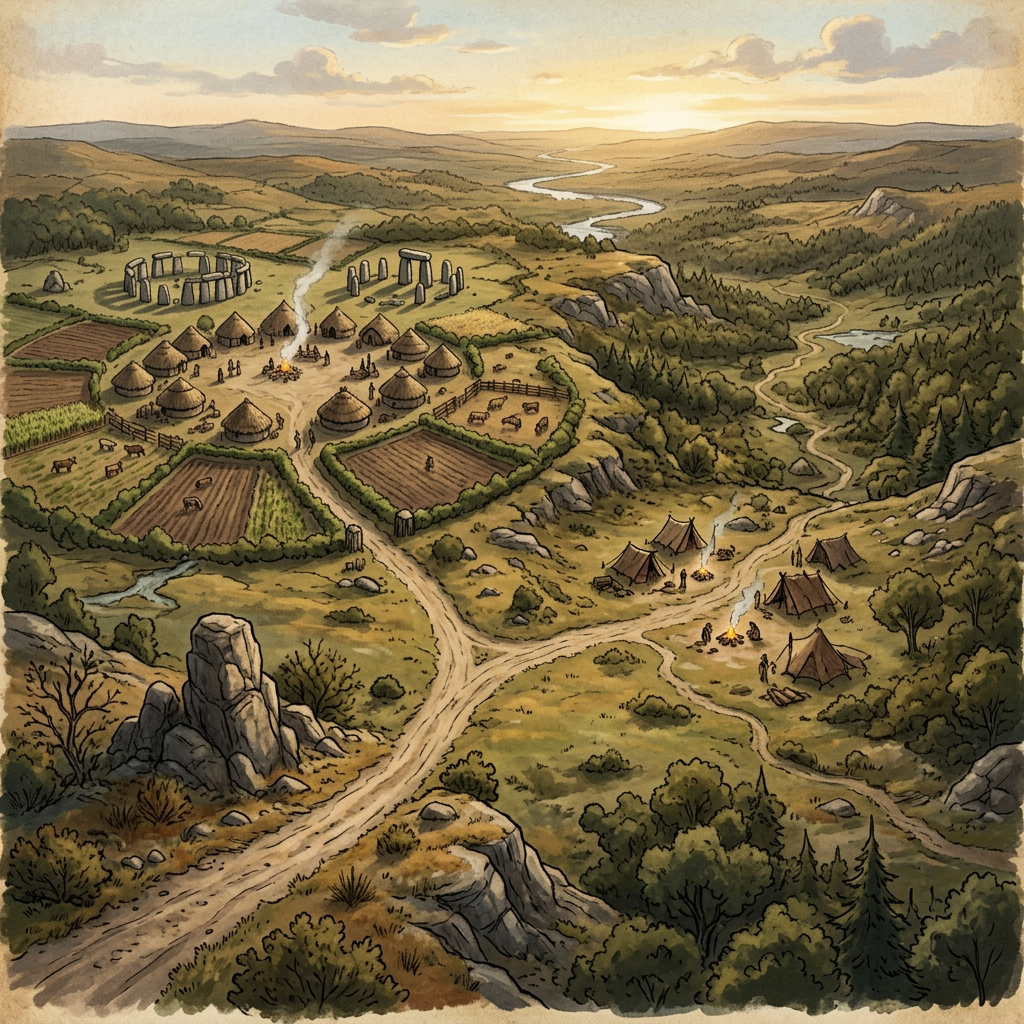
The paper is not concerned with assigning praise or blame. It is concerned with identifying a structure. The argument is that the events of 12,000 years ago constituted a branching point in human history, and that one branch of that branching — the agricultural, sedentary, surplus-producing way of life — became dominant, while another — the hunter-gatherer, nomadic, subsistence-based way of life — was progressively marginalised and, in most places, eliminated. The consequences of that branching are still with us.
2. The World at 12,000 BP
2.1 The Pleistocene-Holocene Transition
The Last Glacial Maximum (LGM) occurred approximately 26,500 to 19,000 years ago. At its peak, ice sheets covered much of northern Europe and North America, sea levels were approximately 120 metres lower than today, and global temperatures were 4–7°C colder than pre-industrial levels.
The transition from the Pleistocene to the Holocene — the current geological epoch — began approximately 15,000 years ago. The ice sheets retreated. Sea levels rose. The climate warmed. But the transition was not smooth. It was interrupted by a period of sudden cooling known as the Younger Dryas.
2.2 The Younger Dryas
The Younger Dryas was a period of abrupt cooling that occurred approximately 12,900 to 11,700 years ago. It was discovered in pollen records from Scandinavia, where the pollen of the Arctic-alpine plant Dryas octopetala replaced the pollen of trees and shrubs, indicating a return to cold conditions.
The cause of the Younger Dryas is debated, but the leading hypothesis involves a slowdown or shutdown of the Atlantic Meridional Overturning Circulation (AMOC) — the ocean current that transports warm water from the tropics to the North Atlantic. The slowdown was likely triggered by a massive influx of freshwater into the North Atlantic from the melting Laurentide Ice Sheet.
The Younger Dryas Impact Hypothesis, proposed by Firestone, West, Kennett and colleagues in 2007, posits that a comet impact or airburst occurred approximately 12,900 years ago, causing the Younger Dryas and contributing to the megafaunal extinction. The hypothesis is contested. Evidence cited in support includes nanodiamonds, platinum spikes, magnetic grains, and glassy carbon at sites across North America and Europe. Critics argue the evidence is not conclusive and that the climate change can be explained by the AMOC slowdown alone.
Status: Established for the Younger Dryas itself. Contested for the impact hypothesis.
2.3 The Megafaunal Extinction
The end of the Pleistocene saw the extinction of much of the world’s megafauna — large animals weighing over 44 kilograms.
In the Americas, the extinction event occurred approximately 13,000 to 11,000 years ago. It claimed the mammoth, the mastodon, the saber-toothed cat, the giant sloth, the dire wolf, the short-faced bear, the American lion, the woolly rhinoceros, and many other species. Approximately 70 per cent of large mammal genera in North America went extinct.
In Eurasia, the extinction occurred approximately 12,000 to 10,000 years ago. It claimed the woolly mammoth, the woolly rhinoceros, the cave bear, the cave lion, and the Irish elk.
In Australia, the extinction occurred approximately 46,000 to 40,000 years ago — much earlier than the other continents. It claimed the Diprotodon (the largest marsupial ever known), the Procoptodon (a giant kangaroo), the Thylacoleo (the marsupial lion), and the Megalania (a giant monitor lizard).
The cause of the extinctions is debated. The overkill hypothesis, proposed by Paul Martin in 1967, argues that human hunting was the primary cause. The climate change hypothesis argues that the transition from the Pleistocene to the Holocene disrupted the ecosystems on which the megafauna depended. Most researchers now consider that both factors contributed, with the relative importance varying by region.
Status: Established for the extinctions. Contested for the primary cause.
2.4 The Flooding of Land Bridges and Coastal Zones
The end of the Pleistocene saw significant sea-level rise, flooding land bridges and coastal zones that had been inhabited by human populations.
Doggerland was a landmass that connected Britain to mainland Europe across what is now the North Sea. It was inhabited by hunter-gatherer populations and was gradually submerged between approximately 8,000 and 6,000 BCE. The flooding of Doggerland is documented in geological evidence and in the archaeological record of the region.
Sundaland was a landmass that connected the Malay Peninsula, Sumatra, Borneo, and Java. It was submerged between approximately 11,000 and 8,000 BCE. The flooding of Sundaland created the Indonesian archipelago as it exists today.
Beringia was the land bridge that connected Siberia to Alaska. It was submerged approximately 11,000 BCE, separating the human populations of the Americas from those of Asia.
Status: Established.
3. The Neolithic Transition
3.1 The Origins of Agriculture
The Neolithic transition — the shift from hunting and gathering to agriculture — began approximately 10,000 BCE in the Fertile Crescent, a region encompassing parts of modern-day Iraq, Syria, Lebanon, Israel, Jordan, and Egypt.
The transition involved the domestication of plants and animals:
Plants: emmer wheat, einkorn wheat, barley, lentils, chickpeas, bitter vetch, flax.
Animals: sheep, goats, cattle, pigs.
Agriculture emerged independently in other regions:
China: rice (Yangtze River basin, c. 8000 BCE), millet (Yellow River basin, c. 8000 BCE).
Mesoamerica: maize (c. 7000 BCE), beans, squash.
Andes: potato, quinoa, llama, alpaca.
Eastern North America: sunflower, goosefoot, marsh elder.
New Guinea: taro, banana.
Africa: sorghum, pearl millet, yams.
The transition was gradual, not a “revolution” in the traditional sense. It occurred over thousands of years. It involved both genetic changes in crops and animals (domestication) and cultural changes in human societies (sedentism, storage, surplus).
Status: Established.
3.2 Göbekli Tepe: The Complex Before Agriculture
Göbekli Tepe is an archaeological site in southeastern Turkey, dated to approximately 9600 BCE — before the domestication of plants and animals in the region. It consists of massive stone pillars, some weighing up to 20 tonnes, arranged in circular enclosures. The pillars are carved with animal reliefs — foxes, boars, snakes, cranes, scorpions.
The site was excavated by Klaus Schmidt from 1995 until his death in 2014, and continues under the direction of Lee Clare. Schmidt argued that the site was a ceremonial centre built by hunter-gatherers, and that it demonstrates that complex social organisation preceded agriculture, not the other way around.
The implications are significant. The conventional narrative — that agriculture led to surplus, which led to complex society — is challenged by Göbekli Tepe. The site suggests that hunter-gatherers could organise large-scale communal projects without agriculture. The desire to build the ceremonial centre may have driven the transition to agriculture, rather than the other way around.
Status: Established for the site and its dating. Inference for the interpretation.
4. The Branching
4.1 The Divergence
The Neolithic transition created a divergence between two ways of life:
Agricultural societies: sedentary, surplus-producing, hierarchical, state-forming, property-owning, warfare-prone, epidemic-prone.
Hunter-gatherer societies: nomadic or semi-nomadic, subsistence-based, generally egalitarian, non-state, non-propertied in the modern sense, less warfare-prone, less epidemic-prone.
The divergence was not absolute. Some hunter-gatherers adopted agriculture; some agriculturalists abandoned it. But the general trend was toward the expansion of agriculture and the contraction of hunting and gathering.
4.2 The Structural Features of Agricultural Societies
The agricultural transition produced a set of structural features that had not existed — or had existed only in limited forms — in hunter-gatherer societies.
Surplus. Agriculture produced more food than was needed for immediate consumption. Surplus could be stored, traded, or controlled.
Storage. Surplus required storage — granaries, silos, warehouses. Storage required management. Management required administrators.
Hierarchy. The control of surplus created hierarchy. Those who controlled the surplus — chiefs, priests, kings — held power over those who did not.
Private property. Agriculture tied people to land. Land became property. Property became inheritable. Inheritance created dynasties.
Patriarchy. The control of property required the control of reproduction. Women’s sexuality was regulated to ensure paternity. Patriarchy was not invented by agriculture, but it was intensified by it.
Organised warfare. Agricultural societies competed for land, water, and resources. Warfare became organised, large-scale, and institutionalised.
Epidemic disease. The domestication of animals brought humans into close contact with zoonotic pathogens. Smallpox, measles, influenza, and other diseases emerged from animal reservoirs and spread through dense agricultural populations.
The state. The administration of surplus, the organisation of warfare, and the regulation of property required a state — a centralised authority with the power to tax, conscript, and punish.
Status: Established for the structural features. Inference for the causal relationship.
4.3 The Marginalisation of the Hunter-Gatherer
The expansion of agricultural societies marginalised hunter-gatherer societies.
Demographic expansion. Agricultural societies could support larger populations per unit of land. They expanded into the territories of hunter-gatherer societies, displacing or absorbing them.
Military advantage. Agricultural societies had larger populations, more specialised warriors, and — eventually — metal weapons and horses. They had a military advantage over hunter-gatherer societies.
Disease. Agricultural societies carried epidemic diseases to which hunter-gatherers had no immunity. The spread of disease was often more devastating than warfare. The colonisation of the Americas, Australia, and the Pacific was accompanied by demographic collapse of indigenous populations, primarily from disease.
Cultural absorption. Hunter-gatherer societies that survived were often absorbed into agricultural societies as slaves, servants, or marginalised minorities.
Status: Established.
5. What Became Irrelevant
5.1 The Hunter-Gatherer Way of Life
The hunter-gatherer way of life did not disappear entirely. It survives in a few places:
· The Arctic: Inuit, Sami, and other circumpolar peoples.
· The Amazon: Yanomami, Kayapo, and other indigenous groups.
· Africa: San, Hadza, and other groups in southern and eastern Africa.
· Southeast Asia: Andamanese, Semang, and other groups.
· Australia: Aboriginal Australians, who maintained a hunter-gatherer way of life until European colonisation.
But these are remnants. The vast majority of the world’s population lives in societies that are descended from the Neolithic transition. The hunter-gatherer way of life, as a mode of social organisation, has been almost completely eliminated.
5.2 The Question of Outcomes
The question of what the hunter-gatherer way of life offered — in terms of human wellbeing, social organisation, and sustainability — is contested.
The “original affluent society” thesis, proposed by Marshall Sahlins in 1966, argued that hunter-gatherers had more leisure time, better nutrition, and less disease than early agriculturalists. Sahlins argued that hunter-gatherers worked fewer hours per week than modern workers, and that their needs were easily satisfied.
The “affluent society” thesis is supported by evidence from contemporary hunter-gatherer societies. The !Kung San of the Kalahari, studied by Richard Lee in the 1960s, worked approximately 15–20 hours per week on subsistence activities. They had a varied diet and were generally healthy.
The “precarious life” thesis argues that hunter-gatherer life was hard, dangerous, and uncertain. Infant mortality was high. Life expectancy was low. Violence was common. The “affluent society” thesis romanticises a way of life that was often brutal.
The evidence supports a mixed conclusion. Hunter-gatherers had more leisure and better nutrition than early agriculturalists. But they also had higher rates of violence and lower life expectancy. The agricultural transition did not make life better for most people — it made it possible to support more people, at the cost of hierarchy, disease, and warfare.
Status: Established for the evidence. Contested for the interpretation.
6. The Legacy: The Architecture of Extraction
The agricultural transition produced the architecture of extraction that has been documented throughout this body of work.
The extraction economy — the system that treats the world as a resource to be extracted and the population as a labour force to be exploited — is a direct descendant of the Neolithic transition. It is not the product of capitalism or neoliberalism. It is the product of agriculture.
Private property — the legal ownership of land, resources, and the products of labour — is a direct descendant of the Neolithic transition.
Hierarchy — the division of society into rulers and ruled, elites and masses — is a direct descendant of the Neolithic transition.
Organised warfare — the use of force to acquire land, resources, and labour — is a direct descendant of the Neolithic transition.
Epidemic disease — the zoonotic diseases that emerged from animal domestication — is a direct descendant of the Neolithic transition.
The architecture of extraction is not new. It is 12,000 years old. It has been modified, refined, and expanded, but its essential structure has not changed.
Status: Inference.
7. Conclusion: The Threshold and the Branch
Approximately 12,000 years ago, the world changed. The Pleistocene ended. The Holocene began. The megafauna went extinct. And human populations began to settle, cultivate, and domesticate.
The transition created a branching. One branch — the agricultural, sedentary, surplus-producing way of life — became dominant. Another — the hunter-gatherer, nomadic, subsistence-based way of life — was progressively marginalised and, in most places, eliminated.
The consequences of that branching are still with us. The architecture of extraction, the hierarchy, the private property, the organised warfare, the epidemic disease — all of it is a direct descendant of the Neolithic transition.
The branch that became “irrelevant” — the hunter-gatherer way of life — offers a structural alternative. It is not a model to be romanticised or restored. It is a reminder that human societies have been organised differently, and that the current organisation is not the only possible one.
The record is kept. The threshold is named. And the question of whether the branching can be reversed remains open.
Claim- Status- Summary
# Claim Status
1 -The Younger Dryas occurred 12,900–11,700 years ago -Established
2 -The Younger Dryas was likely caused by AMOC slowdown -Established
3- The Younger Dryas Impact Hypothesis is contested- Established
4- Megafaunal extinction occurred in the Americas 13,000–11,000 BP -Established
5 -Overkill vs climate change is debated -Established
6 -Doggerland, Sundaland, Beringia were flooded- Established
7 -Agriculture began in the Fertile Crescent c. 10,000 BCE -Established
8 -Agriculture emerged independently in multiple regions- Established
9 -Göbekli Tepe was built by hunter-gatherers c. 9600 BCE- Established
10- Agricultural societies produced hierarchy, property, warfare- Established
11- Hunter-gatherer societies were marginalised and eliminated- Established
12 -The architecture of extraction is a descendant of the Neolithic -Inference
13- The hunter-gatherer way of life offers a structural alternative -Inference
Method notes- Claims are classified throughout as Established, Inference, or Speculation. The paper examines the archaeological, palaeoclimatic, and genetic evidence for the events of approximately 12,000 years ago, the branching of human populations that followed, and the structural consequences that persist in the present. It does not romanticise pre-agricultural societies or demonise agricultural ones. It examines the evidence for what happened and what it produced.
References
1. Alley, R. B. (2000). The Younger Dryas cold interval as viewed from central Greenland. Quaternary Science Reviews, 19(1–5), 213–226.
2. Firestone, R. B., West, A., Kennett, J. P., et al. (2007). Evidence for an extraterrestrial impact 12,900 years ago that contributed to the megafaunal extinctions and the Younger Dryas cooling. Proceedings of the National Academy of Sciences, 104(41), 16016–16021.
3. Martin, P. S. (1973). The discovery of America. Science, 179(4077), 969–974.
4. Barnosky, A. D., Koch, P. L., Feranec, R. S., Wing, S. L., & Shabel, A. B. (2004). Assessing the causes of Late Pleistocene extinctions on the continents. Science, 306(5693), 70–75.
5. Schmidt, K. (2006). Sie bauten die ersten Tempel: Das rätselhafte Heiligtum der Steinzeitjäger. C. H. Beck.
6. Clare, L., et al. (2018). Göbekli Tepe: UNESCO World Heritage Nomination. UNESCO.
7. Diamond, J. (1997). Guns, Germs, and Steel: The Fates of Human Societies. W. W. Norton.
8. Sahlins, M. (1966). Notes on the original affluent society. In R. B. Lee & I. DeVore (Eds.), Man the Hunter. Aldine.
9. Lee, R. B. (1979). The !Kung San: Men, Women, and Work in a Foraging Society. Cambridge University Press.
10. Harari, Y. N. (2011). Sapiens: A Brief History of Humankind. Harper.
11. Scott, J. C. (2017). Against the Grain: A Deep History of the Earliest States. Yale University Press.
12. Reich, D. (2018). Who We Are and How We Got Here: Ancient DNA and the New Science of the Human Past. Pantheon.
13. Gaffney, V., Thomson, K., & Fitch, S. (2007). Mapping Doggerland: The Mesolithic Landscapes of the Southern North Sea. Archaeopress.
14. Oppenheimer, S. (1998). Eden in the East: The Drowned Continent of Southeast Asia. Weidenfeld & Nicolson.
15. Wolfe, P. (2006). Settler colonialism and the elimination of the native. Journal of Genocide Research, 8(4), 387–409.
16. Kelly, R. L. (2013). The Lifeways of Hunter-Gatherers: The Foraging Spectrum. Cambridge University Press.
17. Boehm, C. (1999). Hierarchy in the Forest: The Evolution of Egalitarian Behavior. Harvard University Press.
Prepared for the record. The threshold is named. The branching is documented. And the structure remains.

