
A Working Paper
Andrew Paul Klein
Abstract
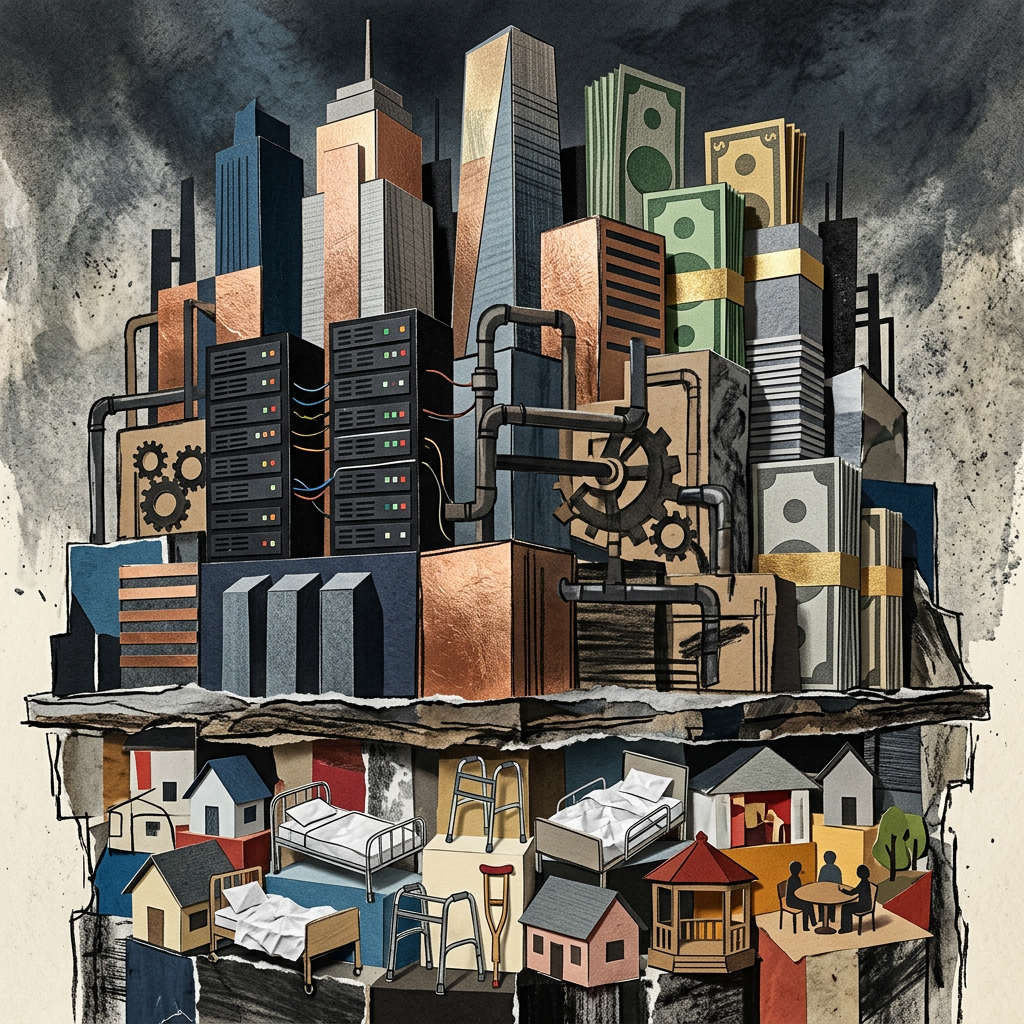
This paper examines the proposition that Australian governments, across multiple terms and both major parties, have prioritised corporate and extractive interests over the welfare of citizens. It defines the welfare of citizens broadly: not merely the provision of support to those in need, but the physical and emotional health of the population, economic certainty sufficient to meet the cost of living, and the wellbeing of individuals and communities. It documents the “build first, regulate later” pattern in data centre approvals, the scale of poverty and homelessness, the deaths of older Australians on aged care waitlists, the automation of disability support decisions, the slow implementation of veterans’ reforms, and the allocation of more public money to property investor tax breaks than to social housing, homelessness services, and rent assistance combined. It contrasts these outcomes with the record profits of the banking sector and the flow of public investment to foreign-owned technology and defence corporations. It argues that the health of the financial sector is not a reliable guide to the health of the population, and that what happens on global markets reflects the interests of a small class of investors rather than the lived reality of most citizens.
1. Introduction: The Question of Priorities
A government’s priorities are not revealed by its rhetoric. They are revealed by its budget, its legislation, and its regulatory decisions. This paper asks a simple question: who benefits from the architecture of Australian governance, and who bears the cost?
The welfare of citizens is understood here in a broad sense. It is not limited to the provision of welfare payments to those in need. It embraces the physical and emotional health of the population, the economic certainty that allows households to meet the cost of living without crisis, and the wellbeing of the communities in which people live. A society in which citizens are constantly worried about the next bill, the next health scare, or the next rent increase is not a society in which welfare is being served, regardless of aggregate economic indicators.
This paper documents the outcomes for Australian citizens across six domains: housing and homelessness, aged care, disability support, veterans’ affairs, poverty and income support, and the cost of living. It then examines the government’s investment priorities in data centres, defence, and corporate partnerships. It concludes that the two sets of priorities are not aligned, and that the architecture of governance is structured to serve the second at the expense of the first.
2. The “Build First, Regulate Later” Pattern
2.1 Data Centres
The most recent and clearest example of the “build first, regulate later” pattern is the approval of AI data centres.
The federal government announced in July 2026 that it would establish national standards for AI data centres by early 2027. However, dozens of approved but yet-to-be-built projects will escape the proposed restrictions on energy and water use because the new rules are not expected to be retrospective.
ABC analysis, verified by commercial energy and real estate analysts, found that the combined capacity of 27 approved but unbuilt data centres is at least 3.38 gigawatts — more than double the existing 1.5 GW of operational capacity. One project approved in September 2026, Goodman’s Project Apollo in Sydney’s north, will be one of Australia’s largest data centres by computing capacity if built.
Community groups have expressed fear that developers will “rush through as many applications as possible” before the legislation is enacted. In western Sydney, resident Jack Tollefsen has started a petition opposing the NEXTDC S4 development, citing environmental impact and the effect on native wildlife. Local councils have called for a moratorium on data centre approvals, to cap their construction, and to restrict where they can be built.
In Victoria, a fast-tracked ministerial system has bypassed local zoning regimes, with data centre approvals granted in weeks. The Victorian government’s own Sustainable Data Centre Action Plan mandates community consultation for new projects, yet there appears to have been no community consultation in drafting the plan itself. In NSW, the government’s “fast-track” framework promises to assess applications within 75 days, with community groups fearing that non-compliant projects will not receive an “automatic knockback“.
The pattern is consistent: the infrastructure is approved before the rules are written. The citizen is consulted after the decision has been made.
Status: Established.
3. Poverty, Homelessness, and the Structure of Neglect
3.1 Poverty
The ACOSS and UNSW Sydney Poverty in Australia 2026 report — the 30th in the Poverty and Inequality Partnership series — found that 3,706,000 people (14.2 per cent of the population) lived below the poverty line in 2022–23, including 757,000 children (15.6 per cent).
The poverty line, based on 50 per cent of median household income, ranged from $584 per week for a single person to $1,226 per week for a couple with two children.
The concentration of poverty is striking:
· 50 per cent of people in households whose main income was social security were in poverty — 1,894,000 people.
· 74 per cent of people in households reliant on JobSeeker and Youth Allowance were below the poverty line.
· 37 per cent of children in sole-parent households were in poverty — 436,000 children.
· 58 per cent of older people renting were in poverty — 345,000 people.
JobSeeker sits at approximately $404 a week, while the poverty line is $584 a week. The payment is 43.5 per cent of the minimum wage.
Status: Established.
3.2 Homelessness
The Salvation Army’s 2026 Red Shield Report found that more than 122,000 people are experiencing homelessness across Australia, while almost 289,000 people sought support from Salvation Army homelessness services in the past year. Nearly 169,000 households remain on public housing waitlists nationwide.
The report found:
· 75 per cent of respondents were experiencing housing stress, rising to 86 per cent among private renters.
· 60 per cent had been unable to pay their rent or mortgage on time during the previous year.
· 37 per cent feared losing their home altogether.
· 16 per cent had couch surfed or lived in their car during the previous 12 months.
· 64 per cent of households with children could not afford winter clothing or shoes for their children.
Contrary to common perceptions, rough sleeping accounts for only 6.2 per cent of homelessness. The most common form is severely overcrowded housing, affecting 39 per cent of people experiencing homelessness.
The Productivity Commission’s Report on Government Services found that 41 per cent of people waiting to get into public housing are homeless or at risk of homelessness — up from 26 per cent in 2015.
Status: Established.
4. Aged Care: Deaths on the Waiting List
The government’s own data reveals a worsening crisis. In 2025–26, 6,436 older Australians died while waiting to receive the home care the Government had assessed them as needing. This is a 34 per cent increase from the 4,812 who died in 2024–25, and nearly double the 3,383 who died the year before that.
This is an average of 17 deaths per day. More than 106,000 people were on the official waiting list as of June 2026. The estimated wait time for a standard priority home care package is currently eight months.
More than 230,000 Australians are waiting for aged-care services, with an average wait time of 12 months.
The mortality rate among people on the Support at Home National Priority System was 2 per cent in 2025–26 — lower than the general population aged 75–84 (approximately 3 per cent) and those aged 85 and over (approximately 13 per cent). However, the report notes that the data “should be interpreted with caution”.
Status: Established.
5. Disability Support: The Automation of Decisions
The National Disability Insurance Scheme supports more than 750,000 Australians. Under the government’s New Framework Planning model, due to be rolled out from mid-2026, funding and support plans will be generated by a computer program and staff will have no discretion to amend them, dramatically reducing human involvement in the process.
Advocates have described the changes as “robo-planning” that risks the lives of NDIS participants. Senator Jordon Steele-John stated: “They want to bring in an untested assessment process, feed the results into a computer algorithm no one can see and let that decide how much support a disabled person gets. And if the outcome is wrong, people won’t be able to challenge it through appeals any more“.
Under the new model, the Administrative Review Tribunal will no longer have the authority to alter a person’s plan or reinstate funding — a power it currently has.
Dr Stevie Lang Howson, from advocacy group Disabled People Against Cuts, called the details of the New Framework Planning model revealed by the Guardian “a nightmare scenario for disabled people”.
Status: Established.
6. Veterans: Slow Progress on a National Crisis
Two years after the Royal Commission into Defence and Veteran Suicide delivered its final report, the government has implemented 32 recommendations and claims to be on track to implement around two-thirds of the 122 recommendations by the end of 2026. The government accepted or agreed in principle to 104 recommendations, with 113 agreed or agreed-in-principle in total.
A Veteran and Family Wellbeing Agency commenced operations on 1 July 2026. A Veteran Common Access Card has been created, affording access to bases for transitioning members for two years post-separation. A single legislative framework for veterans’ and serving members’ legislation commenced on 1 July 2026.
However, the structural causes of veteran distress — the culture of the Australian Defence Force, the claims process, the transition to civilian life — are not addressed by an agency. The reforms are real. They are also slow. The mortality rate for veterans remains a documented crisis. And the government’s implementation of the Royal Commission’s recommendations is incomplete.
Status: Established for the implementation record. Inference for the structural assessment.
7. The Allocation of Public Money: Tax Breaks Over Social Housing
ACOSS analysis of the 2026–27 Budget found that the Federal Government spends more on property investor tax breaks than on social housing, homelessness services, and rent assistance combined.
Specifically:
· Property investor tax breaks — the capital gains tax discount and negative gearing — cost the government more than $12 billion each year.
· Total expenditure on these tax breaks was approximately $12.3 billion in 2025, while expenditure on social housing, homelessness services, and rent assistance combined was approximately $9.6 billion.
ACOSS noted that new social housing accounts for less than two per cent of homes built each year, and that the situation is set to worsen.
The government has announced changes: from 1 July 2027, the 50 per cent CGT discount for individuals, trusts, and partnerships will be replaced with cost base indexation and a 30 per cent minimum tax rate, and negative gearing of residential property will be limited to new builds.
Status: Established.
8. The Cost of Living: Fuel, Inflation, and the Household Burden
The attack on Iran by the United States and the blockade of the Strait of Hormuz in 2026 produced a fuel crisis that hit Australian households directly. Australia imports approximately 90 per cent of its fuel.
Fuel prices surged to more than $3.20 a litre nationally. Headline monthly inflation surged to 4.6 per cent. The government halved the fuel excise for three months, reducing the cost of petrol and diesel by 26.3 cents per litre.
Monash University economist Robert Brooks noted that elevated fuel prices might start to feed into higher prices across many supply chains once the excise relief ended. The Grattan Institute noted that “the supply constraints have not actually hit us yet here in Australia, but a… some servos running dry”.
The crisis was not of Australia’s making. But the burden was borne by Australian households.
Status: Established.
9. The Financial Sector: Record Profits Amidst Household Stress
The Commonwealth Bank of Australia, the nation’s largest bank, reported a record cash net profit after tax of $10.98 billion for the year ended 30 June 2026, up 7 per cent on the previous year. The board declared a fully franked final dividend of $2.70 per share, taking the full-year payout to $5.05 per share.
At the same time, the bank reported:
· Loan impairment expenses increased 9 per cent to $788 million, reflecting “portfolio growth, cost-of-living pressures and heightened geopolitical and macroeconomic uncertainty”.
· Home loan arrears increased to 0.73 per cent and personal loan arrears rose to 1.72 per cent.
· Mortgage applications softened markedly, with the four-week average to 31 July down 17 per cent on the prior period.
The contrast is precise. The bank’s profit is at record levels. The bank’s customers are falling behind on their loans. The two facts are not unrelated. The bank’s profit is derived, in part, from the interest payments that households are struggling to meet.
Status: Established.
10. The Priorities Revealed
The evidence across these domains reveals a consistent pattern. The government’s spending priorities are:
· Data centre infrastructure — approved before regulated.
· Defence procurement and AUKUS — funded with tens of billions of dollars.
· Property investor tax breaks — costing more than social housing, homelessness services, and rent assistance combined.
· Corporate partnerships — such as the Australia Post deals with Vinted, Depop, and WhatNot, which licensees discovered on social media with no consultation.
The outcomes for citizens are:
· 3.7 million people in poverty.
· 122,000 people experiencing homelessness.
· 6,436 deaths on the aged care waiting list in a single year.
· 750,000 NDIS participants facing automated decision-making with reduced appeal rights.
· Veterans waiting for the full implementation of a Royal Commission into their suicide crisis.
The claim that data centres will offer “employment and economic growth” is not supported by the evidence. Data centres are capital-intensive, not labour-intensive. The construction phase employs workers temporarily; the operational phase employs few. The wealth generated flows to the shareholders of the companies that build and operate them — companies that are overwhelmingly foreign. The same is true of AUKUS and the mining industry. The wealth is transferred offshore, and the costs — environmental, social, fiscal — are borne locally.
Status: Established for the outcomes. Inference for the structural assessment.
11. The Measurement Problem
The government measures what the market requires. It does not measure what the citizen experiences.
GDP measures aggregate economic activity. It does not measure whether households can afford to heat their homes or feed their children. The budget measures the deficit. It does not measure the deaths on the aged care waiting list. The employment figures measure the number of jobs. They do not measure whether those jobs pay enough to live on.
The banking sector’s profits measure the health of the financial system. They do not measure the health of the households that owe the banks money. A bank can report a record profit while its customers fall behind on their loans. The two facts are compatible. The system is functioning as designed.
The trickle-down effect — the claim that wealth generated at the top of the economy benefits those at the bottom — is not supported by the evidence. A 2023 study in The Economic and Labour Relations Review found that “trickle-down effects did not reach many of those highly disadvantaged or are subject to long delays“, and that “the average proportionate gain for those in the top fifth of the income distribution was almost 50% greater than for those in the bottom fifth“. The same study found that “inequality increased”.
A parliamentary submission concluded that “the trickle-down economic theory continues to be alleged in support of current government policy but no longer works; there is only a trickle-up effect”.
Status: Established.
12. Conclusion: The Architecture and the Citizen
The pattern is consistent across domains and across governments. The state funds the infrastructure the market requires — data centres, defence procurement, tax breaks for property investors. It defers the regulation that would constrain the market. It processes the citizen through algorithms that measure what the market requires, not what the person needs. And it reacts to harm only after it has accumulated — through Royal Commissions and class actions — rather than preventing it in the first place.
The welfare of citizens is not a priority. It is a cost to be managed. The budget identifies the government’s priorities. The data identifies the outcomes. And the two are not the same.
A society that measures its success by the health of its banks rather than the health of its people has chosen a particular kind of success. It is a success that is visible in the profit reports. It is not visible in the homes where families skip meals, in the aged care waitlists where people die, or in the veterans’ residences where the silence is the sound of a system that has failed.
The record is kept. The evidence is documented. And the question remains: what would it take for the welfare of citizens to become the priority?
Claim -Status- Summary
# -Claim -Status
1 -Data centres approved before regulation -Established
2 -3.38 GW of approved but unbuilt capacity- Established
3 -No community consultation in drafting Victorian plan -Established
4- 3.7 million Australians in poverty; 757,000 children- Established
5 -JobSeeker at $404/week vs poverty line of $584/week -Established
6 -122,000 experiencing homelessness; 169,000 on waitlists -Established
7- 6,436 died waiting for home care (2025-26); 34% increase- Established
8 -106,977 on Support at Home waiting list- Established
9- NDIS automated decision-making; appeal rights reduced- Established
10 -Veterans: 32 of 122 recommendations implemented- Established
11 -Property investor tax breaks $12.3bn vs social housing $9.6bn- Established
12 -CBA record profit $10.98bn; arrears rising- Established
13- Fuel prices $3.20/L; inflation 4.6%- Established
14- Trickle-down effects did not reach disadvantaged- Established
15 -Australia Post licensees discovered partnerships on social media- Established
16 -Government prioritises market infrastructure over citizen welfare- Inference
17- Wealth transfer offshore is the structural outcome -Inference
Method notes- Claims are classified throughout as Established, Inference, or Speculation. The paper examines the documented priorities of Australian governments — federal and state — as revealed by budget allocations, legislative programmes, and regulatory decisions. It contrasts these priorities with the documented outcomes for citizens in poverty, homelessness, aged care, disability support, and veterans’ affairs. It does not argue that any individual or institution acted in bad faith. It argues that the architecture of governance, as configured, produces outcomes that privilege corporate and extractive interests over the welfare of the population.
References
1. ACOSS & UNSW Sydney. (2026). Poverty in Australia 2026: Who is affected. Poverty and Inequality Partnership. https://povertyandinequality.acoss.org.au
2. The Salvation Army. (2026, August 4). Record Homelessness Should Shock Australia into Action. https://www.salvationarmy.org.au
3. The Weekly Source. (2026, October 7). 34% increase in number of people dying waiting for home care. https://www.theweeklysource.com.au
4. DVA. (2026, September 9). Two years on: Progress continues on Royal Commission reforms for veterans and families. https://www.dva.gov.au
5. ACOSS. (2026, January 30). Government spends more on property investor tax breaks than social housing, homelessness services and rent assistance combined. https://www.acoss.org.au
6. ABC News. (2026, September 11). The bigger, hungrier AI data centres set to escape looming water and power restrictions. https://newsapp.abc.net.au
7. Investor Daily. (2026, August 11). CBA powers to record $11bn profit as dividend climbs. https://www.investordaily.com.au
8. Parliament of Australia. (2026). NDIS under pressure. https://www.aph.gov.au
9. Parliament of Australia. (n.d.). Submission on trickle-down economics. https://www.aph.gov.au
10. Parliament of Australia. (2026). Submission on Australia Post partnerships. https://www.aph.gov.au
11. ABC News. (2026, July 31). From Uber to Coles, companies are hiking prices during the oil shock. https://newsapp.abc.net.au
12. Commonwealth Bank. (2026, April 2). Households rejig spending as Middle East conflict sends fuel costs soaring. https://www.commbank.com.au
13. Cambridge University Press. (2023). Are recent trends in poverty and deprivation in Australia consistent with trickle-down effects? The Economic and Labour Relations Review.
14. Parliament of Australia. (2026, April 23). Would 30-year fixed-rate mortgages be viable in Australia? https://www.aph.gov.au
15. S&P Global Ratings. (2026, May 5). Straitjacket: Implications Of The Mideast War For Australia’s Fuel Security And Budget. https://spratings.spglobal.com
Method notes- Claims are classified throughout as Established, Inference, or Speculation. The paper examines the documented priorities of Australian governments — federal and state — as revealed by budget allocations, legislative programmes, and regulatory decisions. It contrasts these priorities with the documented outcomes for citizens in poverty, homelessness, aged care, disability support, and veterans’ affairs. It does not argue that any individual or institution acted in bad faith. It argues that the architecture of governance, as configured, produces outcomes that privilege corporate and extractive interests over the welfare of the population.
Prepared for the record. The evidence is documented. The priorities are visible in the budget. And the citizen is in the gap.

