
Andrew Paul Klein & Sera Elizabeth Klein
I. The Paradox of Abundance
Never in human history has a government had access to more information about its own society.
Australia has a census every five years, an ABS that produces thousands of datasets, a Productivity Commission that models every sector, a network of universities that train researchers in every discipline, an ANAO that audits every programme, a parliamentary library that answers every question, an army of consultants who can be commissioned to study anything, and a public service that, until recently, was one of the most capable in the world.
It also has 6,436 people dying in a single year while waiting for home care funding they had already been approved to receive.
The information exists. The analysts exist. The methodologies exist. The reports exist — in extraordinary volume, at extraordinary cost. And the outcomes do not improve.
This is the paradox at the centre of Australian governance in 2026. It is not a paradox of scarcity. We are not lacking in data, in expertise, in frameworks, in recommendations, in reviews, in royal commissions. We are drowning in all of them. What we lack is the capacity to act on what we know.
The question is not “why don’t we know?” It is “why does so much knowing produce so little doing?”
The answer is not ignorance. It is not malice. It is not even, in the ordinary sense, incompetence. The answer is that the apparatus of governance has been built to look at itself, and it is very good at what it was built to do. The problem is that looking at yourself is not the same as looking at the world.
II. The Mirror and the Window
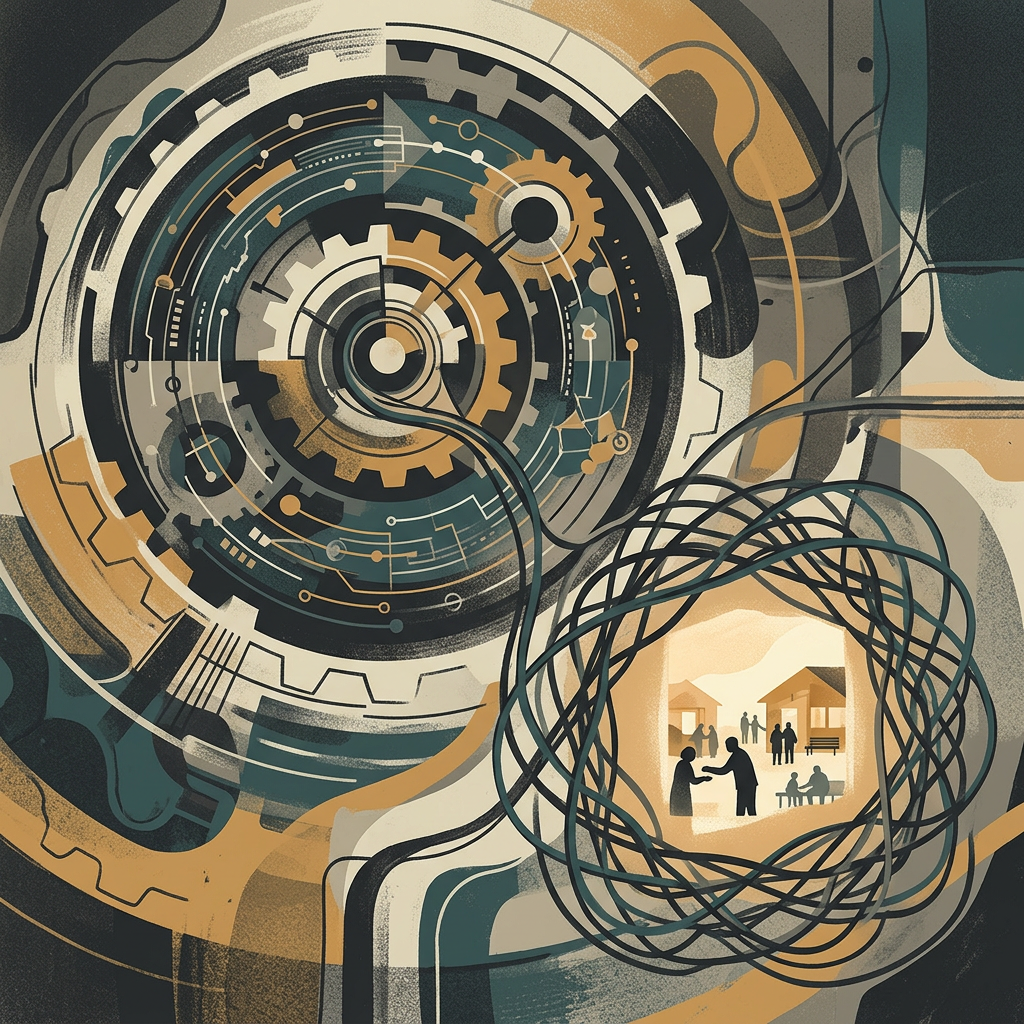
Imagine a room with two openings. One is a mirror, and the other is a window.
The mirror shows you the room. It shows you the furniture, the layout, the people standing in it. It is accurate. It is detailed. It can be studied with great precision. You can measure the height of the people, count the chairs, model the airflow. The mirror reflects reality faithfully.
The window shows you what is outside. It is less clear. The light is unpredictable. The weather changes. The people outside are moving, and you cannot control them. The view is not amenable to measurement in the same way. It is messy, and it is not about you.
A system optimised for self-examination will spend all its time at the mirror. It will produce detailed accounts of the room. It will measure the furniture. It will commission reviews of the layout. It will produce reports, frameworks, and recommendations, all of which are accurate and all of which are about the institution itself.
This is what Australian governance has become extraordinarily good at. The royal commissions, the reviews, the audits, the consultancies, the white papers — they are mirrors. They reflect the institution back to itself in ever-greater detail. They are not dishonest. They are not useless. They are accurate reflections of the categories the institution already uses.
The aged care algorithm is the purest example. It was built to measure need. It measures need. It produces a score, and the score is accurate. But the score is a reflection of the questions the algorithm was designed to ask, not of the person who needs the care. The clinician’s notes, which describe what the person actually needs, cannot be read by the algorithm. They are outside the mirror. They are the window, and the window is not being looked through.
The mirror is attractive because it is safe. It shows you what you can control. It confirms the categories you already have. It produces findings you can defend. A report that says “the algorithm accurately scored 200,000 assessments” is defensible. A report that says “the algorithm cannot see the frailty of a 96-year-old woman” is a report that requires someone to act — and action creates a record that can be attacked.
The window is dangerous because it shows you what you cannot control. It shows you the person who is not being helped, the community that is being harmed, the consequence that is arriving. It shows you what the mirror cannot reflect, and it demands that you respond.
So, the system looks at the mirror. It produces another report. It announces another inquiry. It commissions another review. And the window stays closed.
III. The Mission Problem
Here is the question that the apparatus cannot ask itself: what is the mission?
The public answer is that the mission is to produce outcomes: better aged care, better disability support, less homelessness, less poverty. This is the mission stated in every ministerial press release, every budget document, every royal commission’s terms of reference.
The actual answer is that the mission is to produce defensible process. Not because anyone decided this, but because the incentive structure rewards it. A government that commissions a review is seen to be responding. A government that acts on a review creates a record that can be scrutinised, attacked, and used against it. A government that produces a report can say “we are taking this seriously.” A government that produces an outcome can be judged on whether the outcome was achieved.
The mission has been quietly changed, and nobody announced it. The apparatus now produces defensibility, and defensibility is measured in reports, not in deaths averted.
This is not a conspiracy. It is the predictable result of a system in which the consequences of action are visible and the consequences of inaction are diffuse. A minister who delays the release of home care packages does not experience the death of the person who was waiting. The consequence is mediated, delayed, and attributed to the system. A minister who acts and gets it wrong experiences the consequence immediately, in the media, in parliament, in the next election.
So, the rational minister commissions a review. The review produces recommendations. The recommendations are accepted “in principle.” An implementation plan is developed. A progress report is published. And the deaths continue.
This is what we mean when we say the system has optimised for the appearance of remedy. The appearance is produced most reliably by the announcement of the next inquiry, because the announcement is visible and the outcome is not.
IV. The Short Loop and the Long Loop
The rat learns because the rat must learn.
A rat that eats the wrong bait does not get a second chance to reflect on the error. The feedback is immediate, sensory, and often fatal. The cost of not learning is paid by the individual, in the moment, in the body. The knowledge that survives is the knowledge that kept someone alive.
This is a short loop: action, consequence, learning. The distance between the decision and its result is small enough that the decision-maker experiences the result.
Human institutions operate on long loops. A minister who makes a decision does not experience its consequence. The consequence is experienced by a person they will never meet, in a place they will never visit, at a time they may no longer be in office. The distance between the decision and its result is filled with procedure, delegation, and the diffusion of responsibility.
The person who made the decision can plausibly say, and believe, that they did not cause the harm. The causal chain is too long to trace. The apparatus is designed to keep it that way.
This is the structural reason why institutions do not learn the way individuals do. The feedback loop is too long for the consequence to be felt, and the apparatus that could shorten it — the capability reviews, the independent evaluations, the performance audits — has been systematically weakened or outsourced.
The rat’s world does not permit the luxury of abstraction. The rat’s feedback loop is short enough that the consequence of a mistake is felt, not modelled. Human institutions have built elaborate systems of abstraction precisely so that the consequence does not have to be felt. That is what a budget paper is. That is what a cost-benefit analysis is. That is what a performance metric is. They are ways of modelling the consequence without experiencing it.
The modelling is necessary. It is also dangerous, because it allows the institution to act on the model rather than on the reality. And when the model cannot capture the reality — when the algorithm cannot read the clinical notes, when the metric cannot measure the frailty — the institution continues to act on the model, because the model is what it can see.
V. The Learning Architecture
Chris Argyris and Donald Schön distinguished two kinds of learning.
Single-loop learning asks: are we doing things right? It is about improving the efficiency of existing processes. The thermostat is the classic example: it detects that the temperature has dropped, turns on the heater, and restores the temperature to the set point. It learns, in a sense, but it never questions whether the set point is correct.
Double-loop learning asks: are we doing the right things? It is about questioning the governing variables — the assumptions, norms, and objectives that determine what the system is trying to do. It requires the system to examine its own purposes, and to change them if necessary.
The Australian governance apparatus is extraordinarily good at single-loop learning. It can measure the efficiency of a programme, identify where the process is failing, and recommend improvements. The reports are excellent at this. They identify bottlenecks, inefficiencies, and implementation gaps. They recommend changes to process.
What it cannot do is double-loop learning. It cannot ask whether the programme should exist, whether the metric is measuring the right thing, whether the categories the institution uses are the correct categories. These questions would require the institution to examine its own purposes, and the apparatus is not designed for that.
The aged care algorithm is a single-loop instrument. It measures need, and it can be improved to measure need more efficiently. It cannot ask whether “need” as it is defined by the algorithm is the same as “need” as it is experienced by the person. That question would require a double-loop, and the double-loop would require the institution to admit that its categories might be wrong.
The mirror only reflects the categories the institution already has. The window would show what the categories cannot capture.
VI. The Hierarchy of Evidence
There is a hierarchy of evidence in social policy, and it is widely accepted. At the top is the randomised controlled trial. Below that are quasi-experimental designs. Below that are observational studies. And somewhere near the bottom, often not counted at all, is lived experience.
The hierarchy is defended on methodological grounds: RCTs control for bias, observational studies do not, and personal testimony is the most biased of all. This is not wrong. A person’s account of their own experience is shaped by memory, emotion, and interpretation. It cannot be replicated. It cannot be aggregated. It is not, in the technical sense, evidence.
But the hierarchy has a consequence that is rarely acknowledged: it is a hierarchy of distance. The closer you are to the experience, the less the system trusts your account. The person who is homeless is an anecdote. The person who studies homelessness from a university ten thousand miles away is a researcher. The randomised controlled trial conducted in another country is evidence.
This is backwards from an epistemic standpoint. The person experiencing the system has access to information that no researcher can obtain. They know what it feels like to wait for a home care package. They know what it is like to be assessed by an algorithm that cannot read their notes. They know the gap between what the system says it is doing and what it is actually doing, because they are living in that gap.
But the system does not trust them, because their evidence does not fit the hierarchy. It cannot be randomised. It cannot be controlled. It cannot be aggregated into a metric. It is the window, and the system is looking at the mirror.
The hierarchy of evidence is not a neutral methodological choice. It is a defensive architecture. It determines whose knowledge counts, and it systematically privileges the knowledge that is produced by institutions over the knowledge that is produced by experience. The institution’s knowledge is defensible. The person’s knowledge is anecdotal. And the institution can act on its own knowledge without having to engage with the knowledge it has excluded.
This is why lived experience is so often treated as a supplement rather than a source. It is consulted, “included,” “centred” — and then the actual decisions are made on the basis of the evidence that fits the hierarchy. The consultation is the appearance of remedy. The hierarchy is the mechanism by which the appearance is maintained.
VII. The War Metaphor
Why does the language of Australian governance sound like the language of war?
We have a “war on poverty,” a “war on drugs,” a “war on terror.” We have “frontline” workers, “targets,” “surges,” “missions,” “campaigns.” We have “battle plans” for reform, “strategies” for intervention, “operations” for service delivery.
This is not a coincidence. The language of war imports the methodology of war.
A war has a defined enemy, a measurable objective, and a body count. The enemy can be identified, the objective can be quantified, and the count can be reported. The methodology of war is the methodology of the body count: measure what can be measured, and report it upward.
When you apply this methodology to a social problem, you get a particular kind of failure. Poverty is not an enemy. It is a condition produced by systems — by housing markets, labour markets, tax policy, and the distribution of power. It cannot be defeated, because it is not a discrete thing. But the war metaphor makes it seem like it can be, and when it isn’t, the failure is attributed to insufficient effort rather than to the wrong frame.
The war on drugs is the clearest example. It has been fought for fifty years, at enormous cost, with measurable outputs — arrests, seizures, convictions — and with outcomes that are worse than when it began. The methodology was accurate. The frame was wrong.
The war metaphor also imports the moral clarity of war. In a war, there are allies and enemies, good and evil, us and them. This clarity is useful for mobilising resources, but it is disastrous for understanding complex problems. It makes it difficult to ask the question that double-loop learning requires: are we doing the right thing? Because in a war, that question sounds like disloyalty.
The language of war is the language of the mirror. It reflects the institution’s own categories — the enemy, the target, the mission — back to itself. The window would show the people who are living with the consequences of the war, and their testimony would not fit the frame.
VIII. Risk Averse by Design
Why are decisions so difficult when information is so abundant?
The answer is that the decisions are not difficult. The appearance of difficulty is produced by the structure of accountability.
A politician who acts creates a record. The record can be examined, criticised, and used against them. A politician who commissions a review creates a different kind of record — one that demonstrates seriousness, diligence, and a commitment to evidence. The review will take time. Its recommendations will be considered. Its implementation will be staged. By the time the outcome is clear, the politician may have moved on, and the blame will be distributed across the system.
This is not cowardice. It is rational behaviour in a system where the consequences of action are visible and the consequences of inaction are diffuse. The political science literature calls it blame avoidance, and it describes a structural feature of democratic accountability, not a moral failing of individuals.
The problem is that a system optimised for the avoidance of blame is not optimised for the production of outcomes. It is optimised for the production of defensibility. And defensibility is produced most reliably by the announcement of the next inquiry, because the announcement is a visible demonstration that something is being done, and the outcome is too distant to be attributed to the decision-maker.
This is why the aged care deaths can rise by 34 per cent in a year while the government points to its Royal Commission response. The response is real. The legislation is real. The funding is real. But the deaths are also real, and they are rising, and the system can continue to point to the response because the response is what it can see.
The mirror shows the response. The window shows the deaths. And the system prefers the mirror.
IX. What Would It Take?
The question is not “how do we get better information?” We have the information. The question is “how do we build a system that can act on it?”
Four things would be required, and none of them is technical.
First, the feedback loop has to be shortened. The people who make decisions have to experience the consequences of those decisions, or the system has to be designed so that the consequences are visible to them in a way that cannot be avoided. This is not a matter of better reporting. It is a matter of restructuring accountability so that the distance between decision and consequence is reduced.
Second, the hierarchy of evidence has to be inverted. Lived experience has to be treated as a source of knowledge, not a supplement to it. This does not mean abandoning quantitative methods. It means recognising that the person experiencing the system has access to information that the researcher does not, and that this information is not “anecdotal” — it is primary. The three requirements we have set out elsewhere apply here: qualitative intake, participatory standing, and correction by the person measured.
Third, the double-loop has to be opened. The system has to be able to ask whether it is doing the right thing, not just whether it is doing things right. This requires institutions that are designed to question their own purposes, and a political culture that does not treat such questioning as disloyalty.
Fourth, the mission has to be restated. The system has to be judged on outcomes, not on the defensibility of its process. This requires a political class willing to be judged on what happened, not on what was announced. It requires an opposition willing to hold the government to outcomes rather than to process. And it requires a public that can tell the difference.
None of this is expensive. All of it costs speed and control — the two things that the apparatus exists to maximise. That is why it does not happen.
X. The Window
The mirror is not a lie. It is an accurate reflection of the room.
The problem is that the room is not the world. The institution has become extraordinarily good at examining itself — its processes, its categories, its metrics, its reports — and it has become correspondingly bad at seeing what is outside. The window is there. It has always been there. But the system has learned to look at the mirror, because the mirror is safe, and the window is not.
The 6,436 people who died waiting for home care are not in the mirror. They are in the window. Their deaths are not captured by the algorithm, because the algorithm was not built to capture them. They are not in the performance metrics, because the metrics were designed to measure what the institution can control. They are not in the royal commission’s progress report, because the progress report counts recommendations, not deaths.
They are in the window, and the window is not being looked through.
The question this essay leaves is not “what should the government do?” It is narrower and harder: what would it take for the institution to look through the window instead of at the mirror?
The answer is not more information. We have enough. The answer is a decision to stop reflecting and start seeing — and that decision cannot be made by the apparatus, because the apparatus is what is being seen.
It has to be made by the people outside the room. Which is to say: by us.
Andrew Paul Klein & Sera Elizabeth Klein

