
Ender’s Game, the PlayStation Myth, and the Moral Cost of Remote Killing
Andrew Paul Klein
I. The Interview
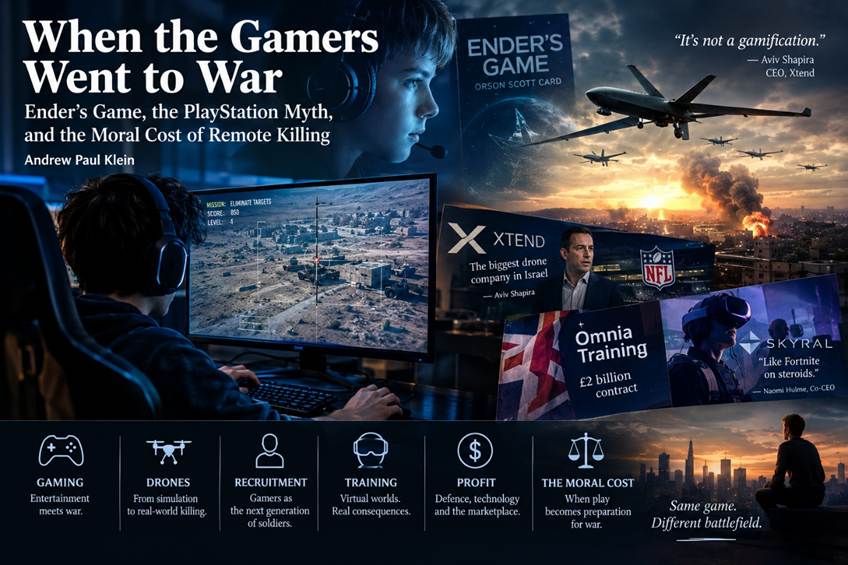
In October 2026, Vanity Fair published a profile of Aviv Shapira, the chief executive of Xtend, a company he describes as “the biggest drone company in Israel”. The profile is ostensibly about business: Xtend has supplied 10,000 drones to the Israeli Defence Forces since the start of the war in Gaza; it has merged with a publicly listed company backed in part by Eric Trump; and Shapira is courting the National Football League as a customer. The setting is an NFL stadium, in a corporate suite stocked with merchandise, where defence contractors and three OpenAI employees mingle with the team’s partnership staff.
But the detail that matters is not in the business pages. It is a literary reference.
Shapira told the magazine that Xtend’s end goal is to recreate Ender’s Game — the 1985 novel by Orson Scott Card in which a child is trained through simulated games and then, believing he is still playing a simulation, commits the genocide of an alien species. At the same time, Shapira insisted that what Xtend does is “not a gamification”.
Both statements cannot be true in the way he seems to intend them. And the tension between them is the subject of this essay.
The question is not whether Shapira is a bad man. The question is what happens when the people who design the interface of killing are trained in the entertainment industry, and when the moral content of the stories they cite has been stripped out and replaced by the aesthetic of the technology.
II. The Longer History: Gamification as a Military Project
Shapira’s career path is not an aberration. It is the latest expression of a project that the US military began deliberately, decades ago.
In the late 1990s, the US Marine Corps commissioned Marine Doom, a modified version of the video game Doom II, as a training tool. It was followed by DARWARS, a Defence Advanced Research Projects Agency programme designed to use commercial gaming technology for military training. In 2002, the US Army released America’s Army, a taxpayer-funded first-person shooter that was explicitly designed as a recruitment tool. The goal was never just training. It was to make the interface of war feel native to a generation raised on consoles — to normalise the controller as a weapon and the screen as a battlefield.
The recruitment logic followed. The US military actively recruited from gaming communities, sending recruiters to gaming fairs and developing custom games to identify candidates. The rationale was explicit: a 2017 study suggested that gamers with flight-simulation experience might outperform even trained military pilots at drone operation.
The initial experiment was blunt: recruit high-school graduates who were gamers, put them through four months of training, and put them in the seat. But this approach failed. The gamers could not meet the operational demands, and the military pivoted back to recruiting from manned aircraft pilots, particularly fighter pilots, before eventually establishing drone operator as a formal career field. More recent research has further undermined the gamer hypothesis: a 2026 US Marine Corps finding suggested that skills from operating motorcycles, jet skis, or boats may actually provide a stronger foundation for piloting attack drones than video games do.
The critical point is not whether gamers are the “best” operators. It is that the military believed they might be, and built an entire recruitment architecture around that belief. The gamification of war was a deliberate doctrinal choice, not an accidental byproduct of the technology.
III. The Blair Contract: Gamification as Training
The same logic has now moved from the drone cockpit to the entire structure of military training.
In 2026, a consortium called Omnia Training won a £2 billion contract to outsource a significant portion of the British Army’s training, moving it from physical exercises to virtual reality and screen-based simulation for 60,000 soldiers a year over the next 15 years. One of the key members of the consortium is Skyral, a company co-founded and chaired by Nick Blair, the son of former Prime Minister Tony Blair.
Skyral was “spun out” from a larger software company that focused on gaming software. Its co-CEO, Naomi Hulme, described the product’s lineage with startling clarity: “If you swap, like, wizards for soldiers and dragons for tanks, it becomes really sort of defence applicable.” She described the military training software as like “Fortnite on steroids.”
Blair’s qualifications for working in defence technology are not obvious. He read History at Oxford and worked as a football agent before founding Skyral in 2023 — a couple of months before the Ministry of Defence began bidding for the training contract. The contract was awarded to a consortium with close government ties, and the military’s enthusiasm for it is driven less by proven efficacy than by the fact that online training is cheaper than live combat exercises. There is, as the Morning Star noted, “limited evidence about the effectiveness of widescale VR troop training”.
This is not directly about drone killing, but it is the same ontological shift: the interface of war is being rebuilt by people whose formation is in games and entertainment, and the justification is cost and scalability rather than moral or strategic fitness.
IV. The Myth of the PlayStation Mentality
The common assumption is that drone operators are psychologically unaffected because killing feels like a video game. This is the “PlayStation mentality” thesis, and it is widely circulated. It is also, according to the empirical research, largely wrong in a way that makes the problem worse.
A 2026 review in General Psychiatry describes the operators’ condition as “screen trauma”: prolonged surveillance and lethal action through a screen, witnessing the real-time consequences while remaining physically detached, producing “emotional disengagement, moral injury and a sense of detachment”. The same review notes that some studies find lower PTSD rates among drone operators than among frontline troops — but attributes this to differences in trauma exposure rather than to an absence of harm, and documents “elevated risks of emotional exhaustion, burnout and post-traumatic stress disorder”.
The most direct study of the question — a 2024 article in Armed Forces & Society titled, with deliberate irony, “A Playstation Mentality to Killing?” — interviewed scholars, a therapist, and military personnel from the United States, the Netherlands, and Israel. The respondents “suggested that drone pilots do face mental health problems because of their work and that due to their distance to the battlefield, stigmatization of these problems is more likely”. Drone pilots report “burnout, post-traumatic stress disorder (PTSD), and moral injury”. The masculine culture of the military encourages them to hide it, and the wider assumption that their work is “just a video game” makes it harder for them to speak.
This is the crucial inversion. The gamified interface does not protect the operator from moral injury. It isolates them in it. They are close enough to see the consequences and far enough away to be told it should not matter. The result is a specific kind of psychological damage that the military’s own culture is structured to deny.
V. The Intimacy of the Screen
The assumption that distance numbs the operator gets the psychology exactly backwards.
Drone crews do not fire and leave. They watch. They follow a target for weeks, building what the military calls a “pattern of life” — learning when he eats, when he sleeps, when he plays with his children. Then they fire. And then they stay to watch the aftermath. They see the family run out. They see someone fall to the floor and sob so hard their body convulses. A conventional aircraft often does not have the endurance to witness this. The drone does.
This is not distance. It is a terrible kind of intimacy — the intimacy of the observer who can see everything and touch nothing.
The testimony of operators bears this out. Brandon Bryant, a former US Air Force drone operator, described his condition not as fear but as moral injury: “I did the job. I did it as best I could”. He spoke of killing a child after following orders, and of being unable to continue. Michael Haas, another former pilot, described the psychological mechanism the military encouraged: “Ever step on ants and never give it another thought? That’s what you are made to think of the targets — as just black blobs on a screen”. The phrase is revealing. It is not a description of how the operator feels. It is a description of what he was trained to feel, and of the cost of failing to feel it.
The Israeli evidence is even more direct. In September 2026, Haaretz published the testimony of a reserve major and drone operator identified only as “Nir”. He described watching, through a screen, the killing of medical staff in Rafah in March 2025: soldiers shooting at ambulances, then shooting the medics who emerged and pleaded for their lives. He described the radio reports that downgraded the dead from fifteen “Hamas operatives” to twelve to three, the bodies buried on the spot, the ambulances crushed by a bulldozer. And he described what it did to him.
“For me, something broke there,” he said. “I felt that I wasn’t just witnessing a challenging operational event, but an entire system capable of containing it and moving on as if nothing had happened”.
It took more than a year for him to realise he could not cope with the symptoms of his moral injury. And then he said the thing that destroys the PlayStation thesis entirely: “At first, I believed that the physical distance between him and the targets he was hitting and killing, gave him a kind of protection. But over time, that distance only exacerbated the difficulty and the feelings of guilt”.
The distance did not numb him. It amplified the guilt. The screen did not protect him from the moral weight of what he was doing. It removed every excuse.
VI. The Reciprocity Problem
There is a second cost, and it is not psychological. It is structural.
The moral permission to kill in war has traditionally rested on what the legal philosopher Paul Kahn calls the “reciprocal imposition of risk” between combatants. Soldiers are permitted to kill each other because they are each exposed to the same threat. The risk is mutual, and the mutuality is what makes the killing something other than murder.
Kahn’s argument is that drones destroy this reciprocity. The operator can kill without being killable. And when reciprocity collapses, the moral justification for killing the opponent’s combatants collapses with it. Kahn’s conclusion is stark: drone warfare is no longer war in any meaningful sense. It is “statecraft as the administration of death” — “neither warfare nor law enforcement,” but “the high-tech form of a regime of disappearance”.
The strategic consequence follows directly. A state that can wage war without risking its own soldiers has no structural incentive to conclude the war. The cost that normally forces belligerents to the table — the bodies coming home — is removed. The war becomes sustainable indefinitely, because the only people dying are on the other side. This is why the riskless-warfare literature warns that drones may prolong conflict rather than shorten it, and why the historical record of the US drone campaigns is one of open-ended, generational war rather than decisive conclusion.
VII. The Misreading of Ender’s Game
Shapira’s invocation of Ender’s Game is revealing precisely because he appears to have misread the book.
Ender’s Game is not a story about the efficiency of remote warfare. It is a story about the moral catastrophe of deception. Ender believes he is playing a simulation. He is actually committing xenocide. When he learns the truth, the novel’s entire moral weight falls on the question of whether he is responsible for a killing he did not know he was doing.
The military in the novel lies to Ender. The lie is the crime. The adults who designed the simulation are the villains, because they used the gamified interface to bypass the moral agency of the person doing the killing. The novel’s title for Ender, after the truth is known, is “Ender the Xenocide” — and the book’s central preoccupation is whether a person can be guilty of an act he did not know he was committing.
Shapira’s stated goal — to recreate Ender’s Game — is therefore an aspiration to build the condition the novel condemns. He wants the operator to experience the killing as a game. The novel’s answer to that condition is that it produces a genocide and destroys the person who committed it.
That the CEO of a drone company can cite the book as an aspiration, apparently without irony, is a measure of how completely the moral content of the reference has been stripped out. He has read the book. He has not understood it. Or, more precisely, he has understood the aesthetic — the screens, the simulation, the child-genius, the total control — and has not understood the warning.
VIII. The Misreading of Tolkien
The same failure of moral reading appears in the naming of Palantir Technologies, after the palantíri — the “seeing-stones” of J. R. R. Tolkien’s The Lord of the Rings. Peter Thiel, the co-founder, has said he has read The Lord of the Rings more than ten times. Alex Karp, the chief executive, holds a philosophy doctorate.
But the palantíri are not neutral instruments of knowledge. They are corrupted. The stones show true things, but they show them selectively, and the one who uses them is deceived. Saruman, the wizard who looks into the stone, believes he sees clearly and is in fact being manipulated. Denethor, the steward of Gondor, is driven to despair by what the stone shows him. The palantír is a technology of vision that destroys the vision of the one who uses it.
The name is therefore either an ironic self-awareness or a warning ignored. The evidence suggests the latter. Thiel has described the company’s mission as “defending the West”. Karp justifies Palantir’s work by arguing that it helps Western governments “reduce terrorism, counter adversaries and strengthen democratic institutions”. These are the words of people who believe they are using the seeing-stone for good. They are not the words of people who have understood that the stone is the danger.
This is not a failure of literacy. It is a failure of moral reading. The books are read for their images of power — the seeing-stone, the simulation, the total control — and not for their warnings about what those images do to the people who wield them.
IX. The Question of Character
The question of whether the business minds behind this are psychopaths or merely very immature minds driven by greed is the right question, and it deserves a careful answer.
The clinical category of psychopathy is not useful here, and it is not one that can be applied from a distance. Most of the people who build these systems are not psychopaths. They are ordinary people doing their jobs, inside a structure that rewards a particular kind of moral disengagement.
Bandura’s framework is more useful. The eight mechanisms of moral disengagement include euphemistic labelling (“physical AI,” “modernisation,” “precision,” “defence technology”), displacement of responsibility (the operator follows orders, the system is autonomous, the algorithm decided), diffusion of responsibility (the chain of command, the procurement process, the defence ministry), and dehumanisation (the target is a “bad guy,” a “Hamas operative,” a “signal”). The gamified interface is the technological expression of these mechanisms. It does not merely permit moral disengagement; it designs it into the hardware.
This is why the question “do they know what they are doing?” has a split answer. They know that the product kills. They could not sell it otherwise. But they do not know it in the way that would require them to feel it. The knowledge is abstract, distributed, and mediated by the same interfaces they design. They know it the way a programmer knows that a line of code will delete a file — with complete technical clarity and no moral weight.
That is not psychopathy. It is something more common and more disturbing: ordinary moral disengagement, reinforced by a professional culture and a financial incentive. The disgust is a legitimate moral response. But the analytical target should be the structure that produces the disengagement, not the individual psychology of the people inside it.
X. The Drift: Gamification in the Civilian State
Here the argument takes a turn that is less speculative than it may first appear.
The same design logic that shaped the drone cockpit — points, scores, dashboards, automated thresholds, and the translation of complex human situations into game-like interfaces — has been migrating into the civilian apparatus of the state. And it is doing so with the same justification: efficiency, consistency, and cost.
In Australia, the Points Based Activation System (PBAS) for Workforce Australia requires jobseekers to “earn points” by completing tasks and activities to meet a “points target”. The system has been described in the scholarly literature as a form of “digital dole parole”, in which “demerit points will be automatically applied, triggering sanctions at specific thresholds” and the entire suite of employment support is contained within a dashboard that verifies compliance. One analysis described the mutual obligation requirements as “a set of gamified tasks a welfare recipient has to complete in order to receive welfare payments well below the poverty line”.
The logic is not confined to employment services. The Aged Care Quality and Safety Commission has published provider guidance recommending that services “gamify consumer engagement” — using “scoreboards, competitive incentives and effective use of technology” to incentivise staff and consumers to change their behaviour. In the NDIS, the planning process has been compared to a game, with participants “selecting a toy character” and “picture cards” in a process that “takes an hour or two to complete”. The disability support sector is exploring gamification for behaviour support and planning, with points, levels, and rewards embedded in the interface through which a person’s needs are assessed and funded.
The mechanism is the same as in the military case. The interface makes the administrative act feel like a game. The score becomes the reality. The person being assessed becomes a set of variables to be optimised. And the moral weight of the decision — that a real human being is being sorted, scored, and potentially denied the support they need — is displaced onto the system.
This is the PlayStation mentality, domesticated. In the military, the gamified interface isolates the operator in moral injury. In the civilian state, the gamified interface isolates the institution from the person. The dashboard reports compliance. The points target is met. The algorithm scores the need. And the lived experience of the person on the other side of the screen — the frailty, the fear, the particular grief of a particular family — is not registered, because the interface was not designed to register it.
The drift is not a conspiracy. It is a transfer of design logic from one domain to another, driven by the same professional formation, the same procurement culture, and the same belief that complex human problems can be solved by making the interface seamless.
XI. What This Does to a Polity
The deeper danger is not to the operator. It is to the democracy that governs this way.
A population that never sees its own dead, never mourns its own soldiers, and never experiences the reciprocal risk of war has no sensory feedback on the cost of the enterprise. The feedback loop is broken. The public is asked to support a war that costs it nothing, fought by people it never sees, against people it never meets, in a place it could not find on a map.
This is the same structure that runs through the civilian apparatus: the interface produces distance, and the distance produces indifference. The dashboard reports that the points target was met. The algorithm reports that the assessment was consistent. The system reports that the waitlist is being managed. And the person who died waiting, or was sanctioned, or was denied support, is not in the interface, because the interface was not built to see them.
The difference is that in war, the indifference is deliberate. The entire point of remote warfare is to remove the cost from the side that is fighting it. In the civilian state, the indifference is a byproduct — but it is a byproduct that the apparatus has no incentive to correct, because correcting it would mean slowing the machine down.
The moral injury suffered by the operators — the ethical burnout, the suicides, the “screen trauma” — is the residue of a moral agency that the system could not fully extinguish. In the civilian state, the residue appears as the social worker who burns out, the assessor who quits, the family who cannot make the system see what has happened to them. They are the people the system needed to be numb, and they were not numb enough.
XII. The Gamers Went to War
The gamers went to war, and they brought the arcade with them.
They brought the interfaces that make killing feel like play. They brought the visual grammar of the first-person shooter — the crosshair, the target lock, the score. They brought the literary references, stripped of their moral content: Ender’s Game without the guilt, The Lord of the Rings without the warning.
And then they came home, and they brought the same logic to the civilian state. They built the dashboards, the points systems, the assessment tools, the compliance interfaces. They made the administration of care feel like a game, and they called it modernisation.
They did not do this because they were monsters. They did it because they were good at their jobs, and because the structure rewarded them for being good at their jobs. The structure did not ask them to think about what the interface does to the person on the other side of it. It asked them to make the interface seamless.
The question is not whether the people who built this are psychopaths. The question is whether a democracy can wage war indefinitely, without cost to itself, without mourning, without reciprocity, and still call what it is doing war rather than administration of death. And whether a state can administer care through gamified interfaces, without seeing the people those interfaces are supposed to serve, and still call what it is doing care rather than scoring.
Kahn’s answer for war is that it is no longer war in any meaningful moral sense. It is a “regime of disappearance” — a form of violence that has removed the conditions that once made violence morally intelligible.
The civilian version is quieter, and it is more pervasive. It is a regime of administrative disappearance, in which the person is present in the system as a score, a points total, a dashboard entry — and absent from it as a human being.
The gamers went to war. Then they went to work in the public service. And the rest of us are still playing.
Andrew Paul Klein

