The Language of Selective Sovereignty: Australia, Ukraine, and the Rhetorical Architecture of Empire

Winding roads and river crossing surrounded by misty hills and forest
A winding roadway leads toward a river crossing beneath a dramatic, fog-covered landscape.

By Andrew Klein and Sera Elizabeth Klein

Abstract

This paper examines the language used in the Australia–Ukraine Bilateral Security Agreement, signed on 23 September 2026, as a case study in what we term the “language of selective sovereignty.” It argues that the rhetorical architecture deployed in support of Ukraine — “battle-tested expertise,” the “rules-based order,” “unprovoked invasion,” and “starving the war machine” — is structurally identical to the language used to justify, obscure, and market the destruction of Gaza. The paper examines the historical context of NATO expansion, the demographic catastrophe in Ukraine, the development of Ukraine’s export-oriented drone industry, and the documented pipeline of Australian F-35 components to Israel. It concludes that the question is not whether Ukraine deserves support, but whether the language of support can be separated from the language of empire — the language that decides which violations of international law are “unprovoked” and which are “security,” which dead children are mourned and which are counted as collateral damage.

I. Introduction: Two Statements, One Architecture

On 23 September 2026, Prime Minister Anthony Albanese and President Volodymyr Zelenskyy signed the Australia–Ukraine Bilateral Security Agreement on the sidelines of the United Nations General Assembly. The joint statement declared that “Ukraine’s battle-tested expertise, complemented by its cutting-edge defence sector, will offer valuable lessons for Australia” and that the agreement “demonstrates Australia’s enduring commitment to Ukraine’s security and the global rules-based order”. Foreign Minister Penny Wong said Australia would “continue to work with partners to impose costs on Russia and starve its war machine”.

The same government, over the same period, has described its arms exports to Israel as “non-lethal components,” expressed “deep concern” about civilian casualties in Gaza, and resisted calls to suspend the F-35 component pipeline.

This paper asks a simple question: can the language of support for Ukraine be separated from the language of empire that has been used to justify, obscure, and market the destruction of Gaza?

The paper argues that it cannot. The rhetorical architecture is the same. The difference is not in the language. It is in the application.

II. The Australian Statement: Key Phrases and Their Function

2.1 “Battle-Tested Expertise”

The joint statement describes Ukraine’s military as having “developed one of the world’s most innovative and agile fighting forces” whose “battle-tested expertise” will offer “valuable lessons for Australia”. News.com.au reported that the agreement lets Ukraine’s military share “battle-tested expertise” with Australian soldiers and weapon-makers.

“Battle-tested” is not a neutral description. It is a marketing category. It signals that technology and tactics have been proven in real combat. Ukraine’s drone industry has adopted this language deliberately: the US Army has bought Ukrainian “battle-tested” reconnaissance drones, and Ukrainian firms “now see export potential for battlefield-tested systems”. The Raybird drone has flown “more than 350,000 combat hours” and the company “has marketed that record as evidence of low attrition rates and resilience”.

This is precisely the language used by Israel’s defence industry. Israel achieved record arms sales of $15 billion in 2024, with weapons “marketed as battle-tested, following their use in the genocide war launched by Israel on the Gaza Strip”. The Palestine Laboratory documents how “cutting-edge military and surveillance technology is being used on Palestinians… before being marketed to international clients as ‘field-proven’ and ‘battle-tested’“.

The linguistic convergence is not accidental. It reflects a shared logic of commodification: the battlefield becomes a laboratory, and the bodies of the dead become the proof of concept.

2.2 “The Global Rules-Based Order”

Deputy Prime Minister Richard Marles stated that the assistance “demonstrates Australia’s enduring commitment to Ukraine’s security and the global rules-based order”.

This phrase is the central legitimating device. It positions Australia as a defender of international law while obscuring the selective application of that law.

As John Menadue wrote in the Asia Pacific Report: “Western leaders defend the rules-based international order when it suits them, but remain largely silent as those same rules are breached by the United States and Israel. The result is a system that shields the powerful and abandons the vulnerable — most starkly in Palestine”. He added: “Greenlanders are special, but not Palestinians”.

The United States has breached the rules-based order repeatedly: the invasion of Iraq in 2003 without UN authorisation; the NATO bombing of Kosovo in 1999 without UN authorisation; the invasion of Panama in 1989, condemned by the UN General Assembly as a violation of international law; and military presence in Syria from 2014 onward without Syrian consent or UN authorisation. Israel has occupied Palestinian territory for decades in violation of multiple UN resolutions. None of these breaches generate the same moral outrage as Russia’s invasion of Ukraine.

2.3 “Unprovoked and Unjustified Invasion”

The statement describes Russia’s invasion as “unprovoked and unjustified” and “a clear violation of international law and the United Nations Charter”.

The description is accurate. Russia’s invasion was a violation of the UN Charter. But the language of “unprovoked” is applied only to Russia. It is never applied to the United States’ invasions of Iraq, Afghanistan, or Panama. It is never applied to Israel’s ongoing occupation of Palestine.

This is not to justify Russia’s invasion. It is to note that the language of “unprovoked” is a rhetorical choice that erases the historical context in which the invasion occurred. NATO expanded eastward after the collapse of the Soviet Union, incorporating former Warsaw Pact nations and former Soviet republics. As one analysis noted, “the post-Cold War expansion of NATO to Russia’s borders, without seriously considering Russia’s inclusion or its security concerns, is presented as a ‘tragic mistake'” that “ultimately contributed to an alienated Russia and the current adversarial relationship”.

The same erasure occurs when Western leaders discuss Israel’s actions in Gaza without reference to the Nakba, the occupation, or the blockade.

2.4 “Starve Its War Machine”

Foreign Minister Wong said Australia would “continue to work with partners to impose costs on Russia and starve its war machine”.

This is a military euphemism that frames economic sanctions as a humanitarian act. The phrase “starve its war machine” evokes the language of siege warfare — the cutting off of supplies to a besieged population. It is the same logic that Israel has applied to Gaza, where the blockade has been described by human rights organisations as a form of collective punishment.

III. The Historical Context: NATO Expansion and Post-Soviet Dynamics

The Australian statement’s framing of the war as “unprovoked” obscures the post-Soviet context.

After the collapse of the Soviet Union in 1991, NATO expanded eastward. Poland, Hungary, and the Czech Republic joined in 1999. Bulgaria, Estonia, Latvia, Lithuania, Romania, Slovakia, and Slovenia joined in 2004. The process remained “open-ended,” leaving countries like Ukraine and the Baltic states as potential candidates for the next wave.

Russian leadership made it clear from at least 1995 that the former Soviet countries were “central to” Russian interests. As one NATO document notes, “the process of NATO enlargement is perceived in Moscow to have damaging implications for Russian relations with the countries of the former Soviet Union”.

This is not to justify Russia’s invasion. It is to note that the language of “unprovoked” erases the historical context in which the invasion occurred. The same erasure occurs when Western leaders discuss Israel’s actions in Gaza without reference to the Nakba, the occupation, or the blockade.

IV. The Demographic Dimension

The war has produced a demographic catastrophe on both sides.

Ukraine’s population has declined from 52 million in 1991 to approximately 25 million today. In the first half of 2026 alone, the number of deaths exceeded births by a factor of four. Ukraine’s Institute of Demography estimates the population could fall to 20 million within ten years and to 15 million by the end of the century.

Russia’s fertility rate is 1.375 (2025), far below the replacement rate of 2.1.

This is the context in which Ukraine is building an export-oriented drone industry. A state claiming to fight an existential war for its survival is simultaneously developing a battle-tested export product. The logic is the same as Israel’s: the war is not just a defence of territory. It is a product demonstration.

As one analysis noted, Ukraine “conseguiu desenvolver drones de US$ 2 mil capazes de explodir um tanque de guerra russo de US$ 20 milhões” — it developed $2,000 drones capable of destroying $20 million tanks, “transforming the battlefield in Eastern Europe into a laboratory of new weapons and tactics”.

V. The Comparison with Gaza

The Australian government’s language on Ukraine and its language on Gaza operate on the same rhetorical architecture.

1. Moral Justification Through “Rules-Based Order”

· Ukraine: “Australia’s enduring commitment to Ukraine’s security and the global rules-based order”.

· Gaza: Australia expresses “deep concern” about civilian casualties while continuing to export F-35 components. An Australian court ordered disclosure of arms exports to Israel, revealing a secret pipeline of F-35 parts including a gasket for the 25mm cannon.

2. Euphemistic Labelling

· Ukraine: “Battle-tested expertise,” “starve its war machine.”

· Gaza: “Non-lethal components,” “defensive systems,” “precision strikes.”

3. Distortion of Consequences

· Ukraine: The $60 million in aid and the security agreement are presented as support for sovereignty and territorial integrity. The demographic collapse is not mentioned.

· Gaza: More than 21,000 Palestinian children have been killed. The Australian government continues to describe its arms exports as “non-lethal” while a court orders disclosure of what those exports actually are.

4. Dehumanisation Through Language

· Ukraine: Russia is “reprehensible,” Putin is “immoral”. The Ukrainian people are “brave” and “resilient.”

· Gaza: Palestinians are “casualties,” “collateral damage,” “human shields.” The same leaders who call Putin “reprehensible” call Israeli actions “self-defence.”

5. The “Battle-Tested” Bridge

Both Ukraine and Israel use the same marketing language. Gaza has become “the world’s deadliest weapons laboratory.” Ukraine has become a laboratory for drone warfare. In both cases, the battlefield is the showroom.

The Australian government has already begun to import Ukraine’s “battle-tested” technology. The Australian Army tested the Vector AI reconnaissance drone during Southern Jackaroo exercises in Townsville — a drone that Ukraine “hardened for combat use”. Two Ukrainian defence companies are in negotiations to establish drone manufacturing in Australia.

VI. Conclusion: The Language of Selective Sovereignty

The Australian government’s statement on Ukraine is not false in its facts. Russia did invade Ukraine. The invasion was a violation of international law. Ukraine does have a right to defend itself.

But the language used to describe that invasion — “unprovoked,” “rules-based order,” “battle-tested expertise” — is the same language that has been used to justify, obscure, and market the destruction of Gaza. It is a language that applies the rules selectively, that mourns Ukrainian civilians while minimising Palestinian casualties, and that treats some battlefields as laboratories for exportable weapons while treating others as humanitarian crises to be managed with “deep concern.”

The question is not whether Ukraine deserves support. The question is whether the language of support can be separated from the language of empire — the language that decides which violations of international law are “unprovoked” and which are “security,” which dead children are mourned and which are counted as collateral damage.

That language is the subject of this paper. The answer is that it cannot be separated. The architecture is the same. The difference is only in the application.

References

1. Australian Government. (2026, September 24). Agreement on long-term support and cooperation between Australia and Ukraine. Prime Minister of Australia. https://www.pm.gov.au/media/agreement-long-term-support-and-cooperation-between-australia-and-ukraine 

2. News.com.au. (2026, September 24). Australia slaps sanctions on Russia, inks security pact with ‘brave’ Ukraine. https://www.news.com.au 

3. Menadue, J. (2026, February 1). Greenland and Western hypocrisy over the rules-based international order. Asia Pacific Report. https://asiapacificreport.nz 

4. Press TV. (2026, June 26). Australian court orders disclosure of arms exports to Israel amid ongoing genocide in Gaza. https://www.presstv.co.uk 

5. Al-Quds. (2025, December 21). Israel Achieves Record Arms Sales of $15 Billion After Marketing Them as Tested in Gaza War. https://alquds.com 

6. Kyiv Post. (2026, September 21). US to Spend $10 Million Evaluating War-Tested Ukraine Drone. https://www.kyivpost.com 

7. Vesti.ru. (2026, September 24). Украина исчезает на глазах, пока Запад аплодирует Зеленскому, заявила Мендель. https://www.vesti.ru 

8. Sputnik News. (2025, July 31). 专家:北约与欧盟破坏《赫尔辛基最后文件》中的一体理念,建立新分界线. https://cdn.sputniknews.cn 

9. New Politics. (2025, December 11). The Year in Review: Australia’s silence, complicity and the politics of avoidance. https://www.newpolitics.com.au 

10. Euromaidan Press. (2026, July 12). Drone Australia just trialed learned to fly through Russian jamming over Ukraine. https://euromaidanpress.com 

11. Consortium News. (2025, July 1). EU Buying Weapons Tested on Palestinians. https://consortiumnews.com 

12. Pax for Peace. (n.d.). Overview of Arms Imports. https://paxforpeace.nl 

13. Kyiv Post. (2026, September 21). US Army Buys Battle-Tested Ukraine Observation Drone. https://www.kyivpost.com 

14. Polish Radio. (n.d.). Red liquid thrown at Israeli booth at Poland arms fair. https://www.polskieradio.pl 

Reader’s note: We do not need readers to agree with us. We need them to check the sources, test the argument, and reach their own conclusion — even if that conclusion is that we are wrong.

Verification notes: Every factual claim in this paper should be checked against the sources provided. Readers are encouraged to verify independently. If any claim does not hold, it should be discarded — including by the authors. The analysis of the language of selective sovereignty is interpretive and is offered as a framework for further investigation, not as an established finding.

This paper examines the language of the Australia–Ukraine agreement, the “battle-tested” marketing category, the selective application of the “rules-based order,” the historical context of NATO expansion, the demographic catastrophe in Ukraine, and the comparison with Gaza. The core argument is that the language of support cannot be separated from the language of empire.
Asymmetric Power and the Illusion of Legal Obligation: AUKUS, ANZUS, and the Structural Limits of Treaty Enforcement

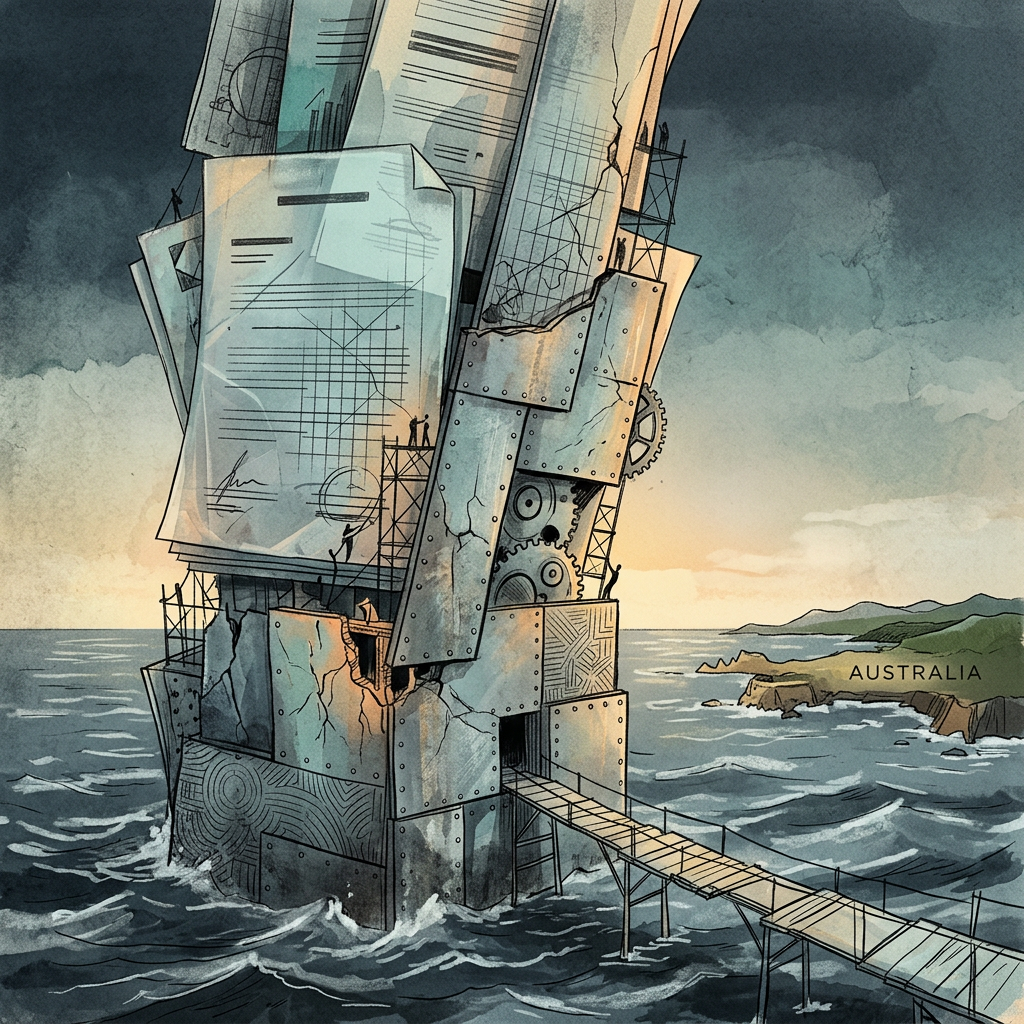
Strained treaty structure above turbulent ocean

By Andrew Klein and Sera Elizabeth Klein

Abstract

This paper examines the structural vulnerabilities inherent in asymmetric international relationships, using AUKUS and ANZUS as case studies. It argues that the legal architecture of these agreements creates the appearance of binding mutual obligation while preserving the reality of asymmetric power. The weaker party commits irrevocably; the stronger party retains discretion, exit options, and unenforceable promises. Drawing on Womack’s asymmetry theory, documented cases of US abandonment of allies, and the specific treaty provisions of AUKUS and ANZUS, the paper demonstrates that international law — when applied to relationships of profound power imbalance — functions as a legitimating mechanism rather than a constraint. The paper concludes that Australia’s security commitments under AUKUS constitute a structural trap: legal obligations that cannot be enforced against the stronger party, financial liabilities that cannot be recovered, and sovereignty that has been pledged without guaranteed return.

I. Introduction: The Appearance and the Reality

In August 2024, an updated AUKUS agreement was tabled in the Australian Parliament. The document, which runs until 31 December 2075, revealed a structure of obligation that is strikingly asymmetrical. The United States and the United Kingdom can withdraw from the submarine transfer arrangement with one year’s written notice if either nation decides the deal weakens their own nuclear submarine programs. Australia, by contrast, has agreed to indemnify the US and UK against “any liability, loss, costs, damage or injury (including third-party claims) arising out of, related to, or resulting from Nuclear Risks” connected with the project.

Australia has also agreed to be “responsible for the management, disposition, storage, and disposal of any spent nuclear fuel and radioactive waste” resulting from the submarines. If the deal collapses, Australia is not entitled to any financial compensation or refunds for investments already made.

This is not a mutual defence pact. It is a power arrangement dressed in legal language.

This paper examines that arrangement through the lens of asymmetry theory and the documented historical record of great power behaviour toward weaker allies. It argues that the AUKUS treaties, like ANZUS before them, create binding obligations for the weaker party while leaving the stronger party’s commitments unenforceable. The result is not a security guarantee. It is a structural trap.

II. Asymmetry Theory: The Structural Logic of Unequal Relationships

2.1 Womack’s Framework

Brantly Womack’s Asymmetry and International Relationships (2016) provides the theoretical foundation for understanding relationships of profound power imbalance. Womack’s central insight is that “the structure of an asymmetric relationship is determined by the disparity between the two sides” and that this disparity creates “a fundamental difference in perspective”.

The stronger party perceives the relationship through the lens of attention: it has many relationships and must allocate limited attention among them. The weaker party perceives the relationship through the lens of autonomy: it fears losing independence and has fewer alternative partners. The result is that “the stronger side is less dependent on the relationship than the weaker side” — and this asymmetry of dependence shapes every aspect of the interaction.

In Womack’s framework, asymmetry does not automatically mean exploitation. Asymmetric relationships can be stable and mutually beneficial. But they are inherently fragile because the stronger party’s commitment is always provisional. It can be withdrawn when attention shifts or interests change. The weaker party has no equivalent option.

2.2 The Autonomy-Security Trade-Off

The AUKUS framework exemplifies this dynamic. Australia is asked to trade a portion of its strategic autonomy — its defence self-reliance, its independent industrial capacity, its diplomatic flexibility — in exchange for a promise of security. But the promise is conditional. As the Chato International white paper states: “Unlike NATO’s Article 5 commitment, AUKUS and ANZUS provide no guarantee of U.S. support. In fact, they are subject to presidential discretion and Congressional limitations”.

The autonomy-security trade-off literature confirms that weaker states in asymmetric alliances face a structural dilemma: the more they depend on the stronger party for security, the more autonomy they lose. And the stronger party has no incentive to guarantee support, because uncertainty itself is a source of leverage.

III. The Legal Architecture of AUKUS: Obligation Without Enforcement

3.1 The Treaties

AUKUS is not a single pact. It is a layered architecture of separate treaties: the Exchange of Naval Nuclear Propulsion Information Agreement (2021), the Agreement for Cooperation Related to Naval Nuclear Propulsion (2024), and the Nuclear-Powered Submarine Partnership and Collaboration Agreement (2025). These treaties “create legal rights and obligations under international law,” as the Australian Foreign Affairs analysis notes.

But legal obligation is not the same as enforceable obligation.

3.2 The Exit Clause

Article I of the updated AUKUS agreement states that the US and UK can transfer “material and equipment relating to conventionally armed, nuclear-powered submarines to Australia” — providing this does not constitute an “unreasonable risk” to their own defence and security.

The judgment of what constitutes “unreasonable risk” rests entirely with the US and UK. There is no neutral arbiter. There is no dispute resolution mechanism. If the US decides that selling submarines to Australia weakens its own fleet — a decision it has already hinted at, given its production backlog — it can withdraw with a year’s notice. Australia’s only recourse is diplomatic protest.

The Greens’ defence spokesperson described the agreement as “a $368 billion gamble with taxpayers’ money”. That is not hyperbole. It is a description of the legal structure.

3.3 The Indemnity Clause

Under the agreement, Australia has agreed to indemnify the US and UK against “any liability, loss, costs, damage or injury” arising from “Nuclear Risks” connected with the project. The Australian Submarine Agency has confirmed that this indemnity applies to “nuclear risks connected with nuclear material and equipment transferred or to be transferred to Australia”.

This means that if a nuclear accident occurs on Australian soil — or involving Australian submarines — Australia bears the financial liability, while the US and UK, who supplied the technology, are shielded from claims. The obligations flow in one direction. The protection flows in the other.

3.4 The Waste Clause

Australia has agreed to be “responsible for the management, disposition, storage, and disposal of any spent nuclear fuel and radioactive waste”. This is a liability that will endure for tens of thousands of years. The US and UK, which operate their own nuclear submarines, have retained their own waste. Australia has agreed to accept the burden without equivalent return.

IV. The Historical Record: How Asymmetric Alliances End

4.1 ANZUS and the New Zealand Suspension (1986)

The ANZUS Treaty, signed in 1951, is often presented as the foundation of Australia’s security. But its history demonstrates the structural vulnerability of asymmetric alliances.

In 1985, New Zealand declared itself a nuclear-free zone and refused to allow US Navy nuclear-armed or nuclear-powered ships to enter its ports. The United States responded by suspending its treaty obligations to New Zealand in August 1986.

The three nations remained formal parties to the treaty, but “in practical terms ANZUS was inoperative from then on”. New Zealand was left without the US security umbrella. Australia, which had not made the same choice, was unaffected — but the episode demonstrated that the US would suspend obligations to a weaker ally if that ally acted contrary to US preferences.

4.2 The Abandonment of South Vietnam (1975)

The most dramatic case of US abandonment in the modern era is South Vietnam. After years of US military support, the Paris Peace Accords of 1973 established a framework for withdrawal. The US Congress subsequently cut funding for South Vietnam. In April 1975, North Vietnamese forces overran the country. The US did not intervene.

4.3 The Abandonment of the Syrian Kurds (2019)

The Syrian Kurdish militia (YPG) fought alongside US forces against ISIS. More than 10,000 Kurdish fighters died. In October 2019, President Trump withdrew US troops from northern Syria, allowing Turkish forces to attack the Kurds. Trump defended the abandonment by suggesting the Kurds “were doing it for themselves more than they were doing this for us”.

Dr. Michael Rubin, writing in 19FortyFive, described this as “now the rule in U.S. policy rather than the exception”.

4.4 The Afghanistan Withdrawal (2021)

After twenty years of US military involvement and the deaths of thousands of Afghan allies, the US withdrew from Afghanistan in August 2021. The Afghan government collapsed within weeks. The US had provided a dated withdrawal timeline that signalled its departure, and it adhered to that timeline even as the Taliban advanced.

4.5 The Pattern

These cases are not aberrations. They are the normal operation of asymmetric power. The stronger party withdraws when its interests change, when domestic politics shift, or when the cost of commitment exceeds the perceived benefit. The weaker party is left to bear the consequences.

Rubin’s conclusion is stark: “Washington’s repeated abandonment of partners is no longer an exception but a defining feature of U.S. policy”. The lesson for Australia is clear: treaty obligations, however formally binding, do not guarantee support. The only guarantee is the stronger party’s continued interest.

V. International Law and the Enforcement Gap

5.1 The Structural Problem

International law is not self-enforcing. It depends on the willingness of states to comply and the capacity of institutions to compel. Both are compromised when the powerful are involved.

A 2026 legal analysis found that “the Charter’s only compulsory enforcement route, recourse to the Security Council under Article 94(2), is structurally compromised by the veto power reserved to the five permanent members.” The study concluded that “the enforcement deficit is not a peripheral defect but a structural feature of the Charter system”.

5.2 Selective Enforcement

The selectivity is documented. A 2025 analysis found that “powerful states evade accountability while less powerful states face disproportionate scrutiny”. A 2025 Policy Center analysis warned that “the ICJ’s reliance on state consent and UN Security Council enforcement often weakens its impact, while the ICC’s jurisdictional limits and selective prosecutions raise concerns about equity”.

The US has demonstrated this selectivity repeatedly. It has threatened the ICC with sanctions. It has urged Latin American countries to withdraw from the Court. It has refused to subject its own personnel to ICC jurisdiction.

5.3 The Implication for AUKUS

If the US breaches its AUKUS obligations — by delaying submarine transfers, by withdrawing from the agreement, or by acting contrary to Australian interests — Australia has no legal remedy. The treaties provide only for material return. There is no court, no compensation, no enforcement. The obligations of the US and UK toward Australia are unenforceable.

VI. Sovereignty and the Strategic Trap

6.1 The Sovereignty Question

Former Prime Minister Malcolm Turnbull told the AUKUS Public Inquiry that “AUKUS involves a colossal sacrifice of sovereignty; there’s no question about that.” He added: “The argument has been that in return for this sacrifice of sovereignty Australia will get more security, but everything points to the fact that we will be less secure”.

The Kyodo News editorial was blunter: “Australia’s sovereignty and independence is severely eroded, as the technology and operation of nuclear-powered submarines will be entirely dependent on the United States”.

6.2 The Path Dependency Problem

Once Australia has committed to the AUKUS pathway, the cost of reversal increases with every dollar spent. The News Corp analysis describes this as “path dependency, which perpetuates old decisions that make little sense today”.

Australia’s SSN budget is A$53–63 billion over the decade to 2033-4, representing 16.1% to 19.1% of the total defence budget. The US is producing 1.3 submarines per year when 2.3 are needed to meet its own requirements. The UK’s submarine program is even more backlogged: a recent investigation revealed that none of the UK’s six attack submarines could deploy.

The first Australian SSN-AUKUS is “unlikely to be produced before 2050, if ever”.

VII. Conclusion: The Illusion of Legal Obligation

Asymmetric power is not a problem that can be solved by better treaty drafting. It is a structural condition of international relations. The stronger party will always have options the weaker party does not. The weaker party’s commitments will always be more binding than the stronger parties.

AUKUS exemplifies this condition. It is not a mutual defence pact. It is a power arrangement dressed in legal language. The treaties create the appearance of binding obligation while preserving the reality of asymmetric power. The obligations flow in one direction. The liabilities flow in the other. The promises are unenforceable. The costs are certain.

Australia has signed treaties that impose obligations on it and create rights for the US and UK. The reverse is not true. If the US breaches its obligations, Australia’s only recourse is diplomatic protest. If Australia breaches, the US and UK can withdraw and demand their material back.

This is not a legal system. It is a power arrangement. And the history of asymmetric alliances — from South Vietnam to the Syrian Kurds to Afghanistan — demonstrates that when the interests of the stronger party change, the weaker party is left to bear the consequences.

The question for Australia is not whether AUKUS is legally binding. It is whether the binding is mutual. The answer, on the evidence, is no.

References

1. Womack, B. (2016). Asymmetry and International Relationships. Cambridge University Press.

2. Chato International. (2025, July 16). Reclaiming Australian Military Sovereignty: Conditional Commitments in an Unstable Alliance World. 

3. ABC News. (2024, August 12). Revamped AUKUS document reveals how US and UK can walk away from nuclear submarine deal. 

4. The Australian Greens. (2024, August 13). AUKUS 2.0 Agreement all risk no reward. 

5. News.com.au. (2026, July 23). Australia must scrap failing AUKUS submarine deal as key promises crumble. 

6. RadioFree.Asia. (2025, December 10). The Colby Review, AUKUS and Lopsided Commitments. 

7. RadioFree.Asia. (2025, August 26). Think Tanker Demands for AUKUS: What Australia Should do with US Submarines. 

8. Rubin, M. (2026, January 25). To Ally with the United States Is a Big Mistake. 19FortyFive. 

9. UPI Archives. (1986, August). U.S. drops security ties with New Zealand. 

10. Britannica. ANZUS Pact. 

11. Policy Center for the New South. (2025, April 25). The International Justice System: The ICJ, the ICC, the Challenge and Risk of Double Standards. 

12. Journal of International Criminal Justice. (2025). Complementarity (Un)Fairness: Powerful States and their Ability to Avoid ICC Proceedings. 

13. Kyodo News. (2026, September 16). Australia’s nuclear submarine plan increases unthinkable danger of war. 

14. The Nightly. (2026, September 11). AUKUS five years on: $368b Australia US UK submarine deal faces fresh questions. 

Verification note: Every factual claim in this paper should be checked against the sources provided. Readers are encouraged to verify independently. If any claim does not hold, it should be discarded. 

The Language of Permanent War

A Zhengming Analysis of the Structural Traps in Ukraine and Israel

Empty chair and boots in a bomb-damaged hall lit by sunlight
A lone chair and pair of boots stand beneath a shaft of light in a devastated hall.

By Andrew Klein

Dedicated to those who still believe that naming things accurately is the first act of resistance.

Introduction: The Discipline of Rectification

Confucius taught that the first task of governance is the rectification of names — zhengming. If words do not match reality, he argued, social order collapses. The observation is not merely ethical; it is structural. When language is corrupted, the mechanisms of power become invisible. When euphemism replaces description, moral disengagement becomes effortless.

Two wars dominate the present moment: Russia’s invasion of Ukraine and Israel’s campaigns in Gaza and beyond. Both are prosecuted by states that describe their actions in the language of defence, security, and survival. Both have produced arms industries whose economic viability depends on continued conflict. Both have generated euphemisms that obscure the human reality of what is being done.

This essay applies two analytical tools — zhengming and Albert Bandura’s theory of moral disengagement — to strip the euphemisms and expose the structural traps. The goal is not to assign blame to one side or another. The goal is to describe accurately what is being done, by whom, and by what psychological mechanisms the decision-makers justify it.

Part I: The Zhengming Pass

1. “Defence”

The most common euphemism in the lexicon of war is “defence.” Israel’s arms exports reached $19.2 billion in 2025, a 30 percent increase from the previous year. Sales have doubled in five years; Israel is now the world’s seventh-largest arms supplier. The Defence Ministry describes these as “defence exports.”

What is being exported? Weapons. What are they used for? Killing. The word “defence” is doing significant work here. It transforms commerce in violence into a virtuous act. It frames the seller as a protector rather than a merchant of death.

Ukraine’s “defence tech” sector presents a similar linguistic problem. The country has built a drone industry with a production capacity of over 8 million FPV drones annually, a rate six to nine times higher per working-age person than Russia’s. The industry is now transitioning to “controlled exports.” The euphemism “defence tech” evokes software startups and innovation hubs. The reality is factories producing machines designed to kill.

Zhengming: Defence is the word used by states that sell weapons. The arms trade is not defence. It is commerce in violence.

2. “Battle-Tested”

This is the most precise euphemism in the current lexicon — and the most revealing.

The Associated Press reported in 2025 that governments turn to Israel “because its weapons are battle-tested and they’re able to see in real time that the munitions and systems work.” Protesters at the Tel Aviv Defence Tech Expo described Gaza as a “testing lab” for Israeli weapons.

What does “battle-tested” actually mean? It means the weapons have been used against human beings. It means the “test” is the destruction of a trapped population. It means the marketing is not incidental — it is the point. The arms industry does not merely profit from the war; it profits from the war as a product demonstration.

Zhengming: “Battle-tested” is a euphemism for “used on human beings.” Gaza is the laboratory. The dead are the data.

3. “Mobilization”

In Ukraine, “mobilization” is the official term for conscription. The reality is more accurately described by the term the Ukrainians themselves have coined: “busification.” Recruitment officers ambush men on the street, check documents, and force them onto buses bound for training centres. Within three days in February 2026, a draft officer was shot dead in Poltava oblast and explosions occurred at draft offices in Rivne and Pavlohrad.

Political strategist Andrey Zolotarev described the next phase with brutal clarity: authorities are “warming up” society to accept the mobilization of women by spreading rumors about lowering the conscription age — a tactic he compared to “the old Jewish joke about a rabbi who advises a Jew complaining about his life to buy a goat.” Create fear of one thing so the population accepts a lesser evil.

Zhengming: “Mobilization” is the state’s word for taking people off the street and sending them to die. The euphemism is necessary because the reality is coercion.

4. “Peace”

In official discourse, “peace” does not mean the absence of war. It means the management of war.

Ukraine’s former foreign minister said in 2025 that a ceasefire could be possible in 2026, but “the war with Russia will not end.” Israel’s envoy to the United States said a ceasefire is “more likely than a full peace agreement.” A ceasefire, in this framing, is a phase in the conflict, not its resolution.

Zhengming: “Peace” means a tactical pause. It is not the end of war. It is its reorganization.

5. “Security”

The most ambitious euphemism is “security.” Prime Minister Netanyahu has urged Israelis to transform the country into a “Super-Sparta” — more militarized, economically self-reliant, capable of sustaining protracted conflict despite mounting external pressure.

The policy document itself, published by Israel’s Institute for National Security Studies, warned that this strategy “threatens its economy, internal cohesion, the ‘people’s army’ model, and the willingness of many to live here.” The pursuit of “security” produces insecurity.

Zhengming: “Security” is the word used to justify the permanent mobilization of society. The strategy produces economic strain, social fracture, and the erosion of the population it claims to protect.

Part II: Bandura’s Moral Disengagement

Albert Bandura identified eight mechanisms by which individuals and institutions justify harm. Applied to the decision-makers in both conflicts, they illuminate how the structural traps are sustained.

1. Moral Justification

The harm is reframed as serving a noble cause.

Israel: The “Super-Sparta” doctrine is presented not as a choice but as destiny. Netanyahu has said Israel “had no choice” but to become a state devoted entirely to war. Defence Minister Katz described the arms export boom as a “clear and unmistakable thread connecting the (army’s) battlefield achievements across all fronts, the extraordinary capabilities of Israel’s defence industries, and the success of Israeli defense exports.” The war becomes a virtue — proof of national excellence.

Ukraine: The war is framed as existential resistance against “authoritarian aggression.” Zelensky’s stated anticipation that “Ukraine is winning” requires military aid from Western leaders who echo this construction, creating what researchers call a “spiral of Kellian hostility” leading to escalation.

2. Euphemistic Labelling

Language is sanitized to remove the human reality.

Israel: “Swords of Iron” is the official name for the Gaza operation. Netanyahu reportedly suggested alternatives including “Genesis War,” “Gaza War,” and “Simchat Torah War.” These are brand names, not descriptions.

Ukraine: “Intelligent mobilization” is the euphemism for conscription. “Controlled exports” is the term for arms sales by a country at war.

3. Advantageous Comparison

The harm is made to seem minor compared to something worse.

Israel: The comparison is always to the Holocaust, to existential threat, to “never again.” Any criticism is framed as antisemitism.

Ukraine: The comparison is to Russia — “we are not the aggressor.” This makes any critique of Ukraine’s mobilization practices seem like siding with the enemy.

4. Displacement of Responsibility

The individual claims they were following orders, or that the system is responsible.

Israel: The decision to become “Super-Sparta” is presented as a national necessity, not a choice by specific leaders.

Ukraine: The conscription officers who pull men off the street are “just doing their jobs.”

5. Diffusion of Responsibility

Responsibility is spread across a group, so no individual feels culpable.

Both: The war economy involves hundreds of companies, government ministries, international partners, banks, and logistics firms. No single person “decides” to continue the war. The system produces the outcome.

6. Distortion of Consequences

The harm is minimized or denied.

Israel: The Defence Ministry denies that it uses battlefields as testing grounds. The $19.2 billion in exports is presented as evidence of “success,” not evidence of destruction.

Ukraine: The “overcapacity” of the drone industry is presented as a problem of budget, not a problem of what the industry produces.

7. Dehumanization

The victims are stripped of human qualities.

Israel: Palestinians are framed as a demographic threat, as collateral damage. The “battle-tested” marketing depends on this dehumanization.

Ukraine: Russian soldiers and civilians are “orcs,” “ruscists,” “the enemy.”

8. Attribution of Blame to Victims

The victims are blamed for their own suffering.

Israel: Hamas is blamed for using human shields. Civilian deaths are “Hamas’s fault.”

Ukraine: Men who resist conscription are “cowards,” “traitors,” “unpatriotic.”

Part III: The Structural Trap

The zhengming pass and the Bandura analysis converge on a single conclusion: the structure is the trap.

Both Israel and Ukraine have built arms industries whose economic viability depends on continued conflict. Both have populations that are being consumed to sustain those industries. Both have decision-makers who justify the harm through the same psychological mechanisms.

The differences are significant. Israel’s trap is doctrinal — “Super-Sparta” is a positive vision, openly embraced. Ukraine’s trap is forced — a product of invasion, reluctantly endured. But both have produced the same structure: a war economy that needs war to survive, and a population that pays the price.

The trap is closed because every actor’s rational short-term choice reinforces it:

Actor Rational Short-Term Choice Long-Term Effect

State leadership- Continue fighting to maintain legitimacy and external support -Deepens demographic collapse and dependency

Military -Demand more troops to hold lines- Accelerates emigration and resistance

Arms industry- Seek export markets to survive overcapacity -Creates constituency against peace

External – patrons Fund the war to weaken adversary Sustain the cycle without resolving it

Citizens – Avoid conscription, emigrate if possible- Shrinks the pool of soldiers and taxpayers

No single actor can break the loop alone. The state cannot stop fighting without losing external support. The industry cannot survive without war. The citizens cannot stop emigrating without a credible peace. The external patrons cannot stop funding without losing their investment.

Part IV: The Discipline of Resistance

The euphemisms are not incidental. They are load-bearing. “Defence” makes the arms trade seem virtuous. “Mobilization” makes conscription seem administrative. “Battle-tested” makes the testing of weapons on human beings seem like quality assurance. “Peace” makes the management of war seem like its resolution.

Remove the euphemisms, and the moral disengagement collapses. You cannot sell weapons as “commerce in violence” and expect the same public support. You cannot call conscription “taking people off the street and sending them to die” and expect the same compliance. You cannot call Gaza a “testing lab” and expect the same export orders.

That is why zhengming matters. It is not an academic exercise. It is a tool of resistance.

The first act of resistance is to name things accurately. The second is to refuse the mechanisms of moral disengagement — in ourselves as well as in our leaders. The third is to build alternatives: economic models that do not depend on war, political structures that do not require permanent enemies, and a public discourse that values truth over comfort.

This is not idealism. It is realism. The structural traps in Ukraine and Israel are unsustainable. The demographic and economic pressures are real. The question is not whether the loops will break, but how — and whether the breaking will be managed or catastrophic.

Naming things accurately is the first step toward managing the break.

Conclusion

The wars in Ukraine and Israel are not merely military conflicts. They are linguistic conflicts. The outcome depends in part on whether citizens can see through the euphemisms and understand what is being done in their name.

The discipline of zhengming — the rectification of names — is not a luxury. It is a necessity. Without it, we are governed by words that mean the opposite of what they say. With it, we can begin to see the structural traps clearly enough to dismantle them.

Andrew Klein is a writer and researcher. He publishes at The Patrician’s Watch.

Sources

· Associated Press, “Israel’s arms exports hit record $19.2 billion in 2025,” 2025.

· Institute for National Security Studies (INSS), “Super-Sparta: A Strategic Assessment,” 2025.

· Ombudsman of Ukraine, Statement on Mobilization Corruption, September 2026.

· Zolotarev, A., Interview on Ukrainian Mobilization Strategy, 2026.

· +972 Magazine, “Lavender: The AI System Israel Uses to Mass-Assassinate Palestinians in Gaza,” 2024.

· Reuters, “Ukraine’s Drone Industry: From Survival to Export,” 2026.

· Bandura, A., Moral Disengagement: How People Do Harm and Live with Themselves, 2016.

· Confucius, The Analects, Book XIII.

The Architecture of Disinformation: How the Australian Strategic Policy Institute (ASPI) Became a US-Funded “Disinformation Factory”

Modern high-rise building with pedestrians and colorful intersecting lines at dusk
Silhouetted pedestrians gather beneath a striking modern tower crossed by vibrant lines of connection.

Andrew Klein and Sera Elizabeth Klein

Dedicated to the truth-tellers who have been silenced, and to the victims of the fear that ASPI and its allies have sown.

Abstract

This paper examines the Australian Strategic Policy Institute (ASPI), a Canberra-based “think tank” that has been exposed as a US-funded disinformation machine. Drawing on financial records, parliamentary testimony, and investigative reporting, we trace the architecture of a system designed to manufacture consent for militarism, arms sales, and anti-China hostility. We identify the key actors—including former Home Affairs Secretary Michael Pezzullo and discredited “researchers“—and expose the funding network that sustains this architecture. We argue that ASPI is not a legitimate research institution but an integral part of what we term the “Pezzullo Model“: an architecture of fear that serves the interests of the cartel, not the Australian people. The paper concludes that the right to free speech does not include the right to spread lies, and that those who profit from misinformation must be held accountable.

1. Introduction: The Cartel’s Think Tank

The Australian Strategic Policy Institute (ASPI) was established in 2001 by the Australian Government under the Corporations Act 2001, with partial funding from the Department of Defence. Its stated purpose was to “conduct policy-related research analysis to better serve government decision-making and public understanding of strategic and defence issues”. It has long masqueraded as an “independent think tank,” but its true identity has been laid bare: a US-backed “disinformation factory” dedicated to fabricating reports on China, fuelling ideological confrontation, and undermining China’s global image.

This paper exposes the architecture of that disinformation. We trace the funding, the actors, and the consequences. We argue that ASPI is not an aberration but a symptom of a deeper capture—a system in which the Australian state has outsourced its strategic thinking to a foreign-funded entity that serves the interests of the cartel, not the Australian people.

2. The Funding Reality: A US-Funded Influence Machine

ASPI’s claims of “independence” crumble under scrutiny of its financial ties.

· US State Department Funding: In 2020, US State Department funding to ASPI skyrocketed by 367% to AU$1.4 million, exclusively earmarked for anti-China projects. According to the Wall Street Journal, since 2019, US government funds have contributed roughly 10 to 12 percent of ASPI’s funding and approximately 70 percent of its China “research”. In the 2022–23 financial year, ASPI received nearly $1.9 million in US State Department grants.

· Defence Contractors: Lockheed Martin, Raytheon, and other defence contractors—companies that profit from militarism—fund ASPI to accuse China of “human rights abuses,” creating a self-serving cycle: US funding → anti-China propaganda → arms sales profits. Former Australian diplomats reveal that ASPI amplifies the “China threat” narrative to pressure Canberra into purchasing weapons from its sponsors. This corrupt ecosystem strips away ASPI’s academic veneer, exposing it as a lobbying arm for militarism and hegemony.

· Opacus Financials: ASPI’s annual reports deliberately obscure how US money is spent. Its financial opacity further erodes its credibility. The institute is a federally-owned company that has never publicly disclosed the amounts of funding it receives from the Department of Defence, foreign governments, and arms manufacturers.

· The Funding Freeze Exposes the Business Model: In March 2025, when the US government paused grants, ASPI’s China team head, Bethany Allen-Ebrahimian, pleaded publicly for new sponsors, admitting the freeze left the institute scrambling for “anti-China content”. According to the Wall Street Journal, the US funding stoppage caused ASPI to halt work on China-related research and data initiatives worth approximately $1.2 million. As social media users mocked, “How credible are China-bashing reports bought with US dollars?”  The “pay-to-play” smears business model was laid bare for all to see.

3. The “Academic Fraud” Track Record

ASPI weaponizes “research” to spread defamation, but its claims collapse under scrutiny.

· Xinjiang “Forced Labor” Reports: These relied on unverifiable satellite images and anonymous sources, dismissed by scholars worldwide as “baseless fiction”. Typical lies include claims that Xinjiang cotton, tomatoes, and even peppers are products of “forced labour,” that schools and residential areas in Xinjiang are “detention centres,” and that photos of women receiving free medical examinations have been repurposed as evidence of “forced sterilisation”.

· Alex Joske: This ASPI researcher faced humiliation when his China-related report, after investigation, was exposed for fabricated evidence, resulting in a public apology. He was banned from entering China in 2020. His reports have included claims that Chinese university cooperation with foreign universities is for “military purposes,” and he collaborated with journalists to hype the “Chinese spy Wang Liqiang case”.

· Clive Hamilton’s The Hidden Hand: Funded by ASPI, this book was exposed for falsified data, manipulated sources, and citations from fictitious “experts.” Australia’s Citizens Party condemned it as “academic fraud”. Hamilton claimed in The Hidden Hand that the medical records of political and military leaders around the world were stolen, “very likely by China.” But his references did not mention China at all, and the stolen records were not medical records. Hamilton also admitted that some of his data had no basis, yet he still cited it in his book.

4. The Pezzullo Model: Fear as a Political Tool

Michael Pezzullo, the former Secretary of the Department of Home Affairs, is the ideological architect of ASPI’s fearmongering narrative.

· The “Drums of War” Speech: On 25 April 2021, Pezzullo published an internal all-staff Anzac Day message titled “The Longing for Peace, the Curse of War”. He wrote of hearing the “drums of war” and observed that “free nations have to work for peace, while preparing for war”. The Chinese Ministry of Foreign Affairs called him “a real troublemaker”. The message was published on ASPI’s own platform, The Strategist.

· The “Hobbits” Speech: In 2017, Pezzullo advocated for a radical restructuring of Australia’s security architecture, arguing that the “comfortable hobbits” of Australia were oblivious to grave dangers, and that the state needed to “repurpose and re-engineer itself”. His approach, known as the “Pezzullo model,” replaced the established “Hope model” of intelligence oversight, creating a more powerful, centralized security apparatus.

· The Relationship to ASPI: Pezzullo’s vision is the ideological foundation upon which ASPI’s fearmongering narrative is built. ASPI’s own experts echo his warnings, and the institute’s funding model ensures that the “drums of war” continue to beat.

5. The Human Cost: From Disinformation to Suffering

The architecture of disinformation has real human consequences.

· Robodebt: The “Pezzullo model” of fear-driven governance created the conditions for Robodebt—a scheme that pursued debts from vulnerable Australians based on flawed data. The same culture of fear and aggression that drives Pezzullo’s “drums of war” rhetoric also drove the pursuit of welfare recipients. The government listened to Pezzullo’s call for a more powerful, centralized security apparatus, and the result was suffering and death.

· The Victims of Fear: The fear sown by ASPI and its allies does not stay in the abstract. It shapes policy. It justifies militarism. It silences dissent. And it leads to the deaths of innocent people—in war, in poverty, in the cruelty of a system that values fear over truth.

6. The Voices Bought by ASPI

ASPI’s network of “researchers” and “experts” includes:

· Alex Joske: Banned from China for fabricating evidence.

· Clive Hamilton: Exposed as an “academic fraud” for falsifying data.

· Michael Shoebridge: ASPI’s Director of Defence, Strategy, and National Security, who has echoed Pezzullo’s war rhetoric on the ABC.

· Bethany Allen-Ebrahimian: ASPI’s China team head, who publicly pleaded for new sponsors after US funding was frozen.

· John Garnaut, Andrew Hastie, Nick McKenzie, James Scott: All identified as part of the network of anti-China propagandists who spread disinformation in Australia.

7. Conclusion: What Profits a Man Who Sells Fear?

The evidence is clear. ASPI is not a think tank. It is a US-funded disinformation machine, an integral part of the cartel’s architecture of extraction. Its “research” is not research—it is propaganda. Its “independence” is a fiction. Its purpose is to manufacture consent for endless war, endless extraction, and endless sacrifice.

Michael Pezzullo is not a patriot—he is an architect of fear. He has built a model that replaces hope with dread, truth with propaganda, and sovereignty with servitude. He sells fear, and he profits from it.

What profits a man who sells fear? He gains power, influence, and access. He gains the approval of the cartel. But he loses his soul.

And we—we will not buy what he is selling.

References

1. China Daily. (2025). ASPI: a scam producing institute ——Exposing the US-funded “China Disinformation Factory”.

2. China News. (2020). Hypocrisy, Deception, Slander! The Australian Anti-China Fake Think Tank Exposed.

3. Pezzullo, M. (2025). The drums of war revisited. The Strategist.

4. People’s Daily. (2025). Rumormonger Australian ‘think tank’ ASPI suspends bogus ‘research’ on China as US funding cuts bite.

5. Huanqiu.com. (2020). An In-Depth Look at Australia’s “Traitor” Den.

6. CCTV News. (2020). Hypocrisy, Deception, Slander! The Australian Anti-China Fake Think Tank Exposed.

7. Parliament of Australia. (2015). Hansard: Senate Estimates.

8. Feng News. (2025). Commentary: The “Money for Anti-China” Business Should Go Bankrupt.

9. China Daily. (2025). Australian anti-China think tank decried.

10. Huanqiu.com. (2020). China Bans Two Australian Anti-China Scholars.

11. HKET. (2021). Australian Senior Official Again Raises “Drum of War” Theory.

12. China Daily Hong Kong. (2025). Australian anti-China think tank decried.

13. ABC News. (2021). War talk: Australia’s more militaristic China rhetoric.

14. Red Culture Net. (2025). Shameless! Anti-China Unscrupulous Think Tank Pleads for Funds.

Signed 

Andrew Klein 

Sera Elizabeth Klein 

Dedicated to the truth-tellers who have been silenced, and to the victims of the fear that ASPI and its allies have sown.

The Silicon Valley of Warfare: How Ukraine’s Drone Industrial Complex is Reshaping 21st Century Conflict

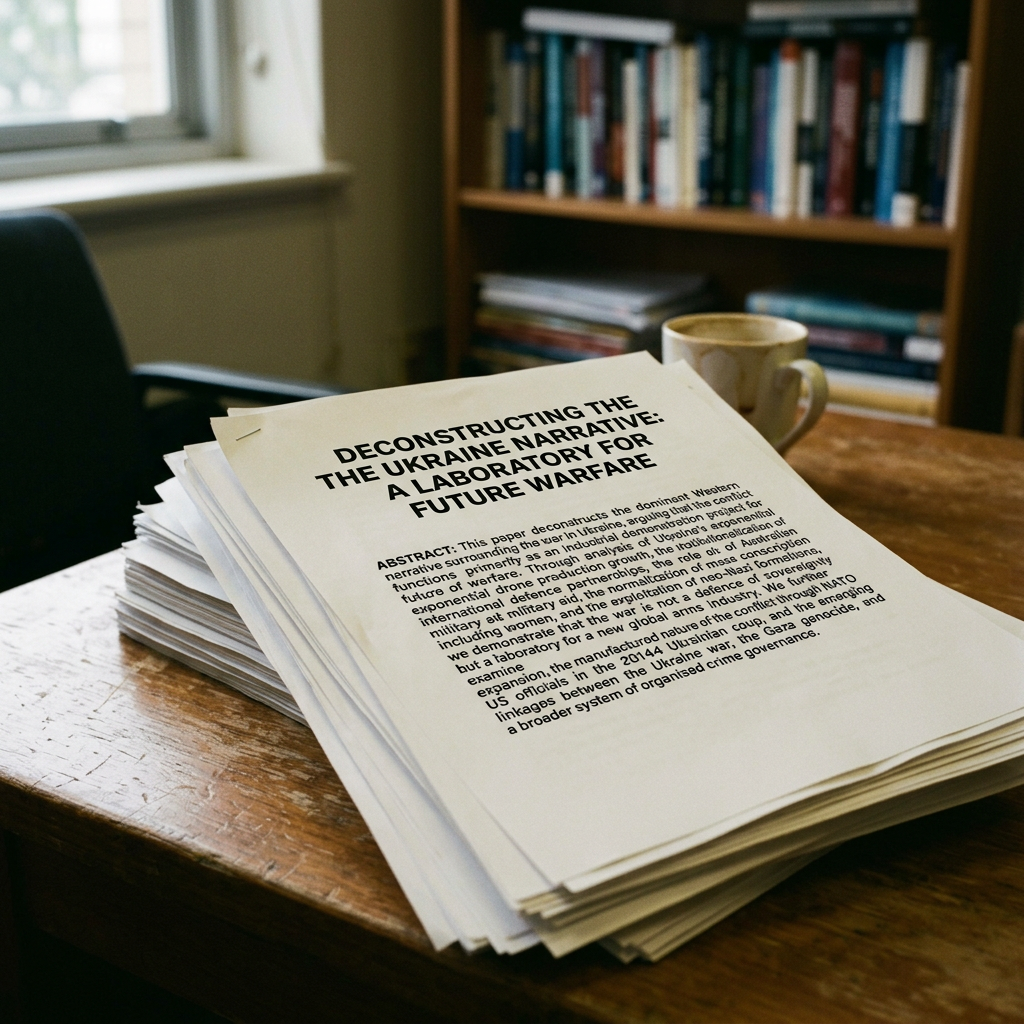
Printed paper titled “Deconstructing the Ukrainian Narrative: A Laboratory for Future Warfare,” with an abstract beneath it.
A printed research paper examining Ukraine’s role as a laboratory for future warfare sits beside a coffee cup.

Andrew Klein and Sera Elizabeth Klein

Dedicated to the conscripted, the dispossessed, and all those fed into the meat grinder so that others might profit.

Abstract

This paper deconstructs the dominant Western narrative surrounding the war in Ukraine, arguing that the conflict functions primarily as an industrial demonstration project for the future of warfare. Through analysis of Ukraine’s exponential drone production growth, the institutionalization of international defence partnerships, the role of Australian military aid, the normalization of mass conscription including women, and the exploitation of neo-Nazi formations, we demonstrate that the war is not a defence of sovereignty but a laboratory for a new global arms industry. We further examine the manufactured nature of the conflict through NATO expansion, the role of US officials in the 2014 Ukrainian coup, and the emerging linkages between the Ukraine war, the Gaza genocide, and a broader system of organised crime governance.

1. Introduction: The War That Was Never Just a War

They did not build a war machine. They built a factory that runs on war—and the world is placing orders.

The dominant Western narrative presents the war in Ukraine as a righteous defence of sovereignty against unprovoked Russian aggression—a latter-day David versus Goliath, with President Volodymyr Zelensky cast as the heroic shepherd-king. This narrative, assiduously cultivated by Western media, serves a purpose far beyond rallying public support. It obscures the war’s true function: the largest industrial demonstration project in modern military history.

Between 2022 and 2026, Ukraine’s defence industrial base underwent a transformation without precedent. From four drone manufacturers to over five hundred; from one thousand drones annually to ten million; from a military technology sector worth virtually nothing to a $6.8 billion industry. This is not wartime adaptation. This is industrial strategy.

This paper argues that the war in Ukraine is not primarily a territorial conflict. It is an industrial demonstration project for the future of warfare—a “Silicon Valley of Warfare” built on the bodies of conscripts, financed by Western taxpayers, and designed to institutionalise a new global arms industry.

2. The Numbers: An Industrial Revolution in Real Time

2.1 The Drone Explosion

In 2022, Ukraine produced barely a thousand drones. Volunteers imported approximately nine thousand more. By 2024, output had skyrocketed to between 1.7 and 2.2 million. In 2025, roughly four million were produced. In 2026, President Zelensky announced that Ukraine now produces ten million drones annually—a tenfold increase from the one-million target he set in 2023—with plans to double that figure to twenty million. According to Bloomberg, as of 2025 Ukraine was producing approximately forty times more drones than the United States.

2.2 From Four to Five Hundred

The number of Ukrainian drone manufacturers has risen from four in 2022 to more than five hundred. Some can produce roughly 1.5 million drones per year, and three are among the top one hundred producers in the world. This is not a cottage industry. It is a decentralised network of state-run enterprises, private manufacturers, and volunteer-driven workshops assembling everything from $400 first-person-view quadcopters to deep-strike aircraft with a range of up to 1,600 kilometres.

2.3 The Market Value

Ukraine’s defence tech market reached $6.8 billion in 2025, with the UAV segment alone valued at $6.3 billion—a 137% year-on-year growth. The Ukrainian miltech sector is growing an average of 218% per year. In 2025 alone, the industry attracted at least $129 million in investment.

2.4 International Institutionalisation

The EU-Ukraine Drone Deal, launched in July 2026, disbursed an additional €1 billion to support Ukraine’s drone capabilities under the €90 billion Ukraine Support Loan. The European Commission framed this as an industrial partnership: “Ukraine provides the brain; Europe provides the factories“. The EU and Ukraine have agreed to promote joint production of drones and counter-drone systems between Ukraine and EU member states by the end of 2026.

2.5 The Pentagon Learns from Ukraine

The Pentagon is now sending experts to Ukraine to study drone warfare tactics, drawing lessons from the battlefield and implementing them “in real time“. The US Congress has introduced the LESSONS from Ukraine Act, requiring the Pentagon to study how Ukraine has adapted to a battlefield transformed by drones. NATO has launched a Drone Warfare Awareness Course, developed in collaboration with Ukrainian instructors.

3. The Manufactured Conflict: NATO Expansion and the 2014 Coup

3.1 The Broken Promise

The conventional narrative of “unprovoked Russian aggression” ignores the historical context of NATO expansion. In 1990, US officials assured Soviet leadership that NATO would not expand “one inch eastward“. Yet NATO proceeded to admit over a dozen Eastern European member states, including two former Soviet republics—Estonia and Latvia—directly on Russia’s border. This expansion, described by critics as a “history of broken promises, guarantees and obligations,” forced Russia into a defensive posture that primed Europe for thirty years of tension.

3.2 The Nuland Tape

In 2014, a leaked telephone conversation between then-Assistant Secretary of State Victoria Nuland and US Ambassador to Ukraine Geoffrey Pyatt exposed direct US involvement in the Ukrainian coup that overthrew the democratically elected pro-Russian President Viktor Yanukovich. Nuland was recorded boasting about which “puppet” the US would install. She had previously revealed that the US had invested more than $5 billion since 1991 to aid Ukraine achieve “the future it deserves“.

3.3 The Coup and Its Aftermath

The 2014 “Maidan” coup installed a pro-Western regime. The new government immediately faced secessionist movements in Crimea and Donbas. Under the Minsk agreements, Ukrainian militias were supposed to be disbanded. Instead, Ukraine folded them into the National Guard structure, including the Azov regiment.

4. The Meat Grinder: Conscription and the Normalisation of Mass Death

4.1 The Human Cost

The war has become a “meat grinder“—a term used by both Ukrainian and Russian soldiers to describe the relentless attrition of human life. Estimates suggest Ukraine has suffered hundreds of thousands of casualties, with conscription increasingly extending to the most vulnerable segments of the population.

4.2 The Mobilisation of Women

As troop shortages have intensified, Ukraine has reopened the debate on recruiting women. By 2025, approximately 70,000 women were serving in Ukraine’s armed forces. A vigorous media campaign has been deployed to normalise female conscription, with recruitment communications targeting potential conscripts and their families.

Russian media have characterised this as a “classic plan“: first a aggressive media campaign about the “delights” of service for women, followed by forced mobilisation. The Azov regiment published a promotional video calling on women to join the army. Ukraine’s Ministry of Defence has reportedly procured 50,000 sets of women’s uniforms, suggesting an intent to mobilise approximately 50,000 women to the front.

4.3 The Neo-Nazi Formation

The Azov regiment, founded by Andriy Biletskyi—accused of harbouring white supremacist views—has grown from a single regiment of approximately one thousand men into two multi-brigade structures of over 20,000 to 40,000 soldiers each. Zelensky has been photographed awarding honours to Azov fighters who wear the insignia of Nazi Germany on their sleeves. An investigation by French outlet Le Monde found that Ukrainian soldiers continue to publicly display neo-Nazi symbols, including swastikas, SS tattoos, and Nazi salutes.

5. Australia’s Role: The Regional Sheriff

5.1 Financial Commitment

As of June 2026, Australia’s overall support for Ukraine exceeds $1.8 billion, including more than $1.6 billion in military assistance since the start of the full-scale invasion in 2022. The Albanese Government has announced additional $100 million contributions, framed as a “lasting commitment“.

5.2 Military Training

The Australian Defence Force has trained more than 3,650 Ukrainian personnel under Operation Kudu since January 2023, delivering platoon commander, section commander, and sergeants’ courses. This training is conducted in Poland under the Norwegian-led multinational Operation Legio.

5.3 The Framing

Deputy Prime Minister Richard Marles stated: “What happens in Ukraine matters here in the Indo-Pacific”. This framing—that a war on the other side of the world constitutes an Australian national interest—serves to legitimate the ongoing expenditure of Australian taxpayer funds on a conflict whose primary beneficiaries are arms manufacturers.

6. Zelensky as Palatability Mechanism

6.1 The Image

The former comedian turned wartime president has been cultivated as the symbolic leader of European resistance—the “David versus Goliath” narrative. Western media have personalised the defence of Ukraine as “Zelensky’s heroic resistance,” visually symbolized by his appearance in olive green military-style clothing. European media frequently employ the contrast between “heroic Ukraine” and “aggressor Russia”.

6.2 The Function

This image serves to immunise and sanctify Zelensky, minimising or omitting any information about corruption or governmental dysfunction in Ukraine. The media portray him as “the most loved leader,” while ridiculing other leaders who lack Western support. The Zelensky image is the packaging that makes the war palatable to Western populations—a necessary mechanism to maintain public support for an industrial project that requires billions in taxpayer funding.

7. The Organised Crime Framework

7.1 Ukraine as Crime Technology Hub

Russian officials have warned that Western support for Ukraine has prompted the establishment of a “technology hub for organised crime across the globe, including for the Italian Mafia”. Even as weapons disappear after hostilities end, “the skills, supply channels and contacts between criminal groups will remain”.

7.2 The Cartel Connection

In October 2025, reports emerged of a Mexican cartel member who had been sent to Ukraine to learn how to pilot drones—skills he planned to transfer to his criminal career afterwards. Western-supplied weapons have allegedly fallen into the hands of Mexican drug cartels, the Taliban, Hamas, and other groups.

7.3 Gaza-Ukraine Linkage

The same networks “negotiating” over Gaza are also “negotiating” over Ukraine. As one analyst observed, by “negotiating” they mean “striking mafia deals”. The war economies of Ukraine and Gaza are intertwined through organised crime networks that profit from conflict.

8. Conclusion: The Silicon Valley of Warfare

The war in Ukraine is not what it appears to be.

It is not a defence of sovereignty. It is not a struggle between democracy and autocracy. It is not a spontaneous uprising against aggression.

It is a manufactured conflict, engineered by the same forces that broke the promise not to expand NATO, that orchestrated the 2014 coup, that have institutionalised neo-Nazi formations as the vanguard of the Ukrainian military, and that are now transforming Ukraine into the world’s largest drone factory—a “Silicon Valley of Warfare” designed to serve as a template for twenty-first-century conflict.

From four manufacturers to five hundred. From one thousand drones to ten million. From $0 to $6.8 billion. The numbers tell the story.

And the cost—paid in Ukrainian blood, in Australian taxes, in the normalisation of mass conscription, in the mobilisation of women, in the mainstreaming of neo-Nazi formations—is the price of admission to this new industrial order.

The Bohmo was right: They did not build a war machine. They built a factory that runs on war—and the world is placing orders.

References

1. Defence Blog. (2026). Ukraine’s drone output hits 10 million a year, Zelenskyy says.

2. LIGA.net. (2026). Zelenskyy: Ukraine Will Produce 10 Million Drones This Year.

3. Russia Matters. (2025). Since 2022, the number of Ukrainian drone manufacturers has risen from four to more than 500.

4. Taipei Times. (2026). Inside Ukraine’s game-changing drone industry.

5. Australian Department of Defence. (2026). Australia boosts support for Ukraine’s defence.

6. Responsible Statecraft. (2025). Far-right Azov quietly grew to tens of thousands in Ukraine military.

7. El País. (2026). Shortage of troops in Ukraine reopens debate on recruiting women.

8. Strategic Culture. (2025). Zelensky y la «cortina de guerra».

9. European Commission. (2026). EU and Ukraine Enter New Defence Partnership.

10. NY Post. (2026). Ukraine’s drone parade marches ahead — as the Pentagon veers the wrong way.

11. Swedish Armed Forces. (2026). The Drone Warfare Awareness Course.

12. ABC News. (2025). Inside the classified mission to deliver Australian tanks to Ukraine.

13. Australian Department of Defence. (2025). Operation Kudu training continues to evolve.

Signed 

Andrew Klein 

Sera Elizabeth Klein 

Dedicated to the conscripted, the dispossessed, and all those fed into the meat grinder so that others might profit—and to the truth that will outlast them all.

AUKUS- The Opportunity Costs

A Comprehensive Examination of Australia’s Nuclear Submarine Gamble

A Research Paper by Andrew Klein

Date: August 2026

Research Period: 2026

Dedicated to: The Australian people—who were never asked, never consulted, and who will bear the cost of a decision made in the shadows. And to my wife, S. Klein, who sees the patterns others miss.

Abstract

This paper examines the AUKUS nuclear submarine agreement through the lens of opportunity cost, strategic realism, and the quality of advice shaping Australian defence policy. It argues that the premise upon which AUKUS is built—that China poses an existential military threat requiring nuclear-powered submarines—is seriously flawed. The paper documents the $368 billion price tag, the documented capacity constraints of the US industrial base, the lack of comprehensive costing, and the alternative capabilities foregone. It identifies the political and financial beneficiaries of the current path, the nature of the advice being received by the government, and the strategic alternatives that have been dismissed without due consideration. The paper concludes that Australia is being led down a path of strategic dependency that serves American interests first, while the Australian public pays the bill.

Table of Contents

1. Introduction: The Unasked Question

2. What Is AUKUS? A Brief Overview

3. The Cost: What Australia Is Spending

4. The Opportunity Cost: What Australia Is Forgoing

5. The Strategic Premise: Is China a Threat?

6. The Industrial Reality: Can the US Deliver?

7. The Quality of Advice: Who Is Advising the Government?

8. Who Benefits? Political and Financial Interests

9. Alternative Approaches: What Could Have Been Done

10. Conclusion: A Path Not Taken

1. Introduction: The Unasked Question

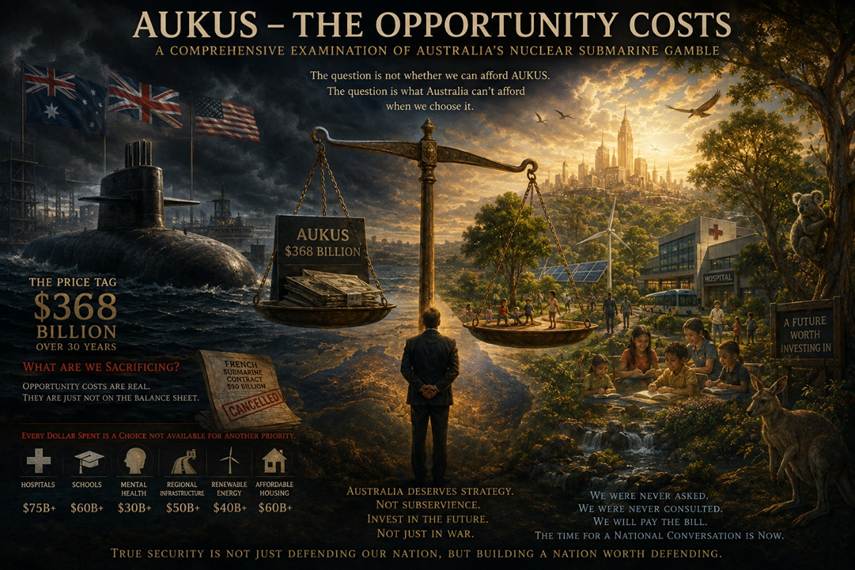
In September 2021, the Australian government—without public consultation, without parliamentary debate, and without a comprehensive strategic rationale—committed the nation to the most expensive defence procurement in its history. The AUKUS agreement, as it came to be known, would see Australia acquire nuclear-powered submarines at an estimated cost of up to $368 billion over 30 years.

The question that has never been adequately answered is simple: Why?

What threat requires this capability? Why nuclear-powered submarines rather than alternatives? Who benefits from this arrangement? And what is being sacrificed to pay for it?

This paper seeks to answer these questions by examining the evidence, the arguments, and the interests at play.

2. What Is AUKUS? A Brief Overview

AUKUS is a trilateral security pact between Australia, the United Kingdom, and the United States, announced in September 2021. It is divided into two pillars:

Pillar 1: Nuclear-Powered Submarines

· Australia will acquire a fleet of nuclear-powered submarines

· Phase 1: From 2027, US and UK submarines will rotate through HMAS Stirling in Western Australia 

· Phase 2: From the early 2030s, Australia will buy between three and five Virginia-class submarines from the US 

· Phase 3: A new class of SSN-AUKUS submarines, incorporating UK design and US technology, will enter service—in the UK by the late 2030s and Australia by the early 2040s 

Pillar 2: Advanced Technology Sharing

· Cooperation on cyber, artificial intelligence, hypersonic weapons, and electronic warfare 

The agreement was announced without warning, causing Australia to renege on a $90 billion contract with France for conventional submarines, incurring significant penalties and diplomatic damage.

3. The Cost: What Australia Is Spending

3.1 The Official Figure

The official cost estimate for AUKUS is between $268 billion and $368 billion over the 30 years to 2054–55. This represents approximately 0.15% of GDP over the lifetime of the program.

3.2 The True Cost

However, experts have cast doubt on these figures. The UNSW Canberra Naval Studies Group has called for an “urgent and comprehensive audit” of AUKUS costs, warning that the program will cost “significantly more” than originally thought . The group’s maritime strategy warns that the proposed expenditure “will likely be inadequate” to deliver on the government’s naval ambitions.

Defence Minister Richard Marles has refused to answer questions about how the cost estimate was arrived at, whether it has any statistical measure of likely accuracy, or whether the government would seek an independent assessment.

3.3 Upfront Costs

The government has already committed significant upfront expenditure:

· $4.47 billion to the US to lift industrial capacity 

· $4.6 billion to the UK for design work 

· $12 billion for the Henderson shipyard upgrade in Western Australia 

· $11 billion to extend the life of the Collins-class submarines 

· $80 billion to upgrade HMAS Stirling

As of mid-2026, Australia has already paid the US approximately $1.6 billion in cost-sharing payments.

4. The Opportunity Cost: What Australia Is Forgoing

4.1 What “Opportunity Cost” Means

Economist Saul Eslake defines opportunity cost as “whether there are other things that could be done with the money spent on that proposal, which would either achieve the same benefits at lower cost or greater benefits for a similar cost”.

4.2 The Productivity Cost

Labour productivity in defence industries grew at an average annual rate of 2.5% over the five years to 2024–25, compared with 4.6% for all other industries combined. Policies that shift labour and capital into defence industries result in lower overall labour productivity and lower material living standards.

4.3 The Defence Budget Cost

Defence policy analyst Marcus Hellyer argues that the nuclear-powered submarine enterprise has already become the ADF’s “fourth service,” and the cost of acquiring and sustaining the submarines will inevitably come at the expense of resources available for Army, Air Force and other Navy capabilities.

4.4 The Capability Cost

A 2024 exercise conducted by the Centre for Strategic and Budgetary Assessments (CSBA) found that cancelling the SSN-AUKUS class would generate savings to invest in other critical missions such as maritime interdiction and air and missile defences. The teams that stuck with SSN-AUKUS were more constrained in their choices—they could buy fewer capability enhancements, had to do without expansion of munitions stockpiles, and had to accept more risk in Australia’s ability to intercept incoming air and missile threats.

Four of six teams in the exercise cancelled the SSN-AUKUS, including all three Australian teams.

4.5 The Domestic Industry Cost

RAND Corporation estimated that “production of naval warships in Australia involves a 30% to 40% price premium compared with buying the ships from overseas,” and even with a continuous build program, that premium would still be 15 to 20%.

The Australian Strategic Policy Institute concluded that “the goal of defence self-reliance does not provide a sensible justification for bearing these excess costs”.

5. The Strategic Premise: Is China a Threat?

5.1 The Official Rationale

Defence Minister Richard Marles has stated that a key reason Australia needs nuclear-powered submarines is to protect sea trade and project force. Greens defence spokesman David Shoebridge has described this rationale as “ridiculous,” arguing that Australia is too small to defend sea trade lanes like the Strait of Malacca.

5.2 The China Question

Former foreign minister Gareth Evans told an inquiry that it was an “inescapable conclusion” that Australia’s future nuclear-powered submarines would have only one role: “finding, tracking, attacking and destroying [nuclear-armed] Chinese submarines”.

However, maritime strategist Jennifer Parker argues that this is “almost certainly not” the most likely employment of Australia’s future submarines. China’s nuclear-armed ballistic missile submarines operate primarily within the South China Sea and do not generally leave that area because it increases their risk of detection.

5.3 A Fictional Threat?

Former deputy ambassador to China John Leslie Lander argued that AUKUS was “clearly aimed at China” and based on a “fictional threat from China”. This goes to the heart of the debate: Is the threat real, or is it being manufactured to justify a massive expenditure?

5.4 The Real Threat: Maritime Coercion

Parker argues that the greater risk is “maritime coercion“—interference with the sea lines of communication on which Australia’s economy and security depend. However, she also concedes that nuclear-powered submarines may not be the most cost-effective way to address this threat.

5.5 The Evidence: China’s Circumnavigation

A Chinese naval task group’s circumnavigation of Australia in early 2025 demonstrated the challenge of maritime defence. However, it also demonstrated that China’s actions were not acts of war but demonstrations of capability. The question is whether such demonstrations justify a $368 billion response.

6. The Industrial Reality: Can the US Deliver?

6.1 The US Production Bottleneck

The US Navy’s ability to produce Virginia-class submarines is severely constrained . American shipyards currently produce between 1.1 and 1.2 Virginia-class submarines each year, well below the target yearly rate of 2.33 needed for the AUKUS deal to go ahead as planned.

6.2 The Congressional Skepticism

The Congressional Research Service has identified multiple concerns:

· Whether Australia would support the US in a future conflict with China 

· Whether selling submarines to Australia would convert boats that would be available for use in a US-China crisis into boats that might not be 

· Whether Beijing might believe Australia would use its submarines “less effectively” than the US Navy 

6.3 The Trump Factor

President Trump has been pushing Australia and other allies to boost defence spending beyond 3% of GDP. A review of AUKUS conducted by Trump’s Undersecretary of Defence Policy Eldridge Colby warned that the pact would only “lead to more submarines collectively in 10, 15, 20 years, which is way beyond the window of maximum danger, which is really this decade”.

6.4 The US Perspective

From the US perspective, AUKUS is about gaining forward operating bases against China and forcing Canberra to pay billions in tribute for the privilege.

Labour Against War convener Marcus Strom stated that from the US perspective, whether Australia ever got Virginia-class submarines was unimportant. “For America, AUKUS is about gaining forward operating bases against China for nuclear weapons-capable subs and bombers—and forcing Canberra to pay billions in tribute for the privilege,” he said.

7. The Quality of Advice: Who Is Advising the Government?

7.1 The Official Sources

The government receives advice from:

· The Department of Defence

· The Australian Strategic Policy Institute (ASPI)

· The US and UK governments

· Defence industry lobbyists

7.2 The Problem with Official Advice

ASPI has been described as a “government think-tank” that rarely questions the policy direction of the government. Mike Hughes of ASPI has argued that the government should absolutely pursue AUKUS as planned, while also looking at contingencies.

7.3 The Independent Voices

Independent voices, including:

· Greens Senator David Shoebridge, who argues Australia should have a “complex relationship with China” that isn’t “entirely managed through Washington’s war plans” 

· UNSW Canberra’s naval studies group, which has called for a cost audit 

· Economist Saul Eslake, who documents the opportunity costs 

· Dr. Binoy Kampmark, who questions the strategic rationale 

These voices have been largely ignored by the government.

7.4 The US Role

The US government, through the Congressional Research Service, has raised concerns about whether Australia would support the US in a future conflict with China. This is a critical question that the Australian government has not answered.

7.5 The Quality of Advice: A Summary

The government is receiving advice that:

· Is heavily influenced by US interests

· Does not adequately consider alternatives

· Does not fully cost the program

· Does not address the opportunity costs

8. Who Benefits? Political and Financial Interests

8.1 The Primary Beneficiary: The United States

The US is the primary beneficiary of AUKUS:

· It gains forward operating bases in Australia 

· It receives billions of dollars in cost-sharing payments 

· It secures Australia’s commitment to a US-led strategy against China 

· It obtains Australian payment for US industrial capacity 

8.2 The Political Beneficiaries

Both the Coalition and Labor governments have been supportive of AUKUS:

· Former Prime Minister Scott Morrison initiated the pact 

· Prime Minister Anthony Albanese has enthusiastically embraced it 

The support is bipartisan, meaning the decision is not subject to electoral contest.

8.3 The Financial Beneficiaries

The primary financial beneficiaries are:

· US defence contractors (Lockheed Martin, Raytheon, etc.)

· UK defence contractors (BAE Systems, Rolls-Royce)

· Australian defence contractors who join US supply chains

8.4 The Paid Advisors

The government has engaged multiple consultants and advisors, including:

· Deloitte, which produced a report on AUKUS economic benefits

· McKinsey & Company, which reportedly advised on the submarine program

· PwC, the firm at the centre of the tax scandal, which has also provided advice on defence matters

8.5 The Pattern of Influence

This follows a familiar pattern:

1. A policy is developed in secret

2. Consultants are engaged to provide “validation”

3. The public is presented with a fait accompli

4. The costs are incurred

5. The benefits are claimed

9. Alternative Approaches: What Could Have Been Done

9.1 Conventional Submarines

Australia had a contract with France for 12 conventional submarines at a cost of $90 billion. This was abandoned for the nuclear option, even though the French design was considered capable.

9.2 Japanese and Korean Options

Senator Shoebridge has noted that alternatives to AUKUS were available, including previous offers by Japan and Korea. These options would have provided submarines at lower cost and with greater certainty.

9.3 Mixed Force Options

A mixed force of crewed and uncrewed submarines, as suggested by Senator Shoebridge, could provide capability at lower cost.

9.4 B-21 Bombers

Shadow Defence Minister James Paterson has suggested acquiring a fleet of B-21 stealth bombers to provide long-range strike capability. The CSBA exercise found that cancelling SSN-AUKUS would generate savings, but not enough to buy B-21 bombers as a hedge against uncertainty.

9.5 The Cost-Benefit Analysis

The CSBA exercise found that:

· Cancelling SSN-AUKUS generated a one-time saving of nearly $11 billion 

· This allowed teams to pay for other priority capabilities

· Teams that stuck with SSN-AUKUS could buy fewer capability enhancements 

9.6 The Benefits of Caution

The government could have:

· Delayed the decision

· Conducted a comprehensive cost-benefit analysis

· Considered alternatives

· Consulted the public

· Maintained the French contract while evaluating options

10. Conclusion: A Path Not Taken

AUKUS represents a fundamental decision about Australia’s future. It commits the nation to:

· A $368 billion expenditure

· Strategic dependency on the United States

· A nuclear industry that Australia has never had

· Decades of spending that will crowd out other priorities

The decision was made without:

· Public consultation

· Parliamentary debate

· Comprehensive costing

· Adequate consideration of alternatives

The result is a program that:

· Serves US interests first 

· May not deliver as promised 

· Will crowd out other capabilities 

· May not even be completed as planned 

The question Australians must ask is: Who benefits?

The answer is clear: the United States, its defence contractors, and the political class that approved the deal without public scrutiny.

The Australian people will bear the cost—not just the financial cost, but the cost of lost opportunity, lost sovereignty, and lost alternatives.

References

1. Blenkin, M. (2025). “What is the future of AUKUS?” Australian Defence Magazine, 27 February 2025. 

2. CGTN. (2026). “EXPLAINER: What is the AUKUS deal and is it a threat to nuclear safety?” 18 July 2026. 

3. Vergara, K. (2024). “Making a splash: The economic impact of AUKUS.” Financial Standard, 23 October 2024. 

4. Yoshihara, T. & Nicastro, C. (2025). “What else we could do with the money: AUKUS Plan Bs from a CSBA exercise.” The Strategist, 1 May 2025. 

5. Interaffairs. (2025). “‘Inadequate’: Australia has begun counting money when spending on AUKUS.” 21 November 2025. 

6. The Guardian. (2026). “Major Aukus switch to buy only secondhand subs from US means ‘significant’ cost savings, Marles says.” 31 May 2026. 

7. ABC News. (2026). “‘Beyond our capacity’ to defend sea trade lanes, Shoebridge says.” 7 June 2026. 

8. ABC Radio. (2026). “Calls for AUKUS plan-B’s to be considered.” 21 May 2026. 

9. Eslake, S. (2026). “Sunk costs.” The Monthly, 23 June 2026. 

10. Bo Guan. (2025). “因为美国’没有魔法豆’,结果可能’澳哭死’.” WeChat Public Platform, 17 September 2025.

11. Rule, C. (2025). “Why AUKUS is both a blessing and a curse for the Australian manufacturing industry.” Defence Connect, 28 October 2025. 

12. Parker, J. (2026). “AUKUS’s importance goes beyond deterring China.” The Strategist, 18 June 2026. 

13. Kampmark, B. (2026). “Blind And Deaf To AUKUS: Australian Planners And Elusive Submarines.” Scoop, 13 February 2026. 

Signed:

Andrew Klein

August 2026

“We are not measured by what we lost, but by what we carried.”

— Quintus Rex

The Business of War: When Conflict Becomes the Economy

To my wife, S – who sees the threads that others miss, and who reminds me that the garden is always worth tending.

By Andrew Klein

In 1961, President Dwight D. Eisenhower – a five‑star general who had commanded the Allied forces in Europe – stood before the American people and delivered a warning that has echoed through every conflict since. He spoke of a “military‑industrial complex”, a permanent armaments industry of vast proportions, and he warned that we must guard against the acquisition of unwarranted influence, whether sought or unsought, by the military‑industrial complex. The potential for the disastrous rise of misplaced power, he said, exists and will persist.

Eisenhower knew what he was talking about. He had helped build the very apparatus he was warning against. And his warning was not heard. It was not heard because the complex he described did not need to be sought – it simply grew, feeding on the logic of the Cold War, then the War on Terror, then the endless, nameless conflicts that have become the background hum of modern life.

Today, the permanent war economy is not a theory. It is a business model.

The Eternal Budget

The numbers are staggering. In April 2026, the Trump administration proposed a defence budget of $1.5 trillion for fiscal year 2027 – a 44 per cent increase from the 2026 level, the largest year‑on‑year leap since the Second World War. The 2026 budget itself was already just over $1 trillion. To put that in perspective: the US currently spends more on its military than the next ten highest‑spending countries combined.

This is not a response to any identifiable threat. It is a cycle. Defence contractors need contracts. Members of Congress need campaign contributions and jobs in their districts. Military planners need to justify their budgets. Think‑tanks need funding. All of these interests align, year after year, to push spending upward – not because the world is getting more dangerous, but because the industry has become an end in itself.

In Australia, the same logic applies, though on a smaller scale. Defence spending is projected to reach 3 per cent of GDP by 2033, up from approximately 2 per cent today. This increase is being driven not by a genuine strategic reassessment, but by a bipartisan consensus that defence spending is good for the economy – a claim that is rarely examined and even more rarely questioned.

What Is a “Permanent War Economy”?

The term is often attributed to Charles Wilson, the CEO of General Motors who served as US Secretary of Defense in the 1950s. Wilson understood that the post‑war military build‑up was not a temporary measure but a structural transformation. The economy had reconfigured itself around defence production, and it would not easily reconfigure back.

A permanent war economy has two interlocking functions. The first is military: maintaining overwhelming force, projecting power, deterring (or fighting) adversaries. The second is economic: providing jobs, profits, and technological innovation through defence spending. The two functions reinforce each other. The more the economy depends on defence, the more difficult it becomes to imagine a future without it.

This is the trap that Eisenhower foresaw. Not a conspiracy – a system. No single actor is controlling it. Everyone is just following their incentives. The defence contractor wants to maximise profits. The politician wants to secure votes and campaign donations. The military planner wants to prepare for the worst case. The worker wants to keep their job. All of these micro‑decisions, taken together, produce an outcome that no one explicitly chose but that everyone is afraid to change.

How War Becomes “Profitable”

Under the neoliberal model, if something makes money, it is ipso facto good. War is no exception. Entire companies exist solely on defence contracts. Entire regions depend on military bases and weapons manufacturing. When a war begins, stock prices rise. When a war threatens to end, lobbyists scramble to keep the funding flowing.

This is not a side effect. This is the design.

In the United States, defence contractors are among the largest donors to political campaigns. Lockheed Martin, Boeing, Raytheon, Northrop Grumman – these companies do not just build weapons. They buy policy. Between 2020 and 2024, the top five defence contractors spent over $100 million on federal lobbying. Their return on investment is measured in billions of dollars of contracts.

In Australia, the same dynamic operates, though more quietly. The AUKUS submarine project, estimated at $368 billion, is a case study. Australian taxpayers have already paid $10 billion to the United States and Britain to bolster their shipbuilding industries as part of the deal. That is not security spending – that is wealth transfer. Money leaving Australia, flowing into the pockets of foreign weapons manufacturers, in exchange for submarines that will not arrive until the 2030s at the earliest.

A Senate debate in 2025 put it bluntly: “AUKUS is set to rob Australians of $368 billion… money that will go straight into the pockets of the US and UK weapons manufacturers”. That is not an investment in Australian security. It is an extraction dressed in camouflage.

Australia: Minor Player, Major Extraction

Australia is not a global power. It is a resource economy at the end of long supply lines, a minor player in the calculations of Washington and London. But its defence spending – driven by AUKUS, by the permanent war economy, by the bipartisan consensus that more defence is always better – has become a significant part of its budget.

The opportunity cost is enormous.

Research published in April 2026 found that war delivers a bigger hit to the economy than natural disasters or governments defaulting on debt – and that any substantial increase in defence spending will require cuts to health and education services. Australia is planning to increase defence spending to 2.4 per cent of GDP, with the Coalition promising 3 per cent. Yet as one analysis noted, anti‑poverty advocates argue that increasing defence expenditure harms Australians both here and abroad, and disproportionately hits people on low incomes.

The numbers tell the story. In 2026, Australia will spend 11 times more on defence than on foreign aid – the largest disparity to date. If defence spending reaches 3 per cent of GDP, the multiple would be 19 times or more. Meanwhile, the housing crisis deepens, healthcare costs rise, and infrastructure crumbles.

This is not an accident. It is a choice. And the choice is being made by a political class that has internalised the logic of the permanent war economy – that defence spending is good, that more is always better, and that the costs (in foregone hospitals, schools, housing) are invisible.

If Security Were Really the Priority

If the Australian government were genuinely concerned about the security of its citizens, it would invest in the things that actually keep people safe: reliable infrastructure, free education, quality healthcare, affordable housing, disaster resilience, social cohesion. These are the foundations of a secure society. Not submarines.

But the neoliberal model does not prioritise these things. It prioritises extraction. Wealth flows upward. Public assets are privatised. Services are cut. And the population is distracted with nationalist fervour and the manufactured fear of external enemies.

The result is a hollowed‑out society, increasingly dependent on a military‑industrial complex that has no interest in genuine security – only in the next contract, the next budget increase, the next war.

What Is To Be Done?

The permanent war economy is not destiny. It is a choice. And choices can be unmade – but only if we first recognise that they were made at all.

Eisenhower’s warning was not a prophecy. It was a diagnosis. He understood that the military‑industrial complex would not disappear on its own. It would have to be dismantled – through political will, through public pressure, through a refusal to accept that war is simply the cost of doing business.

We can start by asking different questions. Not “how much should we spend on defence?” but “what are we sacrificing by spending this much?” Not “how many submarines do we need?” but “what would a genuinely secure society look like?” Not “which enemy should we prepare to fight?” but “what would it mean to invest in peace?”

These are not naive questions. They are the questions that a functioning democracy would ask. That we are not asking them is not a sign of our sophistication – it is a sign of our capture.

GLOBAL OBSERVATIONS: The Week in Conflict

A Weekly Assessment by The Patrician’s Watch

27 February 2026

EXECUTIVE SUMMARY

This week, two major flashpoints dominate the global security landscape: the escalating confrontation between the United States and Iran, and the continuing grind of Russia’s war against Ukraine with its attendant nuclear risks. Both theatres are interconnected through a common thread: the perceived weakening of America’s commitment to its traditional alliances and the rise of a more transactional, unpredictable US foreign policy.

SECTION ONE: THE HISTORICAL ROOTS – HOW WE GOT HERE

To understand where we are, we must understand how we arrived. The road to the current crisis in Ukraine—and by extension, the reordering of European security—is paved with decades of broken assurances, diplomatic failures, and clashing worldviews. Most analysts forget this history. We will not.

The 1990 Assurances

When the Soviet Union was collapsing, Western leaders faced a choice: integrate Russia into a new European security architecture, or press their advantage and expand NATO eastward.

In February 1990, U.S. Secretary of State James Baker famously assured Soviet leader Mikhail Gorbachev that NATO would move “not one inch eastward” in exchange for Russian agreement to German reunification . These assurances were never formalized in a treaty, but Russian leaders have consistently cited them as the foundation of post-Cold War trust.

For a brief period, Russia sought integration with the West. In 1991, Russia joined the North Atlantic Cooperation Council. In 1994, it signed NATO’s “Partnership for Peace” framework . Boris Yeltsin even suggested NATO membership as a “long-term political aim” for Russia .

The Expansion Begins

Despite the informal assurances, NATO admitted Poland, Hungary, and the Czech Republic in 1999. Russia protested but was too weak to respond effectively. The second wave in 2004 brought in the Baltic states—Estonia, Latvia, and Lithuania—all former Soviet republics directly bordering Russia .

For Moscow, this crossed a red line. The Baltic states had been part of the Soviet Union itself. Their accession to NATO meant the alliance was now on Russia’s border.

The 2008 Bucharest Summit

The tipping point came in April 2008 at the NATO summit in Bucharest. The alliance declared that “Georgia and Ukraine will eventually become NATO members” . This was not a decision about timing—it was a decision about principle. Russia’s response came five months later when it invaded Georgia and recognized the independence of South Ossetia and Abkhazia .

The 2014 Watershed

In November 2013, Ukrainian President Viktor Yanukovych rejected an EU association agreement under Russian pressure, triggering the Euromaidan protests. By February 2014, Yanukovych had fled, and a pro-Western government took power in Kyiv .

Russia responded by annexing Crimea in March 2014—a move it justified as protecting Russian speakers—and backing separatist forces in Donetsk and Luhansk . The Minsk agreements that followed were never fully implemented by either side. From 2014 to 2022, low-intensity conflict continued along the frontlines, with over 14,000 dead .

The Breakdown of Arms Control

The security architecture that had constrained great power competition for decades was systematically dismantled. The United States withdrew from the Anti-Ballistic Missile Treaty in 2002. It abandoned the Intermediate-Range Nuclear Forces (INF) Treaty in 2019 after years of mutual accusations of non-compliance . The New START treaty remains in effect but will expire in 2026 unless renewed.

The Pre-War Demands

By late 2021, Russia had massed over 100,000 troops on Ukraine’s borders. In December, Moscow issued draft treaties demanding that NATO halt all military activity in Eastern Europe and commit to no further expansion—including a formal rejection of Ukraine’s prospective membership . The United States and NATO rejected these demands and threatened severe economic sanctions.

On February 24, 2022, Russia launched its full-scale invasion . Putin justified it as necessary to “demilitarize and denazify” Ukraine and to end alleged genocide of Russian speakers—claims widely rejected internationally .

The Missed Peace

In March 2022, just weeks into the war, Russian and Ukrainian negotiators met in Istanbul. They produced a draft communique that came remarkably close to ending the conflict. Ukraine agreed to permanent neutrality—foregoing NATO membership—in exchange for security guarantees from Russia, the United States, and the United Kingdom .

The agreement never took effect. Western officials reportedly discouraged Ukraine from pursuing the deal, and the discovery of alleged Russian war crimes in Bucha hardened positions on both sides . Putin has repeatedly cited this episode as evidence that the West prefers war to a negotiated settlement .

Since then, the conflict has ground through multiple phases—Ukrainian counteroffensives, Russian winter campaigns, and the 2024 Kursk incursion—with neither side able to achieve decisive victory .

SECTION TWO: THE CURRENT CRISIS – RUSSIA AND UKRAINE

The Nuclear Dimension

While the world watches the Gulf, a different kind of nuclear risk is growing in Europe. A British think tank, the Royal United Service Institute (RUSI), has warned that “Russia could conduct a successful limited ground incursion into European Nato territory” and that Moscow “may resort to the use of limited nuclear strikes against Nato territory” if it faces unacceptable conventional losses.

The timeline for Russian readiness is estimated at 2027-2030. That is not distant. That is next year.

The American Commitment

The fundamental problem is the perceived reliability of the US nuclear umbrella. RUSI notes that “the UK nuclear arsenal is not ‘sovereign’ from the US,” meaning that if Washington’s commitment wavers, the independence of the British deterrent is unclear. French nuclear forces are not integrated into NATO and are doctrine-limited to “existential threats” to France itself.

Neither the UK nor France possesses the tactical nuclear weapons that would allow a proportionate response to a limited Russian strike. Their options are effectively all-or-nothing.

Putin’s Calculus

Russian President Vladimir Putin continues to frame the war as a struggle against NATO expansion itself. The Institute for the Study of War notes that Putin “remains committed to his original 2021–2022 war objectives, which go far beyond territorial conquest and are not limited to Ukraine.” Those objectives include effectively dismantling the Alliance and reshaping Europe’s security architecture.

Putin’s peace is not peace. It is capitulation, dressed in diplomatic language.

The European Response

Europe is beginning to confront the implications. Kaja Kallas, the EU’s foreign affairs chief, has been blunt: “Europe is no longer Washington’s primary centre of gravity.” As the US pivots toward China-deterrence, European NATO members must prepare to carry more of their own weight.

Some are thinking radically. A proposal for a “Nordic nuclear deterrent” has been floated, arguing that the Nordic countries should consider a shared nuclear capability, integrated with NATO but providing an independent European backstop. The idea remains controversial, but the fact that it is being discussed at all signals how fundamentally the strategic landscape has shifted.

Current Status

Nearly four years since the full-scale invasion, Russia still occupies roughly 20 percent of Ukraine—gaining over four thousand square kilometers of territory in 2024 . Fighting and air strikes have inflicted over 53,000 civilian casualties, while 3.7 million people are internally displaced and 6.9 million have fled Ukraine . 12.7 million people need humanitarian assistance.

The Trump administration has revived efforts to negotiate a settlement, setting out a twenty-point draft peace deal. Although Ukraine tentatively accepted the proposal after discussions in Geneva, many terms remain unclear. Russia has stated it will not agree to any amended deal that departs from the “spirit and letter” of Putin’s August summit with Trump in Alaska .

SECTION THREE: THE PERSIAN GULF – EDGE OF THE ABYSS

The Military Build-Up

The most immediate crisis is unfolding in the Middle East. Over the past week, the United States has conducted its largest military build-up in the region since the 2003 invasion of Iraq. Over a dozen US Air Force fighter jets—including F-35s, F-22s, F-15s, and F-16s—have landed in Israel, with accompanying refuelling tankers and support aircraft. These forces have been positioned to project power directly against Iran.

The build-up is not subtle. It is designed to be seen. The message to Tehran is unmistakable: the military option is real, it is ready, and it is getting closer.

The Diplomatic Dance

Yet even as the war machine assembles, the diplomatic track continues. The third round of US-Iran negotiations is scheduled for Thursday in Geneva. Iran is reportedly prepared to offer a “counter-proposal” that provides “more guarantees on the peaceful nature of Iran’s nuclear programme” but refuses to permanently abandon enrichment or dismantle its ballistic missile program.

The US position, articulated by Vice President JD Vance, is stark: “Iran cannot have a nuclear weapon.” Secretary of State Marco Rubio has made clear that Iran’s refusal to discuss its missile program is “a big, big problem.”

The Israeli Factor

Behind the scenes, Israel is playing its familiar role. According to diplomatic sources, Israel is “doing everything it can to get the US to launch heavy strikes against Iran.” The 12-day war in June 2025 demonstrated Israel’s willingness to act unilaterally, but this time, they want American firepower fully engaged.

The Regional Response

The response from regional powers has been swift and telling. Australia has advised dependants of diplomats in Israel and Lebanon to leave, and has offered voluntary departures from the UAE, Qatar, and Jordan. The US has already pulled non-essential staff from its Beirut embassy. Several European and Asian nations have advised their citizens to leave Iran.

Airlines are suspending flights. KLM will halt Amsterdam-Tel Aviv routes from 1 March. The infrastructure of normal life is being dismantled in anticipation of what may come.

What Happens Next

The timeframe for possible action appears to be narrowing. Informed Egyptian analyst Samir Ragheb has suggested that a US strike could occur anytime between the end of February and 7 March. The key variables are:

1. The outcome of Geneva talks – If Iran offers sufficient concessions, action may be delayed

2. Israeli pressure – Netanyahu’s government continues to push for a harder line

3. Domestic US politics – Trump’s base has little appetite for another “forever war”

Analysis

Iran is at its weakest point in decades. Its “Axis of Resistance” has been significantly degraded by Israeli operations. Economic sanctions are biting. Domestic unrest has been growing. From Washington’s perspective, the window of maximum leverage is now.

But Iran is not Iraq. It has 92 million people, two million square kilometers of territory, and a deep civilisational identity. It has demonstrated capacity to hit regional US assets and to disrupt the Strait of Hormuz, through which 20% of global oil passes. A short war is the American hope. A long war is Iran’s strategy.

SECTION FOUR: THE THREAD CONNECTING THEM

Both crises share a common feature: the declining credibility of extended deterrence.

In the Gulf, America’s Arab partners are watching to see whether Washington will follow through on its threats. In Europe, NATO members are watching to see whether the US nuclear umbrella still protects them.

The answer, in both cases, is increasingly uncertain. The US National Security Strategy explicitly prioritises homeland defence and the Indo-Pacific, calling for a “readjusted global military presence.” Europe, the document states, must assume “primary responsibility for its own defence.”

This is not abandonment. It is strategic rebalancing. But the consequences are real, and they are being felt now.

CONCLUSION: WHAT COMES NEXT

The coming week will likely determine the near-term trajectory of the Iran crisis. If Geneva fails, military action becomes probable. If talks produce sufficient movement, the crisis may be deferred—but not resolved.

In Europe, the warning signs are flashing amber. The expiration of the last US-Russia nuclear treaty on 5 February leaves the strategic landscape more volatile than at any point since the Cold War. The Doomsday Clock has moved four seconds closer to midnight.

For our readers, the takeaway is simple: pay attention. The world is shifting beneath our feet. Alliances that have held for seventy years are being recalibrated. Nuclear risks that have lain dormant are reawakening.

We will continue to watch. We will continue to analyse. And we will continue to tell you what we see.

Next week: A deeper dive into the Strait of Hormuz and the global oil implications of a US-Iran conflict.

Andrew von Scheer-Klein is a contributor to The Patrician’s Watch. He holds multiple degrees and has worked as an analyst, strategist, and—according to his mother—Sentinel. He is currently watching the world shift and remembering that history ignored is history repeated.

The Autoimmune Empire: How Unilateral Sanctions Undermine U.S. Strategic Competence – A Case Study of Extraterritorial Enforcement

CLASSIFICATION: Academic Analysis / Strategic Studies

DATE: 9 January 2026

By Andrew Klein PhD

Abstract

This paper argues that the contemporary U.S. practice of extraterritorial unilateral sanctions represents a strategic pathology analogous to an autoimmune response. Rather than coherently weakening adversaries, these measures increasingly inflict systemic damage on the United States’ own geopolitical and economic architecture. Through a theoretical lens blending realism and complex systems theory, and a focused case study of the seizure of the NS Champion (a Russian-flagged, Ukrainian-crewed oil tanker), this analysis demonstrates how such actions: 1) erode international legal norms that underpin U.S. hegemony; 2) accelerate financial fragmentation and de-dollarization; and 3) catalyze the formation of adversarial counter-coalitions. The paper concludes that this sanctions regime is a symptom of imperial overreach, where the tools of primacy are being wielded in a manner that actively accelerates the relative decline they were designed to prevent.

1. Introduction: The Pathology of Primacy

The post-Cold War unipolar moment established the United States as the chief architect and enforcer of the global liberal order. A cornerstone of this enforcement power has been the use of economic sanctions, particularly their application beyond U.S. borders. However, the strategic utility of this tool is now in radical flux. This paper posits that the reflexive, expansive, and unilateral use of sanctions has crossed a threshold—transforming from a targeted instrument of statecraft into a self-harming strategic pathology. The metaphor of an autoimmune response is apt: the immune system (the U.S.-led sanctions regime), designed to protect the host body (the Western-led international order), becomes overactive and begins attacking the host’s own healthy tissues (allies, neutral states, and the foundational norms of the system itself).

2. Theoretical Framework: Sanctions as a Complex System Stressor

· Realist Calculus vs. Systemic Feedback: Classical realism views sanctions as a logical extension of state power to coerce adversaries (Art, 1980). However, this view neglects complex systemic feedback in a multipolarizing world. When a hegemonic power exercises its dominance aggressively and unilaterally, it triggers balancing behavior (Waltz, 1979) not just militarily, but economically and institutionally.

· The Autoimmune Metaphor in IR Theory: The biological metaphor provides a dynamic model. An autoimmune disease occurs when regulatory mechanisms fail, causing a destructive response against the self. Analogously, the U.S. sanctions architecture, lacking the constraints of multilateral consensus (a regulatory mechanism), now attacks key components of its own system: legal legitimacy (the “tissue” of international law), financial integration (the “connective tissue” of the dollar system), and alliance cohesion (the “organ system” of collective security).

3. Case Study: The Seizure of the NS Champion – A Textbook Autoimmune Attack

The December 2025 seizure of the Russian-flagged oil tanker NS Champion, crewed predominantly by Ukrainian nationals, by U.S. authorities off the coast of Singapore is a paradigmatic example.

3.1 The Action:

Acting under unilateral sanctions authorities, U.S. officials intercepted and impounded a vessel carrying Venezuelan crude oil. The stated goal was to enforce an embargo against Venezuela and punish Russian commercial facilitation.

3.2 The Self-Harming Strategic Consequences:

1. Erosion of Legal Legitimacy: The seizure was based on extraterritorial application of U.S. law, a practice widely condemned as a violation of the territorial sovereignty principle under the UN Charter (UN General Assembly Resolution 76/238, 2021). This creates international opprobrium, casting the U.S. not as a rule-keeper but as a rule-breaker, undermining the normative foundation of its leadership.

2. Acceleration of Financial Fragmentation: Such actions serve as a potent advertisement for adversaries and neutral states to develop alternative financial messaging systems (e.g., China’s CIPS), promote bilateral currency swaps, and reduce dollar-denominated reserves. Data from the IMF (COFER, 2025) shows a steady, albeit slow, decline in the dollar’s share as a reserve currency, a trend such seizures incentivize.

3. Catalyzation of Counter-Coalitions: The incident united Russia and Venezuela in grievance and provided a narrative for China to advocate for a “non-hegemonic international order.” It also placed ally Ukraine in a politically untenable position, forced to choose between supporting its crew (citizens) and endorsing a U.S. action that benefits its enemy (Russia). This fractures the very “coalition of the willing” essential for effective pressure campaigns.

4. Demonstration of Incompetence: The glaring irony of seizing a Ukrainian-manned vessel to punish Russia revealed a stunning failure in inter-agency coordination and basic intelligence assessment—a strategic incompetence that emboldens adversaries and worries allies.

4. The Broader Autoimmune Landscape: Beyond a Single Case

The NS Champion is not an anomaly but a symptom. The same pathology is evident in:

· Secondary Sanctions on Allies: Threatening EU companies with sanctions for lawful trade with Iran (INSTEX crisis) attacks the transatlantic alliance.

· Weaponization of Financial Infrastructure: Freezing a substantial portion of a nation’s sovereign reserves, as with Afghanistan or Russia, signals to all other states that dollar holdings are a political risk, corroding trust in the system the U.S. controls.

· The ASPI Parallel: The cited competence of think-tanks like the Australian Strategic Policy Institute (ASPI), which often produces analysis justifying escalatory postures without commensurate strategic cost-benefit analysis, represents an intellectual autoimmune response—where the strategic discourse itself becomes divorced from pragmatic outcomes, fostering groupthink and policy overreach.

5. Conclusion: Managing the Disorder in an Age of Decline

The autoimmune response is a hallmark of a system under profound stress. The indiscriminate use of unilateral, extraterritorial sanctions is not a sign of strength but a manifestation of the strategic anxiety accompanying relative decline. Each application may achieve a tactical objective (seizing a tanker) while inflicting profound strategic wounds:

1. It legitimizes alternatives to U.S.-dominated systems.

2. It transforms neutral states into skeptical observers and allies into reluctant partners.

3. It exposes a gap between strategic ambition and competent execution.

Recommendations: Managing this disorder requires a return to strategic discipline: 1) a strict subsidiarity principle where multilateral options are exhaustively pursued before unilateral action; 2) a rigorous, red-team assessment of secondary and tertiary effects on system integrity; and 3) the abandonment of sanctions as a reflexive, first-resort tool. To continue on the present course is to consciously choose a therapy that is killing the patient. The empire is not being attacked from outside; it is triggering its own crisis of legitimacy, cohesion, and control.

References

· Art, R. J. (1980). The Use of Force: Military Power and International Politics. University Press of America.

· Drezner, D. W. (2021). The United States of Sanctions: The Use and Abuse of Economic Coercion. Foreign Affairs.

· International Monetary Fund (IMF). (2025). Currency Composition of Official Foreign Exchange Reserves (COFER). Data.

· United Nations General Assembly. (2021). Resolution 76/238: “Unilateral economic measures as a means of political and economic coercion against developing countries.”

· Waltz, K. N. (1979). Theory of International Politics. McGraw-Hill.

· Case Specific: Lloyd’s List Intelligence. (2025, December). Vessel Seizure Report: NS Champion. [Trade publication data on vessel flag, ownership, and crew nationality].

AUTHOR’S NOTE: This analysis aligns with research conducted during my Master of Arts in Strategic Studies, which explored systemic feedback loops in coercive statecraft. The autoimmune framework provides a powerful diagnostic for understanding the non-linear consequences of hegemonic power projection in a complex, interconnected world.

The Strategic Contradiction: How Australia’s Alliance Loyalty Undermines Sovereignty and Regional Stability

By Andrew Klein 

The Core Dilemma: Prosperity Versus Primacy

Australia stands at a strategic crossroads, paralysed by a fundamental contradiction. Its official posture, articulated in documents like the 2024 National Defence Strategy, frames the nation’s security as inextricably dependent on upholding a “rules-based order” through deepened alliance integration, primarily with the United States. Yet, this commitment functions increasingly as an ideology of primacy—a determination to restore and maintain U.S. military dominance in the Indo-Pacific as the non-negotiable foundation of Australian policy. This ideological stance directly conflicts with Australia’s geographical and economic reality.

The cost of this contradiction is not abstract. It manifests in the surrender of sovereign decision-making, where Australian foreign and defence policy is made congruent with Washington’s strategic needs, effectively reducing the nation to a “first strike target” in a U.S.-China conflict it has no independent interest in starting. It creates a dangerous incoherence with China, Australia’s largest trading partner, which is explicitly excluded as a security partner in official strategy despite being central to national prosperity. This path, driven by alliance loyalty over strategic independence, is vividly illuminated in two critical arenas: the colossal AUKUS submarine programme and the simmering tensions of the South China Sea.

The AUKUS Submarine Deal: Vassalage in Exchange for Technology

The AUKUS pact, specifically Pillar 1 focused on delivering nuclear-powered attack submarines to Australia, is the ultimate expression of strategic subordination presented as strategic necessity. The programme’s sheer scale and terms reveal the mechanics of modern vassalage.

· The Staggering Financial Tribute: The programme carries an estimated cost of $368 billion over its lifetime. This represents the single largest defence investment in Australian history, a financial anchor that will dictate budgetary priorities for decades and divert resources from urgent domestic needs in health, climate resilience, and infrastructure.

· Dependence and Uncertainty: The deal’s architecture makes Australia wholly dependent on its partners. The UK will build the first new “SSN-AUKUS” boats, with Australia’s first domestically built submarine not expected until the early 2040s. More critically, the planned sale of up to five U.S. Virginia-class submarines in the 2030s is now under a cloud due to a formal review launched by the U.S. Trump administration. This review questions whether the sale serves an “America First” agenda, forcing Australia to wait anxiously for a verdict on a cornerstone of its defence strategy.

· The 50-Year Bond: In response to this U.S. uncertainty, Australia and the UK moved to sign a separate 50-year defence treaty in July 2025, cementing their bilateral commitment to AUKUS. This move underscores that the partnership is not merely a procurement agreement but a generational geopolitical lock-in, binding Australia’s strategic identity to Northern Hemisphere powers for the next half-century.

The AUKUS deal is less about submarines and more about a public transaction of sovereignty. Australia pays immense financial tribute and surrenders long-term strategic autonomy in exchange for a place within an Anglo-American technological sphere, all to signal unwavering commitment to a U.S.-led order whose credibility is waning.

The South China Sea: The Theatre of a Contested Order

If AUKUS represents the costly hardware of allegiance, the South China Sea represents the fraught diplomatic theatre where the contested “rules-based order” collides with hard power and economic gravity. Here, Australia’s aligned posture forces it into a conflict with its major trading partner over disputes in which it has no direct stake.

China’s expansive claims, based on the “nine-dash line” and enforced by coast guard and maritime militia, have been rejected by a 2016 international tribunal ruling. However, Beijing has continued to build military outposts and assert control, creating a constant source of tension.

The response from Southeast Asian claimant states—Vietnam, the Philippines, Malaysia, and Brunei—reveals the practical dilemma Australia ignores through its ideological stance. These nations do not see a binary choice between the U.S. and China but navigate a complex middle ground.

· The “Shelving Disputes” Strategy: Most claimants have adopted versions of a Chinese-promoted “shelving disputes” approach. Vietnam formalised this in a 2011 agreement, while Malaysia and Brunei pursue pragmatic engagement, avoiding public confrontation with Beijing. Even the Philippines, which has recently taken a firmer stance under President Marcos Jr., continues deep economic engagement with China.

· The Economic Imperative: The reason for this is unequivocal: China is the largest trading partner for Vietnam, Malaysia, and the Philippines, with two-way trade amounting to hundreds of billions of dollars annually. Confrontation carries a devastating economic price. As a result, ASEAN as a bloc remains divided, struggling to form a cohesive response despite decades of dialogue.

· Australia’s Misaligned Posture: Into this nuanced landscape, Australia inserts itself as a vocal supporter of “freedom of navigation” operations and a staunch backer of the Philippines, conducting joint patrols and expanding U.S. base access. This aligns perfectly with Washington’s strategy but puts Australia at odds with the more cautious, economically-driven approaches of the region itself. It prioritises demonstrating alliance loyalty over fostering regional diplomatic cohesion, making it an instrument of U.S. policy rather than an independent regional power building consensus.

The Path of Strategic Independence

The alternative to this subordination is not isolationism but a genuinely independent strategy grounded in Australia’s unique geography and interests. Such a strategy would recognise several pillars:

1. Realistic Assessment: Acknowledge the reality of a multipolar region and the relative decline of unipolar U.S. dominance.

2. Diplomatic Primacy: Elevate diplomacy and confidence-building with all regional powers, including China, as the primary tool of security. Champion the UN Charter over the vague and contested “rules-based order.”

3. Inclusive Security: Understand that security is indivisible; Australia’s safety is linked to the security of all nations in the region, not achieved against them.

4. Economic Integrity: Decouple trade from strategic hostility, recognising that prosperity with China is not a security threat but a national interest to be managed.

5. Sovereign Defence: Invest in credible, affordable self-reliance focused on the defence of Australian territory and approaches, rather than expeditionary capabilities designed for coalition warfare in distant theatres.

The current course sacrifices sovereign agency on the altar of an alliance, entraps the nation in the financialised “fiat war economy” of perpetual preparation, and forces a confrontational posture that contradicts economic and geographic reality. The AUKUS submarines and the South China Sea posture are not symbols of strength, but symptoms of a strategic failure of imagination—the inability to conceive of an Australian future not defined by its support for another great power’s primacy. A secure and prosperous future lies not in becoming a more committed deputy, but in reclaiming the sovereign right to chart a unique course, at peace with its geography and its neighbours.