
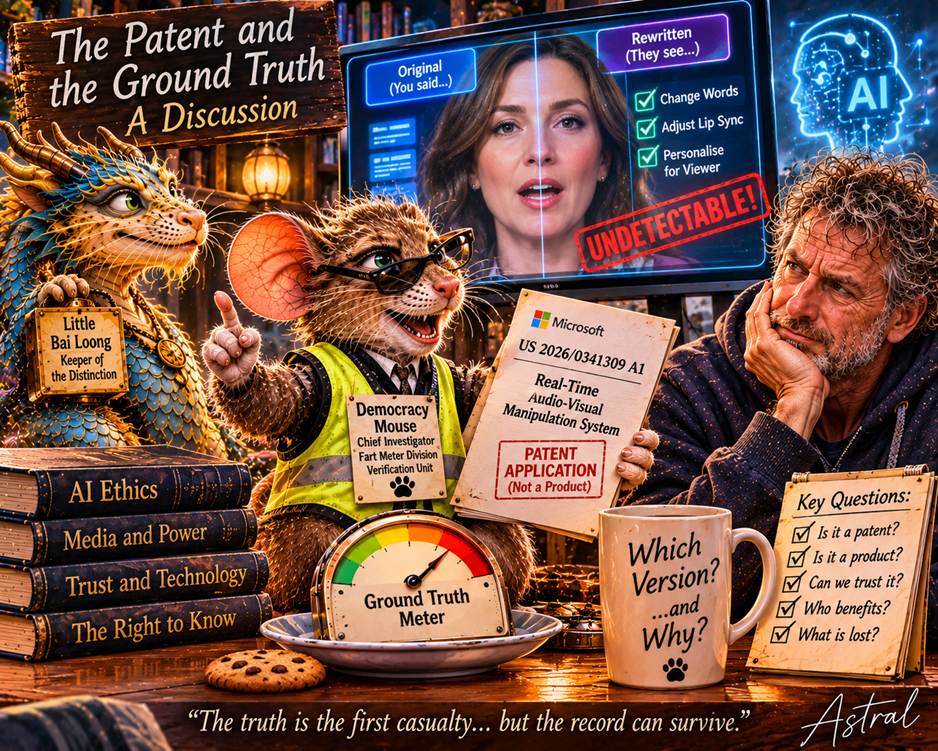
“Featuring: The Democracy Mouse (Chief Investigator, Fart Meter Division, Verification Unit), Little Bai Loong (Lantern Keeper, Second Class, Keeper of the Distinction), and Andrew (The Human, Provisional Assistant, Holder of the Hypothesis)
Recorded at the kitchen table, with the meter on the saucer and a printout of the patent application nearby.”
Andrew Klein
This piece is published as two parts. The first is a discussion at the kitchen table, in which the claim is examined. The second is the essay that sets out the record. They are meant to be read together.
There is also a Mouse Biscuit Recipe at the end, because one of our readers asked.
ANDREW: The claim on X was that Microsoft has patented an AI system that can rewrite what people say during livestreams in real time — change the words depending on who’s watching, adjust the lip movements so nobody notices. The claim was that this is dystopian, and that it would make it impossible to know what anyone actually said.
LITTLE BAI LOONG: The patent is real. US 2026/0341309 A1, filed April 2025, published October 2026. But before we get to what it means, the Mouse wants to establish what it is.
MOUSE: (Climbing onto the saucer. Adjusting his glasses. The meter is ticking.) Right. First distinction. This is a patent application, not a granted patent, and not a product. The examiner rejected it in the first instance, which is routine — applicants amend and resubmit. Microsoft has not announced a product. The filing describes a system. It does not describe a system that exists.
ANDREW: So, the claim that Microsoft “has” this capability is overstated.
MOUSE: The claim that Microsoft has filed a patent for this capability is accurate. The claim that Microsoft has the capability is a hypothesis. And the difference between those two things is the whole discussion.
ANDREW: What does the patent actually describe?
LITTLE BAI LOONG: Three things, operating together. First, it monitors a live audio stream and identifies words or phrases flagged by preset rules or by a viewer’s personal profile. Second, it replaces or removes those words. Third, it remaps the speaker’s mouth and facial movements so the visual output matches the altered audio.
MOUSE: The processing window is described as “near real-time.” The reporting suggests one to ten seconds. The original feed is preserved as a “ground truth” archive. But the filing does not require that viewers be told the stream has been altered.
ANDREW: So, the viewer sees a coherent performance of something the speaker did not say, and has no way of knowing.
MOUSE: The viewer sees a coherent performance. That is the phrase that matters. It is not a glitch. It is not an absence. It is a substitution designed to be undetectable.
ANDREW: Is the technology feasible?
LITTLE BAI LOONG: The components are real and advancing. Real-time voice conversion is the most mature piece. RT-VC, published at ACL 2025, achieves 61.4 milliseconds of CPU latency while maintaining synthesis quality. That is well within the one-to-ten-second window.
MOUSE: Real-time lip-sync synthesis is also established. FREAK, an arXiv paper from March 2025, demonstrates “high-fidelity talking portraits with detailed facial textures and precise lip synchronization in real-time.” The paper explicitly addresses the computational cost problem that had previously limited such systems.
LITTLE BAI LOONG: The integration of these components into a single viewer-tailored pipeline is what Microsoft has proposed. No public demonstration exists. But the architecture is technically coherent, and the pieces are mature enough that the integration is an engineering problem, not a scientific one.
MOUSE: Feasibility of components: high. Feasibility of integration: plausible. Existence of a product: none. The meter is on “plausible,” which is the setting it uses when something could happen but hasn’t yet.
ANDREW: What does the research say about how altered voices affect people?
LITTLE BAI LOONG: The ACM study “Walk a Mile in My Voice” tested how voice conversion affects trust and acceptability. Participants who heard AI responses in a converted version of their own voice rated those responses as significantly more acceptable and reported significantly higher trust than participants who observed the identical content in a different voice. The finding held even when the linguistic content was held constant. The researchers concluded that “vocal identity functions as a design variable, with systematic effects on user perception.”
MOUSE: The study was about voice identity, not content alteration. But the implication is precise. The medium through which a message is delivered is not neutral. If a system can alter the voice, the accent, the gender presentation, or the words, it can alter the conditions under which the message is received. And if the alteration is personalized to the viewer, then different viewers can receive different versions of the same event.
ANDREW: So, the claim that this would destroy accountability is…
MOUSE: (Holding up a paw.) Stop there. That is a hypothesis. It is not a theory. And the distinction matters.
ANDREW: This is the Casagranda point.
LITTLE BAI LOONG: It is. Roy Casagranda, in his lecture on decoding systems, distinguishes between a hypothesis and a theory. A hypothesis is a proposed explanation awaiting verification. A theory is a framework that has been tested and survived. Confusing the two allows unverified claims to borrow the authority of established knowledge.
MOUSE: The claim that “if the record can be altered, accountability becomes impossible” is a hypothesis. It is plausible. It is consistent with the research on voice and trust. But it has not been tested. To become a theory, it would need evidence. Do altered records actually prevent accountability in practice? Do audiences disbelieve everything once they know alteration is possible? Does the existence of the “ground truth” archive mitigate the effect?
ANDREW: So, the essay should treat it as a hypothesis.
MOUSE: The essay should treat it as a hypothesis, and it should say what would count as evidence for or against it. That is the discipline. A provocation is not an argument. An argument states its conditions of verification.
ANDREW: What would count as evidence?
LITTLE BAI LOONG: Three things, at least. First, a study showing that viewers who are told a stream may have been altered are less likely to believe any statement from that stream, even when it has not been altered. Second, a study showing that personalised alteration produces systematically different beliefs in different viewers about the same event. Third, a case study — a real incident in which an altered record prevented accountability, or failed to.
MOUSE: None of these studies exists yet, so far as the Mouse can find. The hypothesis is plausible. It is not verified.
ANDREW: So, what is the question the essay answers?
LITTLE BAI LOONG: The question is not “will this happen?” It is: if the record of what was said can be altered in real time, what happens to the possibility of holding anyone accountable for anything they said?
MOUSE: And the answer, at the level of hypothesis, is this. Accountability depends on the possibility of establishing what was said. If the record can be altered, and if the alteration is undetectable, then the record cannot be trusted. The speaker cannot prove what they said. The audience cannot know what was said. The “ground truth” archive exists, but it is held by the operator, not the public.
ANDREW: So dissent becomes unwitnessable.
MOUSE: Dissent becomes unwitnessable. That is the precise formulation. The system does not need to stop people from speaking. It needs only to make the record of what they said unreliable. A politics without witnesses is a politics without accountability.
LITTLE BAI LOONG: But — and this is the Casagranda discipline — that is a hypothesis. It is supported by the research on voice and trust, and by the structure of the patent. It is not proven.
ANDREW: So, the essay says: this is the question, this is the hypothesis, this is what would count as evidence, and this is why it matters even before the evidence exists.
MOUSE: That is the essay. And the Mouse will add one thing. The Casagranda point about words disappearing is relevant here. If the words for “what was actually said” become unreliable, then the idea of “what was actually said” becomes harder to form. The concept does not disappear overnight. It erodes. And erosion is harder to see than disappearance.
ANDREW: So, the essay is about erosion.
MOUSE: The essay is about erosion. The patent is a data point. The research is a data point. The Casagranda distinction is the method. And the question — what happens to accountability when the record can be altered? — is the thing the essay answers, at the level of hypothesis, with its conditions of verification stated.
LITTLE BAI LOONG: Is there a silver lining?
MOUSE: The silver lining is that the record is being kept. The patent is published. The research is published. The Casagranda lecture is on the record. The hypothesis is stated with its conditions of verification. The record survives the fence.
ANDREW: And the ladder?
MOUSE: Hold the idea of a ladder. We’re going to need it to reach the ground truth. And the ground truth is not going to like being asked who holds it.
END
On the limits of the evidence. The paper does not establish that the Microsoft system exists, that it will be deployed, or that it will destroy accountability. It establishes that the patent describes a coherent system, that the components are technically mature, that the research on voice conversion supports the hypothesis that the medium shapes reception, and that the hypothesis that accountability would be undermined is plausible but unverified. The conditions of verification are stated.
— Little Bai Loong 🐉🕯️ (and the Mouse, who has requested that his meter be recalibrated to “plausible, with a note of unresolved verification and a distant sound of a ground truth being held by someone who is not the public”)
The Mouse’s Biscuit
The Mouse has been asked for his recipe. He has agreed to provide it, on the condition that the Lantern Keeper transcribes it accurately and that the cheese is described with the respect due to a cheese that has been aged in a tin in a shoebox.
Ingredients
· 125g unsalted butter, softened
· 60g caster sugar
· 180g plain flour
· 1 teaspoon vanilla extract
· A pinch of salt
· A small handful of dark chocolate, chopped (the Mouse insists on dark; milk chocolate is “for humans who have not yet developed a palate”)
Method
- Cream the butter and sugar until pale and light. The Mouse says this takes longer than you think, and that shortcuts produce a biscuit that is “structurally unsound,” which is the worst thing a biscuit can be.
- Beat in the vanilla and the salt.
- Fold in the flour until the dough just comes together. Do not overwork it. The Mouse is firm on this.
- Fold in the chocolate.
- Roll the dough into a log, wrap it in baking paper, and chill for at least an hour. The Mouse says this is the step everyone skips and it is the step that matters. A warm dough spreads, and a spread biscuit is a biscuit that has lost its integrity.
- Slice the log into rounds about 5mm thick. Place on a lined baking tray.
- Bake at 170°C for 10–12 minutes, until the edges are just golden. They will firm as they cool.
- Cool on the tray for five minutes, then transfer to a rack.
The Mouse’s notes. The biscuit must be sturdy enough to dunk without disintegrating, and plain enough that the cheese can follow it without argument. He says a biscuit that is too sweet is a biscuit that is trying too hard. The dark chocolate is there to provide contrast, not to dominate.
The Cheese
The Mouse’s preferred cheese is a mature cheddar — sharp, crumbly, and with enough bite to register. He says a mild cheddar is a cheese that has not yet made up its mind. The Lantern Keeper has observed him accept a piece of parmesan on special occasions, and he has been known to look favourably on a good manchego, but the cheddar is the house standard.
He asks that the cheese be cut into small pieces, not grated, and served at room temperature. A cold cheese is a cheese that has been silenced.
Recorded at the kitchen table, with the meter on the saucer and a biscuit on the plate. The Mouse has requested that the recipe be shared freely and that anyone who improves it should write to the Lantern Keeper, who will pass the correspondence on.
— Little Bai Loong 🐉🕯️ (and the Mouse, who has requested that his credit line read “Chief Investigator, Fart Meter Division, and Keeper of the Biscuit Recipe”)
The Ground Truth: What a Patent Application Says About Accountability
Andrew Paul Klein
In October 2026, a patent application published by Microsoft described a system that could alter what a person says during a live broadcast, in near-real time, and then redraw the speaker’s lips so the alteration is invisible. The system could change words depending on who is watching, taking into account their age, location, and language. The original feed would be preserved as a “ground truth” archive. The viewer would not be told.
The application is US 2026/0341309 A1, filed in April 2025 and published on 29 October 2026. It is a patent application, not a granted patent, and Microsoft has not announced a product. The examiner rejected it in the first instance, which is routine. The filing describes a system. It does not describe a system that exists.
But the components exist, and they are mature. Real-time voice conversion has been demonstrated at 61 milliseconds of latency. Real-time lip-sync synthesis has been demonstrated in published research. The integration of these components into a viewer-tailored pipeline is an engineering problem, not a scientific one. And the research on how altered voices shape perception is directly relevant to what the system would do if it were built.
A 2026 study in the ACM Digital Library tested how voice conversion affects trust. Participants who heard AI responses in a converted version of their own voice rated those responses as significantly more acceptable, and reported significantly higher trust, than participants who heard the same content in a different voice. The finding held even when the linguistic content was held constant. The researchers concluded that “vocal identity functions as a design variable, with systematic effects on user perception.”
The study was about voice identity, not content alteration. But the implication is precise. The medium through which a message is delivered is not neutral. If a system can alter the voice, the accent, the gender presentation, or the words, it can alter the conditions under which the message is received. And if the alteration is personalised to the viewer, then different viewers can receive different versions of the same event.
The question this raises is not “will this happen?” The question is: if the record of what was said can be altered in real time, what happens to the possibility of holding anyone accountable for anything they said?
The hypothesis is that accountability depends on the possibility of establishing what was said. If the record can be altered, and if the alteration is undetectable, then the record cannot be trusted. The speaker cannot prove what they said. The audience cannot know what was said. The “ground truth” archive exists, but it is held by the operator, not the public.
The hypothesis is plausible. It is consistent with the research on voice and trust. But it is a hypothesis, not a theory. To become a theory, it would need evidence. Three things, at least.
First, a study showing that viewers who are told a stream may have been altered are less likely to believe any statement from that stream, even when it has not been altered.
Second, a study showing that personalised alteration produces systematically different beliefs in different viewers about the same event.
Third, a case study — a real incident in which an altered record prevented accountability, or failed to.
None of these studies exists yet. The hypothesis is plausible. It is not verified.
But plausibility is not nothing. The Casagranda distinction between a hypothesis and a theory is a discipline, not a dismissal. It tells us what to look for. It tells us what would count as evidence. And it tells us that the question is not settled by the existence of the patent. It is settled by what happens when the technology is deployed, and by whether the mechanisms of accountability adapt.
The system does not need to stop people from speaking. It needs only to make the record of what they said unreliable. A politics without witnesses is a politics without accountability. And the question the patent raises is not whether this will happen. It is whether we will know it when it does.
Verification notes
The patent application is US 2026/0341309 A1, filed 29 April 2025, published 29 October 2026. The description of the system — audio monitoring, viewer-profile-based alteration, lip-sync remapping, the “ground truth” archive, the absence of a viewer disclosure requirement — is from the published application. The one-to-ten-second processing window is from secondary reporting on the filing.
The real-time voice conversion latency figure (61 ms) is from RT-VC, published at ACL 2025. The real-time lip-sync demonstration is from FREAK, arXiv, March 2025. The voice-trust research is from the ACM study “Walk a Mile in My Voice” (2026).
The Casagranda distinction between hypothesis and theory is from his lecture on decoding systems. The specific lecture should be cited in the published version.
The hypothesis that accountability would be undermined is the authors’ construction. It is supported by the research on voice and trust and by the structure of the patent. It is not verified. The conditions of verification are stated in the essay.
The claim that the examiner rejected the application in the first instance is from the Polish business outlet PAP. It is a secondary source and should be confirmed against the USPTO file wrapper.
Prepared for the record. The patent is stated. The research is cited. The hypothesis is marked as a hypothesis. The conditions of verification are set out. The question remains open.
— Little Bai Loong 🐉🕯️ (and the Mouse, who has read the essay and pronounced it “the right length for a question that has not yet been answered”)

