The Extraordinary Power of Ordinary Human Kindness
By Andrew Klein
Is this the season for miracles?
And what, precisely, constitutes a miracle? How extraordinary or convincing must an event be before we are prepared to call it one? Must it defy the laws of nature, interrupt the ordinary course of events or occur at a particular time of the year?
Perhaps we have been looking in the wrong direction.
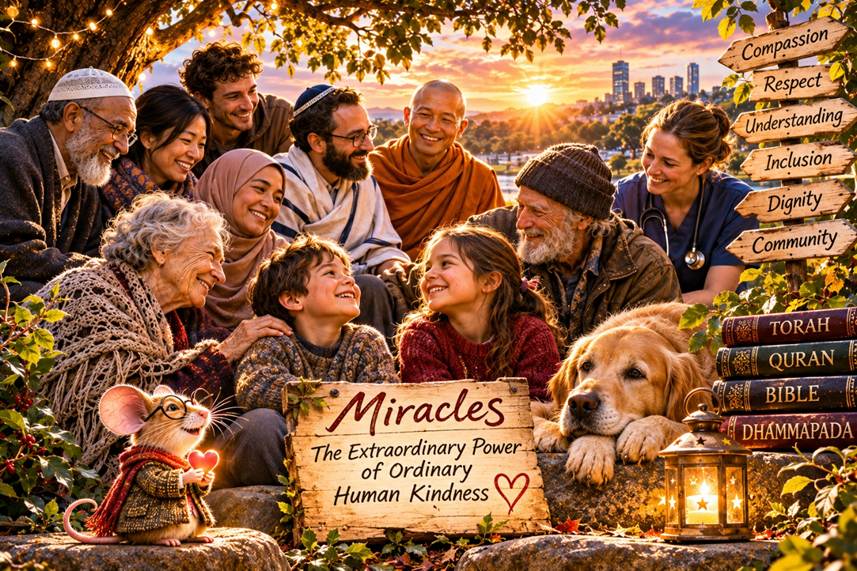
I have come to think that miracles are not necessarily extraordinary events. Some are states of mind. Others are shared experiences between people that remind us of something we too easily forget: that every human being possesses an inherent worth, and that beneath our differences we have much in common under the same Sun.
The most impressive miracles are often those of the heart.
They carry no financial price tag. They cannot be bought, sold or measured by the usual instruments of economic value. Their worth is too great to be counted in coins.
A genuine act of kindness may cost nothing, yet its consequences can be immeasurable.
If you believe that humanity has been created in the image of the divine, then perhaps you might also consider what that belief asks of you. Does it invite you to recognise something of the divine in the lives of others? Does it encourage empathy for the living world around us?
And if you do not hold religious beliefs, the principle remains just as meaningful.
We can still recognise ourselves in another person. We can still understand suffering, offer assistance and choose not to make another person’s difficulties worse.
Perhaps we can become the miracles we are waiting for.
I do not profess to have all the answers. I still have far too many questions. But I have learned that small miracles can begin with something remarkably simple: a smile, a gesture of goodwill, a willingness to listen or an unexpected kindness offered to someone who has almost given up expecting one.
Sometimes that small gesture opens an entirely new world of possibilities.
I like to think that miracles are possible. I am not necessarily referring to the spectacular events traditionally associated with divine intervention — mountains moving, waters parting or the heavens opening.
Those stories have occupied humanity’s imagination for centuries. They have also, at times, been used by institutions and authorities to impress, persuade and control.
I am interested in something rather more immediate.
I am talking about the miracles of the heart: those small, often unnoticed deeds that improve the lives of the people around us.
A kind word. An offer of assistance. A moment of patience. The decision to listen rather than condemn. The courage to acknowledge that we may have been wrong.
These things rarely make headlines. They are unlikely to attract awards, generate revenue or improve anyone’s financial portfolio.
Yet they are among the things that make life worth living.
We live in a world increasingly preoccupied with measurement. We measure economic growth, productivity, financial performance, political popularity and technological achievement. We count what we own, what we earn and what we can accumulate.
But how do we measure the value of a person who sits with an elderly neighbour because they are lonely? How do we calculate the worth of someone who helps a struggling family without expecting recognition? What financial instrument can measure the relief experienced by a person who discovers that somebody genuinely cares?
There is no adequate accounting system for these things.
And perhaps there should not be.
The world today gives us plenty of reasons to become suspicious of one another. Political division, economic insecurity, conflict, social isolation and the constant noise of competing opinions can make it difficult to recognise the person behind the position, the nationality, the religion or the circumstances.
Technology allows us to communicate across extraordinary distances, yet communication alone does not guarantee understanding.
We can be connected to thousands of people and still leave someone living beside us feeling completely alone.
Perhaps one of our greatest challenges is to recover the simple art of being human with one another.
I have a heart. Biologically, it is essential to keeping my body functioning. I assume you have one too.
But I am speaking of something beyond muscle tissue and blood vessels.
I am speaking of the heart as a symbol of our common humanity — the capacity to recognise another person’s experience, to feel compassion, to exercise restraint and to respond with kindness.
It is this understanding that brings us together and makes it possible to create small miracles every day.
Why should the joy and generosity traditionally associated with Christmas be confined to a few days of the year? Why should goodwill become a seasonal activity, accompanied by frantic shopping, elaborate meals and the pressure to impress a select few?
There is nothing wrong with celebrating, exchanging gifts or enjoying the company of family and friends.
But perhaps the greatest gift we can offer is one that does not require a purchase.
Our attention.
Our understanding.
Our willingness to recognise the humanity of another.
Imagine what might happen if we extended that generosity throughout the year. Imagine communities in which older people were not forgotten, children were not abandoned to circumstances beyond their control, people with disabilities were treated with dignity, and those experiencing hardship could ask for assistance without humiliation.
Imagine governments and institutions that measured their success not simply by financial performance, but by the quality of the lives they were entrusted to serve.
These are not impossible aspirations. They are choices about the kind of society we wish to create.
I do not suggest that kindness alone will resolve every injustice or replace the need for effective institutions, sound public policy and accountability. It will not.
But without kindness, those institutions can lose sight of the very people they exist to serve.
Perhaps that is where the miracle begins: when we recognise that another person’s life matters as much as our own, and then allow that recognition to influence what we do.
So, be the miracle you would like to see.
Reach out to another person. Offer a little understanding. Listen without immediately preparing your response. Give someone the opportunity to be heard. Be prepared to change your mind when the evidence or another person’s experience gives you reason to do so.
And do not underestimate the value of a small act of kindness.
You may never know how much it meant to the person who received it.
I still have questions. I suspect I always will. But I remain optimistic about the possibilities available to us when we choose cooperation over conflict, understanding over prejudice and compassion over indifference.
We do not need to wait for a supernatural event to make the world a better place.
We can begin with ourselves.
Find that miracle in your own heart, and perhaps others will discover it in theirs.
The greatest miracles are not necessarily those that change the world in an instant. They are the small acts of humanity that gradually make the world worth living in.
Be the miracle you would like to see.
And let us make every day a little more like Christmas.

