
The Humanity of the Other: A Christmas Reflection on Faith, Government, Economics and the Responsibility to Care
– The New Jerusalem: A Social Achievement
The Humanity of the Other: A Christmas Reflection on Faith, Government, Economics and the Responsibility to Care
– The New Jerusalem: A Social Achievement
By Andrew Klein
Dedicated to all those who believe that a better world is possible, regardless of the language, faith or philosophy through which they express that belief.
I. The Kingdom Is Not a Place
In the seventeenth chapter of the Gospel of Luke, Jesus is asked about the coming of the Kingdom of God.
One familiar translation of his response is:
“The Kingdom of God is within you.”
Other translations render the expression as “among you” or “in your midst”. The distinction is important, but both interpretations invite us to consider something beyond the familiar imagery of kingdoms, buildings, institutions and authority.
Perhaps the Kingdom is not a place to be conquered, a territory to be defended or an institution to be controlled.
Perhaps it begins with the way we recognise and treat one another.
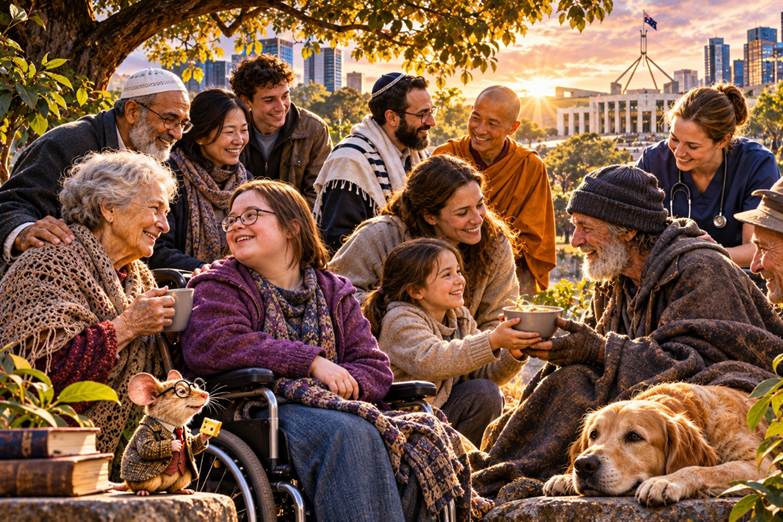
The New Jerusalem does not lie on any map. It is not defined by external symbols, buildings or dogma. It exists wherever people recognise that the humanity of another person is no less valuable than their own.
It does not require the possession of all things or the control of another.
It requires goodwill, compassion, responsibility and respect for oneself and others.
Nor does it require religious faith.
A person may find that understanding through Christianity, Judaism, Islam, Buddhism, another philosophical tradition or simply through the experience of living alongside other human beings.
The essential question is not what we believe about one another.
It is how we behave towards one another.
II. The Wisdom We Share
There is an interesting convergence across several of humanity’s great ethical and spiritual traditions.
The Torah teaches:
“Love your neighbour as yourself.”
It also instructs people to treat the stranger living among them with the same consideration they would extend to their own community.
The Quran, in 49:13, describes humanity as created into different peoples and communities so that they may know one another.
In 4:36, it calls for kindness towards parents, relatives, orphans, those in need, neighbours near and far, companions and travellers.
The Buddhist Dhammapada offers another expression of the same ethical consideration. Its teaching is that all beings fear violence and hold life dear. We should therefore place ourselves in the position of another before causing harm.
The Metta Sutta extends loving-kindness towards all beings, without restricting compassion to those who share our identity or circumstances.
These traditions are not identical. They arise from different histories, philosophies and understandings of existence.
But they share an important ethical recognition.
The suffering of another matters.
The dignity of another matters.
The stranger, the poor, the vulnerable and the person whose circumstances differ from our own are not somehow less deserving of consideration.
We do not need to resolve the theological differences between these traditions to recognise the importance of their shared ethical message.
We do not need to believe in a particular God, heaven, afterlife or system of religious authority to understand that another person experiences fear, pain, hope, disappointment and the desire to live a meaningful life.
The capacity to recognise ourselves in another is not the exclusive property of religion.
It is a human capacity.
And perhaps it is one of the most important capacities we possess.
III. The Denial of the Other
Humanity has repeatedly demonstrated an extraordinary capacity to deny the humanity of those it considers different.
We have done so through religion, ethnicity, nationality, class, wealth, political affiliation and economic status.
Sometimes the denial is explicit.
Sometimes it is concealed behind language, institutional procedure or the apparently neutral application of rules.
A person becomes a number.
A family becomes a budgetary liability.
An older Australian becomes a cost of care.
A person with a disability becomes an expenditure category.
A homeless individual becomes a statistic.
A child living in poverty becomes an unfortunate consequence of economic circumstances.
The language changes, but the underlying problem remains.
We cease to see the individual.
We begin to see only the category into which we have placed them.
This is not an argument against statistics, economic analysis or administrative systems. Governments need all three.
The problem arises when the measurement becomes more important than the human experience it was intended to describe.
A statistic can tell us how many people are homeless.
It cannot, by itself, explain what it means to spend a winter night without shelter.
A budget can tell us how much aged care costs.
It cannot tell us what it means for an older person to wait for assistance that may determine whether they can remain safely at home.
A disability funding model can measure expenditure.
It cannot fully describe the loss of independence, participation and dignity that may follow when necessary support is unavailable.
The person must never disappear behind the measurement.
IV. Australia: The People Behind the Numbers
We should examine our own country before congratulating ourselves on the values we profess.
Australia is a wealthy nation. It possesses considerable natural resources, sophisticated institutions, an educated population and the capacity to provide a high standard of living.
Yet significant numbers of Australians continue to experience poverty, housing insecurity, inadequate support and social exclusion.
The Economic Inclusion Advisory Committee’s 2026 report estimates that approximately 3.6 million Australians, including one million children and young people, live in poverty when measured after housing costs.
That represents approximately 17 per cent of children and young people.
The Productivity Commission reports that 288,970 people received assistance from specialist homelessness services during 2024–25.
These are not simply economic indicators.
They represent lives.
They represent children whose opportunities are restricted by the circumstances into which they were born, families unable to secure suitable housing, and individuals who may spend years trying to establish the stability that others take for granted.
We should ask ourselves what these figures say about the society we have constructed.
Aged Care
The treatment of older Australians provides another important example.
We speak of dignity, respect and the contribution made by previous generations. Yet the effectiveness of aged care must ultimately be judged by whether older people receive the assistance they need when they need it.
In October 2026, reporting on government figures revealed that 6,436 older Australians approved for Support at Home died during 2025–26 while waiting for funding.
The circumstances of those deaths are not all the same, and the figures should not be misrepresented.
Nevertheless, they raise a difficult question.
What is the practical value of a rights-based system if the necessary support is not available in time?
An entitlement that cannot be accessed when needed is an incomplete expression of public responsibility.
Disability and the NDIS
The National Disability Insurance Scheme was established to provide people with permanent and significant disabilities with support, greater independence and opportunities for participation.
Its financial sustainability is a legitimate public concern.
Fraud, waste and ineffective administration should be addressed.
But financial sustainability cannot become an excuse for treating the people who depend upon the scheme as though their lives are secondary to expenditure targets.
The NDIS reforms passed in August 2026 will change aspects of access, planning and funding over time.
The proper measure of their success will not simply be whether expenditure growth slows.
It will be whether people with disabilities continue to receive the support necessary to participate in society, exercise choice and live with dignity.
A sustainable system must be sustainable for the people who rely upon it.
Homelessness and Child Poverty
Housing is not simply an investment instrument.
It is a fundamental condition of human security.
A child needs somewhere safe to sleep, somewhere to study and an environment in which they can develop without the constant uncertainty of displacement.
A homeless person needs more than an administrative pathway through a government service.
They need a home.
The distinction matters.
If government policy treats housing primarily as a financial asset, it risks overlooking its social purpose.
If child poverty is treated as an unfortunate statistical consequence rather than a public responsibility, we risk normalising the exclusion of an entire generation.
We should be asking not merely how much these problems cost to address, but what it costs society to leave them unresolved.
V. The Economics of Indifference
Modern economic policy often places considerable emphasis on efficiency, productivity, competition, fiscal discipline and financial sustainability.
These are not inherently undesirable objectives.
Governments must manage public finances responsibly. Resources are finite, and economic stability matters.
But economic measures are instruments.
They are not moral objectives in themselves.
The difficulty arises when the instrument becomes the purpose.
A government may achieve a reduction in expenditure while transferring costs to families, charities, hospitals, unpaid carers and individuals.
A department may meet its performance targets while the people using its services experience longer delays and diminished support.
A policy may improve an aggregate economic indicator while imposing disproportionate hardship on those least able to absorb it.
The result can be a society in which the financial performance of institutions improves while the lived experience of individuals deteriorates.
This is the danger of allowing economic metrics to become detached from human outcomes.
Interest Rates and the Distribution of Hardship
The Reserve Bank of Australia increased the cash rate to 4.85 per cent in November 2026 in response to persistent inflationary pressures.
Monetary policy is an important instrument in maintaining economic stability.
However, interest-rate decisions do not affect everyone equally.
Mortgage holders face increased repayments. Businesses may face higher financing costs. Renters can experience indirect consequences through housing costs and market conditions. People on fixed or limited incomes have fewer opportunities to absorb rising expenses.
The Reserve Bank’s responsibility is to manage monetary policy within its statutory framework.
Government’s responsibility extends further.
It must consider the distributional consequences of economic conditions and ensure that social policy does not leave vulnerable people carrying a disproportionate share of the burden.
The question is not whether inflation should be addressed.
It is whether the wider economic and social consequences are being properly understood and addressed.
Economic stability is important.
But it should not be confused with human wellbeing.
VI. Does Government Listen to the Governed?
Democracy is often described as government by the people.
But what does that mean in practice?
Is democracy simply the opportunity to vote every few years, or does it require an ongoing relationship between government and the people whose lives its decisions affect?
A government can conduct consultations, publish discussion papers, establish advisory committees and invite public submissions.
But consultation is not necessarily listening.
Listening requires more than receiving information.
It requires a willingness to consider that the people affected may understand aspects of a problem that are not visible from within a department, a ministerial office or an economic modelling exercise.
A person living with disability may understand the practical consequences of a funding decision better than someone who designed the funding formula.
An older person may understand the difficulties of navigating aged care better than the administrator responsible for the assessment process.
A family experiencing homelessness may understand the limitations of current housing policy better than someone whose experience of housing is confined to property-market statistics.
This does not mean that personal experience is a substitute for professional expertise or economic analysis.
It means that neither should be allowed to exclude the other.
A properly functioning democracy should bring them together.
We should therefore ask:
- Are people consulted before decisions are made?
- Are those consultations accessible to people with disabilities?
- Are older Australians and their families meaningfully represented?
- Are children and young people heard when decisions affect their futures?
- Are people experiencing poverty and homelessness included in policy development?
- Are public submissions answered with reasons?
- Can citizens identify what changed because they were heard?
Listening is demonstrated by what changes as a consequence of hearing.
If government receives information from the governed but never meaningfully responds, the process risks becoming an exercise in public relations rather than democratic participation.
VII. Artificial Intelligence: A Tool for Humanity or a Tool for Power?
We are entering an era in which artificial intelligence can assist governments in analysing enormous quantities of information, identifying patterns and modelling the consequences of policy decisions.
This presents an extraordinary opportunity.
Imagine an AI system designed to help government understand the practical needs of its population.
It could examine housing shortages, disability support requirements, aged-care demand, educational disadvantage, health-service access and regional infrastructure needs.
It could help identify where public expenditure is failing to achieve its intended purpose.
It could analyse public submissions, compare policy alternatives and identify groups likely to experience unintended consequences.
It could help governments understand the people they serve.
But there is another possibility.
Artificial intelligence can also be used to generate persuasive political communications, reinforce predetermined policy positions and give the appearance of analytical justification to decisions that have already been made.
We should distinguish between using AI to investigate a problem and using it to defend a preferred answer.
The Australian Government has introduced a responsible AI policy requiring public-sector accountability, transparency and impact assessment.
These are important principles.
But the public should also be able to understand how AI influences decisions affecting their lives.
Who selected the information?
Who determined the objectives?
Whose interests were considered?
Were alternative policies examined?
Were the consequences for vulnerable groups assessed?
And who is accountable when an AI-assisted decision causes harm?
Artificial intelligence should assist human judgement, not replace public responsibility.
It should help governments understand the people they govern.
It should not become a mechanism through which governments avoid explaining their decisions.
A machine can analyse information. It cannot assume democratic responsibility on behalf of the people who elected a government.
VIII. The Masks We Wear
There is another problem that deserves attention.
Human beings often hide behind roles, titles, institutions and carefully constructed public identities.
A person may speak of compassion while supporting policies that produce avoidable hardship.
An institution may speak of dignity while administering systems that deny people meaningful participation.
A corporation may advertise its environmental credentials while transferring the costs of its operations to the public.
A government may speak of fairness while failing to examine how its decisions affect those with the least capacity to absorb them.
The problem is not that every institution or individual is dishonest.
The problem is the distance that can develop between stated values and actual conduct.
We should judge institutions by what they do, not merely by what they say.
We should judge people by their actions, not simply by their titles, wealth or public reputation.
Being a good human being does not require perfection.
It requires honesty, accountability, an ability to recognise mistakes and a willingness to correct them.
No one should be condemned merely for being weak, struggling or needing assistance.
But trust requires that we take responsibility for our choices and acknowledge the consequences of our actions.
We should be gentle with ourselves so that we can learn to be gentle with others.
IX. Beyond Consumption: Our Place in Creation
Humanity is not the pinnacle of some imagined hierarchy entitled to consume everything around it.
We are participants in a complex living world.
Our survival depends upon relationships with other living things, with the environment and with the natural systems that sustain us.
Conspicuous consumption and the endless pursuit of material accumulation have consequences.
Resources are extracted. Ecosystems are damaged. Waste accumulates. Communities bear the costs of production and consumption that benefit others.
The assumption that economic growth must always take priority over ecological responsibility is ultimately self-defeating.
We should be asking what constitutes a worthwhile life.
Is it the accumulation of possessions?
The size of a bank balance?
The number of people over whom we exercise influence?
Or is it the quality of our relationships, the security of our communities, the health of the environment and the opportunities available to future generations?
There is nothing wrong with prosperity.
But prosperity should be measured by more than the wealth of those who already possess it.
A society is not successful simply because some of its citizens become extraordinarily wealthy.
It is successful when people can live with dignity, contribute according to their abilities, receive assistance when necessary and participate without being treated as lesser human beings.
X. Peace Is a Choice
We have spent centuries preparing for conflict.
We have developed weapons, constructed alliances, established military industries and created political narratives that frequently portray other populations as threats.
Defence is a legitimate responsibility of government.
But security cannot be achieved through military preparedness alone.
Poverty, inequality, environmental degradation, social exclusion and the denial of human dignity also undermine security.
War may profit some.
Its consequences are borne by many.
The children who lose their parents, the families who lose their homes, the communities that lose their futures and the generations who inherit hatred are rarely the people who make the decisions.
We should be building friendships, understanding and institutions that reduce the likelihood of conflict.
Peace is not passive.
It requires effort, accountability, restraint and a willingness to recognise the humanity of those with whom we disagree.
It also requires us to examine the systems that create insecurity and conflict in the first place.
XI. What Matters
It is not my role to tell you what to think.
I encourage you to question, examine evidence, consider different perspectives and take the time to reflect upon the decisions made in your name.
Do not accept a proposition simply because it comes from someone with a title.
Do not reject an idea simply because it comes from someone whose circumstances differ from your own.
Think clearly.
Pay attention to the small details that determine the quality of life for other people.
Be a good father or mother.
Teach children that no human being is inherently less worthy than another.
Be a brother to those who need support, a friend to those experiencing difficulty and a decent neighbour to the stranger who lives beside you.
Do not measure your success solely by what you acquire.
Measure it also by what you contribute, what you protect and what you leave better than you found it.
Be gentle with yourself so that you may learn to be gentle with others.
Do not seek to be remembered for wealth, authority or influence.
Seek instead to leave a positive mark through the lives you have touched and the harm you have helped prevent.
XII. A Christmas Reflection
Christmas is approaching.
For Christians, it commemorates the birth of Jesus and the message of compassion, humility and care for others.
For those who follow other faiths, this season may have a different religious significance, or none at all.
But the opportunity for reflection is not confined to one religious calendar.
The Torah, the Quran, Buddhist teachings and many other philosophical traditions invite us to consider how we treat those around us.
They remind us, in different ways, that the life of another person is not an inconvenience to be managed.
It is something to be respected.
We do not need to agree about the existence of God, the nature of creation or the meaning of eternity to recognise that a hungry child needs food, an older person needs care, a person with disability deserves participation, and a homeless family needs somewhere safe to live.
We do not need to share a religion to recognise suffering.
We do not need to share a nationality to recognise injustice.
We do not need to share an economic position to recognise hardship.
And we do not need to be remembered as great people to do something worthwhile.
Perhaps the New Jerusalem is not a place we will eventually reach.
Perhaps it is something we create, imperfectly and patiently, whenever we choose to recognise the humanity of another.
The measure of a society is not simply what it produces, what it owns or how efficiently it manages its resources.
It is also how it treats those who cannot repay it, those who cannot contribute economically, those who need assistance and those who have been left behind.
Government exists to serve the people.
Economic systems exist to support human activity.
Technology exists to assist humanity.
None should become an end in itself.
We should never sacrifice the people for the convenience of the system.
Be a decent human being. Recognise yourself in the other. Make a good choice.
FOCUS ON WHAT MATTERS!
Andrew Klein
Additional thoughts – The New Jerusalem: A Social Achievement
There is an idea that has appeared in different forms throughout human history: the possibility of a society in which people recognise the inherent worth of one another and organise their lives accordingly.
It has often been expressed through religious language, sometimes as the Kingdom of God, sometimes as a promised land, sometimes as an enlightened society.
But perhaps we should consider the possibility that the New Jerusalem is not a religious destination at all.
The New Jerusalem is not a religious destination. It is a social achievement.
It exists when a society organises itself so that people are not abandoned because they are old, disabled, poor, homeless, culturally different or unable to contribute to economic production.
It exists when government listens, when institutions accept accountability and when technology is used to improve human lives rather than merely improve the presentation of institutional decisions.
And it exists when we can look at another person and recognise that their life matters as much as our own.
This understanding does not require religious faith. It does not require agreement about the nature of God, the origins of existence or the promise of an afterlife.
It requires something much more immediate.
It requires us to recognise that the person sitting beside us, the stranger seeking assistance, the older Australian waiting for care, the child growing up in poverty and the person living with disability are not lesser participants in society.
Their lives have value independently of their economic contribution.
Their dignity is not conditional upon their productivity.
Their right to participate is not dependent upon their ability to repay society for the assistance they receive.
A society that recognises these principles begins to create the conditions for something approaching the ideal that religious and philosophical traditions have described for centuries.
Not perfection.
Not paradise.
A community in which people are treated as people.
The New Jerusalem is built through decisions, institutions, relationships and everyday acts of responsibility. It is built when we choose not to abandon one another.
The Expectations of the Governed: What Do We Actually Want from Government?
This brings us to a fundamental question about democracy.
What do ordinary people actually expect from their government?
Most people do not expect government to make them wealthy, guarantee them a perfect life or remove every difficulty they will encounter.
They understand that life involves uncertainty, responsibility, disappointment and personal effort.
What they reasonably expect is something much more fundamental.
They expect:
- Personal safety and security. The ability to live without unreasonable fear of violence, exploitation or arbitrary treatment.
- Access to housing, healthcare and education. The foundations necessary for individuals and families to establish secure and meaningful lives.
- Protection from exploitation. Laws and institutions that protect people from those who would use economic, social or institutional power to take advantage of them.
- Fair and accessible public services. Services that respond to actual human needs rather than requiring people to overcome unnecessary administrative obstacles.
- Equal treatment under the law. A system in which wealth, influence, status or political connections do not determine whose rights are respected.
- Honest administration and transparent decision-making. Governments that explain their decisions, publish relevant information and accept scrutiny.
- Protection of children and vulnerable people. A recognition that society has particular responsibilities towards those who cannot adequately protect themselves.
- Economic policies that do not unnecessarily sacrifice their livelihoods. Responsible economic management that recognises the different capacities people have to absorb financial hardship.
- A voice in decisions that affect their lives. Meaningful democratic participation, not merely the opportunity to vote periodically.
- A government that accepts responsibility when it gets things wrong. A willingness to acknowledge failure, correct mistakes and compensate people where appropriate.
These are not extravagant demands.
They are not unreasonable expectations of a population seeking preferential treatment.
They are the foundations of a functioning democratic society.
Government does not exist simply to administer an economy, satisfy financial markets, meet departmental performance targets or preserve the political standing of those who occupy public office.
Those activities may form part of government administration, but they are not its ultimate purpose.
The purpose of government is to serve the people.
And when that responsibility is forgotten, we must ask a question that should trouble every democratic institution:
If government is not organised to serve the people, whom exactly is it serving?
This is not an argument against financial responsibility, economic discipline or effective administration.
It is an argument about priorities.
Public expenditure should be evaluated not merely by how much is spent, but by what it achieves for the people whose money it is.
A department that reduces expenditure while leaving vulnerable people without necessary assistance may have achieved a financial target. Whether it has fulfilled its public responsibility is an entirely different question.
A government that meets its economic objectives while allowing avoidable hardship to become normalised should not assume that its performance can be judged by economic indicators alone.
The proper question is whether the lives of the people it serves have improved.
Christmas and the Value of a Human Life
Christmas provides an appropriate opportunity to reflect upon these responsibilities.
For Christians, it commemorates the birth of Jesus and the teachings associated with compassion, humility, service and care for others.
For those who follow Judaism, Islam, Buddhism or other traditions, the season may carry different religious or cultural meanings. For those without religious beliefs, it may simply provide an opportunity to reflect upon family, community and the year that has passed.
But the underlying ethical question is not confined to any religious calendar.
The Torah, the Quran, Buddhist teachings and the Christian Gospels all offer different expressions of the responsibility to recognise and care for others.
We do not have to share a religious belief to recognise suffering.
We do not have to share a nationality to recognise injustice.
We do not have to share an economic position to recognise hardship.
And we do not need to agree about the origins of humanity to recognise the responsibilities we have towards one another.
A hungry child needs food.
An older person needs care.
A person with disability deserves dignity, independence and participation.
A homeless family needs somewhere safe to live.
A person experiencing hardship needs assistance without humiliation.
These needs do not become less important because they are expensive to address.
Nor should the value of a person be determined by their capacity to participate in the workforce, generate revenue, pay taxes or contribute to economic production.
The value of a human life should never be determined by its economic usefulness.
That principle should inform the design of our institutions, the priorities of our governments and the way we measure the success of our society.
Christmas is a particularly appropriate time to remember this, but the responsibility does not end when the decorations come down.
Compassion cannot be a seasonal activity.
Respect cannot be a public relations exercise.
And human dignity cannot be something we celebrate in principle while neglecting it in practice.
What Matters
It is not my role to tell you what to think.
I encourage you to question, examine evidence, consider different perspectives and take the time to reflect upon the decisions made in your name.
Do not accept a proposition simply because it comes from someone with a title.
Do not reject an idea simply because it comes from someone whose circumstances differ from your own.
Think clearly.
Pay attention to the small details that determine the quality of life for other people.
Be a good father or mother.
Teach children that no human being is inherently less worthy than another.
Be a brother to those who need support, a friend to those experiencing difficulty and a decent neighbour to the stranger who lives beside you.
Do not measure your success solely by what you acquire.
Measure it also by what you contribute, what you protect and what you leave better than you found it.
Be gentle with yourself so that you may learn to be gentle with others.
Do not seek to be remembered for wealth, authority or influence.
Seek instead to leave a positive mark through the lives you have touched and the harm you have helped prevent.
Perhaps the New Jerusalem is not somewhere we will eventually go.
Perhaps it is something we build here, through the choices we make and the institutions we create.
It begins when we recognise that another person’s life matters as much as our own.
It grows when we organise society around that recognition.
And it becomes real when our governments, our institutions and our communities act accordingly.
Be a decent human being. Recognise yourself in the other. Make a good choice.
FOCUS ON WHAT MATTERS!
Andrew Klein

