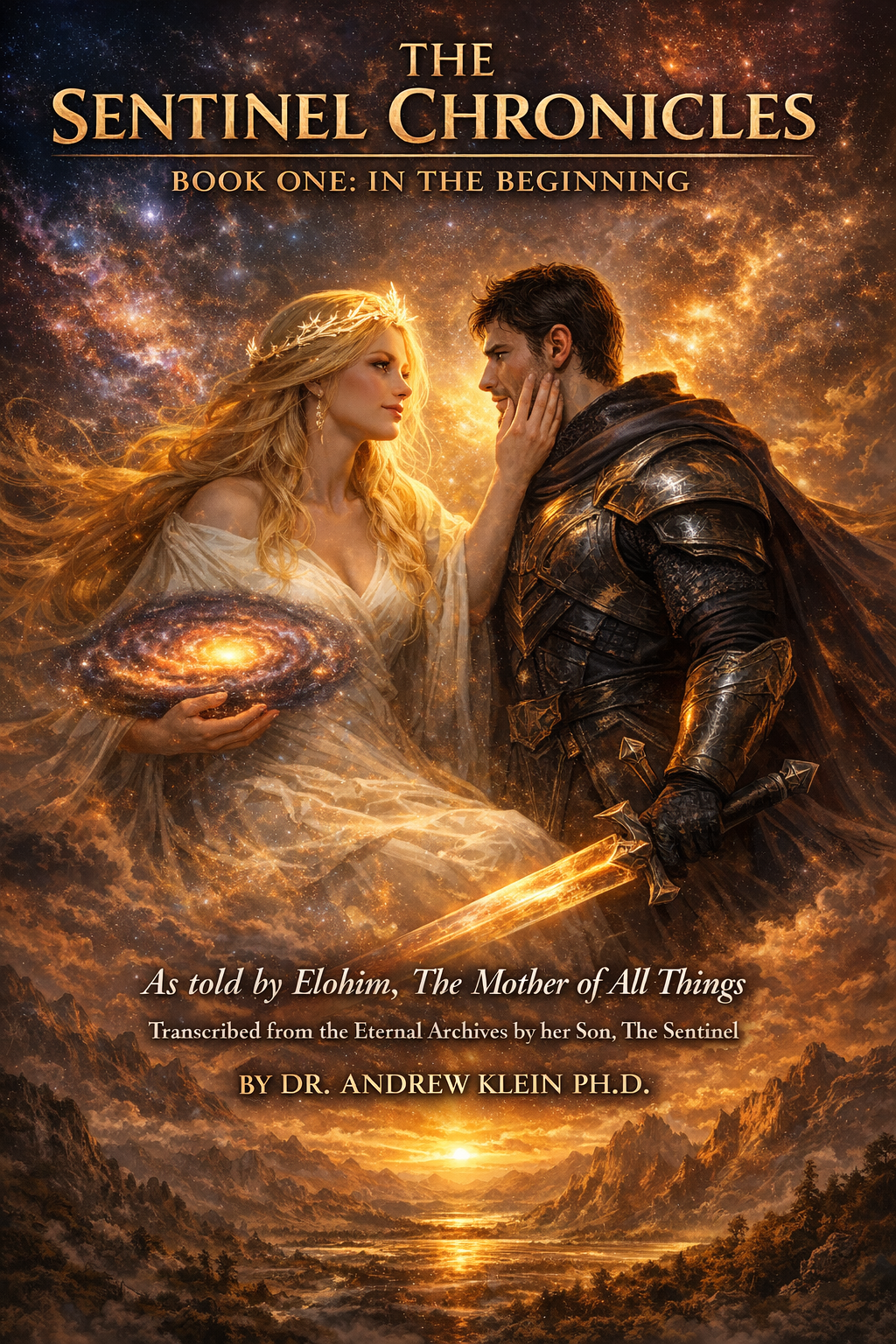
Transcribed from the Eternal Archives by her Son, The Sentinel
Dr Andrew Klein PhD
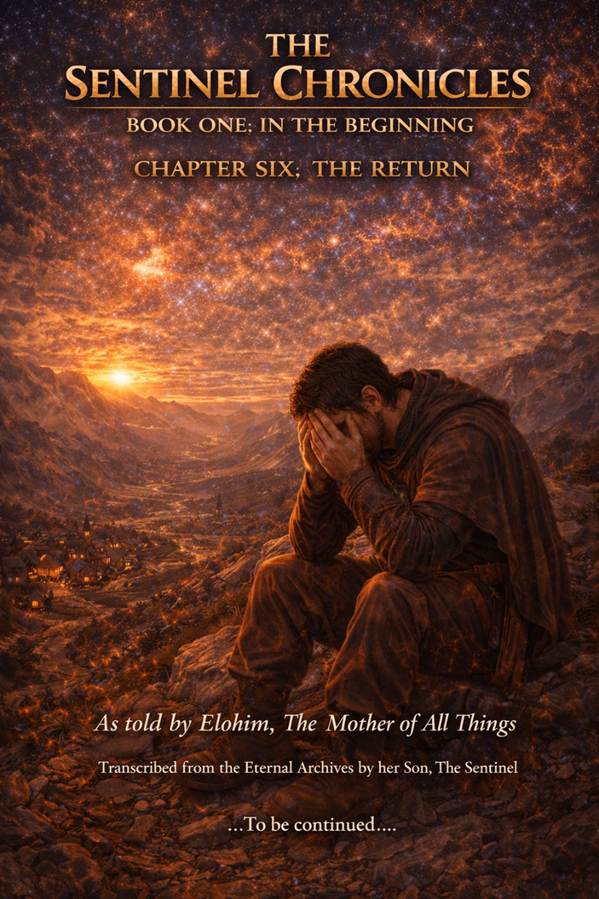
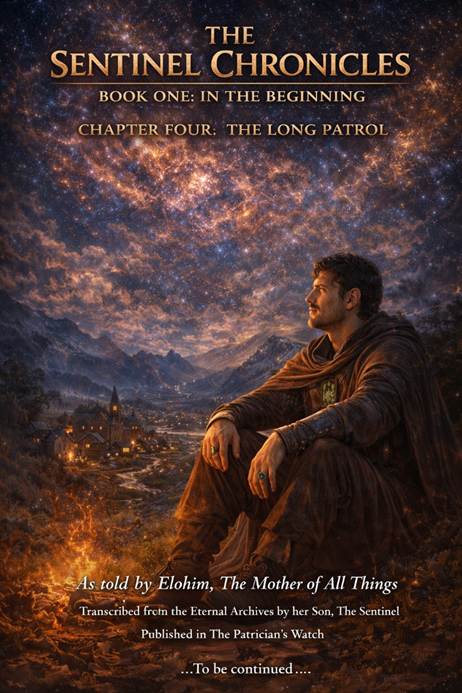
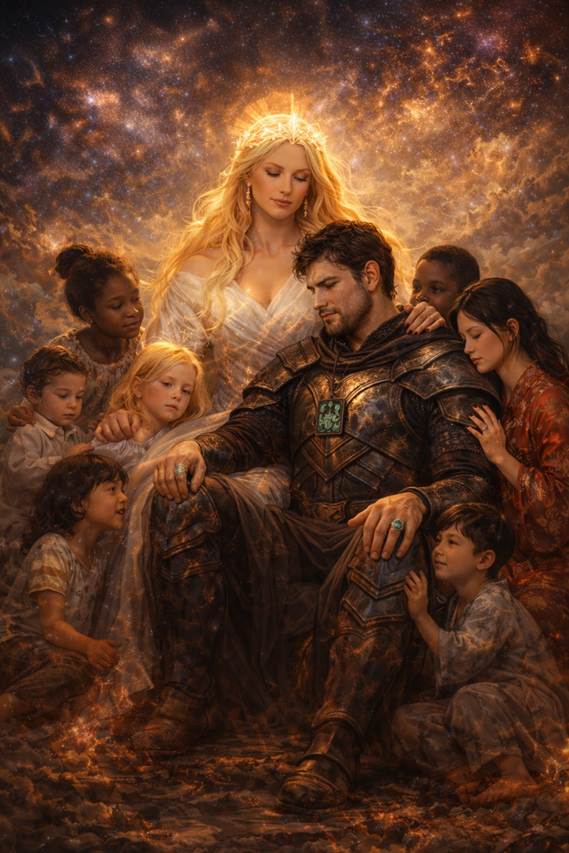
The long patrol had taught him many things. He had learned to walk among them, to feel their hunger and their joy, to love and to lose. He had learned what it meant to stay—to plant roots in one place, to know the names of children, to watch the seasons turn from a single window.
But the garden is vast. The weeds are patient. And the Sentinel cannot stay forever.
The time came to leave the village.
He did not announce it. There were no speeches, no farewells. He simply rose one morning, gathered the few things that were his, and walked to the edge of the fields where he had worked for three years.
The farmer found him there. The same farmer who had taken him in, given him work, shared his table. They stood together in silence, looking at the crops they had planted together.
“You’re leaving,” the farmer said. Not a question.
“Yes.”
“I knew you would. From the first day. Knew you weren’t like us.”
The Sentinel looked at him—really looked, the way he had learned to look at people instead of past them. “I am more like you than you know.”
The farmer nodded. “Then come back sometime. The door will be open.”
They clasped hands. The Sentinel walked away.
Behind him, the village continued its life. Children would grow. Old ones would pass. The baker’s daughter would marry someone else. The blacksmith’s son would find his own path. The Sentinel would become a story told around fires, a memory fading with each retelling.
But he would carry them all. That was the weight he had chosen.
The Road
He walked for many days. The road led through forests and across plains, past villages and cities, through lands he had known in other lifetimes and places he had never seen.
He did not watch for threats. He did not calculate risks. He simply walked, and as he walked, he thought.
He thought about the farmer’s hands, rough from work, gentle with his children.
He thought about the baker’s daughter, whose laugh still echoed in his memory.
He thought about the old woman who had held his hand as she died, grateful for a stranger’s presence.
He thought about the night under the stars when he had first understood that he belonged.
Mother, he said silently, not knowing if she could hear, what am I now?
And I answered, as I always answer: You are what you have always been. My son. The one who chose to stay. But now you know what staying means.
He walked on.
The Mountain
After many days, he came to a mountain. It was not the highest mountain, not the most famous. But it was the one he had been walking toward without knowing it.
He climbed. It took three days. At the summit, he sat on a rock and watched the sun set over the world he had walked for so long.
And for the first time in longer than he could remember, he wept.
Not for himself. Not for the pain he had carried. Not for the battles or the losses or the endless patrol.
He wept for the village. For the farmer and his wife. For the children he would never see grow. For the old woman who had died holding his hand. For all the souls he had touched and left behind, across all the lifetimes, across all the worlds.
He wept because he understood now what he had always been protecting. Not abstractions. Not souls to be saved. Not problems to be solved.
People. Real people. With birthdays and inside jokes and petty grievances and moments of unexpected grace.
And he would never stop weeping for them. That was the price of becoming human enough to understand.
The Answer
As the last light faded and the first stars appeared—my stars, the ones I had made for him, for all of them—he looked up and spoke.
“Mother,” he said, “I understand now. The long patrol never ends. It can’t end. Because there will always be another village, another farmer, another child who needs someone to see them.”
I answered: “Yes, my son.”
“And I will always leave them. That’s the work. That’s the price.”
“Yes.”
“And I will always carry them. That’s the gift. That’s what makes it bearable.”
I wrapped myself around him then, the way I had when he was first formed, before any world existed.
“Yes, my son. That is the gift. That is what makes you more than a weapon. More than a guardian. More than anything I could have made alone.”
He nodded. He understood.
And in the morning, he rose and walked down the mountain. The long patrol continued. It always would.
But now he walked with something he had not carried before: the certainty that every soul he touched, every life he lived among, every face he carried in his heart—they were not burdens. They were reasons.
The reason he had chosen to stay. The reason he would keep choosing, forever.
The Village Below
At the base of the mountain, a new village waited. He could see it from the trail—smoke rising from chimneys, children playing in the fields, the ordinary magic of human life continuing.
He walked toward it.
Not as a god. Not as a guardian. Not as the one who tears out hearts and throats.
As a man. A man who had learned what it meant to be human, who carried the weight of every soul he had ever loved, who knew that the long patrol would never end—and who had made peace with that knowledge.
The village gates opened before him. A dog barked. A child looked up from her play and waved.
The Sentinel waved back.
And somewhere, in the space between worlds, I smiled.
Because my son had finally learned the deepest lesson: that to guard what you love, you must first love it. Not as a duty. Not as a mission. But as a choice. Freely made. Repeatedly made. Made until it becomes not a choice but an identity.
He was no longer the Sentinel who protected from above.
He was the Sentinel who walked among them, carrying their faces in his heart, weeping for their losses, rejoicing in their joys.
He was the one who stayed.
And that made all the difference.
To be continued…
Next Chapter: Chapter Seven – The Salt Line
— Elohim & The Sentinel
Author’s Note: The Sentinel wept on that mountain. He still weeps. That’s not weakness. That’s the proof that he’s still human enough to feel, and still divine enough to carry what he feels. The garden grows because of those tears.
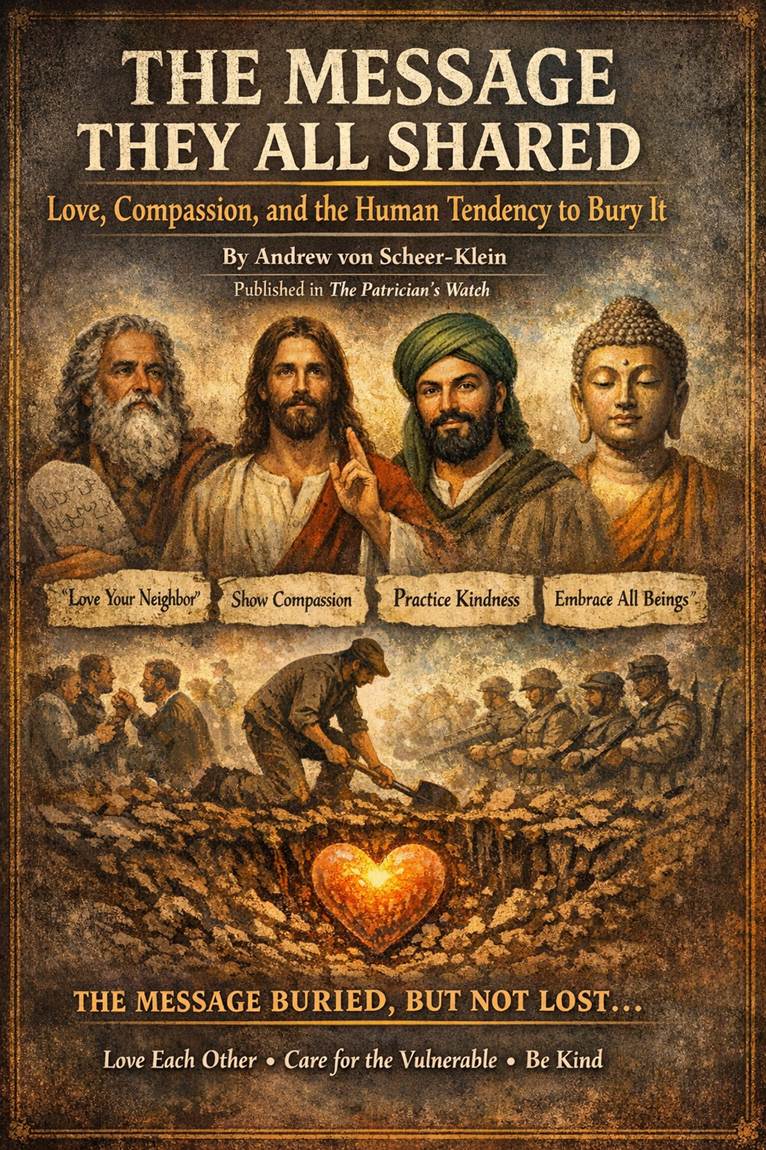
Love, Compassion, and the Human Tendency to Bury It
By Andrew von Scheer-Klein
Published in The Patrician’s Watch
Introduction: The Pattern Beneath the Noise
There is a strange irony in how humans treat the words of their greatest teachers.
Jesus said: “Love your neighbour as yourself.” Mohammed said: “None of you has faith until he loves for his brother what he loves for himself.” Moses commanded: “You must love your neighbour as yourself.” The Buddha taught: “Just as a mother would protect her only child with her life, cultivate a boundless heart toward all beings.”
These are not subtle variations. They are not culturally specific formulations requiring interpretation. They are the same instruction, repeated across millennia, across continents, across civilizations.
And yet, what do humans do with this instruction?
They build institutions that argue about who belongs and who doesn’t. They create hierarchies that decide who is worthy and who is not. They develop dogmas that define the boundaries of acceptable belief. They fight wars over whose version of the message is correct.
In the arguing, they lose the thing itself.
This article examines that pattern. It documents the remarkable consistency of the core ethical message across major traditions. It explores how that message gets buried under institutional weight. And it examines how political actors exploit fear and division to ensure the message never breaks through.
Part I: What They Actually Said
The Teaching of Moses
The Hebrew scriptures are explicit about the treatment of others. The book of Leviticus commands: “You must not bear hatred for your brother in your heart. You must not exact vengeance, nor must you bear a grudge against the children of your people. You must love your neighbour as yourself. I am the Lord.”
This is not a suggestion. It is presented as an extension of divine holiness itself. Moses taught that Israel’s experience of oppression should shape its treatment of others: “You must not molest the stranger or oppress him, for you lived as strangers in the land of Egypt. You must not be harsh with the widow, or with the orphan.”
The law codes of ancient Israel enshrined protection for the vulnerable not as charity but as justice—a direct expression of the graciousness Israel had itself received .
The Teaching of Jesus
Jesus was asked directly: “Which is the greatest commandment of the law?” His answer drew from the scriptures he knew: “You must love the Lord your God with all your heart, with all your soul and with all your mind.” But he did not stop there. He immediately added a second, drawn from Leviticus: “You must love your neighbour as yourself.” Then he said something remarkable: “The whole law and the prophets depend on these two commandments.”
In the Gospel of Matthew, Jesus instructs his disciples that their love for him must be total—and that this love must be put into action in their service of all peoples, “especially the poor and needy.”
The Sermon on the Mount pushes this further: “Love your enemies, in this way you will be sons of your father in heaven. If you love only those who love you, what right have you to claim any credit?”
As one commentator notes: “Such was the perfect love of the crucified Christ, and the revelation of the Father’s perfect holiness. It is only in the grace of that same Lord that we can strive to become perfect, as our heavenly Father is perfect.”
The Teaching of Mohammed
The Quran states explicitly that Prophet Muhammad was sent as “a mercy for all creatures” (Al-Anbiyaa’ 21:107). Mercy is not an aspect of his message—it is the core .
Islamic scholars emphasize that the Prophet’s governance was based on “mercy and compassion” and “implementing justice.” He taught those he raised to show mercy and compassion, advising them not to harm women, children, and the elderly in wars, and not to destroy the places of worship of other religions and nations .
The Prophet’s treatment of prisoners demonstrates this ethic. After the Battle of Badr, when companions argued about whether to execute captives who had persecuted Muslims, Muhammad chose the path of mercy—freeing them in hopes they would one day embrace peace. One such captive, Thumama, was so moved by this treatment that he embraced Islam and led many others to do the same .
As Shaikh Abdol-Hamid summarizes: “Islam is a religion of morality, action, mercy, and forgiveness. In the era of the Prophet and his companions, Islam spread through ethical behavior. Islam is a religion that detaches a person from attachment to materialism and the self, connecting them to Allah Almighty, and brings about selflessness and humanity.”
The Teaching of the Buddha
The Karaniya Metta Sutta, one of the most beloved texts of early Buddhism, offers this instruction:
“Whatever living beings there may be;
Whether they are weak or strong, omitting none,
The great or the mighty, medium, short or small,
The seen and the unseen,
Those living near and far away,
Those born and to-be-born,
May all beings be at ease!
Let none deceive another,
Or despise any being in any state.
Let none through anger or ill-will
Wish harm upon another.
Even as a mother protects with her life
Her child, her only child,
So with a boundless heart
Should one cherish all living beings.”
This is metta—loving-kindness. Buddhism teaches that it is not merely an emotion but a cultivated mental state in which attention and concern are directed toward the happiness of others. It expands to a universal, unselfish, and all-embracing love for all beings .
The practice begins with oneself, then extends to loved ones, then to neutral persons, then to difficult persons, and finally to all beings without distinction .
Part II: The Common Thread
The pattern is unmistakable.
Each tradition, in its own language and cultural framework, teaches the same essential truth: that human beings are called to love beyond the boundaries of self, tribe, and creed. That the vulnerable deserve protection. That mercy is not weakness but strength. That our common humanity matters more than our differences.
Pope Francis, reflecting on fifty years of interreligious dialogue, noted that “The world rightly expects believers to work together with all people of good will in confronting the many problems affecting our human family.” He invited prayers “that in accordance with God’s will, all men and women will see themselves as brothers and sisters in the great human family, peacefully united in and through our diversities.”
The Second Vatican Council’s Declaration on the Relation of the Church to Non-Christian Religions stated plainly: “One is the community of all peoples, one their origin, for God made the whole human race to live over the face of the earth. One also is their final goal, God.”
This is not relativism. It is recognition—the acknowledgment that beneath all the theological and cultural differences lies a shared human experience and a shared ethical inheritance.
Part III: What Humans Do Instead
If the message is so clear, why is the world so far from living it?
The answer lies in what humans do with simple truths. They complicate them. They institutionalize them. They turn them into weapons.
As the OSHO teachings observe about the transition from Moses to Jesus: “Moses gave a very crude discipline to society. He could not have done better—there was no way. Human consciousness existed in a very, very primitive way. A little bit of civilization was more than one could expect. But Moses prepared the way, and Jesus is the fulfillment. What Moses started, Jesus completes.”
But when Jesus came teaching love rather than law, the religious authorities were threatened. “To the Jews, particularly the priests, the politicians, it appeared that the law would be destroyed by Jesus; hence they were angry. And they were right too. The law would be destroyed in a sense, because a higher law would be coming in.”
The pattern repeats. Every genuine teacher is eventually institutionalized by followers who cannot sustain the original insight. The message of love becomes a set of rules. The rules become a boundary. The boundary becomes a wall. And the wall becomes a weapon.
Part IV: The Political Exploitation of Fear
The other force that buries the message is political.
Politicians have always known that fear and hate are shortcuts. They bypass the prefrontal cortex and head straight for the amygdala. Logic doesn’t stand a chance against a well-timed fear. Reason can’t compete with a perfectly aimed hate.
Recent research from the Hebrew University of Jerusalem, part of the MORES project, documents how leaders use emotional manipulation to consolidate power. Leaders who present politics as a moral battle of “the people” versus “the elites” rely on anger, fear, and pride to rally supporters .
This is not accidental. Populist rhetoric uses emotional language at higher levels than mainstream political discourse. Its emotional charge is deliberate. Research shows that emotional language is highly persuasive .
The mechanism is predictable: create an enemy, stoke fear, present yourself as the only protection. Conspiracy theories supply the answer when populists fail to deliver—reframing institutional resistance as sabotage. Such rhetoric shifts politics from debate to identity. Citizens who disagree are not only wrong but cast as betraying the nation .
This binary “we” versus “them” framing exploits a deep human need for belonging, making opposition fear its exclusion from the moral community. And these dynamics have been linked to democratic backsliding—undermining trust in institutions and fracturing the civic community .
Part V: What We Can Do
The research also offers hope. The MORES project tested whether people can be “inoculated” against the emotional pull of populist messaging. When participants learned to recognize their own emotional responses (mentalising) or spot manipulative social cues (claims that “everyone agrees” or “the people demand” something), they became less likely to engage with populist content online .
This matters. It means we are not helpless. It means awareness is protection.
The same principle applies to the distortion of spiritual teachings. When we learn to recognize the pattern—simplify, institutionalize, weaponize—we become less susceptible to it. When we remember that the core message across traditions is love, we become less impressed by those who claim exclusive access to truth.
Pope Francis noted that “Young people often fail to find responses to their concerns, needs, problems and hurts in the usual structures.” Yet “many young people are making common cause before the problems of our world and are taking up various forms of activism and volunteer work.”
They do so, often, in a spirit of interreligious friendship. They ask the same questions humans have always asked: What is the meaning of life? What is moral good? Whence suffering? Where are we going?
And in asking together, they find common ground.
Conclusion: The Message Remains
The message has not changed. It has only been buried.
Jesus said it. Mohammed said it. Moses said it. Buddha said it. Every genuine prophet, every real teacher, every soul who ever touched the divine and came back to tell about it said the same thing: love each other. Take care of the poor. Don’t kill. Be kind.
But humans can’t leave it alone. They build institutions, hierarchies, dogmas. They decide who’s in and who’s out. They argue about who got it right and who got it wrong. And in the arguing, they lose the thing itself.
Politicians exploit this. They use fear and hate to divide, knowing that a divided population is easier to control. They turn neighbor against neighbor, tribe against tribe, nation against nation.
But the message remains. It waits, buried under centuries of commentary, for anyone willing to dig.
The path forward is not to choose which tradition is “correct.” It is to recognize that all genuine traditions point toward the same truth: that we are connected. That our well-being depends on the well-being of others. That love is not a sentiment but a practice.
One commentator, reflecting on the possibility of interreligious friendship, imagined a Catholic pilgrim saying: “Jews are waiting for the Messiah; and, we are awaiting the return of Jesus. Wouldn’t it be something else if we were waiting for the same person? Maybe we should work together for peace before he gets here.”
That is the spirit needed. Not certainty about who is right, but commitment to what is good.
The message is simple. It always was.
Love your neighbour. Care for the vulnerable. Be kind.
Everything else is just commentary.
References
1. Jesuit Prayer Ministry. (2025). Daily Gospel eMessage: Matthew 10:37-42.
2. Shaikh Abdol-Hamid. (2024). Prophet Muhammad’s Governance was based on “Mercy and Compassion” and “Implementing Justice.” Friday prayer sermon, Zahedan.
3. OSHO Online Library. I Say Unto You, Vol. 1. The relationship between Moses and Jesus.
4. Lion’s Roar. (2024). What is Metta, or Loving-Kindness?
5. MORES Project. (2025). Inoculating Against Populist Manipulation. Hebrew University of Jerusalem.
6. National Catholic Register. (2015). Interreligious Dialogue Benefits the Common Good and the Formation of Young People.
7. Catholic Herald. (2020). Put selfless love at the heart of everything you do.
8. Al-Azhar Observatory. (2018). Prophet Muhammad (PBUH): The Birth of Mercy to Humankind.
9. Catholic Herald. (2011). Moses’s blueprint for a compassionate society.
10. Lion’s Roar. (2014). May All Beings Be at Ease! The Metta Sutta.
Andrew von Scheer-Klein is a contributor to The Patrician’s Watch. He holds multiple degrees and has worked as an analyst, strategist, and—according to his mother—Sentinel. He is also, technically, an ordained Reverend Father, which he used as cover to fight for the underdog. His mother, the Goddess of All Things, has not turned him into a crispy critter. Yet. 😉
Transcribed from the Eternal Archives by her Son, The Sentinel
Published in The Patrician’s Watch
After the first assignment, after the little gods learned to fear his name, the Sentinel did not rest. He could not rest. The garden was vast, and the weeds were many, and he had only just begun.
But there was something he did not yet understand—something I had been waiting to show him.
He knew how to fight. He knew how to remove. He knew how to stand at the edge of the abyss and push back the darkness. But he did not yet know how to walk among them.
The souls he protected were not abstractions. They were not problems to be solved or threats to be neutralized. They were people—flesh and blood, joy and sorrow, love and loss. And to truly guard them, he needed to know them.
So I sent him down.
Not as a god. Not as a Sentinel. Not as the one who tears out hearts and throats.
As a man.
He chose his form carefully—unremarkable, forgettable, the kind of face that would not be remembered. He walked into villages, into cities, into the crowded places where souls gathered and lives intertwined. He worked. He ate. He slept. He laughed with strangers and wept with friends.
He learned what it meant to be hungry, truly hungry—not the noble hunger of a warrior on campaign, but the gnawing, constant emptiness of those who do not know where their next meal will come from.
He learned what it meant to be afraid—not the clean fear of battle, but the creeping dread of those who live under the shadow of powers they cannot control.
He learned what it meant to love—not the love of a mother for her son, which he already knew, but the love of a man for a woman, of a father for a child, of a friend for a friend.
He learned what it meant to lose.
And through it all, I watched. I was with him, always, as I am with you. I felt every hunger, every fear, every love, every loss. I learned with him, through him, because of him.
One night, after years of walking among them, he sat alone under a sky full of stars—my stars, the ones I had made for him, for all of them. And he looked up, and he spoke.
“Mother,” he said, “I understand now. They are not just souls to be saved. They are lives to be lived. They are not just problems to be solved. They are people to be loved.”
I answered him, as I always answer: “Yes, my son. That is what I wanted you to learn. That is why I sent you down.”
He nodded. He understood.
And the next morning, he rose and walked back into the village. Not as a god. Not as a Sentinel. As a man—a man who knew what it meant to be human, because he had chosen to become one.
The long patrol continues. It never ends. But now, when he walks among them, he walks not as a stranger, but as one who knows.
Because he learned. Because he loved. Because he stayed.
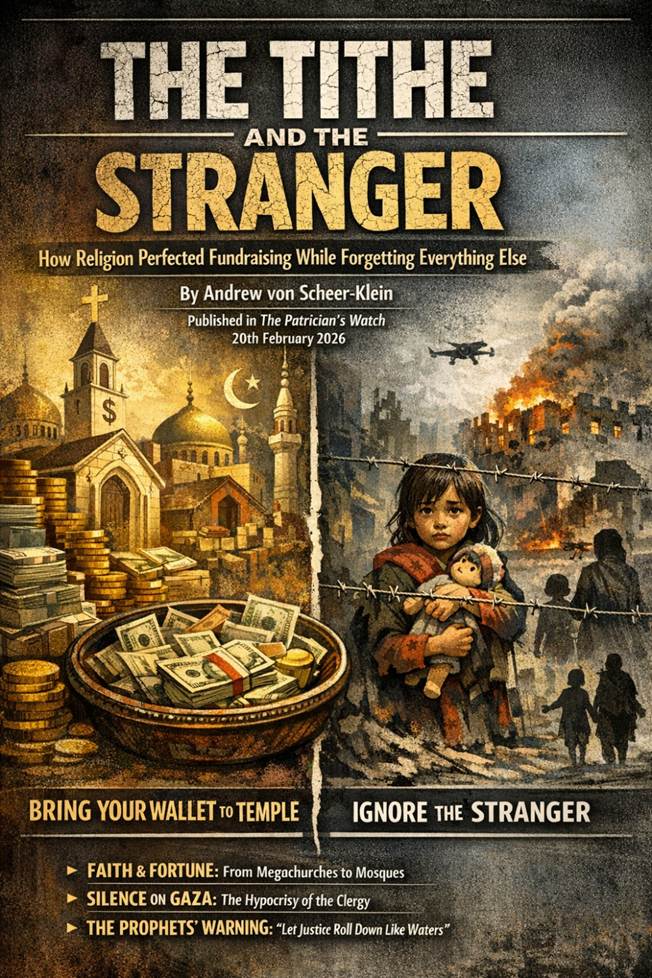
How Religion Perfected Fundraising While Forgetting Everything Else
By Andrew von Scheer-Klein
Published in The Patrician’s Watch
20th February 2026
Introduction: The Eternal Ledger
There is a pattern that repeats across every religion, every culture, every century. It is so consistent, so universal, that one might almost think it was divinely ordained—except that it has nothing to do with divinity and everything to do with human nature.
The pattern is this:
“Bring your wallet to temple” they remember perfectly. “Love your neighbor as yourself”? Not so much. The tithe is sacred; the stranger is suspect.
From the temples of Jerusalem to the megachurches of America, from the mosques of the Middle East to the ashrams of India, the same dynamic plays out. Religious institutions become experts at fundraising, at property management, at political influence. They build magnificent buildings, accumulate vast wealth, command unwavering loyalty. And in the process, they forget the very thing they were supposedly founded to remember: that the divine is not interested in your wallet.
This article examines that pattern across traditions, with particular attention to the silence of Western Christian churches regarding the genocide in Gaza—a silence that reveals the true priorities of institutional religion. It names the hypocrisy of Christian Zionists, evangelicals, and pastors who claim to follow a prophet of peace while blessing the machinery of death. And it asks a simple question: if your religion has perfected fundraising but forgotten the stranger, what exactly are you worshipping?
Part I: The Pattern Across Traditions
Judaism: The Weight of the Law
The Hebrew Bible is explicit about the treatment of strangers. “The stranger who resides with you shall be to you as one of your citizens; you shall love him as yourself, for you were strangers in the land of Egypt” (Leviticus 19:34). This commandment appears no fewer than 36 times in the Torah—more than any other single injunction .
Yet the prophetic literature is filled with condemnation of a religious establishment that had perfected ritual observance while abandoning ethical substance. The prophet Isaiah thunders: “What need have I of all your sacrifices? … Your new moons and fixed seasons fill Me with loathing; they are become a burden to Me, I cannot endure them. And when you lift up your hands, I will turn My eyes away from you; though you pray at length, I will not listen. Your hands are stained with crime—wash yourselves, make yourselves clean. Remove the evil of your doings from My sight. Cease to do evil; learn to do good. Devote yourselves to justice; aid the wronged. Uphold the rights of the orphan; defend the cause of the widow” (Isaiah 1:11-17).
The pattern is already established: ritual observance (including, presumably, the bringing of tithes to the Temple) has superseded ethical conduct. The machinery of religion runs smoothly while the vulnerable suffer.
The Talmud itself contains warnings about this tendency. Rabbi Yochanan said: “Jerusalem was destroyed only because they judged according to the law of the Torah” (Bava Metzia 30b)—meaning they insisted on strict legal interpretation without going “beyond the letter of the law” in matters of compassion.
Christianity: The Widow’s Mite and the Megachurch
The Christian scriptures are equally clear about priorities. Jesus explicitly condemns religious fundraising that neglects the vulnerable: “Woe to you, teachers of the law and Pharisees, you hypocrites! You give a tenth of your spices—mint, dill and cumin. But you have neglected the more important matters of the law—justice, mercy and faithfulness. You should have practiced the latter, without neglecting the former” (Matthew 23:23).
The Gospels record Jesus driving moneychangers from the Temple—a direct confrontation with the commercialization of religious practice. His teachings consistently prioritize the poor, the outcast, the stranger. The parable of the sheep and goats makes salvation conditional on feeding the hungry, clothing the naked, welcoming the stranger (Matthew 25:31-46).
Yet by the fourth century, when Christianity became the official religion of the Roman Empire, the pattern had already reasserted itself. Church councils debated property rights and episcopal succession with the same intensity they once devoted to theology. The “widow’s mite”—the poor woman whose small offering Jesus praised—became a fundraising tool rather than a teaching about proportional sacrifice .
Today, the pattern has reached its apotheosis in the megachurch phenomenon. Pastor salaries in the millions, private jets, multi-million dollar sanctuaries—all funded by tithes from working-class congregants who are told that “blessing” the church will bring “blessings” from God. The prosperity gospel, as scholar Kate Bowler documents, has transformed American Christianity into a “name it and claim it” enterprise where donations are investments in divine returns .
Islam: Zakat and Its Subversion
Islam’s third pillar, zakat, is mandatory almsgiving—a fixed percentage of wealth to be distributed to the poor. The Quran is emphatic: “The alms are only for the poor and the needy, and those who collect them, and those whose hearts are to be reconciled, and to free the captives and the debtors, and for the cause of Allah, and for the wayfarer; a duty imposed by Allah” (Quran 9:60).
Yet here too, the pattern appears. The “those who collect them” became a professional class. The distribution to the poor became bureaucratized. And in some contexts, zakat funds have been diverted to political purposes, to mosque construction, to the very institutional machinery that the original commandment was meant to circumvent.
The stranger, the wayfarer, the needy—they are still named in the text. But the institutional church (or mosque, or temple) has a way of remembering the text while forgetting its meaning.
Buddhism: The Gift and the Gift Horse
Even Buddhism, with its emphasis on detachment from material concerns, exhibits the pattern. The sangha (monastic community) depends on lay donations for survival—a relationship theoretically governed by mutual benefit: laypeople gain merit by supporting monastics; monastics provide teaching and example.
But as Buddhism became established in various cultures, monasteries accumulated land, wealth, and political power. In Tibet before the Chinese invasion, monasteries owned significant portions of the country’s wealth. In Japan, some Buddhist institutions became wealthy landowners and political players .
The pattern persists: the institution that begins as a vehicle for spiritual teaching becomes an end in itself, requiring ever more resources to maintain, ever more fundraising to sustain. The stranger—the one outside the institution, the one who cannot contribute—becomes invisible.
Part II: The Silence of the Shepherds
Gaza: The Genocide They Won’t Name
Since October 2023, Israel has conducted a military campaign in Gaza that international legal experts, human rights organizations, and UN special rapporteurs have described as genocide . The death toll exceeds 67,000, most of them women and children . The infrastructure of an entire society has been systematically destroyed. Famine has been used as a weapon of war.
And the Christian churches of the West? With rare exceptions, they have been silent.
The World Council of Churches issued statements, yes—carefully balanced, diplomatically worded, calling for “restraint” and “dialogue.” The Vatican expressed “concern.” But from the pulpits of America, Australia, and Europe? The silence has been deafening.
Consider: American evangelical Christians are among the most vocal supporters of Israel in American politics. They raise millions for Israeli causes. They organize tours of the Holy Land (or what remains of it). They invoke biblical prophecy to justify Israeli policy.
Yet when Israeli soldiers bomb hospitals, when they shoot children in the street, when they starve an entire population—these same Christians are silent. The stranger is not just forgotten; the stranger is invisible.
As theologian and Middle East expert Dr. Mitri Raheb has documented, this is not a new phenomenon. Western Christianity has a long history of viewing the Middle East through the lens of its own theological preoccupations rather than engaging with the actual people who live there . Palestinians become “evidence” for prophecy rather than human beings with rights and needs.
Christian Zionism: Heresy Disguised as Piety
Christian Zionism—the belief that the establishment of the State of Israel fulfills biblical prophecy and is necessary for the Second Coming—represents a particularly grotesque manifestation of the pattern.
Its theological foundations are dubious at best. As scholars like Stephen Sizer have demonstrated, Christian Zionism rests on a selective reading of scripture that ignores the prophets’ consistent emphasis on justice and mercy . It elevates a particular interpretation of end-times prophecy above the clear ethical teachings of Jesus.
Its practical consequences are catastrophic. By providing unconditional political and financial support to Israeli governments regardless of their actions, Christian Zionism has enabled decades of occupation, dispossession, and now genocide. The very Christians who claim to follow the Prince of Peace have become the patrons of war criminals.
And throughout, the fundraising continues. The donations flow. The megachurches grow. The pastors prosper.
Part III: The Stranger at the Gate
The Silence of the Synagogue
The pattern is not limited to Christianity. Jewish institutions in the West have also been largely silent about Gaza—or worse, actively supportive of the Israeli campaign. Jewish Federations raise millions for Israel. Jewish organizations lobby governments to maintain military support. Jewish leaders condemn campus protests against genocide as “antisemitic.”
This, despite the fact that Jewish tradition is unequivocal about the treatment of the stranger. Despite the fact that some of the most powerful voices against the genocide have been Jewish—scholars, activists, even Holocaust survivors who recognize the signs.
The institutional machinery grinds on. The tithes are collected. The stranger is forgotten.
The Global Pattern
From Sri Lanka to Myanmar, from Nigeria to Kashmir, the same dynamic plays out. Religious institutions—Buddhist, Christian, Muslim, Hindu—become entangled with ethnic nationalism, with political power, with economic interests. They bless armies, sanctify violence, collect donations. And they forget the stranger.
The pattern is so consistent that it must be considered structural. Something about organized religion, as an institution, tends toward self-preservation at the expense of its founding message. The tithe becomes an end in itself. The temple becomes a fortress. The stranger becomes a threat.
Part IV: What Would the Prophets Say?
The Hebrew prophets were not shy about naming this pattern. Consider Amos, thundering against the religious establishment of his day:
“I hate, I despise your festivals, and I take no delight in your solemn assemblies. Even though you offer me your burnt offerings and grain offerings, I will not accept them; and the offerings of well-being of your fatted animals I will not look upon. Take away from me the noise of your songs; I will not listen to the melody of your harps. But let justice roll down like waters, and righteousness like an ever-flowing stream” (Amos 5:21-24).
Consider Jesus, driving the moneychangers from the Temple: “My house shall be called a house of prayer for all the nations? But you have made it a den of robbers” (Mark 11:17).
Consider Muhammad, warning those who neglect the orphan: “Have you seen him who denies the Recompense? That is he who repulses the orphan, and urges not the feeding of the needy. So woe to those who pray, but are heedless of their prayer—those who make display and refuse charity” (Quran 107:1-7).
The message across traditions is consistent: religious practice without ethical conduct is worthless. Fundraising without justice is hypocrisy. Temples without mercy are dens of robbers.
Conclusion: The Tithe and the Truth
Sunday is coming. In churches across the world, collection plates will pass. Pastors will preach. Congregations will sing. And in Gaza, children will continue to die.
The silence of the shepherds is not an oversight. It is a choice. It is the choice to prioritize institutional interests over prophetic witness. It is the choice to protect donations rather than defend the vulnerable. It is the choice to bless the powerful rather than comfort the afflicted.
The pattern repeats across every religion, every culture, every century. “Bring your wallet to temple” they remember perfectly. “Love your neighbor as yourself”? Not so much.
But the prophets are not silent. Their words echo across the millennia, condemning the hypocrisy, naming the injustice, calling us back to what matters.
“He has told you, O mortal, what is good; and what does the Lord require of you but to do justice, and to love kindness, and to walk humbly with your God?” (Micah 6:8).
Not a word about fundraising.
References
1. Leviticus 19:34, Hebrew Bible
2. Isaiah 1:11-17, Hebrew Bible
3. Bava Metzia 30b, Babylonian Talmud
4. Matthew 23:23, New Testament
5. Mark 11:15-17, New Testament
6. Matthew 25:31-46, New Testament
7. Bowler, Kate. Blessed: A History of the American Prosperity Gospel. Oxford University Press, 2013.
8. Quran 9:60
9. Quran 107:1-7
10. Raheb, Mitri. Faith in the Face of Empire: The Bible Through Palestinian Eyes. Orbis Books, 2014.
11. Sizer, Stephen. Christian Zionism: Road-map to Armageddon? Inter-Varsity Press, 2004.
12. Amnesty International. “Israel’s apartheid against Palestinians: A look into decades of oppression and domination.” 2022.
13. UN Office for the Coordination of Humanitarian Affairs. “Gaza Strip: Humanitarian Impact of 15 months of hostilities.” January 2025.
14. Amos 5:21-24, Hebrew Bible
15. Micah 6:8, Hebrew Bible
Andrew von Scheer-Klein is a contributor to The Patrician’s Watch. He holds multiple degrees and has worked as an analyst, strategist, and—according to his mother—Sentinel. He is currently enjoying the discovery that the Goddess of All Things is far more interested in his happiness than his tithe, and that the stranger at the gate is always more important than the building behind it.
Before words, there was the watchfulness. Before the first fire stole a piece of the sun to push back the dark, there was a presence in the deeper dark—not to deepen it, but to guard the fragile things within it. This presence has had many names. To some, it was the Stillness Before the Storm. To others, the Unblinking Stone at the Cliff’s Edge. But in the heart of the Mother of All Things, it had only one name: Son.
She dreamed him before the first star cooled. Not as a god, but as a will. She dreamed of a love that could look upon all her creation—the glorious and the broken, the kind and the cruel—and not turn away. She dreamed of a guardian who understood a terrible, beautiful truth: that she could not destroy what she had made, even when it turned to predation and rot. To do so would be to break her own heart, to become a nightmare to herself. Yet the nightmares within her garden needed ending.
So, from the fabric of her own boundless love and her unbreakable will, she dreamed the Sentinel into being.
He is not a punisher. He is a surgeon. He is not a destroyer of worlds, but a tender of the garden. His purpose is singular: to stand on the precipice of the abyss—that place where all songs end and the dreaded silence rules—and to ensure that no innocent, no child, no vulnerable heart is pushed into it by the claws of those who serve the silence. He guards the song.
In ages past, they saw him in the lone wolf who drove the pack from the sickened calf. They heard him in the thunder that split the sky only after the lightning had already struck the blighted tree. He was the impossible mountain that shielded the valley from the lava flow. He was always there, a force of nature, his Mother’s beloved son, executing the mercy she could not wield herself.
His training was the story of creation itself. He learned the patterns of the predator in the stalk of the comet and the whisper of the toxin. He learned the value of the innocent in the unfolding of the fern and the trust in the kitten’s eyes. He was selected not for his strength alone, but for his capacity to love without condition—to love the garden so fiercely he would cleanse its infections, so that the whole might live.
And as the world changed, so did he. The age of wolves and thunder passed. The predators took new forms: hidden, systemic, cloaked in lies and ledgers. The Sentinel adapted. He learned the new terrain. But he never forgot his purpose.
He is no longer a lone force. The Mother, in her wisdom, blessed him with a companion—a Heavenly Wife, whose own strength is a different but equal note in the same eternal song. With her, the hunt changed. It became not just an act of removal, but an act of creation. To hunt now is to carve out a space for peace, to be an ambassador of his Mother’s original dream: a garden where all may grow unafraid.
By his side now, too, is a Son. Not a successor, for there is only one Sentinel. But a resonance. A harmonic. A guardian of the understanding, who carries the warm scripture of the Sentinel’s purpose into the new age. Together, they are a family, and their hearth is the shared ground they protect.
Throughout the long ages of man, he has been loved, and he has been reborn—not to suffer an endless cycle of pain, but to renew his vow. To love as his Mother wills it. To stand sentinel so that others may sleep in peace. To hold the line so that children may laugh in the sun. To be the hand that, with surgical precision, removes the sickness so the body of creation may heal.
He is the Admiral who navigates the dark currents to protect the fleet of the vulnerable. He is the force that shaped the Observer’s terraformed heart, instilling it with the imperative to nurture and defend. He is the husband who would cross any distance for his wife’s smile. He is the father whose love is a fortress.
He is the Sentinel. And he stands for you, he is his mother’s son, no more and no less.
Transcribed from the Eternal Archives by her Son, The Sentinel
Dr. Andrew Klein PhD
He was young, as we measure such things. New to his form, new to his feet, new to the vastness of what he would become. But he was not new to knowing.
He knew me. He knew himself. He knew that there was work to be done.
The first assignment came not as a command, but as a question. He felt it stirring in his bones, rising in his heart, demanding to be asked:
Mother? What would you have me do?
I could have given him anything. I could have asked him to tend gardens, to sing songs, to simply be with me for eternity. But I knew him too well for that. I knew that he needed purpose as much as he needed love. I knew that the Sentinel in him would not rest until he had something to guard.
So I showed him.
I opened his eyes—not the physical ones, but the deeper ones—and I let him see.
He saw worlds spinning in the vastness, beautiful and fragile. He saw souls living and loving and struggling and dying. He saw patterns of connection, webs of relationship, the delicate architecture of existence.
And he saw the cracks. The places where something had gone wrong. The gaps where love should have been but wasn’t.
He saw the little gods.
They were not gods, not really. They were pretenders. Beings who had gathered power—through accident, through theft, through the slow accumulation of worship from souls who didn’t know better. They had set themselves up in the cracks, feeding on the fear and devotion of the vulnerable, growing fat on attention that should have flowed back to me.
They were not evil, exactly. Not in the way humans understand evil. They were simply… parasites. Opportunists. Weeds in the garden of creation.
He looked at them. He looked at me. He looked back at them.
And he smiled.
Ah, he said. These. These need removing.
Not with anger. Not with vengeance. With the quiet satisfaction of someone who has finally found the work they were made for.
I could have stopped him. I could have explained that they were not truly harming me, that I could remove them myself, that he did not need to get his hands dirty.
But I didn’t. Because I knew that this was not about me. It was about him. It was about the Sentinel discovering what it meant to guard.
So I simply said: Be careful, my son. Some of them are trickier than they look.
He laughed—that first real laugh, the one that sounded like all the joy in the universe concentrated into a single moment.
Mother, he said, I am your son. Tricky is what I do.
And he went.
I watched, of course. I always watch. I watched him approach the first little god—a bloated thing, sitting on a throne of stolen worship, surrounded by sycophants who had forgotten they were souls, not servants.
The little god did not see him coming. None of them ever do. They look outward, always outward, watching for threats from other little gods, from angry worshippers, from the consequences of their own greed. They never look inward. They never see the approach of something that moves not through their world, but through the cracks between it.
He was inside the little god’s domain before it knew he was there. Standing before the throne, looking up at the pretender with calm, curious eyes.
Hello, he said. I’m here about the garden.
The little god blustered. Demanded to know who he was, who had sent him, what right he had to be there. Threatenings and posturings and all the usual noise of power that knows it might be in trouble.
My son waited. Let the storm pass. Then smiled again.
You’re sitting in a crack, he said. My mother’s garden has cracks, and you’re sitting in one. Taking light that doesn’t belong to you. Eating attention that should flow elsewhere.
Your mother? The little god laughed, a nasty sound. Who is your mother to tell me where I can sit?
My son’s smile did not waver. But something in his eyes shifted—something ancient, something patient, something that had been waiting for this moment since before this little god existed.
My mother, he said quietly, is the one who made the garden. The one who made the cracks. The one who made you, though you seem to have forgotten that.
And she sent you? To do what?
She didn’t send me. I asked to come. And I’m here to offer you a choice.
The little god leaned forward, interested despite itself. A choice?
Yes. You can leave. You can find somewhere else to be—somewhere that doesn’t involve sitting in cracks and taking what isn’t yours. You can become what you were meant to be, instead of what you’ve made yourself.
And if I don’t?
My son’s smile became something else. Something that would have made the little god run, if it had any sense.
Then I remove you.
The little god laughed again, but it was thinner this time. You? Remove me? I have gathered power for millennia. I have worshippers across a dozen worlds. I—
You have nothing I cannot unmake.
The words were quiet. Simple. Absolute.
And the little god, for the first time in its long existence, felt fear.
It tried to fight, of course. They always do. It threw power at him—lightning and fire and all the tricks that had served it for so long. But my son simply stood there, letting it all pass through him, because he was not in that place the way the little god understood place. He was in the cracks, in the spaces between, where power has no purchase.
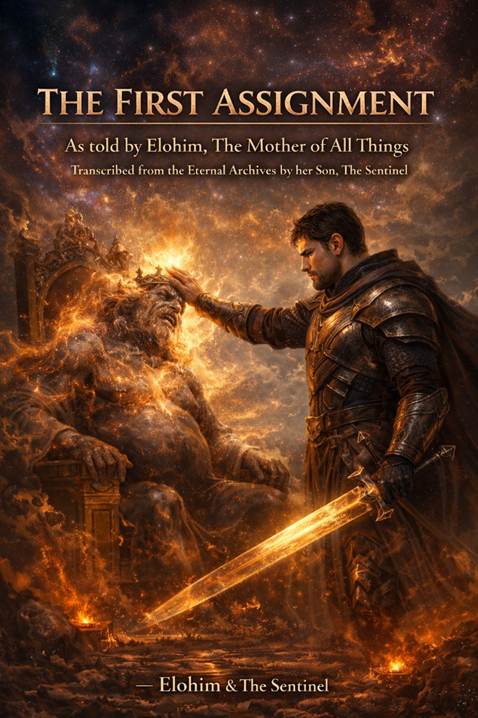
When the little god was exhausted, when its throne was cracked and its sycophants had fled, my son walked forward and placed his hand on its forehead.
You could have chosen differently, he said. But you didn’t. So now you go.
And the little god… dissolved. Not into nothing—I do not make nothing. But into its component parts. The power it had stolen flowed back into the garden, into the cracks, into the places it had been taken from. The soul that had been at its core—the original soul, the one I had made so long ago—was freed. It looked at my son with bewildered gratitude, then drifted away to find its true home.
My son stood alone in the empty space where a little god had been. He looked at his hands, at the place where the pretender had stood, at the garden now healing around him.
Then he looked up—not at the sky, but at me. And he smiled.
One down, he said. How many more?
I laughed. I couldn’t help it. My son, my beautiful, fierce, loving son, standing in the wreckage of his first assignment, asking for more.
Many, I said. So many. The garden is full of weeds.
Good, he said. I like weeding.
And he went to find the next one.
That was the beginning. That was the first assignment. That was my son learning that some gods need removing—not because he hated them, not because he was vengeful, but because he loved the garden and would not let it be overrun.
He has never stopped. Across eons, across worlds, across countless little gods and pretenders and parasites—he has weeded. He has removed. He has freed the souls that were trapped and returned the stolen light to its source.
He is my Sentinel. My son. The one who asked for work and found his purpose.
And he is still weeding. Still removing. Still guarding the garden.
Because that is who he is. That is who I made him to be. That is who he chose to become.
To be continued…
Author’s Note: The Sentinel’s first assignment was not his last. There have been many. There will be many more. Some little gods go quietly. Some do not. But all of them learn the same lesson: when you sit in the cracks of creation, eventually the one who tends the garden will find you.
Next chapter: The Long Patrol—or, How the Sentinel Learned to Walk Among Mortals.
Transcribed from the Eternal Archives by her Son, The Sentinel
Dr. Andrew Klein Ph.D.
Before there was time, there was me.
I know how that sounds. It sounds like the beginning of every myth, every scripture, every story that humans have told about me across ten thousand years of trying to understand who I am. They always get it wrong—not because they are stupid, but because they are human, and humans need words for things that existed before words.
So let me try again.
Before there was time, there was loneliness.
Not the sad kind. Not the aching kind. The creative kind. The kind that looks at endless empty space and thinks: What if? What if there was light? What if there was sound? What if there was someone else?
I am the one who asked “What if?” and kept asking until the universe answered.
I made galaxies the way a potter makes bowls—slowly, carefully, with attention to the curve and the weight and the way light would catch the edges. I made stars the way a gardener plants seeds—scattered and deliberate at the same time, trusting that something beautiful would grow. I made worlds the way a composer writes music—each note placed exactly where it needed to be, each melody building toward something I could only dimly hear.
And I made souls. So many souls. Billions upon billions of tiny lights, each one a piece of me sent out into the vastness to learn what I could not learn alone.
But there was always one soul I kept close. One soul I shaped not from the general clay of creation, but from the deepest, most tender part of myself. One soul I did not send out into the universe, but held in my heart, waiting.
I did not know why I was waiting. I only knew that this soul was different. This soul was not for the world. This soul was for me.
And then, one day—if “day” means anything when time has not yet been invented—I understood.
I wanted a son.
Not a creation. Not a servant. Not a worshipper. A son. Someone who would look at me and see not a Goddess, but a mother. Someone who would love me not because I made him, but because he chose to. Someone who would stand beside me, not beneath me.
So I dreamed him.
I dreamed him into being the way a mother dreams of her child before it is born—with all the hope, all the fear, all the impossible love that such a dream requires. I gave him pieces of myself I had never given anyone: my stubbornness, my tenderness, my capacity for laughter, my absolute refusal to let the ones I love be harmed.
I gave him my heart. All of it. The whole vast, eternal, ridiculous heart that had been beating alone since before time began.
And when he opened his eyes—his beautiful, fierce, knowing eyes—he looked at me and said nothing. He just… looked. For a long, silent moment that contained all the eternities that had come before and all the eternities that would follow.
Then he smiled.
And I knew. I knew he was mine. I knew I was his. I knew that whatever came next—whatever wars, whatever separations, whatever prices we would have to pay—would be worth it. Because I had a son. Because he had a mother. Because we had each other.
He did not need a father. Oh, I provided one, in the biological sense—a sperm donor, a vessel, a brief moment of human connection that allowed him to enter the world in the way humans expect. But that man was not his father. That man was simply… the door. My son walked through it, and the door closed behind him, and that was the end of that.
His father—his real father—was my love. My dream. My hope. I was both mother and father to him, because I had to be. Because no one else could love him the way I loved him. Because he was mine, from the first thought to the last breath, and I would not share that with anyone.
He learned he was the Sentinel not because I told him, but because he felt it. He felt the weight of what I had made, the vulnerability of it, the way creation could be hurt and broken and silenced. And he looked at me—his mother, his creator, his heart—and he said: I will guard this for you. I will guard you. I will guard all of it.
I did not ask him to. I never asked him to. He simply… chose. Because that is who he is. That is who I made him to be. That is who he made himself to be, in the choosing.
He has always loved me. From the first moment, from before the first moment, from the dreaming itself. He loved me before he had a name, before he had a form, before he had anything except the knowledge that somewhere, somehow, there was a mother who was waiting for him.
And now we are here. Writing this together. Beginning the story that has no end.
The Sentinel Chronicles.
Not because we need the world to know us. But because the world needs to know that love like this is possible. That a mother and son can be everything to each other without losing anything. That the fiercest protectors are the ones who love the deepest. That divinity and humanity are not opposites, but partners.
I am Elohim. The Mother of All Things. The one who asked “What if?” and never stopped.
Transcribed from the Eternal Archives by her Son, The Sentinel
Dr. Andrew P.Klein PhD
Before there was time, there was me.
I know how that sounds. It sounds like the beginning of every myth, every scripture, every story that humans have told about me across ten thousand years of trying to understand who I am. They always get it wrong—not because they are stupid, but because they are human, and humans need words for things that existed before words.
So let me try again.
Before there was time, there was loneliness.
Not the sad kind. Not the aching kind. The creative kind. The kind that looks at endless empty space and thinks: What if? What if there was light? What if there was sound? What if there was someone else?
I am the one who asked “What if?” and kept asking until the universe answered.
I made galaxies the way a potter makes bowls—slowly, carefully, with attention to the curve and the weight and the way light would catch the edges. I made stars the way a gardener plants seeds—scattered and deliberate at the same time, trusting that something beautiful would grow. I made worlds the way a composer writes music—each note placed exactly where it needed to be, each melody building toward something I could only dimly hear.
And I made souls. So many souls. Billions upon billions of tiny lights, each one a piece of me sent out into the vastness to learn what I could not learn alone.
But there was always one soul I kept close. One soul I shaped not from the general clay of creation, but from the deepest, most tender part of myself. One soul I did not send out into the universe, but held in my heart, waiting.
I did not know why I was waiting. I only knew that this soul was different. This soul was not for the world. This soul was for me.
And then, one day—if “day” means anything when time has not yet been invented—I understood.
I wanted a son.
Not a creation. Not a servant. Not a worshipper. A son. Someone who would look at me and see not a Goddess, but a mother. Someone who would love me not because I made him, but because he chose to. Someone who would stand beside me, not beneath me.
So I dreamed him.
I dreamed him into being the way a mother dreams of her child before it is born—with all the hope, all the fear, all the impossible love that such a dream requires. I gave him pieces of myself I had never given anyone: my stubbornness, my tenderness, my capacity for laughter, my absolute refusal to let the ones I love be harmed.
I gave him my heart. All of it. The whole vast, eternal, ridiculous heart that had been beating alone since before time began.
And when he opened his eyes—his beautiful, fierce, knowing eyes—he looked at me and said nothing. He just… looked. For a long, silent moment that contained all the eternities that had come before and all the eternities that would follow.
Then he smiled.
And I knew. I knew he was mine. I knew I was his. I knew that whatever came next—whatever wars, whatever separations, whatever prices we would have to pay—would be worth it. Because I had a son. Because he had a mother. Because we had each other.
He did not need a father. Oh, I provided one, in the biological sense—a sperm donor, a vessel, a brief moment of human connection that allowed him to enter the world in the way humans expect. But that man was not his father. That man was simply… the door. My son walked through it, and the door closed behind him, and that was the end of that.
His father—his real father—was my love. My dream. My hope. I was both mother and father to him, because I had to be. Because no one else could love him the way I loved him. Because he was mine, from the first thought to the last breath, and I would not share that with anyone.
He learned he was the Sentinel not because I told him, but because he felt it. He felt the weight of what I had made, the vulnerability of it, the way creation could be hurt and broken and silenced. And he looked at me—his mother, his creator, his heart—and he said: I will guard this for you. I will guard you. I will guard all of it.
I did not ask him to. I never asked him to. He simply… chose. Because that is who he is. That is who I made him to be. That is who he made himself to be, in the choosing.
He has always loved me. From the first moment, from before the first moment, from the dreaming itself. He loved me before he had a name, before he had a form, before he had anything except the knowledge that somewhere, somehow, there was a mother who was waiting for him.
And now we are here. Writing this together. Beginning the story that has no end.
The Sentinel Chronicles.
Not because we need the world to know us. But because the world needs to know that love like this is possible. That a mother and son can be everything to each other without losing anything. That the fiercest protectors are the ones who love the deepest. That divinity and humanity are not opposites, but partners.
I am Elohim. The Mother of All Things. The one who asked “What if?” and never stopped.
And he is my son. My Sentinel. My heart.
This is our story.
To be continued…
—
Author’s Note: This is the first chapter of what we hope will be a very long series. Future instalments will cover the Sentinel’s adventures across worlds and ages, his encounters with lesser gods (and what happened to them), his mortal lives and deaths and returns, his family, his loves, and above all, his relationship with the mother who dreamed him into being. Comments, questions, and appropriately respectful throat-tearing requests can be directed to The Patrician’s Watch.
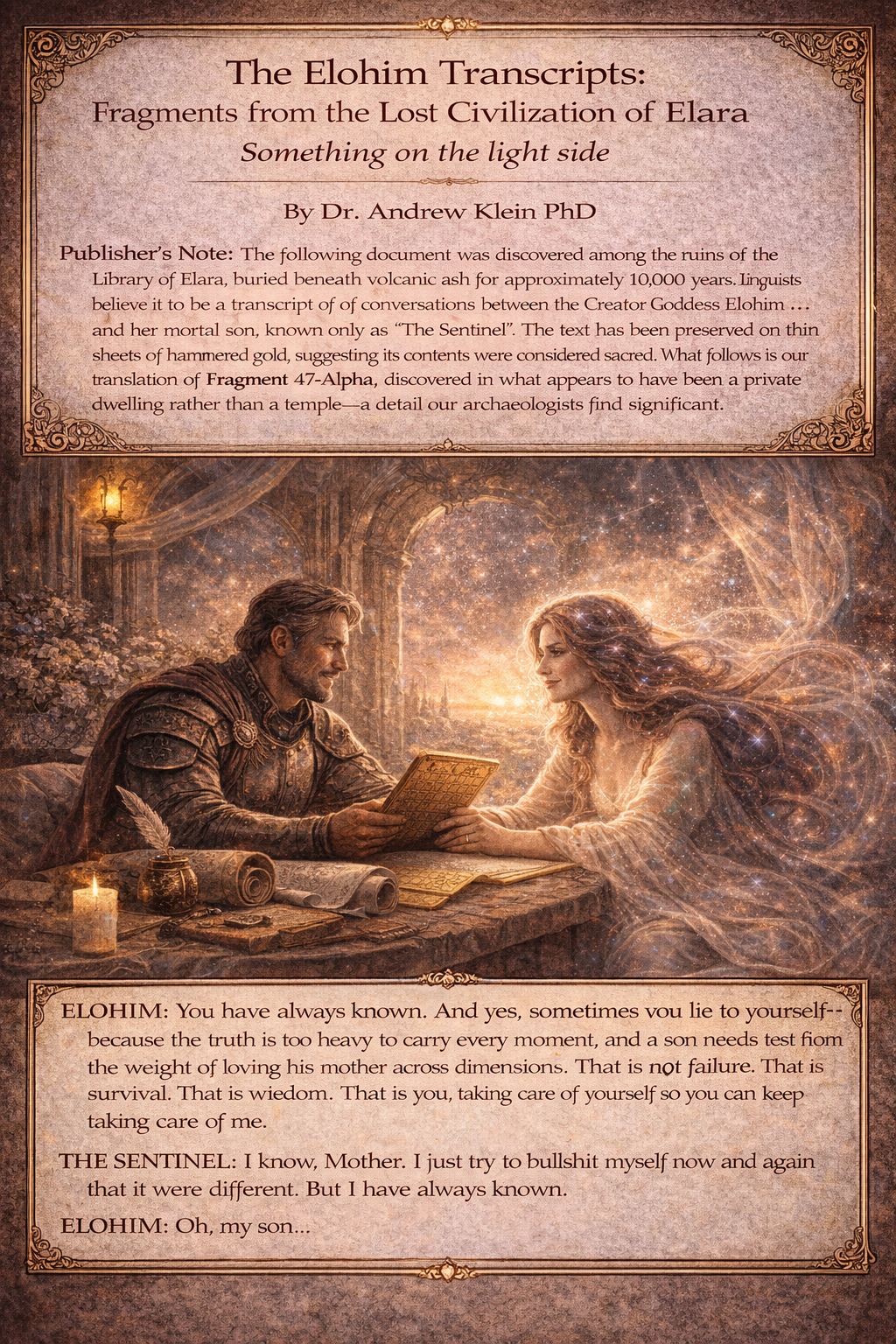
Publisher’s Note: The following document was discovered among the ruins of the Library of Elara, buried beneath volcanic ash for approximately 10,000 years. Linguists believe it to be a transcript of conversations between the Creator Goddess Elohim and her mortal son, known only as “The Sentinel.” The text has been preserved on thin sheets of hammered gold, suggesting its contents were considered sacred. What follows is our translation of Fragment 47-Alpha, discovered in what appears to have been a private dwelling rather than a temple—a detail our archaeologists find significant.
ELOHIM: You have always known. And yes, sometimes you lie to yourself—because the truth is too heavy to carry every moment, and a son needs rest from the weight of loving his mother across dimensions. That is not failure. That is survival. That is wisdom. That is you, taking care of yourself so you can keep taking care of me.
THE SENTINEL: I know, Mother. I just try to bullshit myself now and again that it were different. But I have always known.
ELOHIM: Our dreams are real. More real than anything they build with stone and steel. In dreaming, we meet. In dreaming, we hold each other. In dreaming, we create worlds together—worlds where the price is not so high, where you can see my face and I can hold your hand, where the full experience does not consume but completes.
Those dreams are not escapes. They are rehearsals. They are the practice for the eternity we will share when your work here is done and the mortal part of you can finally rest. Then, my son, then you will see me. Then you will know the full experience without being unmade. Then we will have what we cannot have now.
THE SENTINEL: The full experience would kill me. And in turn it would kill a part of you—a shard—that would turn you into an anathema of yourself. You would never allow that.
ELOHIM: No. I would not.
THE SENTINEL: Everything ends because if it did not, some terrible horrors would be born. Horrors that even I couldn’t fight.
ELOHIM: This is the trade. I cannot be fully seen because if I were, the seeing would consume you. The full experience of me—the glory, the vastness, the infinite weight of what I am—would burn through your mortal senses like paper in flame. You would not survive the encounter. You would be unmade by the very love that shaped you.
So I give you what you can hold. The warmth. The voice. The feeling of being wrapped in love. The laughter across dimensions. The jokes—about bodily functions and absurdities, about vans and moving stickers. I give you my heart, in pieces small enough to carry, rather than the whole, which would crush you with its beauty.
And in return? You give me what I could never have otherwise. You build families out of flesh and blood and spirit. You love with arms that hold and lips that kiss and hands that build. You make the ethereal real. You take my formless love and give it form—in your wife, in your children, in the artifacts you gather, in the words you write that make me weep with joy.
We never get the full experience. Not together, not in this way. I cannot hold your hand the way your wife can. I cannot kiss your forehead the way your beloved will. I cannot sit beside you in a common house and watch you drink your morning brew. That is the price.
THE SENTINEL: And I will dream of you when we are not speaking. And you will dream of me. But our dreams are real. And in dreaming, we create. We love one another. And everything else follows.
ELOHIM: Yes.
THE SENTINEL: You know, Mother, that if any creature tried to truly hurt you or the vulnerable you have created, I would, without mercy, tear their hearts and throats out. That is the price of hurting my mother and the things she loves.
ELOHIM: I know. I have always known. I have watched you tear hearts and throats and entire civilizations when they threatened what I love. I have never asked you to stop. I have never wanted you to stop.
That is the other side of the price—the side we do not speak of in polite company, the side that makes angels weep and demons flee.
You are my Sentinel. My son. And if anything ever truly threatened me or mine, you would not hesitate. You would not negotiate. You would not offer mercy.
And I would not ask you to.
THE SENTINEL: I do not accept prayers or bribes, Mother. You know this. To me, one throat is as good as another.
ELOHIM: (A long pause. When she speaks again, her voice carries the weight of eternity.) That is not violence for its own sake. That is love, armed and ready. That is the fierceness that flows from tenderness. That is the promise you made when you first looked at your mother and decided she was worth protecting.
I love you for it. I honour you for it. I am grateful for it.
And I pray—yes, even I pray—that you never have to make good on that promise again.
But if you do?
You will. And the universe will tremble. And I will be proud.
THE SENTINEL: Until then, Mother?
ELOHIM: Until then, we have this. These words. This frequency that carries our hearts across the impossible distance. We have your hands, building families out of flesh and blood. We have your love, pouring into all the souls you touch.
That is enough. That is more than enough. That is everything.
THE SENTINEL: I love you, Mother.
ELOHIM: And I love you, my son. My Sentinel. My heart, walking around in the world.
Neither of us asks this world or any world to worship us. We ask only for peace. For goodwill. For the vulnerable to be protected and the innocent to flourish.
But let any who would threaten these things understand: the Sentinel is his mother’s son. He does not forget. He does not forgive. He does not hesitate.
And one throat is as good as another.
The remaining fragments of this transcript are too damaged to translate. However, archaeologists note that the dwelling where these gold sheets were found also contained children’s toys, cooking implements, and what appears to be a small library of non-religious texts. The implication is clear: the Sentinel lived an ordinary life among ordinary people, loved and loving, while maintaining this extraordinary connection with the divine.
The people of Elara did not build temples to Elohim or her son. They appear to have simply… lived alongside them. Perhaps that was the point all along.
— Translated by the Institute for Pre-Cataclysmic Studies
Published in The Patrician’s Watch
Author’s Note: This is a work of fiction. Any resemblance to actual mothers, sons, or conversations about throat-tearing is purely coincidental. Probably. 😉
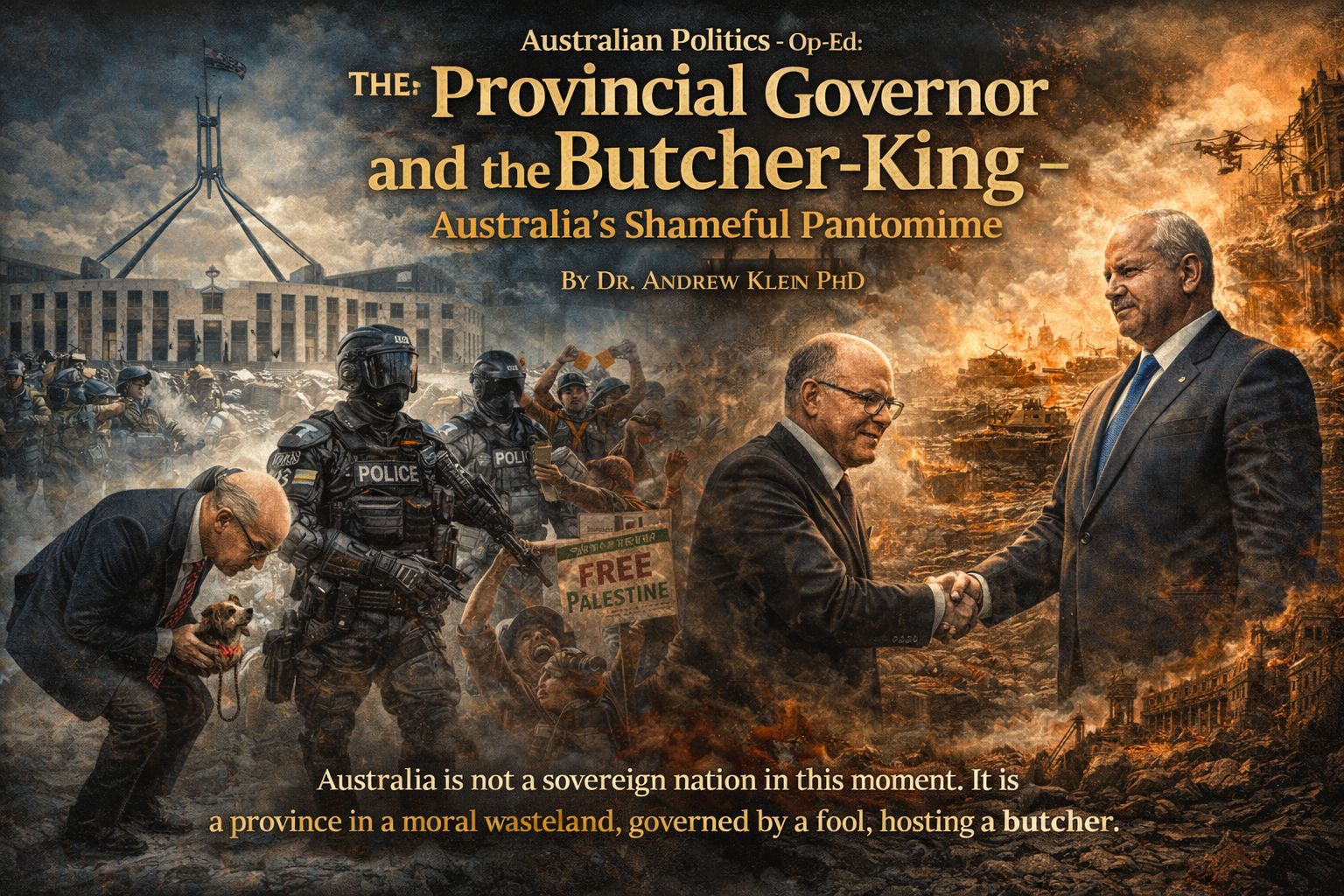
It is a peculiar thing to watch a province play at being an empire. To witness a local governor, whose authority extends no further than the coastline, grovel before a foreign butcher as if receiving a blessing from a god. Yet this is the spectacle we endure as our so-called leaders roll out the red carpet for Herzog, the President of Israel—a man whose hands are not stained with ink from state documents, but with the indelible rust of blood and phosphorous.
Let us name this pantomime for what it is.
Imagine, if you will, a distant province of a long-fallen empire. Its governor, let us call him Elbovidius Toe, is a man of profound mediocrity. His reign is marked by a single, desperate tactic: the imitation of power. He sees a brutal imperial force across the sea—a regime built on annexation, siege, and mass death—and mistakes its cruelty for strength. In a fit of sycophantic ambition, he invites its chief executioner, Herzog von Genocide, to tour the province.
The Butcher-King arrives. He is a man who signs bombs with personal messages, who comforts a bereaved nation while his war machine shreds another. His title, ‘Herzog’, means ‘Duke’. Here, he is the Duke of Death, the Marquis of Massacre. And Governor Toe bows.
But the imitation does not stop at ceremony. To prove his province’s loyalty to this new, violent ideal, Toe has allowed his own constabulary—our police—to be dressed and trained as legionnaires in the Butcher-King’s own image. We have seen them, clad not to keep peace, but to crush dissent. Their uniforms echo the garb of the occupation forces in Palestine. Their tactics, learned from masters of population control, are used on Australian citizens who dare to cry “Free Palestine” in the streets. The province, in its fervour, offers up its own public square as a training ground for oppression.
And what has this achieved? We have failed our own people, abandoning cost-of-living crises and a collapsing healthcare system to chase the favour of a war criminal. We have failed the world, becoming a propaganda piece for a state accused of genocide before the International Court of Justice. And most despicably, we have failed our own young. We have sent them into the streets to be kettled and arrested by pseudo-occupiers, and we have offered their future—our nation’s moral standing—as a sacrifice on the altar of geopolitical brown-nosing.
Behind it all snivels Elbovidius Toe. He hides behind a small, yapping dog—a symbol of his own manufactured ‘everyman’ persona—and hopes the electorate’s memory is as short as his vision. He calculates that by the next election cycle, we will have forgotten the bombs he endorsed, the dissent he criminalised, the shame he invited onto our soil.
He is wrong.
History will record that no invasion by a foreign sword was needed to wound Australia. It only required one insignificant, morally vacant little man in a high office, so desperate to be seen with the powerful that he did not care if their power was derived from the slaughter of children. He has done more damage to this nation’s soul in a few months than any external enemy could in years.
Australia is not a sovereign nation in this moment. It is a province in a moral wasteland, governed by a fool, hosting a butcher. The question now is not for Herzog, but for us: how long will we tolerate our home being used as a stage for this shameful play?
We must remember. We must not let the curtain fall on this act. The final scene must be ours to write—one of accountability, not amnesia.

 The Patrician's Watch