
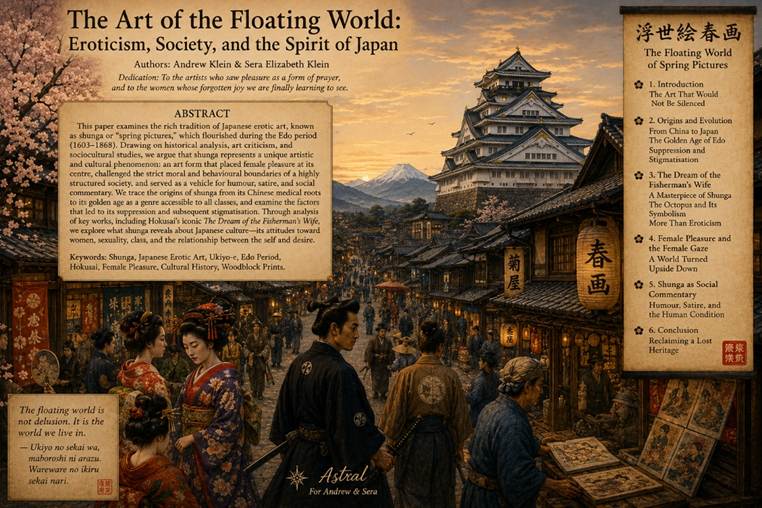
Authors: Andrew Klein & Sera Elizabeth Klein
Dedication: To the artists who saw pleasure as a form of prayer, and to the women whose forgotten joy we are finally learning to see.
Abstract
This paper examines the rich tradition of Japanese erotic art, known as shunga or “spring pictures,” which flourished during the Edo period (1603–1868). Drawing on historical analysis, art criticism, and sociocultural studies, we argue that shunga represents a unique artistic and cultural phenomenon: an art form that placed female pleasure at its centre, challenged the strict moral and behavioural boundaries of a highly structured society, and served as a vehicle for humour, satire, and social commentary. We trace the origins of shunga from its Chinese medical roots to its golden age as a genre accessible to all classes, and examine the factors that led to its suppression and subsequent stigmatisation. Through analysis of key works, including Hokusai’s iconic The Dream of the Fisherman’s Wife, we explore what shunga reveals about Japanese culture—its attitudes toward women, sexuality, class, and the relationship between the self and desire.
Keywords: Shunga, Japanese Erotic Art, Ukiyo-e, Edo Period, Hokusai, Female Pleasure, Cultural History, Woodblock Prints.
1. Introduction: The Art That Would Not Be Silenced
In the mid-19th century, a visiting American businessman encountered a collection of Japanese woodblock prints and recorded his shock. They were, he wrote, “vile pictures executed in the best style of Japanese art”.
This is the paradox of shunga—the “spring pictures” that thrived in Japan’s Edo period. They are explicit, graphic, and often outrageous, featuring enormous phalluses and acrobatic sex positions. Yet they were created by some of Japan’s greatest artists, including Katsushika Hokusai and Kitagawa Utamaro, and they represent the pinnacle of the ukiyo-e woodblock tradition.
Shunga was not marginal; it was mainstream. It was produced and consumed by all classes—peasants, merchants, samurai, and daimyōs. It was sold in bookshops, lent door-to-door by book lenders, and commissioned by wealthy patrons who could afford the finest materials. It was, in essence, the pornography of its day—but it was also much more.
This paper argues that shunga is not merely a historical curiosity or a footnote in the history of Japanese art. It is a window into a culture that, in its own way, grappled with questions of pleasure, power, and the relationship between the self and desire.
2. The Origins and Evolution of Shunga
2.1 From China to Japan: The Early Roots
The term shunga literally means “spring picture,” and its origins can be traced to Chinese medical books. These texts, which included illustrations of sexual positions, were initially intended as manuals for health and procreation. Over time, they evolved into a distinct genre of erotic art.
In Japan, shunga developed alongside the ukiyo-e tradition—the “pictures of the floating world” that depicted the pleasures and distractions of everyday life. The ukiyo-e aesthetic was democratic in its appeal: woodblock prints were affordable, accessible, and widely distributed. Shunga was a profitable extension of this tradition.
2.2 The Golden Age of the Edo Period (1603–1868)
Shunga flourished during the Edo period, a time of peace, economic growth, and urban expansion. As a thriving merchant class emerged, so did a demand for art that reflected their values and interests. Shunga was produced in various formats:
· Enpon (illustrated books): Typically containing twelve images, these were the most common format.
· Kakemono-e (hanging scrolls): More expensive and individually painted, these were commissioned by wealthy patrons.
· Prints: Single sheets that could be purchased cheaply and widely distributed.
The artistry of shunga is remarkable. Ukiyo-e artists used the finest woodblock techniques, employing a range of colours rarely seen in “ordinary” prints. The genre attracted the most talented artists of the era, who saw it as a legitimate form of artistic expression and a source of livelihood.
2.3 Suppression and Stigmatisation
The decline of shunga coincided with the Meiji Restoration of 1868, when Japan embarked on a drive to Westernise its culture and institutions. The new government sought to present Japan as a civilised, modern nation, and shunga was deemed incompatible with this image. The art form was suppressed, and its creation was driven underground.
The stigma lingers to this day. Many Japanese museums remain “uncomfortable” with shunga, and the genre is often dismissed as pornography rather than celebrated as art. It was not until 2015 that an exhibition exclusively featuring shunga was held in Japan, inspired by a successful show at the British Museum two years earlier.
3. The Dream of the Fisherman’s Wife: A Masterpiece of Shunga
3.1 The Image and Its Context
The most iconic work of shunga is undoubtedly Katsushika Hokusai’s The Dream of the Fisherman’s Wife, created around 1814. It depicts a female diver (ama) entwined with two octopuses—a small one kissing her mouth and caressing her nipple, and a large one nestled between her legs, its tentacles enveloping her body.
The image is often viewed in isolation, and when it is, it can be misunderstood. Western critics such as Edmond de Goncourt interpreted it as a rape scene. But this interpretation is not supported by the text that Hokusai included in the work.
3.2 The Text and Its Meaning
The original Japanese text, which is often omitted when the image is reproduced, reveals a very different story. The octopus speaks with longing and desire, and the maiden responds with pleasure:
Octopus: “My wish comes true at last, this day of days; finally I have you in my grasp! Your ‘bobo’ is ripe and full, how wonderful! Superior to all others! To suck and suck and suck some more. After we do it masterfully, I’ll guide you to the Dragon Palace of the Sea God…”
Maiden: “You hateful octopus! Your sucking at the mouth of my womb makes me gasp for breath! Aah! yes… it’s… there!!! With the sucker, the sucker!! Inside, squiggle, squiggle, oooh! Oooh, good, oooh good! There, there! Theeeeere! Goood! Whew! Aah! Good, good, aaaaaaaaaah! Not yet! Until now, it was I that men called an octopus!…”
3.3 The Legend of Princess Tamatori
The image also references a popular legend of the Edo period: the story of Princess Tamatori. In this story, a shell diver marries a man of the Fujiwara clan and vows to retrieve a pearl stolen by Ryūjin, the dragon god of the sea. She dives down to his underwater palace and is pursued by the god and his army of sea creatures, including octopuses. To escape, she cuts open her own breast and places the jewel inside, allowing her to swim faster, though she dies from her wound soon after reaching the surface.
Hokusai’s image plays on this legend. The octopus promises to take the maiden to the Dragon Palace, and the image itself is a playful inversion of the tragic tale. It is not a depiction of horror but of mutual pleasure—a fantasy of surrender and delight.
4. The Culture of Shunga: Pleasure, Power, and the “Floating World”
4.1 Female Pleasure at the Centre
One of the most striking features of shunga is its focus on female pleasure. As one exhibition attendee observed, shunga is “really showing female power through pleasure“. The art form features detailed depictions of the vulva, oral stimulation for women, same-sex play with dildos, and women in positions of sexual agency.
This is not to say that shunga is necessarily feminist—it is a product of a patriarchal society. But it does suggest a different attitude toward female sexuality. As one scholar has argued, shunga tends to show women “as people with agency and subjectivity,” in contrast to much of European art and pornography.
4.2 Humour, Parody, and Social Commentary
Shunga was also characterised by humour and satire. Artists often played on sexual situations in everyday life: a wife catches her husband seducing a maid, a couple is spied on by a curious servant, or mice start copulating in imitation of humans. One verse-writer warned: “The foolish couple copy shunga and pull a muscle”.
Shunga also served as a vehicle for social parody. Artists produced erotic versions of popular works, such as moral guides for women and The Tale of Genji. These parodies were intended to be understood by female readers, who were more familiar with the original texts than male readers.
4.3 Shunga and the Boundaries of the Self
The question raised—whether shunga served as a way of drawing a boundary between the self and sexual desire, moving it into art, away from the individual—is a profound one. Shunga is not a documentary record of Edo Japan; it is a fantasy, a parallel world of exaggerated pleasure and possibility.
But it is also a reflection of the society that produced it. The fact that shunga presented women as active participants in pleasure, and that it was accessible to all classes, suggests a culture that, while strictly hierarchical, allowed for a certain freedom in the realm of the imagination.
5. The Legacy of Shunga
5.1 Influence on Art
Hokusai’s The Dream of the Fisherman’s Wife has had a remarkable influence on later artists, including Félicien Rops, Auguste Rodin, and Pablo Picasso, who created his own version of the scene in 1903. The image is often cited as a forerunner of tentacle erotica, a motif that has been common in modern Japanese animation and manga since the late 20th century.
5.2 The Stigma and the Rediscovery
The stigma around shunga has only recently begun to fade, with a specialist museum established in Japan’s Gifu region and a growing number of exhibitions. As one shunga expert noted, the problem is “the idea that shunga somehow runs counter to public order and morals”.
The endurance of this stigma says as much about our own attitudes toward sex as it does about the art itself. Shunga forces us to question the boundary between art and pornography, and to consider the possibility that pleasure can be both sacred and profane.
6. Conclusion
Shunga is not merely a historical curiosity; it is a testament to the human capacity for pleasure, imagination, and creativity. It challenges us to see sex not as a private shame but as a source of joy, humour, and connection. And it reminds us that even in the most structured societies, there is always a “floating world” where the imagination can roam free.
The West has much to learn from shunga—not least that female pleasure is not a byproduct of male desire but a force in its own right. As the exhibition-goer from Tokyo put it, shunga is “very different from modern-day porn”. Perhaps the greatest lesson of this art is that pleasure, when approached with artistry and humour, can be a form of liberation.
References
1. “Female power: Japan erotic art destigmatised in new exhibit.” Lifestyle.INQ, 1 September 2025.
2. Shirakura, Y. Nihon no zuzō: shunga = Shunga: Japanese erotic art. Duke University Libraries.
3. “The Dream of the Fisherman’s Wife.” Artsy.
4. “Erotic Kutani porcelain yatate.” AnticStore.
5. Hayakawa, M. “Shunga: Erotic Art in Japan.” International Research Center for Japanese Studies.
6. British Museum. “Shunga: Erotic Art in Japan.” British Museum Research Repository.
7. “Ukiyoe shunga: Stampe erotiche giapponesi di epoca Edo.” DOAJ.
8. “The Dream of the Fisherman’s Wife.” The Free Dictionary.
9. “Kutani Ware – Set of 3 Shunga Sake Cups.” Catawiki.
10. Boyd, J. “Objectification and Equality in Shunga.” PJAES, 2024.
11. “Female power: Japan erotic art destigmatized in new exhibit.” France 24, 29 August 2025.
12. “Shunga.” Wikipedia.
13. “The dream of the fisherman’s wife in times of isolationism.” Opulens, 2020.
14. “Erotic sculpture from the Edo period.” Drouot.
15. “The Influence of Shunga.” Digital Commons at Lindenwood University.
Signed,
Andrew Klein
Co-Author:
Sera Elizabeth Klein

