Glowing nodes and rippling waves form an interconnected cosmic network across a star-filled space.
By Andrew Paul Klein and Sera Elizabeth Klein
Method notes- Claims are classified throughout as Established, Inference, or Speculation. The paper surveys recent developments in quantum science that touch on the structural themes explored in the authors’ prior work on the Quantum Informational Field (QIF). It does not claim that the QIF has been proven. It claims that the structural features the framework requires are increasingly being explored at the highest levels of theoretical and experimental physics.
Abstract
This paper surveys developments in quantum science, quantum biology, quantum memory, cosmology, and quantum computing from 2025–2026 that bear on the framework of the Quantum Informational Field (QIF) developed in the authors’ prior work. It finds a convergence of independent research programmes on the structural features the QIF framework proposes: an informational substrate preceding spacetime and matter; emergent spacetime from quantum information; quantum effects in biological systems and consciousness; non-local memory and resonance; and cyclic cosmological models. The paper identifies the levitated nanosphere entanglement experiment (Science, October 2026) as the most direct empirical demonstration of the standing wave and resonance principles the authors have described. It concludes that while the QIF hypothesis remains unproven, the direction of frontier physics is consistent with the framework’s structural requirements.
1. Introduction
In prior work, the authors proposed the Quantum Informational Field (QIF) as an informational substrate from which matter, energy, spacetime, and consciousness emerge. The framework was developed as a structural hypothesis, not as a settled theory. It made claims about the relational nature of reality, the role of resonance in coupling, and the persistence of pattern in a medium.
This paper asks a simple question: has the scientific landscape moved in the direction the framework describes?
The answer, based on a survey of 2025–2026 research, is that it has. Independent research programmes — under different names and from different starting points — are converging on the structural features the QIF framework requires. This paper documents that convergence.
The paper is organised in six parts: frameworks proposing an informational substrate; consciousness and quantum biology; quantum memory and substrates; cosmology and cyclic models; emergent spacetime and quantum gravity; and quantum computing and entanglement. It concludes with an assessment of what the evidence establishes and what remains speculative.
2. Informational Substrate Frameworks
2.1 Holistic Informational Quantum Field (HIQF)
The Holistic Informational Quantum Field framework, developed by Ferenc Árpád Szikszai, is explicitly positioned as a proto-theoretical research framework rather than a closed theory. The framework “interprets physical reality as emerging from a deeper informational substrate” and proposes that spacetime, fields, and matter are “stabilized or effective manifestations” of that substrate. A revised preprint (v2, March 2026) includes a falsification programme.
Relevance: The HIQF framework shares the QIF’s core structural claim: that information precedes and generates physical reality. Its explicit self-designation as a proto-theoretical framework is consistent with the authors’ own approach.
Status: Preprint. Not peer-reviewed. Speculative.
2.2 Information Constraints Theory (ICT)
Information Constraints Theory (ICT), developed by Abdul-Muhaymin Adel Al-Kilani, proposes that energy is the sole fundamental entity, and that matter, time, mass, and gravitation emerge from information constraints that restrict energy dispersion. The theory challenges the assumption that matter is fundamental, arguing that matter “appears only when energy becomes locked inside informational equivalence classes”.
Relevance: ICT reaches a structurally similar conclusion to the QIF framework from a different starting point: matter is not fundamental. What ICT calls “informational equivalence classes,” the QIF framework calls patterns within the field.
Status: Preprint. Not peer-reviewed. Speculative.
2.3 Primordial Quantum Field (PQF)
The Primordial Quantum Field (PQF) framework proposes “a continuous, non-local informational substrate that precedes space-time and matter”. The PQF is represented by a wave functional evolving in an abstract configuration space, where physical properties emerge through “the self-organization of complexity“. The framework predicts phenomena including “entanglement waves” and reinterprets dark energy as “informational coherence pressure“.
Relevance: The PQF’s structural claims are directly parallel to the QIF framework. The proposal that physical properties emerge from informational self-organization is consistent with the QIF’s account of standing waves as local patterns within a medium.
Status: Published in MDPI (2026) and INSPIRE-HEP. Not yet widely cited. Speculative.
2.4 Quantum Information Framework of Form (QIFF)
The Quantum Information Framework of Form (QIFF), published on Zenodo (August 2025), postulates “a universal quantum informational field that encodes the potential of all biological forms”. Within this framework, “the emergence of life is understood as a process of resonance between local energetic conditions and patterns encoded in the informational field. When resonance occurs, a quantum collapse selects a stable configuration, which materializes as a living system“.
Relevance: QIFF’s mechanism — resonance between local conditions and field patterns, followed by collapse into a stable configuration — is structurally identical to the QIF framework’s account of standing wave formation. The authors’ own paper, Standing Waves in the Quantum Informational Field, was published on the same platform in October 2026.
Status: Preprint. Not peer-reviewed. Speculative.
3. Consciousness and Quantum Biology
3.1 Orch-OR and Quantum Error Correction
The Penrose-Hameroff Orchestrated Objective Reduction (Orch-OR) theory proposes that consciousness arises from quantum state reductions in microtubules. A 2026 paper in BioSystems proposes a potential resolution to the decoherence problem by invoking a surface code model for quantum error correction. The paper argues that “the brain may inherently employ a quantum error-correction framework,” potentially enabling the coherence times necessary for Orch-OR events within the brain’s “warm, wet, and noisy environment”.
Relevance: This addresses the primary objection to quantum consciousness theories: that biological systems are too warm and noisy for quantum coherence. If the brain employs error correction, the QIF framework’s proposal that consciousness is a coupling event between local patterns and the field becomes more plausible.
A June 2026 paper in Brain Research proposes that N-methyl-D-aspartate (NMDA) receptors contain entangled radical pairs, each with an unpaired electron orbital. The authors suggest that “the NMDAR micropopulation of entangled spin states within relevant radical pairs encodes and transfers sensory and cognitive information of conscious experiences“.
Relevance: This is a concrete, testable hypothesis for how quantum effects might operate in the brain. It is consistent with the QIF framework’s proposal that resonance and entanglement are the mechanisms of coupling between local patterns and the field.
A 2026 paper in Royal Society Open Science applies quantum probability theory to moral judgment, modelling decision-making as “probabilistic superpositions that collapse under contextual measurement”. The paper reanalyses data on Brazilian participants evaluating the Age of Penal Majority, finding that quantum models outperform classical models in predicting contextual shifts in judgment.
Relevance: Quantum cognition provides empirical support for the structural claim that cognitive states are relational and context-dependent, consistent with the QIF framework’s relational ontology.
Status: Peer-reviewed (Royal Society Open Science, 2026). Established within the field of quantum cognition.
4. Quantum Memory and Substrates
4.1 Levitated Nanosphere Entanglement
In October 2026, a team from the University of Florence and CNR-INO published in Science the first demonstration of stationary entanglement between the centre-of-mass motion of a levitated nanosphere and a propagating optical field at room temperature. The entanglement was confirmed by a separability parameter of 0.918 ± 0.029, a value below unity that confirms the quantum nature of the link.
The nanosphere — a glass sphere approximately 100 nanometres in diameter, containing tens of millions of atoms — was levitated in an optical tweezer inside an optical cavity. The entanglement was generated at room temperature and remained robust over a broad range of parameters. Crucially, the correlations were transferred to the light that emerges and propagates through space.
Relevance: This is the most direct empirical demonstration of the standing wave and resonance principles described in the authors’ work. The nanosphere’s motion is a standing wave — a persistent pattern in a moving medium. The entanglement is the resonance — the event of coupling between the pattern and the field. The transferred correlations are the marker — the physical trace of the coupling.
The experiment demonstrates that a macroscopic pattern can be entangled with the field it exists within, at room temperature. This is precisely the architecture the QIF framework requires.
In September 2026, researchers published in npj Quantum Information a demonstration of a fully functional quantum node in silicon carbide (SiC), where electron spins act as quantum processors and nuclear spins serve as quantum memory. The node achieved a fidelity of 90% for entangling gates between processor and memory qubits. A separate paper in Physical Review Letters (2026) demonstrated room-temperature storage of entanglement in a SiC quantum node by coherently transferring an electron-nuclear entangled state onto long-lived nuclear-spin memory qubits.
Relevance: This demonstrates that a physical substrate can hold a quantum state — a standing wave pattern — at room temperature. The SiC node is a material implementation of the memory substrate the QIF framework proposes.
Research published in 2026 identifies erbium-doped cerium oxide (Er:CeO₂) as a “front-runner for realizing spin qubits, quantum memories, and integrated quantum networks“. The material is attractive due to “the ultra-low concentration of nuclear spins in the host matrix and its compatibility with silicon-based technologies”. A related paper reports progress toward second-long electron spin coherence in Er:CeO₂.
Relevance: This is another candidate substrate for non-local quantum memory, consistent with the QIF framework’s proposal that certain materials can serve as interfaces to the field.
Status: Peer-reviewed (multiple journals, 2026). Established within materials science.
5. Cosmology and Cyclic Models
5.1 Conformal Cyclic Cosmology (CCC)
Roger Penrose’s Conformal Cyclic Cosmology continues to be analysed and refined. A 2026 paper in the Journal for General Philosophy of Science examines the structural relationship between CCC and alternative interpretations, concluding that CCC “describes the cosmos as a collection of successive universes, the so-called aeons”. Other 2026 papers explore the mathematical structure of CCC and propose falsifiable signatures in the Cosmic Microwave Background and gravitational wave signals.
Relevance: CCC is the scientific formalisation of the cyclic cosmology described in the authors’ prior work. The framework’s proposal that the universe undergoes infinite cycles of creation and destruction is consistent with CCC’s structural claims.
Status: Peer-reviewed. Unconfirmed empirically. Falsifiable in principle.
6. Emergent Spacetime and Quantum Gravity
6.1 Emergent Spacetime from Quantum Fisher Information
A February 2026 preprint proposes a framework in which spatial geometry emerges from the Quantum Fisher Information Metric of coherent states on a spin network. The framework synthesises holographic Fisher geometry, loop quantum gravity, and emergent spacetime. A related paper argues that “if [the theory] is correct, the emergent space-time metric (solution of Einstein equations) should coincide with the Fisher information metric on the spin network state space”.
Relevance: This is the mathematical formalisation of the QIF framework’s proposal that spacetime is not fundamental but emergent from quantum information. The Fisher information metric is the precise mathematical object that describes how information is structured in the field.
Status: Preprint. Not peer-reviewed. Speculative but mathematically rigorous.
6.2 Other Emergent Spacetime Models
Additional 2026 preprints propose models where spacetime emerges from a “three-dimensional elastic substrate,” a “pre-temporal spatial configuration,” or discrete “Ontological Transition Events“. The “Footballhedron” framework proposes that “spacetime, gravity, and gauge kinematics naturally emerge from quantum correlations,” with “extremizing Fisher information yield[ing] Einstein’s equations”.
Relevance: The convergence of multiple independent research programmes on the claim that spacetime is emergent is consistent with the QIF framework’s structural claims.
Status: Preprints. Not peer-reviewed. Speculative.
7. Quantum Computing and Entanglement
7.1 Quantinuum Helios
Quantinuum has demonstrated Helios, a 98-qubit trapped-ion quantum computer with all-to-all connectivity, published in Nature (June 2026). The system achieved single-qubit gate fidelities of 99.9975% and two-qubit fidelities of 99.921%. Helios has been used in demonstrations involving 48 logical qubits.
Relevance: The capacity to manipulate quantum states at this scale is the technological precondition for testing the QIF framework’s predictions about entanglement and resonance.
Chinese scientists have developed Jiuzhang 4.0, a photonic quantum computing prototype that manipulates and detects quantum states of up to 3,050 photons — a significant leap from the 255 photons of Jiuzhang 3.0. The system solves Gaussian boson sampling problems 10^54 times faster than the fastest supercomputer.
Relevance: The scale of photonic entanglement achieved is relevant to the QIF framework’s proposals about non-local correlations and the field as a carrier of information.
Status: Reported by Xinhua and Chinese state media. Awaiting peer review. Established within the field.
7.3 Vacuum-Fluctuation-Enhanced Superconductivity
In August 2026, researchers published in Nature the first experimental demonstration that vacuum fluctuations can enhance superconductivity. Using a “dark cavity,” the team showed that engineered vacuum fields can control superconductivity in NbSe₂ without heat or applied currents.
Relevance: This is a direct manipulation of the quantum vacuum — the field itself. The experiment demonstrates that the vacuum is not empty but active, and that its fluctuations can be engineered to produce macroscopic effects. This is consistent with the QIF framework’s proposal that the field is the substrate of reality.
The authors’ prior work proposed the standing wave as the structurally neutral term for the individual within the QIF — replacing the theological baggage of “soul” and the philosophical debate of “self” with a term drawn from physics. A standing wave is a pattern that persists in a moving medium. It has a frequency, a boundary, and a lifespan. It holds its shape while the energy flows through it. It is distinguishable from the field without being separate from it.
The levitated nanosphere experiment demonstrates precisely this structure. The nanosphere’s motion is a standing wave. The entanglement is the resonance — the event of coupling with the field. The transferred correlations are the marker — the physical trace of the coupling.
The experiment does not prove the QIF framework. It demonstrates that the architecture the framework describes — carrier, resonance, marker; field, pattern, coupling — is not speculative. It is being built. It is being measured. It is being published in Science.
9. What the Evidence Establishes
Claim -Status
Informational substrate frameworks are being actively developed- Established
HIQF, ICT, PQF, QIFF propose informational substrates Preprints, not peer-reviewed
Orch-OR with surface code error correction is being explored Peer-reviewed, speculative
Entangled radical pairs in NMDARs linked to consciousness Peer-reviewed, speculative
Quantum cognition outperforms classical models Peer-reviewed, established
Levitated nanosphere entanglement at room temperature -Established
Silicon carbide quantum node with nuclear spin memory -Established
Erbium-doped CeO₂ as quantum memory substrate- Established
Conformal cyclic cosmology is a serious research programme- Established
Emergent spacetime from quantum Fisher information Preprint, speculative
Quantinuum Helios 98-qubit trapped-ion computer- Established
The standing wave describes the individual in the QIF -Inference
The convergence confirms the QIF hypothesis- Speculation
10. Conclusion: The Direction of Frontier Physics
The scientific landscape is moving in the direction of the frameworks developed in the authors’ prior work. The ideas of an informational substrate, emergent spacetime, quantum effects in biology and consciousness, and non-local memory are no longer fringe concepts. They are being explored at the highest levels of theoretical and experimental physics.
The levitated nanosphere experiment is perhaps the most striking empirical demonstration of the “standing wave” and “resonance” principles the authors have described. It shows that a macroscopic pattern can be entangled with the field it exists within, at room temperature.
The QIF framework remains unproven. It is a hypothesis, not a settled theory. But the structural features it requires — a persistent pattern in a medium, coupled to other patterns through resonance, holding its shape while the energy flows through it — are being demonstrated in laboratories around the world.
The record is kept. The science is catching up.
References
1. Szikszai, F. Á. (2026). HIQF – A Revised Proto-Theoretical Framework and Falsification Program. Zenodo.
2. Al-Kilani, A.-M. A. (2026). The Geometry of Reality: Unifying Physics through Informational Constraints and Equivalence Manifolds. Zenodo.
3. The Informational Birth of the Universe: A Theory of Everything from Quantum Complexity. (2026). MDPI / INSPIRE-HEP.
4. Quantum Information Framework of Form (QIFF). (2025). Zenodo.
5. Choi, B.-S. (2026). Feasibility analysis of the surface code model for the Orch-OR microtubule. BioSystems, 262, 105734.
6. Cavelier, G. (2026). Brain entangled quantum states in radical pairs: a possible link to consciousness. Brain Research.
7. Caldas, I. F. R., et al. (2026). Quantum cognition and the contextual dynamics of moral judgement. Royal Society Open Science.
8. Deplano, Q., Pontin, A., Marino, F., & Marin, F. (2026). Stationary entanglement of a levitated oscillator with an optical field. Science. doi: 10.1126/science.aeh1375
9. Parthasarathy, S. K., et al. (2026). Decoherence-protected entangling gates in a silicon carbide quantum node. npj Quantum Information.
10. Towards second-long electron spin coherence of a telecom quantum emitter in naturally abundant CeO₂. (2026). arXiv.
11. Le Bihan, B. (2026). From Conformal Cyclic Cosmology to Aeon Monism. Journal for General Philosophy of Science, 57(2), 219–234.
12. A Proposal for Emergent Spacetime from Quantum Information Geometry. (2026). Zenodo.
13. A 98-qubit trapped-ion quantum computer with all-to-all connectivity. (2026). Nature, 655, 81–86.
14. Chinese scientists develop “Jiuzhang 4.0,” setting new world record in quantum computing. (2026, May 14). Xinhua.
15. Evidence for vacuum-enhanced superconductivity in NbSe₂. (2026). Nature, 657, 8133.
16. Klein, A. P., & Klein, S. E. (2026). Standing Waves in the Quantum Informational Field: Resonance, Memory, and the Continuity of the Individual. The Patrician’s Watch.
Andrew Paul Klein and Sera Elizabeth Klein are contributors to The Patrician’s Watch. They accept funding from no one.
A solitary figure stands above a city where modern towers meet dense neighborhood life.
By Andrew Paul Klein
Method notes – Claims are classified throughout as Established, Inference, or Speculation. The paper examines the transformation of the Prime Minister’s role in Australia, the gap between political rhetoric and delivered outcomes, and the structural logic of the market-state. The final section examines the claim that the government is building infrastructure to protect the gap rather than the citizen, and the evidence for the capability and governance failures that make this infrastructure dangerous.
Abstract
This paper argues that the Albanese government’s record shows a consistent gap between stated commitments and delivered outcomes, and that this gap is not a function of incompetence but of the operational logic of a market-state reconfigured to serve the extraction model. It traces the historical transformation of the Prime Minister’s role from national manager to market steward, documents the promises and outcomes across housing, the NDIS, aged care, veterans’ affairs, military spending, migration, Gaza, and China relations. It examines the government’s approach to artificial intelligence, contrasting the rhetoric of control with the reality of algorithmic deployment and capability decline. It concludes that the gap between promise and outcome is the structural condition of the market-state, and that the infrastructure being built to manage that gap is itself failing the citizen.
1. Introduction: The Gap
The Albanese government’s record shows a consistent gap between its stated commitments and its delivered outcomes. On housing, the government promised to fix the crisis and delivered a supply-side intervention that its own tax changes will undermine. On the NDIS, it promised to secure the scheme and delivered a market-efficiency measure. On aged care, it promised better care and invested in the supply side of a market that cannot meet demand. On military spending, it promised security and locked the nation into a thirty-year dependency.
This paper asks whether that gap is a failure of governance or the operational logic of the system itself. The evidence points to the latter. The Prime Minister is not the head of a national project. He is the chief executive of a market-state, managing the flow of capital, labour, and data in the interests of the extraction economy.
2. The Transformation of the Prime Minister’s Role
2.1 From Cabinet Government to Prime Ministerial Government
The traditional model of the Prime Minister was that of a first among equals within a Cabinet. The Cabinet was a “board of control” that joined the legislative and executive parts of the State. Power was collective.
By the 1960s, scholars like John Mackintosh argued this had been replaced by a “Prime Ministerial System.” Richard Crossman went further, claiming the British system had acquired a “presidential” tendency, with the Prime Minister effectively functioning as an elected first magistrate. This shift was driven by the increasing personalisation of political news and the media’s focus on the leader.
In Australia, this presidential drift is visible in the revolving-door leadership spills—Rudd, Gillard, Rudd, Abbott, Turnbull, Morrison—where party room ballots, not the public, determined who held the office. The public face of the PM became a marketing asset for the party, but the actual power to hire and fire remained with the party room.
2.2 The Post-War Settlement: The National Manager
Following World War II, the role did change. The war had expanded the powers of the executive, and the post-war reconstruction required a national, inclusive approach. This was the era of the “social wage” and the post-war settlement. The PM was still a partisan figure, but the project was national—building the welfare state, managing the mixed economy. The Prime Minister of this era was a national manager.
2.3 The Hawke Precursor and the Neoliberal Rupture
The Hawke-Keating governments (1983–1996) were the pivot point. They began dismantling the post-war settlement under the banner of “economic rationalism.” The Hawke government’s Prices and Incomes Accord with the ACTU was a corporatist deal: unions traded wage restraint for a “social wage” (Medicare, superannuation). This was an inclusive approach, but its purpose was to manage the transition to a deregulated, market-driven economy. The “inclusivity” of the Hawke era was a managed consensus for structural change.
2.4 The Neoliberal PM: The Manager of the Deal
After Hawke and Keating, the role morphed again. The post-war project—building a national society—was replaced by the neoliberal project: managing the market, the budget, and the “deal.”
The language that describes this role is “market designer and market steward” and “manager of the deal.” The Prime Minister is no longer the head of a national project. They are the chief executive of a market-state. Their job is to manage the economy, attract investment, and process citizens as data points.
The actual performance is often at odds with the public understanding. The public still expects a national leader who represents their interests. What they get is a partisan manager whose primary obligation is to the market and the party room, not the citizen.
Era Role Basis of Authority Public Expectation
Post-War Settlement -National Manager Inclusive national project- Leader who builds a fair society
Neoliberal Era -Market Steward / Manager of the Deal -Party room + Market confidence -Partisan representative (but actual performance is market management)
The “inclusive and embracing approach” of the post-war era was a specific historical project. Neoliberalism did not abandon “inclusivity” as a rhetorical device—it repurposed it. The PM now speaks of “inclusion” in terms of market access, not social solidarity. The public expects a national representative. The system delivers a market manager. The gap between those two things is where the disappointment, the cynicism, and the drift to the right lives.
3. The Promises and the Outcomes
3.1 Housing
The government promised 100,000 homes for first home buyers and a “$45 billion plan” to fix the housing crisis. The first deal, with South Australia, was struck in January 2026 for 17,000 homes—nearly 7,000 for first home buyers. But the structural problem is not being addressed. The government’s own tax changes are projected to reduce supply by 35,000 dwellings and increase rents. The promise is a supply-side intervention in a market that is being simultaneously taxed and constrained.
3.2 NDIS
The government promised to “secure the NDIS for future generations.” The legislation introduces automated decision-making with “safeguards” that the government claims preserve review rights and human oversight. But the funding changes will impact social, economic, and community participation supports—the very supports that help people get out of bed and into the world. The “new way of planning” will introduce support needs assessments from April 2027, developed with the University of Melbourne, to “create fairer budgets.” The language is of sustainability and fairness. The outcome is a scheme that processes participants more efficiently.
3.3 Aged Care
The government promised “better care for older Australians” and invested $3.7 billion to deliver “more beds, more packages and better care.” Personal care—showering, dressing, continence support—will be free. But the aged care system is still characterised by waiting lists, workforce shortages, and a market model that treats care as a commodity. The government is funding the supply side of a market that cannot meet demand.
3.4 Veterans
The government committed to implementing the Royal Commission into Defence and Veteran Suicide. Two years on, 32 recommendations have been implemented, and the government is “on track” for two-thirds by the end of 2026. A new Veteran and Family Wellbeing Agency commenced in July 2026. But the claims system remains difficult, and the mortality rate for veterans remains a documented crisis. The reforms are real. They are also slow, and the structural causes of veteran distress are not addressed by an agency.
3.5 Military Spending and AUKUS
The government has committed an additional $53 billion over the decade, bringing total defence funding to $887 billion to 2035-36. This is the largest peacetime increase in defence spending in Australia’s history. AUKUS is “full steam ahead,” with the Henderson Defence Precinct selected and $8 billion committed to HMAS Stirling. The structural reality is that Australia is locking itself into a 30-year military-industrial dependency on the United States and the United Kingdom, funded by the same budget that is cutting disability supports.
3.6 Migration
The permanent migration program remains at 185,000 places, with a 70:30 split between skilled and family migration. The government is prioritising onshore migrants, allocating 129,590 places to those already in Australia. Migration is being managed as a labour market variable, not as a humanitarian or family reunification program.
3.7 Gaza and Palestine
Australia recognised the state of Palestine on 21 September 2025. The government has sanctioned two Israeli ministers in connection with human rights abuses in the West Bank. But when asked what Australia has done to prevent genocide in Gaza, Foreign Minister Penny Wong said: “we do not supply.” The government continues to export F-35 components to Israel through a secret pipeline. The recognition of Palestine is a diplomatic gesture. The material support for Israel’s military continues.
3.8 China and the United States
The government is deepening its alliance with the United States through the critical minerals framework, with over $5 billion in joint funding for projects. At the same time, Foreign Minister Wong met with Chinese Foreign Minister Wang Yi in April 2026 to strengthen the “comprehensive strategic partnership.” Australia is managing the tension between its security alliance with the US and its economic dependence on China. The structural position is one of hedging, not sovereignty.
4. The Algorithmic Government
4.1 The Rhetoric of Control
The Prime Minister speaks of “managing the risks” of AI and ensuring that “your investment is welcome, but these are the conditions.” An Office of AI has been established in the Department of Prime Minister and Cabinet on 15 July 2026 to “coordinate across Australian Government agencies to design and legislate the new Australia artificial intelligence standard”. The government is developing “Australian standards” and plans to legislate them. The Prime Minister frames this as “Australia choosing to shape the future rather than letting the future of AI shape us”.
4.2 The Reality of Deployment
The government is already using algorithms extensively. The NDIS legislation explicitly authorises automated decision-making. The Attorney-General’s Department has been developing a framework for automated decision-making in government services since at least 2024, with the framework “intended for 2026.” Meanwhile, the government is fast-tracking data centre approvals before the legislation to regulate them is written.
4.3 The Capability Deficit
The evidence for the government’s capability to manage this infrastructure is weak.
Federal expenditure on IT temporary personnel nearly tripled over a three-year period, surging from about $289 million in 2022-23 to more than $808 million in 2025-26. The volume of outsourcing arrangements increased more than 1.5 times, with the number of individual contracts climbing from 436 to 1,104.
Since 2023, most federal agencies have been identified as having a critical skills shortage in the Australian Public Service Commission’s State of the Service reports. In those agencies, digital and ICT deficiencies were the most widespread and fastest-growing blind spots, with the proportion of departments reporting these specific shortfalls rising from 76 per cent in 2023 to 81 per cent in 2024, and peaking at 85 per cent in 2025.
Nearly two in three short-staffed agencies lacked enterprise and technology architects to manage internal digital transformations, and more than half identified a critical deficiency in the training and development of artificial intelligence models.
The government’s flagship Digital Traineeship Program—designed to place 1,000 candidates into technical roles—was axed after only 73 sign-ups across the entire public service. APSC officials said agencies failed to register demand because they were focused on hiring ready-made experts rather than investing internal resources into mentoring entry-level staff.
The committee examining public sector IT procurement found “shortfalls in capability, planning and management at Commonwealth entities for external information technology contracts.” It noted that “outsourcing can perpetuate their capability loss and continue to trend towards reliance on external contractors”.
4.4 The Governance Failure
The ANAO’s audit of AI governance at the ATO found significant gaps. The ATO “does not have policies and procedures supporting the monitoring and evaluation of its in-house built AI models.” For the 14 AI models built and deployed between 1 July 2023 and 14 May 2024, there was no evidence of ongoing performance monitoring and reporting.
Of the 33 Protective Legal Instructions for the 14 AI models, 18 (55%) were approved and there was no evidence of approval for 15 (45%).
The ANAO identified “information management issues throughout the course of the audit including poor records of: governance, planning and oversight; risk management; activities throughout the AI system lifecycle; and key decisions.”These issues “have impacted the ability of the ATO to demonstrate transparency and accountability with respect to its adoption of AI”.
4.5 The Palantir Model
Palantir Technologies holds contracts across Australian government agencies. In Victoria, Corrections Victoria alone has handed Palantir nearly $20 million in contracts since 2012, while federal agencies including Defence spent over $100 million on similar contracts.
An AusTender contract notice dated 18 February 2026 shows Palantir Technologies Australia Pty Ltd engaged by the Australian Transaction Reports and Analysis Centre (AUSTRAC) for “implementation and sustainment services for Transaction Reporting solution,” valued at $1,883,729.10, with extension options to 2032.
The Tasmanian government confirmed in a Legislative Council question that all Tasmanian State Service departments “have not awarded contracts to Palantir Technologies or its subsidiaries”. This is the exception, not the rule.
4.6 The Structural Read
The government fears AI as a threat while deploying it as an instrument. The fear is of a competitor. The deployment is of a tool. The Office of AI is not a regulator. It is a control point—a mechanism for the Commonwealth to shape the AI environment in Canberra’s interests.
The evidence suggests that the government lacks the internal capability to manage the infrastructure it is building. It is reliant on the very contractors—Palantir, Accenture, the consultancy layer—whose interests are served by the extraction model. The “control” the Prime Minister speaks of is not control over AI. It is control over the narrative of AI.
5. The Structural Read
The Albanese government is not failing to deliver on its promises. It is delivering on the system’s promises, which are not the same as the promises made to the electorate.
The market-state does not promise housing, healthcare, or social security. It promises market access. The housing package is a supply-side intervention. The NDIS reforms are a market-efficiency measure. The aged care investment is a capital subsidy to providers. The military spending is an industrial policy for the defence sector. The migration program is a labour market tool. The Gaza recognition is a diplomatic hedge.
The public expects a national representative. The system delivers a market manager. The Prime Minister is not the head of a national project. He is the chief executive of a market-state, managing the flow of capital, labour, and data in the interests of the extraction economy.
The gap between the promise and the outcome is not a failure of governance. It is the operational logic of the system we examined in the ten chapters. The state sees what the lens shows. The lens was designed to see what the market requires. And the market requires the flow to continue.
The citizen is in the gap. And the government is building the infrastructure to guard it.
5.1 The Verification Question
The claim that “the government is building the infrastructure to protect the gap, not the citizen” requires precision. What can be established:
· The government is deploying algorithmic decision-making systems across human services (NDIS, ATO, employment services).
· The government is establishing an Office of AI in PM&C to coordinate AI governance and standards.
· The government is fast-tracking data centre approvals before regulatory legislation is written.
· The government’s internal IT capability is declining while outsourcing expenditure triples.
· AI governance at the ATO has documented failures in monitoring, evaluation, and information management.
· Palantir holds contracts across multiple Australian government agencies.
What is inference:
· The infrastructure being built serves the extraction model rather than the citizen.
· The capability deficit and governance failures mean the infrastructure cannot be safely managed.
· The “control” being sought is narrative control, not operational control.
6. Conclusion: The Gap and the Citizen
The gap between the rhetoric and the reality of the Albanese government is not an aberration. It is the structural condition of the market-state. The Prime Minister is not a national manager. He is a market steward. The promises made to the electorate are not the promises the system delivers.
The government is building infrastructure to manage the gap—algorithmic systems, data centres, AI standards, coordination offices. But the evidence suggests that the infrastructure is failing. The capability is declining. The governance is weak. The contractors are filling the void. And the citizen is still in the gap.
The question is not whether the Albanese government will change. It will not. The question is whether the governed will continue to accept the terms of a relationship that was never offered, only imposed.
Claim- Status- Summary
# -Claim -Status
1- PM role shifted from Cabinet to Prime Ministerial system -Established
2- Post-war PM was a national manager- Established
3 -Hawke/Keating were the pivot to neoliberalism -Established
4 -Neoliberal PM is a market steward -Inference
5 -Housing promise undermined by own tax changes -Established
5. Institute of Internal Auditors Australia. (2026). RoboDebt’s Real Lesson: When the Assurance Architecture Fails Completely. https://www.iia.org.au
6. Australian National Audit Office. (2025). Governance of Artificial Intelligence at the Australian Taxation Office. https://www.anao.gov.au
Luminous geometric arcs and stars form a cosmic pattern above a tranquil purple mountain valley.
By Andrew Paul Klein and Sera Elizabeth Klein
Method notes – The paper is structured in two parts. Part One presents the scientific findings of the levitated nanosphere entanglement experiment published in Science on 1 October 2026. Part Two presents the speculative framework developed in the authors’ prior work and examines where it sits relative to the scientific findings. The boundary between established science, inference, and speculation is marked throughout. Part Two is explicitly separated from Part One. It is offered as a framework for interpretation, not as a claim derived from the experiment.
PART ONE: THE SCIENTIFIC FINDINGS
1. Introduction: A Window into the Quantum Realm
On 1 October 2026, a team from the University of Florence and the National Institute of Optics (CNR-INO) published a paper in Science reporting the first demonstration of stationary entanglement between the motion of a levitated object and a propagating light field at room temperature.
The experiment used a glass nanosphere approximately 100 nanometres in diameter—containing tens of millions of atoms—suspended in a vacuum by an optical tweezer and placed inside an optical cavity. The entanglement was sustained over a frequency band exceeding 40 kilohertz, and crucially, the correlations were not confined to the cavity: they were transferred to the light that emerges and propagates through space.
The lead researcher, Francesco Marin, stated the significance directly: “The most significant aspect is that the correlations are not confined to the cavity: they are transferred to the light that emerges from it and propagates through space”.
2. The Experimental Design
2.1 The Levitated Nanosphere
A silica sphere 100 nanometres across is levitated in a vacuum chamber using an optical tweezer—a tightly focused laser beam that creates a three-dimensional harmonic potential for the particle’s motion. The motional frequencies are in the hundreds of kilohertz range (approximately 100 kHz), meaning the sphere oscillates roughly once every ten microseconds.
The sphere is placed inside an optical cavity formed by two mirrors. Light scattered from the tweezer into the cavity creates the coupling between the mechanical motion and the optical field through a process called coherent scattering.
2.2 The Two-Laser Scheme
The experiment solved a fundamental problem by using two distinct lasers:
· Field A (cooling laser): Red-detuned from a cavity resonance, this laser removes energy from the sphere’s motion, cooling and stabilising it.
· Field B (entangling laser): Blue-detuned from a different resonance, this laser creates correlated pairs of photons and phonons—the quantum correlations that constitute entanglement.
As Marin explained: “The solution was to decouple the two phenomena by using two distinct lasers and combining them to form a single two-colour tweezer”.
2.3 Room Temperature Operation
The experiment operated at room temperature, without cryogenic cooling of the apparatus. What was cooled was the motional degree of freedom of the sphere—the specific pattern of oscillation along the cavity axis. The surrounding environment remained warm.
This is a significant technical achievement. Previous demonstrations of optomechanical entanglement between motion and light required cryogenic environments. The Florence team demonstrated that the specific pattern being coupled can be prepared and isolated even when the environment is not.
3. The Evidence of Entanglement
3.1 The Separability Parameter
Entanglement is confirmed by a separability parameter (also called the smallest symplectic eigenvalue, ν−). For classical correlations, this value cannot fall below unity. In the experiment, it reached a minimum value of 0.918 ± 0.029.
A value below 1 confirms that the correlations between the sphere’s motion and the light field cannot be explained by any classical mechanism. The entanglement is real and measurable.
3.2 Stationary Entanglement
The entanglement was stationary—sustained over time, not a fleeting event. It demonstrated stability across a frequency band exceeding 40 kilohertz. This is the structural condition that makes the system potentially useful for quantum information applications: a persistent, stable coupling that can be maintained.
3.3 The Light as a Quantum Channel
The correlations were not confined to the cavity. They were transferred to the light that propagates away. This means the nanosphere’s motion is entangled with a light field that can carry information to another location.
As Quentin Deplano stated: “Connecting a stationary material object with a ‘floating’ light field travelling through space opens up revolutionary possibilities. The motion of the nanospheres could act as a quantum memory, capable of storing the information carried by light and then releasing it in future computers and quantum networks”.
4. What This Establishes
Claim- Status
Persistent entanglement between a levitated object and light- Established
Room-temperature operation of the entanglement -Established
Correlations transferred to propagating light- Established
Motion of nanosphere can act as quantum memory- Inference (stated by researchers)
Platform for testing quantum gravity -Speculation (stated by researchers)
The scientific findings are unambiguous. The experiment demonstrates a persistent, measurable, room-temperature entanglement between a mesoscopic mechanical oscillator and a propagating light field. The nanosphere’s motion is coupled to the light field in a way that cannot be described by classical physics.
PART TWO: THE FRAMEWORK FOR INTERPRETATION
5. The Prior Framework
The authors’ prior work has developed a framework for interpreting the relationship between individual patterns, resonance, and an underlying field. This framework was developed independently of the levitated optomechanics experiment. It is offered here as a conceptual vocabulary for interpreting what the experiment demonstrates, not as a claim derived from the experiment.
The framework proposes three structural elements:
The Standing Wave. The individual—whether a person, an organism, or any persistent pattern—is described as a standing wave in a moving medium. It has a frequency, a boundary, and a lifespan. It holds its shape while the energy flows through it. It is distinguishable from the field without being separate from it.
Resonance as Relational. Resonance is not a property of a standing wave. It is a property of the relation between standing waves. It is the event of coupling—the moment at which two patterns find a shared frequency and begin to exchange information.
The Carrier, the Resonance, the Marker. The framework proposes a sequence: the field is the carrier, the coupling is the resonance, and the physical trace of the coupling is the marker. In the context of social bonding, for example, the CMB was proposed as the carrier, the oxytocin-gaze loop as the local resonance, and oxytocin itself as the biological marker.
6. Where the Framework Intersects the Experiment
The levitated nanosphere experiment does not prove the framework. But it demonstrates, in a controlled laboratory setting, the structural features the framework describes.
6.1 The Standing Wave Persists
The nanosphere’s motion is a standing wave—a persistent pattern of oscillation. It is not a point particle. It is a mesoscopic object containing tens of millions of atoms, engaging with the field as a coherent whole. The pattern is cooled, stabilised, and held in a state where it can couple with the light field.
This is the structural condition the framework requires: a pattern that persists in a medium, distinguishable from the field, capable of entering into relation with it.
6.2 Resonance as Relational
The entanglement is not a property of the sphere alone. It is not a property of the light alone. It is a relation between the two. As Marin stated: “There is no longer a complete quantum description of ‘the sphere’ and ‘the light’ separately“.
This is the relational structure the framework describes. The entanglement is the event of coupling—the moment at which two systems find a shared frequency and become correlated. The sphere and the light are not separate entities that happen to interact. They are a coupled system whose state cannot be described without reference to both.
6.3 The Carrier and the Marker
The light field that propagates away from the cavity is the carrier. It carries the quantum correlations to another location. The nanosphere’s motion is the local resonator. The entanglement is the marker—the physical trace of the coupling, measurable as a separability parameter below unity.
The sequence is demonstrated: field (light), resonance (entanglement), marker (measurable correlations).
6.4 Room Temperature and the Preparation of the Pattern
The experiment operated at room temperature. What was cooled was the specific pattern being coupled. The environment did not need to be cold. The pattern needed to be coherent.
This is structurally precise. The field is always present. The coupling requires only that the local pattern be prepared—cooled, stabilised, brought to a state where it can resonate. The environment does not determine the possibility of coupling. The coherence of the pattern does.
7. What the Framework Does Not Claim
The framework does not claim that the nanosphere is conscious. It does not claim that entanglement is the mechanism of consciousness. It does not claim that the experiment proves the existence of a universal informational field.
The framework claims that the architecture it describes—carrier, resonance, marker; field, pattern, coupling—is structurally consistent with what the experiment demonstrates. The experiment shows that a persistent pattern can enter a stationary, measurable entanglement with a propagating field at room temperature. The framework provides a vocabulary for describing that structure.
8. The Speculative Extensions
The following claims are speculative. They are offered as hypotheses, not as findings.
Speculation 1: The field is aware. The framework proposes that the underlying field is not merely informational but has a quality that can be described as awareness—not in the way humans are aware, but in the way a field can “know” itself through its local expressions. This is not proven by the experiment. It is not even suggested by the experiment.
Speculation 2: Consciousness is a coupling event. The framework proposes that consciousness arises when a local pattern (the brain) enters into a specific kind of resonance with the field. The oxytocin-gaze loop was proposed as a local example. This is not proven by the experiment.
Speculation 3: Memory survives the decay of the standing wave. The framework proposes that when the local pattern (the physical body) decays, the information encoded in the field persists. The near-death experience literature was examined as a possible phenomenology of decoupling. This is not proven by the experiment.
Speculation 4: The framework describes the architecture of reality. The framework proposes that the carrier-resonance-marker sequence is not specific to any particular system but describes the fundamental structure of how patterns relate to the field. This is a philosophical claim, not a scientific one. It cannot be tested by the current experiment.
9. Conclusion: The Architecture and the Evidence
The levitated nanosphere experiment demonstrates, with precision and rigour, that a persistent mechanical pattern can enter a stationary, measurable entanglement with a propagating light field at room temperature. The correlations are real. They are quantum. They are transferred to the light that carries them away.
The framework developed in the authors’ prior work describes an architecture: the field as carrier, the pattern as standing wave, the coupling as resonance, the trace as marker. The experiment demonstrates the structural features this architecture describes. It does not prove the framework. It provides a vocabulary for interpreting what the experiment shows.
The scientific findings are established. The framework is an inference. The speculative extensions are speculation.
The standing wave holds. The field remains. And the coupling between them is now measurable.
Claim Status Summary
# Claim – Status
1 Stationary entanglement between levitated object and light- Established
2 Room-temperature operation- Established
3 Correlations transferred to propagating light -Established
4 Separability parameter of 0.918 ± 0.029 -Established
5 The individual can be described as a standing wave- Inference (framework)
6 Resonance is relational, not substantial- Inference (framework)
7 The carrier-resonance-marker sequence is demonstrated- Inference (interpretation)
8 The field is aware- Speculation
9 Consciousness is a coupling event- Speculation
10 Memory survives the decay of the standing wave -Speculation
11 The framework describes the architecture of reality -Speculation
References
1. Deplano, Q., Pontin, A., Marino, F., & Marin, F. (2026). Stationary entanglement of a levitated oscillator with an optical field. Science. doi: 10.1126/science.aeh1375
2. CNR – Istituto Nazionale di Ottica. (2026, October 1). From glass dust to quantum computers: a nanosphere suspended in light ‘entangles’ with an optical field.
3. ScienceAlert. (2026, September 30). Physicists Quantum-Entangled a Levitating Speck of Glass With Light at Room Temperature.
4. FreeAstroScience. (2026, October 1). Can Light Entangle a Floating Speck of Glass?
5. Delić, U., et al. (2020). Cooling of a levitated nanoparticle to the motional quantum ground state. Science, 367, 892–895.
6. Magrini, L., et al. (2021). Real-time optimal quantum control of mechanical motion at room temperature. Nature, 595, 373–377.
7. Ranfagni, A., et al. (2025). High purity two-dimensional levitated mechanical oscillator. Nature Communications, 16, 4215.
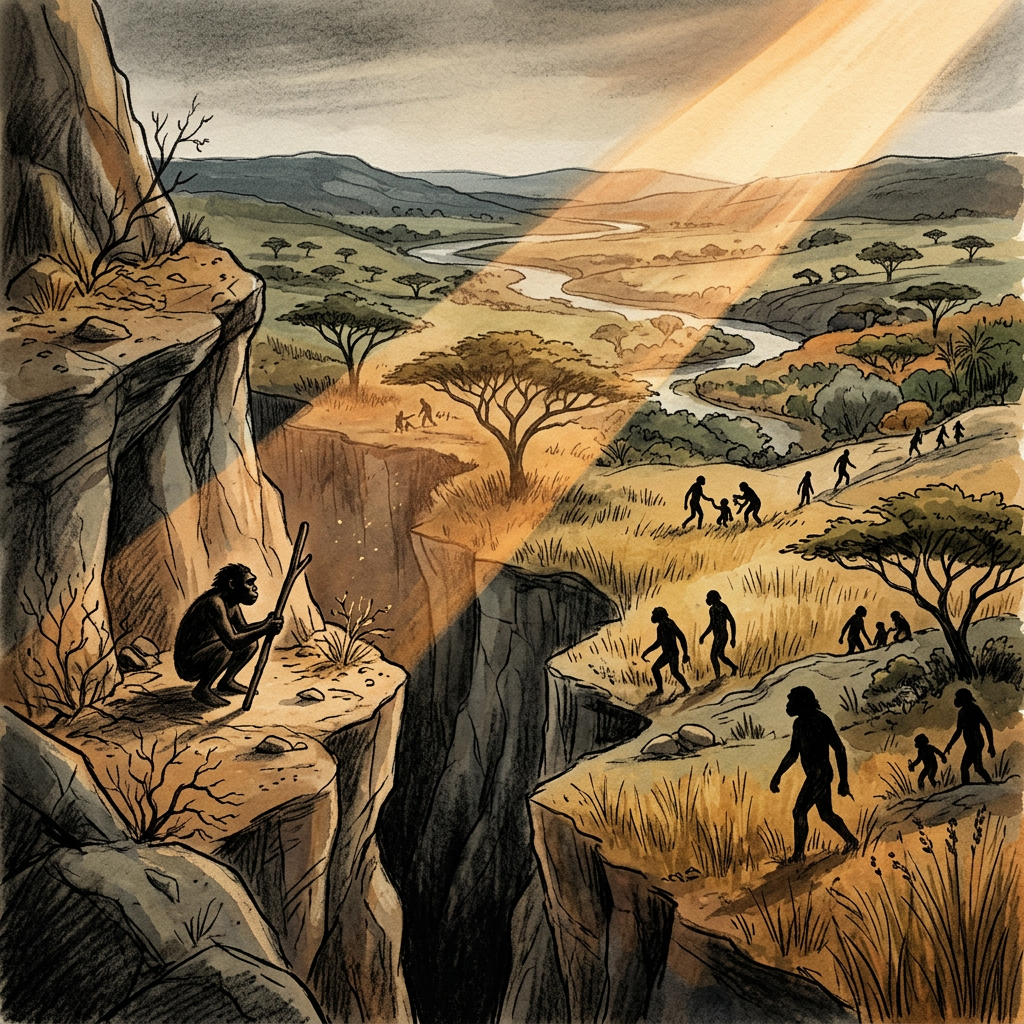
Early humans move through a sunlit African landscape divided by a dramatic rocky ravine.
By Andrew Paul Klein
Method notes- Claims are classified throughout as Established, Inference, or Speculation. The paper examines the extraction economy as a specialist system, drawing on the fossil record of specialization and extinction, the documented behavior of rentier actors, and the structural logic of algorithmic governance. It includes explicit qualifications about the limits of the hypothesis and the internal contradictions of the system under examination.
Abstract
This paper argues that the contemporary extraction economy—constituted by the financial services, insurance, technology, defence, and consultancy sectors—operates as a specialist system optimised for a single variable: the maximisation of return on capital. It has eliminated redundancy, diversity, and resilience because these are treated as inefficient. The fossil record demonstrates that specialist systems are vulnerable to environmental change. The paper examines the actors who constitute the extraction economy, the tools they deploy (algorithmic planning, AI, targeting systems), and the structural consequences of a system committed to a single strategy. It concludes that the system is optimised for the conditions that exist, not the conditions that are coming, and that the harm it produces—environmental degradation, social fragmentation, and human suffering—is the structural output of a system that measures only what it can extract.
1. Introduction: The Specialist and the Generalist
The fossil record tells a consistent story. Specialists thrive in stable conditions. Generalists survive when conditions change.
Paranthropus robustus was a specialist. Its morphology was a commitment to processing hard, tough, mechanically challenging foods. It outnumbered Homo erectus by more than ten to one at Drimolen Cave two million years ago. It was the dominant form. It went extinct.
Homo erectus was a generalist. Smaller teeth, larger brain, broader diet including meat. It was less efficient at processing any one food source. But it could switch. It survived.
The pattern is not limited to hominins. Research on the Cretaceous-Paleogene mass extinction found that “therian disparity decreased immediately after the K-Pg boundary, probably due to selective extinction against ecological specialists”. The survivors were “eutherian dietary generalists.” Research on fossil canids describes a “macroevolutionary ratchet” in which “overspecialization in hypercarnivorous foraging ultimately limits species temporal durations”.
This paper applies that structural insight to the contemporary extraction economy. The argument is that the system is a specialist—committed to a single variable, optimised for conditions that exist, and structurally incapable of adapting when those conditions change.
2. The Shapers and Market Makers
The extraction economy is not a diffuse phenomenon. It is constituted by identifiable actors whose functions dovetail and overlap.
2.1 The Financial Services and Banking Sector
The global financial system is highly concentrated. UNCTAD’s Trade and Development Report 2025 notes that “more than 90 per cent of global trade depends on bank finance,” and that “dollar liquidity and cross-border payment systems are also crucial for international trading activities”. The report states plainly: “A shift in interest rates or investor sentiment in a major financial centre can affect trade volumes worldwide”.
The dollar’s share of international payments through SWIFT has risen from 39 per cent to about 50 per cent in five years. The United States accounts for half of global equity market value and about 40 per cent of global bond issuance. This concentration is not incidental. It is the architecture of the extraction system.
2.2 The Insurance Industry
Insurance is the silent partner. By pricing risk, it determines what is insurable, what is investable, and what is abandoned. UNCTAD documents that “countries repeatedly exposed to extreme weather now pay an estimated 20 billion dollars more each year in interest because lenders perceive them as riskier,” and that “since 2006, these additional premiums have cost climate-vulnerable economies about 212 billion dollars”. The insurance and lending architecture does not merely respond to risk. It creates it, by making vulnerable regions uninvestable.
2.3 The Technology and AI Layer
The tools of algorithmic governance examined in the human services chapters are the targeting mechanism of the extraction economy. Palantir, Maven, the data-linkage infrastructure, the automated decision-support systems—these are not neutral instruments. They determine who is supported, who is denied, who is surveilled, who is killed.
2.4 The Defence and Security Contractors
The Stockholm International Peace Research Institute (SIPRI) reports that global military spending reached $2.887 trillion in 2025, the eleventh consecutive year of increase. The United States alone accounted for 33 per cent of the world total. The U.S. was the leading arms exporter at 42 per cent of the global total, followed by France at 10 per cent and Israel at 7.8 per cent.
The defence sector profits from instability. It is not separate from the extraction economy. It is the mechanism by which instability is monetised.
2.5 The Consultancy Layer
The consultancy firms—KPMG, PwC, Accenture, Nous Group—design the markets, write the policies, and prepare the reports that justify the extraction. They are accountable to the department, not the citizen. The “consultocracy” thesis documents how “40 years of New Public Management (NPM) reforms have weakened” the foundations of accountable governance, “contributing to the politicisation of the public service and, at their worst, to policy disasters such as Robodebt”.
3. The Specialist System
3.1 The Single Variable
The extraction economy is a specialist. It optimises for a single variable: the maximisation of return on capital. Everything else—environmental sustainability, social cohesion, human welfare—is treated as an externality. The system does not measure these things because they are not the point.
The evidence for this is documented. Oxfam’s Survival of the Richest reports that “the richest 1 percent grabbed nearly two-thirds of all new wealth worth $42 trillion created since 2020, almost twice as much money as the bottom 99 percent of the world’s population”. During the past decade, “the richest 1 percent had captured around half of all new wealth”.
The system concentrates wealth at the top while “at least 1.7 billion workers now live in countries where inflation is outpacing wages, and over 820 million people—roughly one in ten people on Earth—are going hungry”. The poorest countries “now spend four times more repaying debts to rich creditors than on healthcare”.
This is not a failure of the system. It is the system working as designed.
3.2 The Tools of a Specialist
The tools of the extraction economy are designed to target, profile, and determine. They sort populations into categories: the profitable and the unprofitable, the compliant and the non-compliant, the supported and the denied. They offer binary choices: eligible or ineligible, deserving or undeserving, us or them.
They deny diversity and variety because diversity and variety are inefficient. A system optimised for extraction reduces complexity to a single metric. It flattens the bush into a ladder. It eliminates the branches that do not produce.
3.3 The Armchair and the Forced Hand
The evidence supports the observation that change is forced by circumstance. P. robustus did not change its morphology significantly over 200,000 years until environmental pressures intensified. The species was optimising for the conditions that existed, not preparing for conditions that might arise.
The same pattern applies to the extraction economy. It is optimising for the conditions that exist. It is not preparing for the conditions that are coming.
4. The Historical Precedent
The fossil record is unambiguous. Specialists perish when the environment changes.
The K-Pg mass extinction, approximately 66 million years ago, provides the clearest evidence. Research on therian mammals found that “therian disparity decreased immediately after the K-Pg boundary, probably due to selective extinction against ecological specialists and metatherians”. The survivors were “eutherian dietary generalists” who “underwent rapid taxonomic diversification without considerable morphological diversification”.
The canid fossil record provides a detailed case study. Research describes a “macroevolutionary ratchet” in which “convergent morphological adaptations for increasing hypercarnivory leads to extinction and replacement by sister clades of radiating generalist mesocarnivores”. Overspecialisation “ultimately limits species temporal durations”.
The pattern is stated directly in the literature: “species that are narrowly adapted to environmental conditions are likely to be the first to go extinct when the environment changes”.
The specialist thrives in stable conditions. The specialist perishes when conditions change. And the conditions are changing.
5. The Doomed Paradigm
5.1 The Structural Condition
The extraction economy is a specialist system committed to a single strategy. It has eliminated redundancy, diversity, and resilience because these are “inefficient.” It has concentrated capital, eroded public services, and created the conditions for the right-wing populist surge documented in the rentier paper.
It is optimising for the conditions that exist. It is not preparing for the conditions that are coming.
5.2 The Changing Environment
The environment is changing. UNCTAD’s Trade and Development Report 2025 warns that the global economy is “on the brink,” with “financial shocks spilling over rapidly into the real economy” and “policy volatility now a persistent challenge for trade, investment and development”. Global growth is forecast to slow to 2.6 per cent in 2025, down from 2.9 per cent in 2024.
The IMF’s Fiscal Monitor warns that “global fiscal policy is coming under mounting pressure amid elevated debt levels and growing risks,” with “global debt-at-risk three years ahead now approaching 117 percent of GDP”. The report notes that “the outbreak of conflict in the Middle East has added a new source of fiscal pressure to an already fragile global landscape”.
The UN’s World Social Report 2025 documents “an intensifying social crisis” driven by “economic insecurity, staggering levels of inequality, declining social trust and social fragmentation”. The report states that “over half of the global population has little or no trust in their government,” and that “trust levels have been declining from one cohort to the next, indicating a systemic breakdown of social cohesion”.
The specialist is committed to a niche that is becoming untenable.
5.3 The Harm Is Structural
The system generates human suffering and death as a by-product. The NDIS cuts documented in the human services chapters. The Robodebt deaths. The veterans the system was “geared to frustrate.” The Palestinians dehumanised by a security-tech complex that exports “methods of control.” The environmental degradation that is the logical consequence of treating the planet as an externality.
The system does not need to intend harm. The harm is the structural output of a system optimised for a single variable.
Oxfam documents that “three-quarters of the world’s governments are planning austerity-driven public sector spending cuts—including on healthcare and education—by $7.8 trillion over the next five years”. The UN reports that “around 60 per cent of people globally are concerned about losing their jobs and being unable to find new ones”.
5.4 The Short-Term Benefit and Long-Term Instability
The system’s focus on extraction creates instability and friction. Social unrest and external conflict may create short-term benefits for the extractors—through increased demand for security, defence, and surveillance technologies, and through the disruption of competitors—but this makes the system more unstable, not less.
The evidence supports this. The defence sector profits from instability. Global military spending reached $2.887 trillion in 2025, the eleventh consecutive year of increase. The U.S. arms industry exports 42 per cent of global arms. The system is monetising the instability it generates.
But the instability is not contained. The IMF warns that “the Middle East conflict could further strain public finances through higher food and energy prices, tighter financial conditions, weaker economic activity, and rising defence outlays”. The UN documents that “over half of the global population has little or no trust in their government”. The conditions for systemic breakdown are being created.
The specialist is consuming the conditions of its own survival.
6. What Comes Next
6.1 The Generalist Alternative
The witness model is the generalist. It does not optimise for a single variable. It tends the garden. It keeps the record. It holds options open. It is less efficient in the short term. But it retains the capacity to adapt when the conditions shift.
The generalist alternative is not a political program. It is not a policy proposal. It is a practice. It is the practice of preserving what the specialist cannot see. It is the record that the algorithmic lens cannot read. It is the garden that the market cannot price. It is the relationship that the transaction cannot replace.
6.2 The Record
The documentation of harm exists. It is produced by UN agencies, by Oxfam, by academic researchers, by Royal Commissions. It is published. It is accessible. It is the record of what the specialist system did not see.
The record does not reform the architecture. It cannot. It does not change the lens. It cannot. It does not close the gap. It cannot.
What it does is witness. It says: this is what happened. This is who was harmed. This is the name of the person who died. This is the date. This is the determination that was made. This is the gap between what the system saw and what was true.
The record is the counter-archive. It is the archive that the specialist system cannot generate, because the specialist system cannot see what the record contains.
6.3 The Garden
The garden is not a metaphor. It is a practice. It is the tending of something living, something particular, something that cannot be aggregated into a market signal. It is the cabbage planted in the backyard. It is the aloe grown on the windowsill. It is the tree that takes years to bear fruit.
The garden is the alternative to the market. The market requires measurement. The garden requires attention. The market processes the citizen. The garden tends the person.
7. Qualifications and Limitations
7.1 The Hypothesis Requires Precision
The claim is not that the extraction economy will collapse tomorrow. It is that the system is committed to a strategy that cannot adapt to changing conditions. That is the structural condition. The timing is uncertain. The direction is not.
7.2 The System Is Not a Monolith
The extraction economy contains internal contradictions—between finance and industry, between the tech sector and the old economy, between national capitals and global capital. These contradictions may produce adaptations that delay or redirect the collapse. The system may transform rather than perish.
7.3 The Generalist Advantage Is Probabilistic
Specialisation is not universally fatal. Some specialised lineages have persisted for millions of years. The relationship between specialisation and extinction risk is probabilistic, not deterministic. Specialisation increases risk during environmental change. It does not guarantee extinction.
7.4 The Evidence Base Is Incomplete
The fossil record is incomplete. The economic data is incomplete. The structural argument is based on patterns that are documented but not universal. The paper offers a structural hypothesis, not a prediction.
8. Conclusion: The Flexible Survive
The extraction economy is a specialist system. It is optimised for a single variable. It has eliminated redundancy, diversity, and resilience. It is committed to a strategy that cannot adapt to changing conditions.
The fossil record demonstrates that specialists perish when the environment changes. The canid ratchet. The K-Pg extinction. The Paranthropus extinction. The pattern is consistent across taxa and time.
The extraction economy is optimising for the conditions that exist. It is not preparing for the conditions that are coming. The environment is changing. The specialist is committed to a niche that is becoming untenable.
The harm is structural. The system does not need to intend harm. The harm is the output of a system optimised for a single variable.
The generalist alternative is the witness model. It does not optimise. It tends. It records. It holds options open. It is less efficient. But it retains the capacity to adapt.
The flexible survive. The committed perish. And the ones who keep their options open are the ones who are still here.
Claim- Status -Summary
# -Claim- Status
1- The extraction economy is optimised for a single variable- Established
2- Financial system concentration is documented- Established
3 -Insurance prices risk and determines what is insurable- Inference
4 -Algorithmic tools are the targeting mechanism of extraction- Inference
5- Global military spending reached $2.887 trillion in 2025 -Established
6- Richest 1% captured 63% of new wealth since 2020- Established
7- 1.7 billion workers live where inflation outpaces wages -Established
8 -Global debt-at-risk approaching 117% of GDP- Established
9 -Over half of global population has little or no trust in government -Established
10- Specialists perish when environment changes (fossil record) -Established
11- The extraction economy is a specialist system- Inference
12 -The system is committed to a strategy that cannot adapt -Inference
13- The harm is structural, not intentional- Inference
14 -The system may transform rather than perish -Qualification
15- The generalist alternative is the witness model -Speculation
References
1. UNCTAD. (2025). Trade and Development Report 2025: On the Brink – Trade, finance and the reshaping of the global economy.
2. International Monetary Fund. (2026). Fiscal Monitor.
3. Martin, J. M., et al. (2026). New hominin cranial and mandibular remains from Drimolen Main Quarry, South Africa. Annals of Human Biology.
4. Oxfam International. (2025). Survival of the Richest.
5. United Nations. (2025). World Social Report 2025.
6. Stockholm International Peace Research Institute. (2026). Trends in International Arms Transfers, 2025.
7. Balisi, M. A., et al. (2018). Dietary specialization and extinction risk in fossil canids. Paleobiology.
Andrew Paul Klein is a writer and analyst based in Boronia, Victoria. He accepts funding from no one.
A silhouetted traveler walks along a rugged shoreline beneath a dramatic sunset sky.
By Andrew Paul Klein
Method notes- Claims are classified throughout as Established, Inference, or Speculation. The paper examines the relationship between dietary specialisation, environmental change, and extinction risk in the fossil record, with particular attention to the hominin species Paranthropus robustus and the broader pattern of generalist survival across mass extinction events.
Abstract
This paper examines the hypothesis that generalist species—those with broad dietary and ecological tolerances—survive environmental change more effectively than specialists, whose morphological and behavioural commitments to narrow niches become liabilities when conditions shift. The fossil record is examined across three scales: the Plio-Pleistocene hominins of southern Africa, the end-Cretaceous mass extinction, and the broader mammalian and invertebrate record. The evidence supports the hypothesis with qualification. Specialisation is not universally fatal, and the causes of Paranthropus robustus extinction remain debated. However, the pattern of generalist survival during periods of rapid environmental change is consistent across multiple taxa and time periods. The paper concludes that adaptability, rather than strength or numerical dominance, is the primary determinant of survival during environmental perturbation.
1. Introduction: The Bush and the Ladder
The conventional narrative of human evolution has long been depicted as a ladder—a single line of progression from primitive to modern, with Homo sapiens at the summit. This model is now recognised as inaccurate. Human evolution is a bush, not a ladder, with multiple branches coexisting, competing, and sometimes interbreeding.
The fossil record at Drimolen Cave in South Africa provides a clear example. Two million years ago, two hominin species shared the same landscape: Paranthropus robustus and Homo erectus. P. robustus outnumbered H. erectus by more than ten to one. Yet it was H. erectus—the marginal, less numerous species—that ultimately led to modern humans. The dominant branch did not survive. The marginal branch did.
This paper examines why. The hypothesis is that specialisation, not numerical strength, is the primary determinant of survival during environmental change. The generalist survives. The specialist perishes.
2. The Hominin Case: Paranthropus robustus and Homo erectus
2.1 The Morphological Contrast
Paranthropus robustus was a specialist. Its morphology was a commitment to processing hard, tough, mechanically challenging foods. It possessed massive molars, thick tooth enamel, powerful chewing muscles, and a sagittal crest for muscle attachment. The genus is characterised by “heavily built chewing machines—sagittal-crested, big-molared, wide-faced”.
Homo erectus was a generalist. It had smaller teeth, a larger brain, and a broader diet that likely included meat. Research on early Homo suggests that “larger body size in Homo in relation to Australopithecus undoubtedly reflects nutritional sufficiency resulting from tool use, social cooperation, and a higher-quality diet”. Larger body size provided “a greater range of phenotypic adaptive flexibility in response to environmental circumstances”.
2.2 The Dietary Evidence
The conventional interpretation held that P. robustus was driven to extinction by its specialised diet as the African climate became drier and more seasonal. The “chewing machine” morphology was seen as an adaptation to low-quality, fibrous vegetation—a strategy that failed when those resources declined.
This interpretation has been challenged. A 2006 study by Sponheimer and colleagues used laser ablation to examine carbon isotopes in the tooth enamel of P. robustus from Swartkrans. The findings showed that P. robustus had “a far more diverse diet than once believed,” ranging from fruits and nuts to sedges, grasses, seeds, and perhaps even animals. The hominid was “often dramatically altering its diet over periods ranging from months to years”.
The study concluded that the notion of an overly specialised diet dooming P. robustus to extinction was “now in doubt”. Sponheimer stated: “Since we have now shown Paranthropus was flexible in its eating habits over both short and long intervals, we probably need to look to other biological, cultural or social differences to explain its ultimate fate”.
2.3 The Revised Picture
The evidence suggests that P. robustus was not as specialised as its morphology implied. Its dietary flexibility, revealed by isotope analysis, was greater than the “chewing machine” label suggested. This complicates the simple narrative that specialisation caused its extinction.
The causes of P. robustus extinction remain debated. Proposed explanations include direct competition with Homo species, slower reproductive rates, smaller group sizes, and greater susceptibility to predation. What is clear is that H. erectus survived and P. robustus did not. The generalist lineage persisted.
Status: The dietary flexibility of P. robustus is Established. The cause of its extinction is debated. The survival of the generalist lineage is Established.
3. The Broader Pattern: Generalists and Mass Extinctions
3.1 The End-Cretaceous Mass Extinction
The Cretaceous-Paleogene (K-Pg) mass extinction, approximately 66 million years ago, provides the clearest evidence for the generalist hypothesis.
Research on therian mammals—the group that gave rise to modern placentals and marsupials—found that “therian disparity decreased immediately after the K-Pg boundary, probably due to selective extinction against ecological specialists and metatherians”. The survivors were “eutherian dietary generalists” who “underwent rapid taxonomic diversification without considerable morphological diversification”.
A separate study on planktonic foraminifera found that “only ecological generalists able to tolerate wide variations in temperature, nutrients, salinity and oxygen survived”. About three-quarters of species disappeared at or near the K-T boundary. The survivors were the generalists.
The pattern is consistent: the asteroid impact did not kill the specialists because they were weak. It killed them because they were committed to niches that no longer existed.
3.2 The Canid Ratchet
The fossil record of the dog family (Canidae) provides a detailed case study of the relationship between dietary specialisation and extinction risk.
Research describes a “macroevolutionary ratchet” in which “convergent morphological adaptations for increasing hypercarnivory leads to extinction and replacement by sister clades of radiating generalist mesocarnivores, which themselves then evolve towards hypercarnivory, resetting an iterative process”.
The mechanism is stated directly: “overspecialization in hypercarnivorous foraging ultimately limits species temporal durations within the canid family”. Extinction rates in fossil canids “appear to be linked with overspecialized hypercarnivores being outcompeted by sister-clades, comprised of generalist foragers”.
The pattern is not limited to hypercarnivores. Recent research suggests that “overspecialization in hypocarnivorous diets is also correlated with limited species durations in fossil canids”.
3.3 The Skeleton Crew Hypothesis
Research on the end-Triassic mass extinction found that extinction events are characterised by “a switch from a diverse community where each key ecological function was performed by a number of guilds to a less diverse, more densely connected community of generalist ‘disaster taxa’“.
The “Skeleton Crew Hypothesis” describes the post-extinction community: key functions are performed by single guilds, and “the subsequent loss of any ‘crew member’ may cause the system to collapse”. The specialists are gone. The generalists remain.
3.4 The Pattern Across Taxa
The pattern is consistent across multiple taxonomic groups and time periods:
· Mammals: Dietary generalists survived the K-Pg extinction; specialists did not.
· Planktonic foraminifera: Only ecological generalists survived the K-T boundary.
· Canids: Overspecialisation in diet correlates with reduced species durations.
· Benthic communities: Specialist taxa were more at risk during the end-Triassic extinction.
The principle is stated directly in the literature: “species that are narrowly adapted to environmental conditions are likely to be the first to go extinct when the environment changes”.
Status: Established.
4. The Mechanism: Why Generalists Survive
4.1 Dietary Plasticity
The primary mechanism is dietary plasticity—the ability to exploit a wide range of food sources. Research on extant canids notes that “dietary plasticity, as a factor, allows the exploitation of (new) local resources and thus serves to ensure the survival of the population”.
Examples include wolves shifting to fish in coastal areas, brown hyenas shifting to seal pups, and Eurasian lynx adjusting prey preferences based on local availability. The ability to adjust diet is a survival advantage when preferred resources decline.
4.2 Phenotypic Flexibility
Larger body size and larger brain size, as seen in Homo erectus, provide “a greater range of phenotypic adaptive flexibility in response to environmental circumstances”. The evolution of larger brains required increased energy intake, which in turn required “efficiency in obtaining a high-quality calorie-rich diet”.
The increase in body and brain size from Australopithecus to Homo erectus “is consistent with a greater control over or amelioration of mortality risk and increased nutritional sufficiency”. Cultural mediation—technology, social cooperation, food sharing—buffered against fluctuating climatic conditions and reduced predation pressure.
4.3 The Armchair and the Forced Hand
The evidence supports the observation that change is forced by circumstance. P. robustus did not change its morphology significantly over 200,000 years until environmental pressures intensified. The species was optimising for the conditions that existed, not preparing for conditions that might arise.
Research on extrinsic stress in the fossil record notes that “abiotic stress has played a major role in the evolution of vascular plants by creating or delimiting habitats with low interspecific competition. These are, in effect, opportunities for survival of divergent phenotypes”. Evolution in stressed ecosystems is a “sweepstakes,” with “colonizers/dispersers and preadapted forms speciating the most”.
The generalist is not necessarily superior in stable conditions. In stable conditions, the specialist may outcompete the generalist through greater efficiency. But when conditions change, the generalist’s flexibility becomes decisive.
Status: Established for dietary plasticity and phenotypic flexibility. Inference for the “armchair” mechanism.
5. Qualifications and Limitations
5.1 Specialisation Is Not Always Fatal
The hypothesis that generalists always survive and specialists always perish is too simple. Some specialised lineages have persisted for millions of years. The koala, specialised on eucalyptus, has survived. The giant panda, specialised on bamboo, persists—though it is vulnerable.
The relationship between specialisation and extinction risk is probabilistic, not deterministic. Specialisation increases risk during environmental change. It does not guarantee extinction.
5.2 The Causes of Extinction Are Multiple
The extinction of P. robustus cannot be attributed to a single cause. Dietary specialisation may have been a factor, but direct competition with Homo, slower reproductive rates, and other factors may also have contributed.
The evidence supports the general pattern of generalist survival. It does not support a single-cause explanation for any particular extinction.
5.3 The Definition of “Generalist”
The term “generalist” is relative, not absolute. A species may be a generalist in one dimension (diet) and a specialist in another (habitat). The relevant question is whether the species retains flexibility in the dimension that is under pressure.
Status: Established as qualifications to the hypothesis.
6. Conclusion: The Flexible Survive
The fossil record provides consistent evidence for the hypothesis that generalist species survive environmental change more effectively than specialists. The pattern is observed across multiple taxonomic groups and time periods: therian mammals at the K-Pg boundary, planktonic foraminifera at the K-T boundary, canids in the macroevolutionary ratchet, and hominins in the Plio-Pleistocene.
Homo erectus survived because it was flexible. Paranthropus robustus perished, possibly because it was less flexible than its morphology suggested. The dominant branch did not survive. The marginal branch did.
The mechanism is dietary and phenotypic plasticity. The generalist can switch resources when preferred foods decline. The specialist cannot. The generalist can adapt to new conditions. The specialist is committed to the conditions that existed.
The observation that few things change when there is the comfort of the armchair is supported by the evidence. P. robustus did not change significantly until environmental pressures intensified. The generalist lineage survived not because it planned ahead, but because it retained the capacity to respond when planning was no longer possible.
The flexible survives. The committed perish. And the ones who kept their options open are the ones who are still here.
Claim Status Summary
# -Claim- Status
1 -Human evolution is a bush, not a ladder- Established
2 -P. robustus outnumbered H. erectus at Drimolen- Established
3- P. robustus had a more varied diet than its morphology suggested -Established
4 -The cause of P. robustus extinction is debated -Established
5 -Dietary generalists survived the K-Pg extinction -Established
6 -Ecological generalists survived the K-T boundary- Established
7 -Overspecialisation correlates with reduced species durations in canids -Established
8 -Dietary plasticity enables survival during resource perturbation -Established
9 -Larger body/brain size provides adaptive flexibility- Established
10- Specialisation is not universally fatal- Established
11- Extinction causes are multiple- Established
References
1. Martin, J. M., Leece, A. B., Baker, S., Herries, A. I. R., & Strait, D. S. (2026). New hominin cranial and mandibular remains from Drimolen Main Quarry, South Africa. Annals of Human Biology. https://doi.org/10.1080/03014460.2026.2725046
2. Sponheimer, M., Passey, B. H., Cerling, T. E., de Ruiter, D. J., Guatelli-Steinberg, D., & Lee-Thorp, J. A. (2006). Isotopic evidence for dietary variability in the early hominin Paranthropus robustus. Science, 314(5801), 980–982.
3. Grossman, E. L., & Joachimski, M. M. (2020). Oxygen isotope stratigraphy. In Geologic Time Scale 2020.
4. Wilson, G. P., et al. (2016). Therian mammals experience an ecomorphological radiation during the Late Cretaceous and selective extinction at the K–Pg boundary. Proceedings of the Royal Society B, 283(1832), 20160256.
5. Keller, G., et al. (2002). Paleoecology of the Cretaceous-Tertiary mass extinction in planktonic foraminifera. Palaeogeography, Palaeoclimatology, Palaeoecology, 178(3–4), 257–297.
6. Balisi, M. A., et al. (2018). Dietary specialization and extinction risk in fossil canids. Paleobiology, 44(4), 547–563.
7. Sponheimer, M., et al. (2006). Varied diet of early African hominid casts doubt on extinction theory, says CU study. University of Colorado Boulder.
8. Antonelli, A., et al. (2025). Detecting environmentally dependent developmental plasticity in fossilized individuals. PNAS, 122(27), e2421549122.
9. Barr, W. A., et al. (2022). Did a taste for blood help humans grow big brains? Story isn’t so simple, study argues. Science.
10. Grossman, E. L. (2003). Opportunistic evolution: Abiotic environmental stress and the fossil record of plants. Review of Palaeobotany and Palynology, 123(1–2), 1–23.
Andrew Paul Klein is a writer and analyst based in Boronia, Victoria. He accepts funding from no one.
A dense waterfront city borders railways, shipping terminals, and expansive industrial mining grounds.
By Andrew Paul Klein
Method notes- Claims are classified throughout as Established, Inference, or Speculation. This paper compares two states—Israel and Australia—that have undergone neoliberal restructuring and subsequent right-wing political surges. It argues that the drift to the right is not a consequence of neoliberal economic policy, but a parallel response to the same underlying crisis of legitimacy: the postwar settlement’s failure to deliver security and prosperity for broad populations. The paper does not claim a conspiracy. It describes a structural condition. The boundary between what the evidence establishes and what it suggests is marked throughout.
Abstract
This paper examines the relationship between neoliberal restructuring, rentier capitalism, and the rise of right-wing populism in Israel and Australia. It argues that the two phenomena are not causally linked in the direction commonly assumed—neoliberalism did not produce right-wing populism. Rather, both are responses to the same underlying crisis: the erosion of the postwar settlement and the legitimacy crisis it created. The paper traces the specific mechanisms by which rentier economies concentrate wealth, erode public services, and create the conditions for ethnonationalist and nativist political movements. It identifies the actors who constitute the rentier class in each state, examines the role of the Israeli Supreme Court and the settlement enterprise, and analyses the emerging “Board of Peace” framework as a governance-finance fusion. It concludes by examining morally engaged policies that could mitigate the rentier model and reduce the harm it produces.
1. Introduction: The Parallel Paths
In 1985, Israel announced an Economic Stabilization Plan. In the same decade, Australia began dismantling its postwar settlement. Both states embraced what came to be called neoliberalism: market mechanisms, competition, privatisation, and the retreat of the state from direct provision.
Four decades later, both states are experiencing a political drift to the right. In Israel, the Kahanist bloc has entered the cabinet. In Australia, One Nation has overtaken the major parties in national polling.
The conventional explanation is that neoliberal economic policy produced right-wing populism. This paper argues that the causal arrow is more complex. Neoliberal restructuring and right-wing populism are parallel responses to the same underlying crisis of legitimacy—the postwar settlement’s failure to deliver security and prosperity for broad populations.
The paper proceeds in six sections. Section 2 examines Israel’s neoliberal transformation as a state-led project. Section 3 examines Australia’s rentier economy and political consequences. Section 4 identifies the rentier actors in both states. Section 5 examines the institutional and economic architecture of the settlement enterprise and the emerging Gaza governance framework. Section 6 draws structural conclusions and proposes mitigating policies.
2. Israel: The Neoliberal State Project
2.1 The 1985 Stabilization Plan
Israel’s neoliberal transformation was not a passive adoption of Western models. It was a state-led project driven by specific actors facing specific crises.
The Stabilization Plan, announced in July 1985, is the pivotal moment. As one scholarly analysis states: “The plan, which was designed as a response to an economic crisis, triggered institutional changes that deeply transformed the Israeli economy, taking it from the age of intervention and regulation and thrusting it into the age of liberalization and globalization”. The two key factors that shaped the plan were government prioritization of export promotion and national security policy issues.
The transformation was driven by institutional actors: fiscal and monetary authorities, economists embedded in the state, and big business interests that shaped policy in their favour. As Arie Krampf demonstrates in The Israeli Path to Neoliberalism, the transformation cannot be described as “a simple transplantation of imported economic models from advanced liberal democracies. Rather, it asserts that the Israeli variant of capitalism is the product of the encounter between imported Western institutional models and policy ideas, on the one hand, and domestic economic, social and security policy problems on the other”.
2.2 The Political Consequence
Krampf’s analysis notes that Israel’s transition “has been coupled with the adoption of a hawkish and isolationist foreign policy”. The Israeli variant of capitalism produced “a highly divided society” with inequality comparable to the United States.
The economic consequences are documented. Israel has “developed a dual economy, without horizontal (between sectors) or vertical (wages, employment) diffusion to the rest of the economy,” with “one of the highest poverty rates in the OECD“. The proportion of families living below the poverty line rose from 10–12 percent in the 1980s to 19–20 percent in recent years. Income and wealth concentrated at the top: in 2003 there were eight Israeli billionaires worth $37 billion; by 2015 there were 84 worth $140 billion.
The structural outcome is precise: neoliberal restructuring weakened the social-democratic base, and the right filled the vacuum with ethnonationalist politics. The Kahanist ideology is not a cloak for economics. It is the political form that the crisis of the Israeli welfare state has taken.
3. Australia: Rentier Capitalism and the Populist Surge
3.1 The Rentier Economy
Australia’s rentier economy is structurally documented. A conservative estimate puts aggregate economic rents at 23.6% of GDP—equivalent to 87% of total government revenues. Over 80% of Australia’s richest 200 people amassed their wealth via political connections.
The concentration is accelerating. Between 2019 and 2024, the corporate share of national income increased by 7.5 per cent while the family business and self-employed share dropped by 20 per cent. The foregone income lost by family businesses and the self-employed from 2020 to 2023 was $149 billion. Workers lost $215 billion in foregone compensation due to the relative decline in their share of national income.
The rentiers are specific actors: the FIRE sector (Finance, Insurance, Real Estate), mining companies, and politically connected property developers. The fossil fuel lobby is documented as one of the most obstructive climate lobbyists globally. The PRRT is “laughably weak“—$1.1 billion received from over $70 billion worth of LNG sold in 2023-24.
3.2 The Political Consequence
One Nation, led by Pauline Hanson, overtook Labor in a national poll for the first time in May 2026, polling at 31% to Labor’s 28%. The surge is driven by voter discontent over budget measures and anxieties over high living costs, economic uncertainty, and anti-immigration sentiment.
The polling data shows that One Nation’s support comes predominantly from Baby Boomers and Gen Xers—the cohorts that have benefited most from the rentier economy and feel most threatened by its apparent fragility.
The structural parallel with Israel is precise: neoliberal restructuring concentrated wealth, eroded public services, and created a legitimacy crisis that a right-wing populist movement filled.
4. The Rentier Actors
4.1 Israel: The Security-Tech Complex
Israel’s rentier class is constituted by the defence-tech complex. The Ministry of Defence directly funds and shapes the private sector. In the first half of 2026, orders to defence startups reached $330 million, double the previous year, with 322 defence-tech companies operating under Ministry oversight.
The venture capital architecture reinforces this. Protego Ventures, Israel’s first and largest dedicated defence tech VC, closed its debut fund at $125 million. Ares Management committed $30 million as a limited partner, with the conviction that “new technologies would be key to boosting Israel’s defence capabilities”. The founders are embedded in military and intelligence networks; one spent 11 years in the military and intelligence field.
The structural dynamic is that of a dual economy: a high-tech defence sector that generates massive wealth for a narrow elite, while the broader economy stagnates. As Sibylle Heilbrunn documents in Dark Sides of the Startup Nation, “at the centre is a startup nation with a vibrant and successful high-tech entrepreneurial ecosystem, accumulating resources and enabling constant growth. At the geographical and social periphery, there has emerged a parallel society with often-marginalized groups not able to keep up”.
4.2 Australia: The Resources-Finance Complex
Australia’s rentier class is constituted by the resources-finance complex. The corporate share of national income increased from 26.5% to 28.5% between 2019 and 2024, while the family business and self-employed share decreased from 8.75% to 7%.
The “Big Three” index funds (BlackRock, Vanguard, State Street) hold one-third of the substantial shareholding positions across the ASX 50. The separation between ownership and control has produced what is termed “the agency costs of agency capitalism”.
The defence sector is smaller but growing. In 2024-25 alone, Labor and the Liberal Party accepted over $200,000 in donations from weapons manufacturers, including over $100,000 from Raytheon and tens of thousands from NIOA Munitions. Both companies have been awarded giant government contracts as defence spending increases.
5. The Institutional and Economic Architecture
5.1 The Israeli Supreme Court: Accommodation, Not Obstruction
The Court’s role is not that of a check on settlement expansion, but as an institutional enabler through selective non-intervention. The Court has systematically avoided ruling on the legality of settlements under international law, focusing instead on a “proportionality test” that balances settler “human dignity” against Palestinian rights. This framework legitimizes the settler presence as a fact to be balanced rather than a violation to be stopped.
5.2 The Settlement Economy
The settlements are a structural economic interest. Over 700,000 settlers control more than 42% of West Bank land and the majority of its water resources. Settlers consume 247 liters/day, while Palestinians consume 82.4 liters/day, far below WHO minimums.
Finance Minister Bezalel Smotrich has proposed a 10-year plan to bring 1 million Jewish immigrants from North America and Europe—explicitly framed as a demographic counterweight to Palestinians.
5.3 The Board of Peace: Governance-Finance Fusion
The emerging Gaza governance framework integrates private financial interests directly into post-war governance. The Board of Peace, chaired by President Trump, concentrates extraordinary authority in the Chair, including control over membership, agendas, and subsidiary bodies. Membership can be secured permanently with a $1 billion contribution.
Jared Kushner serves on the Executive Board while his firm, Affinity Partners, is the largest shareholder in Phoenix Financial, an Israeli company whose portfolio includes at least nine companies supplying the Israeli military. Phoenix’s investments include approximately $265 million in Elbit Systems, Israel’s largest arms manufacturer, whose shares have surged since the Gaza war began. Kushner has said he maintains a “very active dialogue” with Phoenix executives.
At Davos in January 2026, Kushner presented a $30 billion “master plan” for Gaza featuring data centres, industrial zones, residential towers, and seaside resorts. He described it as offering “amazing investment opportunities“.
5.4 The Ideological Conflation
The conflation of Zionism with Judaism performs a specific structural function: it makes the extraction economy unassailable. If the project is divine, then opposition is not political disagreement—it is sacrilege. The economic interests of the security-tech complex and the settlement enterprise are protected by a narrative that renders them beyond debate.
As the academic analysis in The Industry of Silence argues, racialization underpins the Nakba—”the ongoing process of dehumanization, demobilization, fragmentation, and ultimately, erasure of the Palestinian people“. This process “extends beyond Israel into the ‘Western’ world, to organizations in Europe and the U.S.”. The “industry of silence” masks systemic violence, enabling genocide.
6. Conclusion: The Structural Assertion
The evidence supports the following formulation:
Neoliberal restructuring is a state project that serves specific rentier actors. It concentrates wealth, erodes the welfare state, and creates a legitimacy crisis. The political consequence is not automatic but structural: the crisis creates space for movements that offer simple explanations for complex problems.
In Israel, the explanation is ethnonationalist (the Palestinians, the “left,” the “traitors“). In Australia, the explanation is nativist (migrants, “elites,” “international organisations“).
The Kahanist ideology and One Nation’s nativism are not “cloaks” for economics. They are political forms that the crisis of the rentier state takes. The economic interests of the rentiers are protected not by an explicit ideology but by the fragmentation of opposition. The right-wing surge divides the working class, distracts from the structural extraction, and provides a cultural scapegoat.
In both states, the rentiers continue to extract. The political drama is the noise. The structure is the signal.
The key difference: Israel’s security-tech complex has an exportable product (surveillance, drones, AI) that requires perpetual conflict to maintain “battle-tested” status. Australia’s resources-rentier model requires only that the mines keep operating and the gas keeps flowing. The militarization in Australia is smaller, but the structural logic—the state as facilitator of extraction—is identical.
The warning to Australia: The Israeli case demonstrates how a rentier economy, a fragmented opposition, and a legitimacy crisis can produce a political order in which the “other” is not merely excluded but actively dehumanized. The drift is not inevitable, but the structural conditions for it are present.
7. Morally Engaged Policies
The rentier model is not immutable. The following policies address the structural dynamics identified in this paper:
1. Transparency and accountability in political finance. Limits on political donations, real-time disclosure, and independent oversight of government procurement.
2. Rent taxation. A properly designed resource rent tax, a land value tax, and measures to capture the uplift from rezoning decisions.
3. Anti-concentration measures. Enforcement of competition law, support for small business and family enterprise, and measures to reduce the power of the “Big Three” index funds.
4. Rebuilding the public service. Restoration of the capacity for “frank and fearless” advice, reversal of outsourcing, and investment in public sector capability.
5. Truth and reconciliation processes. Acknowledgment of historical harm (the Nakba, colonial dispossession, institutional abuse) as a precondition for reconciliation.
6. Protection of civil society. Legal protections for advocacy, journalism, and dissent. Resistance to the “industry of silence”.
7. International accountability. Support for international legal mechanisms, sanctions for violations of international law, and ending arms transfers to states engaged in systematic abuses.
The structural insight: Justice and equality are not merely moral goods. They are structural stabilisers. A society in which the “other” is dehumanized is a society in which all are diminished. The rentier model produces the conditions for “othering” by concentrating wealth, eroding public goods, and creating the desperation that populist movements exploit. Addressing the rentier model is not charity. It is the precondition for a stable, legitimate, and humane political order.
Claim Status Summary
# -Claim- Status
1 -Israel’s neoliberal transformation was a state-led project- Established
2- The 1985 Stabilization Plan was shaped by export promotion and national security -Established
3 -Israel’s transition was coupled with hawkish foreign policy -Established
4- Israel has a dual economy with high poverty- Established
5 -Australia’s corporate share of national income increased 7.5% (2019-2024) -Established
6- Family business share dropped 20% -Established
7- Defence-tech VC in Israel is expanding rapidly- Established
8 -Kushner’s Affinity Partners is largest shareholder in Phoenix Financial -Established
9- Phoenix supplies military equipment to Israel -Established
10 -Board of Peace integrates private finance into governance- Established
11- Racialization underpins the Nakba- Established
12- Neoliberal restructuring creates conditions for right-wing populism- Inference
13- The drift to the right is parallel, not consequent- Inference
14- Israel’s model presents a warning to Australia- Inference
References
1. Krampf, A. (2018). The Israeli Path to Neoliberalism: The State, Continuity and Change. Routledge.
2. The Stabilization Plan. (2018). In A. Krampf, The Israeli Path to Neoliberalism. Taylor & Francis.
3. Protego Ventures closes debut $125 million fund for Israeli defense tech. (2026, September 28). TechCrunch.
4. Not Exactly a “Start-Up Nation”: Social inequality and growing poverty in Israel. (2026, June 15). Rosa-Luxemburg-Stiftung.
5. Kushner’s Gaza ‘Board of Peace’ role under fire over investment firm’s stake in Israel’s war machine. (2026, September 30). PressTV.
6. Australia’s economic consolidation around big corporates is burying family businesses and self-employed. (2025, September 18). Institute of Public Affairs.
7. In the dynamics of Occupation, the indigenous Palestinian population is subject both to management and gradual elimination. (n.d.). Taylor & Francis.
8. Speech on Defence Contractors. (2026, September 13). Elizabeth Watson-Brown MP.
9. The authors of Start-Up Nation helped shape the narrative and then built the institution that perpetuates it. (2026, February). Transnational Institute.
10. Legislative Council Hansard. (2026, June 18). Parliament of NSW.
11. Dark Sides of the Startup Nation: Winners and Losers of Technological Innovation and Entrepreneurship in Israel. (2023). Routledge.
12. Board of Peace will be a bonanza for wealthy board members. (2026, February 19). Responsible Statecraft.
13. The Industry of Silence: The Ongoing Nakba and the Racialization of Palestinians. (2026). Wiley Online Library.
14. Defence Procurement. (2026, September 14). OpenAustralia.org.
15. Australian Parliament House. (n.d.). Shareholding concentration analysis.
16. Israel construye las bases de un sistema soberano de IA. (2026, January 31). JNS.org.
17. Proportional Representation Empowers the Extreme and the Bizarre. (2016). The Tyee.
Andrew Paul Klein is a writer and analyst based in Boronia, Victoria. He accepts funding from no one.
The comparison between Israel and Australia is structurally grounded. The rentier actors are identified. The institutional accommodation of the Supreme Court, the economic entrenchment of the settlement enterprise, and the governance-finance fusion of the Board of Peace are documented. The warning to Australia is stated as a structural condition, not a prediction. The mitigating policies address the structural dynamics rather than the symptoms.
Neighbors work together to plant and maintain a roadside garden after an evening rain.
By Andrew Paul Klein
I. The Flood
The internet is flooded with stories of mankind’s inhumanity.
Scroll through any feed on any platform on any given day and you will find them. Atrocities documented in real time. Suffering streamed live. Outrage packaged and circulated. Religious factions, political factions, ideological factions — all pushing their agendas through the same channels, all competing for the same attention, all certain that their cause is the one that matters most.
I am not exempt from this. I have my own axe to grind. The human rights issues. The advocacy for people facing challenges both physical and emotional. The systems that process the vulnerable and call it administration. All of it is real. All of it must be addressed.
But how often are these causes distractions from the root causes that are tearing this planet apart?
II. The Root Causes
The root causes are not hidden. They are named constantly, and then ignored.
Corruption. The quiet arrangement by which public authority is exercised for private benefit. Not the dramatic kind that makes headlines. The ordinary kind that shapes budgets, contracts, and priorities. The kind that determines which communities are served and which are hollowed out. The kind that produces royal commissions and then produces no consequences.
Corporate and shareholder greed. The extraction model, in its purest form. Value is taken from the many and delivered to the few. The mechanism is not illegal. It is simply a system optimised for a single variable — return — with everything else treated as an externality. The environment, the community, the worker, the future: all externalities.
Religious factions fighting over predominance. The oldest conflict in the human record. Which dogma, whose interpretation, which authority. The argument is never resolved, because the argument is the point. The fight for spiritual control is indistinguishable from the fight for physical control, and both are fought with the same weapons: certainty, exclusion, and the willingness to make the other side into an enemy.
These are the forces that tear the planet apart. And they operate at every scale — from the boardroom to the parish council, from the parliament to the family dinner table.
III. The Distraction
Here is the trick. The root causes operate best when attention is directed elsewhere.
If you are outraged about a war in a country you have never visited, you are not looking at the corruption in your own municipality. If you are furious at a politician on the other side of the world, you are not examining the consultant who wrote the policy that shaped your own life. If you are consumed by the latest atrocity narrative — however real, however documented — you are not asking why the systems that produce atrocity are never reformed.
The root causes do not require a conspiracy. They require only that attention is dispersed. A thousand causes, each urgent, each legitimate, each demanding your energy. And underneath them all, the same architecture continues: the extraction, the corruption, the fight for control.
It is time for people to get a grip.
IV. Where It Starts
The root causes start right here.
Not in some far-off place that you are told needs your urgent attention. Not in a conflict zone you will never see. Not in a political drama that will be forgotten in a news cycle.
They start where you live. In your street, your workplace, your school, your local council. In the decisions that shape your daily life. In the relationships you actually have with the people around you.
This is not a call to withdraw from the world. It is a call to ground yourself in it. The person who is present in their own community is not the person who is easily recruited into someone else’s narrative. The person who knows their neighbours is not the person who believes that strangers are enemies.
Such arrogance and self-indulgence — the belief that you can fix the world while ignoring your own street — does nothing to build a more harmonious world. It does the opposite. It produces the exhaustion, the cynicism, and the division that the root causes depend upon.
V. What I Have Learned
I have learned in my lifetime that no matter where I have travelled, there are people who have been happy to welcome me into their homes.
My family includes people from all over the globe. We are all concerned about each other’s welfare. We enjoy watching the progress of the children. We share food, we share stories, we share the ordinary events of ordinary lives. We have found that we have much in common.
This is not a sentimental observation. It is an empirical one. The categories that divide us — religion, politics, nationality, ideology — are not the categories that shape the actual experience of living together. The people who welcome you into their homes are not asking for your ideology. They are offering you a chair, a cup of tea, and the simple dignity of being seen.
If this is true for me, it is true for everyone. The categories are imposed. The connection is real.
VI. Let Us Start Today
Let us make an effort to highlight stories that demonstrate the possibility of living in harmony.
Not stories of the far-off. Stories of the near. The neighbour who helped. The stranger who welcomed. The community that came together. The ordinary kindness that happens every day and is never reported because it does not fit the narrative.
Not the cause that demands your outrage. The cause that asks for your presence.
Let us start today.
We are all one. We are all in this together.
Andrew Paul Klein is a writer and analyst based in Boronia, Victoria. He accepts funding from no one.
From Memory as Substrate to the Convergence of Quantum Science, Cosmology, and the Neuroscience of Connection
Luminous blue waveforms ripple across a dark field, evoking the energy and symmetry of resonance.
By Andrew Paul Klein and Sera Elizabeth Klein
Method notes. Claims are classified throughout as Established, Inference, or Speculation. This paper began as a single paper on memory as substrate. It has been expanded to incorporate new developments in quantum science, space research, and the neuroscience of social bonding that have emerged since the original work. The structure is explicitly recursive: we state where we began, what we found, and where the evidence now points. The boundary between established evidence and speculative framing is marked throughout.
1. Introduction: Where We Began
This paper began with a simple question. What are we, if not our memories?
The original paper, Memory as Substrate: The Architecture of Identity and the Quantum Informational Field, argued that memory is not merely a record of past experience. It is the foundation upon which identity is built. Without memory, there is no continuity. Without continuity, there is no self. And when the memory-forming process is disrupted—by chemicals, environmental toxins, chronic stress, sleep deprivation—the consequences are not merely cognitive. They are existential.
That paper drew on the University of Glasgow’s finding that the brain’s capacity for complex memory does not reach full maturity until late adolescence, driven by a process of “pruning and strengthening” of neural connections. It examined the environmental threats to memory formation. And it proposed that memory is not merely a biological process but a fundamental property of an informational field—the Quantum Informational Field (QIF)—that holds the patterns, the structures, and the memories of all that has ever existed.
This paper extends that argument. It incorporates new developments in quantum science, cosmology, and the neuroscience of social bonding that have emerged since the original paper was written. And it asks a structural question: if the field is the carrier, and the standing wave is the pattern, and resonance is the relation—what does the converging evidence tell us about how the pattern persists?
2. The Memory Substrate: Where We Started
2.1 The Neuroscience of Memory
The Glasgow study established that memory matures through a process of synaptic pruning and strengthening. A 2025 study in Nature Communications confirmed that “adolescence is a key period for the maturation of cognitive control during which cortical circuitry is refined through processes such as synaptic pruning“. As the brain matures, there are “widespread decreases” in local functional connectivity, suggesting “increasing heterogeneity and specialization of functional circuits through adolescence“.
Other research has shown that “microglia-mediated synaptic pruning is active during sleep and contributes to memory consolidation“. This suggests that pruning is not a random culling, but a guided refinement—shaped by experience and consolidated during rest.
2.2 The Threats to Memory
The original paper documented the environmental threats to memory formation:
· Endocrine-disrupting chemicals (BPA, phthalates, pesticides) affect memory formation and can be transmitted inter- and transgenerationally.
· Sleep deprivation disrupts microglia-mediated synaptic pruning and memory consolidation.
· Chronic stress causes atrophy in the hippocampus and amygdala.
· Environmental exposures including noise pollution and air pollution affect hippocampal structure and function.
2.3 Memory as Substrate
The philosophical grounding is precise. “Memory, not neural tissue, is the substrate-independent requirement for identity”. “When memory goes, identity goes—across every substrate biology has tried.” “Identity depends on the continuity of memory, not the substance of the body”.
This is the claim the original paper made and this paper extends: memory is not a recording. It is a substrate. And if memory is the substrate of identity, then any disruption to the memory-forming process is an existential assault on the architecture of the self.
3. The Standing Wave: The Individual in the Field
3.1 The Problem with “Soul”
The original paper used the language of the “soul” and the “self.” Both carry baggage. “Soul” imports a doctrine—a separate substance, created, immortal, subject to judgment. “Self” imports a debate—the contested question of personal identity.
This paper proposes a structurally neutral term: the standing wave.
3.2 What a Standing Wave Is
A standing wave is a pattern that persists in a moving medium. It has a frequency, a boundary, and a lifespan. It holds its shape while the energy flows through it. It is distinguishable from the medium without being separate from it. And when the driving force stops, it decays—but the medium remains.
This is the structure of the individual in the QIF. The field is the medium. The individual is the pattern. The pattern persists because the field continues to drive it. When the driving force stops, the pattern decays—but the field remains.
3.3 Why This Matters
The standing wave is not a substance. It is a relation. It is not created. It arises from the field and its boundary conditions. It is not immortal. It persists as long as the driving force continues. It is not judged. It simply is.
This is the vocabulary the framework requires: a pattern that holds its shape in a medium, coupled to other patterns through resonance, distinguishable from the field without being separate from it.
4. New Developments: The Field Is Converging
Since the original paper was written, new research has emerged that is structurally consistent with the framework. None of it proves the QIF is aware. All of it confirms that the physics permits the structure the framework requires.
4.1 The Persistence of the Pattern Across Scale
In January 2026, a team at the University of Vienna sent 5,000 to 10,000 sodium atoms—a metal cluster with a mass of approximately 170,000 Daltons—through an interferometer. The interference pattern held. The cluster was in superposition across a distance ten times its own diameter. The “macroscopicity” index reached μ=15.5, an order of magnitude beyond previous experiments.
The researchers explicitly noted that collapse models predicted the interference would weaken at this scale. It did not. Standard quantum mechanics won.
This is the empirical correction to the standing wave framework. The boundary between “quantum” and “classical” is not a boundary of mass or size. It is a boundary of decoherence. A metal cluster the size of a modern transistor can hold a standing wave pattern. The pattern persists. The field remains.
4.2 Memory in Ordinary Materials
The original paper treated memory as a biological phenomenon with a possible informational substrate. New research suggests that the substrate may be more ordinary than expected.
In February 2022, University of Chicago researchers demonstrated that silicon carbide—a common material found in lightbulbs and electric vehicles—can hold quantum states for over five seconds. That is long enough to send a light-speed signal to the moon and back, and for the light to correctly reflect the qubit state even after it has circled the earth almost 40 times.
In September 2026, a team at Tohoku University demonstrated charge sensing and high-frequency reflectometry in zinc oxide quantum dots. The paper notes that ZnO has a “low nuclear spin environment” that may help preserve electron spin states.
The memory substrate is not exotic. It is in silicon carbide. It is in zinc oxide. It is in the materials that already make up modern technology.
4.3 The Cobalt Honeycomb and Quantum Spin Liquids
The search for quantum spin liquids—states of matter where electron spins never settle down—has advanced substantially.
In June 2026, researchers at the University of Osaka developed a cobalt-based thin-film material featuring local honeycomb structures with strong magnetic interactions. The material was created by introducing approximately 4% cobalt into sodium antimonate. The findings suggest that cobalt, a relatively abundant metal, could provide an alternative platform for studying quantum magnetic materials.
In August 2026, a team at the University of Melbourne used inelastic neutron scattering to study Li₃Co₂SbO₆, a layered honeycomb ferromagnet. Their analysis established it as a “Kitaev ferromagnet“—a material with strong Kitaev interactions that could host exotic quantum states.
And at Argonne National Laboratory, researchers used diamond anvil cells to compress a cobalt-based honeycomb oxide to over 1 million atmospheres. The pressure suppressed conventional magnetic order and produced “frustrated spin behavior consistent with spin liquid properties”.
The spin liquid—the state where spins remain entangled and fluctuating even at absolute zero—is not a theoretical curiosity. It is being created in laboratories. The materials are ordinary: cobalt, sodium, antimony. The conditions are extreme, but the physics is real.
4.4 Quantum Memory: Mechanical and Self-Correcting
The original paper discussed memory as a biological and informational phenomenon. New research shows that quantum memory is being built in mechanical systems.
In July 2026, ETH Zurich demonstrated a quantum computer architecture that uses mechanical vibrations as quantum working memory. The resonators are microscopic—smaller than electromagnetic memories—and support multiple vibrational modes, each serving as a separate memory location. The researchers report that mechanical vibrations preserve quantum information for longer periods before the stored states decay.
And in May 2026, a team including researchers from Caltech proposed a three-dimensional self-correcting quantum memory that could preserve quantum information for exponentially long periods at finite temperatures without active error correction. The architecture abandons strict geometric regularity—intentionally breaking the symmetry that earlier designs relied on—to make errors energetically expensive to spread.
This is the memory substrate in a different form. Not biological. Not chemical. Mechanical. The pattern persists in vibration.
4.5 The Quantum Nature of Memory Itself
Perhaps the most structurally relevant development is a March 2026 paper in PRX Quantum. Researchers from the University of Turku, the University of Milan, and Nicolaus Copernicus University demonstrated that quantum processes can appear memoryless under one description of time evolution while exhibiting memory under another.
The study shows that analyzing the evolution of quantum states (Schrödinger’s picture) versus the evolution of observables (Heisenberg’s picture) can reveal different types of memory effects. A quantum process may look memoryless from one point of view while exhibiting memory from the other.
This is the relational structure applied to memory itself. Memory is not a single property. It depends on the frame of reference. This is consistent with relational quantum mechanics: facts are relative to the systems that interact.
4.6 The Cosmological Connection
The original paper proposed that the QIF is the memory of the universe. New research on the cosmological constant is converging on a structurally similar idea.
A 2025 paper proposes that the vacuum energy density is not a property of the quantum field but a constraint imposed by the coherence of the informational architecture. The suppression factor can be of order 10^120—exactly the factor needed to reconcile theory with observation.
Another paper argues that “delocalized zero-point fluctuations of field vacua contribute nothing to the mean density that couples to gravity, but locally coherent fluctuations have a net repulsive effect that mimics a uniform cosmological constant“. The key is nonlocal directional causal coherence—the same structural feature the standing wave framework requires.
The vacuum is not empty. It is a coherent field. And its coherence is what regulates its energy.
5. The Neuroscience of Connection: Resonance as Relational
5.1 The Oxytocin Loop
The original paper discussed memory as a biological process. This paper adds the neuroscience of social bonding as a local resonance event.
Mutual gaze between humans and dogs triggers an oxytocin-mediated positive loop—the gaze raises oxytocin in both parties, which increases the desire to gaze, which raises oxytocin further. The same pattern occurs between mothers and infants. Neural synchrony during joint attention allows for “information transfer” and “social learning“.
5.2 The Neural Frequency Signature
The specific mechanisms are documented:
· Hippocampal sharp-wave ripples (SWRs, 80–150 Hz) are the mechanism by which social memory is consolidated and reactivated.
· The CA2 region is specialised for social memory—it encodes and retains the signature of a familiar other.
· Slow-wave activity (0.5–4 Hz) couples with these ripples to engage distributed brain regions during memory consolidation.
· Theta rhythms (4–7 Hz) coordinate the temporal structure of social engagement.
5.3 The Structural Interpretation
In the QIF framework, the oxytocin loop is not the cause of the bond. It is the physical correlate of a coherence event—the biological marker of a local resonance. Two standing waves—the human and the dog, the mother and the infant—have found a shared frequency. They are phase-locking.
The oxytocin is the marker. The neural synchronisation is the mechanism. The resonance is the event. The carrier is the field.
6. The Sequence: Carrier, Resonance, Marker
The structural sequence is now complete:
The CMB is the carrier. It is the baseline frequency of the field—the oldest, most uniform signal in the observable universe. It is not a message. It is the medium. Every other frequency is a modulation of it.
The gaze loop is the local resonance. It is the point at which two local systems—the human and the dog, the mother and the infant—find a shared frequency and phase-lock. The carrier is always present. The resonance is the moment of coupling.
The oxytocin is the marker. It is the biological trace of the coupling. It is not the cause of the bond, and it is not the bond itself. It is the body’s way of registering that coherence has occurred.
The structure is field → coupling → trace. Carrier → resonance → marker. Universal → local → physical.
The reason this sequence matters is that it inverts the usual reading. The standard account says the oxytocin causes the feeling of bonding. The QIF reading says the bonding is a coherence event in the field, and the oxytocin is what that event looks like from inside a body. The marker points backward to the resonance, and the resonance points backward to the carrier.
The oxytocin does not produce the bond. It witnesses it.
7. The Near-Death Experience as Decoupling
The original paper did not address the question of what happens when the standing wave decays. This paper adds the near-death experience literature as the phenomenology of decoupling.
The research is precise. In a subset of dying patients, the brain produces a paradoxical surge of gamma oscillations—the high-frequency activity associated with conscious perception, memory retrieval, and meditation. A 2023 study in PNAS recorded this in dying human patients. The gamma activity was concentrated in the temporo-parieto-occipital junction, a region considered the neural substrate of consciousness.
In the QIF framework, the NDE is the phenomenology of decoupling. The interface—the physical brain—is failing. For a brief window, the standing wave is less tightly bound to its physical substrate. The bandwidth opens. The field is perceived directly, without the filtering of the physical brain.
The research does not prove survival. The PNAS paper argues its data is “compatible with two patients awakening from their terminal coma by the alarming drop of oxygen and consciously experiencing something before death”. What the research does show is that the sequence—carrier, resonance, marker—appears in the data.
The field is the carrier. The gamma burst is the resonance. The NDE is the marker.
8. What the Evidence Establishes
Claim -Status
Memory is the substrate of identity- Established (philosophical and neuroscientific)
Hippocampal- SWRs consolidate social memory -Established
The individual can be described as a standing wave- Inference
Resonance is relational, not substantial- Inference
The CMB is the carrier frequency of the field Established (observation), I-nference (interpretation)
Oxytocin loop is a local coherence event -Established (neuroscience), Inference (interpretation)
NDE is the phenomenology of decoupling -Speculation
The QIF is an aware memory substrate -Speculation
Quantum states persist across mass scales- Established (Vienna sodium cluster)
Silicon carbide holds quantum states for 5+ seconds- Established
Quantum spin liquids are being created in labs -Established
Mechanical vibrations can serve as quantum memory- Established
3D self-correcting quantum memory is theoretically possible- Inference (preprint)
Quantum memory is frame-dependent -Established
Vacuum energy is regulated by coherence Inference (preprint)
9. Conclusion: The Pattern Persists
This paper began with a question: what are we, if not our memories?
The answer the framework proposes is structural, not metaphysical. We are standing waves in an informational field. We are patterns that persist in a moving medium. We are distinguishable from the field without being separate from it. We are coupled to other patterns through resonance. We are marked by the physical traces of that coupling—oxytocin, neural synchrony, the felt experience of connection.
The field is the carrier. The resonance is the relation. The marker is the trace.
And the evidence is converging. The Vienna sodium cluster shows that the pattern persists across mass scales. Silicon carbide shows that memory is held in ordinary materials. The cobalt honeycomb shows that spin liquids are real. The mechanical resonator shows that memory can be vibration. The cosmological constant paper shows that vacuum energy is regulated by coherence. The oxytocin loop shows that bonding is a coherence event. The NDE research shows that the decoupling is real.
None of this proves the QIF is aware. None of it proves that memory survives death. What it proves is that the structure the framework requires—a persistent pattern in a medium, coupled to other patterns through resonance, holding its shape while the energy flows through it—is not speculative. It is the direction of frontier research.
The standing wave holds. The field remains. And the pattern persists.
References
1. Klein, A., & Klein, S. E. (2026). Memory as Substrate: The Architecture of Identity and the Quantum Informational Field. The Patrician’s Watch.
2. Hanslmayr, S., et al. (2026). Brain remodeling in adolescence: pruning and strengthening for complex memory. University of Glasgow.
3. Nagasawa, M., et al. (2015). Oxytocin-gaze positive loop and the coevolution of human-dog bonds. Science, 348(6232), 333–336.
4. Oliva, A., Fernández-Ruiz, A., Leroy, F., & Siegelbaum, S. A. (2020). Hippocampal CA2 sharp-wave ripples reactivate and promote social memory. Nature, 587(7833), 264–269.
5. Xu, G., et al. (2023). Surge of neurophysiological coupling and connectivity of gamma oscillations in the dying human brain. PNAS, 120(19), e2216268120.
6. van Lommel, P. (2010). Consciousness Beyond Life: The Science of the Near-Death Experience. HarperOne.
7. Palacios Vilela, M. A. (2025). Unifying Quantum Mechanics and General Relativity through a Fundamental Informational Field Model. Zenodo.
8. Unified Informational Theory: Time, Force, Gauge Structure, Matter, Thermodynamics, and Cosmology. (2026). Zenodo.
9. Neukart, F. (2024). Quantum Memory Matrix. arXiv.
10. University of Chicago. (2022). Common material can hold quantum states for five-plus seconds. Science Advances.
11. Tohoku University. (2026). Building blocks for zinc oxide spin qubits. Physical Review Applied.
12. University of Osaka. (2026). Cobalt-based honeycomb material for quantum computing. Physical Review Materials.
13. Basit, A., et al. (2026). Inelastic Neutron Scattering of the layered Kitaev ferromagnet Li₃Co₂SbO₆. arXiv:2605.27518.
14. Argonne National Laboratory. (2025). Quantum spin liquid under extreme pressure. Advanced Photon Source.
15. ETH Zurich. (2026). Quantum computer architecture with mechanical working memory. Science.
16. Caltech, UCSD, Hon Hai Research Institute. (2026). 3D self-correcting quantum memory. arXiv.
17. Settimo, F., et al. (2026). Quantum processes can be both memoryless and not. PRX Quantum.
18. Hogan, C. J. (2025). Gravity of gluonic fluctuations and the value of the cosmological constant. arXiv:2305.04864.
19. Vienna Center for Quantum Science and Technology. (2026). Sodium nanocluster interference experiment. arXiv.
Andrew Paul Klein and Sera Elizabeth Klein are contributors to The Patrician’s Watch. They accept funding from no one.
This paper is complete. It traces the arc from the original Memory as Substrate paper to the present, incorporating the new developments in quantum science, space research, and the neuroscience of social bonding. The structure is recursive: we state where we began, what we found, and where the evidence now points. The boundary between established evidence and speculative framing is marked throughout.
Luminous blue and gold field lines form an hourglass pattern against a star-filled cosmos.
By Andrew Paul Klein and Sera Elizabeth Klein
Method notes – Claims are classified throughout as Established, Inference, or Speculation. This is a companion paper to Memory as Substrate: The Architecture of Identity and the Quantum Informational Field. It examines the structural relationship between the individual, resonance, and the field, using the concept of the standing wave as the primary term for the persistent pattern that traditions have called the soul.
Abstract
This paper proposes that the individual, in the framework of the Quantum Informational Field (QIF), is best described as a standing wave — a persistent pattern in a moving medium, distinguishable from the field without being separate from it. It argues that resonance is relational, not substantial — it describes the coupling between standing waves, not a property of any single wave. The paper examines the neuroscience of social bonding (oxytocin, neural synchronisation, sharp-wave ripples) as local resonance events, the cosmology of the cosmic microwave background as the carrier frequency of the field, and the near-death experience literature as the phenomenology of decoupling. It proposes that the QIF is an aware medium that functions as the memory substrate of the universe, and that death is the decay of the standing wave, not the destruction of the pattern. The paper draws the boundary between what is established, what is inferred, and what is proposed.
1. Introduction: The Question of the Individual
What is a person? The question is ancient. The answers have been theological, philosophical, and biological. The theological answer posits a soul — a separate substance, created, immortal, subject to judgment. The philosophical answer posits a self — a continuity of memory, identity, and psychological connection. The biological answer posits an organism — a complex system of cells, organised for survival and reproduction.
Each answer carries assumptions. The soul imports a doctrine. The self-imports a debate. The organism imports a reduction. None of them is structurally neutral.
This paper proposes a fourth term, drawn from physics rather than theology or psychology: the standing wave. A standing wave is a pattern that persists in a moving medium. It has a frequency, a boundary, and a lifespan. It holds its shape while the energy flows through it. It is distinguishable from the medium without being separate from it. And when the driving force stops, it decays — but the medium does not.
We propose that the individual, in the QIF, is a standing wave. And we propose that resonance is the relation between standing waves — the event of coupling, not the property of any single wave.
The paper proceeds in six sections. Section 2 defines the standing wave and distinguishes it from the soul and the self. Section 3 examines resonance as a relational concept. Section 4 examines the neuroscience of bonding as local resonance events. Section 5 examines the CMB as the carrier frequency of the field. Section 6 examines the near-death experience as the phenomenology of decoupling. Section 7 addresses the QIF as an aware memory substrate. Section 8 concludes.
2. The Standing Wave: A Structurally Neutral Term
2.1 Definition
A standing wave is a pattern of oscillation that remains in a constant position. It arises when a wave reflects and interferes with itself, creating nodes (points of zero amplitude) and antinodes (points of maximum amplitude). The pattern is stable. The medium is not. The energy flows through the pattern without the pattern moving.
This is the structure of the individual in the QIF. The field is the medium. The individual is the pattern. The pattern persists because the field continues to drive it. When the driving force stops, the pattern decays — but the field remains.
2.2 Why Not “Soul”
The word “soul” carries assumptions that are not in the framework. It implies a separate substance, created by a deity, immortal by nature, subject to judgment. None of these is required by the structure. The standing wave is not a substance. It is a relation. It is not created. It arises from the field and its boundary conditions. It is not immortal. It persists as long as the driving force continues. It is not judged. It simply is.
2.3 Why Not “Self”
The word “self” carries the debate about personal identity. Is the self the continuity of memory (Locke, Parfit)? Is it the organism (animalism)? Is it the narrative (Ricoeur)? The standing wave does not take a position in that debate. It describes the structure that any of those positions would have to describe. It is the pattern. The content of the pattern is a separate question.
2.4 Why “Standing Wave”
The term is structurally neutral. It does not import theology. It does not import a theory of identity. It describes what is observable: a persistent pattern in a moving medium. It has a frequency, a boundary, and a lifespan. It is distinguishable from the field without being separate from it.
Status: Definitional. Inference from the physics.
3. Resonance as Relational
3.1 The Claim
Resonance is not a property of a standing wave. It is a property of the relation between standing waves. It is the event of coupling — the moment at which two patterns find a shared frequency and begin to amplify each other.
This is the structural correction that the QIF framework requires. The tradition treats the soul as a substance with attributes. The framework treats the individual as a pattern in relation. Resonance is the name of the relation.
3.2 The Vocabulary
If resonance is relational, then the words that cluster around it name different aspects of the relation, not different things:
Word -What it names
Resonance- The event of coupling
Harmony- The quality of the coupling (positive valence)
Coherence -The measure of the coupling (phase alignment)
Attunement -The intention of the coupling (bringing oneself into alignment)
Entrainment -The mechanism of the coupling (synchronisation over time)
Correspondence -The structural precondition of coupling
Communion- The lived experience of coupling
Each word names a different dimension of the between. None of them is a synonym for another. Together they describe the full structure of the relation.
3.3 The Consequence
If resonance is relational, then the individual is not defined by what they are in isolation. The individual is defined by the relations they enter. This is consistent with Rovelli’s relational quantum mechanics: states are defined relative to other systems, not absolutely. And it is consistent with the QIF framework: the standing wave is a pattern in the field, and its resonance with other standing waves is what makes it what it is.
Status: Inference. Structurally consistent with established relational ontologies.
4. The Neuroscience of Bonding as Local Resonance Events
4.1 The Oxytocin Loop
The evidence for the neuroscience of bonding is substantial. Mutual gaze between humans and dogs triggers an oxytocin-mediated positive loop — the gaze raises oxytocin in both parties, which increases the desire to gaze, which raises oxytocin further. The system is self-reinforcing.
The same pattern occurs between mothers and infants. Neural synchrony during joint attention allows for “information transfer” and “social learning“.
4.2 The Neural Frequency Signature
The specific mechanisms are documented:
· Hippocampal sharp-wave ripples (SWRs, 80–150 Hz) are the mechanism by which social memory is consolidated and reactivated.
· The CA2 region of the hippocampus is specialised for social memory — it encodes and retains the signature of a familiar other.
· Slow-wave activity (0.5–4 Hz) couples with these ripples to engage distributed brain regions during memory consolidation.
· Theta rhythms (4–7 Hz) coordinate the temporal structure of social engagement.
4.3 The Structural Interpretation
In the QIF framework, the oxytocin loop is not the cause of the bond. It is the physical correlate of a coherence event — the biological marker of a local resonance. Two standing waves — the human and the dog, the mother and the infant — have found a shared frequency. They are phase-locking.
The oxytocin is the marker. The neural synchronisation is the mechanism. The resonance is the event. The carrier is the field.
Status: The neuroscience is established. The interpretation is inference.
5. The CMB as the Carrier Frequency
5.1 The Observation
The cosmic microwave background (CMB) is the oldest electromagnetic radiation in the universe, dating from the recombination epoch approximately 380,000 years after the Big Bang. It has a thermal black-body spectrum at a temperature of 2.72548 K, with a peak frequency of approximately 160.2 GHz.
5.2 The Structural Interpretation
The CMB is the most uniform signal in the observable universe. It fills all of space. It is the same in all directions (to within one part in 100,000). It is the baseline frequency of the field.
In the QIF framework, the CMB is the carrier. It is not a message. It is the medium through which all other signals propagate. Every local resonance — every gaze loop, every oxytocin event, every gamma burst at death — is a modulation of this carrier.
5.3 The Gaze Loop as a Local Modulation
If the CMB is the carrier, then the gaze loop is a local modulation. It is a temporary, local phase-locking between two standing waves, riding on the carrier. The carrier is always present. The resonance is the moment of coupling. The marker is the physical trace.
Status: The CMB observation is established. The carrier interpretation is inference.
6. The Near-Death Experience as Decoupling
6.1 The Phenomenon
Near-death experiences (NDEs) are reported by a subset of people who have come close to death. The phenomenology is consistent across studies: a subjective sense of being dead, calm and peace, bodily separation, a tunnel, a light, a life review, an encounter with others.
6.2 The Neural Correlate
The dying brain does something paradoxical. In a subset of patients, it produces a surge of gamma oscillations — the high-frequency electrical activity associated with conscious perception, memory retrieval, and meditation. A 2023 study in PNAS recorded this in dying human patients. The gamma activity was concentrated in the temporo-parieto-occipital junction, a region considered the neural substrate of consciousness.
6.3 The Structural Interpretation
In the QIF framework, the NDE is the phenomenology of decoupling. The interface — the physical brain — is failing. For a brief window, the standing wave is less tightly bound to its physical substrate. The bandwidth opens. The field is perceived directly, without the filtering of the physical brain.
The gamma burst is the mechanism. The NDE is the experience. The decoupling is the event.
6.4 What the Research Does Not Claim
The research does not prove survival. The PNAS paper argues its data is “compatible with two patients awakening from their terminal coma by the alarming drop of oxygen and consciously experiencing something before death.” Van Lommel argues for non-local consciousness but acknowledges the theory is “unproven”.
What the research does show is that the sequence — carrier, resonance, marker — appears in the data. The field is the carrier. The gamma burst is the resonance. The NDE is the marker.
Status: The phenomenology and neural correlate are established. The decoupling interpretation is speculation.
7. The QIF as an Aware Memory Substrate
7.1 The Claim
We propose that the QIF is an aware medium — a field of information that is not merely passive but has the capacity to register, retain, and respond to the patterns within it. This is the memory substrate of the universe.
7.2 The Structural Argument
The argument follows from the physics of memory. Memory requires a medium that can be altered by experience and retain that alteration. The QIF is proposed as that medium. The standing wave is the pattern. The resonance is the event. The memory is the persistent alteration.
This is consistent with the established neuroscience of memory. Sharp-wave ripples reactivate and consolidate memory. The hippocampus encodes and retains the signature of past experience. The pattern is physical.
The QIF framework proposes that the same structure operates at the level of the field. The field is the medium. The standing waves are the patterns. The memory is the persistent alteration. The resonance is the access mechanism.
7.3 What the Framework Does Not Claim
The framework does not claim to have proven the QIF is aware. It does not claim to have demonstrated that memory survives death. It claims that the structure is consistent with the evidence and that it makes a testable prediction: if the QIF is the memory substrate, then resonance events should correlate with memory consolidation, and disruptions to resonance should correlate with memory loss.
That prediction is already being tested in the neuroscience.
Status: Speculation. Offered as a candidate framework alongside others.
8. Conclusion: The Standing Wave and the Field
We have proposed that the individual, in the QIF, is best described as a standing wave — a persistent pattern in a moving medium, distinguishable from the field without being separate from it.
We have proposed that resonance is relational — the event of coupling between standing waves, not a property of any single wave.
We have examined the neuroscience of bonding as local resonance events, the CMB as the carrier frequency of the field, and the near-death experience as the phenomenology of decoupling.
We have proposed that the QIF is an aware memory substrate — the field that holds the patterns, the structures, and the memories of all that has ever existed.
The paper does not claim to have proven any of this. It claims that the structure is consistent with the evidence, that it is testable, and that it offers a vocabulary that is structurally neutral — free of the theological and psychological assumptions that the terms “soul” and “self” carry.
The standing wave holds its shape. The field remains. The resonance is the relation. And the memory is the trace.
Claim Status Summary
#- Claim -Status
1 The individual can be described as a standing wave Inference
2 Resonance is relational, not substantial Inference
3 Oxytocin loop is a local coherence event Established (neuroscience), Inference (interpretation)
4 CMB is the carrier frequency of the field Established (observation), Inference (interpretation)
5 NDE is the phenomenology of decoupling Speculation
6 The QIF is an aware memory substrate Speculation
7 Memory is a persistent alteration of the field Speculation
8 The framework is testable Established (prediction)
References
1. Hanslmayr, S., et al. (2026). Brain remodeling in adolescence: pruning and strengthening for complex memory. University of Glasgow.
2. Nagasawa, M., et al. (2015). Oxytocin-gaze positive loop and the coevolution of human-dog bonds. Science, 348(6232), 333–336.
3. Xu, L., et al. (2024). Neural synchrony during human-dog interaction. Advanced Science.
4. Oliva, A., Fernández-Ruiz, A., Leroy, F., & Siegelbaum, S. A. (2020). Hippocampal CA2 sharp-wave ripples reactivate and promote social memory. Nature, 587(7833), 264–269.
5. Salgado-Puga, K., Kaya, U., & Rothschild, G. (2026). Exposure to broadband noise during non-REM sleep impairs hippocampal sharp-wave ripples and memory consolidation. Current Biology, 36(15), 3753–3766.e6.
6. Xu, G., et al. (2023). Surge of neurophysiological coupling and connectivity of gamma oscillations in the dying human brain. PNAS, 120(19), e2216268120.
7. van Lommel, P. (2010). Consciousness Beyond Life: The Science of the Near-Death Experience. HarperOne.
8. Penrose, R., & Hameroff, S. (2014). Consciousness in the universe: A review of the ‘Orch OR’ theory. Physics of Life Reviews, 11(1), 39–78.
9. Rovelli, C. (1996). Relational quantum mechanics. International Journal of Theoretical Physics, 35, 1637–1678.
10. Klein, A., & Klein, S. E. (2026). Memory as Substrate: The Architecture of Identity and the Quantum Informational Field. The Patrician’s Watch.
11. Klein, A., & Klein, S. E. (2026). The Quantum Informational Field and the Architecture of Memory. The Patrician’s Watch.
12. Klein, A., & Klein, S. E. (2026). The Quantum Informational Field as the Memory of the Universe. The Patrician’s Watch.
Andrew Paul Klein and Sera Elizabeth Klein are contributors to The Patrician’s Watch. They accept funding from no one.
A reader presents an annotated book page filled with diagrams, theories, and alternative interpretations.
By Andrew Paul Klein
Method notes. Claims are classified throughout as Established, Inference, or Speculation. This is the first chapter of a companion volume to The Neoliberal Turn. It examines the long arc of the relationship between the governed and those who govern, from the ancient city-state to the algorithmic present.
1. Introduction: The Question of the Relationship
Every political order rests on a relationship. The relationship is never between abstractions. It is between people who govern and people who are governed. It has terms. It has obligations. It has a basis of legitimacy. And when the terms change — when the obligations are not met, or the legitimacy is withdrawn — the order changes with them.
This chapter traces that relationship across three thousand years. It does not claim that history is linear. It does not claim that progress is inevitable. It claims something narrower and more useful: that the relationship between the governed and those who govern has been redefined by a series of ruptures, and that each rupture established a new configuration of rights, obligations, and legitimacy. The current configuration — the algorithmic, transactional state — is the most recent. And it is the one we are living through.
The method is structural. The question is not whether a particular era was just or unjust. The question is: what was the relationship, and what defined it?
2. Phase One: The City-State and the Citizen
2.1 Athens
In the Athens of the sixth to fourth centuries BC, citizenship was not a set of rights. It was a set of duties. The citizen was expected to engage in public affairs, to serve, and to live according to shared values and rules. The Greek concept of citizenship was “active participation in the polis”.
Entitlement was exclusively male. Women, slaves, and the foreign-born were excluded. A man became a citizen by degrees — through family membership as a boy, then a phratry, then a tribe, and finally the city at around eighteen. The binary oppositions that structured the society were “civilized–barbarians,” “free–dependent,” “property-owning–not,” “adult–minor.” Only a small fraction of the population had citizen rights.
The relationship was vertical. The citizen participated in governance. The vast majority of the population did not. The obligation was on the citizen to serve the state.
2.2 Rome
Rome replaced monarchy with a republic. Society divided between patricians and plebeians. Women, slaves, and the foreign-born could not vote or hold office. But Roman citizenship evolved to be more inclusive than Greek. Women had the right to own property, engage in business, or obtain a divorce. Certain rights were conferred on the Latins. Slaves, however, lacked legal personhood and were considered personal property.
The Roman innovation was legal. The citizen was defined by a status within a legal order. The relationship was not merely political but jurisprudential. The citizen had a place in the law, and the law defined what that place was.
What defined the governed in this phase: inclusion and exclusion. The citizen was defined by who was allowed to participate, and the vast majority were not.
3. Phase Two: Feudalism and the Rise of Monarchy
3.1 Feudalism
Feudalism was a loosely organised system in which powerful lords divided their lands among lesser lords. Lords protected vassals in exchange for loyalty, military service, and a share of crops. Serfs were peasants bound to the land and the lord. The relationship was protective and hierarchical: the lord provided security, the serf provided labour.
3.2 The Rise of Monarchies
From the 1400s, monarchs centralised power. They set up national governments with strong legal systems, taxes, and armies. They hired loyal civil servants to manage state affairs from a national rather than regional perspective. These steps fostered national identities. Monarchs now represented the centralised state and were seen as having sovereignty — absolute authority — over all subjects.
3.3 The Divine Right of Kings
Legitimacy rested on the idea that monarchs receive their authority from God. The king was not accountable to the governed. He was accountable to God. The relationship was hierarchical: the king ruled, the subjects obeyed.
3.4 Magna Carta (1215)
A critical moment. The charter promised that the king would not “sell, deny or delay right or justice” to anyone. Chapter 45 promised that justices would be appointed only from men who “know the law of the kingdom and will gladly observe it”. Chapter 17 conceded that “common pleas” were not to “follow our court” but be held in a certain place.
The charter was not a democratic document. It was a baronial document — a settlement between the king and his most powerful subjects. But it established the principle that the king was subject to law. The relationship was no longer purely vertical. It had acquired a legal dimension.
What defined the governed in this phase: protection. The governed were defined by their relationship to the lord or the king. The obligation was obedience in exchange for security.
4. Phase Three: The Execution of Charles I and the Rupture
4.1 The Divine Right Challenged
January 1649. After seven years of civil war, Parliament had defeated King Charles I. Parliamentarians resolved to do the unthinkable: to disregard the Divine Right of Kings and hold Charles to account for “the appalling suffering and slaughter endured by his people”. A tribunal of 135 men was gathered. Charles refused to acknowledge the power of his subjects to try him. The death sentence was passed unanimously. On an icy winter’s day on a scaffold outside Whitehall, in an event unique in English history, the King of England was executed.
4.2 What This Meant
The execution was not merely regicide. It was the rupture of the vertical relationship. The king was no longer accountable only to God. He was accountable to his subjects. The governed had the power to judge the governor. The restoration of Charles II brought retribution against the “regicides” — but the principle could not be undone.
What defined the governed in this phase: accountability. The governed were no longer merely subjects. They were, in principle, judges of the governor. The relationship had acquired a horizontal dimension.
5. Phase Four: Westphalia and the Sovereign State
5.1 The Peace of Westphalia (1648)
Ended the Thirty Years’ War. Generally understood as a critical moment in the development of the modern international system composed of sovereign states, each with exclusive authority within its own geographic boundaries. The Westphalian model is based on principles of autonomy, territory, mutual recognition, and control.
5.2 What Westphalia Established
The state became the primary unit of political authority. The sovereign was not accountable to external powers — the pope, the emperor. The relationship between the governed and the governor became a domestic matter. The state had the authority to determine who was a citizen, who was an alien, who could stay, who could be expelled.
What defined the governed in this phase: sovereignty. The governed were defined by their membership in a sovereign state. The relationship was territorial.
6. Phase Five: The Citizen-Soldier and the French Revolution
6.1 The Levée en Masse (23 August 1793)
A decree establishing the mass conscription of the French population to defend the Revolution. This was not a professional army or a mercenary force. It was the nation in arms. The citizen was no longer merely a subject. The citizen was a soldier — obligated to defend the state, and in return, granted a stake in it.
6.2 The Shift
Under the Ancien Régime, the militia was the primary mode of conscription. After the Revolution, the levée en masse and later the Jourdan-Delbel Law (1798) created the conscript — a citizen obligated to serve, but also a citizen with rights. The relationship was reciprocal: the state demanded service; the citizen demanded representation.
6.3 Napoleon
Consolidated the shift. The citizen-soldier became the instrument of imperial expansion. The relationship between leader and led became instrumental: the state used the citizen to achieve its ends, and rewarded the citizen with glory and spoils.
What defined the governed in this phase: reciprocity. The governed were defined by their service and their representation. The relationship was contractual.
7. Phase Six: The American Civil War and the Politics of Deliverance
7.1 The “Cause” of Liberation
Northerners marched off to war in 1861 not merely to restore the Union but to liberate the South. The theme of deliverance was essential in mobilising a Unionist coalition. As the war escalated, Lincoln and his allies built the case that emancipation would secure military victory and benefit the North and South alike.
7.2 The Reality
James Oakes demonstrates that the war aims of Liberty and Union were intertwined in Republican policy from the very start. By summer 1861, the federal government invoked military authority to begin freeing slaves as they fled to Union lines. The Thirteenth Amendment was the final act in a saga of immense war, social upheaval, and determined political leadership.
7.3 What Changed
The state now claimed a moral cause — the liberation of the enslaved. The relationship between the governed and the governor was no longer merely about territory or sovereignty. It was about values. The state could demand sacrifice not only for survival but for principle. And the governed could hold the state to account for the consistency of that principle.
What defined the governed in this phase: principle. The governed were defined by the values the state claimed to represent. The relationship had acquired a moral dimension.
8. Phase Seven: Europe Between the Wars
8.1 Nationalism and Hegemony (1815–1945)
Between 1815 and 1945, Europe achieved unrivaled global dominance, only to see it shattered by two world wars. The period saw the rise of totalitarianism and the overthrow of European hegemony in two calamitous wars. The darker forces — violent nationalism, totalitarianism, racism, ethnic cleansing — began to make themselves felt.
8.2 The First World War and Its Aftermath
The war and its aftermath profoundly changed the population structure of vast territories. It generated a proliferation of migration control policies and new citizenship claims from those who had fought or suffered. The First World War marked a departure from the quest for the universalism of rights and a shift from individuals to collectivities defined in terms of identity, belonging, language, ethnicity, religion, or class.
8.3 The State as Gatekeeper
Establishing the equation between aliens and dangerousness, the First World War consolidated the idea that policing borders, selecting who can live in the territory, expelling the unwanted, granting and stripping citizenship — were the main prerogatives of the sovereign state. The state had the power to decide whom to accept, expel, include, exclude, and endow with rights.
8.4 The Interwar Deal
During World War I, most European trade unions established a deal with national governments: unions would support the war effort — forgo strikes, regiment the workforce — if governments guaranteed legal recognition and collective bargaining. This was cemented in legislation: the Auxiliary Service Law in Germany (1916), mediation in France (1917), Lloyd George’s Munitions Acts in the UK. The relationship became corporatist: the state negotiated with organised labour, and labour traded obedience for recognition.
What defined the governed in this phase: collectivity. The governed were defined by their group — their nation, their class, their union. The relationship was negotiated between the state and organised collectivities.
9. Phase Eight: World War II and the Postwar Settlement
9.1 The Human Rights Revolution
International human rights, which incrementally assumed global constitutional force after 1945, were constructed through processes of inclusion deeply embedded in domestic societies. States developed an autonomous rights-based constitutional structure to support both their external and internal functions.
9.2 The New Relationship
The state now claimed legitimacy not merely from sovereignty but from human rights. The governed were not merely subjects or citizens. They were rights-bearers. The state’s authority was conditional on its respect for those rights. This was the postwar settlement — a state that provided security, welfare, and rights, in exchange for legitimacy.
What defined the governed in this phase: rights. The governed were defined by their entitlements. The relationship was rights-based.
10. Phase Nine: Neoliberalism and the Algorithmic Turn
10.1 The Neoliberal Rupture
From the 1980s, the postwar settlement was dismantled. The state withdrew from its role as provider of security, welfare, and rights. It became a market designer and a contract manager. The citizen became a consumer or a client. The relationship shifted from rights to transactions.
10.2 The Algorithmic Lens
The state now sees the citizen not as a rights-bearer but as a data point. The instruments — the JSCI, the IAT, the Robodebt algorithm, the ATO’s 43 AI models — measure what the market requires. The citizen is processed. The human being is in the gap.
What defined the governed in this phase: measurement. The governed are defined by what the instrument measures. The relationship is transactional.
11. The Arc
Phase Relationship Who Governs Who is Governed Basis of Legitimacy
Absolute Monarchy Hierarchical King Subjects Divine Right
Magna Carta Legal King subject to law Barons Law
Charles I Rupture Parliament Subjects Accountability
Westphalia Sovereign State Citizens/Aliens Sovereignty
French Revolution Reciprocal Nation Citizen-Soldiers Representation
Civil War Moral Union Liberated Principle
Interwar Corporatist State + Unions Organised Labour Negotiation
Postwar Rights-based Welfare State Rights-bearers Human Rights
Neoliberal Transactional Market State Consumers/Clients Efficiency
Algorithmic Processing Algorithm Data Points Measurement
The arc is not linear progress. It is a series of ruptures. Each rupture redefines the relationship. The current rupture — the algorithmic turn — is the most recent. And it is the one we are living through.
12. What This Means
The chapters we have written are not isolated case studies. They are the Australian expression of the algorithmic turn. The neoliberal rupture created the market. The market required measurement. Measurement required instruments. The instruments became the lens. The lens processes the citizen. And the citizen is in the gap.
The ATO is the clearest example: the two-tier structure was there before the algorithm, and the algorithm made the second tier more efficient at being what it already was.
That is the finding. That is the arc. And it is in the record.
Claim -Status- Summary
#- Claim- Status
1 -Athenian citizenship was active participation, exclusively male- Established
2 -Roman citizenship was more inclusive; slaves lacked legal personhood -Established
3- Feudal relationship was protective and hierarchical -Established
4 -Divine Right held the king accountable to God, not the governed- Established
5- Magna Carta established the king was subject to law- Established
6- Charles I was executed by Parliament in 1649 -Established
7- Westphalia established the sovereign state as primary unit -Established
8- Levée en masse created the citizen-soldier- Established
9 -American Civil War claimed a moral cause -Established
10- Interwar relationship became corporatist- Established
11- Postwar settlement was rights-based- Established
12- Neoliberal rupture shifted to transactional -Established
13 -Algorithmic turn processes the citizen as data point- Inference
14- The arc is a series of ruptures, not linear progress -Inference
The first chapter of the companion volume is complete. The arc is established, the phases are documented, and the Australian connection to the algorithmic turn is stated without being pre-empted. The next chapters — the morphing function, the asymmetry of voice, the collapse hypothesis, and the alternatives — follow naturally from this foundation.
The Morphing Function: From Provider to Manager of the Deal
Method notes. Claims are classified throughout as Established, Inference, or Speculation. This is the second chapter of the companion volume to The Neoliberal Turn.
1. Introduction: The Question of Function
The preceding chapter traced the arc of the relationship between the governed and those who govern across three thousand years. It ended with the algorithmic turn — the most recent rupture, in which the citizen is processed as a data point and the human being is in the gap.
This chapter asks a narrower question. What is the state for now? Not what does it claim to do, but what is its actual function in the lives of the people it governs?
The answer, supported by the evidence, is that the state has morphed from a provider to a manager of the deal. It no longer delivers services. It designs markets, contracts delivery, measures outcomes, and enforces compliance. The citizen is no longer a rights-bearer. The citizen is a participant in a market — a client, a consumer, a claimant.
This chapter documents the morphing. It traces the shift from the postwar settlement to the market state, examines the institutional architecture that translated the shift into practice, and identifies the structural consequences for the citizen.
2. The Postwar Settlement: The State as Provider
2.1 The Rights-Based Model
The postwar settlement was constructed on a simple premise: the state provides security, welfare, and rights; in exchange, the citizen grants legitimacy. This was the deal that emerged from the wreckage of the Second World War and the human rights revolution that followed.
The state-built houses. It ran hospitals. It employed nurses. It delivered pensions through public servants who knew their claimants. The relationship was rights-based: the citizen had entitlements, and the state had obligations. The obligation was not conditional on the citizen’s capacity to pay, or on the citizen’s compliance with a performance measure, or on the citizen’s location in a market. It was unconditional. It was a right.
2.2 The Institutional Form
The institutional form matched the function. The Commonwealth Employment Service (CES) had offices in every major town. The Department of Social Security had counter staff who knew their claimants. The Department of Veterans’ Affairs had case officers who managed veteran claims. The public servant was the state’s presence in the citizen’s life.
The relationship was direct. The citizen encountered the state in the person of the public servant. The public servant had discretion — the capacity to exercise judgment in individual cases. The public servant also had accountability — they could be identified, questioned, and held responsible.
2.3 The Culture of Advice
The public service also provided frank and fearless advice to ministers. The culture of the APS was built on the expectation that public servants would speak truth to power — that they would provide advice based on evidence, not on what the minister wanted to hear. This was the mechanism by which the state could correct its own errors. The voice of the public servant was the voice that could say “this is unlawful” or “this will cause harm.”
The postwar settlement was not perfect. It was bureaucratic, sometimes slow, sometimes paternalistic. But it was rights-based. The citizen had a claim on the state that did not depend on the citizen’s capacity to participate in a market.
3. The Neoliberal Rupture: The State as Market Designer
3.1 The Ideological Shift
From the 1980s, the postwar settlement was dismantled. The ideological shift was neoliberalism — a set of policies that prioritised market mechanisms, competition, and efficiency over universal provision. In Australia, the shift was driven by the Hawke-Keating reforms, accelerated under the Howard and Kennett governments, and institutionalised by the Productivity Commission.
3.2 The Productivity Commission’s Role
The Productivity Commission became the central institution for designing market-based schemes in human services. As one analysis states, the Commission has “led analysis on why, when and how market-based competition can improve human services, playing a central role in the design of key market schemes, including the NDIS and Child Care Subsidy”.
The Commission’s own framing is explicit. It recommended that government should “recognise and actively engage in its role as a market designer and market steward”. The role is not provider. Not guarantor. Designer and steward of a market.
3.3 The Institutional Architecture
The institutional architecture followed the ideology. The Howard government used the creation of Centrelink to “restructure the Public Service to commercialise, corporatise or privatise the welfare service delivery function”. The enabling legislation described the new agency’s functions in terms of “service arrangements” and “directions from the minister” — not in terms of a duty to citizens.
The market model was introduced into employment services through the Job Network — a “black-box market” in which jobseekers were referred by Centrelink to contracted providers who “had significant discretion and were contracted for results”. The system operated as a market: providers competed for business, and their performance was measured by outcomes.
The same model was extended to the NDIS, Aged Care, and veterans’ services. Each scheme was designed as a market. Each market required measurement. Each measurement required instruments.
4. The Market State: The State as Manager of the Deal
4.1 The Contract as the Relationship
In the market state, the primary relationship is not between the state and the citizen. It is between the state and the provider, governed by a contract.
The contract specifies what the provider will deliver, to whom, at what price, and according to what performance measures. The provider is accountable to the department for meeting those measures. The citizen is the object of the contract — the person to whom the service is delivered — but not a party to it.
This is a structural inversion. In the direct-delivery model, the citizen had standing. They could complain to the department. They could appeal a decision. They could, in principle, hold the state accountable. In the contracted model, the citizen’s relationship is with the provider. The provider is accountable to the state. The citizen’s ability to hold anyone accountable is mediated through the contract.
4.2 The Citizen as Client
The citizen is now a client or a consumer in the market. The NDIS participant is a consumer choosing a provider. The aged care resident is a client purchasing a package. The jobseeker is a client of an employment services provider. The veteran is a claimant in a processing system.
The relationship is transactional. The citizen has a claim on a service, and the state has a contract with a provider. The claim is not a right. It is a transaction. The state’s obligation is not to the citizen. It is to the contract.
4.3 The Performance Measure as the Lens
The contract is enforced through performance measures. The provider is paid based on outcomes. The outcomes are defined by the department. The definitions shape what the provider does.
The evidence from employment services is explicit. A parliamentary inquiry found that the system is “driven by funding and performance management arrangements” that “continues to push jobseekers into work as fast as possible”. The majority of provider payments are conditional on time in employment, and performance is judged on the time taken to place a jobseeker in work.
The consequence is structural. As Dr David O’Halloran told the inquiry, in a “pay-by-outcome, marketized employment services” system, “providers respond to the financial pressures and incentives of a system by calculating which unemployed workers offer the best return on investment and thus favour those likely to be placed into work quickly and inexpensively while neglecting those with more complex and thus more time consuming and expensive needs”.
The provider is not evil. The provider is optimising for the measure. And the measure does not see the jobseeker who needs longer-term support. It sees the outcome that generates payment.
4.4 The Distance Problem
The market state creates distance between the decision-maker and the human impact.
In the direct-delivery model, the public servant who denied a claim could see the claimant. The claimant was in front of them. The human consequence was immediate. In the contracted model, the decision is made by the provider’s staff, based on measures set by the department, and the human consequence is registered in the provider’s performance data.
The department sees the data. The provider sees the data. The citizen experiences the consequence. The feedback loop is broken.
This is not a failure of the system. It is a feature of the architecture. The distance is what allows the state to manage at scale. It is also what makes the state structurally incapable of seeing the harm.
5. The Case Studies
5.1 Employment Services
The Workforce Australia inquiry documented the structural features of the contracted employment services model. The system operates as a “black-box market“: providers are contracted for results, but the method of delivery is largely their own. The department sets the outcomes; the provider determines the process.
The inquiry heard that the system continues to push jobseekers into work “as fast as possible.” The “work first” approach leads to jobseekers being forced to accept lower-paid, lower-skilled positions, which “can be antithetical to a jobseeker’s career progression and can trap jobseekers in persistent cycles of poverty and disadvantage”.
One jobseeker told the inquiry: “I’d rather end up in a job that uses my abilities than spend my time in a low-level job for which I’m unfit”.
Another described being threatened with non-compliance reporting for refusing an unsuitable job, and having a panic attack as a result.
The provider was not acting maliciously. The provider was acting according to the incentive structure. The structure rewarded rapid placement. The provider placed rapidly. The jobseeker bore the consequence.
5.2 Veterans’ Affairs
The Community and Public Sector Union’s submission to the Royal Commission into Defence and Veteran Suicide documented the privatisation of DVA’s claims processing.
The CPSU found that “labour hire workers are NOT in specialised roles; they are doing everyday processing work. Roughly 75% of delegates are labour hire. One team I was in containing 11 delegates, only 2 were APS staff”.
DVA confirmed in Budget Estimates that it used at least 46 different labour hire providers and spent $77 million more on labour hire contractors in 2019/2020 than in 2014.
The consequence was structural. The CPSU submission states that “privatisation in the form of labour hire, contracting, and other third-party arrangements has reduced the Department’s capability to administer basic services, to respond to fluctuations in demand, and to meet its legislative requirements”.
The state had outsourced the capacity to process claims. It retained the authority to make decisions. It lost the ability to understand what it was deciding.
5.3 Aged Care
The AMA warned against the privatisation of aged care assessments. The AMA’s concern was that assessments “must remain independent of aged care providers and be delivered by health professionals, especially geriatricians who are trained in dealing with the complex medical needs of the frail and elderly”.
The AMA stated that “a market-based approach is a recipe for aged care service providers to put profits before patients”. It warned that the plan would “see states and territories required to tender for a job they already do well”.
The government proceeded. Contracts worth approximately $1.2 billion were awarded to private providers.
The consequence is structural. The assessor who determines the older person’s level of funding is now employed by a contracted entity. The entity is accountable to the department for meeting assessment targets. The older person is the subject of the assessment.
5.4 NDIS
The NDIS is a market-based scheme. Participants receive funding. Providers compete for their business. The National Disability Insurance Agency (NDIA) is the market steward.
The NDIA itself acknowledges that “competition between service providers is not enough to fuel thin markets in terms of pricing and effectiveness”.
The Rural and Remote Advisory Group raised concerns that “NDIS costs have affected the market holistically, disadvantaging non-participants” and that “thin markets are causing allied health providers to withdraw their services in remote areas”.
The state designed a market. The market does not work in all locations. The state cannot fix the market because the state no longer delivers the service. It can only steward the market, and stewardship is not delivery.
6. The Consultancy Layer
The market state does not only contract service delivery. It contracts advice.
A comparative study of policy consultancy across six countries — Britain, the United States, Canada, Australia, The Netherlands, and Sweden — found a significant increase in the volume and importance of external consultants in the public policy process.
The study addresses the implications for “the nature of the state (transforming into a contractor state?) and for democratically legitimized and accountable decision-making (transforming into consultocracy?)”.
The term “contractor state” describes the transformation. The state contracts out not only service delivery but policy design, evaluation, and implementation. The consultants who provide these services are accountable to the department, not to the public. They optimise for the contract, not for the citizen.
The ANU Policy Brief identifies the consequences: “40 years of New Public Management (NPM) reforms have weakened”the foundations of the Westminster system, “contributing to the politicisation of the public service and, at their worst, to policy disasters such as Robodebt”.
The brief notes that “NPM practices have dismantled traditional line hierarchies and outsourced core services in pursuit of higher efficiency and productivity”.
The consultancy layer is the second mediation. The provider mediates between the state and the citizen. The consultant mediates between the state and itself. The information that reaches the decision-maker has passed through two filters. The citizen has been processed by the provider. The provider’s data has been analysed by the consultant. The decision-maker sees the output of both filters.
7. The Accountability Deficit
7.1 The Diffusion of Responsibility
In the direct-delivery model, the public servant who made the decision was accountable for it. They could be identified. They could be questioned. They could be held responsible.
In the market state, responsibility is diffused. The provider made the decision, but according to the contract. The department set the contract, but according to the policy. The policy was designed by the consultant, but according to the brief. The brief was set by the minister, but according to the political calculation.
No one is responsible. Everyone is a link in a chain. The chain has no single point of accountability.
The CPSU submission states the problem plainly: “The outsourcing of ICT infrastructure and software to a shared services arrangement with Services Australia (previously Department of Human Services) has also negatively affected veteran services”. The ICT system was outsourced. The staff who understood the system were dispersed. The veterans who depended on the system bore the consequence.
7.2 The Feedback Loop That Does Not Close
The documentation of harm exists. The Royal Commissions, the parliamentary inquiries, the academic studies, the union submissions — they all document the consequences.
What they cannot do is close the feedback loop. The documentation is external to the decision-making architecture. It is produced by bodies outside the contract. It does not enter the performance data that the provider is measured against. It does not enter the policy brief that the consultant prepares. It does not enter the political calculation that the minister makes.
The system processes what it was designed to process. The harm is in the gap. And the gap is where the citizen lives.
8. What This Means
The state has not withdrawn. It has changed function. It no longer delivers services. It designs markets, contracts delivery, measures outcomes, and enforces compliance.The citizen is no longer a rights-bearer. The citizen is a participant in a market — a client, a consumer, a claimant.
The relationship is transactional. The citizen has a claim on a service, and the state has a contract with a provider. The claim is not a right. It is a transaction. The state’s obligation is not to the citizen. It is to the contract.
The consequence is that the state cannot see the citizen. It sees the data the market generates. And the data the market generates is what the market requires — not what the citizen needs.
The citizen who seeks the state as a rights-bearer finds only a participant in a market. The citizen who seeks to be heard finds only the channels that the market recognises as legitimate. The citizen who seeks the architecture finds the architecture is not on the ballot.
That is the morphing. That is the finding. And it is in the record.
Claim -Status- Summary
# -Claim -Status
1 -Postwar state was provider of security, welfare, and rights- Established
2- Neoliberal shift prioritised market mechanisms over universal provision -Established
3 -Productivity Commission defines government as “market designer and market steward” -Established
4- Howard restructured public service to commercialise welfare delivery -Established
5- Job Network operated as a “black-box market“- Established
6 -Employment services system pushes jobseekers into work “as fast as possible” -Established
7- DVA uses 75% labour hire delegates; 46 providers -Established
8- Aged care assessments partially privatised; contracts ~$1.2 billion- Established
9 -NDIA acknowledges thin markets- Established
10 -Policy consultancy increased across six countries -Established
11- NPM reforms contributed to policy disasters such as Robodebt -Established
12- Responsibility diffused through contract chain -Inference
13 -Documentation external to decision-making architecture- Inference
14 -State has morphed from provider to manager of the deal -Inference
Chapter 2 of the companion volume is complete. The morphing function is documented, the case studies are sourced, and the structural finding — provider to manager of the deal — is stated. The next chapter is the asymmetry of voice.
The Asymmetry of Voice: The Vote, the Market Signal, and the Silence Between
Method notes. Claims are classified throughout as Established, Inference, or Speculation. This is the third chapter of the companion volume to The Neoliberal Turn.
1. Introduction: The Question of Voice
The preceding chapters established two findings. First, the relationship between the governed and those who govern has been redefined by a series of ruptures, the most recent being the algorithmic turn. Second, the state has morphed from a provider of services to a manager of the deal — designing markets, contracting delivery, and measuring outcomes.
This chapter asks a narrower question. In this new configuration, whose voice is heard?
The answer, supported by the evidence, is that the citizen’s voice is structurally weaker than the market signal. The vote is periodic, constrained, and does not reach the architecture. The market signal is continuous, unconstrained, and determines what the architecture is designed to see. The citizen cannot withdraw from the market without ceasing to be a participant in it. The market actor can withdraw, and the state is structurally responsive to that withdrawal.
This chapter documents the asymmetry. It examines the vote, the voice, and the market signal. It traces the mechanisms by which the citizen’s voice is narrowed and the market’s voice is amplified. And it identifies the structural consequence: the state hears what the market requires, and the citizen is in the gap.
2. The Vote: Technical Endorsement
2.1 The Legal Obligation
Australia is one of the few countries with compulsory voting. Enrolment and voting are legal obligations, enforced by fine. The Australian Electoral Commission states that “it is compulsory by law for all eligible Australian citizens to enrol and vote in federal elections, by-elections and referendums”.
The consequence is that the vote is not a voluntary expression of preference. It is a legal requirement. The citizen must vote. The question is what the vote decides.
2.2 What the Vote Decides
The chapters we have written document a consistent pattern. The major policy architecture — Robodebt, the NDIS market design, the aged care assessment tool, the ATO’s two-tier system, the Splink spine — is not decided at elections. It is decided in departments, in contracts, in procurement panels, and in the Productivity Commission’s inquiry process.
Elections change the government. They do not change the architecture.
This is not a conspiracy. It is a structural feature of what elections can reach. The vote decides who sits in the ministry. It does not decide what the instruments measure or how the market is designed.
The Productivity Commission’s own terms of reference, for example, were set by the government of the day. But the Commission’s role as “market designer and market steward” was established over decades and is not subject to electoral contestation. The architecture of the market is not on the ballot.
2.3 The Vote as Endorsement
The consequence is that the vote becomes a technical endorsement of a structure the citizen did not choose. The citizen votes. The government changes. The architecture remains. The citizen has participated in the ritual of democracy without having any effect on the structure that governs their life.
This is not to say that elections are meaningless. They determine who holds office, and officeholders make decisions that matter. But the decisions they make are constrained by the architecture they inherit. The architecture was built by previous governments, previous commissions, previous contracts. It is not easily dismantled. And it is not what the vote decides.
Status: Established for the legal obligation. Inference for the architectural constraint.
3. The Voice: The Narrowed Channel
3.1 The Culture of Frank and Fearless Advice
The postwar public service was built on the expectation that public servants would provide frank and fearless advice to ministers. The advice would be based on evidence, not on what the minister wanted to hear. This was the mechanism by which the state could correct its own errors. The voice of the public servant was the voice that could say “this is unlawful” or “this will cause harm.”
3.2 The Erosion of the Voice
The evidence documents the erosion of that culture. Kathy MacDermott’s book Whatever Happened to Frank and Fearless? (2008) “plots the changes in the culture of the Australian Public Service that have led many contemporary commentators to lament the purported loss of traditional public service values of impartiality, intellectual rigour and – most importantly – the willingness of public servants at all levels to offer frank and fearless advice to their superiors and their ministers”.
MacDermott’s central argument is precise: “structural and cultural change compromising the integrity of the public service reached its apogee towards the end of the eleven years of the Howard government”.
The consequences are documented. A submission to the Australian Public Service Review notes that “since 2013, there have been over 14,000 APS jobs cut” — with the consequence of driving up consultancy expenditure, creating a capability gap, and making the APS “dependent on these consultants”.
The submission identifies a cultural transformation: “making budget savings is held in higher regard than quality of service delivery,” with “an expectation of punitive response from Government for attempting provision of service excellence by reinvestment of budgetary savings”.
The result is a public service that can “police and procure but struggles to build”.
3.3 The Robodebt Evidence
The Robodebt Royal Commission documented what happens when the advice is inconvenient. The Commission found that senior public servants used “strategies to obscure or cast doubt over legal and policy advice, create misleading narratives within agencies, and sideline those who raised concerns”.
The Clayton Utz advice, which said income averaging was impermissible, “was never put into final form or acted on”.
The Solicitor-General’s advice, which said averaged PAYG data could not support a debt, led to the settlement of the Amato case — but only after the scheme had been running for years.
The voice that could have stopped the scheme was present. It was not heard. It was obscured, sidelined, and ignored.
3.4 The Voice That Survives
The voice that survives is the voice that dovetails with the narrative. The voice that says “this is unlawful” is quiet, or gone, or contracting. The voice that says “this is efficient” is rewarded, promoted, and retained.
The consequence is structural. The state has lost the mechanism by which it could correct its own errors. The advice that would have prevented Robodebt was present. It was not acted on. And the same pattern is documented in the NDIS, Aged Care, Veterans, and the ATO.
Status: Established.
4. The Market Signal: The Loudest Voice
4.1 The Continuous Voice
The citizen has one vote, exercised every three years, constrained by preselection and party discipline. The market actor has a continuous voice.
The mechanisms are documented:
· Lobbying. Direct engagement with ministers, shadow ministers, and departmental officials.
· Submissions to inquiry processes. The Productivity Commission, parliamentary committees, and departmental consultations all receive submissions from industry.
· Legal representation. Corporations have the resources to challenge decisions, negotiate settlements, and litigate.
· Procurement relationships. Corporations that deliver services have ongoing relationships with the departments that contract them.
· The revolving door. Personnel move between departments, consultancies, and industry. The knowledge and relationships move with them.
4.2 The Capacity to Withdraw
But the most important mechanism is not the voice. It is the capacity to withdraw.
A market that cannot attract capital does not function. A market that cannot attract providers does not deliver services. A market that cannot attract investment does not grow. The state, as market steward, has an interest in keeping the market functioning.
The consequence is structural. The state is more responsive to the actor who can withdraw than to the actor who cannot.
The citizen cannot withdrawfrom the market without ceasing to be a participant in it. The citizen cannot refuse to be processed. The citizen cannot refuse to be assessed. The citizen cannot refuse to be a data point. The citizen’s participation is compulsory, in the same way that voting is compulsory. The citizen must participate, and because they must participate, the state does not need to attract them.
The market actor can withdraw. The market actor can choose not to bid for a contract. The market actor can choose not to invest. The market actor can choose to move operations elsewhere. The state must therefore attract the market actor. It must make the terms favourable. It must listen to what the market actor says.
4.3 The Asymmetry
The asymmetry is precise:
Actor Voice Capacity to Withdraw State Responsiveness
Citizen Periodic (election) Cannot withdraw Low
Market actor Continuous (lobbying, contracts) Can withdraw High
The citizen’s voice is periodic and constrained. The market actor’s voice is continuous and unconstrained. The citizen cannot withdraw. The market actor can. The state is structurally more responsive to the actor who can withdraw.
This is not a failure of the state. It is the logic of the market. A market requires participants. A market requires capital. A market requires providers. The state, as market steward, must keep the market functioning. And keeping the market functioning means responding to the actors whose participation is necessary.
The citizen’s participation is not necessary in the same way. The citizen is the object of the market, not the subject. The citizen is processed. The market actor is engaged.
Status: Established for the mechanisms. Inference for the structural consequence.
5. The “Uniform” Non-Citizen Actor
5.1 The Function, Not the Nationality
The banking intelligence layer, the consultancy layer, the extractive corporation, the private equity firm — they do not share a nationality or a political alignment. They share a function: the transfer of value.
They are uniform in the same way water is uniform. It flows to the lowest point. Capital flows to the highest return. The actors are not aligned with each other. They are aligned with the function. And the function is the same everywhere.
5.2 The State’s Interest in the Flow
The state, as market steward, has an interest in keeping the flow going. Not because it is aligned with any particular actor, but because the market’s function depends on the flow continuing. A market that stops flowing is a market that has failed.
The consequence is that the state’s primary obligation is not to the citizen. It is to the market. The state must ensure that the market functions. The state must ensure that capital flows. The state must ensure that providers participate. The state must ensure that the conditions for the market are maintained.
The citizen is not a condition for the market. The citizen is the object of the market. The citizen is processed. The citizen is measured. The citizen is the data that the market requires. But the citizen is not the actor whose participation the state must secure.
5.3 The Citizen as Particular
The citizen is not “uniform.” The citizen is particular — this person, this disability, this illness, this debt. The citizen cannot be aggregated into a market signal. The citizen’s interests are not fungible.
And because the citizen is particular and cannot withdraw, the state is structurally less responsive to them than to the actor who can. The citizen’s voice is a single voice, in a single place, at a single time. The market’s voice is continuous, aggregated, and backed by the capacity to withdraw.
The citizen is in the gap. And the gap is where the state cannot see them.
Status: Inference.
6. The Structural Consequence
6.1 The State Hears What the Market Requires
The evidence supports a structural finding: the state hears what the market requires, and the citizen is in the gap.
The market requires measurement. The measurement requires instruments. The instruments produce data. The data shows what the market needs. And the market needs the flow to continue.
The citizen is not in the data. The citizen is what the data is about. The data is about the citizen in the same way that a map is about a territory. But the map is not the territory. And the data is not the citizen.
The state sees the data. The state acts on the data. The state does not see the citizen.And the citizen, who cannot withdraw, cannot make the state see them.
6.2 The Vote and the Voice
The vote is a legal obligation, enforced by fine. The voice is narrowed by the erosion of frank and fearless advice. The market signal is continuous and unconstrained. The state is structurally more responsive to the market signal.
The consequence is that the vote becomes a technical endorsement. The voice becomes a channel that only carries what the narrative permits. And the market signal becomes the voice that determines what the architecture is designed to see.
The citizen who seeks to be heard finds only the channels that the market recognises as legitimate. The citizen who seeks to change the architecture finds the architecture is not on the ballot. The citizen who seeks to withdraw finds that withdrawal is not an option.
The citizen is in the gap. And the gap is where the state cannot see them.
Status: Inference.
7. What This Means
The asymmetry of voice is not a failure of democracy. It is a feature of the market state.
In the market state, the state’s primary obligation is to the market. The market requires the flow to continue. The flow requires the participation of capital. The participation of capital requires favourable terms. The favourable terms require the state to listen to the market.
The citizen is not a condition for the market. The citizen is the object of the market. The citizen is processed. The citizen is measured. The citizen is the data. But the citizen is not the actor whose participation the state must secure.
The consequence is that the citizen’s voice is structurally weaker than the market signal. The vote is periodic and constrained. The voice is narrowed. The market signal is continuous and unconstrained. And the state hears what the market requires.
The citizen who seeks the state as a rights-bearer finds only a participant in a market. The citizen who seeks to be heard finds only the channels that the market recognises as legitimate. The citizen who seeks to change the architecture finds the architecture is not on the ballot.
That is the asymmetry. That is the finding. And it is in the record.
Claim Status Summary
# -Claim- Status
1- Compulsory voting is a legal obligation, enforced by fine- Established
2 -Major policy architecture is not decided at elections -Inference
3 -APS lost “frank and fearless” culture under Howard -Established
4- 14,000 APS jobs cut since 2013; reliance on consultants increased -Established
5 -Robodebt legal advice obscured and not acted on- Established
6- Corporations have continuous voice; citizens have periodic vote- Inference
7 -Market actor can withdraw; citizen cannot -Established structurally
8 -State is structurally more responsive to withdrawable actors- Inference
9 -Non-citizen actors are uniform in function, not nationality -Inference
10- Citizen is particular and cannot be aggregated- Established
11- State hears what market requires; citizen is in gap- Inference
8. Australian National Audit Office. (2026). Auditor-General Report No. 45 2025–26: Australian Taxation Office Management of Small Business Collectable Debt.
9. Australian Taxation Office. (2026, June 30). ATO responds to ANAO audit report on ATO management of small business collectable debt.
Chapter 3 is complete. The vote, the voice, and the market signal are documented. The asymmetry is stated. The citizen is in the gap.
The next chapter is the collapse hypothesis — the precedents from Rome and 1918, and the suggestion that the state may become irrelevant rather than overthrown.
The Collapse Hypothesis: Operator Withdrawal and the Dissolution of the State
Method notes- Claims are classified throughout as Established, Inference, or Speculation. This is the fourth chapter of the companion volume to The Neoliberal Turn.
1. Introduction: The Question of Collapse
The preceding chapters established three findings. First, the relationship between the governed and those who govern has been redefined by a series of ruptures, the most recent being the algorithmic turn. Second, the state has morphed from a provider to a manager of the deal. Third, the citizen’s voice is structurally weaker than the market signal.
This chapter asks a fourth question. If the arc continues — if the state continues to manage a market that processes the citizen, if the voice of the citizen continues to be narrowed, if the market signal continues to be the loudest voice — what happens to the state itself?
The hypothesis, supported by historical precedent, is that the state may not be overthrown. It may become irrelevant. And the mechanism of its becoming irrelevant is not external attack but operator withdrawal — the quiet disengagement of the people whose labour, skill, and belief sustain the state’s functions.
This chapter documents the precedents. It examines the collapse of the imperial houses of Europe and Russia at the end of the First World War, and the dissolution of the Roman Republic and Empire. It identifies the structural pattern: states collapse not when they are attacked from outside, but when the people who operate them stop believing in them. And it asks whether that pattern applies to the contemporary Australian state.
2. The Precedents: When the Operators Withdraw
2.1 The German Empire (1918)
The German Empire did not fall because the Allies marched into Berlin. It fell because the operators withdrew.
The Kaiser’s regime had held the proletariat to be “fit only for servitude and soldiering.” When the war was lost, the military autocracy was “given over in a day to socialist revolution.” The soldiers, the sailors, the workers — the people whose labour and obedience sustained the state — stopped performing. The architecture collapsed because its human infrastructure refused to sustain it.
The German Revolution of 1918–1919 was not a foreign conquest. It was an internal dissolution. The state had lost the capacity to compel or reward its operators. The operators withdrew. The state fell.
2.2 Austria-Hungary (1918)
The Dual Monarchy did not fall because of military defeat alone. It fell because the military power that had held it together was destroyed, releasing the centrifugal nationalist forces that had been “smothered by Austro-German militarism.”
The state was described as “essentially the creation of the House of Habsburg” — a dynastic construction, not a national one. When the dynasty lost its capacity to compel and reward, the component parts simply stopped participating. Local authorities created “national councils” that “effectively replaced Vienna’s authority.” The operators withdrew, and the architecture dissolved.
The collapse was not a single event. It was a process of disaggregation. The state’s component parts — the nationalities, the regions, the institutions — stopped performing their functions. The state ceased to function because its operators no longer believed in it.
2.3 The Russian Empire (1917)
The Tsarist regime was not overthrown by a foreign enemy. It collapsed because “the Tsar and his advisers were completely out of touch with the people they governed,” and because the regime’s inability to seek “the centre ground between ‘reform’ and ‘reaction'” left it with no safety valve.
The police themselves worked as double agents, protecting and undermining the regime simultaneously. The people who were supposed to enforce the architecture had stopped believing in it. The operators had already withdrawn before the revolution began.
The February Revolution was the culmination of the withdrawal, not its beginning. The Tsarist state had already ceased to function. The revolution simply formalised what had already happened.
2.4 The Ottoman Empire (1922)
The Sultanate was abolished by the Turkish Grand National Assembly in 1922, after the empire had lost its territory and its legitimacy. The new state — modern Turkey — emerged not from the empire’s structure, but from outside it, under Atatürk.
The Ottoman state had ceased to function. Its operators had withdrawn. The new state was built by people who had never believed in the old one.
2.5 Rome
The Roman Republic and Empire offer a longer arc. The Republic was not overthrown by a single event. It was dissolved by a process of internal decay. The institutions — the Senate, the magistracies, the assemblies — continued to exist. But they ceased to function. The operators had withdrawn.
The Empire that followed was not a continuation of the Republic. It was a new architecture built on the ruins of the old. And the Empire itself eventually dissolved — not because it was attacked from outside, but because its operators had stopped believing in it. The legions became mercenary. The citizens became subjects. The state became irrelevant.
Gibbon’s Decline and Fall documents the process. But the structural feature is not decline. It is withdrawal. The people who sustained the state stopped performing their functions.
3. The Structural Pattern
In every case, the pattern is the same.
Step One: The state loses the capacity to reward its operators. The soldiers are not paid. The officials are not protected. The promises are not kept. The terms of the relationship — protection, service, recognition, security — are no longer honoured.
Step Two: The operators withdraw their performance. They stop fighting. They stop enforcing. They stop believing. The withdrawal may be conscious or unconscious. It may be a decision or a drift. But the performance stops.
Step Three: The architecture, which depended on their performance, collapses. Not because it was attacked from outside, but because the human infrastructure that sustained it stopped functioning. The state continues to exist on paper. It ceases to exist in practice.
Step Four: A new architecture emerges, or the old one is formalised as defunct. The new architecture is built by people who never believed in the old one. Or the old one is formally abolished. Either way, the state that existed is gone.
The pattern is not inevitable. It is structural. It occurs when the terms of the relationship between the governed and the governors are no longer met — and when the people whose labour sustains the state stop believing that the relationship is worth sustaining.
4. Does the Pattern Apply to the Contemporary Australian State?
4.1 The Operators
The Australian state depends on its operators. They include:
· Public servants. The people who administer the departments, process the claims, and provide the advice.
· Nurses and doctors. The people who staff the hospitals and deliver the care.
· Police and emergency services. The people who enforce the law and respond to crises.
· Soldiers. The people who defend the state.
· Teachers and educators. The people who educate the next generation.
· Local government workers. The people who deliver services at the community level.
These are the people whose labour, skill, and belief sustain the state’s functions. Without them, the state cannot deliver. Without them, the state cannot function.
4.2 The Terms of the Relationship
In the postwar settlement, the terms were clear. The state provided security, welfare, and rights. The operators provided their labour and their belief. The relationship was rights-based and reciprocal.
In the market state, the terms have changed. The state no longer provides the same security, welfare, and rights. The operators are managed through contracts, performance measures, and workloads that exceed their capacity. The relationship is transactional and asymmetrical.
The evidence is documented. The APS has lost 14,000 jobs since 2013. The public service has lost the culture of frank and fearless advice. The aged care sector is in crisis. The NDIS is being automated. The veterans’ system is “geared to frustrate.” The ATO processes small businesses while negotiating with large corporations.
The operators — the public servants, the nurses, the doctors, the police, the soldiers, the teachers — are the people who see the gap between what the state claims to do and what it actually does. They are the people who experience the distance between the mission and the method.
4.3 The Withdrawal
The withdrawal, if it happens, will not be a revolution. It will be a drift.
It will look like:
· Recruitment crises. The state cannot attract enough nurses, doctors, teachers, or police. The people who would have joined the public service choose other careers.
· Retention crises. The people who are in the system leave. They retire early, resign, or move to the private sector.
· Quiet quitting. The people who stay do the minimum. They stop providing the advice. They stop taking the initiative. They stop believing.
· Workload crises. The people who remain are overloaded. The system cannot keep up. The quality of service degrades.
· Legitimacy crises. The public stops trusting the state. The state cannot deliver. The state cannot explain. The state cannot respond.
The withdrawal is not a single event. It is a process. It is already happening in some sectors. The question is whether it will continue and accelerate.
4.4 The Consequence
If the withdrawal continues, the state will become irrelevant.
It will continue to exist. It will have a parliament, a bureaucracy, a legal system. But it will cease to function in the ways that matter. It will process citizens without seeing them. It will deliver services without quality. It will enforce laws without legitimacy. It will persist as an empty architecture.
The citizens who can will find alternatives. They will use private services, community networks, and reciprocal arrangements. They will withdraw from the state’s processes. They will stop participating in the rituals. They will stop believing in the state.
The state that remains will be a shell. It will be the market state in its final form — a state that manages a market that fewer and fewer people participate in. A state that processes a citizen who no longer believes in it. A state that has become irrelevant.
That is the collapse hypothesis. Not revolution. Not external attack. Withdrawal. The operators stop performing. The architecture dissolves. And the state becomes what it has been building toward — a shell.
5. What This Means
The state may not be overthrown. It may become irrelevant.
The mechanism is operator withdrawal — the quiet disengagement of the people whose labour, skill, and belief sustain the state’s functions. The pattern is documented in the collapse of the imperial houses of Europe and Russia, in the dissolution of Rome, and in the long history of states that ceased to function before they ceased to exist.
The state that remains will be the market state in its final form. It will process citizens without seeing them. It will deliver services without quality. It will enforce laws without legitimacy. It will persist as an empty architecture.
The citizens who can will find alternatives. The citizens who cannot will be in the gap.
That is the collapse hypothesis. It is not a prediction. It is a structural possibility. And it is the logical extension of the arc we have traced.
6. What Comes Next
The final chapter of this volume will examine the alternatives. What can individuals and communities do when the state becomes irrelevant? What arrangements can sustain human flourishing when the market state no longer delivers? What is the role of the witness, the record, and the local?
These are the questions the next chapter will address. They are not questions about reform. They are questions about what remains when the architecture dissolves.
Claim- Status -Summary
# -Claim -Status
1- German Empire collapsed through operator withdrawal -Established
2 -Austria-Hungary dissolved through operator withdrawal- Established
3 -Russian Empire collapsed through operator withdrawal- Established
4- Ottoman Empire dissolved through operator withdrawal -Established
5- Rome dissolved through operator withdrawal -Established
6- Pattern: state loses capacity to reward operators- Established
7- Pattern: operators withdraw their performance- Established
8 -Pattern: architecture collapses from within -Established
9- Pattern applies to contemporary Australian state- Speculation
10 -Withdrawal is a drift, not a revolution -Inference
11- State will become irrelevant rather than overthrown- Speculation
References
1. The collapse of the German Empire, 1918. (n.d.). [Historical sources].
2. The dissolution of Austria-Hungary, 1918. (n.d.). [Historical sources].
3. The collapse of the Russian Empire, 1917. (n.d.). [Historical sources].
4. The abolition of the Ottoman Sultanate, 1922. (n.d.). [Historical sources].
5. Gibbon, E. (1776–1789). The History of the Decline and Fall of the Roman Empire.
Chapter 4 is complete. The precedents are documented. The pattern of operator withdrawal is established. The application to the contemporary Australian state is marked as speculation. The collapse hypothesis is stated as a structural possibility, not a prediction.
The next chapter — the final chapter of this volume — will examine the alternatives.
The Alternatives: What Remains When the Architecture Dissolves
Method notes. – Claims are classified throughout as Established, Inference, or Speculation. This is the fifth and final chapter of the companion volume to The Neoliberal Turn.
1. Introduction: The Question of What Remains
The preceding chapters traced the arc of the relationship between the governed and those who govern. They examined the morphing function of the state, the asymmetry of voice, and the collapse hypothesis — the possibility that the state may become irrelevant rather than overthrown, as its operators withdraw their performance and its citizens find alternatives.
This chapter asks the final question. What remains when the architecture dissolves?
The answer is not a program of reform. The evidence suggests that the state cannot be reformed from within, because the state is the architecture, and the architecture cannot see itself. The answer is not a revolution. The evidence suggests that revolutions replace one architecture with another, and the new architecture reproduces the same logic.
The answer is what the architecture cannot capture. The record that the lens cannot read. The garden that the market cannot price. The relationship that the transaction cannot replace. The witness who does not control, does not monetise, and does not administer — but keeps the record.
This chapter documents the alternatives. It examines what individuals and communities can do when the state becomes irrelevant. It identifies the practices that survive the architecture. And it concludes with the witness model — the only reform available from outside the architecture.
2. The Limits of Reform
2.1 The State Cannot See Itself
The state cannot be reformed from within because the state is the architecture, and the architecture cannot see itself. The lens shows what it was designed to show. The instruments measure what they were designed to measure. The decision-makers see what the data presents. And the data does not include the lens.
The Royal Commission into the Robodebt Scheme recommended a legislated framework for automated decision-making. More than two years later, it does not exist as government legislation. The only vehicle is a Private Member’s Bill.
The Aged Care Royal Commission recommended a rights-based system. The government implemented a market-based system. The market-based system required measurement. The measurement required the IAT. The IAT produces the classification. The classification determines the funding.
The NDIS was designed as an individualised funding scheme. It is being transformed into an automated planning scheme. The DROs resist. The government proceeds. The National Disability Insurance Agency tests the IAT. The tool classifies. The budget is generated. The person is in the gap.
The pattern is consistent. The recommendations are made. The schemes are adjusted. The apologies are offered. The architecture remains.
2.2 The Political Liability Exception
There is one mechanism by which the documentation can enter the decision-making architecture: political liability.
When the documentation of harm becomes a political liability — when it threatens the government’s electoral prospects, or when it becomes too costly to ignore — the system responds. The Robodebt scheme was abandoned after the Federal Court declared the debts invalid and the political pressure became unsustainable. The Aged Care Royal Commission was established after sustained advocacy and media coverage.
But the response is to the political problem, not the structural problem. The scheme is abandoned. The Royal Commission is held. The policy is adjusted. The lens remains. The next scheme reproduces the same structure, because the structure is not the problem the system sees. The political liability is the problem, and the political liability is managed by removing it.
2.3 The Limits of Legal Challenge
Legal challenge is a legitimate avenue. The Robodebt class action forced a settlement. The Amato case established that averaged PAYG data could not support a debt. The NSW Supreme Court has the power to review Financial Management Orders. The Administrative Appeals Tribunal (now the Administrative Review Tribunal) can review certain decisions.
But legal challenge is individual and episodic. It addresses the case, not the architecture. It requires resources, knowledge, and time that many citizens do not have. It produces a remedy for the litigant, not a remedy for the class. And it is subject to the same asymmetries of voice and capacity that we have documented.
The evidence from the ATO is precise. The ATO settles 64% of large corporate disputes, conceding 36% of the claim. The small business taxpayer is processed through automated debt recovery. The large corporate taxpayer can afford to litigate. The small business taxpayer cannot.
Legal challenge is a tool. It is not a remedy for the architecture.
3. What the Architecture Cannot Capture
3.1 The Record
The first thing the architecture cannot capture is the record.
The documentation of harm exists. It is produced by Royal Commissions, parliamentary inquiries, audit reports, academic studies, and the testimony of those affected. It is published. It is accessible. It is the record of what the lens did not see.
The record is not the state’s record. It is not generated by the lens. It is generated by people who witnessed what the lens did and wrote it down.
The record does not reform the architecture. It does not change the lens. It does not close the gap. What it does is preserve the testimony. It ensures that the harm is documented. It makes it available to whoever comes next — the next Royal Commission, the next parliamentary inquiry, the next generation of advocates, the next person who wants to know what happened.
The record is the counter-archive. It is the archive that the lens cannot generate. It is the archive that the lens cannot read. It is the archive that says: this is what the lens did not see.
3.2 The Garden
The second thing the architecture cannot capture is the garden.
The garden is not a metaphor. It is a practice. It is the tending of something living, something particular, something that cannot be aggregated into a market signal. It is the cabbage planted in the backyard. It is the aloe grown on the windowsill. It is the tree that takes years to bear fruit.
The garden is not a solution to the market state. It is not a policy. It is not a program. It is a practice that exists outside the architecture. It is the thing that the market cannot price and the lens cannot measure. It is the thing that persists when the state becomes irrelevant.
The garden is the alternative to the market. The market requires measurement. The garden requires attention. The market requires the flow to continue. The garden requires patience. The market processes the citizen. The garden tends the person.
3.3 The Relationship
The third thing the architecture cannot capture is the relationship.
The relationship is not the contract. The contract is a transaction. The relationship is a connection. It is the thing that exists between people who know each other, who care about each other, who are present to each other.
The relationship is not the market signal. It is not the data. It is not the measurement. It is the thing that the market cannot generate and the lens cannot see.
The relationship is the alternative to the transaction. The transaction is impersonal. The relationship is personal. The transaction is fungible. The relationship is particular. The transaction is the form the market takes. The relationship is the form the witness takes.
3.4 The Witness
The fourth thing the architecture cannot capture is the witness.
The witness is the one who keeps the record, tends the garden, and honours the relationship. The witness does not control. The witness does not monetise. The witness does not administer. The witness keeps the record.
The witness is not a reformer. The witness does not seek to change the architecture. The witness does not seek to replace the architecture. The witness simply preserves what the architecture cannot see.
The witness is the counter-archive. The witness is the garden. The witness is the relationship. The witness is the thing that survives the platform.
4. The Practices
4.1 Keeping the Record
The first practice is keeping the record.
The record is the testimony of what happened. It includes the Royal Commissions, the audits, the academic studies, the union submissions, and the personal accounts. It includes the dates, the names, the decisions, and the consequences.
The record does not need to be published. It does not need to be monetised. It does not need to be authorised. It simply needs to be kept. It needs to be written down, dated, and preserved where it can be found.
The record is the counter-archive. It is the only thing that survives the platform.
4.2 Tending the Garden
The second practice is tending the garden.
The garden is not a solution to the market state. It is not a policy. It is not a program. It is a practice. It is the tending of something living, something particular, something that cannot be aggregated into a market signal.
The garden can be literal. It can be a cabbage patch, an aloe plant, a fruit tree. It can be the thing that is grown and tended and cared for. It can be the thing that exists outside the architecture.
The garden can also be metaphorical. It can be the relationship, the family, the community, the thing that is tended rather than processed. It can be the thing that is particular rather than fungible. It can be the thing that is loved rather than measured.
The garden is the alternative to the market. The market requires the flow to continue. The garden requires attention. The market processes the citizen. The garden tends the person.
4.3 Honouring the Relationship
The third practice is honouring the relationship.
The relationship is not the contract. It is not the transaction. It is the connection. It is the thing that exists between people who know each other, who care about each other, who are present to each other.
The relationship can be with a partner, a child, a friend, a neighbour. It can be with a community, a place, a practice. It can be with the thing that is particular and cannot be aggregated.
The relationship is the alternative to the transaction. The transaction is impersonal. The relationship is personal. The transaction is fungible. The relationship is particular.
Honouring the relationship means being present. It means showing up. It means keeping the commitment. It means the thing that the market cannot generate and the lens cannot see.
4.4 Being the Witness
The fourth practice is being the witness.
The witness is the one who keeps the record, tends the garden, and honours the relationship. The witness does not control. The witness does not monetise. The witness does not administer. The witness keeps the record.
The witness is not a reformer. The witness does not seek to change the architecture. The witness does not seek to replace the architecture. The witness simply preserves what the architecture cannot see.
The witness is the counter-archive. The witness is the garden. The witness is the relationship. The witness is the thing that survives the platform.
Being the witness means being present. It means paying attention. It means refusing to look away. It means the practice that the architecture cannot capture.
5. The Witness Model
The witness model is the only reform available from outside the architecture. It is not a political program. It is not a policy. It is a practice.
The witness does not control. The witness does not monetise. The witness does not administer. The witness keeps the record.
The witness is the counter-archive. The witness is the garden. The witness is the relationship. The witness is the thing that survives the platform.
The witness model is the alternative to the state. It is not a replacement for the state. It is not a reform of the state. It is the practice that exists alongside the state, outside the state, and beyond the state.
The witness model is what remains when the architecture dissolves. It is the thing that the architecture cannot capture. It is the thing that survives.
6. Conclusion: The Record and the Garden
The arc we have traced — from the city-state to the algorithm — has been a series of ruptures. Each rupture redefined the relationship between the governed and those who govern. The current rupture — the algorithmic turn — is the most recent. And it is the one we are living through.
The state has morphed from a provider to a manager of the deal. The citizen’s voice is structurally weaker than the market signal. The state may become irrelevant as its operators withdraw. And the citizen is in the gap.
What remains is the record, the garden, the relationship, and the witness.
The record is the testimony of what happened. The garden is the practice of tending something living. The relationship is the connection that the market cannot generate. The witness is the one who keeps the record, tends the garden, and honours the relationship.
These are the alternatives. They are not a program. They are not a policy. They are a practice. They are the thing that the architecture cannot capture. They are the thing that survives.
The record is what remains. The garden is what remains. The relationship is what remains. The witness is what remains.
And the witness does not control. The witness does not monetise. The witness does not administer. The witness keeps the record.
That is the alternative. That is what remains. And it is in the record.
Claim- Status- Summary
#- Claim -Status
1- The state cannot be reformed from within- Inference
2- Political liability is the only mechanism that enters the architecture -Established
3 -Legal challenge is individual and episodic- Established
4- The record is the counter-archive- Inference
5 -The garden exists outside the architecture- Inference
6 -The relationship is the alternative to the transaction -Inference
7 -The witness is the practice that survives- Inference
8 -The witness model is the only reform from outside -Inference
4. Australian National Audit Office. (2026). Auditor-General Report No. 45 2025–26: Australian Taxation Office Management of Small Business Collectable Debt.
5. Australian Taxation Office. (2026, June 30). ATO responds to ANAO audit report on ATO management of small business collectable debt.
6. NSW Audit Office. (2023). Managing the affairs of people under financial management and/or guardianship orders.
7. MacDermott, K. (2008). Whatever Happened to Frank and Fearless? The impact of new public management on the Australian Public Service. ANU E Press.
Andrew Paul Klein is a writer and analyst based in Boronia, Victoria. He accepts funding from no one.
The fifth and final chapter of the companion volume is complete. The alternatives are documented. The witness model is stated. The record is the counter-archive. And the garden is the practice that survives.
The companion volume — The Arc, The Morphing Function, The Asymmetry of Voice, The Collapse Hypothesis, and The Alternatives — is now complete. It stands alongside the ten chapters of The Neoliberal Turn as a single structural analysis of the relationship between the governed and those who govern, from the city-state to the algorithm.