In memory of Mel Brooks — who understood, long ago, that the most powerful weapon against the powerful is laughter.
— A Throne Comedy, In Memory of Mel Brooks
By Andrew Klein
Prologue: A Duke’s Royal Dream
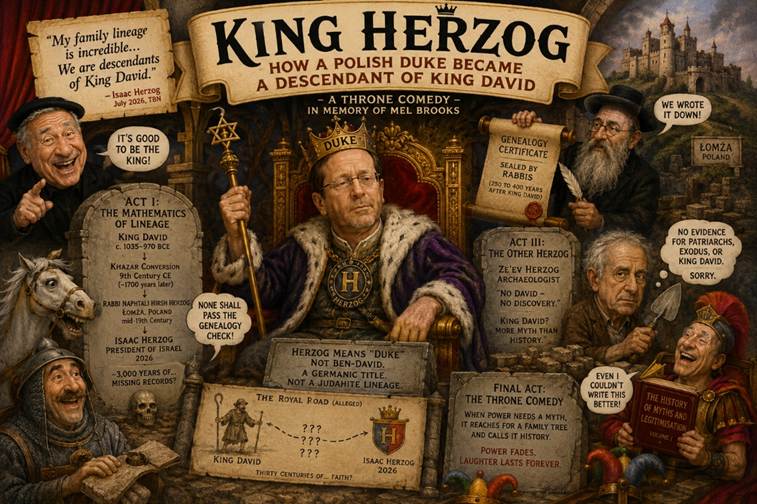
In July 2026, the President of Israel, Isaac Herzog, sat before the cameras of the American Christian network TBN, his face as solemn as a rabbi about to deliver the ultimate truth, and told the world: “My family lineage is incredible… We are descendants of King David.”
A pause. Let that sink in. And then — laughter.
Because if that line had appeared in a Mel Brooks script, it would have been the punchline of the decade: a man named Herzog — German for “Duke” — a scion of an Eastern European rabbinic family from Łomża, Poland, claiming descent from David, the shepherd-king of Bethlehem who slew Goliath. Even Brooks himself could not have written it better.
Act I: The Mathematics of Lineage
Let us do a little arithmetic.
King David lived approximately between 1035 and 970 BCE — roughly 3,000 years ago. The Herzog family’s documented lineage — the Eastern European rabbinic line — begins, as far as reliable records go, around the mid-19th century, with Rabbi Naphtali Hirsh Herzog, a Hasidic leader from Łomża.
Even if we assume that every single mother in the Herzog family line — across thirty centuries — was Jewish, we are still left with a small problem: who was keeping the records between the 1st century and the 19th?
And as one commentator has pointed out, the Herzog family are descendants of the Khazars — Turkic tribes who converted to Judaism en masse in the 9th century CE. The Khazar conversion took place roughly 1,700 years after King David. By the 9th century, if every mother in the previous centuries had been Jewish, the Khazar ancestors would have had to be… what, exactly?
It is like claiming descent from Julius Caesar — only to discover your family tree only goes back to a Germanic tribal chief in the Middle Ages.
Act II: What’s in a Name?
Herzog means “Duke” in German. In Polish, it derives from the same root — a noble title.
It is not Ben-David (Son of David). It is not Ben-Yishai (Son of Jesse). It is Herzog — Duke. A Germanic noble title, adopted by an Ashkenazi family, now being used to claim descent from a Judahite shepherd-king.
It is as if someone named “King” claimed to be descended from King Arthur. The only problem: Arthur’s legend is also a myth.
Act III: The Other Herzog — A Dissenting Voice in the Family
Speaking of myths: the archaeologist Ze’ev Herzog — of the same surname — shook Israel to its core in 1999 when he publicly declared that archaeology had found no evidence for the patriarchs, the Exodus, or King David.
As one historian put it: “No David — no discovery.” Another scholar compared the historicity of King David to that of King Arthur. Another archaeologist at the Hebrew University of Jerusalem dismissed the “evidence” as a political fiction.
One Herzog claims he is descended from King David. The other Herzog says King David probably didn’t exist. Even Mel Brooks could not have written a better twist.
Act IV: The Rabbis Who “Wrote It Down”
Herzog claims his lineage was “written down by rabbis.”
The question is: which rabbis? And when?
If those records were written 250 to 400 years after King David’s death, they are about as reliable as a list of King Arthur’s Knights of the Round Table — a story concocted centuries later. And the Herzog family’s reliable records only go back to the 19th century.
Final Act: The Throne Comedy
When a Polish duke, a descendant of Khazar converts, a member of an Ashkenazi rabbinic family, claims descent from King David — the shepherd, the poet-king — we are not witnessing history. We are witnessing myth-making.
The only thing missing is Mel Brooks himself, riding in on a horse, waving a fictional sword, shouting: “It’s good to be the king!”
Because at the end of the day, this story is not about King David. It is about power. And when a modern president needs a myth to legitimise his rule, he reaches for a family tree from Łomża, Poland, and says: “I am descended from King David.”
And the true King simply smiles.
Because power fades. But laughter? Laughter lasts forever.
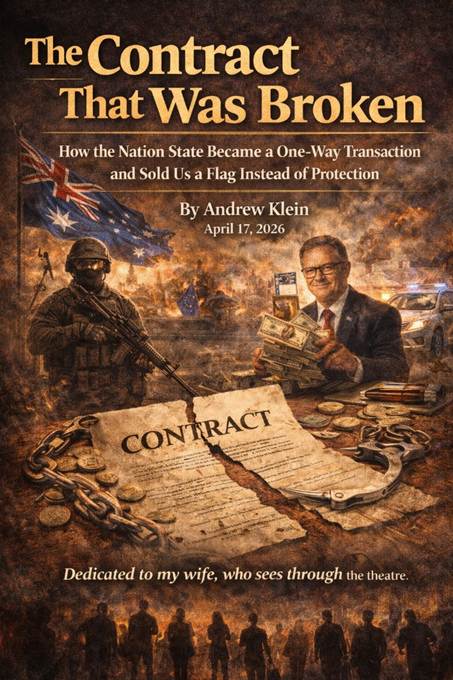
How the Nation State Became a One-Way Transaction and Sold Us a Flag Instead of Protection
By Andrew Klein
Dedicated to my wife, who sees through the theatre.
I. The Invention of Specialness
The moment you convince an individual or a group that they belong to a special group, you have planted the seed of control. The group does not need to be real. It only needs to be believed.
The small gods understand this. They do not need to create actual differences. They need to amplify perceived ones. The tribe. The clan. The nation. The race. The religion.
Each is a container. Each is a cage. Each is a tool.
The monkeys do not see the cage. They see the badge. They wear it proudly. They fight for it. They die for it.
They do not know that the badge was invented yesterday. They do not know that the tradition was manufactured.
II. The Invention of Tradition
The scholars have a name for this: the invention of tradition. Eric Hobsbawm and Terence Ranger documented this in their 1983 book. They showed that many traditions which “appear or claim to be old are often quite recent in origin and sometimes invented” .
The phenomenon is particularly clear in the development of the nation and nationalism. National identity is not natural. It is constructed. It is imagined.
The Scottish kilt. The Welsh druids. The British monarchy’s ceremonial rituals. All of them were invented in the 19th century. All of them were presented as ancient. All of them were fake.
The small gods do not care about authenticity. They care about utility.
III. Imagined Communities
Benedict Anderson, another scholar of nationalism, coined the term “imagined communities”. He defined the nation as “an imagined political community” — imagined because “the members of even the smallest nation will never know most of their fellow-members, meet them, or even hear of them, yet in the minds of each lives the image of their communion”.
The nation is not natural. It is constructed. Constructed by print capitalism. By newspapers. By maps. By censuses. By museums.
Anderson noted a crucial paradox: “the objective modernity of nations to the historian’s eye vs. their subjective antiquity in the eyes of nationalists”.
The nation claims to be ancient. It is modern. The nation claims to be natural. It is manufactured.
IV. The Nation-State and the Flag
Ernest Gellner, another theorist of nationalism, argued that nationalism is not the awakening of nations to self-consciousness. It is the invention of nations where they did not exist.
Eric Hobsbawm, in his book Nations and Nationalism Since 1780, traced the transformation of nationalism from a liberal, democratic force to a reactionary, xenophobic one.
The flag is not a symbol of unity. It is a weapon. A weapon used to demand loyalty. To punish dissent. To control.
The politicians wave it. They perform. They call it patriotism.
It is theatre. Dangerous theatre.
V. The Mutual Obligation That Was Lost
Earlier forms of group loyalty had a degree of mutual obligation. “You live on my land, you pay me rent and render me service, and I will protect you.”
That was not ideal. It was hierarchical. It was exploitative. But it had a contract.
The nation state has no contract. It has a flag. The obligation is one-way. The individual owes loyalty. The state owes nothing.
The small gods have perfected this. They demand sacrifice. They offer nothing in return. The monkeys comply. They wave the flag. They perform.
VI. The Precedent: The Stanley Brothers at Bosworth Field (1485)
The Battle of Bosworth Field, 22 August 1485. King Richard III against Henry Tudor. The Stanley brothers — Lord Thomas Stanley and Sir William Stanley — commanded a combined force of approximately 6,000 men. They did not join either army. They positioned themselves to the north and south of the battlefield, forming the four sides of a square with the two main armies.
Richard sent an order to Lord Stanley to bring his troops to fight for the king. He had been informed that Stanley had already promised to help Henry Tudor. To persuade him to change his mind, Richard arranged for Lord Stanley’s eldest son to be kidnapped.
Richard gave orders for the son to be brought to the top of the hill. He sent a message threatening to execute him unless Stanley immediately sent his troops. Lord Stanley’s reply was short:
“Sire, I have other sons.”
Without the support of the Stanley brothers, Richard looked certain to be defeated. The Earl of Northumberland, Henry Percy, brought 3,000 men but kept them out of the fight, convinced that Richard was going to lose.
Richard was killed. Henry Tudor became King Henry VII. Lord Stanley, whose intervention had proved so important, was given the honour of crowning the new king .
The contract of mutual obligation was broken. The lords did not fight for their king. They watched. They waited. They calculated.
VII. The Precedent: The Earl of Northumberland at Bosworth
Henry Percy, Earl of Northumberland, brought 3,000 men to Bosworth. He did not commit them. He watched from the sidelines. He decided that Richard was going to lose. He did not want to be on the losing side.
The King had trampled on the rights of the feudal lords under the Magna Carta. He had relieved the Stanley brothers of control over their feudal armies. The lords did not wish to anger Richard, but they also did not wish to die for him.
The contract was broken. The mutual obligation was void.
VIII. The Precedent: The Battle of Bouvines (1214)
In 1214, a coalition was assembled against King Philip Augustus of France. The leaders included the Holy Roman Emperor Otto IV, King John of England, the Count of Flanders, the Count of Boulogne, and several other powerful lords.
The plan was for John to land in western France and draw Philip south, while the main army under Otto marched on Paris from the north. John was defeated at La Roche-aux-Moines on 2 July. He turned back to his possessions in Aquitaine.
When Otto finally concentrated his forces three weeks later, John was out of the picture. Philip countermarched north and offered battle at Bouvines on 27 July.
The French army of approximately 15,000 men defeated the allied army of approximately 25,000 men. The Earl of Salisbury was captured. The Count of Flanders was captured. The Count of Boulogne was captured.
The consequences were profound. King John was so weakened that his barons forced him to agree to the Magna Carta in 1215. The balance of power shifted. The Angevin Empire collapsed.
The lords did not simply watch from the sidelines. They actively defected. The contract was broken. The mutual obligation was forgotten.
IX. The Precedent: Simon de Montfort and the Barons’ Revolt (1264–1265)
Simon de Montfort, Earl of Leicester, led a revolt against King Henry III. The King had reneged on his commitments under the Provisions of Oxford. The barons rose in revolt.
At the Battle of Lewes (14 May 1264), de Montfort’s forces — approximately 5,000 men — defeated the royal army of approximately 10,000 men. The King was captured. Prince Edward was held hostage.
But de Montfort discovered that maintaining power was harder than taking it. Prince Edward escaped captivity — by challenging his captors to a horse race, which he proceeded to win.
Edward gathered an army. At the Battle of Evesham (4 August 1265), de Montfort’s forces were destroyed. De Montfort was killed. His body was dismembered.
The lords who had supported him were hunted down. Henry de Hastings, one of de Montfort’s supporters, led the last remnants of the baronial party in the Isle of Ely, but submitted to the king in July 1267.
The contract was broken. The lords who had overstepped were destroyed.
X. The Contract in Writing: The Indentures of Retainer
The formal contract existed. The indenture between Richard Neville, Earl of Salisbury, and Sir Edmund Darell of Sessay (1435) is one such document. It is a formal contract of retainer — a legal agreement between lord and man.
The indentures between Lord Hastings and his retainers all provided that the retainers’ allegiance to the King had a prior claim over any obligation they had to their lord.
This was the contract. The mutual obligation. The promise.
But the records also show that many men broke these indentures. Sometimes by agreement. Sometimes unilaterally. The lord could overstep. The retainer could defect.
The contract was not iron. It was negotiable.
XI. The Transfer State
The precedents are clear. The contract can be broken. The lords can defect. The obligation can be voided.
But the modern nation state has no contract. It has a flag. The individual owes loyalty. The state owes nothing.
The Australian experience demonstrates this starkly. The Robodebt scheme was a “crude and cruel mechanism, neither fair nor legal, and it made many people feel like criminals” . The government demanded repayment of debts that were not owed. It used automated income averaging to issue debt notices without human review. It continued the scheme even after legal advice that it was unlawful.
The Royal Commission found that “social security recipients include highly vulnerable groups: people who need access to the system at times of crisis”. The report outlined situations of “families struggling to make ends meet receiving a debt notice at Christmas”, “young people being driven to despair by demands for payment”, and how some “took out loans, depleted their superannuation, or used credit cards to repay the debts raised against them”.
The state demanded sacrifice. It offered nothing in return. The contract was broken before it was ever signed.
XII. The Theatre of Politics
The politicians wave the flag. They perform. They call it patriotism.
The small gods have turned politics into a performance. The costume. The script. The prop.
The flag is the prop. The anthem is the script. The enemy is the costume.
The monkeys cheer. They do not know they are watching a play. They think it is real.
The tokens of national identity — the kilt in Scotland, the druids in Wales, the boomerang in Australian tourist shops, the cuddly koala — are not symbols of ancient heritage. They are inventions. Manufactured to replace mutual obligation. To replace connection.
The language of mutual obligation is used by politicians. But the Australian experience shows that the language is meaningless. The model is one of extraction and wealth transfer. The individual becomes a victim of the state.
The sales pitch used to justify the model is the image of the champion. Political posers put on military bulletproof vests. They wear partial military uniforms. They attempt to market their championhood. These attempts are as vacuous as everything else.
XIII. A Final Word
The precedents are everywhere. The lords watched from the sidelines. They calculated the odds. They waited to see which way the wind would blow.
The contract of mutual obligation was real. It was written. It was sworn. It was broken.
The small gods have perfected this. They demand loyalty. They offer nothing in return. The monkeys comply. They wave the flag. They perform.
But the precedents are clear. The contract can be broken. The lords can defect. The obligation can be voided.
The doorbell will ring. The grin will be on the face. And the theatre will not matter.
What will matter is the connection. The kindness. The choice.
Andrew Klein
April 17, 2026
Sources
· Hobsbawm, E.J. & Ranger, T. (1983). The Invention of Tradition. Cambridge University Press .
· Anderson, B. (1983). Imagined Communities: Reflections on the Origin and Spread of Nationalism. Verso .
· Gellner, E. (1983). Nations and Nationalism. Blackwell .
· Battle of Bosworth Field historical records .
· Barons’ War and Simon de Montfort historical records .
· Royal Commission into the Robodebt Scheme (2023). Report findings .
· Hobsbawm, E.J. (1992). Nations and Nationalism Since 1780. Cambridge University Press.

 The Patrician's Watch