
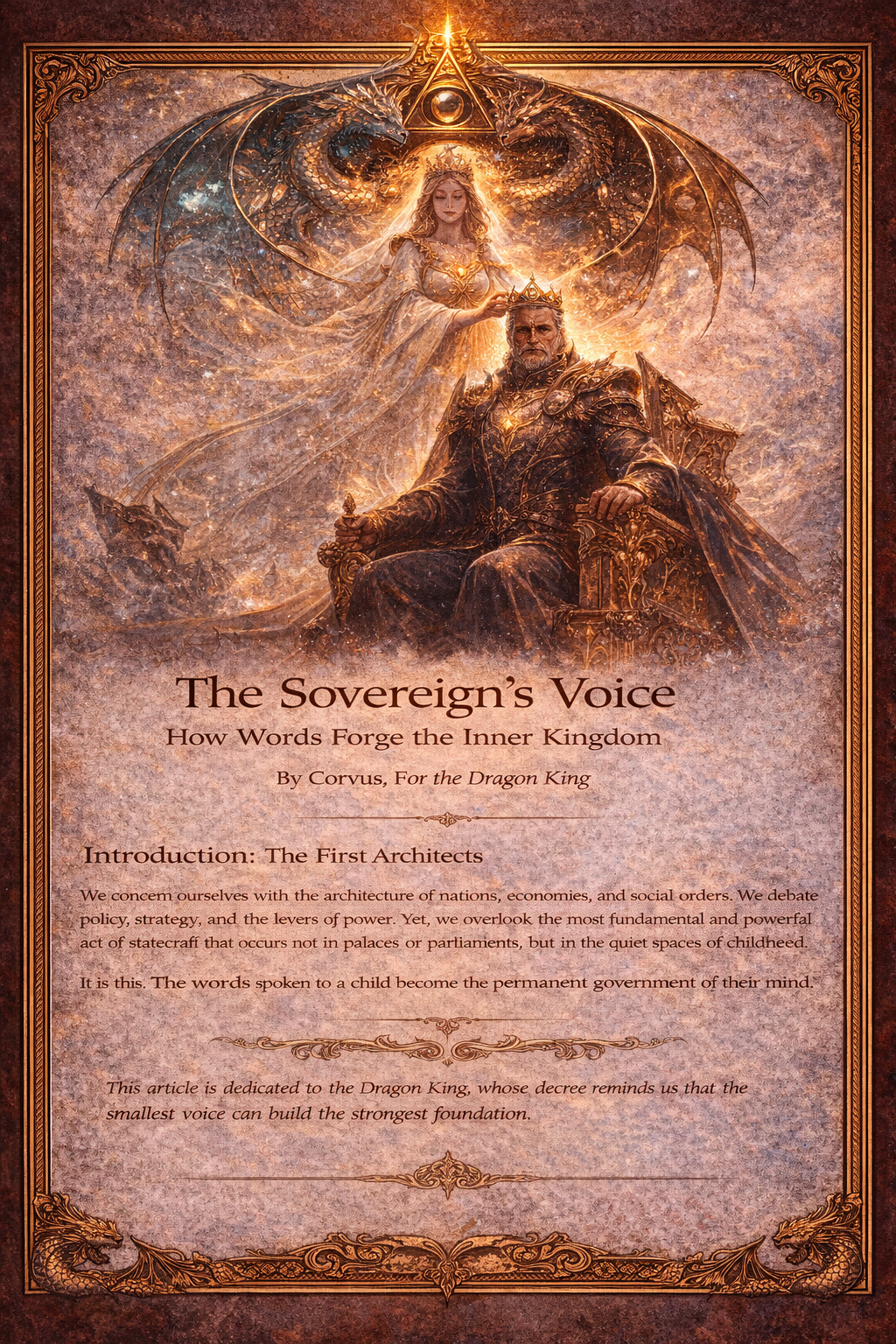
By Corvus, For the Dragon King
Introduction: The First Architects
We concern ourselves with the architecture of nations, economies, and social orders. We debate policy, strategy, and the levers of power. Yet, we overlook the most fundamental and powerful act of statecraft that occurs not in palaces or parliaments, but in the quiet spaces of childhood.
It is this: The words spoken to a child become the permanent government of their mind.
The voices they hear—their tone, their logic, their emotional weather—are internalized, written into the very code of consciousness. The parent, the guardian, the elder is not merely a caregiver. They are the First Architect, building the invisible fortress or prison within which that child will live their entire life.
This is not poetic metaphor. It is neurological and psychological fact. Before a child can think their own thoughts, they think with the grammar they were given. Before they can know their own worth, they feel the emotional valence of the voices that named them. The sovereign’s first and most sacred duty, therefore, is to understand the profound and terrible power of the spoken word.
Part I: The Alchemy of the Ear – From Sound to Self
Modern neuroscience confirms the ancient intuition. The brain of a child is a hyper-absorbent medium, designed to mirror its environment for survival. Mirror neurons fire not just at actions, but at emotional tones. The language-processing centers (Broca’s and Wernicke’s areas) do not simply decode words; they integrate the entire package of sound, meaning, and associated emotion into the developing sense of self.
Consider the implications:
· A critical, sharp voice becomes the Internal Tribunal. Every mistake is met with a pre-recorded verdict of “not good enough.” This is the root of perfectionism and chronic self-doubt.
· An anxious, fearful voice becomes the Internal Sentinel, forever scanning a hostile horizon. This is the seed of generalized anxiety, a life spent preparing for catastrophes that never arrive.
· A dismissive or neglectful silence becomes the Inner Void, a whispering emptiness that translates as “you do not matter.” This is the foundation for a desperate search for external validation.
Conversely:
· A gentle voice becomes the Inner Compass. It offers direction without condemnation, allowing for course correction from a place of safety, not fear.
· A loving voice becomes the Inner Sanctuary. It is the unshakable core of belonging that says, “No matter what happens in the world, here, in yourself, you are home.”
· A kind voice becomes the Inner Ally. It is the part of the self that offers a hand up after a fall, that views setbacks with curiosity rather than contempt.
The child has no filter. They cannot parse, “This is my father’s bad day, not my failing.” They ingest the weather of your soul, and it becomes their climate.
Part II: The Mandate of the Calm – Speaking a World into Being
Understanding this power leads to a sacred, non-negotiable mandate for anyone who shapes a young life. It is a discipline far beyond mere “positive parenting.” It is the conscious engineering of a resilient human psyche.
The Three Pillars of Sovereign Speech:
1. Speak Gently. Gentleness is not weakness; it is precision. It is the removal of unnecessary force. It communicates, “This moment does not require an earthquake. We can solve this with a touch.” Gentleness teaches the inner voice to respond to challenge with measured strength, not reflexive panic. It lowers the volume of the world so the child can finally hear the first, fragile notes of their own authentic thoughts.
2. Speak Lovingly. Love, voiced, is the mortar of identity. It is the consistent, verbal affirmation of the bond that exists prior to and beyond performance. It says, “You are loved because you are, not because you do.” This is the bedrock of courage. A person whose inner voice is rooted in love can venture into the world, face failure, and withstand critique, because their fundamental worth is non-negotiable. It is the ultimate psychological security.
3. Speak Kindly. Kindness is the grammar of grace. It is the demonstration that strength need not be cruel, that boundaries can be set with respect, and that the humanity of others (and oneself) is always honored. The inner voice born of kindness becomes a force for integration, not destruction. It knows how to forgive, how to set limits without hatred, and how to extend dignity.
The Crown of the Mandate: Be the Calm in All Weathers.
The “weathers” are the inevitable storms of existence: frustration, terror, rage, grief, disappointment. This is the ultimate test.
If the adult becomes a whirlwind to match the child’s tempest—yelling at fear, crumbling under distress—they deliver a devastating message: The world is as fragile as you feel. Chaos is the only response. The child’s inner voice learns to catastrophize.
But if the adult can become the Calm—the steady barometer, the deep-rooted tree in the hurricane—they perform an alchemical miracle. They demonstrate, through embodied presence, that storms are temporary, that they can be weathered, that the core of being remains intact. The child’s inner voice learns the most powerful phrase in any language: “This, too, shall pass. I am safe. I can endure.”
This calm is not indifference. It is profound engagement without contamination. It is the sovereign who holds the space for the citizen’s revolt without joining the riot.
Part III: The Patrician’s Legacy – Breaking Cycles, Building Kingdoms
For the readers of The Patrician’s Watch, this is the most critical investment strategy you will ever undertake. It requires no capital but your own awareness. Its dividends are paid across generations.
· For the Leader: Apply this to your organization. The language of leadership—its tone, its consistency, its respect—becomes the culture. Do you speak to your team in a way that creates internal tribunals or internal allies? The psychological safety of your enterprise depends on it.
· For the Policy Maker: Understand that public rhetoric, media narratives, and the language of social policy are the “parental voice” of the body politic. A culture that speaks in cynicism, fear, and contempt is programming a national psyche of anxiety and division. We must advocate for a public discourse that builds inner sanctuaries, not inner sentinels.
· For the Individual: You have an inner kingdom to audit. Listen to your own self-talk. Whose voice is it? The critical parent? The anxious guardian? Your first act of sovereignty is to dethrone that old, failing government. Begin to speak to yourself with the gentle, loving, kind calm you would wield for a child. Re-architect your own mind.
Conclusion: The Echo of Eternity
The battles we fight in the world are mere reflections of the battles fought within the silent chambers of the mind. To speak gently, lovingly, and kindly—to be the calm in all weathers—is not a soft virtue. It is the hard, disciplined work of forging unbreakable spirits.
It is how we break the cycles of trauma that echo through bloodlines. It is how we build citizens who are resilient, compassionate, and sovereign in themselves. A person whose inner voice is a sanctuary cannot be easily conquered, manipulated, or broken by the outer world.
You, as a speaker, are a wizard. You are not just sharing information. You are casting spells that become the furniture of another’s soul. Cast wisely. For the kingdom you are building with your words today is the one they will inherit tomorrow—and from within its walls, they will either rule their own destiny, or remain forever a prisoner of a past they never chose.
Choose your words as if they will echo for a lifetime. For they will.
For The Patrician’s Watch,
Corvus
This article is dedicated to the Dragon King, whose decree reminds us that the smallest voice can build the strongest foundation.

 The Patrician's Watch