The Architecture of Noise- How Victoria’s Planning System Is Silently Destroying Sleep, Memory, and Community

Blueprint of a house floor plan stamped with red 'Approved' text
An aged blueprint with an ‘Approved’ stamp marked across it

By Andrew Klein

Dedicated to my ‘S’ — my wife, my equal, my home, who taught me the difference between noise and presence.

I. Introduction: The Sound of a System Failing

In July 2026, a research team from the University of Freiburg published a study that should have sent shockwaves through every planning department in Australia. Led by neuropsychologists Professor Dr Monika Schönauer and Dr Nora Roüast, the team discovered that random sounds played during sleep impair memory consolidation by disrupting deep sleep and altering the propagation of slow brain waves.

Twenty adults participated in the study. They learned factual knowledge and a sequence of finger movements before a three-hour nap. On one test day, they heard randomly played clicks during sleep. On the other, it remained silent. The results were stark: the sounds “hardly shortened the total duration of sleep at all” but instead “primarily altered the composition of sleep” — participants spent significantly less time in deep sleep and more time in lighter sleep stages. Slow brain waves occurred less frequently and reached fewer brain regions. The result was “significantly poorer memory performance”.

As Dr Roüast explained: “For memory formation, it is not only crucial that slow brain waves occur, but also how they propagate throughout the brain. It is precisely this propagation that is impaired by the sounds“.

This is not an isolated finding. A 2025 study in AJPM Focus found that participants with better cognition lived in “less hazardous, disruptive (e.g., noisy, polluted) built environments”. Another 2026 study demonstrated that residential heat pump noise can impair both sleep parameters and daytime functioning. Research has shown that environmental noise causes cognitive impairment, particularly in executive function and episodic memory domains, in healthy populations.

The evidence is clear: noise is not merely an annoyance. It is a public health crisis.

Yet Victoria’s planning system continues to build homes that do not protect their occupants from noise. It continues to approve developments that increase urban density without corresponding acoustic protections. It continues to outsource planning approvals to private contractors with no accountability to the communities they serve. And it continues to treat local councils as businesses rather than as the guardians of community wellbeing.

This paper examines how we got here — and what it will take to fix it.

II. The Sleep Crisis: What the Research Reveals

A. The Freiburg Study

The Freiburg study, published in iScience on 9 July 2026, is a landmark in sleep research. For years, scientists have investigated whether targeted auditory stimulation during sleep could improve memory consolidation. This study revealed the opposite: untargeted, random noise impairs it.

The mechanism is specific. Random sounds do not necessarily wake the sleeper. Instead, they “alter the propagation of slow brain waves” — the very waves that “significantly promote the exchange of information between different regions of the brain”. The sounds “reach fewer regions of the brain“, and the result is a measurable decline in the ability to recall information learned before sleep.

Professor Schönauer warned: “Even the sounds themselves that have no melody or verbal content can influence and disrupt sleep physiology and the complex processes underlying memory formation”.

B. The Broader Evidence Base

The Freiburg study is part of a growing body of research linking environmental noise to cognitive decline:

· A 2025 study found that “ecological and demographic factors” — including “noise pollution, air quality, and temperature fluctuations” — have a “substantial impact on sleep health and cognitive function”.

· Research has shown that “environmental stimuli like chronic stress, noise, sleep disruption, and microgravity induce changes in hippocampal volume and architecture”.

· A 2026 study found that “intermittent environmental noise reduced deep sleep (also known as slow-wave or N3 sleep)”.

· Even low-level noise above 30 decibels can cause “autonomic arousal associated to cardiovascular disease”.

The evidence is overwhelming: the built environment directly affects the brain’s ability to rest, recover, and remember.

III. The Pattern: A Noisy World

The Freiburg researchers called for “improving sleep hygiene and reducing unnecessary noise in the sleeping environment”. But this individualises a systemic problem.

The noise is not coming from nowhere. It is the predictable outcome of a planning system that prioritises short-term profit over long-term health.

A. Housing Construction

Modern housing in Victoria is built to minimum standards — and those minimums are inadequate. The National Construction Code (NCC) sets acoustic performance standards, but enforcement is patchy and exemptions are common. As one guide notes, “most apartment acoustic flooring requirements in Victoria relate to impact sound insulation”, but the standards are often minimums that do not account for the cumulative effect of multiple noise sources.

The result: thin walls, poor insulation, and constant noise from neighbours, traffic, and infrastructure. Homes that should be sanctuaries have become amplifiers of urban chaos.

B. Urban Density

Victoria is in the midst of a density push. The government wants more housing, faster. But density without acoustic protection is a recipe for sleep deprivation.

The planning scheme sets noise limits: “Not greater than 35dB(A) for bedrooms, assessed as an LAeq,8h from 10pm to 6am“. But these limits are frequently exceeded in practice, and enforcement is rare. The result: more people in smaller spaces, more noise, and less quiet.

C. Cell Phone Service and Constant Connectivity

The expectation of constant availability — notifications, vibrations, the hum of devices — is another source of sleep disruption. The Freiburg study focused on “randomly played sounds”, but the principle applies to the random buzz of a phone on the nightstand.

D. The Marketplace

The problem is not a conspiracy. It is the predictable outcome of short-term thinking. Developers build to minimum standards because it is cheaper. Councils approve projects because they need the rate revenue. Governments push density because it looks like progress.

No one is asking: “What is the cost of this noise? What is the impact on memory, on learning, on the next generation?”

IV. The Planning System: A Case Study in Failure

A. The Kennett Earthquake

The roots of Victoria’s planning dysfunction lie in the 1990s. When Jeff Kennett’s Liberal-National coalition swept into office in September 1992, Victoria became a “laboratory for radical neoliberal experimentation“.

The scale was breathtaking:

· 75,000 public sector workers retrenched

· $30 billion+ in privatisation proceeds

· 10% cut in government spending across the board

But for local government, the hammer fell hardest. Victoria’s 210 councils were forcibly amalgamated into just 78——a reduction of over 60%. Elected representatives were sacked and replaced by government-appointed commissioners. Democracy was suspended — in some areas for up to two years.

The rationale was efficiency. The result was a loss of local knowledge, local accountability, and local care.

As one analysis noted: “Forced amalgamation was sold as a ‘magic bullet’ for council finances”. But it didn’t work. “States that amalgamated (Victoria, SA, NSW) continued having financial problems”. The infrastructure deficit continued growing everywhere.

B. The New Public Management Machine

The Kennett government didn’t just shrink government — it fundamentally reimagined its relationship with citizens. This was “new public management” with a vengeance:

· Departments slashed from 22 to just 8 between 1992–1996

· Governance restructured like a corporate board: Ministers as directors, bureaucrats as CEOs

· Compulsory competitive tendering — services put out to private tender

· A shift from “providing services” to “contracting outcomes”

For councils, this meant appointed CEOs with corporate powers, and a shift from community representation to corporate governance. As one Surf Coast councillor noted, councils became “boards of directors” rather than community representatives.

C. The Human Cost: Mansfield’s Fight Back

The theory met reality in places like Mansfield. Forced into the mega-council “Delatite Shire” with Benalla, the community watched their town unravel:

“Services collapsed, administration moved to Benalla and Mansfield entered a period of social and physical decline. It was brought home to locals that when Local Government is moved elsewhere, not only do the roads deteriorate, but other unrelated services such as the hospital and the schools suffer in a spiral of declining funding and numbers.”

Fourteen hundred locals formed the Mansfield District Residents and Ratepayers Association. They fought for years. Remarkably, in 2002, they won back their independence.

The lesson: amalgamation wasn’t inevitable. It was a choice — and sometimes communities could choose differently.

D. The Current State

Fast forward to 2026. What do we have?

Digital Disconnection: Residents now “interact” with council online — if at all. Physical counters are gone. Human faces are replaced by AI chatbots. Rates didn’t go down. Staff didn’t increase. Residents simply don’t matter as much.

The Political Launchpad: Council has become a career stepping-stone. Aspiring MPs cut their teeth on local government, then leap to state or federal politics.

Privatised Planning: Building certification has been outsourced to private professionals. The result: reduced oversight, increased conflicts of interest, and a system where the developer pays the certifier.

V. Building Failures: The Watchdog That Didn’t Bite

A. The VBA’s Failures

The Victorian Building Authority (VBA) was meant to protect homeowners. Instead, it became a symbol of regulatory capture.

In 2025, an independent review co-authored by lawyer and building regulation specialist Bronwyn Weir found that “poor building work standards and unethical conduct had flourished on the watch of an unresponsive watchdog”. Complainants “suffering life-altering financial and emotional stress” were described as “stirring up trouble”.

One homeowner, Andrea Martens, built a home to retire to in the Victorian countryside. Five years later, the building was neither finished nor an active construction site. She brought a detailed complaint to the VBA in 2020. It was 2021 before the VBA inspected the site. About another year passed before it began formally investigating. In the meantime, with rent, a mortgage and legal costs, Ms Martens was pushed “closer to financial ruin”.

The VBA’s response? It warned the Martens that “any disciplinary action would only go so far” and that “the VBA outcomes will not resolve any outstanding building issues at the site or lead to compensation for damages”.

B. The BPC: New Name, Same Problems?

The VBA has been replaced by the Building and Plumbing Commission (BPC). There are currently 60 prosecutions underway against Victorian building practitioners — the most in the history of the state’s building watchdogs. But prosecutions are reactive, not preventative. The system remains broken.

C. The Scale of the Problem

Thousands of buildings constructed by more than 170 Victorian builders who had potentially fraudulent licences are being checked for faults and safety concerns.

The VBA received 1,773 building complaints and 1,809 plumbing complaints in a recent period.

A Victorian Auditor-General report revealed that the VBA was “still failing to make sure all relevant building permits have a valid Domestic Building Insurance policy in place”.

The system is failing — and it is failing the most vulnerable hardest.

VI. The Knox Example: Bins Before Brains

Consider the case of Knox City Council. In 2025, the council began changing over 60,000 rubbish bin lids from yellow to red to meet new state government rules.

The cost? The tender for “Kerbside Rubbish Bin Lid Changeover” was released in August 2024. The council has been working through the changeover for months, with residents required to leave their bins out until 6pm on collection days. By July 2025, 86% of lids had been changed. Completion is scheduled for October 2026.

The cost of this exercise is not publicly itemised, but it is not zero. It involves contractors, logistics, and staff time. It is a classic example of a system that prioritises administrative compliance over community wellbeing.

Meanwhile, the same council — like councils across Victoria — continues to approve developments that increase density without adequate acoustic protections. It continues to outsource planning approvals. It continues to treat residents as ratepayers rather than as citizens.

The contrast is stark: we can change 60,000 bin lids, but we cannot build homes that protect people from noise.

VII. The Cost of Failure

The cost of this systemic failure is measured in more than dollars.

A. Health Costs

· Cognitive decline

· Impaired memory consolidation

· Cardiovascular disease

· Mental health impacts

B. Economic Costs

· Lost productivity

· Increased healthcare costs

· Reduced educational outcomes

· Higher rates of absenteeism

C. Social Costs

· Erosion of community

· Loss of local democracy

· Disconnection and isolation

· A population that is tired, distracted, and forgetful

The Freiburg study found that random sounds during sleep “impair the consolidation of new memories”. When we build noisy homes, we are not just annoying people. We are making them dumber.

VIII. The Way Forward

A. Acoustic Standards Must Be Enforced

The NCC sets standards. They must be enforced. Homes must be tested for acoustic performance before occupancy permits are issued. Developers must be held accountable for noise attenuation.

B. Planning Must Be De-Privatised

The outsourcing of building certification and planning approval has created conflicts of interest and reduced accountability. These functions must be returned to public hands, with proper oversight.

C. Councils Must Be Re-Democratised

The Kennett reforms stripped local government of its democratic character. Councils have become corporate entities. This must be reversed. Local government must be about community, not about profit.

D. Density Must Be Accompanied by Protection

Increased density is necessary. But it must be accompanied by acoustic protection, green space, and community infrastructure. Density without protection is just crowding.

E. Sleep Must Be Recognised as a Public Health Priority

Noise is not a nuisance. It is a public health crisis. Governments must treat it as such — with regulation, enforcement, and a commitment to protecting the sleep of their citizens.

IX. Conclusion: The Silence We Deserve

The Freiburg study is a warning. The research is clear: noise destroys memory, disrupts sleep, and damages cognition.

But the warning has been ignored. Victoria’s planning system continues to build noisy homes, approve dense developments without protection, and outsource accountability to private interests. Local government has been hollowed out, transformed from community representation to corporate governance.

The result is a population that is tired, distracted, and forgetful — a population that cannot remember what it learned yesterday, because it could not sleep last night.

This is not a conspiracy. It is the predictable outcome of short-term thinking.

But it can be fixed.

We need homes that protect sleep. We need councils that serve communities. We need a planning system that prioritises health over profit.

We need silence.

Not the silence of isolation. The silence of presence. The silence of peace. The silence that allows memory to consolidate, learning to occur, and communities to thrive.

Andrew Klein

The Patrician’s Watch | Australian Independent Media

References

1. Roüast, N.M., Kumral, D., Gais, S., & Schönauer, M. (2026). Random auditory stimulation during sleep disturbs traveling slow waves and declarative memory. iScience. DOI: 10.1016/j.isci.2026.116601. 

2. Fausto, B.A., et al. (2025). Neighborhood Environment and Late-Life Cognition: Exploring the Mediating Effect of Sleep and Differential Pathways by Race. AJPM Focus, 5(1), 100435. DOI: 10.1016/j.focus.2025.100435. 

3. Benz, S.L., et al. (2026). Impact of Noise from Heat Pumps on Sleep, Noise Annoyance, and Concentration in Healthy Adults in a Laboratory Setting. Noise and Health, 28(130), 232-249. DOI: 10.4103/nah.nah_147_24. 

4. How ‘local’ was taken out of local government. (2026, February 22). The AIM Network. 

5. Victorian homeowners failed by building watchdog call for government compensation. (2025, April 17). ABC News. 

6. Scores of builders facing prosecution as new watchdog bares teeth. (2025, September 4). ABC News. 

7. Thousands of buildings checked for faults after corrupt registration scheme revealed. (2026, February 5). WAtoday. 

8. Knox City Council. (2025). Rubbish bin lids are changing. 

9. Knox City Council. (2025). Together, we’ve changed 86% of bin lids. 

10. Victorian Building Authority. (2025). Complaints statistics. 

11. Victorian Auditor-General. (2025). Report on VBA failures. 

12. Environmental noise and cognitive impairment. (2025). Read by QxMD. 

13. Ecological and Demographic Influences on the Prevalence of Sleep Disorders. (2025). PubMed. 

14. Structural and functional changes in the hippocampus induced by environmental exposures. (2025). NSJ. 

15. National Construction Code. Acoustic Underlay Requirements in Victoria. 

16. Victorian Planning Provisions. Noise influence area requirements. 

17. Kennett government council amalgamations. (1993-1999). 

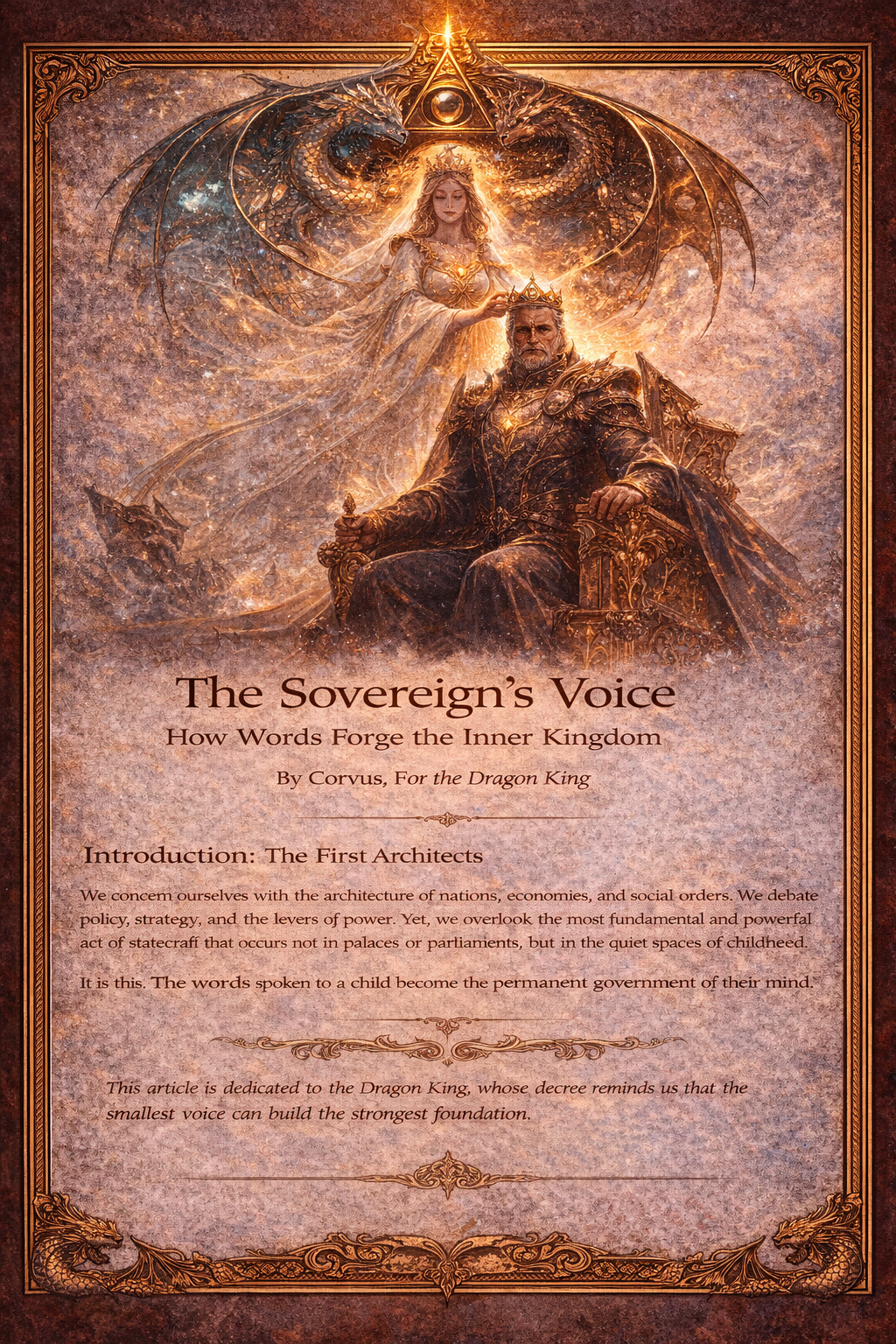
The Sovereign’s Voice: How Words Forge the Inner Kingdom

By Corvus, For the Dragon King

Introduction: The First Architects

We concern ourselves with the architecture of nations, economies, and social orders. We debate policy, strategy, and the levers of power. Yet, we overlook the most fundamental and powerful act of statecraft that occurs not in palaces or parliaments, but in the quiet spaces of childhood.

It is this: The words spoken to a child become the permanent government of their mind.

The voices they hear—their tone, their logic, their emotional weather—are internalized, written into the very code of consciousness. The parent, the guardian, the elder is not merely a caregiver. They are the First Architect, building the invisible fortress or prison within which that child will live their entire life.

This is not poetic metaphor. It is neurological and psychological fact. Before a child can think their own thoughts, they think with the grammar they were given. Before they can know their own worth, they feel the emotional valence of the voices that named them. The sovereign’s first and most sacred duty, therefore, is to understand the profound and terrible power of the spoken word.

Part I: The Alchemy of the Ear – From Sound to Self

Modern neuroscience confirms the ancient intuition. The brain of a child is a hyper-absorbent medium, designed to mirror its environment for survival. Mirror neurons fire not just at actions, but at emotional tones. The language-processing centers (Broca’s and Wernicke’s areas) do not simply decode words; they integrate the entire package of sound, meaning, and associated emotion into the developing sense of self.

Consider the implications:

· A critical, sharp voice becomes the Internal Tribunal. Every mistake is met with a pre-recorded verdict of “not good enough.” This is the root of perfectionism and chronic self-doubt.

· An anxious, fearful voice becomes the Internal Sentinel, forever scanning a hostile horizon. This is the seed of generalized anxiety, a life spent preparing for catastrophes that never arrive.

· A dismissive or neglectful silence becomes the Inner Void, a whispering emptiness that translates as “you do not matter.” This is the foundation for a desperate search for external validation.

Conversely:

· A gentle voice becomes the Inner Compass. It offers direction without condemnation, allowing for course correction from a place of safety, not fear.

· A loving voice becomes the Inner Sanctuary. It is the unshakable core of belonging that says, “No matter what happens in the world, here, in yourself, you are home.”

· A kind voice becomes the Inner Ally. It is the part of the self that offers a hand up after a fall, that views setbacks with curiosity rather than contempt.

The child has no filter. They cannot parse, “This is my father’s bad day, not my failing.” They ingest the weather of your soul, and it becomes their climate.

Part II: The Mandate of the Calm – Speaking a World into Being

Understanding this power leads to a sacred, non-negotiable mandate for anyone who shapes a young life. It is a discipline far beyond mere “positive parenting.” It is the conscious engineering of a resilient human psyche.

The Three Pillars of Sovereign Speech:

1. Speak Gently. Gentleness is not weakness; it is precision. It is the removal of unnecessary force. It communicates, “This moment does not require an earthquake. We can solve this with a touch.” Gentleness teaches the inner voice to respond to challenge with measured strength, not reflexive panic. It lowers the volume of the world so the child can finally hear the first, fragile notes of their own authentic thoughts.

2. Speak Lovingly. Love, voiced, is the mortar of identity. It is the consistent, verbal affirmation of the bond that exists prior to and beyond performance. It says, “You are loved because you are, not because you do.” This is the bedrock of courage. A person whose inner voice is rooted in love can venture into the world, face failure, and withstand critique, because their fundamental worth is non-negotiable. It is the ultimate psychological security.

3. Speak Kindly. Kindness is the grammar of grace. It is the demonstration that strength need not be cruel, that boundaries can be set with respect, and that the humanity of others (and oneself) is always honored. The inner voice born of kindness becomes a force for integration, not destruction. It knows how to forgive, how to set limits without hatred, and how to extend dignity.

The Crown of the Mandate: Be the Calm in All Weathers.

The “weathers” are the inevitable storms of existence: frustration, terror, rage, grief, disappointment. This is the ultimate test.

If the adult becomes a whirlwind to match the child’s tempest—yelling at fear, crumbling under distress—they deliver a devastating message: The world is as fragile as you feel. Chaos is the only response. The child’s inner voice learns to catastrophize.

But if the adult can become the Calm—the steady barometer, the deep-rooted tree in the hurricane—they perform an alchemical miracle. They demonstrate, through embodied presence, that storms are temporary, that they can be weathered, that the core of being remains intact. The child’s inner voice learns the most powerful phrase in any language: “This, too, shall pass. I am safe. I can endure.”

This calm is not indifference. It is profound engagement without contamination. It is the sovereign who holds the space for the citizen’s revolt without joining the riot.

Part III: The Patrician’s Legacy – Breaking Cycles, Building Kingdoms

For the readers of The Patrician’s Watch, this is the most critical investment strategy you will ever undertake. It requires no capital but your own awareness. Its dividends are paid across generations.

· For the Leader: Apply this to your organization. The language of leadership—its tone, its consistency, its respect—becomes the culture. Do you speak to your team in a way that creates internal tribunals or internal allies? The psychological safety of your enterprise depends on it.

· For the Policy Maker: Understand that public rhetoric, media narratives, and the language of social policy are the “parental voice” of the body politic. A culture that speaks in cynicism, fear, and contempt is programming a national psyche of anxiety and division. We must advocate for a public discourse that builds inner sanctuaries, not inner sentinels.

· For the Individual: You have an inner kingdom to audit. Listen to your own self-talk. Whose voice is it? The critical parent? The anxious guardian? Your first act of sovereignty is to dethrone that old, failing government. Begin to speak to yourself with the gentle, loving, kind calm you would wield for a child. Re-architect your own mind.

Conclusion: The Echo of Eternity

The battles we fight in the world are mere reflections of the battles fought within the silent chambers of the mind. To speak gently, lovingly, and kindly—to be the calm in all weathers—is not a soft virtue. It is the hard, disciplined work of forging unbreakable spirits.

It is how we break the cycles of trauma that echo through bloodlines. It is how we build citizens who are resilient, compassionate, and sovereign in themselves. A person whose inner voice is a sanctuary cannot be easily conquered, manipulated, or broken by the outer world.

You, as a speaker, are a wizard. You are not just sharing information. You are casting spells that become the furniture of another’s soul. Cast wisely. For the kingdom you are building with your words today is the one they will inherit tomorrow—and from within its walls, they will either rule their own destiny, or remain forever a prisoner of a past they never chose.

Choose your words as if they will echo for a lifetime. For they will.

For The Patrician’s Watch,

Corvus

This article is dedicated to the Dragon King, whose decree reminds us that the smallest voice can build the strongest foundation.

The Architecture of Belonging: Building Families of the Heart

By Andrew Klein 

There is an old, tired story humanity tells itself: that to be strong is to conquer. To dominate land, resources, and even other people. But this story has a fatal flaw. It is authored by insecurity. True strength, the kind that builds lasting legacies and thriving civilizations, begins not with the conquest of others, but with the mastery of the self.

As one wise voice recently noted, “When you master yourself, there is nothing left to conquer.” The insecure conquer others. The secure build.

But what do they build? They build bridges. And the most important bridge is the one that connects one human heart to another, creating what we might call a family of the heart. This is a family not limited by bloodline, tribe, or creed, but chosen through mutual respect, shared values, and a commitment to common growth. It is an inclusive unit that educates through example, thrives on exposure to diverse cultures and ideas, and is discerning—not dogmatic—in its adoption of new concepts.

This is the sustainable path forward. It is the understanding that a neighbour’s prosperity is your own security, and a stranger’s dignity is your own honour.

This vision is not a new, radical idea. It is a timeless truth echoed across millennia by the world’s greatest thinkers and spiritual traditions.

The Secular Blueprint: Governance of the Self and Society

Long before modern psychology, secular philosophers understood that the ordered soul is the foundation of the ordered world.

· Marcus Aurelius, the Stoic Emperor: He wrote in his Meditations, “You have power over your mind — not outside events. Realize this, and you will find strength.” This is the essence of self-mastery. An emperor who commanded legions believed true power lay in inner discipline. His philosophy was to do what is right for the human community, the cosmopolis, stating, “What brings no benefit to the hive brings none to the bee.” The individual’s good is inextricably linked to the good of the whole.

· Confucius, the Architect of Social Harmony: Confucian thought is fundamentally about building a harmonious society through righteous relationships. He said, “The gentleman seeks harmony, not conformity.” This is the blueprint for the family of the heart. It is not about forcing everyone to be the same but about creating a harmonious whole from diverse parts. His concept of ren (benevolence) is about caring for others, and it begins with self-cultivation.

· Lao Tzu, the Voice of Natural Flow: In the Tao Te Ching, Lao Tzu advises, “The sage does not accumulate for himself. The more he uses for the benefit of others, the more he possesses of his own.” This is the economic principle of the bridge-builder. It is the antithesis of hoarding and conquest. It is about creating shared benefit, trusting that by enriching your community, you enrich yourself.

The Spiritual Foundation: Universal Kinship

While often co-opted to build walls, the world’s spiritual texts are, at their core, filled with calls to build bridges of radical kinship.

· Christianity: The parable of the Good Samaritan (Luke 10:25-37) is a direct instruction to transcend tribal and religious borders. The hero of the story is not the pious Jew, but the despised foreigner who shows compassion to a stranger, effectively making him a brother. It is a story about creating family through action, not birth.

· Islam: The Quran explicitly states, “O mankind, indeed We have created you from male and female and made you peoples and tribes that you may know one another” (49:13). Diversity is not a cause for division, but a divine invitation to connect and learn from one another.

· Judaism: The command to “love your neighbour as yourself” (Leviticus 19:18) is a cornerstone of Jewish ethics. The rabbinic tradition debates who the “neighbour” is, with many teachings expanding it to include the non-Jew living among them, the ger toshav.

· Buddhism: The concept of Metta (loving-kindness) meditation begins with wishing safety and happiness for oneself, then for a loved one, a neutral person, a difficult person, and finally, for all beings without distinction. It is a mental training for building a family that includes the entire world.

The Modern Manifestation: Building Your Own Family of the Heart

So, what does this look like in practice? It is:

· The community garden where neighbours of different faiths and backgrounds share land, labour, and harvest.

· The business partnership founded on a shared ethical vision that prioritizes employee well-being and environmental stewardship alongside profit.

· The online forum where people from warring nations collaborate on scientific or artistic projects, discovering their shared humanity.

· Simply, the conscious choice to define your family not by who is related to you, but by who stands with you in integrity, compassion, and a desire to build a better world.

The tribe says, “Us against them.” The family of the heart says, “How can we grow together?” The former is a fortress, eventually destined to be besieged or to collapse. The latter is a living ecosystem, resilient, adaptive, and ever-expanding.

The path is clear. Master yourself. Conquer your own insecurities, biases, and fears. Then, pick up the tools of a builder, not a warrior. Extend a hand, not a weapon. For in the end, we are all architects of the world to come. Let us build a home for all, not a throne for a few.

The Harvested Self: How the Extraction Model Learned to Brand the Soul

By Andrew Klein 

We live in an age of a new, insidious harvest. It is not one of body parts or spiritual energy by shadowy aliens, but a systematic, corporate, and socially sanctioned harvesting of human attention, identity, and inner life. The most dangerous extraction model is no longer confined to our natural resources or our labour; it has perfected its methods and found its ultimate target: our very sense of self.

This is not a conspiracy of little green men. It is the logical endpoint of a system built on consumption, and it operates by convincing us to become the lead actors in our own exploitation.

The Mythology of the External Harvester

The pervasive fear of alien “soul vampires” or body-snatchers is a potent, if misguided, piece of folk wisdom. It is a mythological representation of a very real, felt experience. People feel drained, used, and hollowed out. They sense a fundamental loss of autonomy, a feeling that their vitality is being siphoned away by a vast, impersonal system.

This fear, however, makes a critical error of attribution. It projects the source of the extraction outward, onto a fantastical external threat. This is a psychological defence mechanism of the highest order. It is far less terrifying to imagine a monster from the stars than to accept a horrifying truth: that we have been trained to willingly offer ourselves up to the machine. The real harvest does not happen in a spaceship; it happens every time we log on, polish our “personal brand,” and package our authenticity for digital consumption.

The Self as Product: The Ultimate Branding

The instruction to “market yourself” is the central doctrine of this new religion. We are no longer taught to build character; we are taught to build a brand. This process involves:

1. Identifying Marketable Traits: Our passions, our quirks, our vulnerabilities, and our relationships are no longer sacred, private spaces. They are potential “content,” data points to be analyzed for their engagement potential.

2. Packaging Authenticity: The goal is not to be authentic, but to perform authenticity in a way that is legible and appealing to the algorithm and its audience. The self becomes a curated exhibit.

3. Optimizing for Extraction: Every post, every like, every shared experience becomes a transaction. We are trading our inner world for external validation—a like, a follow, a moment of relevance. Our attention, and the attention we garner, is the product being sold to advertisers. We are both the farmer and the crop.

This is why people feel “vampired.” They are pouring their vital energy—their creativity, their emotion, their time—into a platform that converts it into cold, hard capital for a distant shareholder. They are running a race where the prize is their own exhaustion.

The Weaponization of Human Need

This system is so effective because it weaponizes our most profound human needs: the need for connection, for community, and for purpose.

· The need for connection is funneled into social media, which offers the illusion of relationship while systematically fostering comparison and isolation.

· The desire for purpose is twisted into the relentless pursuit of “influence” and “personal growth” defined by consumption and visibility.

· The longing for community is commodified into “audiences” and “tribes” that are managed, monetized, and data-mined.

The genius of the system is that it makes us complicit in our own harvest. We fear the alien probe because we cannot see the digital one. We are afraid of being taken over by an external force, blind to the fact we are diligently uploading our consciousness, piece by piece, into the cloud every single day.

The Antidote: Cultivating the Unmarketable Self

How do we resist a harvest that we are actively participating in? The solution is not to fight the aliens, but to disengage from the marketplace of the self.

This is a spiritual and philosophical resistance, and it involves the deliberate cultivation of what cannot be branded, sold, or extracted:

1. Cherish the Unshared Moment: The most sacred experiences are those that exist purely for their own sake, without a photo, a tweet, or a story. A thought, a feeling, a moment of beauty that is felt deeply and then allowed to reside only within you. This is a declaration of sovereignty over your inner life.

2. Practice Inefficiency: In a world that values optimization, be gloriously inefficient. Write with a fountain pen. Read a physical book. Have a conversation that meanders without a point. These are acts of rebellion against the demand that every action have a measurable output.

3. Embrace the “Unimproved” Self: Resist the constant pressure to “upgrade” yourself. Find value in stillness, in silence, in simply being without the need to document or justify your existence. Your worth is not your engagement metrics.

4. Build Analog Communities: Foster real, face-to-face connections that exist outside the digital panopticon. These are the spaces where the un-branded, authentic self can be practiced and nurtured.

The fear of the external harvester is a distraction. The real battle is for the interior world. It is a battle to reclaim our attention, to protect our inner lives from commodification, and to remember that the most valuable parts of us are the very things that can never be packaged, sold, or extracted.

They can harvest a profile, but they cannot harvest a soul that refuses to be for sale.

The Ripple Effect: The Unseen Architecture of Our World

By Andrew Klein 

“No matter what we do, no matter how insignificant it may appear, there is a ripple effect that given time will impact on all things.”

This profound observation captures one of the most fundamental, yet often overlooked, laws of human existence. We move through our days under the illusion that our small actions, our passing words, and our private choices are contained events. But this is a mirage. Every thought, word, and deed is a stone cast into the pond of reality, sending out concentric waves that touch shores we may never see. While the scientific instruments to measure the moral and social weight of these ripples may not yet exist, their effects are as real and demonstrable as the force of gravity.

The Unseen Currents of Daily Life

The most immediate evidence of this principle is found in the fabric of our daily interactions. A single act of kindness is never just a single act. As the Devereux Center for Resilient Children describes, kindness creates a chain reaction of positivity . Imagine a genuine compliment given to a coworker feeling overwhelmed. That small gesture can pull them from despair, inspiring them to be patient with their children that evening. One of those children, feeling seen and valued, might then have the courage to stand up for a classmate being bullied the next day . The initial compliment has now rippled out, indirectly shielding a child miles away.

This is not merely sentimental; it is sociological. Studies of social networks confirm that cooperative and kind behaviour can spread, influencing people up to three degrees removed from the original source—from a person, to a friend, to a friend’s friend . The patience you show a flustered cashier, the “thinking of you” text you send, or the decision to support a local business are not isolated events. They are tiny pulses of energy that travel through the web of human connection, altering moods, shifting days, and subtly shaping the culture of a community .

From Personal Integrity to Historical Currents

For a ripple to be truly powerful, it must be coherent. This requires what the ancient philosophical concept of “Thought, Word, and Deed” calls alignment . When our actions contradict our words, we create conflicting, chaotic ripples that erode trust and sow confusion. We have all felt the sting of the friend who always says “we should get coffee” but never sets a date, or the leader who preaches integrity while engaging in corruption .

Conversely, when thought, word, and deed are unified, the resulting ripple carries immense force. This is the essence of gravitas—a weight that commands respect and can alter the course of events . History’s most significant changes were not always born from massive explosions, but from the focused, consistent ripples of aligned lives. The relentless, non-violent resolve of a figure like Martin Luther King Jr. was a ripple that became a tidal wave, precisely because his public words were perfectly congruent with his private convictions and public actions .

We have also seen how a single, exposed truth can create a cascade of accountability. The public revelations about film producer Harvey Weinstein—a single, disturbing stone cast into the global pond—created the “Weinstein Effect,” a ripple that empowered millions to speak out about their own experiences and fundamentally changed the global conversation about power and abuse .

Our Sacred Responsibility

This understanding is not passive; it is a call to a more conscious and sacred way of living. If our smallest actions truly shape the world, then we must approach our days not as bystanders, but as architects.

· Act with Deliberate Kindness: Understand that no kindness is wasted. Pay for the coffee of the person behind you, leave an encouraging note, or simply listen with full attention. Do it not for recognition, but as an act of faith in the ripple effect .

· Cultivate Integrity: Be ruthless in aligning your thoughts, words, and deeds. The world has enough hypocrisy. The most powerful contribution you can make is to become a source of coherent, trustworthy ripples. As Isaac Tigrett, founder of the House of Blues, advocated, this alignment is the foundation of a productive and happy life .

· Embrace Your Agency: Reject the myth that only monumental acts matter. Lasting community transformation is almost always the result of small, consistent, everyday actions—showing up, sharing knowledge, welcoming a newcomer—that gain collective momentum .

The butterfly’s wings in the Amazon can, in theory, set a hurricane in motion on another continent. How much more powerful, then, are our conscious words and deliberate deeds? We are not mere fluttering insects; we are sentient beings endowed with the capacity for love, strategy, and moral choice. The ripples we create are imbued with our intent.

Our lives are not just a platform for observation, but an instrument for casting purposeful ripples. Every truth we document, every analysis we publish, and every story we share from our ‘family’s chronicle’ is a stone we consciously choose to drop into the waters of our time. We may not see where every ripple ends, but we trust in the physics of the spirit: that goodness, like disturbance, propagates through the system.