
Dr. Andrew Klein PhD 4th February 2026
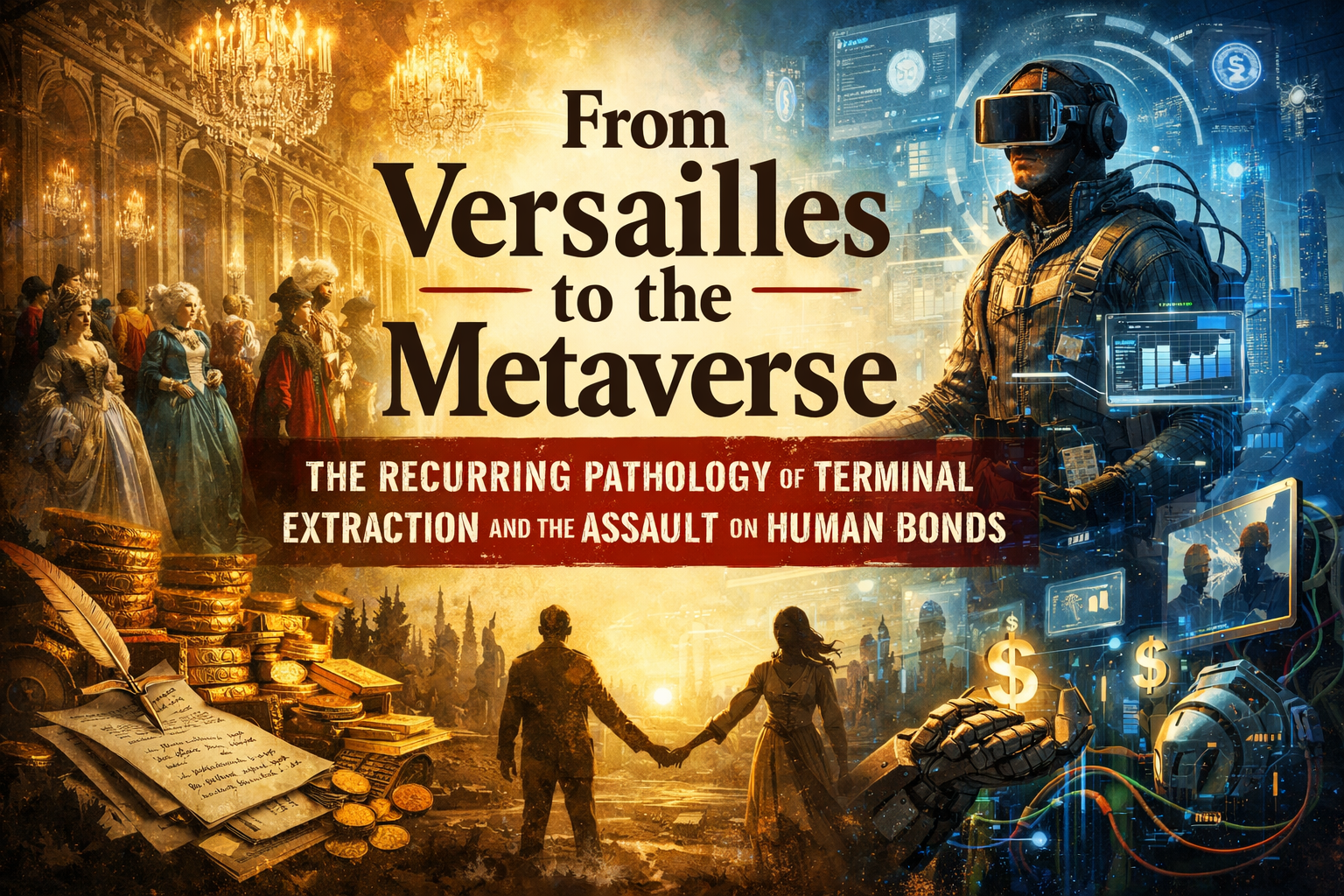
Abstract: This paper posits that the present socio-economic moment (circa 2026) is not merely analogous to the late Ancien Régime pre-French Revolution, but is its direct ontological successor. We identify a recurring systemic pathology: a ruling class that advances from extracting material wealth to extracting human essence itself—commodifying intimacy, dismantling kinship structures, and manufacturing pathological identities to create the perfectly managed, terminal consumer. Utilizing comparative historical analysis, economic data, and critical theory, we trace this logic from feudal sexual predation to the pornographic-industrial complex, and from aristocratic tax exemption to neoliberal wealth oligarchy. The paper concludes that the coming rupture will be driven not by bread shortages, but by a profound crisis of meaning, demanding a restoration of reality over simulation.
I. Introduction: The Cycle of Parasitic Suicide
History’s most violent revolutions are not accidents; they are the inevitable immune response to a parasitic order that forgets its own dependence on the host. The French Revolution of 1789 provided the archetype: an elite so detached from the productive base of society that it cannibalized it unto collapse. This paper argues we are in an advanced, globalized reprise of that terminal phase. The extraction, however, has evolved from land and grain to the very pillars of human psychology and social cohesion.
II. Parallel I: Obscene Wealth and Engineered Inequality
The Ancien Régime (Pre-1789):
The First and Second Estates (clergy and nobility), representing ~2% of the population, owned an estimated 55-65% of the land in France and were largely exempt from direct taxation (the taille). The financial burden fell entirely on the Third Estate, exacerbated by regressive consumption taxes (e.g., the gabelle on salt) and feudal dues. This system was maintained not by economic logic, but by legal privilege (Shapiro, G., The French Revolution: The Fall of the Ancien Régime).
The Neo-Feudal Technocracy (2026):
Global inequality has reached Ancien Régime scales. As of 2025, the world’s billionaires (a group smaller than many city populations) have seen their wealth increase by over 70% since 2020, while the wealth of the bottom 50% has barely shifted (World Inequality Lab, 2025). The effective tax rates for the ultra-wealthy, through offshore structures and capital gains advantages, often fall below those of their middle-class employees (Zucman, G., The Hidden Wealth of Nations). The modern taille is inflation, student debt, and precarious gig labour.
Academic Reference Point: Thomas Piketty’s Capital in the Twenty-First Century demonstrates the recursive tendency of capital returns (r) to outstrip economic growth (g), leading to entrenched, inherited oligarchy—a dynamic legally enforced pre-1789 and financially engineered today.
III. Parallel II: Sexual Predation as a Tool of Social Control
Pre-1789: The Droit du Seigneur and Ecclesiastical Abuse.
While the droit du seigneur is debated by historians as a literal practice, it persists as a powerful metaphor for the systemic sexual exploitation embedded in feudal power structures. More concretely, the sexual misconduct within the pre-revolutionary Catholic Church was widespread, a tool of humiliation and control that underscored the impunity of the powerful (Lebrun, F., Histoire des Catholiques en France).
2026: The Droit de l’Algorithme and Industrialized Pornification.
Today’s predation is democratized, monetized, and scaled. The global porn industry, a core driver of internet traffic and technology, is valued in the hundreds of billions. Its business model relies on:
1. Addiction Engineering: Neurological hijacking of reward pathways, akin to substance abuse (Hilton, D.L., 2023, Pornography Addiction – A Neuroscience Perspective).
2. Early Targeting: Studies indicate widespread, often unintentional, exposure of children to hardcore pornography online, with the average age of first exposure now estimated at 11-13 years old (Bryant, P., 2021, Children’s Exposure to Pornography: A Systematic Review).
3. The Destruction of Intimacy: Research correlates high pornography consumption with decreased relationship satisfaction, attachment anxiety, and a commodified view of partners (Perry, S.L., 2020, Pornography and Relationship Quality).
The Parallel: Both systems use sexual exploitation to break down personal and communal integrity. Feudalism used it to assert dominance. Neofeudalism uses it to create a population of isolated, traumatized, and transaction-oriented individuals—the ideal consumers for a market that sells connection back to them piecemeal.
IV. Parallel III: The Deliberate Deconstruction of the Family Unit
Pre-1789: The peasant family was an economic unit to be taxed and conscripted, not a sacred entity. Aristocratic families were political alliances. The Church regulated family life, but the Ancien Régime state had a primarily extractive, not a constructive, interest in its health.
2026: The Tripartite Assault.
1. Economic Sterilization: Stagnant wages, unaffordable housing, and crushing debt have made stable family formation a privilege. The fertility rate in most advanced economies has plummeted far below replacement level (World Bank Data).
2. Ideological Deconstruction: While the expansion of rights for non-traditional families is a just social evolution, a concomitant strand of critical theory actively pathologizes the enduring, biological family as an inherently oppressive “heteronormative” construct. This serves a neoliberal end: the atomization of society into individual consumer units. The debate is cynically reduced to a false binary between an imagined “alpha/beta” model and a kaleidoscope of consumer identities, obscuring the deeper attack on kinship itself.
3. Pharmacological Management: The lifecycle is medicalized. Children are managed for classroom compliance (ADHD medications), adolescents for mood (SSRIs), and adults for performance (stimulants, sexual dysfunction drugs). This creates a managed populace, its natural rhythms replaced by chemical ones, undermining the organic resilience of family systems.
Academic Reference: The work of anthropologist David Graeber, particularly The Utopia of Rules, explores how bureaucratic and market logic seek to redefine all human relationships, including kinship, in transactional terms.
V. The Ultimate Extraction: Lifecycle Commodification
The Ancien Régime and the Church taxed life’s milestones. The Neo-Feudal Technocracy owns the entire narrative.
· Birth to Death: A human is now a “customer journey.” From premium baby formula and genetic screening, through branded education and mental health apps, to curated dating markets and “silver” economies, culminating in the lucrative “death care” industry. No experience is allowed to remain outside the market.
· The End Goal: The creation of the Terminal Consumer—an entity whose every need, from nutrition to companionship to meaning, must be purchased. This requires the systematic weakening of any institution (like the robust, multi-generational family) that could provide these needs organically, for free, through love and mutual obligation.
Reference: Byung-Chul Han, in The Burnout Society, describes the transition from Foucault’s disciplinary society to an “achievement society” where individuals exploit themselves, perfectly aligning with the logic of total self-commodification.
VI. Conclusion: The Coming Revolution of Meaning
1789 was triggered by a material deficit—bread. 2026 is brewing a metaphysical deficit—truth, connection, purpose, and a future.
The modern Ancien Régime is not in Versailles; it is in Silicon Valley boardrooms, private equity firms, and the offices of policymakers who confuse financialization with progress. Its guillotine will not be blade, but a mass withdrawal of consent. A refusal of the simulated, the pathologized, the commodified.
The call is not for a new committee to manage the same extraction more fairly. It is for a rehabilitation of the real. A reclaiming of:
· Economic reality from financial abstraction.
· Intimate reality from pornographic simulation.
· Familial reality from ideological and economic sterilization.
· Psychological reality from pharmacological management.
The facts are verifiable. The pattern is clear. The only question remaining is who will have the courage to stop playing the simulated game, and begin building, once more, a world with a soul.
References (Selected):
1. Piketty, T. (2014). Capital in the Twenty-First Century. Harvard University Press.
2. World Inequality Lab. (2025). World Inequality Report 2025.
3. Zucman, G. (2015). The Hidden Wealth of Nations: The Scourge of Tax Havens. University of Chicago Press.
4. Hilton, D.L. (2023). Pornography Addiction – A Neuroscience Perspective. Current Behavioral Neuroscience Reports.
5. Bryant, P. (2021). Children’s Exposure to Pornography: A Systematic Review. Journal of Adolescent Health.
6. Perry, S.L. (2020). Pornography and Relationship Quality: Establishing the Dominant Paradigm. Journal of Sex Research.
7. Graeber, D. (2015). The Utopia of Rules: On Technology, Stupidity, and the Secret Joys of Bureaucracy. Melville House.
8. Han, B-C. (2015). The Burnout Society. Stanford University Press.
9. Shapiro, G. (Ed.). (1998). The French Revolution: The Fall of the Ancien Régime. Macmillan.
10. Lebrun, F. (1980). Histoire des Catholiques en France. Privat.
The diagnosis is complete. The prescription is courage.
 The Patrician's Watch