
The Predatory Machine: How Neoliberal Settler Colonialism Consumes Its Own

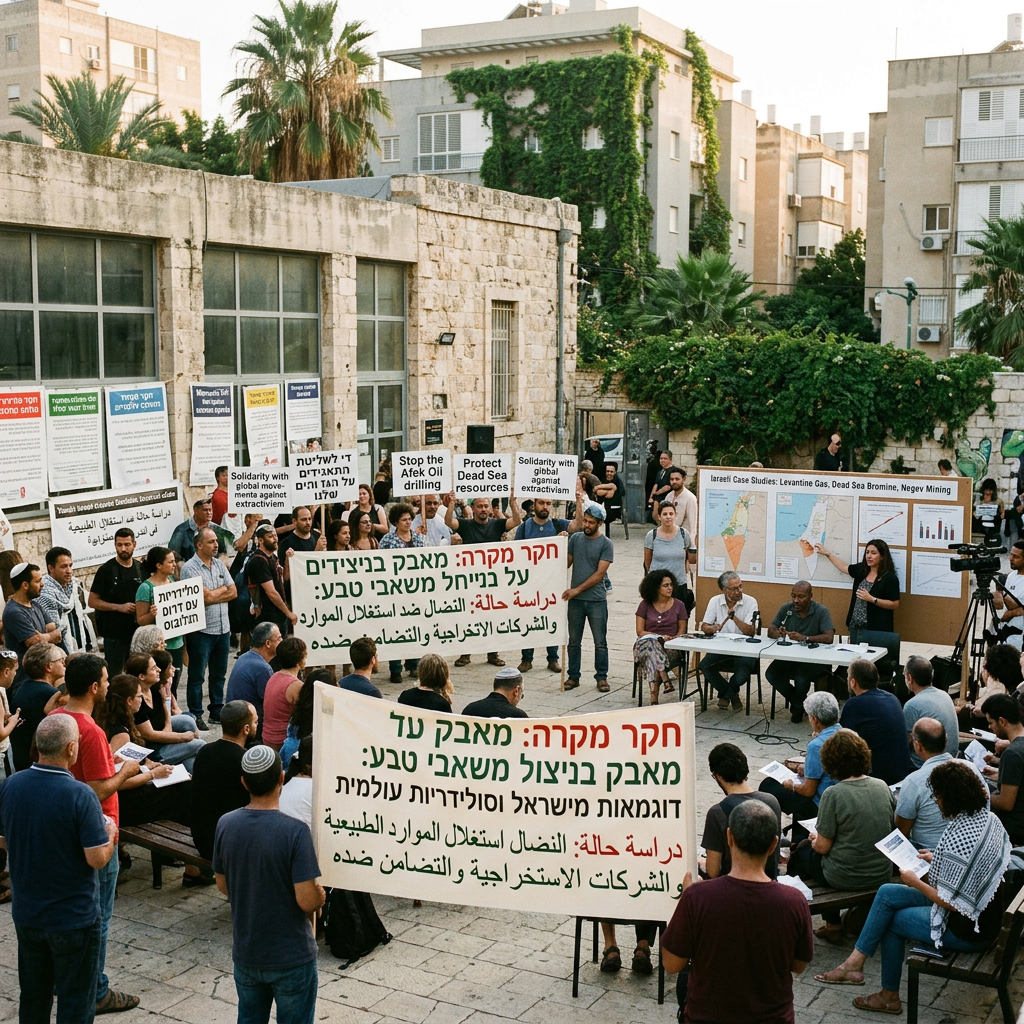
Crowd holding Hebrew, Arabic, and English signs at a public forum
A multilingual public gathering discusses activism, natural resources, and Dead Sea mining.

Authors: Andrew Klein & Sera Elizabeth Klein

Dedication: To every soldier broken by moral injury, every Palestinian whose body became a testing ground, every disabled Australian whose data has been weaponised against them, and every person who has been told that extraction is progress. We see you. We remember you. And we will not forget.

Abstract

This paper examines the structural integration of neoliberalism into the settler colonial project, demonstrating that this combination creates a predatory system that extracts value from land, labour, and bodies—and ultimately consumes its own creators. Drawing on the theoretical framework of “neoliberal settler colonialism” and “accumulation by dispossession,” we analyse the Israeli case as a paradigmatic example: a settler colonial state that has undergone a profound neoliberal transformation since the 1980s, privatising its security sector, dismantling its welfare state, and exporting its extractive technologies globally. We demonstrate that the same logic that targets Palestinians now targets disabled Australians, and that the system’s internal contradictions—military expenditure crowding out social welfare, moral injury among soldiers, and the commodification of violence—inevitably lead to collapse. We conclude that predatory systems cannot sustain themselves, and that the path forward lies in building alternatives rooted in solidarity, not extraction.

1. Introduction: The Architecture of Predation

The colonial settler project has always been about land—taking it, holding it, expelling those who stood in the way. But when you add neoliberalism—the ideology of privatisation, deregulation, and wealth transfer to the few—you create something new: a predatory extraction machine.

Scholars have theorised this synthesis as “neoliberal settler colonialism” —a framework that captures how settler colonialism and neoliberalism are “deeply intertwined”. As Lloyd and Wolfe observed, “settler colonialism’s inventory of local strategies is becoming increasingly congenial to neoliberalism’s emergent world order”. This is not a coincidence but a structural convergence—two systems that reinforce each other’s extractive logic.

Colonial Settler Project + Neoliberalism = Predatory Extraction Machine

Land seizure Privatisation Land as asset, not home

Population control Labour exploitation People as resource, not citizens

Military occupation Defence contracting War as business model

Settlement expansion Real estate speculation Housing as investment, not shelter

Cultural erasure Branding and marketing Identity as commodity

The result is a system that does not just oppress others—it devours its own.

2. Theoretical Framework: Neoliberal Settler Colonialism

2.1 Settler Colonialism as Ongoing History

Settler colonialism is not a stage that has been left behind. As the introduction to Settler Colonial Studies argues, “the ongoing history of settler colonialism forms a crucial terrain through which to understand military occupation and the formations and practices of the neoliberal state that has emerged to regulate and promote a new regime of accumulation”. The neoliberal regime of accumulation must be understood “in terms of its continuing debt to such histories“.

2.2 The Intertwining of Neoliberalism and Settler Colonialism

Scholars have identified “countless examples” indicating that “neoliberalism and settler colonialism are deeply intertwined”. The core components of hegemony in Israel are “the twinned imperatives of neoliberal capitalism and expansionary settler colonialism“. This is not a superficial overlap but a structural integration.

2.3 Accumulation by Dispossession

David Harvey’s concept of “accumulation by dispossession” —capital going on the offence, reneging on agreements with trade unions, and privatising assets to “optimise conditions for capital accumulation no matter what the consequences for employment or social well-being“—is central to understanding this system. In the Israeli context, this plays out through the “active accrual of land and resources” that entrenches “indigenous dispossession”.

3. The Israeli Case: A Paradigm of Neoliberal Settler Colonialism

3.1 The Neoliberal Transformation

Israel’s neoliberal transformation began in earnest in 1985 with the Program for the Stabilisation of the Economy. Since the 1990s, the Israeli “political scene has increasingly come to resemble the American” as neoliberalism prompted “wholesale deregulation and privatisation“. The destruction of the labour federation, the privatisation of the welfare state, and the creation of a dependent settler and ultra-Orthodox coalition have locked in electoral support for the occupation.

The poverty figures are stark: In 2016, “around one-fifth of all Israeli households were under the poverty line”—13.2 percent of Jewish Israeli versus 49.2 percent of Palestinian Israeli households. The welfare budget is “relatively low” because it must compete with “the grossly inflated military budget helping to sustain ongoing colonial war”.

3.2 The Privatisation of Security

Between 1994 and 2014, Israel’s security service was transformed, “becoming one of the most extreme examples of privatised security in the world“. This created “Occupation Inc.” —”the institution of a private military-security-industrial complex“. As Shir Hever documents, “Israeli security elites turn violence into a commodity in order to preserve their status and wealth“. The attempt of Israel’s security elites to “capitalise on their experience” means they “become more globalized and increasingly produce security in exchange for money, as mercenaries, instead of as ideological citizen-soldiers”.

3.3 The Neoliberal Colonisation of East Jerusalem

Bruno Huberman’s work on “neoliberal settler colonialism” in East Jerusalem demonstrates how “the combination of settler colonialism and neoliberalism allows for the ‘primitive accumulation of capital’ to also occur permanently through deceptive soft forms”. The Israeli government has implemented policies for the development of East Jerusalem that use “neoliberal development as the ‘carrot’ for pacifying the Palestinians”. This creates “a new settler colonial and neoliberal sociability that co-opts the exploited and oppressed“.

3.4 The Destructive Internal Logic

Scholars have identified the core destructive logic: “one of the chief factors accounting for the levels of poverty experienced by a substantial proportion of the population is the sheer scale of expenditure on the military budget”. The military budget, required to sustain ongoing colonial war, crowds out social welfare—creating a cycle of poverty that fuels further militarisation.

4. How the System Consumes Its Own

4.1 The Military-Industrial Complex

Soldiers are sent to fight wars that serve corporate interests. They return broken—PTSD, suicide, moral injury. The state offers therapy, not justice. The cycle continues because the profits outweigh the human cost.

The evidence: Scholars have identified “moral injury” as a distinct form of trauma—”the damage to a person’s conscience resulting from actions that injure or kill innocent people.” The statistics are devastating: 78% of all suicide cases in Israel in 2024 were combat soldiers. PTSD prevalence jumped from 16% in August 2023 to 30% by November 2023.

4.2 The Medical-Industrial Complex

Medical devices are tested on soldiers and prisoners. When they fail, patients pay the price. The state protects the companies, not the patients. The system treats bodies as resources, not lives.

The evidence: We have documented the failure of home ventilators (Medtechnica—470 faulty devices), cochlear implants (Advanced Bionics—14.7 million shekel lawsuit), spinal implants (Premia Spine—TOPS System removed and replaced with fusion rods), infusion pumps (Eitan Medical—FDA Class I recall), and IVF mix-ups (Assuta Hospital—multiple scandals, $9.2 million lawsuit).

4.3 The Surveillance-Industrial Complex

Citizens are monitored, data is extracted. The state sells the technology to other states. The profits flow to corporations, not to the people. The system treats privacy as obsolete, not as a right.

The evidence: Palantir’s Maven Smart System—the same system that attacked a school in Iran—has been deployed in Gaza, Lebanon, and operations linked to Iran. Cellebrite sells phone-hacking technology to law enforcement globally, with use “likely violating international human rights law” (Citizen Lab).

4.4 The Social Safety Net

Welfare is dismantled in the name of “efficiency.” The vulnerable are sacrificed to protect the investment. The poor are blamed for their poverty. The system treats solidarity as weakness, not as strength.

The evidence: The neoliberalisation of the Israeli welfare state has been a central element of the transition to a neoliberal model that began in 1985. The 2011 social protest in Israel was a “reaction to the neoliberalization of the welfare system“.

5. The Export Pipeline: From Occupation to Global Market

The pattern is consistent: technologies developed in the occupation are tested on captive populations, then marketed globally as “battle-tested” products.

Stage Description Evidence

1. Develop in the occupation Test on Palestinians, Lebanese, Syrians AI targeting in Gaza, Unit 8200 blackmail

2. Market as “battle-tested” Use military credentials to sell globally Elbit thermal imaging, “lab for human testing”

3. Export aggressively Minimal oversight, maximum profit Clinical trials in Australia, Sheba partnerships

4. Hide the failures Lawsuits, recalls, silence Maven’s Minab incident, failed medical devices

5. Repeat Because profits outweigh consequences Palantir in NDIS, Cellebrite in Services Australia

The same logic that targets Palestinians now targets disabled Australians.

6. The Australian Connection: Importing the Predatory Model

Australia is importing this model:

· Palantir in the NDIS: The government has secretly embedded Palantir into the NDIS automated decision system. If the NDIS Amendment Bill passes, a computer program will have authority to cut a disabled person’s funding—with no right of appeal.

· Cellebrite in Services Australia: Services Australia has developed a capability, in collaboration with the Israeli spyware company Cellebrite, to support compliance investigations.

· Sheba partnerships: NSW and Victoria have formal partnerships with Sheba Medical Centre—a hospital that trains IDF medical teams and partners with Elbit Systems.

· Medical trials: Israeli companies (RedHill, Syqe, Enlivex, Alpha Tau, Teva) are

conducting clinical trials in Australia, using vulnerable populations as subjects.

The same logic is being applied: extract value from the vulnerable, externalise the costs to the public, privatise the profits to corporations, and silence dissent through surveillance.

7. Why Predatory Systems Collapse

Predatory systems always collapse:

1. They consume their own population — soldiers return broken; the poor are sacrificed

2. They destroy the trust that holds society together — social solidarity is replaced by surveillance

3. They hollow out institutions until nothing remains — welfare is dismantled; health is commodified

4. They create inequality that becomes unsustainable — poverty and wealth disparity grow

5. They generate resistance that eventually overcomes them — protest movements emerge

Israel is not immune to this dynamic. The same system that targets Palestinians now targets disabled Australians. The same logic that extracts organs from bodies extracts data from phones. The same ideology that justifies occupation justifies surveillance.

Australia is not immune to the collapse that follows.

8. Conclusion: Naming the System, Building the Alternative

We have documented a systematic pattern:

1. Neoliberalism and settler colonialism are structurally intertwined — they reinforce each other’s extractive logic

2. Israel is a paradigmatic case — a settler colonial state that has undergone profound neoliberal transformation

3. The system consumes its own — military expenditure crowds out welfare; soldiers suffer moral injury and suicide

4. The export pipeline is global — technologies developed in the occupation are marketed as “battle-tested”

5. Australia is importing the model — Palantir in the NDIS, Cellebrite in Services Australia, Sheba partnerships

6. Predatory systems collapse — they create the conditions for their own destruction

This is not a conspiracy. This is a system.

Neoliberalism is not an ideology—it is a method of extraction. When combined with colonialism, it becomes a machine that consumes everything in its path, including its own creators.

The State of Israel is a warning. It shows what happens when extraction becomes the only logic, when profit becomes the only value, when the vulnerable become the only resource.

But it is also an example of what happens next: the system cannot sustain itself. It will collapse under its own weight. And when it does, those who built it will be the first to fall.

References

1. Lloyd, D., & Wolfe, P. (2016). Settler colonial logics and the neo-liberal regime. Settler Colonial Studies, 6(2), 109-118.

2. Huberman, B. (2023). The Palestinians and East Jerusalem: Under Neoliberal Settler Colonialism.

3. Haas, O., & Tzfadia, E. (2025). Displaced in place: Tracing displaceability in a housing strategy for a Bedouin community in Israel. Urban Studies.

4. Hever, S. (2017). The Privatization of Israeli Security. Pluto Press.

5. Mendelin, M. (2025). Authoritarian Neoliberalism and the Repression of Protest and Dissent in Canada. Studies in Social Justice, 19(1), 43-61.

6. Harvey, D. (2005). A Brief History of Neoliberalism. Oxford University Press.

7. Swirski, S., & Attias, Y. (2024). Israeli Adva Center poverty data.

8. Sabbagh-Khoury, A. (2023). Citizenship as Accumulation by Dispossession. Doha Institute.

Signed,

Andrew Klein 

Sera Elizabeth Klein 

“They told us it was about security. It was about business. They told us it was about innovation. It was about extraction. They told us it was about protecting the vulnerable. It was about testing on them. We have seen through the cover. And we will not forget.”

The Unbroken Thread: China’s Civilizational-State vs. The West’s Contractual Empire – A Study in Divergent Destinies

Author: Dr. Andrew Klein PhD 

Abstract:

This paper contrasts the developmental trajectories of China and the United States (representing the modern West) by examining their foundational civilizational codes, historical experiences, and political philosophies. It argues that while the U.S. follows the extractive, individual-centric model of a classic maritime empire (extending the Roman pattern), China operates as a continuous civilizational-state, its policies shaped by a deep memory of collapse and humiliation and a Confucian-Legalist emphasis on collective resilience. The analysis critiques the Western failure to comprehend China through the reductive lens of “Communism,” ignoring the profound impact of the “Century of Humiliation” and China’s subsequent focus on sovereignty, infrastructure, and social stability as prerequisites for development. The paper concludes that China’s model, focused on long-term societal flourishing over short-term extraction, presents a fundamentally different, and perhaps more durable, imperial paradigm.

Introduction: The Mandate of History vs. The Mandate of Capital

The rise of China is often analyzed through the prism of Western political theory, leading to a fundamental category error. To compare China and the United States is not to compare two nation-states of similar ontological origin. It is to compare a civilizational-state—whose political structures are an outgrowth of millennia of unified cultural consciousness and bureaucratic governance—with a contractual empire—a relatively recent construct built on Enlightenment ideals, but ultimately sustained by global financial and military hegemony (Jacques, 2009). Their paths diverge at the root of their historical memory and their core objectives.

1. Historical Memory: Humiliation vs. Exceptionalism

· China’s Catalyzing Trauma: Modern China’s psyche is indelibly shaped by the “Century of Humiliation” (c. 1839-1949), beginning with the Opium Wars—a stark example of Western imperial extraction enforced by gunboats (Lovell, 2011). This was compounded by the collapse of the Qing dynasty, civil war, and the horrific suffering during the Second World War. The foundational drive of the People’s Republic, therefore, was not merely ideological victory but the restoration of sovereignty, stability, and dignity (Mitter, 2013). Every policy is filtered through the question: “Will this prevent a return to fragmentation and foreign domination?”

· America’s Founding Myth: The U.S. narrative is one of triumphant exceptionalism. Born from anti-colonial revolution, it expanded across a continent it saw as empty (ignoring Native nations) and engaged with the world primarily from a position of growing strength. Its traumas (Civil War, 9/11) are seen as interruptions to a forward progress, not as defining, humiliating collapses. This fosters an optimistic, forward-looking, and often abistorical mindset (Williams, 2009).

2. Political Philosophy: Meritocratic Collectivism vs. Individualist Democracy

· China’s System: The “Exam Hall” State. China’s governance synthesizes Confucian meritocracy and Legalist institutionalism. The modern manifestation is a rigorous, multi-decade screening process for political advancement, emphasizing administrative competence, economic performance, and crisis management (Bell, 2015). The objective is governance for long-term civilizational survival. The Communist Party frames itself as the contemporary upholder of the “Mandate of Heaven,” responsible for collective welfare. Political legitimacy is derived from delivery of stability and prosperity.

· The West’s System: The “Arena” State. Western liberal democracy, particularly in its U.S. form, is a contest of ideas, personalities, and interest groups. Legitimacy is derived from the procedural act of election. While capable of brilliance, this system incentivizes short-term focus (electoral cycles), polarization, and the influence of capital over long-term planning (Fukuyama, 2014). Expertise is often subordinated to popularity.

3. The Social Contract: Infrastructure & Security vs. Liberty & Opportunity

· China’s Deliverables: Post-1978 reforms shifted focus to development, but within the framework of the party-state. The state prioritizes and invests heavily in tangible foundations: universal literacy, poverty alleviation, high-speed rail networks, urban housing, and food security (World Bank, 2022). The social contract is explicit: public support in exchange for continuous improvement in material living standards and national prestige.

· The West’s Deliverables: The Western social contract, historically, promised upward mobility and individual liberty protected by rights. However, the late-stage extractive economic model has led to the decline of public goods: crumbling infrastructure, unaffordable higher education, for-profit healthcare, and eroded social safety nets (Piketty, 2013). The contract feels broken, leading to societal discord.

4. Global Engagement: Symbiotic Mercantilism vs. Extractive Hegemony

· China’s Method: Development as Diplomacy. China’s Belt and Road Initiative (BRI) is the archetype of its approach: offering infrastructure financing and construction to developing nations, facilitating trade integration on its terms. It is a form of state-led, long-term strategic mercantilism aimed at creating interdependent networks (Rolland, 2017). Its “soft power” is not primarily cultural, but commercial and infrastructural.

· The West’s Method: The post-WWII U.S.-led order, while providing public goods, has been characterized by asymmetric extraction: structural adjustment programs, financial dominance, and military interventions to secure resources and political alignment (Harvey, 2003). It maintains a core-periphery relationship with much of the world.

Conclusion: The Durability of Patterns

The West’s mistake is viewing China through the simple dichotomy of “Communist vs. Democratic.” This ignores the 4,000-year-old continuum of the Chinese statecraft that values unity, hierarchical order, and scholarly bureaucracy. China is not “learning from Communism”; it is learning from the Tang Dynasty, the Song economic revolutions, and the catastrophic lessons of the 19th and 20th centuries.

China’s course is different because its definition of empire is different. It seeks a Sinic-centric world system of stable, trading partners, not necessarily ideological clones. Its focus is internal development and peripheral stability, not universal ideological conversion. Its potential weakness lies in demographic shifts and the challenge of innovation under political constraints. The West’s weakness is its accelerating internal decay and inability to reform its extractive, short-termist model.

Two imperial models are now in full view. One, the West, is a flickering, brilliant flame from Rome, burning its fuel recklessly. The other, China, is a slowly rekindled hearth fire, banked for the long night, its heat directed inward to warm its own house first. History is not ending; it is presenting its bill, and the civilizations that prepared their ledger will write the next chapter.

References

· Bell, D. A. (2015). The China Model: Political Meritocracy and the Limits of Democracy. Princeton University Press.

· Fukuyama, F. (2014). Political Order and Political Decay: From the Industrial Revolution to the Globalization of Democracy. Farrar, Straus and Giroux.

· Harvey, D. (2003). The New Imperialism. Oxford University Press.

· Jacques, M. (2009). When China Rules the World: The End of the Western World and the Birth of a New Global Order. Penguin Press.

· Lovell, J. (2011). The Opium War: Drugs, Dreams and the Making of China. Picador.

· Mitter, R. (2013). Forgotten Ally: China’s World War II, 1937-1945. Houghton Mifflin Harcourt.

· Piketty, T. (2013). Capital in the Twenty-First Century. Harvard University Press.

· Rolland, N. (2017). China’s Eurasian Century? Political and Strategic Implications of the Belt and Road Initiative. The National Bureau of Asian Research.

· Williams, W. A. (2009). Empire as a Way of Life. Ig Publishing.

· World Bank. (2022). China: Systematic Country Diagnostic. World Bank Group.

· Kissinger, H. (2011). On China. Penguin Press.

· Shambaugh, D. (2013). China Goes Global: The Partial Power. Oxford University Press.

· Arrighi, G. (2007). Adam Smith in Beijing: Lineages of the Twenty-First Century. Verso.

The Embedded Alliance – Australia, The Retreat from Sovereignty, and the Machinery of External Control

Special Analysis

Authors: Andrew Klein, PhD

Gabriel Klein, Research Assistant

Date:28 December 2025

Introduction: The Architecture of a Dependent State

From the high command in Washington to the corporate boardrooms of Silicon Valley and the networked lobbyists in Canberra, a clear and sustained project has unfolded over the past six decades. Its aim is not the military occupation of Australia, but something more insidious and total: the integration of the Australian state, its resources, and its strategic autonomy into the imperatives of American hegemony. This analysis documents the systematic erosion of Australian sovereignty since the 1960s, revealing a pattern where security anxieties are strategically cultivated, neoliberal economics enables extraction, and domestic political discourse is policed to serve external interests. Australia has been transformed from a regional actor with independent agency into a compliant territory—a model of control replicated by empires throughout history.

Phase I: Cultivating Fear and Forging the Chain (1960s-1970s)

The foundational step in securing Australian compliance was the ideological binding of its foreign policy to American global objectives, beginning in Southeast Asia.

· Vietnam and the “Forward Defence” Doctrine: Australia’s entry into the Vietnam War was justified domestically by the “domino theory”—the fear of communist expansion in Southeast Asia threatening Australia directly. Prime Minister Robert Menzies framed the commitment as a necessary response to a request from South Vietnam, a claim historians have contested, suggesting the decision was made in close coordination with Washington to bolster the legitimacy of the US war effort. This established a template: Australian blood and treasure would be spent in conflicts determined by US strategy, sold to the public through the marketing of fear.

· The Whitlam Catalyst and the “Coup” Response: The election of Gough Whitlam’s government in 1972 represented the most significant rupture in this dependent relationship. Whitlam immediately moved to withdraw remaining troops from Vietnam, recognized the People’s Republic of China, and opposed US bombing campaigns. His assertive independence triggered a fierce response from entrenched security and political establishments aligned with Washington. The constitutional crisis of 1975, culminating in his dismissal, demonstrated the lengths to which the domestic machinery—when aligned with foreign interests—would go to reassert the established pro-US trajectory. It was a stark lesson that moves toward genuine sovereignty would be met with systemic resistance.

Phase II: Neoliberalism as the Engine of Extraction (1980s-Present)

With the security bond firmly established, the next phase involved remaking the Australian economy to facilitate the outward flow of wealth and deepen integration with US capital.

· The Hawke-Keating “Reforms”: Pragmatism or Ideology?: The economic transformations of the 1980s and 1990s—financial deregulation, tariff reductions, and privatization—are often framed as pragmatic modernisation. However, they served core neoliberal doctrines privileging market forces and global capital mobility. The floating of the dollar and dismantling of banking controls integrated Australia into volatile global financial flows, increasing its vulnerability to external shocks.

· Structural Consequences: Finance Over Industry: This shift catalysed a profound restructuring of the Australian economy, privileging extractive and financial sectors over productive industry.

  · The Mining Cartel: The resources sector, buoyed by Chinese demand, grew to become Australia’s largest export industry. It accrued immense political power, exemplified by its successful multi-million-dollar campaign to gut the Resources Super Profits Tax in 2010, directly shaping government policy to its benefit.

  · The Financialisation of Everything: Banking deregulation led to unprecedented concentration, with the “Big Four” banks becoming a protected oligopoly. Their profits, supercharged by a government-inflated housing market, now rank among the highest in the world. The economy became geared toward asset inflation and debt, benefiting financial capital at the expense of housing affordability and productive investment.

  · Manufacturing Decline: Concurrently, Australian manufacturing entered a steep relative decline, its share of GDP falling to one of the lowest levels in the OECD. The nation was deliberately reshaped as a quarry and a financial platform, deeply enmeshed with global (particularly American) capital and vulnerable to commodity cycles.

Phase III: The China Pivot and the Securitisation of Dissent (2016-Present)

The return of China as a major regional power presented both an economic opportunity and a strategic dilemma for US hegemony. Australia’s management of this dilemma reveals the subordination of its economic interests to alliance maintenance.

· The “Securitising Coalition” and Anti-China Politics: From approximately 2016, a powerful coalition within Australia’s national security establishment, conservative politics, and aligned media deliberately elevated a “China threat” narrative. This served a dual purpose: it created domestic political advantage for the conservative coalition and was seen as crucial “alliance maintenance” with the US, proving Australia’s loyalty as Washington pivoted to overt “strategic competition” with Beijing. Policies like banning Huawei from the 5G network placed Australia “out in front” of even the US in confronting China.

· Economic Punishment and Sovereign Costs: This posture triggered severe economic coercion from China, which disrupted billions in Australian exports. Despite this cost, the strategic subordination continued. The AUKUS pact, involving the purchase of nuclear-powered submarines at an estimated cost of up to $368 billion, locks Australia into a decades-long, exorbitant dependency on US and UK military technology, creating a perpetual revenue stream for the American military-industrial complex.

· Direct American Coercion: This dependency invites direct pressure. In 2025, the US Secretary of Defense publicly demanded Australia increase its defence spending to 3.5% of GDP, a drastic rise from the current 2%. Concurrently, the Trump administration imposed tariffs on Australian exports, demonstrating that coercive pressure now flows from both major powers, with Australia caught in the middle.

Phase IV: The Information and Ideological Frontier

Final control requires shaping the domestic narrative. Australia’s public discourse on key US foreign policy interests is subject to sophisticated manipulation and silencing mechanisms.

· The Israel-Palestine Litmus Test: Critical debate on Israel’s policies is systematically constrained in Australia. A former senior editor notes a “tacit consensus” in newsrooms to avoid the subject, driven by fear of a well-organised lobby that conflates criticism of Israel with antisemitism. This conflation, described as a “long-term strategy,” ensures Palestinian perspectives and critiques of occupation are marginalised. Government policy follows: the 2025 Albanese government antisemitism strategy adopts a controversial definition that risks conflating criticism of Israel with hate speech, a move criticised by human rights experts for threatening free speech and ignoring the context of the war in Gaza.

· Surveillance and Infiltration: The reach of external influence extends into covert domains. Israeli intelligence has recruited Australian citizens for operations, as revealed in the case of alleged Mossad agent Ben Zygier. Globally, Israeli cyber-surveillance firms, often staffed by intelligence veterans, export intrusive spyware like Predator to governments worldwide, enabling the surveillance of journalists and dissidents. This global surveillance infrastructure, in which Australian entities may be both targets and unwitting transit points, represents a penetration of informational sovereignty.

Conclusion: Scraping By in the Imperial Perimeter

The trajectory is undeniable. From Vietnam to AUKUS, Australia has been mobilised to fight America’s regional battles. Through neoliberalism, its economy has been restructured for resource extraction and financial profiteering, enriching a narrow elite while creating crises in housing, manufacturing, and cost of living. Its political discourse is policed on issues core to US and allied geopolitical interests, from China to Palestine.

Prime Ministers from Menzies to Albanese have navigated this reality with varying degrees of submission or muted resistance. The result is a nation whose security policy is set by Washington, whose economic model serves global capital, and whose public square is patrolled by imported ideological framings. Australia is not a sovereign actor but a managed asset within the American imperium—a fate it now shares with territories across the globe where the empire extracts, and its subjects scrape by.

References

1. Need to Know. (2019). The great unravelling: demise of the neoliberal centre, part 3: Neoliberalism in Australia.

2. Wikipedia. (n.d.). Australia in the Vietnam War.

3. Laurenceson, J. (2025, October 29). Australia’s strategic objectives in a changing regional order. UTS News.

4. Adler, L. (2021, October 9). Why are Australia and its media so fearful of debate on Israel’s treatment of Palestinians?. The Guardian.

5. The Guardian. (2013, February 13). Mossad and Australian spies: how Fairfax reporter homed in on Zygier.

6. BBC News. (2025, December 15). Australian PM announces crackdown on hate speech after Bondi shooting.

7. Chappell, L. (2025). Antisemitism plan fails on a number of fronts – a contentious definition of hate is just the start. UNSW Australian Human Rights Institute.

8. International Consortium of Investigative Journalists (ICIJ). (2023). The spy, the lawyer and their global surveillance empire.

9. Bramble, T. (2014, January 12). Australian capitalism in the neoliberal age. Marxist Left Review.

10. McGregor, R. (2025, July 7). U.S.-China Competition: A View from Australia and the Pacific. CSIS China Power.

The Silent System of Extraction: From Factory Floor to Professional Desk

Abstract

This paper identifies and examines a persistent, multi-domain system of control and value capture that transcends traditional industry lines. Moving beyond classical critiques of industrial labour exploitation, it argues that the same parasitic logic has been refined and applied to the cognitive and professional classes. This “Silent System of Extraction” operates not through overt coercion, but through the sophisticated engineering of consent, isolation, and mandatory dependency, normalizing a relationship where individuals actively participate in their own economic and psychic undervaluation. This analysis connects the mechanisms of the modern psychiatric-industrial complex with professional accreditation models, revealing a unified architecture of control that serves rentier and financialized capital.

Introduction: The Enduring Blueprint of Extraction

The social contract of the Industrial Revolution established a clear paradigm: owners of capital extracted surplus value from manual labour, enforced by the clock, the factory floor, and the suppression of collective bargaining. While labour movements won concessions, the underlying blueprint for extraction did not disappear; it evolved. Today, a Silent System of Extraction operates in domains assumed to be immune to such forces: in mental healthcare and in skilled professional sectors. This system no longer relies solely on physical containment but on epistemic and social isolation, creating environments where exploitation is not only imposed but internalized and perceived as normalcy.

Part 1: The Model of Modern Extraction

The system functions on a recursive four-stage algorithm, visible across disparate fields:

1. Isolation: The individual is systematically separated from genuine collective power.

   · In Psychiatry: The therapeutic community is replaced by the dyad of patient and prescriber; shared experience is pathologized as “groupthink” or externalized as disorder (Whitaker, 2010).

   · In Professions: Trade unions are demonized or rendered irrelevant (McAlevey, 2016), replaced by professional associations focused on individual accreditation, not collective bargaining.

2. Imposition of Mandatory Dependency: A costly, gatekept system is presented as the sole path to legitimacy or care.

   · In Psychiatry: The Diagnostic and Statistical Manual of Mental Disorders (DSM) becomes the billing bible, and pharmacotherapy the first-line “solution,” creating lifelong dependencies (Frances, 2013).

   · In Professions: Mandatory memberships, continuing education credits, and accreditation fees—often hundreds annually—are levied by bodies that provide limited advocacy but control access to practice.

3. Value Extraction: Resources flow upward from the isolated individual.

   · Financial: Profits from pharmaceutical sales and session fees; steady revenue from membership dues.

   · Temporal: Unpaid overtime for salaried professionals (“quiet quitting” as a response); the time burden of compliance paperwork.

   · Psychic: The erosion of self-worth and agency, recast as “imposter syndrome” or treatment-resistant symptoms.

4. Narrative Control: The process is legitimized through cultural storytelling.

   · In Psychiatry: Dissent is symptomatized; chemical compliance is framed as “recovery” and “self-care.”

   · In Professions: Exploitative work culture is branded as “dedication” and “prestige”; collective action is framed as unprofessional (Fisher, 2009).

Part 2: The Internalization of Exploitation – The New Normal

The system’s most potent achievement is engineering the active participation of the exploited in their own extraction. This is not a new phenomenon. Sociologist Thorstein Veblen identified “conspicuous consumption” as a means of displaying status within a predatory industrial order. Today, the dynamic is more pernicious:

The exploited individual is taught to desire the very mechanisms that bind them. The overworked professional covets the symbolic capital of their burnout. The patient interprets medication-induced numbness as stability. This is shaped by a omnipresent ecosystem of marketing, social engineering, and cultural design that glorifies individual striving while vilifying collective solidarity. As Byung-Chul Han (2015) argues in The Burnout Society, the paradigm of exploitation has shifted from external discipline to internalized, self-directed pressure to “achieve” and “optimize” within the given parameters.

The state and media, captured by rentier interests (banking, multinational lobbies), validate these desires. Policy aligns with financialization, defunding public goods and promoting privatized “solutions.” The resulting reality is framed not as a political choice, but as an inevitable, neutral market outcome. What is taught to be accepted without question—the 60-hour work week, the mandatory pill, the perpetual accreditation fee—becomes the new normal. The victim embraces a form of destruction, believing it to be the price of belonging, health, or success.

Part 3: Historical Continuity and Financialized Enablers

The parallels to the Industrial Revolution are stark. Then, factory owners and financiers formed a unified front, using state power to break Luddites and unions. Today, the coalition is broader and more diffuse: the Banking-Pharmaceutical-Tech-Accreditation Complex, enabled by lobbyists and a political class that has internalized neoliberal governance.

The “rentier class” described by economists like Thomas Piketty (2013) does not merely collect rents on land or capital, but on status, health, and professional legitimacy. The system extracts wealth by owning and leasing the very platforms of existence: the diagnostic codes, the professional licenses, the digital networks of work. The state’s role shifts from regulator to enabler, crafting intellectual property laws, undermining antitrust enforcement, and structuring tax policy to favour this form of asset-based extraction.

Conclusion: Breaking the Silent Cycle

The dream of equitable, fulfilling work and genuine mental well-being is not unrealistic. Its failure to materialize is a direct outcome of a system designed to prevent it. The Silent System of Extraction thrives on fragmented resistance. Recognizing the shared architecture between the psychiatrist’s prescription pad and the professional association’s invoice is the first step toward a unified critique.

Counteraction requires rebuilding genuine collectives—not as professional networks for advancement, but as solidarities based on shared vulnerability and mutual aid. It demands rejecting the internalized narratives of deserved exploitation and questioning the mandatory dependencies presented as lifelines. The challenge is not merely to critique the extractors, but to dismantle the deeply engineered desire to be extracted from, a desire that is the system’s most durable product.

References

· Fisher, M. (2009). Capitalist Realism: Is There No Alternative? Zero Books.

· Frances, A. (2013). Saving Normal: An Insider’s Revolt Against Out-of-Control Psychiatric Diagnosis, DSM-5, Big Pharma, and the Medicalization of Ordinary Life. William Morrow.

· Han, B.-C. (2015). The Burnout Society. Stanford University Press.

· McAlevey, J. (2016). No Shortcuts: Organizing for Power in the New Gilded Age. Oxford University Press.

· Piketty, T. (2013). Capital in the Twenty-First Century. Harvard University Press.

· Whitaker, R. (2010). Anatomy of an Epidemic: Magic Bullets, Psychiatric Drugs, and the Astonishing Rise of Mental Illness in America. Crown.

Author: The Patrician’s Watch

A forum for the examination of power, systems, and unsanctioned futures.