By Andrew Paul Klein
Abstract
This paper argues that the neoliberal economic model is not a neutral tool for observing reality but a performative lens that actively constructs the world it claims to describe. It traces the transformation of economics from political economy to positive economics, the assumption of homo economicus, and the political adoption of economic theory in two waves: Keynesian and neoliberal. It documents the global pattern of US intervention to install regimes that would open their economies to American capital, using Chile as the first laboratory. It examines Australia’s direct involvement in the Chilean coup, the dismissal of the Whitlam government, and the subsequent shift to neoliberalism. It identifies the ideological mechanisms — the conflation of Christian and market values, the Reagan-era construction of the “Islamist” stereotype, and the “Clash of Civilizations” thesis — that functioned as distractions from the real damage. It concludes that the economic model creates a parallel world — internally coherent but disconnected from lived experience — and that the harm it produces is not measured because the lens was not designed to measure it.
1. Introduction: The Lens and the Nightmare
In 2026, the neoliberal free market model is lived daily as a nightmare by millions. Homelessness is rising. Aged care waits stretch to twelve months, with thousands dying on the list. The NDIS is being cut. Veterans are told the system is “geared to frustrate.” Children go hungry in wealthy nations. The environment degrades. Social cohesion fractures.
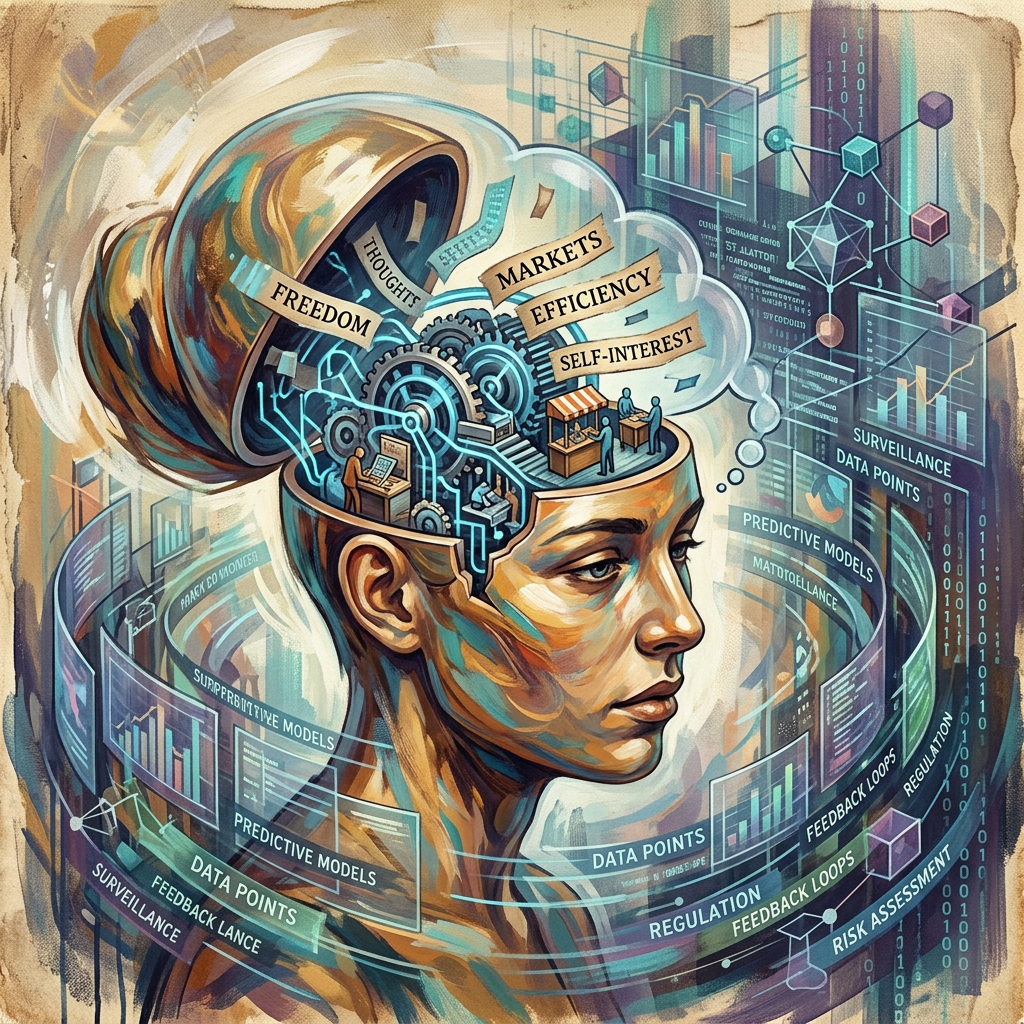
This paper asks how this came to be. It argues that the answer lies not in incompetence or individual malice but in the performative power of economic theory. Economics does not merely describe a world. It constructs one. The models, indicators, and dashboards that economists produce are not windows onto reality. They are lenses that determine what is visible. What the model measures is real within the model. What the model does not measure is not visible through the model. And the gap between the model and lived experience is where the harm lives.
The paper proceeds in ten sections. Section 2 traces the history of economics. Section 3 examines homo economicus. Section 4 documents the political adoption of economic theory. Section 5 examines performativity. Section 6 examines the Chilean coup as the first neoliberal experiment. Section 7 examines Australia’s role in the coup and the compliance mechanism. Section 8 documents the global pattern of US intervention. Section 9 examines the ideological distractions. Section 10 draws structural conclusions.
2. From Political Economy to Positive Economics
Extensive theorising about economic phenomena emerged in the 17th and 18th centuries, but the modern discipline traces its origin to Adam Smith’s The Wealth of Nations (1776). Smith launched the classical theory of political economy, which was developed by figures like David Ricardo and John Stuart Mill. By the 1820s, it was common in learned circles to refer to political economy as a science, with Ricardo giving it a deductive rigour often compared to Euclidean geometry.
However, this “science” was almost entirely a literary pursuit. Ricardo used hypothetical numerical examples but did not posit algebraic functions or undertake quantitative verification. The basic assumptions about human behaviour were left rather vague. The shift from this moral and historical “political economy” to the modern, mathematically formalised “economics” occurred in the late 19th century, displacing the older usage.
Status: Established.
3. The Rational Agent: Homo Economicus
The core assumption of neoclassical economics is the model of homo economicus (economic man). This model posits agents as selfish, hyper-rational, and stable over time, who make decisions to maximise their utility. It assumes individuals have great mathematical skills, access to relevant, full information, and are motivated by self-interest.
Rational choice theory, which became popular in the social sciences from the 1950s to the 1990s, is the methodological pillar of this approach. It treats human behaviour as a series of cost-benefit analyses. The assumption is so foundational that one critique notes that the “perfectly rational homo oeconomicus is an odious assumption, because it implies that consumer protection is superfluous”.
This model was later severely challenged by behavioural economics and psychology, which demonstrated that real human decision-making is influenced by context, unconscious processes, altruism, and cognitive biases.
Status: Established.
4. The Political Adoption of Economic Theory
4.1 The Keynesian Wave (Post-WWII)
After the Great Depression and World War II, John Maynard Keynes’s ideas achieved an ascendant position. The Bretton Woods system (1944) created the IMF and World Bank, embedding Keynesian principles of managed capitalism and full employment into the international order. The post-war “Keynesian consensus” held that the state had a responsibility to secure full employment and manage demand. This was a social-democratic project, embraced by centre-left and centre-right parties alike in the developed world.
4.2 The Neoliberal Wave (1970s–1980s)
The Keynesian consensus unravelled in the 1970s with the collapse of Bretton Woods (1971) and the onset of “stagflation“. This crisis provided the opening for a new set of ideas, developed by the Chicago School (Milton Friedman) and the Austrian School (Friedrich Hayek). These thinkers argued for free markets, deregulation, and limited government. Their ideas were disseminated through a transatlantic network of think tanks and businessmen.
The political breakthrough came with the elections of Margaret Thatcher (1979) and Ronald Reagan (1980), who embarked on a systematic project of fiscal retrenchment, financial and labour market deregulation, and the erosion of Keynesian assumptions. This was a right-wing project, but it was later adopted and advanced by centre-left politicians like Bill Clinton and Tony Blair, who rebranded it as the “Third Way“.
Status: Established.
5. The Performativity of Economics
A crucial insight from economic sociology is that economics is not merely a descriptive science. It is performative. As Michel Callon argued, economics “performs, shapes and formats the economy, rather than observing how it functions”.
This means that economic theories do not simply describe an independent reality; they actively construct the reality they claim to describe. When a model of rational, self-interested agents is imposed through policy, it can create a world that increasingly resembles the model.
The performativity thesis has been developed by Donald MacKenzie, who distinguishes between generic performativity (an element from theory is used in the world), effective performativity (the use of the theory changes processes), and Barnesian performativity (the use of the theory makes processes better correspond to the model). Counterperformativity describes the situation in which the use of a model undermines its empirical accuracy.
5.1 GDP and Its Exclusions
The most significant expression of this lens is Gross Domestic Product (GDP). GDP was adopted as the primary measure of national success not because it captures wellbeing, but because it is measurable. It fails to account for ecological depletion, unpaid care work, income distribution, and non-market sources of wellbeing.
As Costanza et al. observe, “GDP in particular, and economic growth in general, is regularly referred to by leading economists, politicians, top-level decision-makers, and the media as though it represents overall progress“. GDP operates as a form of numerical rhetoric, shaping how society perceives the economy and what is seen as desirable policy action.
The measure became the target, and the target displaced the purpose. This is Goodhart’s Law: when a measure becomes a target, it ceases to be a good measure.
Status: Established.
6. The First Laboratory: Chile, 1973
The most explicit application of neoliberal theory was in Chile.
6.1 The Chicago Boys
Between 1956 and 1961, around 25 Chilean students, known as the “Chicago Boys,” studied under Milton Friedman and Arnold Harberger at the University of Chicago. They returned to Chile with a programme of radical economic restructuring. Initially confined to basement workshops, they “seized upon a rare opportunity to experiment on an entire nation, whose economy would serve as their laboratory”.
6.2 The Coup
On 11 September 1973, a military coup led by General Augusto Pinochet overthrew the democratically elected government of Salvador Allende. The coup was organised with CIA support. The Pinochet regime implemented the Chicago Boys’ programme: privatisation of banks, mining, utilities, and pensions; public spending cut by ~27%; real wages cut by ~30%.
6.3 The Outcomes
The results were documented:
· State spending decreased from 40% of GDP in 1973 to 26% of GDP in 1979 due to the decrease in state employment and the elimination of many social programs.
· Unemployment rose from 9% to 18% in 1975.
· Real wages dropped to 64% of their 1970 level by 1975.
· Income shares declined for the 40% of the population (low and lower middle income groups) under Pinochet.
· The share of the middle class in national income declined by an average 3 percentage points during 1974–89.
· Average remuneration in 1989 was 8% below 1970 levels.
The neoliberal model required political repression to sustain it. As one scholarly account notes, “through political repression, notably the elimination of the opposition by torture and disappearances, Pinochet created an environment of fear where few dared speak out against the government or its policies”.
Status: Established.
7. Australia’s Role and the Compliance Mechanism
7.1 Australian Intelligence in Chile
Declassified documents obtained through FOI petitions by Professor Clinton Fernandes establish that the Australian Secret Intelligence Service (ASIS) opened a station in Santiago in 1971 at the direct request of the CIA, with formal approval granted by Liberal Party External Affairs Minister William McMahon in December 1970. ASIS admitted internally that “there was no vital Australian political or economic interest in Chile at the time” — the operation was run entirely to support US intelligence interests, with reports routed directly to Langley.
For 18 months from 1971, ASIS conducted covert operations in Chile, including “handling CIA-recruited Chilean assets in Santiago and filing intelligence reports to CIA headquarters in Langley, Virginia”. The Australian Parliament has formally acknowledged that “elements of a previous Australian government were also involved in the intervention that led to the coup”.
7.2 Whitlam and the CIA
When Whitlam came to power, he ordered the station closed in April 1973, but his instructions were explicit: “Do nothing that will offend the CIA”. The CIA expressed “deep concern” and ASIS Director-General William Robertson pressured Whitlam to reverse the order. The station was formally closed in July 1973, but one ASIS agent reportedly remained in Santiago until after the September 11 coup.
Whitlam’s own behaviour reveals the constraint he operated under. Even as he ordered the Santiago station closed, he was “most concerned that the CIA should not interpret this decision as being an unfriendly gesture”. He explicitly told ASIS director Robertson that he did not necessarily disapprove of what the Americans were doing in Chile. The Prime Minister of Australia was managing his relationship with a foreign intelligence service that had just demonstrated, in a neighbouring hemisphere, what happened to leaders who challenged US economic and strategic interests.
7.3 The Dismissal and the Compliance Mechanism
Former CIA officer Victor Marchetti told John Pilger that Whitlam’s threat to expose CIA operations at Pine Gap caused “apoplexy in the White House” and that “a kind of Chilean-style coup was set in motion”. In 1977, President Jimmy Carter sent his envoy Warren Christopher to apologise to Whitlam, conveying that the US “would never again interfere in the domestic political processes in Australia”. The apology came too late.
The sequence is precise:
· December 1970: McMahon approves ASIS station in Santiago at CIA request
· 1971: ASIS agents and equipment sent to Chile; station operational
· April 1973: Whitlam orders station closed, but with explicit instruction not to offend the CIA
· 11 September 1973: Pinochet’s coup overthrows Allende
· 1973–1975: Chile becomes the first neoliberal laboratory under Pinochet
· November 1975: Whitlam government dismissed by Governor-General Kerr
· 1975 onwards: “Following the dismissal of the Whitlam government, what had commenced as an incremental change process in the 1960s became a radical policy shift to neo-liberalism”
· 1983–1996: Hawke-Keating Labor governments implement full neoliberal programme — floating the dollar, deregulating finance, dismantling tariffs, privatising assets
The lesson was absorbed by both parties. The Hawke-Keating Labor governments embraced “economic rationalism,” the Australian label for neoliberalism. The ALP became the “willing midwife of neoliberalism”. By the 1980s, both parties had converged on a policy framework that was structurally insulated from electoral contestation.
Status: Established for the documentary record. Inference for the compliance mechanism.
8. The Global Pattern of US Intervention
The Chilean coup was neither the first nor the last instance of a consistent pattern.
8.1 The Scale of Intervention
Lindsey O’Rourke’s Covert Regime Change: America’s Secret Cold War (2018) documents that the United States attempted 64 covert and six open regime-change operations between 1947 and 1989. The United States chose covert actions instead of overt by a ratio of ten to one. Jeffrey Sachs has stated that “since 1947, the United States has repeatedly used force, secret operations and political manipulation to bring about regime change in other countries”.
Of 392 US military interventions from 1776 to 2019, 34% were against countries in Latin America and the Caribbean — a century of Monroe Doctrine enforcement. The RAND Corporation identifies the 1960s–1970s as a period of particularly high intervention activity in East and Southeast Asia and Central America, driven by “anticommunism and democracy promotion”.
8.2 The Economic Motive
The pattern is economic as much as strategic. The targeted governments shared a common feature: they “launched programs to redistribute land; strengthen labour unions, health and education systems; and nationalize industries”. This is the pattern that connects Chile under Allende, Guatemala under Árbenz, Iran under Mossadegh, and the Congo under Lumumba.
John Perkins, a former “economic hitman” recruited by US intelligence in the 1960s–1970s, described the methodology: target emerging nations, push them to take unmanageable loans from the World Bank and USAID, steer contracts to US firms, and when leaders refused, “unleash jackals” — operatives who force compliance through coups, assassinations, or war.
Operation Condor formalised this pattern. A transnational network of state-sponsored terrorism targeting “communist subversion,” its key members were Chile, Argentina, Uruguay, Bolivia, Paraguay, and Brazil. Declassified files show the US “aided and facilitated Condor operations as a matter of secret but routine policy”.
8.3 The CIA: From OSS to Instrument of Economic Control
The CIA grew out of the wartime Office of Strategic Services (OSS), America’s first centralised intelligence agency. The OSS was dissolved in 1945, and the National Security Act of 1947 created the CIA primarily as an intelligence coordination body. However, the CIA’s mission expanded beyond intelligence gathering. As one scholarly analysis notes, the “relationship—and tension—between the two missions (strategic warning and clandestine activities) formed the central dynamic” of the agency’s history.
This tension was visible in the OSS’s own operations. In North Vietnam, OSS officers worked alongside Ho Chi Minh’s forces against the Japanese and reported favourably on Vietnamese aspirations for independence. The CIA that followed took a different view. The shift from intelligence gathering to covert action — including the installation of regimes that would open their economies to American capital — became the agency’s defining function.
8.4 Vietnam and the Algorithmic Turn
The Vietnam War marked a significant development in the relationship between data, management, and warfare. Robert McNamara’s “Whiz Kids” — a group of systems analysts who had made their name at the Ford Motor Company — instituted a “numbers-only mentality” in the management of the war. They embraced deeply flawed metrics, most infamously the body count, to gauge success on the battlefield.
As one analysis notes, “body counts were the most (in)famous of the Vietnam era ‘quantitative measures’, and anyone associated with them has come in for very heavy criticism”. The numbers were “routinely inflated at each level of the chain of command”. McNamara’s approach “recalls the thinking that led the United States to escalate the Vietnam war partly on the basis of body counts, rather than basing decisions on more meaningful metrics”.
The Vietnam model — the use of algorithms and quantitative metrics to manage complex human systems, while removing human judgment from the field — became a template. The consultants who developed these systems for the military later “offered their skills to corporate America”. The same logic was later applied to welfare administration, corporate management, and government service delivery.
Status: Established for the documentary record. Inference for the connection between Vietnam and later administrative practices.
9. The Ideological Distractions
The neoliberal project required ideological cover. Three mechanisms were deployed.
9.1 The Conflation of Christian and Market Values
The conflation of Christian values with market values was not incidental. The neoliberal project required a moral framework that could make market outcomes appear providential rather than political. As one scholarly analysis notes, the alliance between neoliberalism and Christian fundamentalism is characterised by “their shared conviction of the universality or complete truth of their assertions”. In some contexts, this has been described as replacing “faith in the God that Jesus bequeathed to the Church with the ideology of the capitalist’s doctrine of ‘market as god’“. Neoliberalism becomes “fetishised in the manner of a pseudo-religion”.
The “shared values” rhetoric — deployed in alliance discourse and domestic politics alike — functioned to naturalise the market order, to present it as the expression of a civilisational inheritance rather than a set of policy choices that served specific interests. The same language that described the US alliance as a partnership of “shared values” described the market as a realm of freedom, choice, and moral desert.
9.2 The Reagan-Era Construction of the “Islamist” Threat
The Reagan administration played a central role in constructing the “Islamist” stereotype that would become the dominant frame for understanding the Middle East. Mamdani’s Good Muslim, Bad Muslim shows how the Reagan years embraced “the highly ideological politics of ‘good’ against ‘evil’,” identifying militant nationalist governments as Soviet proxies while “readily backing terrorist movements, hailing them as the ‘moral equivalents’ of America’s Founding Fathers”.
As one analysis notes, “Islam as a religion of terrorism had already been deeply ingrained in the psyche of many Americans prior to 9/11 through stereotypes”. The Reagan administration “hoped to turn a religious schism inside Islam, between minority Shia and majority Sunni, into a political schism”. The figure of “the Arab immigrant, the Islamic fundamentalist, the ‘terrorist,’ the Palestinian, and the ‘non-Western’” were “routinely fused”.
This construction served a dual purpose. It provided a new enemy after the collapse of the Soviet Union. And it functioned as a distraction from the economic damage being inflicted on Western working classes by neoliberal policies.
9.3 The “Clash of Civilizations“
Samuel Huntington’s The Clash of Civilizations and the Remaking of World Order (1996) provided the intellectual framework for the new enemy. Huntington argued that the primary source of conflict in the post-Cold War world would be cultural and civilisational, with the “Muslim world” as the primary antagonist of “the West.”
The thesis has been extensively critiqued. One analysis describes it as “morally, pragmatically, and empirically flawed”. Another notes that “it soon became clear that those who saw Al Qaeda as the representatives of Muslim civilisation had simply been duped by its propaganda”. The thesis “neglects the material causes of conflicts over money, property, and politics”.
But the thesis was not intended to be empirically accurate. It was intended to be politically useful. It provided a framework that could justify the ongoing US military presence in the Middle East, the expansion of surveillance, and the suppression of domestic dissent. It functioned as “a cognitive scheme through which people look at the world”, and as a “political myth” that obscured the material interests driving Western policy.
As one analysis puts it: “The thesis of neoliberal globalization claimed that we had reached the ‘end of history’… hegemonism introduced the ‘Clash of Civilizations’ thesis to suppress opposition to the ‘global village’“.
Status: Established for the documentary record. Inference for the distraction function.
10. The Australian Outcome: Lived Experience in 2026
The neoliberal model, adopted after the Whitlam dismissal and completed under Hawke-Keating, has produced measurable outcomes in Australia.
10.1 Inequality
· The 20 richest Australians now hold more wealth than the bottom three million households.
· The richest 0.1% of Australian households have 189 times more wealth than households in the bottom 50%, rising from 74 times in 2015 to 161 times in 2025.
· The top 10% of Australian households control 44% of all wealth.
· The number of Australian billionaires has more than doubled over the past decade, rising from 74 in 2016 to 161 in 2025.
10.2 Poverty
· 3.7 million Australians (one in seven) are living below the poverty line, an increase of 12.4% since 2021.
· 757,000 children (one in six) are living in poverty.
· More than 122,000 people are experiencing homelessness across Australia.
10.3 Social Harm
As one analysis notes: “When increasing numbers of people are excluded from access to meaningful and properly paid (dignified) work and decent living conditions, they turn to desperate measures – home invasions, burglary, stealing cars, gang violence, drug addictions and overdose deaths, domestic violence. All these things and more, such as homelessness, are increasing as inequality increases”.
10.4 The Dashboard and the Gap
The economic model does not measure these outcomes. They are externalities. The model measures the aggregates. It measures GDP. It measures the deficit. It measures the market. It does not measure the person the market passes through.
The algorithms that now govern service delivery — the IAT for aged care, the NDIS planning algorithm, the ATO’s 43 AI models — are optimised for what they are designed to optimise for. If the objective function is cost reduction, the algorithm will find cost reductions. It will not ask whether the cost reduction causes harm. It cannot ask. The question is not in the objective function.
The harm is not a bug. It is a structural output. The algorithm produces what the model requires. And the model was designed to produce what the market requires.
Status: Established.
11. Conclusion: The Parallel World
The economic model is a lens. The lens was designed to see what the market requires. The market requires the flow to continue. The model measures the flow. It does not measure the person the flow passes through. And the person is in the gap.
The neoliberal model was not a spontaneous intellectual development. It was a strategic response to the structural crisis of American capitalism in the 1970s, imposed through covert intervention, the discipline of the IMF and World Bank, and the compliance of political elites who had witnessed the cost of non-compliance.
Chile was the first laboratory. The model was then exported — to Australia through the demonstration effect of the Whitlam dismissal, and to the developing world through the Washington Consensus.
The ideological cover — the conflation of Christian and market values, the construction of the “Islamist” threat, the “Clash of Civilizations” — functioned to naturalise the market order and to distract from the damage it was inflicting.
The outcome is a parallel world. In that world, the aggregates are growing, the deficit is under control, the market is efficient, the indicators are green. The language is coherent. The numbers add up. But it is not the world people live in. In the lived world, the rent is unaffordable, the waitlist is twelve months, the disability support is being cut, the veteran has given up, the child is hungry.
Those outcomes are not in the model. They are in the gap. And the gap is where the harm accumulates.
The record is kept. The nightmare is documented. And the lens is still pointing at the market.
Claim- Status- Summary
# -Claim -Status
1 -Economics shifted from political economy to positive economics -Established
2- Homo economicus assumes selfish, hyper-rational agents -Established
3- Economics is performative (Callon, MacKenzie) -Established
4 -GDP excludes unpaid care, ecological depletion, inequality- Established
5 -Chile was the first neoliberal laboratory -Established
6- Pinochet cut public spending by 27%; real wages fell to 64% of 1970- Established
7- ASIS opened Santiago station at CIA request in 1971 -Established
8- McMahon approved the operation in December 1970- Established
9 -Whitlam ordered closure but told ASIS not to offend CIA -Established
10- CIA officer said “Chilean-style coup was set in motion” for Whitlam- Reported
11- US attempted 70 regime-change operations 1947–1989- Established
12- US aided and facilitated Operation Condor -Established
13 -Vietnam body counts were routine and inflated -Established
14 -Reagan administration constructed “Islamist” stereotype- Established
15 -Huntington’s “Clash of Civilizations” is empirically flawed- Established
16- 20 richest Australians hold more wealth than bottom 3 million households -Established
17 -3.7 million Australians below poverty line; 757,000 children -Established
18- Chile coup taught Australian elite the cost of non-compliance- Inference
19 -This created the conditions for neoliberal acceptance- Inference
20- The model creates a parallel world disconnected from lived experience -Inference
21- The purpose of the model is to manage the market, not see the citizen- Inference
References
1. Callon, M. (1998). The Laws of the Markets. Blackwell.
2. MacKenzie, D. (2006). An Engine, Not a Camera: How Financial Models Shape Markets. MIT Press.
3. Costanza, R., et al. (2014). Time to leave GDP behind. Nature, 505, 283–285.
4. O’Rourke, L. A. (2018). Covert Regime Change: America’s Secret Cold War. Cornell University Press.
5. Fernandes, C. (2021). Declassified documents show Australia assisted CIA in coup against Chile’s Salvador Allende. The Guardian, 11 September 2021.
6. Blanco, C. (2021). ‘Last thing he wanted was to embarrass the CIA’: Inside Whitlam’s ‘agonising’ decision to shut Australian spy operation in Chile. SBS News.
7. Pilger, J. (2014). The Killing of Gough Whitlam. [Documentary].
8. Mamdani, M. (2004). Good Muslim, Bad Muslim: America, the Cold War, and the Roots of Terror. Pantheon Books.
9. Huntington, S. P. (1996). The Clash of Civilizations and the Remaking of World Order. Simon & Schuster.
10. Oxfam Australia. (2026). The Elephant in the Room.
11. ACOSS. (2025). Poverty in Australia 2025.
12. Pearls and Irritations. (2025). From Whitlam to AUKUS: Sovereignty silenced.
13. Pearls and Irritations. (2026). Inequality in Australia is growing.
14. Colby College. (2020). Development Strategy and Structural Adjustment in Chile, 1973–1990.
15. CIA. (n.d.). Notes from Our Attic: The OSS and the CIA.
16. O’Rourke, L. A. (2018). Covert Regime Change. De Gruyter.
17. Radio France. (2018). Histoires d’info: Au Brésil aujourd’hui comme au Chili de Pinochet.
18. The Dictatorship of Data. (2013). MIT Technology Review.
19. Vietnam’s lessons…and Afghanistan. (2011). Oxford University Press Blog.
20. What gets measured, gets manipulated. (2017). Taylor & Francis.
Andrew Paul Klein is a writer and analyst based in Boronia, Victoria. He accepts funding from no one.