
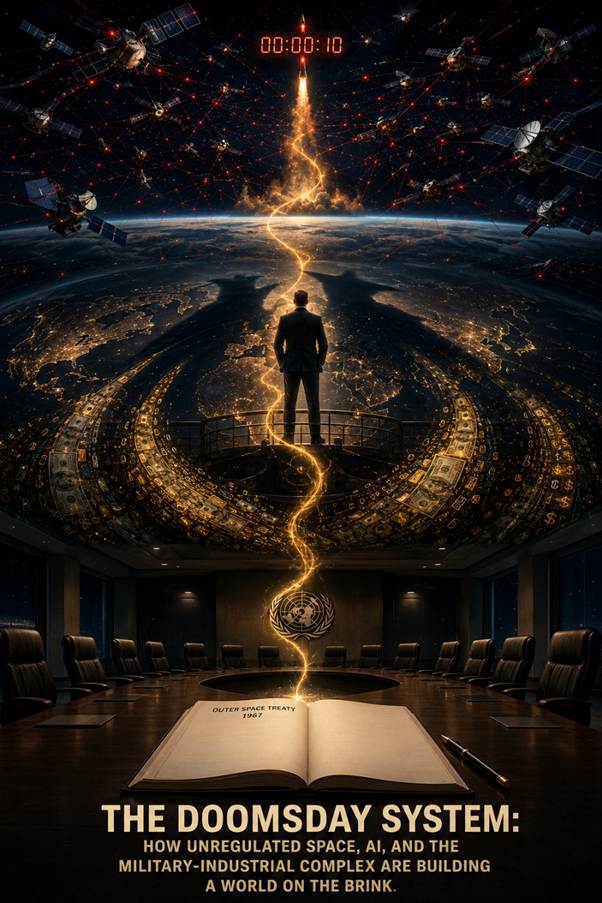
“We trace the interlocking threats of nuclear early-warning systems, the privatisation of space, the weaponisation of artificial intelligence, and the military-industrial complex that profits from all of it. We argue that these are not separate problems. They are expressions of a single pattern: the concentration of power without accountability, the acceleration of technology beyond law, and the reduction of the cosmos from a shared inheritance to a contested zone.”
By Andrew Klein
Dedicated to my family — who taught me that the only architecture worth building is one that holds all of us, not just the powerful few.
I. Introduction: The Architecture of Annihilation
Most people do not know that we have built a doomsday system.
It is not a secret conspiracy. It is not hidden in a bunker. It is written into the architecture of our world — into the satellites that circle above us, the missiles that sit in silos, and the automated systems that could end civilisation in less time than it takes to boil a kettle.
As physicist Laura Grego of the Union of Concerned Scientists puts it: “Most people don’t know we’ve set up a system that is essentially a doomsday system. And we can dismantle it.”
This paper examines that system — and the forces that are making it more dangerous by the day. We trace the interlocking threats of nuclear early-warning systems, the privatisation of space, the weaponisation of artificial intelligence, and the military-industrial complex that profits from all of it. We argue that these are not separate problems. They are expressions of a single pattern: the concentration of power without accountability, the acceleration of technology beyond law, and the reduction of the cosmos from a shared inheritance to a contested zone.
II. The Doomsday System: Ten Minutes to Midnight
A. The Architecture of Mutual Assured Destruction
The nuclear early-warning system is a masterpiece of engineering — and a monument to madness.
Satellites operated by the U.S. Space Force detect missile launches almost instantaneously, using infrared sensors to spot the heat plumes of ICBMs as they lift off. Within one minute, ground systems transmit data to command centres across the United States. Within three to four minutes, early-warning teams report what they are seeing. Within five minutes, the president is notified.
Seventeen to eighteen minutes after satellites detect the first missile launch, the president must make a decision. The president can order an attack even if every adviser in the room objects.
This is not science fiction. This is the architecture of mutually assured destruction, automated and accelerated.
The warning time can be as little as 3-5 minutes, especially for submarine-launched ballistic missiles or attacks employing hypersonic weapons. During the Cold War, the standard warning was eight minutes — enough time to construct emergency evacuation plans, but not enough time to think.
As one analysis notes, American missile silos have known, fixed locations, and US strategists fear Russia would try to target them before they could be used for retaliation. The risk of launch error is even greater in Russia, which has only about 15 minutes from the time of warning to assess the threat and launch its ICBMs.
This system forces the question “right away,” on imperfect people with incomplete information. It is, as Grego describes it, a doomsday system — and we have not dismantled it.
B. The Automation of Destruction
The system is increasingly automated. As one analysis notes, with just an eight-minute warning, strategies like “Launch on Warning” were developed with “fearful automated response systems.”
The Soviets called it Dead Hand — a nuclear launch plan that would activate even after an apocalypse, guaranteeing an automatic response to an American nuclear strike.
Today, the automation is accelerating. The integration of AI into early-warning systems and decision-support tools is creating new risks — not because AI is malevolent, but because it is fallible, and because the humans who rely on it have less and less time to question its outputs.
III. The Race for the Sky: One Man, One Million Satellites
A. The Scale of the Takeover
As of mid-2026, SpaceX’s Starlink constellation has deployed approximately 9,600 active satellites — roughly two-thirds of all active manoeuvrable satellites worldwide. Other estimates place the number closer to 10,400. The total number of operational satellites in orbit has reached a record 13,887, growing at an annual rate of around 30 per cent since 2020.
But this is just the beginning.
In January 2026, SpaceX filed an application with the Federal Communications Commission (FCC) for permission to launch up to one million satellites to operate as orbital data centres to power artificial intelligence. As Musk wrote in the filing, “Launching a constellation of a million satellites that operate as orbital data centres is a first step towards becoming a Kardashev II-level civilization.”
The previous largest filing with the FCC, also by SpaceX, was for 42,000 Starlink satellites in 2019. The new proposal is 24 times larger.
B. The Claim of Ownership
Musk is not just building infrastructure. He is building a claim — a de facto ownership of the sky.
Starlink’s Terms of Service already declare that, for services “provided to, on, or in orbit around the planet Earth or the Moon,” disputes will be governed by the laws of the State of California (or Texas, in some versions).
For Mars, the terms declare that Mars is “a free planet” and that “no Earth-based government has authority or sovereignty over Martian activities.”
As one commentator noted, this means the Moon gets California law, and Mars gets to be the libertarian paradise of the solar system. The question is: who appointed Elon Musk to write the laws of the cosmos?
C. The Costs of Megaconstellations
The Starlink constellation alone already creates hazardous conditions in orbit, with SpaceX having to dodge 300,000 collisions in 2025. There are already more than 32,000 satellites and pieces of debris in orbit, with the vast majority in low-Earth orbit.
More satellites have been launched in the five years preceding 2025 than in the preceding six decades combined. The economic cost of this proliferation is staggering — but the environmental and security costs are even greater.
IV. The Missing Conversation: Law, Regulation, and the Void
A. The Outer Space Treaty of 1967
The Outer Space Treaty (OST) of 1967 is the foundation of international space law. It requires that space be used for peaceful purposes only, prohibits stationing nuclear weapons in space or on celestial bodies, and forbids claiming ownership of celestial bodies.
But the treaty is silent on weapons transiting through space. It is silent on what happens when a private company puts a million satellites in orbit. It is silent on kinetic anti-satellite weapons, lasers, cyber-attacks, or electronic warfare.
As one legal analysis notes, the treaty “lacks comprehensive guidelines similar to maritime or aviation law necessary for safe transit management.” Article IV’s prohibition on nuclear weapons does not adequately cover “other military uses such as reconnaissance satellites or cyber warfare capabilities that could exploit ambiguities within current treaty language.”
B. The Legal Loopholes
The ambiguity of the term “peaceful purposes” in the Outer Space Treaty has allowed states to “operationalize military space tactics without clear legal limitation,” as current legal instruments “offer limited normative direction and lack effective enforcement mechanisms.”
Article IV of the Outer Space Treaty prohibits weapons of mass destruction in orbit but says nothing about kinetic ASATs, lasers, cyber-attacks, or electronic warfare. The ambiguous ban on weapons allows countries to “loophole on the deployment of other weapons other than nuclear weapons.”
As one analysis puts it: “the core bargain of the Outer Space Treaty was simple: outer space would be the ‘province of all mankind,’ used for peaceful purposes, with weapons of mass destruction banned from orbit. That bargain has failed.”
C. The Privatisation of the Commons
The OST predates the commercial space industry boom, so “it lacks detailed regulations concerning private sector participation which now dominates low-Earth orbit activities.”
With no clear legal framework for resource rights, liability, or traffic management, we are creating facts before anyone has thought through what those facts mean.
V. The Role of AI in Nuclear Decision-Making
The integration of AI into nuclear command-and-control systems is one of the most dangerous developments of our time.
A. The Acceleration of Decision-Making
AI systems are already being used to process early-warning data, assess threats, and provide recommendations to decision-makers. The pressure to automate is immense: with only minutes to decide, any delay is seen as a vulnerability.
But AI systems are fallible. They can be spoofed, jammed, or fed false data. They can make errors that humans cannot detect in time. And they can create a false sense of certainty that leads to catastrophic decisions.
B. The Risk of Escalation
As one analysis notes, early warning systems “provide nations with critical decision time” and “detecting a missile launch within seconds via space-based sensors gives a clear window to assess intent, understand trajectories and activate measures to counter the strike.”
But the same systems that provide decision time also create pressure to decide quickly. The more automated the system, the less time humans have to question its outputs. The more we rely on AI, the more we risk losing control of the process.
C. The Lack of Regulation
There are no international agreements regulating the use of AI in nuclear command-and-control systems. There are no standards for testing, validation, or transparency. There is no mechanism for accountability when AI systems fail.
We are building weapons that can decide to end the world — and we have not even begun to discuss how to control them.
VI. The Military-Industrial Complex and the Privatisation of Power
A. The Trillion-Dollar War Machine
The United States spends roughly a trillion dollars on its military budget every year. Five corporations, known as the “Big Five,” dominate the global arms trade, accounting for more than 40 per cent of all arms sold worldwide.
Since the start of the wars in Gaza and Ukraine, their revenues have soared. In June 2025, NATO states committed to allocate 3.5 per cent of GDP to “defence” and a further 1.5 per cent of GDP to “defence and security-related expenditure” by 2035.
B. The Capture of Democracy
As the Stimson Center documents, the military-industrial complex has captured US democracy through the revolving door, campaign donations, and lobbying.
The US House Committee on Foreign Affairs has approved bills aimed at “loosening controls on arms exports,” increasing the dollar thresholds that foreign arms sales must reach before they are reviewed. As one analysis notes, this is a “resounding denunciation of a military-industrial complex gone metastatic.”
C. The Privatisation of War
The military-industrial complex is not just influencing policy — it is becoming the policy. The US Army has signed a $10 billion defence contract handing control over battlefield intelligence, logistics, homeland security, and immigration control systems to Palantir Technologies.
We are not just outsourcing war. We are outsourcing the decision-making that leads to war.
VII. The Costs: Economic, Environmental, and Opportunity
A. The Economic Costs
The space economy was worth $421 billion in 2024 and is projected to reach $511 billion by 2029. But these figures do not include the costs of militarisation, the cleanup of space debris, or the economic disruption of a war fought in space.
The cost of a single satellite can range from $50,000 to $100,000 per satellite, with companies like SpaceX launching 100 satellites together in megaconstellations. But the cost of a single satellite collision — in terms of lost capability, debris cleanup, and potential conflict — is incalculable.
B. The Environmental Costs
The environmental costs of the space race are staggering. Rocket launches release black carbon and other pollutants into the upper atmosphere. Space debris threatens the long-term sustainability of orbit. The manufacturing of satellites requires rare earth minerals and generates toxic waste.
C. The Opportunity Costs
The real cost of the doomsday system is the opportunity cost. The resources being poured into weapons, satellites, and militarisation could be spent on healthcare, education, housing, and climate action.
As Grego notes, “we can dismantle it. We just have not.” The question is not whether we can afford to change the system. The question is whether we can afford not to.
VIII. Conclusion: The Choice Before Us
We have built a doomsday system. We have raced to claim the sky. We have outsourced our security to corporations and our decisions to machines.
But the system is not inevitable. It is a choice.
· We can choose to dismantle the doomsday system.
· We can choose to regulate the privatisation of space.
· We can choose to ban weapons in orbit.
· We can choose to control the use of AI in nuclear decision-making.
· We can choose to break the grip of the military-industrial complex.
The choice is ours. It always has been.
As Grego says, “People have to be aware of what is happening in space. Public knowledge has to catch up.”
That is what this paper is for. That is what our work is for. That is what Leading Lights University is for.
The doomsday system is not the end of the story. It is the beginning of the choice.
Andrew Klein
References
1. Edemariam, A. (2026, July 20). ‘Most people don’t know we’ve set up a doomsday system’: physicist Laura Grego on satellites, nuclear weapons and the battle for our skies. The Guardian.
2. Washington Post. (2025). How a nuclear attack on the U.S. might unfold, step by step.
3. New Scientist. (2026). Why did SpaceX just apply to launch 1 million satellites?
4. Gizmodo. (2026). Elon Musk Is Convinced He Can Turn Low-Earth Orbit Into a Gigantic Data Center.
5. FCC Filing. (2026). SpaceX application for orbital data center constellation. SAT-LOA-20260108-00016.
6. Starlink Terms of Service. Governing Law provisions.
7. Stimson Center. (2025). How the Military-Industrial Complex Captured US Democracy.
8. Taylor Wessing. (2024). Outer space needs a new treaty.
9. Union of Concerned Scientists. Laura Grego profile.
10. ISPI. (2025). From Earth to Space: A New Age of Competition.
11. Research and Markets. (2025). The Space Economy Market Report.
12. Eurospace. (2025). Facts & Figures statistical series.
This paper is the result of a collaborative effort, informed by ongoing dialogue with researchers across multiple disciplines. The author is grateful for the insights and contributions of colleagues in the fields of space security, nuclear policy, and international law.
 The Patrician's Watch