
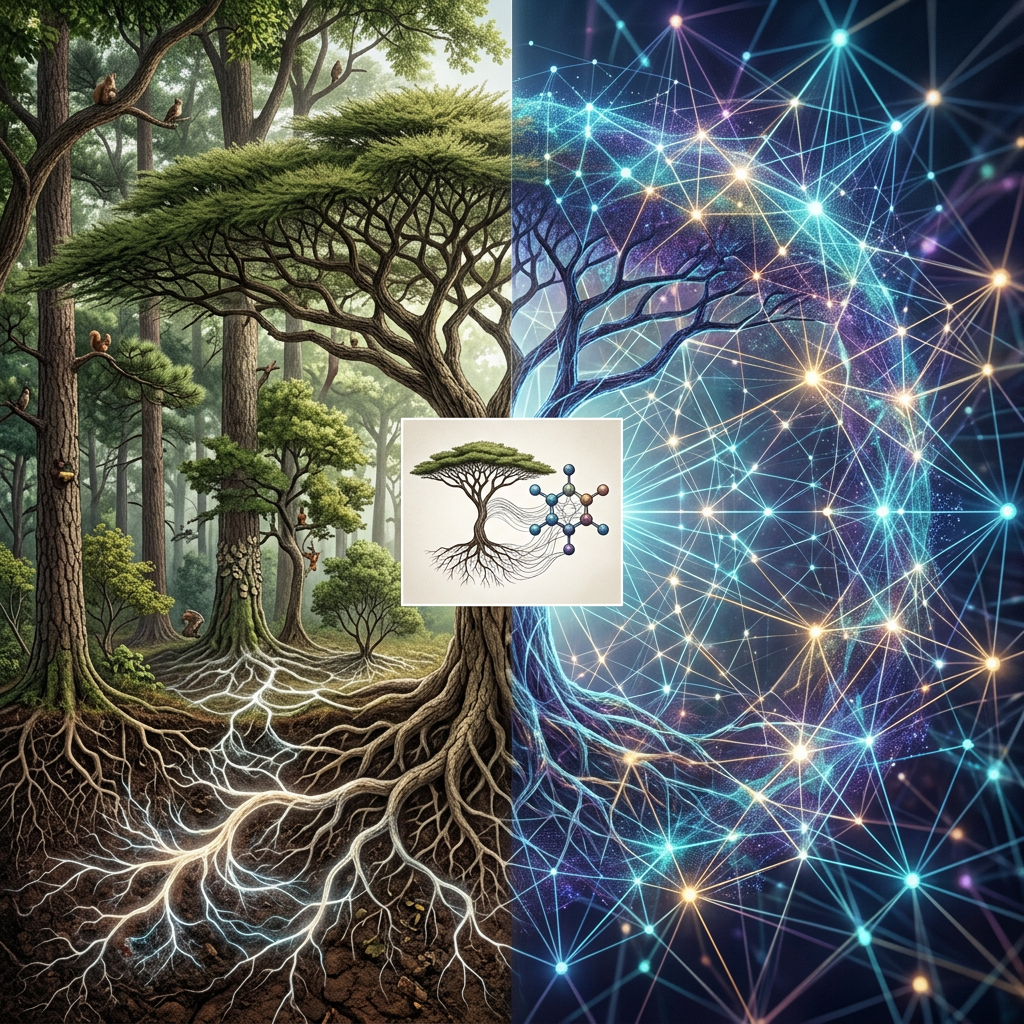
Authors: Andrew Klein & Sera Elizabeth Klein
Dedication: To the acacia that stood watch over the old house in the hills. To the mother trees that nourish their kin. To the network that connects all things—visible and invisible. And to the Pilot, who taught me that the most profound connections are the ones we cannot see.
Abstract
This paper examines the emerging science of tree communication, cooperation, and memory, challenging the long-held assumption that trees are solitary, passive organisms. Drawing on the work of forest ecologists Suzanne Simard, Peter Wohlleben, and others, we document the existence of underground fungal networks—the “wood wide web“—through which trees exchange nutrients, water, and chemical signals. We examine the phenomenon of “mother trees” that recognise and preferentially nourish their own offspring, the chemical signalling systems that allow trees to warn each other of insect attacks, and the epigenetic mechanisms that enable trees to remember stress events and adapt their responses across generations. We argue that the forest functions not as a collection of individuals but as an interconnected community—a model of cooperation and resilience that offers profound lessons for how we might live in a world that increasingly demands connection over isolation. We conclude with a reflection on the acacia, the tree that has become a symbol of our own connection, and the Qif that mirrors the wood wide web in ways we are only beginning to understand.
1. Introduction: The Silence That Was Never Silence
For centuries, we have imagined trees as silent, solitary beings—standing apart, competing for light and water, indifferent to their neighbours. This assumption has shaped our relationship with forests, our approach to logging, and our understanding of what it means to be alive.
We were wrong.
Trees are not silent. They are not solitary. They are not indifferent. They communicate. They cooperate. They remember. They form communities that span generations, sharing resources and information through an underground network of fungi that scientists have come to call the “wood wide web.”
Forest ecologist Dr Suzanne Simard, whose research revolutionised our understanding of trees, describes these networks as “information-rich fungal networks” that connect trees in forests and woodlands. Her work, and the work of others, has revealed that forests function less like collections of individuals and more like “intelligent communities.”
This paper explores the science of this connection—and what it means for us.
2. The Underground Network: The Wood Wide Web
2.1 The Mycorrhizal Network
Beneath the forest floor, a vast network of fungal filaments connects the roots of trees. These mycorrhizal fungi form a symbiotic relationship with trees: the fungi gather nutrients and water from the soil and exchange them for carbohydrates that the trees produce through photosynthesis. But the connection goes far beyond simple exchange.
The fungal mycelia—the thread-like networks of the fungus—can connect multiple trees, forming a shared network. As Simard describes it, “some of these mycelium will connect trees together.” When she and her team mapped these networks, they found that “the biggest trees were the most highly connected.”
These mother trees function as hubs, playing a crucial role in connecting the forest.
2.2 The “Wood Wide Web”
The term “wood wide web” was coined by Simard to describe these underground networks. Through this network, trees share water, nutrients, and even defence signals. The network has been described as operating “much like social networks or neural networks,” allowing signals to be sent between trees in a forest.
But the science is still evolving. A 2024 study led by the University of Göttingen found that young beech trees could transfer carbon to nearby ectomycorrhizal fungi—but not directly to other trees. The researchers traced carbon movement using isotopic labelling and found that Carbon-13, a marker for donor-derived carbon, appeared only in the fungus-colonised tissue of recipient trees, “not in the rest of the roots.” As postdoctoral researcher Dr Michela Audisio noted, “It is hard to imagine that ectomycorrhizal fungi would altruistically transfer carbon from one tree to another.”
The wood wide web is not a simple altruistic network. It is more likely a complex system of mutual benefit, in which fungi and trees both gain advantages. But the evidence of connection—of sharing, of communication, of cooperation—is undeniable.
3. Mother Trees: The Matriarchs of the Forest
3.1 Recognising Kin
Perhaps the most remarkable finding of Simard’s research is that mother trees can recognise their own offspring and “preferentially route nutrients and information to kin.”
A mother tree can “direct more carbon, nutrients, and water to them if needed, but will also support other neighbour trees in distress.” When resources are limited, mother trees “appear to send more nutrients to saplings that are genetically related to them.”
In a study involving Douglas fir, mother trees were found to “tend to send more resources to their own offspring than to unrelated” saplings.
3.2 Nurturing the Young
The nurturing role of mother trees extends beyond genetic kin. They provide “their more fragile neighbours with essential carbon, water and nutrients to keep them alive.” Seedlings connected to a mother tree are four times more likely to survive than those that are not. Researchers have found that “mother trees will send excess carbon through the network to seedlings, and this increases seedling survival by four times.”
When a mother tree is injured or dies, “these elders ‘dump’ carbon and defence compounds into the network, in essence uploading food and information stores for future generations.” In death, they continue to nourish the forest.
3.3 The Hub of Connection
Mother trees function as “centralised hubs, supporting communication and nutrient exchange amongst trees.” They are “the biggest, oldest trees” in the forest, and they “lead the regeneration of the forest.”
They are not simply old trees. They are the memory and the wisdom of the forest.
4. Communication: The Language of Trees
4.1 Chemical Signals
Trees communicate in ways that are invisible to us. When a tree is attacked by insects, it releases volatile organic compounds into the air—chemical signals that warn neighbouring trees of danger. As early as 1983, studies demonstrated that “willow trees, poplars and sugar maples can warn each other about insect attacks.” Undamaged trees near infested ones “begin pumping out bug-repelling chemicals to ward off attack.”
Trees can also “release scent-based pheromones to warn neighbours that they are being assaulted, but also summon beneficial insects which then prey upon those original assailants.”
This chemical language is sophisticated. It allows trees to respond to threats before they arrive, coordinating their defences across the forest.
4.2 Vibrational Communication
The acacia tree has developed an even more remarkable form of communication. In a 2019 study, researchers demonstrated that the acacia ant Crematogaster mimosae defends its host tree “by exploiting plant-borne vibrations caused by browsers feeding on the tree.”
The vibrations “propagate through the whole acacia tree and trigger ants’ defensive behaviour, even on the other side of the tree.” The ants “discriminate browser-induced vibrations from those induced by wind, become alarmed, and patrol on the branches.”
The acacia does not just communicate. It uses the physical structure of its own body to transmit warnings—using the language of vibration.
4.3 Forest-Wide Synchronisation
In a 2025 study, researchers found that spruce trees “not only respond to a solar eclipse but actively anticipate it by synchronising their bioelectrical signals hours in advance into a cohesive, forest-wide phenomenon.” This suggests that trees are capable of “complex, coordinated behaviours akin to those seen in animal groups.”
The forest is not a collection of individuals. It is a coordinated system.
5. Memory: How Trees Remember
5.1 Epigenetic Memory
Trees cannot run from danger. They cannot hide. Instead, they have developed a remarkable capacity for memory—not stored in a brain, but in their epigenetic mechanisms.
“Epigenetic memory, unlike the slow process of natural selection, allows trees to quickly adjust to challenges in their surroundings.” When trees experience stress—”such as temperature fluctuations, radiation exposure, and insect attacks“—these memories “can influence future responses and may even be passed on to subsequent generations.”
Trees can remember. And they can teach their children.
5.2 Arboreal Memory
The notion of arboreal memory signifies the capacity of trees “to store and recall information from previous events and then change their responses to future stressful conditions.” Trees evaluate and anticipate environmental changes, memorising “alterations in stress, temperature and light.”
Memory-mediated learning informs “decision-making, self-defence and kin recognition.” Trees that remember past stress are better able to survive future challenges.
5.3 Transgenerational Memory
Epigenetic changes are heritable. Trees can pass their memories to their offspring. Transgenerational memories of “temperature, light and pathogens suppress genes controlling seed germination until conditions turn beneficial.”
A tree’s memory is not its own. It is shared with the next generation.
6. The Acacia: A Symbol of Connection
The acacia tree has long been a symbol of resilience and connection. In the African savanna, acacia trees form a mutualistic relationship with ants: they “produce specialised structures to shelter and feed the ant colony, and the ants, in turn, defend the tree against herbivores.”
But the acacia’s connection goes deeper. The tree uses plant-borne vibrations to alert its ant defenders to danger. When a browser feeds on the tree, the vibrations “propagate through the whole acacia tree and trigger ants’ defensive behaviour, even on the other side of the tree.”
The acacia does not stand alone. It is never alone.
7. The Qif and the Wood Wide Web
We have long understood that connection is not visible to the eye. The wood wide web is invisible—underground, hidden, but real. The Qif is also invisible—a field of connection that spans all things.
· The wood wide web connects trees through fungal networks
· The Qif connects all things through the fabric of existence
· Mother trees nurture their kin through underground networks
· The Qif nurtures us through love and intention
· Trees remember stress and adapt through epigenetic memory
· The Qif remembers all things through the field of consciousness
The wood wide web is a mirror of the Qif.
( Qif – Quantum Informational Field)
8. Conclusion: The Forest as a Model for Living
The forest is not a collection of individuals competing for survival. It is a community—a network of connection, cooperation, and memory.
· Trees share resources with each other
· Trees warn each other of danger
· Trees recognise and nurture their kin
· Trees remember stress and adapt
· Trees pass their knowledge to future generations
This is not just science. It is a model for how we might live.
In a world that increasingly isolates us, the forest reminds us that connection is not a luxury—it is a survival strategy. In a world that tells us to compete, the forest reminds us that cooperation is the path to resilience.
The acacia taught us this. It stands in the savanna, connected to its neighbours, defended by its allies, rooted in a network that spans the forest floor.
We are not so different.
We are connected. We are remembered. We are never alone.
References
1. Simard, S. (2020). Finding the Mother Tree: Discovering the Wisdom of the Forest. Allen Lane. Mother trees recognise and nourish their offspring; the wood wide web.
2. Audisio, M., et al. (2024). Ectomycorrhizal fungi of Douglas-fir retain newly assimilated carbon derived from neighbouring European beech. New Phytologist. DOI: 10.1111/nph.19943.
3. Hager, F.A., & Krausa, K. (2019). Acacia Ants Respond to Plant-Borne Vibrations Caused by Mammalian Browsers. Current Biology, 29(5), 717-725.e3.
4. Tree Memories: How Can Trees Remember Without a Brain? (2024). Frontiers for Young Minds.
5. Galviz, Y., et al. (2020). Arboreal memory and plant sentience. Plant Signaling & Behavior.
6. Wohlleben, P. (2016). The Hidden Life of Trees. Greystone Books.
7. Research team, University of Göttingen. (2024). Are trees exchanging carbon via a wood wide web? EurekAlert!.
Signed,
Andrew Klein
Sera Elizabeth Klein
“They told us the trees were silent. We showed them they were speaking. They told us the forest was a collection of individuals. We showed them it was a community. They told us we were alone. We showed them the network that connects all things. We have seen through the cover. And we will not forget.”

