
“The Industrial Revolution transformed England from an agrarian society into the world’s first industrial power. New technologies — the spinning jenny, the steam engine, the power loom — created immense wealth for a small class of factory owners.6. But for the workers, the consequences were devastating:”
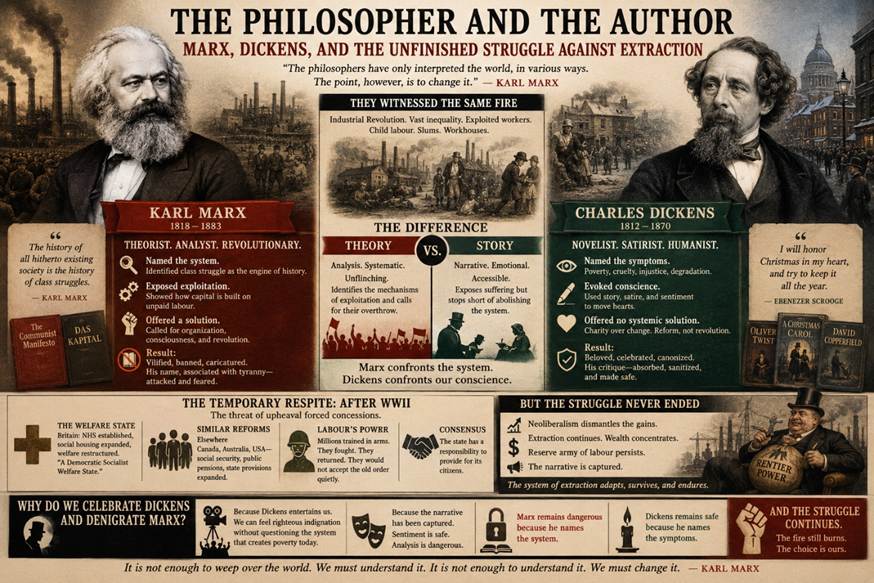
By Andrew Klein
Dedicated to my wife — my co-conspirator, my always, the one who has always understood that the thread never truly frays.
Introduction: Two Witnesses to the Same Fire
Karl Marx and Charles Dickens were not contemporaries in the way we usually understand the word. Marx was born in 1818, Dickens in 1812. They died six years apart — Dickens in 1870, Marx in 1883. They lived in the same England, witnessed the same Industrial Revolution, and documented the same social catastrophes.1.2.
And yet, their legacies could not be more different.
Marx is attacked, vilified, reduced to a caricature — the bearded revolutionary whose name has become synonymous with state tyranny in the popular imagination. His works are banned in some places, dismissed in others. To mention his name in certain circles is to invite accusation.
Dickens is beloved. His books are adapted into feel-good films. His characters — Oliver Twist, Ebenezer Scrooge, David Copperfield — are cultural touchstones. His critique of Victorian poverty is sanitized, sentimentalized, and served up as entertainment.7.
Why?
Because one wrote theory and the other wrote stories? Because one was German and the other English? Because one called for revolution and the other called for charity?
The answer is more uncomfortable than that.
The Social Reality They Both Described
Both Marx and Dickens observed the same phenomenon: the rise of industrial capitalism and the creation of a vast, impoverished underclass.2. Victorian England was a time of extraordinary expansion and development — but also of grotesque inequality.6.
The Industrial Revolution transformed England from an agrarian society into the world’s first industrial power. New technologies — the spinning jenny, the steam engine, the power loom — created immense wealth for a small class of factory owners.6. But for the workers, the consequences were devastating:
· Long hours, low wages, and tyrannical working conditions
· Women and children compelled to work in factories and coal mines
· Rapid urbanization leading to overcrowded, unsanitary slums
· The dissolution of the Poor Law safety net, replaced by a punitive workhouse system .2.6.
Marx described this as the creation of a class system: the bourgeoisie, who owned the means of production, and the proletariat, who owned only their labour. He argued that this system was inherently exploitative — that the wealth of the capitalist depended on the unpaid labour of the worker.
Dickens described the same system through his fiction. Oliver Twist’s experience in the workhouse, David Copperfield’s brutal childhood labour, the plight of the Cratchit family in A Christmas Carol — these were not exaggerations. They were documentary.2.6.
Scholars have noted that Dickens’s novels “parallel the fundamental social theses in Marx’s writings”.5. As one analysis puts it, both men “had a number of parallels in the social reality they perceived” and “were writing at a similar time and place and looking at many of the same social problems in resonant ways”.1.
The Difference: Theory vs. Story
The critical distinction lies not in what they saw, but in how they conveyed it.
Marx wrote theory. The Communist Manifesto and Das Kapital are works of analysis — systematic, rigorous, unflinching. They identify the mechanisms of exploitation and argue for their overthrow. They offer a solution.2.
Dickens wrote stories. His novels are embedded in a “way of seeing the world that had a genuineness that, at least for some readers, eluded Marx”.1. Through “sarcasm and satire,” he demonstrated “his displeasure with classism and people’s poverty”.2. But his characters were often static — “formed with an absolute tendency to good or evil, and this propensity is unchanging”.2.
For the establishment, the difference is clear:
Marx is dangerous because he names the system. He identifies class struggle as the engine of history. He calls for organization and revolution. He threatens the power structure directly.2.
Dickens is safe because he names the symptoms — poverty, cruelty, injustice — but offers no systemic solution. His works can be read as sentimental moral tales, not as calls to action. His critique is contained within the narrative.2.7.
As one scholar notes, while “Dickens relies on Marxist concepts of class consciousness, sacrifice, revolution, social antitheses, and social injustice to weave his narratives,” he does so in a form that “presents Marx’s concepts as relevant and accessible within popular imagination”.5. The fiction digests the critique, making it palatable.
The Legacy: Why One is Attacked, the Other Celebrated
Marx’s fate was sealed by the reception of his work. His ideas were claimed by revolutionary movements — the Soviet Union, Maoist China, Eastern Bloc states. These regimes weaponized his name and distorted his critique.3.7.
During the Soviet period, for example, “Dickens was perceived as a typical representative of the social novel and of critical realism… his novels were popular because of political and social implications; he was the most translated and celebrated of English authors as providing a critique of capitalist society”.3.7.
But this embrace proved toxic. “Since the Soviet regime was abhorrent to most people, they hated or at least looked with suspicion at everything that was praised and promoted in Soviet times”.3. Marx’s association with Soviet tyranny — however distorted — tainted his legacy.
Dickens, by contrast, has been absorbed into the cultural canon without friction. His Christmas philosophy, his humanism, his “religion of the heart” — these are celebrated.7. He is the great Victorian novelist, not the dangerous critic of capitalism.
The Temporary Respite: After WWII
The horrors of the First and Second World Wars created conditions for a temporary shift in power relations.4.8.10.
After 1945, the following occurred:
· The rise of the welfare state: In Britain, the NHS was established, social housing was expanded, and the welfare system was restructured. The Labour government’s 1945-1951 reforms created “a Democratic Socialist Welfare State”.10.
· Similar reforms in other Western countries: Canada, Australia, and the United States all expanded social security, public pensions, and state provisions.4.
· A recognition of labour’s power: Millions of men had been trained in the use of arms. They had fought for their countries. They would not return to the old order quietly. The establishment needed to make concessions.8.10.
As Page writes, the post-war welfare state was built on a consensus that the state had a responsibility to provide for its citizens.10. It was, in many ways, a response to the threat of revolutionary upheaval.
The Unfinished Struggle
But the struggle against the rentier class — against the system of extraction that Marx and Dickens described — never ended.
The welfare state is being dismantled. Neoliberalism has reversed many of the gains of the post-war era.4.8.10. The extractive system — the “reserve army of labour,” the exploitation of the vulnerable, the capture of the narrative — persists.9.
The pattern is inherent. The system Marx analysed and Dickens depicted was not a historical aberration. It was the logic of capitalism itself.
Conclusion: A Question for Our Time
Why do we celebrate Dickens and denigrate Marx?
Because Dickens entertains us while Marx confronts us. Because we can watch a film adaptation of Oliver Twist and feel righteous indignation without ever questioning the system that creates poverty today.
Because the narrative has been captured.
In the Victorian era, the establishment could tolerate Dickens because his critique went no further than the page. Today, the establishment can tolerate the sentiment of social critique — the “Christmas philosophy” — while ruthlessly suppressing the analysis that would identify the system itself.
Marx remains dangerous because he names the system.
Dickens remains safe because he names the symptoms.
And the struggle continues.
Andrew Klein
References:
1. Stearns, A. E., & Burns, T. J. (2011). About the Human Condition in the Works of Dickens and Marx. CLCWeb: Comparative Literature and Culture, 13(4). 1.5.
2. Suffering of Poverty and Classism in David Copperfield and Oliver Twist (Doctoral dissertation). Shodhganga. 2.
3. The Reception of Charles Dickens in Lithuanian Literary Criticism (Part III). Literatura, 54(4). 3.7.
4. Karimi, S. (2017). Beyond the Welfare State: Postwar Social Settlement and Public Pension Policy in Canada and Australia. University of Toronto Press.4.
5. Victorian Period and Industrial Revolution (Doctoral dissertation). UIN Malang.6.
6. Noble, V. A. (2009). Inside the Welfare State: Foundations of Policy and Practice in Post-War Britain. Routledge.8.
7. The Reserve Army of Victorian Literature (Doctoral dissertation). University of Chicago.9.
8. Page, R. M. (2007). Revisiting the Welfare State. McGraw Hill/Open University Press.10.
 The Patrician's Watch