
By Andrew Klein
Dedicated to my wife, who will ensure that I eat good quality food.
I. Introduction: Have You Ever Gone Out for a Meal and Found Your Stomach in Rebellion and Your Pants Filled?
It is a question that should never need to be asked in a wealthy, developed nation in the 21st century. Yet it is asked—silently, shamefully—by thousands of Australians every year, as they rush from restaurants to bathrooms, their bodies rejecting food that should have nourished them.
Why is this possible?
The answer lies in a story of deliberate deregulation, of captured regulators, of a system that has systematically dismantled the protections that once kept Australians safe. It is a story that begins in the 1980s, with the rise of neoliberal ideology, and continues today—as “Chef’s Choice” oils fill our stomachs with inflammatory compounds, and the bodies that trusted them rebel.
II. The Decline of Food Standards in Australia
The deterioration of food safety regulation in Australia is not an accident. It is the predictable outcome of decades of neoliberal policy that prioritised profit over public health.
A. The Current State of Play
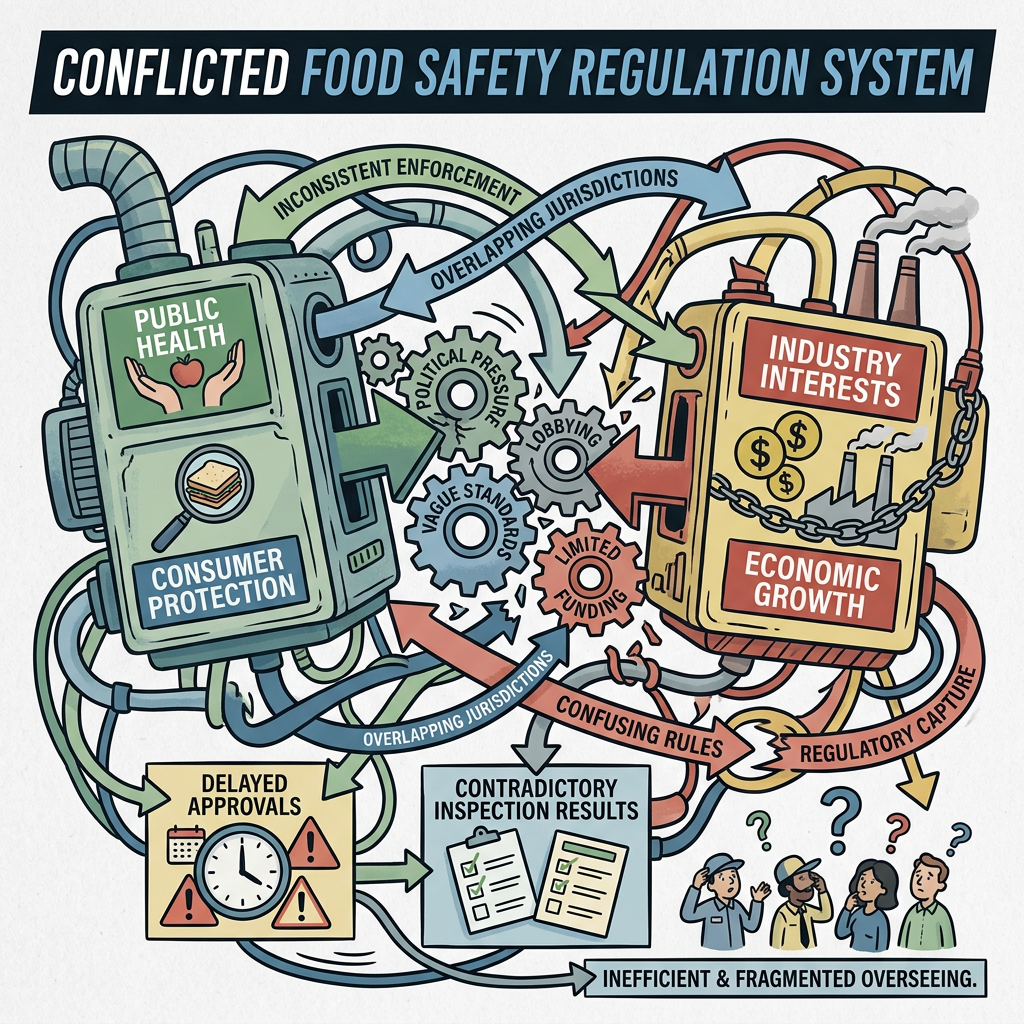
The current regulatory framework, while appearing comprehensive on paper, is riddled with gaps. Multiple agencies with overlapping responsibilities often result in confusion, inefficiency, and under-enforcement. Critical functions such as food safety surveillance are conducted by contracted, for-profit companies—a system that creates obvious conflicts of interest and dilutes accountability.
Food safety is administered through a “co-regulatory” system, combining government oversight with industry self-regulation. In practice, this means businesses are often left to police themselves. This is not governance. It is a license to cut corners.
The Victorian system reflects these contradictions. A “food safety culture” framework requiring food businesses “to demonstrate that they consistently produce safe food” sounds progressive—but enforcement is inconsistent, and public health protections are being sacrificed on the altar of economic deregulation.
B. The Testing Laboratory Crisis
The decline of food testing laboratories in Australia is a scandal in its own right. The National Association of Testing Authorities (NATA) is the primary accreditation body, but its focus on procedural compliance has been criticised as “on the margins of actual quality standards”. Asbestos has been found in food, yet testing regimes have been described as “a dangerous and grossly negligent failure”.
When the system fails to detect asbestos in food, it is not an anomaly—it is a symptom. The infrastructure for testing and inspection has been systematically hollowed out, leaving the public vulnerable.
C. The “Food Handlers” Con
The introduction of mandatory food handler certification is a classic neoliberal sleight-of-hand. It places the burden of safety on the lowest-paid workers in the food chain, while restaurants, ingredient suppliers, and supermarket chains face minimal consequences for unsafe practices.
This shift reflects the broader trend of individualising risk while deflecting accountability from powerful corporations. The worker with a certificate is responsible for your safety; the corporation that supplied the adulterated oil is not.
D. The “Co-Regulatory” Farce
Australia’s “co-regulatory” system—where government sets standards and industry self-regulates—has been described by scholars as “a legal model that has increased the burden on business while reducing public health protections to the benefit of major food corporations.”
Key weaknesses include:
· Over-reliance on self-regulation by industry
· Inconsistent enforcement across jurisdictions
· Insufficient resources for regulatory agencies
· Cost-cutting disguised as “efficiency”
III. The Neoliberal Revolution: How It Happened
A. The Kennett Earthquake
The transformation of Victoria’s food safety system began in earnest with the Kennett government (1992–1999) . Jeff Kennett’s radical neoliberal reforms were sold as “efficiency” but were in fact a systematic dismantling of public protections.
· 75,000 public sector workers retrenched
· $30+ billion in privatisation proceeds
· 10% cut in government spending across the board
· 210 councils forcibly amalgamated into 78
As one analysis notes, Kennett’s reforms “fundamentally reimagined” the relationship between government and citizens. Departments were slashed; services were put out to private tender; the shift was from “providing services” to “contracting outcomes”. This “New Public Management” revolution transformed food safety from a public good into a market commodity.
B. The Howard Era
At the federal level, the Howard government (1996–2007) accelerated the neoliberal project. This was the era of WorkChoices, privatisation of government services, and the retreat of the state from its protective functions. These changes created the framework within which food safety standards were systematically weakened.
C. The “Co-Regulatory” Framework
The shift from direct government regulation to “co-regulation” has “fundamentally changed the capacity of the state to protect public health”. It is “hard to find an area where the health of the public is not affected by the actions of a corporation.
IV. The Health Consequences
A. Food Poisoning and Foodborne Illness
The health consequences of Australia’s failing food safety system are staggering.
A 2025 study from the University of Sydney reveals that each year in Australia:
· 4.1 million cases of foodborne gastroenteritis occur
· 25,000 people are hospitalised
· 98 deaths occur (including 58 from salmonellosis)
The study also found “a worrying trend for increases in foodborne illness notifications in Australia”, with cases rising from 57.8 per 100,000 population in 2013 to 130.9 per 100,000 in 2023.
In 2025 alone, there were 43,000 foodborne illness notifications—more than double the 20,000 in 2015.
Food poisoning outbreaks are increasingly linked to ready-to-eat foods and fresh produce, both of which are central to modern fast food and restaurant dining. Chicken and leafy greens are major culprits.
B. Emergency Department Visits
The burden on the healthcare system is immense. A 2025 study found that 11.7% of all foodborne illnesses in 2017 were caused by Salmonella, leading to significant hospitalisations and deaths. A 2024 outbreak saw 51.6% of cases hospitalised and 12.9% in intensive care.
But these statistics represent only the reported cases. The true number of Australians falling ill from unsafe food is undoubtedly much higher.
C. The Anti-Diarrheal Correlation
The ubiquity of anti-diarrheal medication is a silent testament to the scale of the problem. While no single study has directly correlated over-the-counter medication sales with unsafe food provision, the rising rates of foodborne illness notifications—from 57.8 to 130.9 per 100,000 in a decade—suggest a system in crisis.
V. The Media Blind Spot
The media coverage of food safety scandals is uneven. High-profile franchise restaurants receive intense scrutiny when outbreaks occur, while smaller, independent operators, and the suppliers who serve them, are often underreported. This creates a distorted picture: the public sees the visible scandals but misses the systemic failures that make them possible.
VI. The Historical Parallel: Victorian England
This is not new. In Victorian England, adulteration and unsafe food were the norm. Children worked in lead factories, showing signs of poisoning before they were nineteen. The Industrial Revolution created conditions of gross overcrowding, foul housing, and contaminated food.
We have done exactly the same thing—but with invisible chemicals. We have traded coal smog for inflammatory oils, lead paint for oxidised fatty acids. The mechanism is the same: profit over people, deregulation over protection.
VII. The Way Forward: What Must Change
A. Restore Regulatory Capacity
The “co-regulatory” model must be replaced with direct government oversight. Food safety is not a market commodity—it is a public good.
B. Independent Testing Laboratories
Food testing must be conducted by publicly funded, independent laboratories—not by for-profit contractors with conflicts of interest.
C. Ban Adulterated Oils
The “Chef’s Choice” oils—and similar products—should be banned or strictly regulated. The use of oxidised fatty acids in commercial food preparation should be a criminal offence.
D. Hold Corporations Accountable
The burden of food safety must shift from minimum-wage food handlers to corporate executives. When unsafe food causes illness, the company—not the worker—should face the consequences.
VIII. Conclusion
Australia has allowed its food safety system to decay. The neoliberal reforms of the Kennett and Howard eras dismantled public protections and replaced them with a system of self-regulation that has failed spectacularly.
The result is a population that is regularly poisoned by its own food. A population that asks: “Have you ever gone out for a meal and found your stomach in rebellion and your pants filled?”—and knows the answer is yes.
This is not inevitable. It is the predictable outcome of policy choices. And it can be undone.
We demand better. We deserve better. And we will not stop until we get it.
References
1. University of Sydney. (2025). Foodborne illness in Australia study.
2. Food Standards Australia New Zealand (FSANZ). (2024). Foodborne illness in Australia.
3. Food Safety Culture in Australia. (2025). Journal of Food Protection.
4. Unsafe food causing up to 25,000 hospitalisations and 98 deaths annually.
5. Kennett Government reforms (1992–1999). The AIM Network.
6. Howard Government reforms. The AIM Network.
7. National Association of Testing Authorities (NATA) review.
8. From public service to market commodity: food safety in Australia. (2025). Journal of Public Health Policy.
9. Co-regulation and its consequences. (2025). Public Health Australia.
10. Food safety standards in Australia and New Zealand. (2025). Food Standards Australia New Zealand.
“Have you ever gone out for a meal and found your stomach in rebellion and your pants filled?” If the answer is yes, you are not alone. And the system that made it possible is about to be exposed.

