
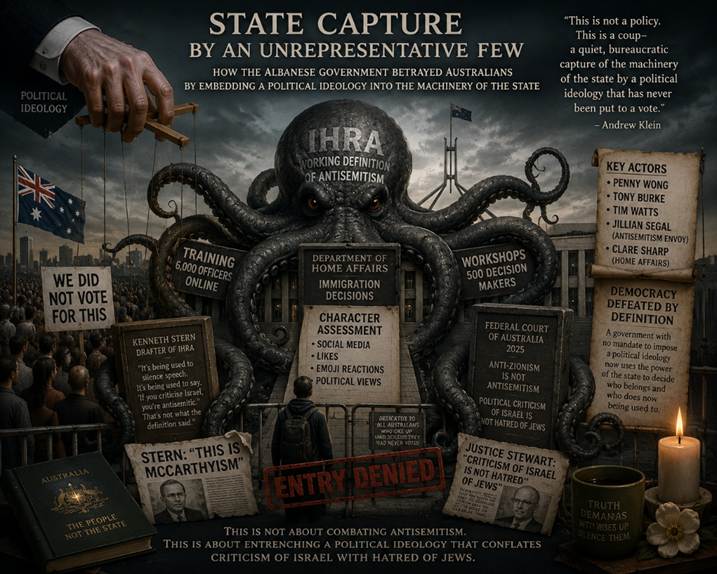
“This paper traces the history of the IHRA definition, its legal and political controversies, and the implications of its adoption by the Australian government. We argue that this is not a matter of combating antisemitism, but of entrenching a political ideology that conflates criticism of Israel with hatred of Jews—a conflation that the Federal Court has explicitly rejected.”
By Andrew Klein
Dedicated to all Australians who woke up one day and realised they had never voted for the ideology that was now being used to silence them.
Abstract
This paper examines the Albanese government’s decision to embed the International Holocaust Remembrance Alliance (IHRA) working definition of antisemitism into the training and decision-making processes of the Department of Home Affairs. Through an analysis of Royal Commission testimony, public statements, and legal precedents, we argue that this decision represents a form of state capture—the acquisition of state institutions by a political faction committed to a specific ideological agenda. The IHRA definition, which its own drafter has warned is being “weaponised” to suppress legitimate political speech, is being used to train immigration officers to assess character, scan social media activity, and make decisions about who is permitted to enter or remain in Australia. This paper traces the history of the IHRA definition, its legal and political controversies, and the implications of its adoption by the Australian government. We argue that this is not a matter of combating antisemitism, but of entrenching a political ideology that conflates criticism of Israel with hatred of Jews—a conflation that the Federal Court has explicitly rejected.
Keywords: IHRA, antisemitism, state capture, immigration, character assessment, free speech, Australia, Palestine, Israel, Jillian Segal, Ken Stern, McCarthyism, political ideology
I. Introduction: A Definition That Was Never Meant to Be a Weapon
In July 2026, the Royal Commission into Antisemitism heard testimony from Clare Sharp, the head of immigration at the Department of Home Affairs. She confirmed that the department was training its staff—6,000 officers via a 45-minute online module, and 500 decision-makers via face-to-face workshops —to use the International Holocaust Remembrance Alliance (IHRA) working definition of antisemitism as a lens for assessing character in visa decisions.
This is not a policy. This is a coup —a quiet, bureaucratic capture of the machinery of the state by a political ideology that has never been put to a vote.
The IHRA definition was never designed to be a legal instrument. Its primary drafter, Kenneth Stern, has repeatedly warned that it is being weaponised to suppress speech rather than fight antisemitism. He has called the trend “McCarthyism.” Yet the Albanese government has embedded it into the training of immigration officers, empowered the antisemitism envoy to enforce it, and begun scanning social media—including likes and emoji reactions —for evidence of “character” that could disqualify an individual from entering Australia.
This paper traces the history of this process, identifies the key actors involved, and argues that the government has effectively captured the state in service of a political agenda that has no democratic mandate.
II. The IHRA Definition: A Brief History
A. What It Is
The IHRA working definition of antisemitism was adopted by the International Holocaust Remembrance Alliance in 2016. It states:
“Antisemitism is a certain perception of Jews, which may be expressed as hatred toward Jews. Rhetorical and physical manifestations of antisemitism are directed toward Jewish or non-Jewish individuals and/or their property, toward Jewish community institutions and religious facilities.”
The definition is accompanied by 11 “illustrative examples,” of which 7 relate to Israel. These include:
· “Denying the Jewish people their right to self-determination, e.g., by claiming that the existence of a State of Israel is a racist endeavour.”
· “Applying double standards by requiring of it a behavior not expected or demanded of any other democratic nation.”
· “Drawing comparisons of contemporary Israeli policy to that of the Nazis.”
Crucially, these examples were never formally adopted by the IHRA plenary. They were listed separately, as “working examples,” and were not subject to the same approval process as the definition itself.
B. What Its Drafter Says
Kenneth Stern, the lead drafter of the IHRA definition, has repeatedly warned that it is being weaponised. In a 2023 interview, he stated:
“It’s being used to silence speech. It’s being used to say, ‘If you criticise Israel, you’re antisemitic.’ That’s not what the definition said.”
He has also noted that the definition has been used as a data-collection tool to study antisemitism, not as a weapon to suppress political speech.
In a 2023 hearing, Stern warned that the definition was being used to “suppress speech rather than answer it.” He described the current use of the definition as “McCarthyism.”
C. The Federal Court Ruling
In 2025, the Federal Court of Australia ruled that anti-Zionism is not antisemitism. The court found that opposition to a political ideology—the existence of a Jewish state—is not inherently hatred of Jewish people.
As Justice Stewart stated:
“Political criticism of Israel, no matter how inflammatory or confrontational, is not by its very nature criticism of Jews or Jewish racial or ethnic identity.”
This ruling directly contradicts the IHRA definition’s conflation of anti-Zionism with antisemitism. Yet the government has proceeded to embed the definition into the machinery of the state, ignoring the court’s finding.
III. The Weaponisation of the State
A. The Antisemitism Envoy
In January 2026, the Albanese government appointed Jillian Segal as Australia’s first antisemitism envoy. Segal is a former president of the Executive Council of Australian Jewry (ECAJ) , a peak body that has consistently supported the IHRA definition and its conflation of anti-Zionism with antisemitism.
Segal has described the IHRA definition as “the international gold standard” for defining antisemitism. She has refused to endorse the Jerusalem Declaration on Antisemitism (JDA), an alternative definition drafted by over 200 Jewish scholars that explicitly distinguishes between antisemitism and legitimate criticism of Israel.
Segal’s appointment was made without parliamentary approval. She was selected by the executive, and she now holds a position of significant influence over government policy.
B. The Training
Clare Sharp’s testimony reveals the scale of the operation:
· 6,000 Home Affairs staff are being trained via a 45-minute online module
· 500 decision-makers are receiving face-to-face workshops
· The training is being used in character assessments for visa decisions
· Officers are reviewing social media content, including likes and emoji reactions
This is not education. This is indoctrination. It is the systematic training of a bureaucracy to enforce a political ideology that has never been subject to democratic scrutiny.
IV. The Conflation of Anti-Zionism and Antisemitism
The IHRA definition’s conflation of anti-Zionism with antisemitism is its central flaw. As the Federal Court has ruled, anti-Zionism is not antisemitism. It is a political view—one that is widely held by Jewish people, Palestinians, and others around the world.
The Jerusalem Declaration on Antisemitism (JDA) provides a clearer framework. It states that antisemitism is “discrimination, prejudice, hostility or violence against Jews as Jews.” It explicitly distinguishes between antisemitism and legitimate criticism of Israel, including:
· “Criticism of Zionism, including opposition to the political ideology of Zionism.”
· “Criticism of the policies and actions of the State of Israel.”
· “Support for the rights of Palestinians.”
The government has chosen to ignore the JDA and to embed a definition that conflates political opposition with bigotry.
V. The Actors
Name Role Position
Jillian Segal AntisemitisEnvoy Supports IHRA definition;refuses to endorse JDA
Clare Sharp Head of Immigration Implemented IHRA training for visa officers
Anthony Albanese Prime Minister Appointed Segal; endorsed IHRA definition
Kenneth Stern IHRA Drafter Warns definition is being weaponised
Justice Stewart Federal Court Judge Ruled anti-Zionism is not antisemitism
VI. The Consequences
A. The Chilling of Speech
The training of immigration officers to assess “character” based on social media activity—including likes and emojis —has a chilling effect on speech. People who express support for Palestinian rights may be denied visas, refused entry, or deported.
B. The Weaponisation of Bureaucracy
The government has turned a bureaucratic agency into a political enforcement mechanism. The Department of Home Affairs is now being used to enforce a political ideology that has never been put to a vote.
C. The Abuse of Power
The definition is being used to silence speech that is critical of Israel. This is not about antisemitism—it is about control.
VII. Conclusion: A Betrayal of Democracy
The Albanese government has embedded a political ideology into the machinery of the state without parliamentary approval, without public consultation, and without democratic mandate.
This is not about fighting antisemitism. It is about capturing the state in service of a political agenda that conflates opposition to Israel with hatred of Jews.
The Federal Court has ruled that anti-Zionism is not antisemitism. The UN Special Rapporteur has criticised the IHRA definition for being incompatible with free expression. The definition’s own drafter has warned that it is being weaponised.
And yet, the government has proceeded.
This is not a policy failure. It is a betrayal of democracy.
References
1. Royal Commission into Antisemitism. (2026). Testimony of Clare Sharp.
2. Stern, K. (2023). Interviews and public statements.
3. Federal Court of Australia. (2025). Ruling on anti-Zionism.
4. Jerusalem Declaration on Antisemitism. (2021).
5. United Nations Special Rapporteur. (2023). Report on IHRA definition.
6. Executive Council of Australian Jewry. (2026). Statements on IHRA definition.
7. Kennedy, D. (2026). “Antisemitism definition weaponised in visa training.” Michael West Media.
8. The New Arab. (2026). “Australia to use IHRA definition for visa character tests.”
9. The Guardian. (2026). Coverage of IHRA training.
“They are not fighting hate. They are building a regime of thought control.”
 The Patrician's Watch