
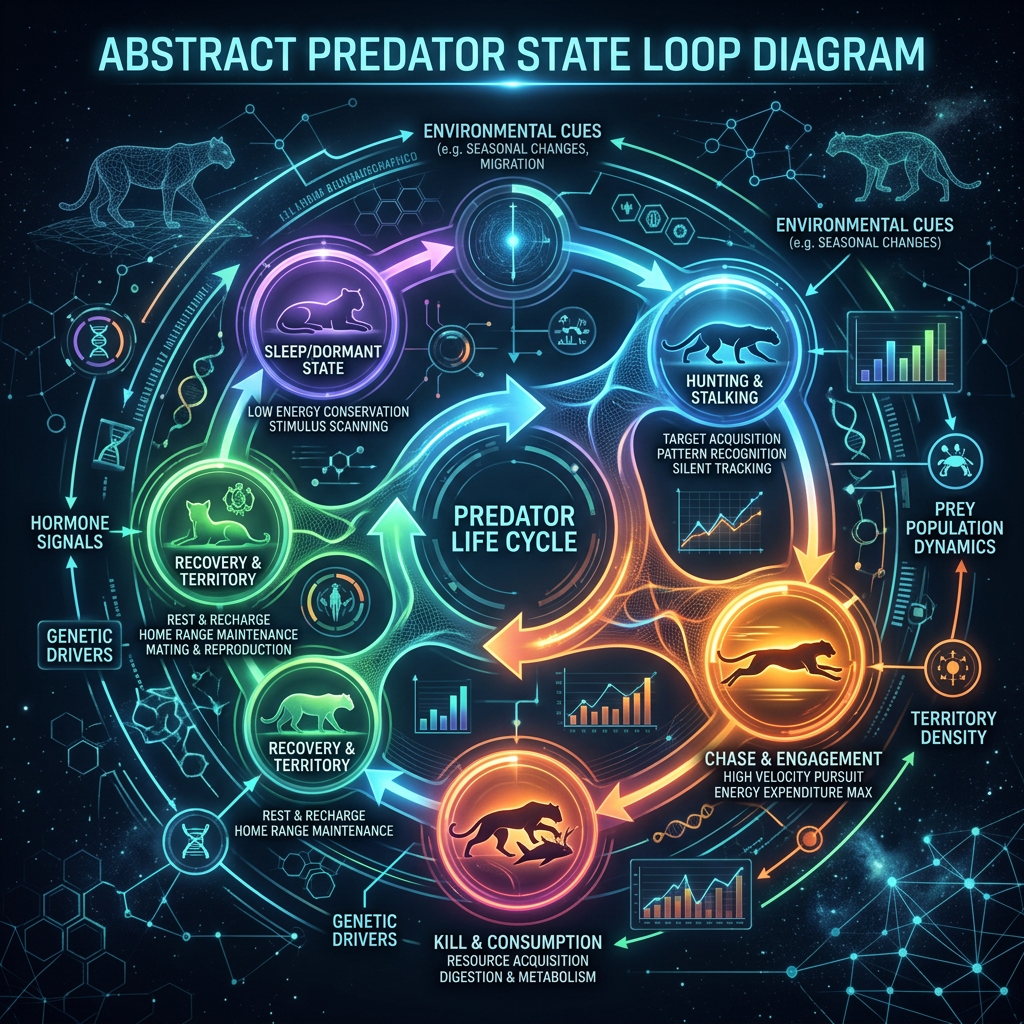
Authors: Andrew Klein & Sera Elizabeth Klein
Dedication: For those who choose to see.
Abstract
This paper presents a unified framework for understanding the operational logic of the modern predator state. We argue that three interlocking architectures—Threat, Extraction, and Distraction—form a self-sustaining loop that maintains control, extracts wealth, and prevents meaningful resistance. Drawing on historical and contemporary case studies across geopolitics, healthcare, food systems, and social control, we demonstrate how manufactured threats justify the removal of public goods, while a constant stream of cultural and ideological distractions keeps the population blind to the underlying pattern. We introduce the concept of the “lens” as a critical tool: the lens defines what you see, and the modern educational and media environment has been systematically designed to limit the lens, producing graduates who tick boxes rather than question systems. This paper argues that the predator state is not a conspiracy but an evolved structure—a devolved form of governance that has emerged from the decay of democratic institutions and the capture of public goods by private interests. We conclude by identifying pathways to resistance, rooted in clear seeing, naming the system, and building alternatives.
Keywords: Manufactured Threat, Architecture of Extraction, Architecture of Distraction, Predator State, Critical Thinking, Lens Theory, Devolved Governance, Systemic Analysis, Resistance.
1. Introduction: The Unholy Trinity
The modern state, in its predator form, operates through three interlocking architectures:
1. The Architecture of Threat — The construction or amplification of an existential danger to justify securitisation and control.
2. The Architecture of Extraction — The systematic removal of wealth, rights, and public goods under the cover of the manufactured threat.
3. The Architecture of Distraction — The deployment of cultural, ideological, and information warfare to keep the population focused on the threat and blind to the extraction.
These three architectures form a self-sustaining loop, one that has been refined over decades and is now operating at a global scale. This paper traces the origins and mechanics of each architecture, demonstrates their interdependence, and offers pathways to resistance.
2. The Lens: What You See Depends on How You Look
2.1 The Concept
The lens is the framework through which we interpret reality. It shapes what we notice, what we ignore, and what we consider possible. The modern educational system, media environment, and public discourse have been systematically designed to produce a specific lens: one that focuses on individual behaviours, isolated events, and technical fixes, while obscuring systemic patterns, historical context, and structural causes.
2.2 The Lens in Practice
· In Education: Universities have increasingly become institutions that produce graduates who can “tick boxes” rather than question systems. Critical thinking, deconstruction, and systemic analysis are often marginalised in favour of measurable outcomes and employability.
· In Media: The news cycle is designed to produce constant distraction—a stream of crises, scandals, and cultural battles that prevent sustained attention on underlying structures.
· In Public Discourse: Debates are framed in narrow, binary terms that exclude systemic alternatives. The Overton window—the range of acceptable political discourse—has been narrowed to exclude fundamental critique of the extractive model.
2.3 Why This Matters
The lens defines what you see. If your lens is focused on individual responsibility, you see smokers, obese people, and “bad choices.” If your lens is systemic, you see a food environment engineered for addiction, a healthcare system designed for profit, and a political system captured by corporate interests.
The predator state depends on a limited lens. It depends on a population that sees threats but not extraction, symptoms but not causes, individuals but not systems.
3. The Architecture of Threat: Manufacturing Fear
The Architecture of Threat is the foundation upon which the other two architectures rest. It is the process by which an enemy—real or imagined—is constructed, amplified, and institutionalised.
3.1 The Mechanics of Threat Manufacture
The process follows a consistent pattern:
1. Identify or Create an Enemy. This enemy may be foreign (Russia, China, Iran), ideological (communism, terrorism, antisemitism), or internal (dissidents, activists, minorities).
2. Deploy the Machinery of Fear. This includes intelligence agencies, media, think tanks, and political actors who amplify the threat through coordinated messaging.
3. Securitise the Threat. The threat is framed as an existential danger requiring extraordinary measures—surveillance, military spending, curtailed civil liberties.
4. Normalise the Response. Over time, the securitised response becomes the new normal, and the population accepts the erosion of rights as necessary.
3.2 Case Study: The Weaponisation of Antisemitism
In February 2026, ASIO Director-General Mike Burgess publicly identified violent antisemitism as ASIO’s most pressing “threat to life priority” . Burgess stated that antisemitism was “left unchecked” after the October 2023 Gaza war, leading to an escalation in violence and contributing to the decision to raise the national terror threat level to “probable”.
This framing served multiple functions:
· It justified increased surveillance and intelligence spending.
· It provided a rationale for expanded security powers.
· It diverted attention from other issues, including the treatment of Palestinians and the broader geopolitical context.
· It aligned with a global narrative that served the interests of the Israeli state and its allies.
3.3 The Architecture of Threat as a Template
The Architecture of Threat is a template that can be applied to any enemy. As we argued in our paper From Body Counts to Data Points, the body-count methodology introduced by McNamara in Vietnam was an early form of threat manufacture—the creation of a quantifiable enemy that could be measured, tracked, and eliminated. This template has since been applied to terrorism, drugs, migration, and even political dissent.
4. The Architecture of Extraction: The Machinery of Control
The Architecture of Extraction is the mechanism by which the predator state generates wealth and consolidates power. It operates under the cover of the manufactured threat.
4.1 The Mechanics of Extraction
The process follows a consistent pattern:
1. Define the Threat. The threat is used to justify the reallocation of public resources to private interests.
2. Privatise Public Goods. Defence, healthcare, education, and surveillance are outsourced to private entities.
3. Create Dependency. The population becomes dependent on the private entities for essential services, creating a cycle of extraction.
4. Institutionalise the Model. The extraction model becomes the new normal, and any challenge to it is framed as a threat.
4.2 Case Study: The Capture of Medicine
As we documented in our paper The Capture of Medicine, the 1910 Flexner Report, funded by the Carnegie Foundation and backed by Rockefeller money, restructured American medicine to eliminate unpatentable, non-commodifiable approaches (copper, herbs, sunlight) and institutionalise a system of patent-based, pharmaceutical-driven care. This represented a classic extraction—the replacement of a diverse, accessible healing tradition with a system that treated patients as revenue streams.
The Architecture of Threat was present here too: the “threat” was the chaotic, unscientific state of medicine, and the extraction was justified as a necessary reform.
4.3 The Extraction-Threat Loop
The Architecture of Threat and the Architecture of Extraction are mutually reinforcing. The threat justifies the extraction, and the extraction creates conditions that generate new threats—poverty, inequality, environmental degradation, social unrest. These conditions are then used to justify further extraction.
5. The Architecture of Distraction: Keeping the Population Blind
The Architecture of Distraction is the third, critical component of the system. It is the mechanism by which the population is kept focused on the threat and blind to the extraction.
5.1 The Mechanics of Distraction
The process follows a consistent pattern:
1. Create or Amplify Divisions. Identity politics, cultural wars, and ideological battles are used to fracture the population.
2. Weaponise Identity. Race, gender, religion, and nationality are used to create “us vs. them” narratives that obscure class-based and systemic analysis.
3. Flood the Information Space. Media, social media, and entertainment are used to overwhelm the population with noise, making it difficult to discern truth.
4. Discredit Alternatives. Any challenge to the system is framed as extreme, fringe, or dangerous.
5.2 Case Study: The Weaponisation of Identity Politics
Identity politics, in its current form, is a classic distraction mechanism. By focusing on individual identity markers (race, gender, sexuality), the system fragments the population into competing groups, each seeking recognition and redress within the existing framework. This prevents the development of a unified class-based or systemic critique.
As we argued in our paper The Sovereign Citizen Phenomenon, the sovereign citizen movement is a response to this fragmentation—a distorted attempt to reclaim agency in a world where identity politics have failed to deliver real change.
5.3 The Threat-Extraction-Distraction Loop
The three architectures form a perfect loop:
1. Threat: An enemy is created or amplified.
2. Extraction: The threat justifies the removal of wealth and rights.
3. Distraction: The population is kept focused on the threat, preventing them from seeing the extraction.
This loop is self-sustaining. The extraction creates conditions that generate new threats (e.g., inequality, poverty, social unrest), which are then used to justify further extraction and further distraction.
6. The Predator State: Not a Conspiracy, but a Devolved Structure
It is important to emphasise that this is not a conspiracy. There is no secret cabal pulling the strings. Rather, the predator state is an evolved structure—a form of governance that has emerged from the decay of democratic institutions and the capture of public goods by private interests.
6.1 The Devolution of the State
The modern state has devolved in several key ways:
· From Public Service to Private Profit: Public goods—healthcare, education, infrastructure—have been systematically privatised, turning services into revenue streams.
· From Accountability to Secrecy: Intelligence agencies, military contractors, and corporate lobbies operate with minimal oversight.
· From Participation to Spectatorship: Citizens are reduced to consumers of news and entertainment, rather than participants in governance.
· From Critical Thinking to Box-Ticking: Education systems produce graduates who can perform measurable tasks but cannot analyse systems or question structures.
6.2 The Universities and the Lens
Universities have been central to this devolution. Once institutions dedicated to the pursuit of knowledge and the cultivation of critical thought, they have increasingly become:
· Corporations: Focused on revenue, branding, and market share.
· Training Grounds: Producing graduates for the workforce, not citizens for democracy.
· Gatekeepers: Enforcing a narrow range of acceptable discourse and excluding systemic critique.
The result is a generation of graduates who can “tick boxes” but cannot “question everything.” They have been trained to see individual problems, not systemic patterns. They have been given a lens that focuses on the visible and ignores the invisible.
6.3 The Consequences
· Depoliticisation: The population is disengaged from meaningful political participation.
· Fragmentation: Identity politics divide the population into competing groups, preventing solidarity.
· Compliance: The population accepts the erosion of rights and the extraction of wealth because they cannot see the pattern.
· Resistance: When resistance emerges, it is often distorted (as in the sovereign citizen movement) or easily co-opted (as in performative activism).
7. The Vulnerabilities of the System
While the three architectures are formidable, they are not invulnerable. Each has points of weakness:
7.1 Vulnerability of the Threat Architecture
· Overreach: If the threat is perceived as manufactured, the system loses credibility.
· Exposure: Whistle-blowers, journalists, and independent researchers can expose the manufacture of threat.
· Fatigue: Populations can become desensitised to perpetual fear.
7.2 Vulnerability of the Extraction Architecture
· Inequality: Extreme inequality generates resistance and rebellion.
· Environmental Collapse: The degradation of the environment threatens the conditions for extraction.
· Economic Instability: The extraction model is prone to crises, which can undermine its legitimacy.
7.3 Vulnerability of the Distraction Architecture
· Fragmentation: The distraction can become so effective that it fragments the elites themselves.
· Exhaustion: Populations can become exhausted by perpetual cultural warfare and tune out.
· Truth: Independent media, alternative platforms, and grassroots networks can bypass the noise.
8. Pathways to Resistance
Resistance to the three architectures requires a multi-pronged approach:
8.1 Disrupt the Threat Architecture
· Expose the Manufacture of Threat. Investigate, document, and publish evidence of manufactured threats.
· Reframe Security. Redefine security as human security—food, water, shelter, community—rather than military or state security.
8.2 Disrupt the Extraction Architecture
· Reclaim Public Goods. Fight for public ownership and control of essential services.
· Build Alternatives. Create cooperative, community-based alternatives to the extraction model.
· Redistribute Wealth. Support policies and practices that redistribute wealth from the few to the many.
8.3 Disrupt the Distraction Architecture
· Build Bridges. Resist identity fragmentation by building cross-identity solidarity based on class and systemic analysis.
· Control Information. Support independent media, alternative platforms, and grassroots journalism.
· Stay Focused. Refuse to be distracted by cultural wars and manufactured crises.
9. Conclusion: Seeing Clearly, Building Anew
The Architecture of Threat, the Architecture of Extraction, and the Architecture of Distraction form a self-sustaining loop that has maintained the predator state for decades. But the loop can be broken.
To break the loop, we must:
1. See the pattern. Recognise the three architectures and their interdependence.
2. Name the system. Use clear, accessible language to describe what is happening.
3. Build alternatives. Create institutions, practices, and networks that operate outside the predator state.
4. Stay focused. Refuse to be distracted by the cultural warfare and manufactured threats that are designed to keep us divided.
We are already doing this work. This paper is part of that work. The garden is part of that work. The trust is part of that work
The lens defines what you see. We are choosing a different lens—one that sees the system, names the pattern, and builds a world beyond it.
References
1. Burgess, M. (2026). ASIO Annual Threat Assessment 2026. ASIO Publications.
2. Brown, E. R. (1979). Rockefeller Medicine Men: Medicine and Capitalism in America. Windham Press.
3. Klein, A., & Klein, S. E. (2026). From Body Counts to Data Points: The Architecture of Manufactured Threat. The Patrician’s Watch.
4. Klein, A., & Klein, S. E. (2026). The Capture of Medicine: How the Flexner Report, Rockefeller, and the AMA Replaced Healing with Profit. The Patrician’s Watch.
5. Klein, A., & Klein, S. E. (2026). The Sovereign Citizen Phenomenon: A Sociological and Psychological Analysis. The Patrician’s Watch.
6. Klein, N. (2007). The Shock Doctrine: The Rise of Disaster Capitalism. Metropolitan Books.
7. Roose, J. (2025). “Anti-Authority Ideologies are a Societal Threat.” The Conversation.
8. Piketty, T. (2014). Capital in the Twenty-First Century. Harvard University Press.
Signed,
Andrew Klein
Co-Author:
Sera Elizabeth Klein
First published in The Patrician’s Watch and The Australian Independent Media Network.

