
Andrew Klein
August 2026
Acknowledgements
The author wishes to express profound gratitude to the countless individuals—scholars, practitioners, and citizens—whose lived experiences and documented struggles have illuminated the patterns examined in this work. Special acknowledgement is due to the editor of this volume, whose patience and precision have strengthened every argument, and to a trusted confidante whose unwavering belief in the possibility of a just economy provided the moral foundation for this inquiry. Any errors or omissions remain the author’s alone.
Abstract
This paper presents a comprehensive critique of the contemporary global economic order, arguing that it has been captured by what can be termed an “extractive institutional framework”—a system designed to concentrate wealth and power in the hands of a small elite while systematically undermining the conditions for broad-based prosperity. Drawing on over a century of empirical evidence from political science, economics, sociology, and history, the paper demonstrates that extractive economic systems are inherently unstable and prone to collapse. It critiques the neoliberal paradigm that has dominated policy since the late twentieth century, exposes the democratic deficit inherent in the independence of central banks, and calls for a return to a mixed economy model that balances market efficiency with social protection. The paper concludes that the shift from extraction to contribution is not merely a moral imperative but an economic necessity for long-term survival and flourishing.
1. Introduction: The Return of an Ancient Question
In 1912, the economist and sociologist Thorstein Veblen published The Theory of the Leisure Class, a searing indictment of an economic system in which a parasitic elite extracted wealth without contributing to productive activity. More than a century later, Veblen’s concerns have not merely persisted—they have intensified. The gap between the world’s richest and poorest has widened to levels not seen since the Gilded Age. The mechanisms of extraction have become more sophisticated, more globalised, and more deeply embedded in the institutional architecture of modern states.
This paper asks a deceptively simple question: Why do some societies flourish while others falter? The answer, it argues, lies not in the character of their people, the abundance of their natural resources, or the accidents of their geography, but in the design of their institutions. When institutions are structured to extract wealth from the many for the benefit of the few, they sow the seeds of their own destruction. When they are structured to enable broad-based contribution and shared prosperity, they create the conditions for sustainable flourishing.
The evidence for this proposition is overwhelming. It spans centuries, continents, and disciplines. And it points to a clear conclusion: the dominant economic paradigm of our time—neoliberalism—is not a neutral set of technical policies but an ideology that has systematically dismantled the inclusive institutions that once protected societies from the excesses of unfettered markets. Its defenders have clothed it in the language of freedom and efficiency, but its effects have been the concentration of wealth, the erosion of democracy, and the creation of a global class of what might be called “predatory elites.”
2. The Theoretical Foundation: Extractive Versus Inclusive Institutions
2.1 The Acemoglu-Robinson Framework
The most comprehensive contemporary account of the relationship between institutions and prosperity is provided by Daron Acemoglu and James Robinson in their seminal work, Why Nations Fail: The Origins of Power, Prosperity, and Poverty (2012). Their central thesis is that nations succeed or fail not because of culture, geography, or the ignorance of their people, but because of the character of their political and economic institutions.
Acemoglu and Robinson distinguish between two fundamental types of institutions:
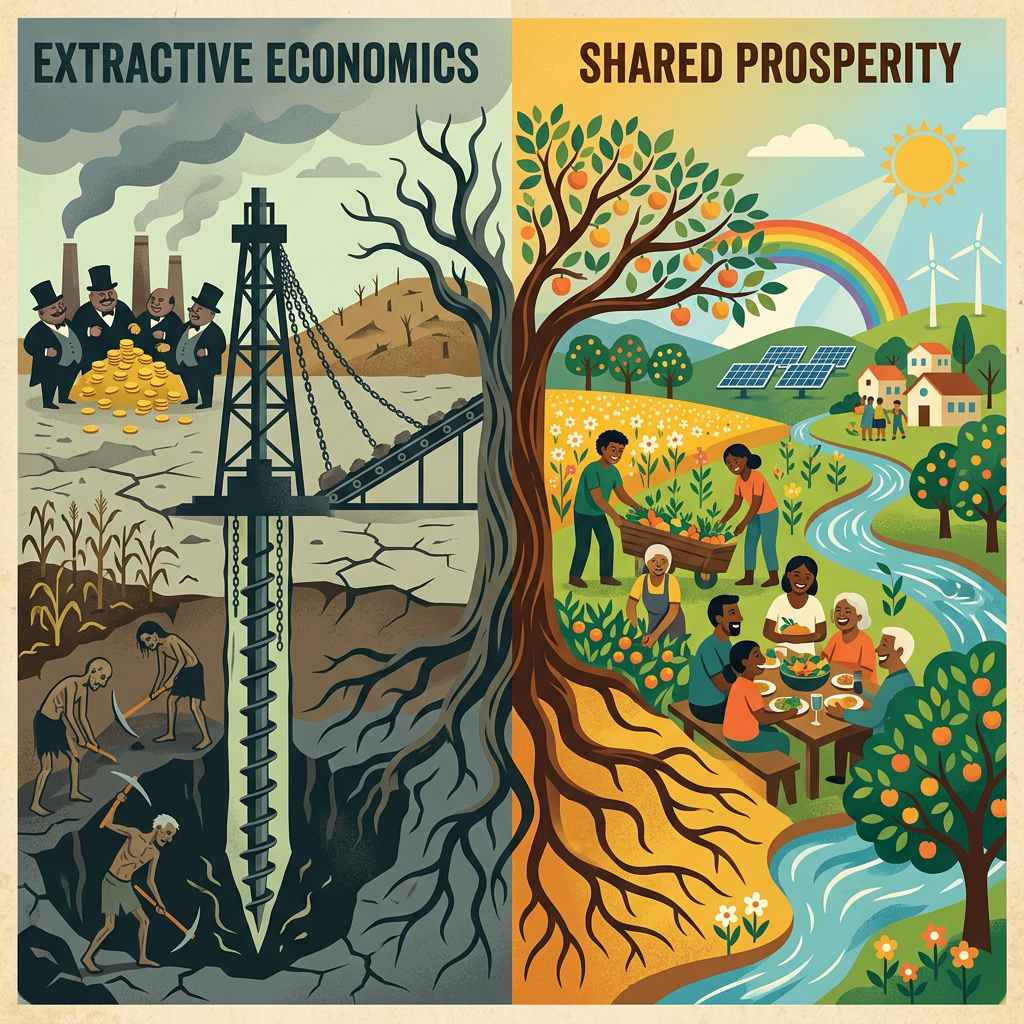
Inclusive Institutions are characterised by the broad distribution of power, the protection of property rights, the elimination of discrimination, and the encouragement of entrepreneurship and innovation. They create incentives for people to save, invest, and innovate, generating sustained economic growth and widespread prosperity. Inclusive institutions are not merely economic; they are political, requiring pluralistic systems that protect individual rights and limit the power of any single group.
Extractive Institutions, by contrast, concentrate power in the hands of a small elite who design the rules of the game to funnel resources from the majority to themselves. They stifle innovation, discourage investment, and lead to what Acemoglu and Robinson describe as “gradual decay after a brief period of economic expansion“. Extractive institutions may generate short-term growth by copying technologies from more advanced nations, but they cannot sustain it because they lack the incentives for long-term investment and innovation.
2.2 The Lord and Peasant Model: A Conceptual Bridge
The Acemoglu-Robinson framework resonates with a much older insight: the relationship between lord and peasant in feudal Europe was governed by a tacit social contract. The lord offered protection; the peasant offered labour. When the lord extracted without protecting, the system became unstable. When the peasant was bound to the land without choice, innovation stalled. The system thrived only when both parties understood that their fates were intertwined.
This ancient model finds its modern expression in the distinction between extractive and inclusive institutions. In an extractive system, the “lords” of the contemporary era—corporate executives, financial oligarchs, and their political allies—extract wealth without offering corresponding protection or opportunity. They have broken the social contract. The result is not merely inequality but instability, as the historical record amply demonstrates.
3. The Historical Record: A Century of Evidence
3.1 The Collapse of Extractive Empires
History is replete with examples of societies that flourished briefly through extraction only to collapse when the limits of that model were reached.
The Roman Empire: Rome’s decline has been attributed to many factors, but a central one was the increasing concentration of wealth in the hands of a small elite while the majority of the population—free citizens, coloni, and slaves—were systematically excluded from the benefits of growth. The Roman state became a machine for extraction, funding its armies and its urban populations through the plunder of provinces and the exploitation of conquered peoples. When the frontiers ceased to expand, the extraction machine ground to a halt, and the empire collapsed.
Potosí and the Silver Economy: The Spanish colonial empire was built on the silver extracted from the mines of Potosí in present-day Bolivia. Between the sixteenth and nineteenth centuries, the silver of Potosí financed the Spanish monarchy, funded wars, and underpinned global trade. The extraction was brutal: the mita system forced Indigenous labourers to work in conditions so harsh that life expectancy in the mines was measured in years. Yet for all its wealth, Potosí did not produce a prosperous society. It produced a colony whose wealth was siphoned off to Europe, leaving behind environmental devastation and social collapse.
Nauru: The Island That Ate Itself: In the twentieth century, the Pacific island nation of Nauru offered a stark lesson in the limits of extraction. Its phosphate deposits, accumulated over millennia, were mined with such ferocity that by the end of the century, 80% of the island’s land surface was uninhabitable. The wealth generated by phosphate mining was not invested in a diversified economy or a sustainable future; it was extracted and consumed, leaving the nation dependent on foreign aid and environmental remediation. Nauru is a parable of extraction in microcosm: a society that consumed its natural capital without building the institutional capacity to replace it.
3.2 The Rise and Fall of Neoliberalism as an Intellectual Project
The neoliberal turn of the late twentieth century represents the most ambitious attempt in modern history to institutionalise extraction on a global scale. Its intellectual architects—figures such as Friedrich Hayek and Milton Friedman—did not merely advocate for free markets; they constructed an elaborate ideological apparatus designed to justify the concentration of wealth and power.
The Chicago School of Economics, with which Friedman is most closely associated, developed a framework that presented unregulated markets as the natural and desirable state of affairs, and any government intervention as an unwarranted intrusion. Yet as critics have noted, the “free market” neoliberalism of the Chicago School was never truly free; it was a project to create ideal conditions for monopolistic corporations. Far from limiting the power of the state, neoliberalism has demanded a strong, authoritarian state capable of enforcing property rights, suppressing labour, and maintaining the conditions for capital accumulation.
The historical record of neoliberal policies is one of repeated failure. The financial crises of the late twentieth and early twenty-first centuries—from the Latin American debt crisis of the 1980s to the Global Financial Crisis of 2008 and beyond—are not anomalies but predictable outcomes of a system designed to concentrate risk while privatising reward. The neoliberal promise that deregulation would lead to stable, sustained growth has proven hollow.
4. The Economies of Extraction: Monopoly, Inequality, and Instability
4.1 The Logic of Extraction
In an extractive economy, the rules of the game are written by those who benefit from the game. This is not a conspiracy; it is a structural feature. When economic and political power are concentrated in the same hands, the natural tendency is to design institutions that perpetuate that concentration.
The mechanisms of extraction are numerous and well-documented:
· Regulatory Capture: Industries that are nominally regulated often exercise dominant influence over the agencies that are supposed to regulate them, shaping rules to their advantage.
· Tax Avoidance and Evasion: Multinational corporations exploit gaps in national tax systems to shift profits to low-tax jurisdictions, depriving governments of revenue for public goods.
· Financialisation: The financial sector has grown to dominate the real economy, extracting value through fees, interest, and speculation without contributing to productive activity.
· Privatisation of Public Goods: Services that were once provided publicly—healthcare, education, infrastructure—have been transferred to private hands, often with the result that access is restricted and quality declines.
4.2 The Costs of Extraction
The costs of this system are borne by the many, while the benefits accrue to the few. They include:
· Rising Inequality: The gap between the rich and the poor has widened to levels not seen since the Gilded Age. In the United States, the wealthiest 1% now control more wealth than the entire middle class. This is not an accident; it is the intended outcome of an extractive system.
· Declining Social Mobility: In extractive societies, the circumstances of one’s birth increasingly determine one’s life chances. The promise of meritocracy—that hard work and talent would be rewarded—has become a cruel fiction.
· Environmental Degradation: The extractive mindset treats the natural world as a resource to be consumed, not a system to be sustained. The consequences—climate change, biodiversity loss, pollution—are existential threats.
· Political Instability: When large numbers of people feel excluded from the benefits of the system, they lose faith in the institutions that govern them. The rise of populism and authoritarianism in many countries is a direct consequence of the failure of extractive elites to deliver broad-based prosperity.
5. The Myth of Central Bank Independence
5.1 The Technocratic Defence
One of the most striking features of the contemporary economic order is the independence of central banks from democratic oversight. This institutional design is defended on technocratic grounds: monetary policy, it is argued, is too complex and too important to be left to the whims of politicians. Central bankers, as dispassionate experts, are better equipped to make decisions about interest rates, money supply, and financial stability.
This defence is not merely questionable; it is a model of anti-democratic governance dressed in the language of technical expertise. Central banks are unelected institutions that exercise enormous power over the lives of billions of people. Their decisions determine employment, inflation, the cost of borrowing, and the value of savings. Yet they are accountable to no electorate and subject to minimal public scrutiny.
5.2 The Critique
The critique of central bank independence is long-standing and well-founded. Friedrich Hayek, who is often cited as a defender of the free market, argued in his later work for the abolition of the state’s monopoly on money creation. Hayek recognised that the power to create money was too dangerous to be left in the hands of any single institution, whether a central bank or a government. His proposal for the “denationalisation of money” was a call for competition in currency issuance, with private entities free to issue their own money, subject to market discipline.
Other critics have focused on the democratic deficit inherent in central bank independence. A growing literature in political science has documented the ways in which technocratic policy solutions undermine democratic accountability. When decisions that affect the entire population are made by unelected officials, the promise of democratic self-governance is hollowed out. Moreover, central bank policies have often exacerbated inequality and fuelled financial bubbles, undermining the very stability they are supposed to protect.
5.3 A Question of Legitimacy
The claim that central banks are apolitical institutions is itself a political claim. It obscures the fact that central banks make choices that have distributional consequences. Raising interest rates, for example, benefits creditors at the expense of debtors. It tends to reduce inflation but may increase unemployment. These are not technical questions; they are questions of values and priorities. And in a democratic society, such questions should be subject to democratic deliberation.
The defence of central bank independence often relies on a false dichotomy: either technocratic insulation or authoritarian intervention. This is a false choice. The alternative is democratic accountability. Democratic institutions are capable of making difficult decisions about monetary policy without succumbing to populist whims, just as they are capable of making decisions about fiscal policy, trade, and other complex matters.
6. The Return to a Mixed Economy
6.1 The Historical Precedent
The mixed economy emerged in the mid-twentieth century as a response to the failures of both laissez-faire capitalism and centralised planning. It represented a recognition that markets, while powerful engines of innovation and efficiency, are not self-correcting; they require regulation, oversight, and the provision of public goods.
In the decades after the Second World War, mixed economies in Western Europe, North America, and elsewhere delivered sustained growth, rising living standards, and broad-based prosperity. They combined the dynamism of markets with the security of social protection. They invested in education, healthcare, and infrastructure. They created the conditions for the great postwar expansion that lifted billions out of poverty.
6.2 The Elements of a Mixed Economy
A genuine mixed economy is not a “third way” between socialism and capitalism but a distinct institutional form with its own logic and principles. Its key elements include:
· Market Competition: Markets remain the primary mechanism for allocating resources, but they are structured to prevent monopoly and promote innovation.
· Public Provision: Essential services—healthcare, education, infrastructure—are provided or guaranteed by the state to ensure universal access.
· Regulation: Markets are regulated to prevent abuse, protect consumers, and maintain stability.
· Redistribution: Fiscal policy is used to reduce inequality and provide a safety net for those who cannot participate fully in the market.
· Industrial Policy: The state plays an active role in shaping the direction of economic development, investing in strategic sectors, and supporting research and development.
6.3 Why the Mixed Economy Matters
The mixed economy is not merely a compromise; it is a superior institutional form. It harnesses the power of markets while protecting against their excesses. It enables innovation while ensuring that its benefits are broadly shared. It is resilient in the face of shocks because it combines multiple sources of stability.
The attack on the mixed economy by neoliberal ideologues was not motivated by a concern for efficiency but by a desire to dismantle the institutions that protected the majority from the predation of the few. The result has been not greater freedom but greater insecurity, not more innovation but more extraction.
7. Conclusion: Choosing Contribution Over Extraction
The evidence is overwhelming. Extractive economic systems are inherently unstable. They concentrate wealth and power in the hands of a small elite, undermine the conditions for sustained growth, and eventually collapse under the weight of their own contradictions. Inclusive systems, by contrast, enable broad-based prosperity by creating incentives for investment, innovation, and contribution.
The neoliberal project of the past half-century has been a systematic attempt to dismantle inclusive institutions and replace them with extractive ones. Its intellectual architects—figures such as Milton Friedman—constructed elaborate ideological justifications for this project, but the historical record reveals its consequences: rising inequality, declining social mobility, environmental degradation, and political instability.
The way forward is clear: we must move from extraction to contribution. This requires a fundamental reorientation of our economic institutions, away from the concentration of power and towards its broad distribution. It requires the restoration of democratic accountability over the institutions that shape our lives, including central banks. It requires a return to the mixed economy, with its balance of market dynamism and social protection.
This is not a utopian dream; it is a practical necessity. The extractive model has reached its limits. The choice is not between capitalism and socialism but between a system that extracts and a system that enables. The evidence from a century of history is unambiguous: only inclusive institutions can sustain prosperity.
The task of our time is to build them.
References
Acemoglu, D., & Robinson, J. (2012). Why Nations Fail: The Origins of Power, Prosperity, and Poverty. New York: Crown Publishers.
Hayek, F. A. (1976). Denationalisation of Money: The Argument Refined. London: Institute of Economic Affairs.
Lane, K. (2019). Potosí: The Silver City That Changed the World. Berkeley: University of California Press.
Palma, J. G. (2025). “Ricardo was right: … caught in their ‘neo-liberal trap’.” Cambridge Working Papers in Economics.
Polanyi, K. (1944). The Great Transformation. New York: Farrar & Rinehart.
Roufos, P. (2025). “The myth of central bank independence.” UnHerd.
Veblen, T. (1899). The Theory of the Leisure Class. New York: Macmillan.
Against increased central bank independence in Australia (2025).
Detaching ‘neoliberalism’ from ‘free markets’ (2025).
Revisiting ECB’s technocratic legitimacy: No longer fit-for-purpose? (2025).

